If you are asking “how much does a walkie stacker weight,” you are really asking two things: what the machine itself weighs, and what that weight does to your floors, docks, and trailers. This guide walks through typical walkie stacker service weights, how they relate to load capacity, and what that means for concrete slabs, dock equipment, and trailer planning. You will also see how battery choice, wheel loads, and site conditions affect safety margins and long‑term operating costs.
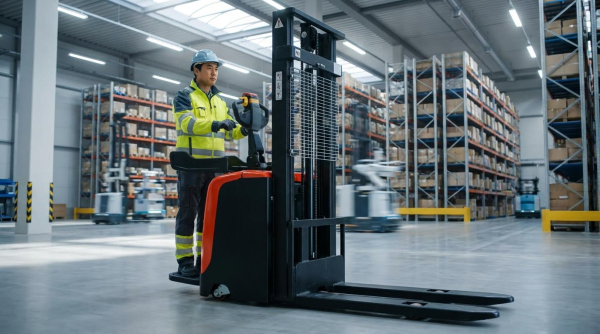
Typical Walkie Stacker Weights and Key Specs
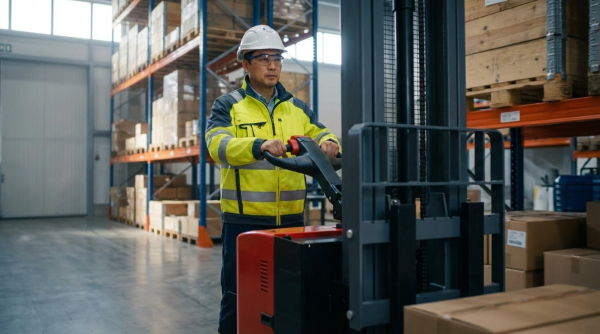
This section answers the practical side of “how much does a walkie stacker weight” by looking at real-world service weight ranges and the link between truck weight and rated capacity. Use these numbers as planning ranges for floors, trailers, and handling layouts, not as substitutes for the exact data plate on a specific unit.
Service weight ranges by class and capacity
Service weight is the truck plus battery and standard equipment, with no load. It is the number that matters for floor loading, trailer loading, and elevator checks.
Typical electric walkie and walkie stacker service weights fall into these bands based on capacity and mast type.
| Class / type | Rated capacity (lb) | Typical service weight range (lb) | Example data from sources | Typical use case |
|---|---|---|---|---|
| Light‑duty walkie pallet / small walkie stacker | 1,000 | 550–1,500 | 1,000 lb unit ≈553 lb service weight (example spec) | Light stacking, tight spaces, mezzanines |
| Mid‑capacity walkie stacker (standard mast) | 2,000–3,000 | 3,500–4,500 | 2,500 lb stacker ≈4,194 lb service weight (example spec) | General warehouse stacking to moderate heights |
| Higher‑capacity walkie stacker (taller mast / heavy‑duty) | 3,500–4,000 | 4,500–5,800 | 4,000 lb stacker ≈5,496 lb service weight (example spec) | Heavier pallets, higher lift heights |
| Compact electric pallet truck (no mast, for comparison) | 2,000–4,000 | 200–400 | Many electric pallet trucks weigh 200–400 lb (example range) | Ground‑level transport only, no stacking |
When you ask “how much does a walkie stacker weight,” most warehouse‑class machines with 2,000–4,000 lb capacity sit in the 3,500–5,500 lb service weight band, depending on mast height and battery size. Smaller 1,000 lb units are closer to 550–1,500 lb, while simple electric pallet trucks without a mast can be as light as 200–400 lb.
Other key specs that influence handling and floor loading
Beyond pure weight, several standard dimensions and performance specs affect how that weight interacts with your building and process.
- Typical overall length: around 1,750 mm for compact electric stackers, important for turning in short aisles (example).
- Typical overall width: about 790 mm, which drives aisle width and door clearance needs (example).
- Turning radius: roughly 1,390 mm for compact units, critical for layout planning in dense storage (example).
- Battery system: commonly 24 V with capacities from about 75 Ah up to ~500 Ah, which adds significant weight but also defines run time (example).
- Lift height: many walkie stackers reach up to about 3,500 mm for racking applications (example).
- Travel speed: typically around 3.5 km/h loaded and up to 4 km/h unloaded for compact electric stackers (example).
How load capacity relates to truck weight
Capacity and service weight are tightly linked. Higher capacity and higher lift height require more counterweight in the chassis and mast, which drives up the answer to “how much does a walkie stacker weight.”
The relationship is governed by stability and load‑center rules, not just “bigger is better.”
- Rated capacity is defined at a standard load center. Most walkie stackers are rated with the load at a 24 in (600 mm) load center and at the specified maximum lift height. If the load center increases, the safe capacity drops. Capacity definition
- Heavier trucks support higher capacities. As capacity rises from 1,000 lb to 4,000 lb, service weight jumps from a few hundred pounds to well over 5,000 lb in typical designs. Example: a 1,000 lb unit at ~553 lb vs a 4,000 lb unit around 5,496 lb. Light unit Higher‑capacity unit
- Lift height drives weight as much as capacity. Taller masts need stronger sections, wider outriggers, and more base weight to keep stability margins. Capacity is often derated at higher lift points because the combined center of gravity rises. Deration principles
- Attachments and options add weight but reduce capacity. Side‑shifters, fork positioners, or specialized clamps move the load center forward and add mass at the front, so the data plate capacity must be reduced even though the truck itself becomes heavier. Attachment impact
- Battery choice affects both weight and stability. Larger lead‑acid batteries add significant counterweight, while lighter batteries reduce truck weight and can slightly reduce stability margins if the design does not compensate.
| Rated capacity (lb) | Typical max lift role | Approx. service weight band (lb) | Engineering drivers |
|---|---|---|---|
| 1,000 | Light stacking / short lift | 550–1,500 | Small mast, compact chassis, modest battery |
| 2,000–2,500 | General warehouse stacking | 3,500–4,500 | Larger mast, heavier frame, higher Ah battery |
| 3,000–3,500 | Heavier pallets / higher racking | 4,000–5,200 | Stronger mast sections, wider outriggers, more counterweight |
| 4,000 | High‑duty warehouse / light industrial | 4,500–5,800 | Maximum counterweight for walkie format; careful floor and trailer checks needed |
From an engineering standpoint, you cannot get high capacity and high lift in a very light truck and still satisfy stability requirements. That is why any realistic answer to “how much does a walkie stacker weight” must start with: “What capacity, what lift height, and what options?”.
Why Walkie Stacker Weight Matters for Floors
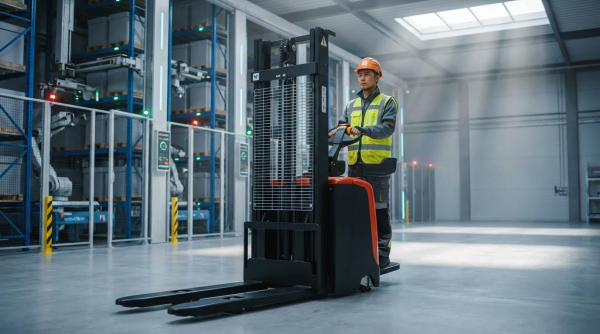
Walkie stacker weight drives how loads transfer into your slab, joints, and mezzanines. If you are asking how much does a walkie stacker weight, you also need to ask what those pounds do to concrete, joints, and toppings. Understanding wheel loads, contact areas, and battery choice helps you avoid cracked slabs, curled joints, and damaged trailers.
Point loads, wheel loads, and slab design
Floors do not “see” the total truck weight; they see concentrated wheel loads. A 4,000 lb‑capacity walkie stacker can weigh over 5,400 lb before adding the load (example: ~5,496 lb service weight for a 4,000 lb unit). With a full 4,000 lb pallet, the floor is carrying roughly 9,500 lb through a handful of small wheel footprints.
Key concepts for floor loading:
- Service weight = truck + battery (often 500–5,500 lb depending on capacity) documented ranges from ~553 lb to ~5,496 lb.
- Gross load = service weight + lifted load.
- Wheel load ≈ gross load divided by number of load‑bearing wheels (not always equal front/rear).
- Contact area = wheel footprint; small polyurethane wheels create high psi on the slab.
- Point load = wheel load / contact area; this drives surface crushing or pitting risk.
Example: simplified wheel load calculation
Assume:
- Truck service weight: 4,200 lb (typical 2,500 lb stacker)
- Load: 2,500 lb pallet.
- Gross: 6,700 lb.
- Four primary load wheels share 70% of weight ≈ 4,690 lb.
- Per wheel ≈ 1,170 lb.
If each wheel contacts ~3 in² of floor, point load ≈ 390 psi. Thin toppings, poorly compacted sub‑base, or low‑strength concrete can fail under repeated passes at this stress level.
When engineers design slabs for walkie stackers, they typically check:
- Concrete strength (e.g., 3,000–4,000 psi typical warehouse slabs).
- Slab thickness and reinforcement (mesh/rebar, fibers).
- Sub‑base stiffness and drainage.
- Traffic patterns (aisles, turning zones, dock approaches).
- Stacker class and expected gross weight range, not just “how much does a battery-powered stacker weight” on paper.
Evaluating concrete floor capacity and joints

Even if the slab thickness looks adequate, joints and discontinuities are usually the weak link. Small, hard wheels from walkie stackers repeatedly impact joints, causing spalling and differential settlement over time.
When you evaluate an existing floor for walkie stacker traffic, focus on:
- Slab thickness verification (core samples or as‑built drawings).
- Joint layout (saw‑cut spacing, dowels, load transfer devices).
- Surface condition (spalls, curl, cracks, patch materials).
- Support conditions (voids, pumping, wet sub‑base).
- Traffic intensity (passes per day, turning at joints, braking zones).
| Floor / Joint Issue | How Walkie Stacker Weight Makes It Worse | Typical Mitigation |
|---|---|---|
| Joint spalling | High wheel point loads chip joint edges at every pass. | Repair joints, add armored joint nosings, re‑route traffic. |
| Slab curling at joints | Heavy front axle loads drop off “steps,” amplifying impact. | Grind transitions, inject slab support, control moisture. |
| Thin toppings / overlays | Concentrated loads crush weak topping before main slab. | Specify industrial toppings or restrict heavy stackers. |
| Mezzanine / elevated slabs | Walkie stacker + load may exceed design live load. | Check structural design, limit gross truck weight. |
In many buildings, mezzanines and rack‑supported platforms were designed for 100–150 psf live load, not for repeated 6,000–9,000 lb wheel loads. Before you introduce heavier units, verify capacities instead of relying on generic assumptions about how much does a electric platform stacker weight.
Practical field checks before adding heavier stackers
Have a qualified engineer:
- Review truck datasheets (service weight, wheel layout, wheel type).
- Calculate wheel loads for your heaviest pallets.
- Compare to slab and joint design assumptions.
- Recommend traffic patterns, joint upgrades, or wheel changes if needed.
Li‑ion vs lead‑acid: weight, TCO, and safety
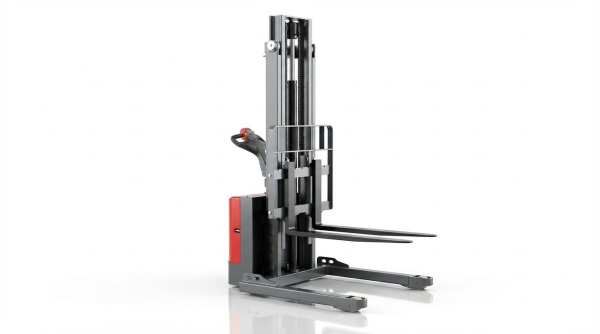
Battery chemistry is one of the biggest drivers of walkie stacker service weight. Lead‑acid packs are heavier for the same energy; Li‑ion packs are lighter and more energy‑dense. That weight difference changes both floor loading and lifecycle cost.
Main differences for floors and operations:
- Lead‑acid
- Heavier battery; higher service weight for the same capacity.
- More mass over small wheels = higher point loads on slabs and joints.
- Requires battery change or long charge windows; more handling and risk of spills.
- Li‑ion
- Lighter battery; reduces overall truck weight and wheel loads.
- Opportunity charging; less downtime and fewer battery swaps.
- Higher upfront cost but lower maintenance and better energy efficiency over time.
| Aspect | Heavier Lead‑acid Configuration | Lighter Li‑ion Configuration |
|---|---|---|
| Typical service weight impact | Higher; can push truck into 4,000–5,500 lb range for mid‑capacity units (service weights up to ~5,496 lb) | Lower; reduces axle and wheel loads for the same capacity. |
| Floor / joint stress | Higher point loads, more joint impact and spalling risk. | Reduced stress; better for marginal slabs and mezzanines. |
| Energy & maintenance | Lower battery cost, more watering and maintenance. | Higher initial cost, lower maintenance and better uptime. |
| Safety & environment | Acid spill and off‑gassing risk in charge areas. | No acid, lower emissions at the charge point. |
From a total cost of ownership (TCO) standpoint, a lighter Li‑ion walkie stacker can reduce floor repair costs and downtime while improving productivity. When you compare options, do not just ask how much does a manual pallet jack weight today; consider how that weight will cycle over your slab millions of wheel passes over the truck’s life.
Trailer, Dock, and Site Planning Considerations
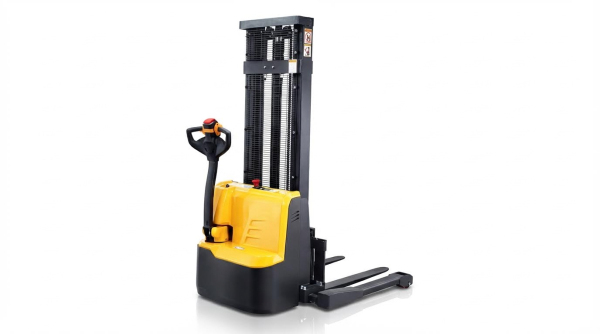
When you ask “how much does a walkie stacker weight,” you also need to ask what that weight does to trailers, docks, and yards. This section focuses on concentrated wheel loads, floor ratings, and simple checks so you do not crush a trailer floor or damage dock equipment.
Trailer floor ratings and concentrated axle loads
Trailer floors are usually rated for distributed pallet loads, not for a heavy walkie stacker plus load bearing on a few small wheels. A typical walkie stacker can weigh from a few hundred pounds up to well over 5,000 lb with the battery installed, depending on capacity. For example, a 1,000 lb capacity unit can have a service weight of about 553 lb, while higher capacity electric stackers can reach roughly 5,496 lb service weight with batteries installed. Typical electric stacker service weight range When you add the rated load (often 1,000–4,000 lb) to the truck weight, the total mass on the trailer can be significant. Example: 2,500–4,000 lb capacity units weighing roughly 4,200–5,500 lb
| Item | Typical value / range | Why it matters for trailers |
|---|---|---|
| Walkie stacker service weight | ~553–5,500 lb (incl. battery) | Drives concentrated wheel loads into trailer floor |
| Typical rated load capacity | 1,000–4,000 lb | Total mass = truck + load when entering trailer |
| Wheel contact area (per wheel) | Small footprint (a few in²) | High psi at floor surface, risk of local crushing |
| Trailer floor design intent | Distributed pallet loads | May not be rated for powered truck + load at one spot |
To avoid structural damage or a floor punch‑through, you should treat the walkie stacker as a high point‑load machine, not as a pallet. Basic planning steps include:
- Determine the maximum combined weight (walkie stacker + heaviest load) expected in the trailer.
- Estimate how that weight splits between drive and load wheels in worst‑case positions (e.g., on a ramp or at the dock interface).
- Compare resulting wheel loads to trailer floor ratings from the trailer provider or fleet specs.
- Use load‑spreading devices (steel plates, heavy plywood, dock boards) if wheel loads exceed safe limits.
- Restrict use of heavier, high‑capacity walkie stackers in older or lightly built trailers.
Simple engineering check for wheel load impact
You can approximate wheel pressure by dividing the wheel load by the contact area. For example, if one wheel carries 2,000 lb and the contact patch is 4 in², the local pressure is about 500 psi. That helps you judge whether the trailer floor and deck boards are likely to tolerate the concentrated load, especially at damaged or cutout areas.
Dock levelers, dock plates, and approach ramps
Dock equipment must safely bridge between the building slab and the trailer while carrying the walkie stacker and its load. The question “how much does a walkie stacker weight” becomes critical when you compare its gross loaded weight to the rated capacity of dock levelers, dock plates, and ramps.
| Component | Key rating or parameter | Planning concern |
|---|---|---|
| Dock leveler | Rated load (often based on lift truck + load cycles) | Must exceed total weight of walkie stacker + max pallet |
| Portable dock plate | Static and dynamic load rating | Risk of bending or failure under concentrated wheel loads |
| Yard or approach ramp | Structural capacity and grade (%) | Truck traction, braking, and wheel load increase on slopes |
| Walkie stacker gradeability | Typical: ~3% laden, up to ~10% unladen | Limits safe ramp slope when carrying full loads |
Electric walkie stackers often had gradeability limits of around 3% when carrying a load and up to 10% when unladen. Typical gradeability and speed data for electric stackers That means even modest ramps can become unsafe if they are too steep or if the surface is wet or uneven.
- Verify dock leveler and dock plate capacities against the maximum expected combined weight (truck + load).
- Account for dynamic effects: impact when entering/exiting the trailer and when crossing the dock lip.
- Prefer equipment rated specifically for powered industrial trucks instead of light hand‑truck plates.
- Limit ramp slopes to what the walkie stacker can climb safely when loaded, with margin for wet or icy conditions.
- Ensure approach areas are flat and well‑drained so small wheels do not drop into potholes or slab gaps.
Site layout tips to protect docks and trailers
Good site planning places high‑traffic dock positions on the strongest slabs and keeps turning areas away from slab joints and utility trenches. Where you must use heavier walkie stackers, specify higher‑capacity dock levelers and thicker dock plates, and consider marking “no entry” for powered equipment on weaker trailers or temporary containers.
Final Thoughts on Selecting the Right Walkie Stacker Weight
Walkie stacker weight is not just a catalog number. It sets the real limits for floor performance, joint durability, trailer safety, and dock equipment life. Higher capacity and lift height always demand higher service weight, which raises wheel loads and point pressures on concrete and timber decks. Battery choice then fine‑tunes this picture by shifting thousands of pounds between lead‑acid and Li‑ion options.
Engineering and operations teams should treat each walkie stacker as a moving structural load case. Start with the exact service weight, wheel layout, and maximum pallet weight. Convert these into wheel loads and compare them to slab design assumptions, mezzanine ratings, trailer floor capacities, and dock leveler or plate ratings. Where margins look thin, reduce gross weight, upgrade equipment, or re‑route traffic before damage appears.
The safest strategy is simple: size the truck only as large and heavy as your loads and building can truly support. Favor lighter, Li‑ion‑based designs where floors, joints, or trailers are marginal. Use Atomoving specification data, plus local engineering checks, to align stacker weight, site conditions, and throughput goals. When you plan this up front, you protect people, structures, and uptime over the full life of the equipment.
Frequently Asked Questions
How heavy is a walkie stacker?
A walkie stacker’s weight can vary depending on the model and specifications. On average, a typical walkie stacker weighs around 1542 kg (3400 lbs) including the battery. The exact weight will depend on factors like lift capacity, mast height, and additional features. For more detailed specifications, you can refer to product pages from manufacturers or suppliers. Walkie Stacker Specifications.
What are the common uses of a walkie stacker?
Walkie stackers are versatile tools commonly used in warehouses for lifting and moving pallets. They are ideal for:
- Storing loads at heights up to 6100 mm.
- Applications with minimal travel distances.
- Serving as mobile work platforms for ergonomic task positioning.
These functions make them suitable for various material handling tasks. Crown Walkie Stacker Uses.