Knowing how high you can safely raise a pallet is never a simple “max height” number. It depends on truck design, mast stages, load center, standards, and the stability of both truck and stacked goods. This guide walks through the core concepts, typical safe lift ranges by equipment type, and the engineering limits that answer the question “how high can a pallet lift” in real warehouses. You will also see how aisle width, racking, power source, and total cost of ownership drive the right specification for your site.
Core Concepts Of Safe Lift Height Limits
Definitions: lift height, free lift, working height
Before you ask “how high can a pallet lift” in a given application, you need clear, shared definitions. Manufacturers, standards bodies, and safety engineers use specific height terms that appear on data plates, drawings, and spec sheets. Misunderstanding these is one of the fastest ways to overspecify a mast or overload a truck at height.
- Lift height (rated lifting height, H5)
- Vertical distance from the floor to the top surface of the forks or load platform at the maximum height where the truck can still carry its rated capacity at the stated load center.
- Defined in industrial truck standards such as ANSI B56.1 as the highest point where stability moment and structural limits are not exceeded. One example shows a 2.5 t truck with a 4.8 m mast only lifting its full 2,500 kg to about 2 m; at 4.8 m, residual capacity drops to 1,760 kg.
- In practice, this is the answer to “how high can a pallet lift at full rated capacity?”
- Free lift (H4)
- Vertical travel available before any mast section extends above its retracted height.
- Critical in low-ceiling or mezzanine applications where the truck must lift pallets without striking sprinklers or door headers.
- Typical values: a 2‑stage (duplex) mast may offer only 50–100 mm free lift, while a 3‑stage (triplex) mast can provide about 1.5–2.2 m.
- Maximum no‑load height (H1)
- Geometric maximum fork height with an empty carriage or a very small test load.
- Higher than the rated working lift height because structural and stability limits are less critical without a heavy pallet.
- Example: a triplex mast might reach 4.3–6.5 m no‑load, but its working height with 1,000 kg is typically 4.5–5.8 m.
- Working height
- Practical, safe lift height used in design and risk assessment, usually equal to or slightly below rated lift height.
- Accounts for operator clearance to the top beam, pallet overhang, and required safety margins.
- In racking, engineers often set working height so forks reach 75–100 mm above the top beam level to allow entry under the pallet stringers.
- Rated vs. residual capacity at height
- Rated capacity is the maximum load at the specified load center at or below the reference lift height.
- Residual capacity is the remaining safe capacity at a specific higher lift height.
- Residual capacity always decreases as mast height increases because the overturning moment grows. In the 2.5 t / 4.8 m mast example, capacity falls by roughly 30% at full height.
Why these definitions matter when planning storage heights
When you size racking or choose equipment, you must align top beam elevations with the truck’s working height, not just its catalog mast height. Confusing free lift with rated lift, or no‑load with loaded height, leads to trucks that technically “reach the beam” but cannot safely place a full pallet there.
Standards: ISO, ANSI, OSHA and FEM constraints
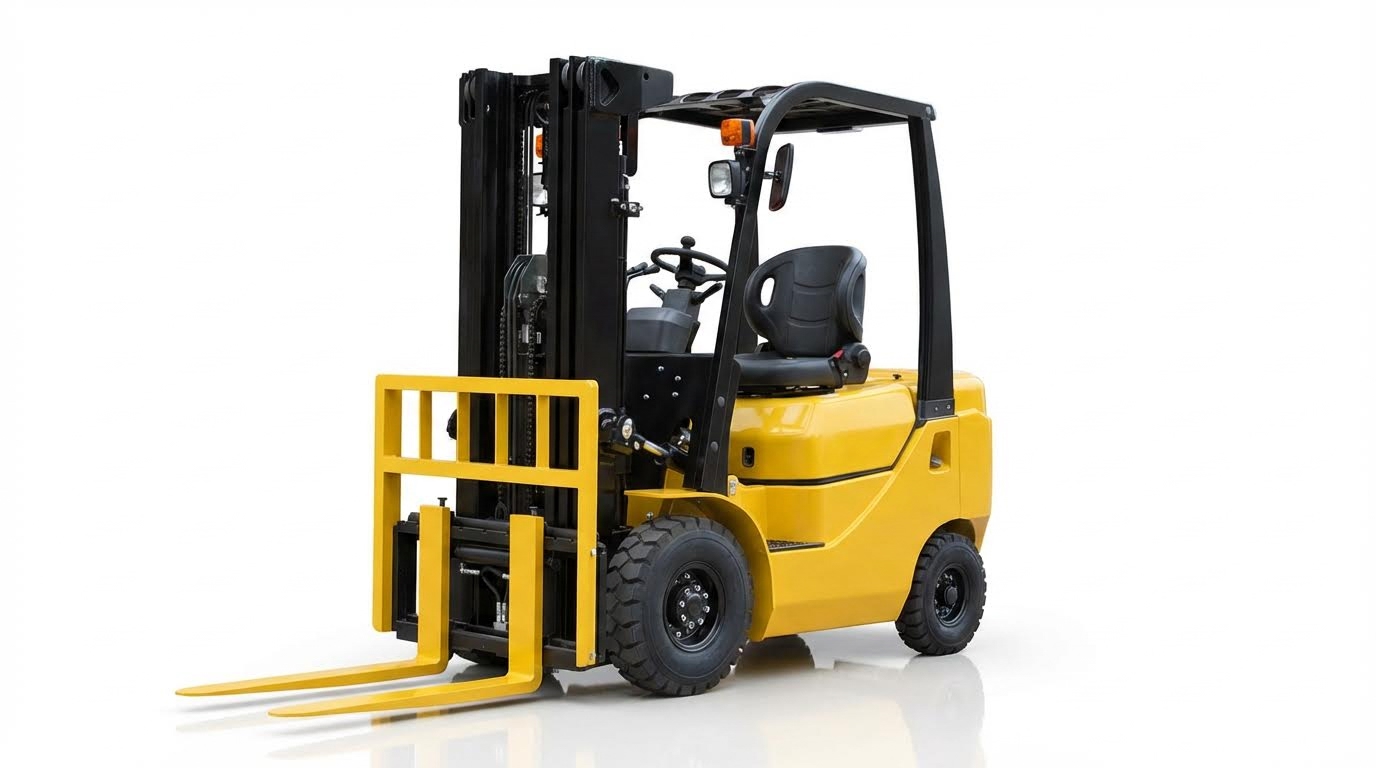
Safe answers to “how high can a pallet lift” are ultimately bounded by design and safety standards, not just what the mast can physically reach. These standards define test methods, stability margins, chain factors of safety, and environmental clearances that all feed into maximum safe lift height for palletized loads.
- ISO – equipment types and basic lift limits
- ISO 3691‑5:2014 covers pedestrian‑propelled industrial trucks with fork arms or platforms.
- Defines performance and safety requirements for low‑lift pallet trucks and similar devices on smooth, hard floors.
- Typical limits under this family of standards: low‑lift pallet trucks up to about 300 mm lift with rated capacity ≤ 2,300 kg, and scissor‑lift pallet trucks up to about 1,000 mm with around 1,000 kg capacity.
- These values show that for floor‑level transport equipment, “how high can a pallet lift” is deliberately kept low to avoid stability and foot‑crush hazards.
- National stability standards (ANSI / GB‑type)
- ANSI B56.1 defines stability tests and how to determine maximum lifting height where the truck can still handle its rated load center without exceeding the allowable stability moment.
- Under these rules, the same truck often has different safe capacities at different heights; data plates must show this, and users must respect those curves.
- Other standards, such as GB/T 26949.4‑2022, specify stability verification methods for pallet stackers, double stackers, and order pickers with operator elevation up to about 1,200 mm and rated capacities up to 5,000 kg. They require stability tests that reflect attachments and additional lifting devices.
- OSHA – stacking and clearance rules
- OSHA does not define a universal maximum stacking height for palletized loads.
- Instead, it requires that materials be stacked so they do not slide, collapse, or create other hazards, and that stacks are stable, blocked, and interlocked where needed. Guidance notes also call for at least 18 in (about 450 mm) clearance between sprinkler heads and stored materials.
- So even if a truck can lift higher, OSHA‑driven fire protection and stability rules often cap practical pallet heights below the mechanical maximum.
- FEM and component‑level constraints
- European FEM standards address mast, chain, and roller behavior, which indirectly limit safe lift height.
- For example, guidance aligned with FEM 4.004 limits chain speed to about 0.25 m/s above roughly 6.5 m unless active damping is provided, to control chain whip and dynamic loads. Above about 8 m, standard leaf chains and mast profiles may need upgrading to heavier chain sizes, dual reeving, and profiled rails to prevent roller scissoring.
- These component rules are why many standard masts are capped around 8–8.5 m, and why very high‑bay applications require specially engineered trucks.
| Standard / Body | Scope | Typical effect on maximum safe lift height |
|---|---|---|
| ISO 3691‑5 | Pedestrian low‑lift and scissor pallet trucks | Limits low‑lift trucks to about 300 mm and scissor pallet trucks to about 1,000 mm with specified capacities. |
| ANSI B56.1 (and similar) | Powered industrial trucks | Defines stability tests and how to determine maximum lifting height at rated load center; enforces capacity derating at height. |
| GB/T 26949.4‑2022 | Stackers and low‑elevation order pickers | Requires stability verification up to about 1,200 mm operator elevation and up to 5,000 kg capacity. |
| OSHA rules | Workplace safety and material stacking | No fixed max stack height; requires stable stacks and at least 18 in clearance to sprinklers, often reducing usable height. |
| FEM 4.004 and related | Mast chains, rollers, dynamics | Restricts chain speed and mast design above ~6.5–8 m, effectively capping standard mast heights without special engineering. |
Practical takeaway for specifiers
When selecting equipment and racking, do not rely on catalog “max mast height” alone. Cross‑check ISO/ANSI capacity at height, OSHA stacking and clearance requirements, and FEM‑driven mast and chain limits. Only then can you state with confidence how high a given truck can safely lift a pallet in your real warehouse, with your load geometry and your fire‑protection layout.
Safe Lift Heights By Common Equipment Type
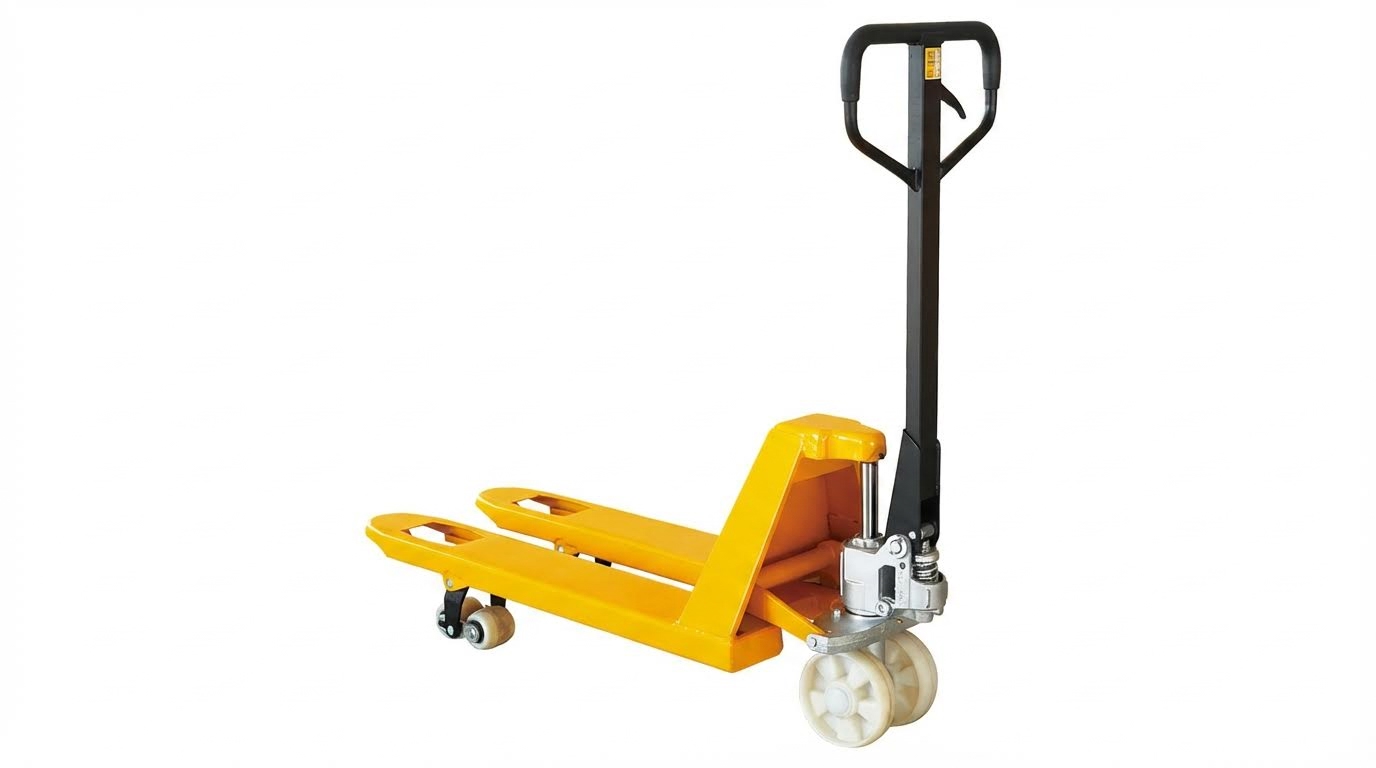
This section answers the practical question “how high can a pallet lift?” for the most common truck types. Values below are typical safe working ranges, assuming rated load, correct load center, and level, smooth floors.
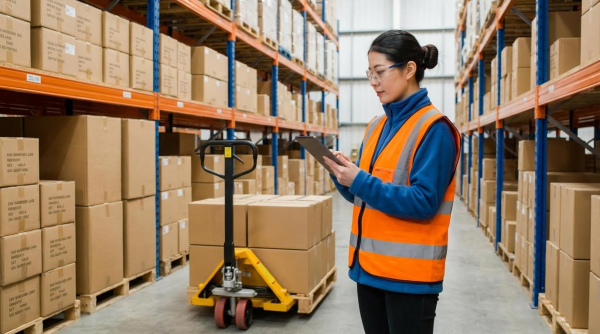
Low-lift trucks and pallet jacks (≤ 300 mm)
Low-lift pallet jacks are designed for floor-level transport, not stacking. Their maximum lift only needs to clear floor irregularities, dock plates, and truck beds.
| Equipment type | Typical rated capacity | Typical lift height range | Primary use |
|---|---|---|---|
| Manual / powered low-lift pallet truck | Up to about 2,300 kg per ISO 3691‑5 | Up to 300 mm fork lift height (low‑lift class) | Horizontal pallet transport on smooth, level floors |
| Scissor-lift pallet truck | Up to about 1,000 kg per ISO 3691‑5 | Up to about 1,000 mm lift height (elevating platform) | Ergonomic picking / work positioning, not racking |
For low-lift trucks and pallet jacks, the practical answer to “how high can a pallet lift” is:
- Standard pallet jacks: only a few inches / up to ~300 mm, just enough for travel and loading docks (low‑lift).
- Scissor-lift pallet trucks: up to about 1,000 mm, but they are not intended to place pallets into racking.
- Safe operation assumes smooth, hard, level surfaces and loads within the rated capacity.
When to avoid stacking with low-lift equipment
You should not use low-lift pallet trucks to stack pallets vertically in racking or to create high floor stacks. Their limited lift height and lack of mast guidance mean the stability margin drops quickly if you try to “push” loads higher using ramps or uneven surfaces.
Pallet stackers and pedestrian stacker trucks (3–4 m)
Pallet stackers are the first true “stacking” solution for palletized loads. They answer “how high can a pallet lift” for light to medium warehouse duties where operators stay on the floor or walk behind the truck.
| Equipment type | Typical capacity range | Typical lift height range | Operator position |
|---|---|---|---|
| Pedestrian pallet stacker | About 1,000–2,500 kg (typical values) | Up to about 3–4 m lift height (standard stackers) | Pedestrian (walk-behind or ride-on platform) |
| Double stacker / low-level order picker | Up to about 5,000 kg combined, depending on configuration (standard coverage) | Operator elevation up to about 1,200 mm (for verification) | Operator platform may elevate for picking |
Key points for safe lift heights with pallet stackers:
- Most standard models safely place pallets into racking up to about 3–4 m when loads are within the rated capacity.
- Stability is verified by standards such as GB/T 26949.4, which covers stackers with rated capacities up to 5,000 kg and operator elevation up to 1,200 mm.
- Above roughly 4 m, many operations move to ride-on reach or counterbalance trucks because of stability, throughput, and ergonomics.
Typical applications at 3–4 m lift height
Pallet stackers are well suited to:
- Small warehouses and back-of-store areas with low to medium racking.
- Block stacking where only two or three pallet layers are needed.
- Operations that want powered lifting but do not justify full counterbalance or reach trucks.
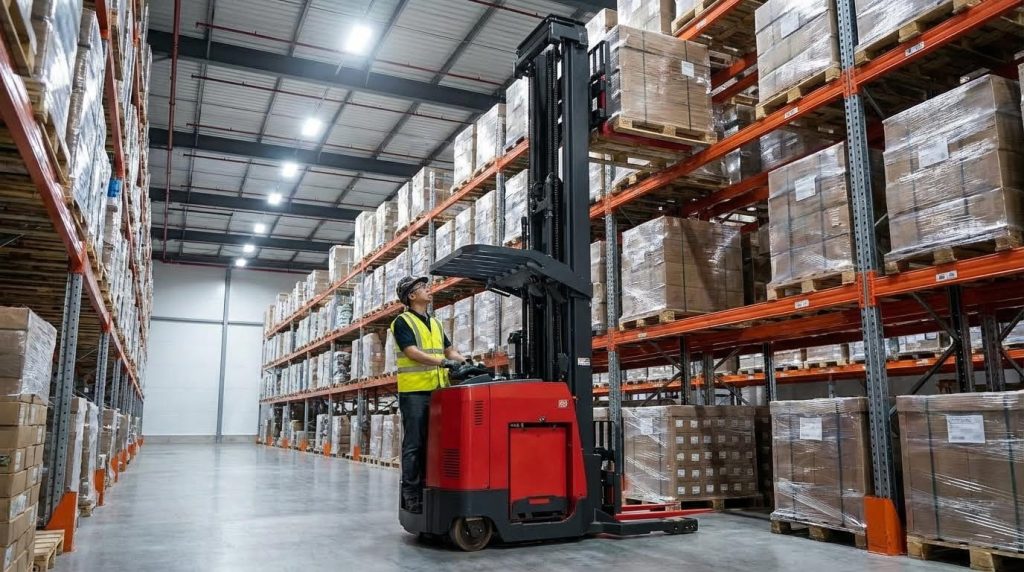
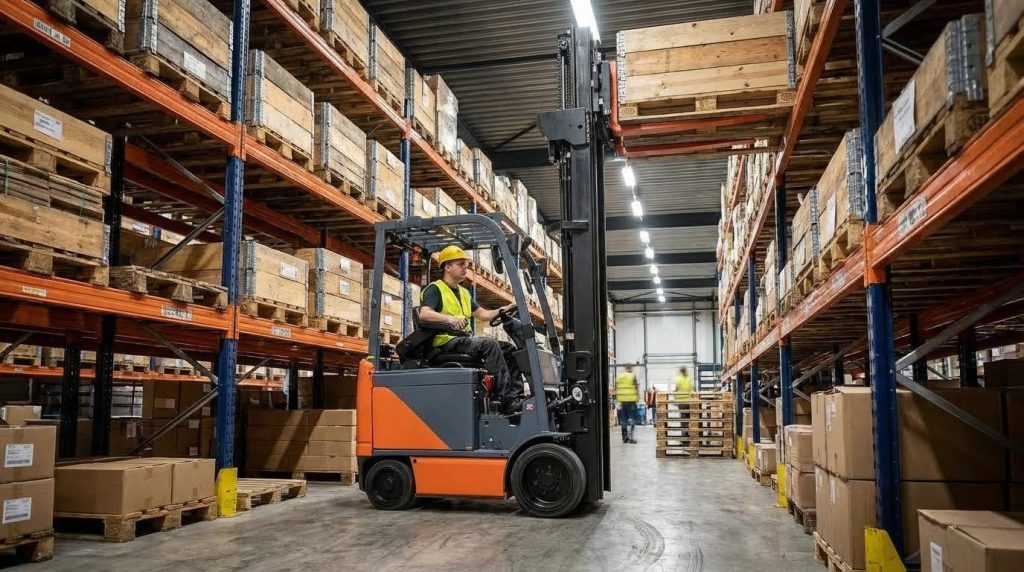
Counterbalance and reach trucks up to 8–10 m
Counterbalance and reach trucks are the workhorses for medium and high-bay storage. They extend the practical answer to “how high can a pallet lift” into the 8–10 m range and beyond, but with sharply reduced capacity at full height.
| Equipment type | Typical capacity range | Typical maximum lift height | Notes on residual capacity |
|---|---|---|---|
| Counterbalance truck (warehouse class) | About 1,000–5,000 kg (typical forklifts) | Commonly up to about 8–10 m, depending on mast | Capacity reduces significantly at maximum height; e.g. a 2.5 t truck with a 4.8 m mast may only handle about 1,760 kg at full height (≈30% reduction) per sample calculation. |
| Reach truck (narrow-aisle) | About 1,000–2,500 kg (typical) | Typically up to about 10 m or more for high-bay racking (forklifts up to ≥10 m) | Residual capacity depends on mast stages, reach mechanism, and load center. |
The engineering limit for how high a pallet can lift on these trucks is set by mast design and stability moment:
- Standards define maximum lifting height (often called H5) as the highest point where the truck can handle its rated load center without exceeding its stability moment.
- As an example, raising a 2,500 kg load to 4.8 m may require upgrading from a 2.5 t chassis to a 3.5 t chassis to maintain safe residual capacity at height (illustrative case).
- High masts (above roughly 8 m) also run into chain and roller limits, so many standard configurations cap out around 8.5 m unless upgraded chains, reeving, and mast profiles are used (chain and FEM guidance).
Counterbalance vs reach truck choice at 8–10 m
For lift heights in the 8–10 m band, many operations favor reach trucks in narrow aisles because they:
- Maintain better stability with the load taken into the wheelbase.
- Require less aisle width for the same racking height.
- Offer smoother, more controlled mast movement at high elevation.
Counterbalance trucks are still preferred where outdoor use, ramps, or mixed duties (trailers, yards, and racking) are common.
Engineering Factors That Limit Lift Height
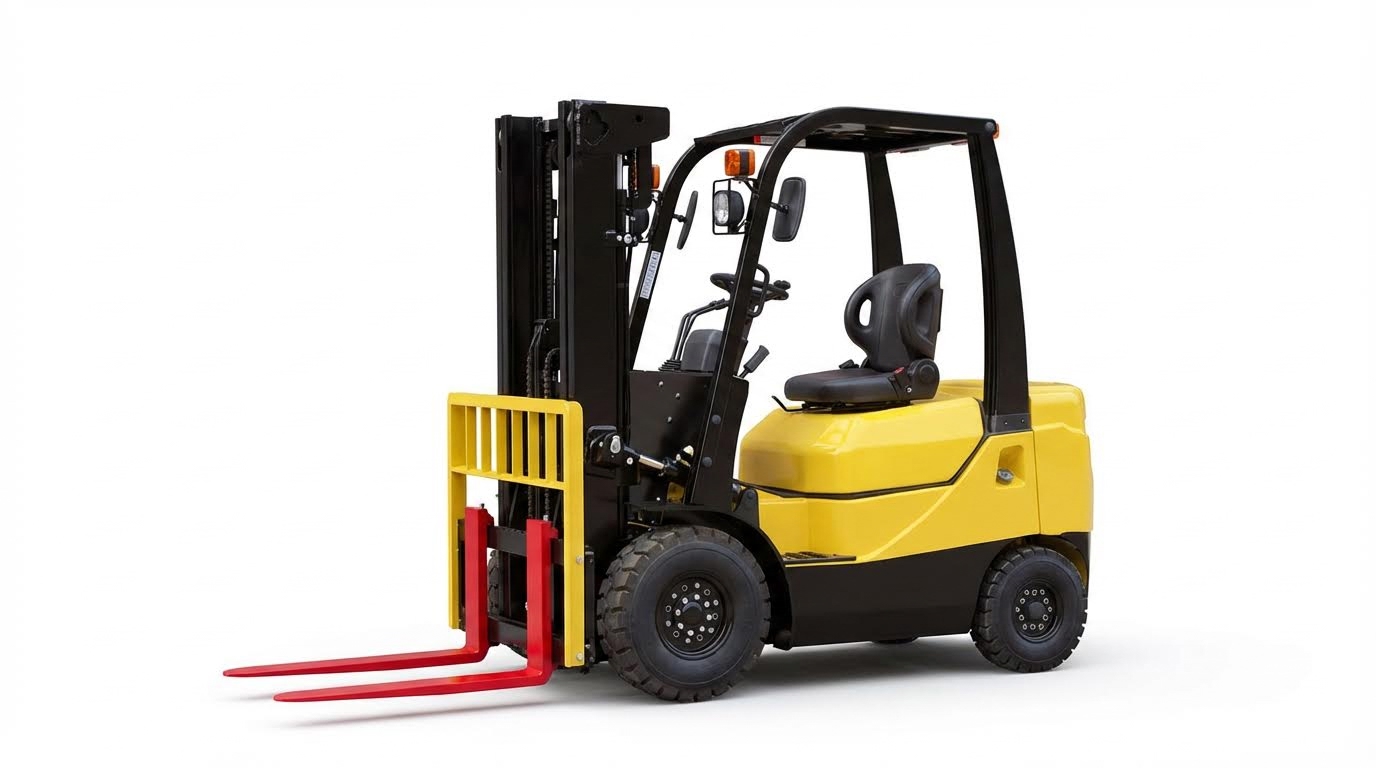
Engineering limits on mast design, stability and load-handling components ultimately answer the question “how high can a pallet lift” safely. At a certain height, mast deflection, reduced residual capacity and chain/roller dynamics all combine to cap the maximum safe working height, even if the truck still has power in reserve.
Mast architecture, stages and rail profiles
Mast architecture is the first hard limit on how high you can lift a pallet. Each extra stage, rail profile and overlap section adds weight, deflection and friction, which all reduce usable capacity at height.
| Parameter | 2‑stage (duplex) mast | 3‑stage (triplex) mast | Engineering impact on “how high can a pallet lift” |
|---|---|---|---|
| Typical free lift (H4) | ≈ 50–100 mm cited data | ≈ 1.5–2.2 m cited data | Determines how high you can raise pallets inside low doorways or beneath sprinklers before the mast extends |
| Max no‑load height (H1) | ≈ 3.0–3.5 m | ≈ 4.3–6.5 m cited data | Defines the absolute upper limit of the forks with empty carriage |
| Typical working height (H5) with ≈ 1,000 kg | ≈ 3.0 m | ≈ 4.5–5.8 m cited data | Real‑world answer to “how high can a pallet lift” with a typical warehouse load |
| Added mobile mast weight per extra stage | Baseline | + ≈ 150 kg per stage | Extra mass reduces residual capacity and increases overturning moment |
| Loss of forward reach due to roller overlap | Minimal | ≈ 50 mm reduction | Limits how deep into racking you can place pallets at maximum height |
Rail profile selection (C‑rails, I‑beams, or nested rolled profiles) also controls stiffness and deflection. Taller masts need heavier, deeper sections to keep fork tip sway within acceptable limits at the top pallet position.
- Heavier rail sections increase mast weight and lower residual capacity at height.
- Long overlap zones between stages improve guidance but consume lift stroke.
- Profile geometry must balance low friction for rollers with enough section modulus to resist bending.
Design trade‑offs in mast architecture
Designers trade free lift, total height and visibility against weight and cost. High free‑lift triplex masts allow you to lift pallets to upper beams in low-roof buildings, but they add several hundred kilograms to the truck front end, which directly reduces how high a pallet can be lifted at full rated load compared with a simpler duplex mast.
Load center, residual capacity and stability moment
Even with a tall mast, stability and residual capacity decide how high a given pallet can be lifted. As height increases, the load’s center of gravity moves further from the truck’s tipping axis and eats into the available stability moment.
| Parameter | Lower lift height | Near maximum lift height | Effect on “how high can a pallet lift” |
|---|---|---|---|
| Rated capacity example | 2,500 kg @ low height | ≈ 1,760 kg @ 4.8 m on same truck cited data | ≈ 30% capacity loss at full height on a 2.5‑ton chassis |
| Chassis upgrade needed to keep 2,500 kg at 4.8 m | 2.5‑ton truck | 3.5‑ton truck required cited data | Larger counterweight and wheelbase restore stability moment at height |
| Load center (typical pallets) | 500 mm nominal | Effective center grows if load overhangs or is tall | Longer load center reduces safe height for the same rated capacity |
| Stability moment | High margin at low lift | Much lower margin at top beam | Defines the safe envelope of height vs. load weight |
To understand how high can a pallet lift on a given truck, you must read the capacity plate and the detailed load chart, not just the nominal rating.
- Check rated capacity at the actual load center (e.g., 600 mm for overhanging pallets).
- Verify capacity at the target racking height, not just at ground level.
- Account for attachments, which shift the load forward and reduce residual capacity.
Standards such as ANSI B56.1 define maximum lifting height (often called H5) as the highest point where the truck can handle its rated load center without exceeding the allowable stability moment. This is why two trucks with the same nominal capacity can have very different answers to “how high can a pallet lift” when you compare their mast and chassis combinations.
Why tall, light loads can still be risky
A tall, light pallet with a high center of gravity can be more critical than a low, compact pallet of the same weight. As you raise it, the combined center of gravity of truck plus load moves forward and upward, shrinking the stability triangle. Side shifts, braking, or uneven floors then have a much larger effect on tipping risk.
Chains, rollers, and dynamic effects above 6–8 m
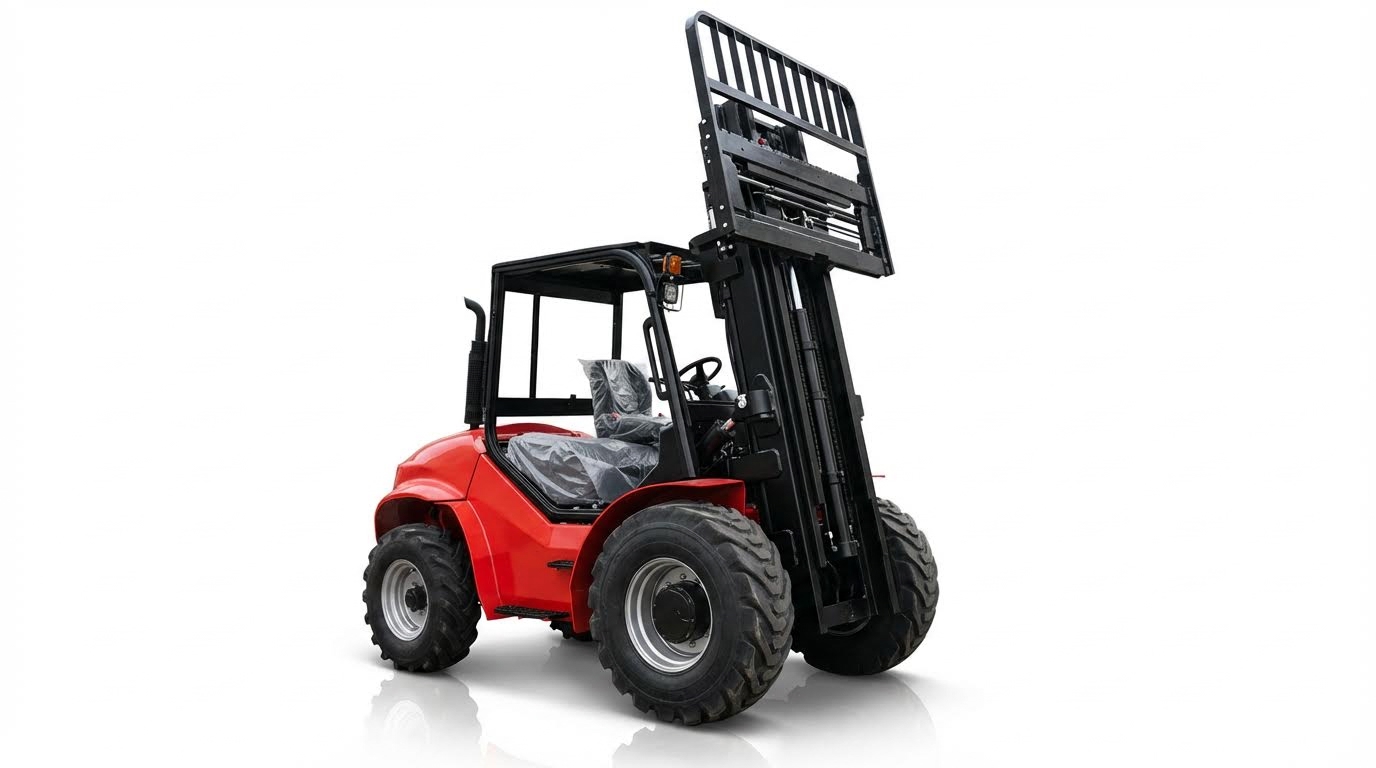
Above about 6–8 m, the limiting factor on how high a pallet can be lifted shifts from static stability to chain, roller and dynamic behavior. Long chains and tall rails introduce vibration, whip and impact loads that standards and OEM design limits must control.
| Component / effect | Typical value / rule | Impact on maximum safe lift height |
|---|---|---|
| Standard leaf chain (16B‑2) | ≈ 25.4 mm pitch, ≈ 113 kN minimum UTS, ≈ 22.6 kN working load at 5:1 safety factor cited data | Comfortable for ≈ 2,300 kg gross loads but mainly used up to moderate heights |
| Chain catenary and whip | Noticeable above ≈ 8 m during deceleration | Generates shock loads at rollers and anchors; can destabilize tall masts |
| Chain speed limit (FEM 4.004) | ≈ 0.25 m/s above ≈ 6.5 m unless damped cited data | Slows cycle times and effectively caps how aggressively you can work at extreme heights |
| Typical OEM cap for standard masts | ≈ 8.5 m overall height | Heights beyond this usually need heavier chains, dual reeving and special rails |
| Heavy‑duty chain option | 20B‑2, ≈ 177 kN UTS, dual‑chain reeving and profiled rails cited data | Required for very high masts beyond the common 8–10 m warehouse range |
Roller design and rail profiling are also critical.
- Long masts need profiled rails that keep rollers captured and prevent “scissoring” under side load at height.
- Roller diameters and bearing selection must handle both static load and dynamic impact from chain whip.
- Poor lubrication or worn rollers increase friction, heat and stick‑slip, which amplifies mast sway at the top pallet levels.
From a practical engineering standpoint, once you approach or exceed 8 m, the question “how high can a pallet lift” safely becomes a system question. Mast architecture, chain selection, damping, truck wheelbase, and even operator speed settings must all be engineered together to keep dynamic stresses and stability within the limits set by FEM and ANSI/ISO standards.
Why very high lifts need speed limits and damping
At high lift heights, even modest carriage speeds generate significant kinetic energy in the moving mass of the carriage, forks and pallet. When the operator stops or feathers the hydraulic control, that energy must go somewhere. Without speed limits and hydraulic or mechanical damping, it converts into oscillation of the mast, chain snap loads, and sudden shifts in the combined center of gravity, all of which reduce the safety margin against tipping.
Matching Lift Height To Application And TCO
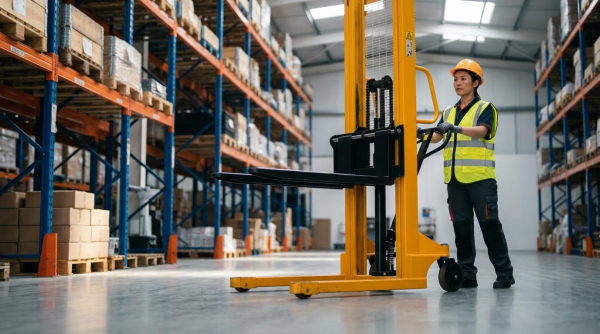
When you ask “how high can a pallet lift” for a project, the better question is “how high do I need to lift for the lowest total cost of ownership (TCO) without compromising safety.” The right answer depends on aisle geometry, racking layout, load profile, and powertrain. This section links required lift height to application design and long‑term operating cost.
Aisle width, storage profile and racking design
Lift height and aisle width must be designed together. As racking gets higher, stability margins shrink and truck maneuvering space becomes more critical, especially when handling palletized loads at or near rated capacity. Standards such as ANSI B56.1 define maximum lifting height at rated load center and show how residual capacity drops as height increases. For example, a 2.5‑ton truck with a 4.8 m mast may only handle about 1,760 kg at full height, roughly 30% less than its nominal rating. This is why chassis size and mast choice must follow the storage profile, not the other way around.
To translate “how high can a pallet lift” into a practical design, start from the top pallet position you actually need, then work backwards to aisle width and truck type.
- Define maximum beam level (top pallet underside height).
- Add clearance for pallet, deflection, and handling (typically 150–300 mm).
- Select a mast that provides this working height with adequate residual capacity.
- Choose truck type (lift stacker, reach, counterbalance) that can operate in the planned aisle width.
- Verify that turning radius and stability at height are acceptable for the load and rack type.
Different equipment families answer “how high can a pallet lift” very differently, with big implications for aisle width and rack layout.
| Equipment type | Typical lift height range | Typical aisle width | Best fit storage profile |
|---|---|---|---|
| Low‑lift pallet jacks | Up to ~300 mm (floor level only) (low‑lift trucks) | Very narrow, basically gangways | Block stacking, ground‑level staging, dock work |
| Pallet stackers (pedestrian) | ≈3–4 m for palletized loads (typical spec) | Narrow aisles (often 2.2–2.6 m) | Light to medium‑duty racking to ~4 m, back‑of‑store |
| Counterbalance forklifts | ≈3–10 m or more, depending on mast (general range) | Wider aisles (often 3.2–4.0 m+) | Mixed indoor/outdoor, drive‑in racks, heavy pallets |
| Reach / narrow‑aisle trucks | ≈6–10 m common in warehouses (high‑lift forklifts) | Very narrow aisles (often 2.5–3.0 m) | High‑bay pallet racking, dense storage |
Racking design must also respect fire protection rules. OSHA required that stacked materials maintain at least 18 in (≈460 mm) below sprinklers to keep fire suppression effective. This limits how high you can stack pallets in a given building height.
Checklist: aligning rack height with lift equipment
Before finalizing racking and asking “how high can a pallet lift,” confirm:
- Clear inside height vs. required top beam level and sprinkler clearance.
- Load weight and center at each beam level vs. truck residual capacity charts.
- Aisle width vs. truck manufacturer’s recommended working aisle.
- Rack type (selective, drive‑in, push‑back) vs. truck mast and carriage dimensions.
- Floor flatness and levelness vs. stability at the highest pick level.
Power source, duty cycle and Li-ion considerations
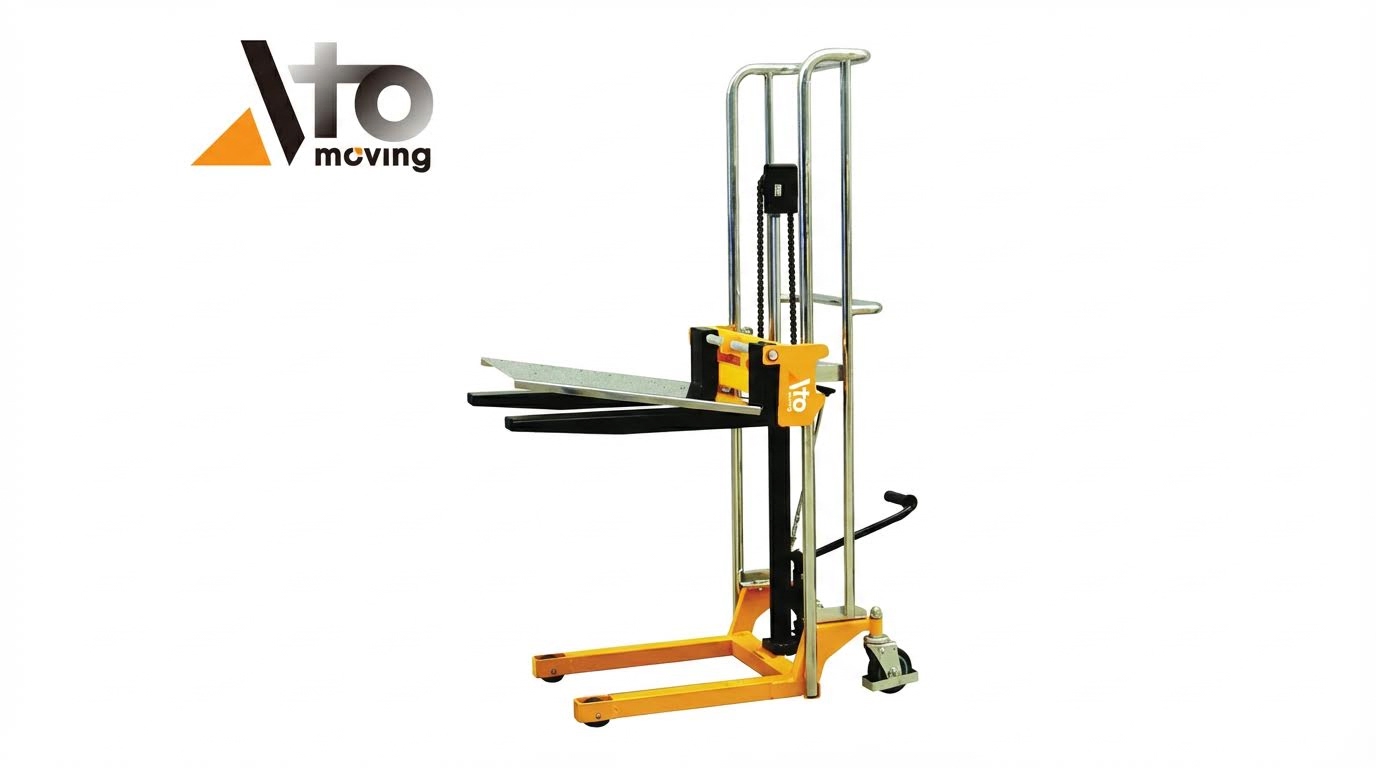
Power source selection (lead‑acid vs. Li‑ion vs. internal combustion) does not directly change the theoretical maximum mast height, but it strongly affects how safely and economically you can work at height over a full shift. Duty cycle and energy density become more critical as you move from low‑lift pallet handling to high‑bay storage where every lift is vertical work against gravity.
Different equipment and power sources handle lift work and utilization very differently.
| Aspect | Pallet stackers (typically electric) | Counterbalance / reach trucks (electric or IC) |
|---|---|---|
| Typical lift range | Up to about 3–4 m for pallets (standard stackers) | Often 6–10 m or higher, model‑dependent (high‑lift forklifts) |
| Power options | Manual or electric walk‑behind (common designs) | Electric, diesel, LPG, gasoline (common designs) |
| Duty cycle suitability | Low to medium duty, shorter shifts | Medium to heavy duty, multi‑shift capable |
| TCO trend | Lower purchase and maintenance cost (stackers vs forklifts) | Higher capital and service cost but more throughput |
Li‑ion power makes the “how high can a pallet lift” discussion more about throughput per m² than about battery limitations. Opportunity charging and flat discharge curves allow consistent lift speed and acceleration even late in the shift, which is critical when placing or retrieving pallets at 7–10 m. In contrast, lead‑acid voltage sag near end of discharge slows lift and tilt, increasing cycle time and operator fatigue.
- For low‑lift pallet jacks and short shifts: Li‑ion improves availability but may not pay back if daily hours are low and lifts are only to ~300 mm.
- For 3–4 m stackers: Li‑ion reduces downtime in multi‑shift retail or light warehouse operations where trucks are shared and opportunity charging is easy.
- For high‑bay reach or counterbalance trucks: Li‑ion often lowers TCO by avoiding battery change rooms, reducing maintenance, and sustaining full lift speed at maximum height.
TCO levers when choosing power source for high lifts
When you design for high‑bay storage and ask “how high can a pallet lift without blowing up my TCO,” review these cost drivers:
- Number of shifts and average lifts per hour at or above 70% of maximum height.
- Battery change or charging infrastructure (space, labor, ventilation for lead‑acid).
- Energy cost per kWh vs. fuel cost per liter or gallon for IC trucks.
- Maintenance profile (battery watering, emissions systems, oil changes).
- Downtime risk if lift performance degrades mid‑shift (impact on service level).
In summary, the safe and economical answer to “how high can a pallet lift” is not a single number. It is the height at which your chosen truck, mast, and power source can repeatedly handle your heaviest pallet, in your aisle and rack layout, while meeting standards and delivering the lowest life‑cycle cost.
Final Thoughts On Specifying Maximum Lift Heights
Safe lift height is never just a mast catalog figure. It is the point where geometry, stability, components, and standards all still work in your favor with a real pallet in a real aisle. As lift height rises, residual capacity falls, mast deflection grows, and chain and roller dynamics become critical. At the same time, OSHA clearances, fire protection rules, and racking geometry quietly cap how high you can usefully store product.
Operations teams should therefore start from the storage need, not the truck brochure. Fix the top pallet underside height, add realistic clearances, then select mast, chassis size, and aisle width that still meet capacity charts at that level. Above about 6–8 m, insist on detailed engineering checks for chains, rails, floor flatness, and speed settings.
The best practice is simple but strict: always design around working height and residual capacity, verify against ANSI/ISO/FEM rules, and validate against your building and load profile. When in doubt, choose the more stable chassis, the stiffer mast, and conservative beam elevations. That approach lets you exploit the full value of high-bay storage while keeping operators, equipment, and Atomoving pallet-handling solutions within a robust safety envelope.
Frequently Asked Questions
How high can a pallet lift?
A standard pallet lift, such as a manual or electric pallet jack, typically lifts to a height of around 150 mm (6 inches). However, specialized models can reach heights of over 500 mm (20 inches). The exact height depends on the type and design of the equipment. For more details, check this Pallet Jack Lift Guide.
What factors determine the maximum lifting height of a pallet lift?
The maximum lifting height of a pallet lift is influenced by its design, intended use, and load capacity. Standard models are designed for heights of about 150 mm (6 inches), while specialized lifts for industrial environments may reach up to 500 mm (20 inches) or more. Always refer to the manufacturer’s specifications for precise information. Learn more in this Lift Height Guide.
Are there limits to how high a pallet can be stacked for shipping?
Yes, most shipping providers enforce height limits for pallets, typically ranging from 1200 mm to 1500 mm (48 to 60 inches). These limits ensure safety during transport and compatibility with handling equipment. However, they may vary based on cargo type, transport method, and regional standards. For further insights, see this Shipping Safety Guide.