
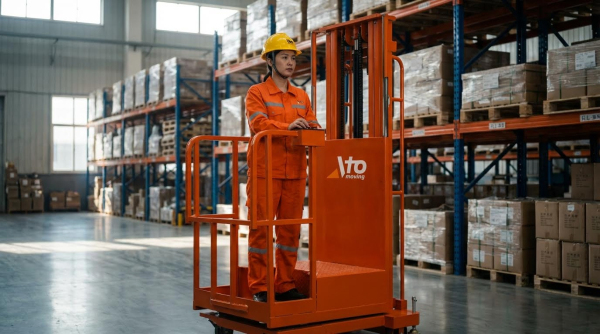
An aerial order picker is one of the most effective ways to pull individual cartons or pieces from high-bay racking without sacrificing narrow aisle density. This guide walks through how these order picking machines work, where they outperform other lift types, and which technical specs matter most in tight warehouse layouts. You will also see how safety standards, operator protection, and disciplined maintenance practices come together to keep vertical picking both productive and compliant. Use it as a practical reference when specifying new equipment or upgrading an existing storage system.
What Aerial Order Pickers Are And Where They Fit
Defining aerial order pickers vs. other lifts
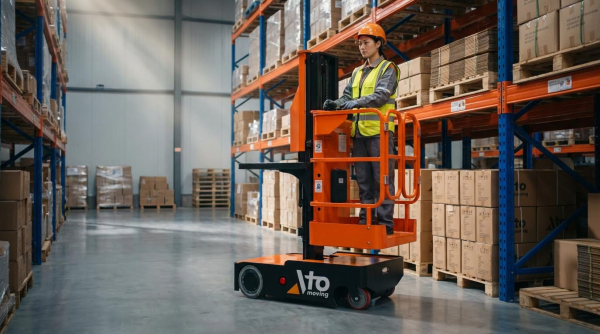
An aerial order picker is a self-propelled lift where the operator rides up with the load to pick individual items directly from racking, rather than lifting whole pallets. Typical units offer platform heights from about 2.7 m to 4.5 m, with overall machine heights up to 6.0 m, and load capacities around 300 kg for compact warehouse models. Unlike counterbalanced forklifts, which need wide aisles to turn with a full pallet, an aerial platform uses a small chassis, tight turning radius (around 1.6 m), and a narrow platform to work in very confined spaces while still carrying a person and goods. Compared with man-up turret trucks or high-reach trucks, aerial order pickers focus on case and each picking, not deep pallet storage. They sit between simple mobile ladders and complex automated systems, providing powered travel, powered lift, and integrated fall protection for efficient manual order picking.
Where they excel in narrow aisles and high bays
An aerial order picker is designed to maximize storage density and picking efficiency where aisle width is restricted and racking is tall. Narrow-aisle equipment can work in aisle widths much smaller than the roughly 3.6 m that conventional counterbalanced trucks typically require for safe turning and load handling. Key design features that make aerial order pickers effective in these environments include:
- Compact footprints, for example overall lengths near 1.5–1.6 m and widths around 700 mm on small electric models.
- Tight turning radii around 1.6 m, allowing smooth maneuvering in very narrow aisles without excessive steering corrections.
- Lift heights above 4.5 m on some vertical order picker designs, enabling access to high-bay storage levels in dense racking systems.
These characteristics make the warehouse order picker a strong fit for e‑commerce, spare parts, and high-SKU warehouses where operators must reach many locations quickly, safely, and with minimal travel distance.
Key Technical Specs And Safety Standards To Evaluate
Height, stability envelope, and aisle width
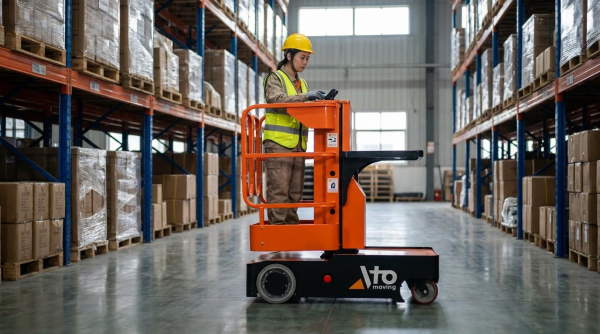
When you specify an aerial order picker for high-bay storage, start with working height and footprint. Typical maximum platform heights range from about 2,700 mm to 4,500 mm, with overall machine heights from 4,120 mm to 6,000 mm depending on model configuration (platform and machine height ranges). This defines which rack levels the operator can reach and how close you can run to sprinklers or roof steel. A narrow-aisle warehouse order picker should match its turning radius to your aisle width; compact units achieve around a 1,600 mm turning radius to work in aisles much narrower than the 12 ft typically required by counterbalanced trucks (turning radius) (narrow aisle guidance). Stability depends on the relationship between load, height, and wheelbase, so you must confirm that rated capacity is maintained across the full lift range and that operators keep heavier loads on lower levels to preserve the stability envelope (load handling and stability).
Drive, battery, and lifting performance
Drive and lift systems determine how many picks per hour your order picking machines can realistically achieve. Typical narrow-aisle units offer travel speeds around 4 km/h with the platform lowered, reducing automatically to about 1.6 km/h when elevated to protect stability and pedestrians (speed and auto‑adjustment). Dual 24 V drive motors around 0.4 kW each, combined with a 24 V, 1.6 kW lift motor, are common for light to medium-duty picking, supported by maintenance-free batteries such as 2×12 V, 150 Ah configurations and matched 24 V/15 A chargers (motor, battery, charger). For heavier-duty or higher-lift applications, you may specify 48 V systems and three-phase AC motors to improve efficiency and duty cycle (24 V vs 48 V options). Also check climbing ability (often 15–20% grade) and turning radius, as these influence how well the machine handles dock transitions, ramps, and tight transfer aisles in a real warehouse layout (climbing ability and maneuverability).
Operator protection, fall arrest, and compliance
Vertical picking in narrow aisles concentrates risk, so operator protection and standards compliance are non-negotiable selection criteria. Regulations require properly fitted fall protection whenever operators work from an elevated aerial platform, alongside standard guardrails and protected entrances on all exposed sides, with minimum platform widths around 20 inches to allow safe footing and movement (fall protection) (platform and guardrail rules). Many jurisdictions also limit travel when the platform exceeds about 152 inches, and require a flashing warning light between 4–6 ft that activates automatically when the platform rises above 6 ft during movement (travel and warning light requirements). Advanced machines add electronically monitored side barriers, emergency-lowering valves, and scanner-based personal protection systems that intervene in driving to prevent aisle collisions (operator safety features). In very tight storage aisles, you should also design in guide rails or electronic guidance systems as collision-prevention measures between the truck, racks, and pedestrians (collision prevention in aisles).
Selecting And Maintaining The Right Vertical Picker
Matching platform, load, and throughput to your layout
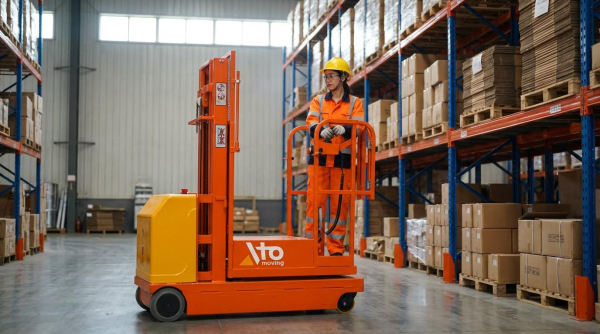
Start by checking that the warehouse order picker physically fits your aisles and rack heights. Typical units offer platform heights from 2,700 mm to 4,500 mm, with overall machine heights between 4,120 mm and 6,000 mm, so you must match these to your top beam level and sprinkler clearance. Platform and machine height ranges A compact footprint around 1,530–1,620 mm long and 700 mm wide, plus a minimum turning radius near 1,600 mm, works well in narrow aisles. Dimensions and turning radius data Match load and SKU profile to platform and capacity. A 300 kg rated capacity with a 600 x 640 mm platform suits carton and tote picking, but not deep pallet handling. Capacity and platform size Then size drive and battery. Dual 24 V, 0.4 kW drive motors with a 1.6–4 km/h travel envelope and 2×12 V, 150 Ah batteries balance energy use and productivity for most medium-throughput shifts. Motor, speed, and battery specs
Preventive and predictive maintenance to cut TCO
Lower total cost of ownership comes from disciplined preventive maintenance plus selective use of predictive tools. Daily checks should cover forks and mast structure, tires, wheels, battery terminals, and all safety controls such as brakes, horn, and emergency stop. Daily inspection items Weekly, verify hydraulic oil level and inspect hoses and fittings for leaks, then clean the aerial platform and mast and lubricate chains, bearings, and rails on a fixed schedule. Hydraulic and lubrication tasks Keep batteries above 20% state of charge and schedule professional servicing about every six months to inspect electrical, hydraulic, and mechanical systems. Battery and service guidance For larger fleets, add sensors and condition monitoring; predictive maintenance can cut maintenance cost by up to 25% and avoid unplanned downtime that may otherwise cost tens of thousands per hour. Predictive maintenance savings Unplanned downtime costs.
Conclusion: Building A Safe, Efficient Vertical Picking Strategy
Aerial order pickers let you push storage higher and aisles tighter without slowing order lines, but only if engineering and safety stay aligned. Geometry comes first. You must match platform height, overall machine height, and turning radius to your rack layout, sprinklers, and transfer aisles. This protects clearance, prevents rack strikes, and keeps the stability envelope intact at every lift height.
Drive, battery, and lift choices then set real throughput. Correct motor sizing and voltage give steady travel speeds and duty cycles across a full shift. When you size capacity and platform to the SKU mix, operators avoid overloads and awkward handling that can cause falls or tip risk.
Protection systems and strict standards compliance close the loop. Guardrails, fall arrest, travel limits, and warning lights reduce the chance of a single mistake turning into a serious injury. Guidance systems and collision controls add another barrier in very tight aisles.
The best strategy is simple. Engineer the truck around your layout and loads, enforce training and inspection, and run a disciplined preventive program, backed by predictive tools on larger fleets. Done well, an Atomoving aerial order picker becomes a safe, reliable core of a high-density, high-velocity warehouse.
Frequently Asked Questions
What is an aerial order picker?
An aerial order picker is a type of aerial work platform designed for lifting workers to high shelves or racks in warehouses. It allows operators to pick items directly from elevated storage locations. These machines typically feature a small lifting platform and are equipped with controls at the operator’s fingertips.
What is an alternative to a cherry picker?
An alternative to a cherry picker is a boom lift. Boom lifts can handle more complex jobs and often finish tasks faster than cherry pickers. They are versatile and can reach areas that cherry pickers cannot, though they may require more training to operate safely. For more details, check this Boom Lift Comparison.