
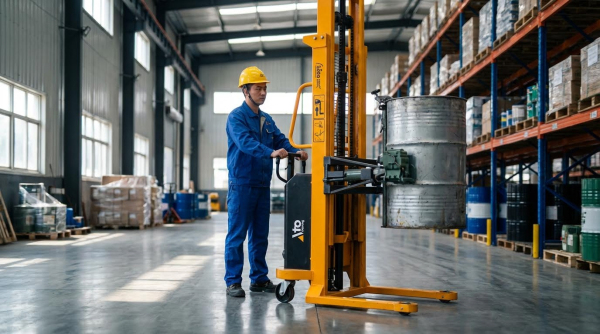
Selecting a lifting device for transporting steel drums is a safety‑critical decision that affects operator risk, product loss, and overall handling efficiency. This guide explains the main drum lifter types, their mechanisms, and the key design and safety factors you should check before buying. You will see how to match vertical lifters, beam clamps, and forklift drum attachments to real warehouse, production, and loading‑dock workflows. Use it as an engineering checklist to improve drum handling safety, ergonomics, and uptime while staying compliant with current standards.
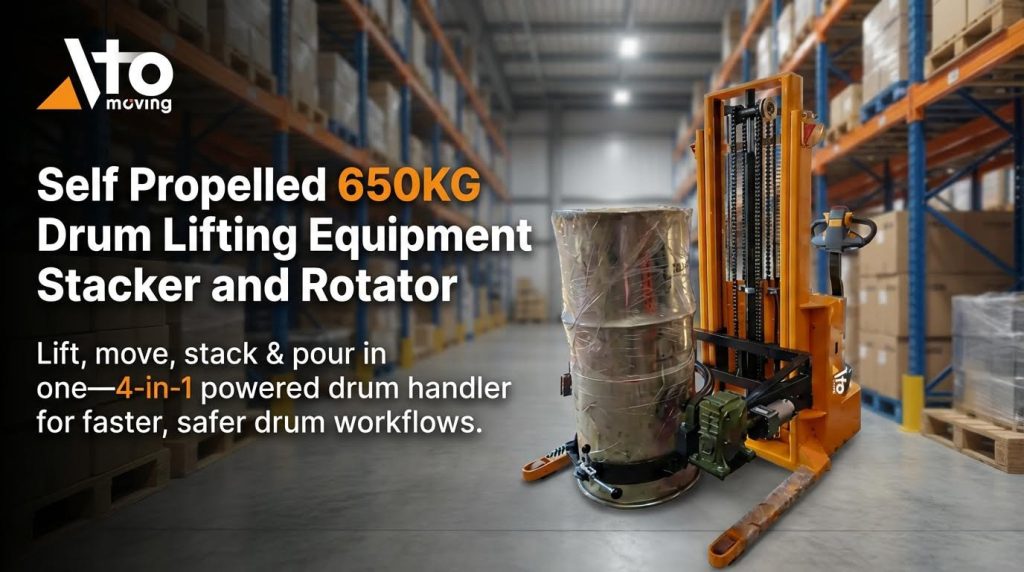
Key Types Of Lifting Devices For Steel Drums
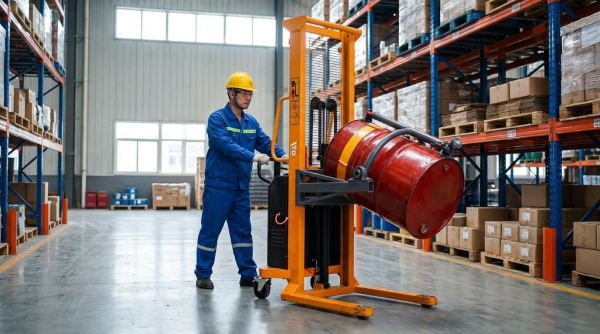
Vertical drum lifters and beam clamps
Vertical drum lifters are a lifting device for transporting steel drums when you use overhead cranes, hoists, or monorails. They grab the drum from the top or around the body and allow a single operator to lift, move, and precisely position standard 30–55 gallon drums, often with controlled 360° rotation for pouring or palletizing tasks vertical drum lifter functionality. This reduces manual handling, leakage risk, and back strain while using vertical space above production lines or filling stations. Many vertical lifters are relatively lightweight, sometimes around 20 kg, yet still support full 55‑gallon drums with capacities in the 360 kg range, giving a strong capacity‑to‑weight ratio for mobile or portable setups weight-optimized drum lifters. Beam clamps are simple structural attachments that secure to an I‑beam or runway and provide a fixed or adjustable suspension point for chain hoists or trolleys. In drum handling, they turn an existing building beam into a safe anchor point for vertical drum lifters, allowing straight‑line travel along a bay and keeping floor space clear for pallets, forklifts, or operators.
- Best suited to: fixed transfer routes, workstations, filling/decanting, and areas with overhead runway beams.
- Typical drum types: 55‑gallon steel drums; many devices also handle select fiber or plastic drums if the rim geometry matches.
- Key advantages: excellent vertical control, minimal floor footprint, and strong safety improvement over manual drum tipping.
Forklift drum clamps and rotators
Forklift drum clamps convert a standard forklift into a lifting device for transporting steel drums across warehouses, yards, and loading docks. Automatic clamping heads can grab and release drums without the operator leaving the seat, improving productivity and keeping personnel away from the danger zone at the mast automatic clamping mechanisms. On many designs, the clamping force increases with drum weight, so heavier 205‑liter steel drums are held tighter as the load grows, and release occurs simply by lowering the drum to the floor and reversing. For applications that require pouring or dosing, hydraulic drum rotator attachments use the truck’s auxiliary (third‑function) hydraulics to lift and rotate drums, typically up to about 130°, using chain belly straps and eccentric locks to keep the drum secure during rotation hydraulic drum rotator specifications. These units often handle heavy 205‑liter drums up to around 1000 kg, and safety catches or dual‑chain systems are used to prevent accidental release during transport or tipping dual-chain safety features.
- Best suited to: high‑throughput warehouse moves, loading/unloading trucks, and feeding drums into production from floor level.
- Typical drum types: 205‑liter / 55‑gallon steel drums; some clamps can be specified for compatible plastic drums.
- Key advantages: uses existing forklifts, allows fast point‑to‑point movement, and supports controlled tilting for decanting or dosing operations.
Technical Design, Safety, And Performance Factors
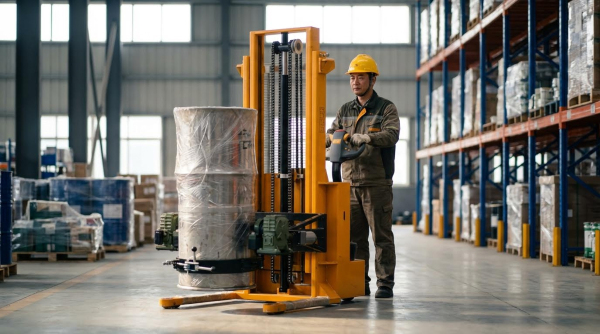
Clamping, strapping, and rotation mechanisms
For a lifting device for transporting steel drums, the holding method is the primary safety barrier. Automatic clamping systems use cam or jaw mechanisms that tighten as drum weight increases, so the grip becomes stronger under load as the drum gets heavier. This allows the operator to stay on the truck, reducing exposure to crush and pinch points. For vertical handling, dual-chain belly straps with eccentric locks wrap around the drum body and mechanically lock, giving near “fail-safe” retention when moving full 205‑liter drums with additional safety catches to prevent release.
- Clamping systems – rim or jaw clamps for steel drum chimes; automatic engagement and release via lift/lower cycles.
- Strapping systems – chain or web straps with mechanical locks for long travel or rough floors.
- Secondary latches – safety catches to prevent accidental opening during shock loads or impacts.
Rotation mechanisms must match the process (pouring, mixing, or re‑palletizing). Manual units use hand cranks to tilt drums up to about 120° for controlled decanting with a crank-driven tilt of around 120 degrees. Hydraulic or powered rotators can provide up to roughly 130° of rotation using a forklift’s auxiliary hydraulics, controlled from the operator seat for higher-frequency tipping cycles with hydraulic rotation of about 130 degrees via a third-function lever. When specifying a lifting device for transporting steel drums, engineers should check that the rotation axis passes near the drum’s center of gravity to minimize torque, reduce strain on clamps and straps, and give smooth, controllable pouring.
Load capacity, materials, and corrosion resistance
Most standard 55‑gallon steel drums weigh roughly 400–500 lb when full, so rated capacity is a critical design input. A safe lifting device for transporting steel drums should handle at least the heaviest drum in the process plus an appropriate safety factor. Many portable drum lifts are rated around 550 lb for uniform loads, giving margin above typical drum weights with both configurations supporting a 550 lb capacity. Some heavy-duty rotators for 205‑liter drums reach capacities near 1000 kg for demanding industrial environments with heavy lift capacities up to about 1000 kg.
| Design factor | Typical engineering choice | Reason |
|---|---|---|
| Capacity rating | Above 400–500 lb range for 55‑gal drums matching typical drum weights | Prevents overload and structural failure. |
| Base material | Carbon steel frames and arms used for portable drum lifts | High strength, cost-effective fabrication. |
| Surface protection | Paint, enamel, or zinc-plated finishes for corrosion resistance | Improves life in wet or chemical areas. |
Material choice drives fatigue life and corrosion performance. Steel construction is common for frames and masts due to its strength and stiffness under dynamic handling loads with drum lifts typically built from steel. In corrosive or outdoor environments, zinc-plated or coated components resist rust and maintain structural capacity over time improving durability in harsh conditions. Where chemical exposure or washdown is severe, engineers may specify higher-grade coatings or stainless elements on contact parts. For multi-drum or high-capacity systems, attention to load distribution across beams and forks reduces stress peaks and enhances system efficiency by spreading loads more evenly.
Power options, ergonomics, and maintenance
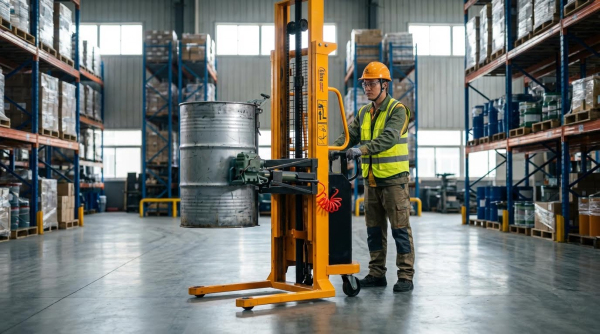
Power choice affects throughput, ergonomics, and maintenance planning. Manual drum lifters use hand pumps and cranks for lifting and tilting, which keeps the design simple and low-cost but requires more operator effort and suits low-frequency tasks making them better for occasional use. Electric or hydraulic units offer faster, smoother motion and are preferred where drums are moved or rotated many times per shift because powered systems improve speed and ease of use. Industrial manipulators and advanced drum handling systems add precise motion control and are well-suited to heavy drums and repetitive operations, often reducing long-term injury and damage costs by offering fast, precise movements and fewer damages.
- Ergonomics – good handle positions, minimal push forces, and seated operation from forklifts reduce strain and align with OSHA-oriented ergonomic guidance to lower injury risk.
- Mobility – casters with suitable diameters and tread materials, such as poly-on-steel wheels, improve maneuverability on typical plant floors using rigid and swivel casters for steering.
- Inspection and lubrication – regular checks for wear, deformation, and proper function, plus lubrication and periodic load testing, can extend system life and reduce accident risk by a significant margin with inspections cutting accident risk and lubrication extending drum life.
From a safety-engineering standpoint, a lifting device for transporting steel drums should incorporate overload protection and robust braking or holding mechanisms, especially on powered or high-lift designs where overload protection and fail-safe brakes are standard in high-risk lifting. Combined with clear capacity labels, operator training, and a defined inspection schedule, these technical choices deliver reliable performance, lower whole-life cost, and safer drum handling across warehouses, production areas, and loading docks.
Matching Drum Lifters To Applications And Workflows
Warehouse, production, and loading dock use cases
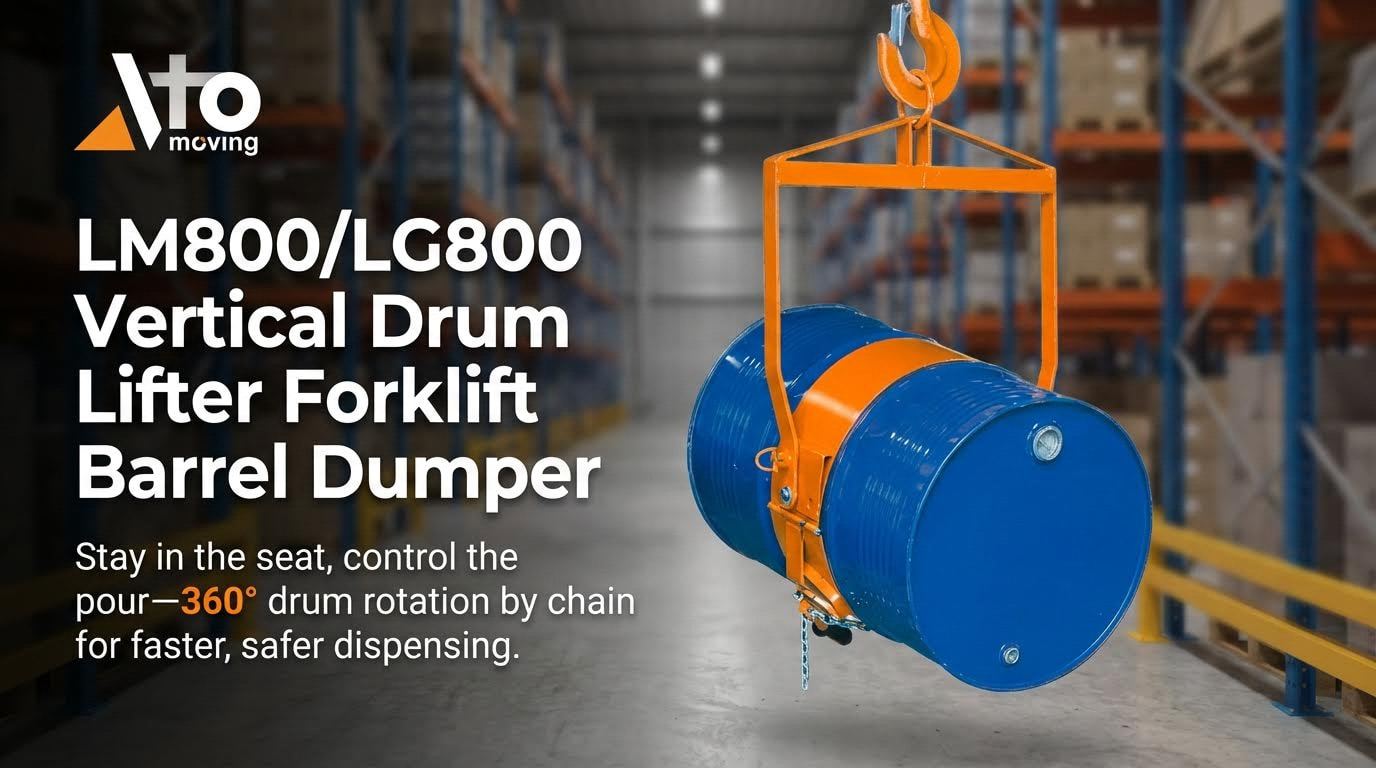
In warehouses, a lifting device for transporting steel drums must balance maneuverability, stacking height, and quick changeovers. Vertical drum lifters that use overhead cranes or hoists are effective where racking height is critical and floor space is tight, because they use the vertical space and allow single-operator handling with precise 360° drum rotation for positioning and decanting 30–55 gallon drums while reducing leakage and manual handling risks. In production areas, operators often need to lift, tilt, and pour into reactors or mixers, so drum rotators with controlled rotation angles around 120–130° and secure belly straps or eccentric locks are preferred to prevent slippage during dosing and mixing operations especially for 205-liter drums up to about 1000 kg capacity. Loading docks typically see high throughput with frequent truck loading and unloading, so forklift-mounted drum clamps and rotators with automatic clamping are ideal, as they let the driver stay in the seat and increase clamping force with drum weight, which improves cycle time and reduces exposure to traffic and pinch points while supporting standard 205-liter steel drums with corrosion-resistant finishes. Where drums must be moved between areas without fixed handling infrastructure, portable drum lifts built from steel, with caster sets and manual pump-and-crank systems, work well for occasional transfers of 55-gallon steel drums, offering lockable vertical and horizontal positions for either spill prevention or controlled drainage during internal logistics moves with typical raised heights around 53–59 inches and uniform capacities near 550 lbs.
Typical device choices by area
- Warehouse racking and storage: overhead vertical drum lifters or compact manipulators.
- Production and batching: drum rotators with secure straps and fine rotation control.
- Loading docks: forklift clamps and rotators with automatic grip and fast release.
- Internal transfers: portable drum lifts with casters for short, low-frequency moves.
Selection checklist and standards compliance
When selecting a lifting device for transporting steel drums, start with drum characteristics and duty cycle. Standard 55-gallon steel drums often weigh about 400–500 lb when full, so the device’s rated capacity must comfortably exceed this to maintain an adequate safety margin under real conditions and also match drum size and material. Construction materials and finishes should match the environment: robust steel frames with appropriate corrosion resistance are needed for harsh or outdoor areas, while compact, highly maneuverable designs are preferred in tight indoor aisles or congested production cells to ensure both durability and environmental adaptability. Safety and ergonomics are non-negotiable: look for positive locking or automatic clamping systems, secondary safety catches, and secure belly straps, combined with controls and operating positions that minimize operator strain and align with ergonomic guidance referenced in OSHA-related best practices to reduce injury risk and training time. Finally, verify that equipment meets applicable ANSI and ISO requirements for lifting devices, and put in place a maintenance plan with regular inspections, lubrication, and load checks, since systematic inspection and adherence to correct weight ratings have been shown to cut accident risk by roughly a third over the life of drum handling systems and extend system life when combined with proper servicing.
| Checklist Item | What To Verify |
|---|---|
| Load & drum compatibility | Max drum weight, size, and type (steel, plastic, fiber) the device can safely handle. |
| Environment & layout | Clearances, aisle widths, floor conditions, and indoor/outdoor exposure. |
| Handling function | Lift-only vs. lift-and-tilt vs. full rotation and pouring requirements. |
| Power & frequency | Manual vs. electric or hydraulic, based on lifts per shift and cycle time. |
| Safety & standards | Positive locking, overload margins, and compliance with relevant ANSI/ISO rules. |
| Ergonomics & training | Operator posture, force required, visibility, and ease of learning safe use. |
| Maintenance | Access for inspection, lubrication, spare parts availability, and service intervals. |
“”
Final Recommendations For Drum Lifting Equipment
Engineering teams should treat drum handling as a controlled lifting problem, not a simple material move. The right device geometry, clamping method, and rotation axis keep the drum’s center of gravity stable and reduce tipping and shock loads. Correct capacity ratings, steel construction, and corrosion-resistant finishes protect against overload and long-term fatigue, especially with full 55-gallon or 205-liter drums in harsh environments.
Automatic rim clamps, secure belly straps, and secondary latches form a layered safety system. These features prevent slip or release if a driver brakes hard, hits a joint, or misaligns a pour. Powered lift and rotation reduce strain and support high-frequency cycles, while good ergonomics and caster selection cut push forces and injury risk.
Operations teams should start with a clear use-case map: overhead vertical lifters for tight racking, forklift clamps and rotators for docks, and portable stackers for internal transfers. Then check each candidate against a strict checklist for load, environment, function, power, and standards. Finally, lock in a maintenance and inspection plan with defined intervals and training. With that approach, Atomoving drum handling equipment can deliver higher throughput, lower damage, and a clear, auditable safety margin across the entire plant.
Frequently Asked Questions
What is a barrel lifter?
A barrel lifter is a specialized device designed to lift and transport steel drums, often with an extended reach for accessing hard-to-reach areas. This tool allows operators to safely move drums in and out of storage cabinets or process machinery. For more details, see Barrel Lifter Guide.
How does a drum lifter work?
A drum lifter typically uses a hydraulic system to lift cylindrical objects like steel, plastic, or fiber drums off the ground. The hydraulic mechanism ensures stability and control during transportation. These devices are commonly used in warehouses and industrial settings. Learn more about this at Hydraulic Drum Lifter Info.
What is a drum grabber?
A drum grabber is an attachment for forklifts that helps operators lift and transport drums, barrels, and similar containers made of steel, fiber, or plastic. These tools enhance safety and efficiency when handling heavy cylindrical loads. Find additional information at Drum Grabber Details.