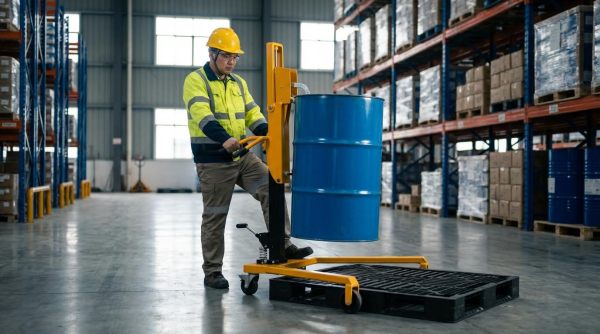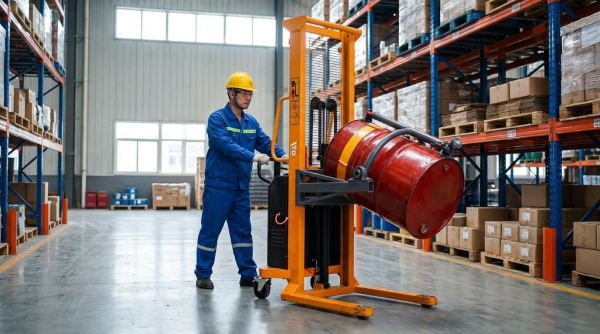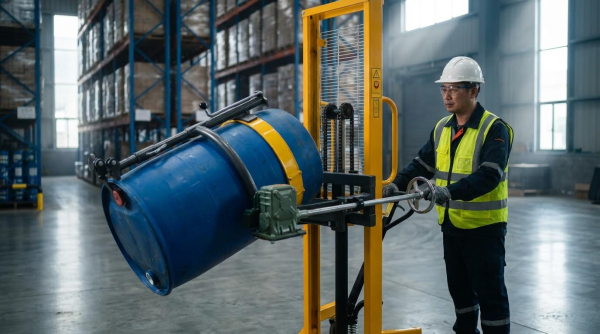
Knowing how to move 55 gallon drums safely means treating every drum as a 180–360 kg load with real crush, spill, and chemical exposure risks, not just “another container.” This guide explains how drum weight, center of gravity, and floor conditions drive your choice of dollies, drum trucks, pallet jacks, and forklift attachments, and why OSHA/ANSI rules and PPE are non‑negotiable. You will see practical comparisons of equipment, step‑by‑step handling principles, and how to align storage layout, inspection, and predictive maintenance with your drum-handling program. By the end, you can design a drum handling system that cuts push–pull effort, reduces spill incidents, and keeps operators compliant and injury‑free.
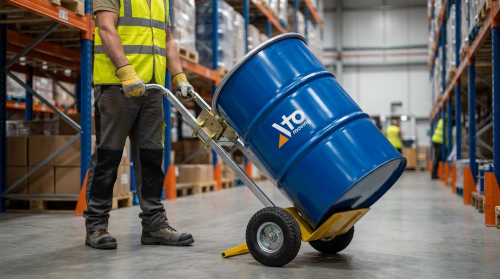
Core Principles For Moving 55-Gallon Drums Safely
Core drum-handling principles define how to move 55 gallon drums without injuries, spills, or tip-overs by controlling drum weight, center of gravity, hazards, labeling, and PPE in line with OSHA/ANSI requirements.
Knowing these fundamentals turns “how to move 55 gallon drums” from guesswork into a controlled, repeatable process. You reduce push–pull forces, keep drums upright and contained, and protect operators from chemical and crush hazards.
💡 Field Engineer’s Note: Most drum accidents I see start with a tiny shortcut—like moving a slightly bulged drum “just a few meters” by hand. If a drum looks wrong, tag it out and investigate before moving it.
Drum weights, stability, and center of gravity
Drum weight and center of gravity determine how easily a 55-gallon drum can tip, roll away, or crush feet and hands, so you must size equipment and layout around these forces, not around convenience.
A full 55-gallon drum typically weighs about 180–360 kg (400–800 lbs), depending on product density and content. That mass creates significant kinetic energy if a drum tips or rolls, which is why manual lifting or “walking” full drums is prohibited in most facilities.
| Parameter | Typical Value / Practice | Why It Matters | Field Impact |
|---|---|---|---|
| Full drum mass | 180–360 kg range | Defines kinetic energy and crush risk during tipping or rolling | Requires mechanical aids (trucks, dollies, lifters) instead of manual lifting or dragging |
| Center of gravity (CoG) | Above mid-height of drum | High CoG makes drums prone to overturning on uneven or sloped floors | Small floor defects, ramps, or pallet edges can trigger sudden tip-overs |
| Stacking height | Max 2 drums high, 2 wide | Limits combined CoG and prevents column collapse | Reduces domino failures and makes each drum reachable with handling gear |
| Rolling practice | Balanced on bottom chime, level floors only | Controls path and reduces side-roll or runaway risk | Still high-risk; use only when mechanical aids are unavailable and drums are inspected |
| Equipment selection | drum trucks, dollies, palletized systems | Cradles drum and keeps CoG inside wheelbase | Prevents tip-overs when crossing joints, thresholds, or minor slopes |
Because the drum’s center of gravity sits above its mid-height, any lateral push, floor defect, or sudden stop can create a tipping moment. Stacking more than two high or two wide multiplies this effect and increases the chance of a “drum avalanche” if one fails under load.
Safe practice for how to move 55 gallon drums is to keep the drum’s center of gravity well inside the wheelbase of the device you use—drum truck, dolly, or pallet—so that even if an operator missteps, the system stays upright.
Why “just rolling it” is risky
Rolling a drum on its bottom chime on level floors with uncrossed hands is an accepted last-resort technique in guidance, but any slope, crack, or liquid on the floor can redirect or accelerate the drum. Once it starts to fall, a 200–300 kg drum is not something a person can “catch” safely.
💡 Field Engineer’s Note: If you see operators “walking” drums by rocking them corner-to-corner, you have a training and equipment gap. That method overloads backs and fingers and often ends with crushed toes or pinched hands against racking.
Hazard identification, labeling, and PPE
Hazard identification, clear labeling, and PPE ensure you never move a “mystery drum,” and that operators are protected from the specific chemical, splash, and impact risks of each 55-gallon drum.
Before any movement, operators must positively identify drum contents and hazards from labels and Safety Data Sheets (SDS). If a drum is unlabeled or the label is illegible, it must be treated as hazardous until identified per OSHA 29 CFR 1910 Subpart H.
- Label verification: Confirms contents, hazard class, and handling instructions before movement.
- Pre-move inspection: Detects leaks, bulging, corrosion, or missing closures that could lead to spills.
- Baseline PPE: Protects feet, hands, and eyes from impact, sharp edges, and minor splashes.
- Chemical PPE upgrades: Adds chemical-resistant gloves, aprons, and face shields for corrosive or toxic materials.
- Respiratory/splash protection: Applied when SDS indicates inhalation or severe splash risks.
| Check / PPE Item | Typical Requirement | Why It Matters | Field Impact |
|---|---|---|---|
| Label and SDS check | Confirm product, hazard pictograms, UN number | Prevents incompatible mixing and wrong handling method | Operators choose correct route, equipment, and PPE for each drum |
| Visual drum inspection | Look for leaks, corrosion, bulging, dents at seams, missing bungs | Finds integrity issues before movement | Leaking or bulged drums are isolated and overpacked instead of rolled or lifted |
| Foot protection | Safety shoes with toe protection | Mitigates crush injuries from rolling or dropped drums | Reduces severity of common foot and toe incidents |
| Hand protection | Cut-resistant or chemical-resistant gloves | Prevents cuts from chimes and chemical burns from leaks | Operators keep grip without skin contact with residues |
| Eye and face protection | Safety glasses; face shield for corrosives/toxics | Protects from splashes during leaks or decanting | Essential when opening bungs or moving suspect drums |
Guidance stresses that operators must wear safety shoes with toe protection, cut-resistant or chemical-resistant gloves, and eye protection as a baseline for drum handling in typical facilities. For corrosive or toxic substances, add chemical aprons and face shields.
From an operational standpoint, “how to move 55 gallon drums safely” always starts with a short inspection: check labels, check the drum body and closures, confirm PPE, and only then bring in the dolly, drum truck, or lifter.
Red flags that should stop movement
Stop and escalate if you see: bulging ends, hissing sounds, heavy corrosion at chimes, product staining or dampness under the drum, missing bungs, or incompatible labels in the same storage zone during routine checks. These drums should go to containment or overpack, not onto a dolly.
💡 Field Engineer’s Note: A 30-second label and seam check prevents the classic “mystery leak in the aisle” incident. Train operators that if they can’t read the label clearly from arm’s length, they don’t move the drum yet—period.
Selecting The Right Drum Handling System
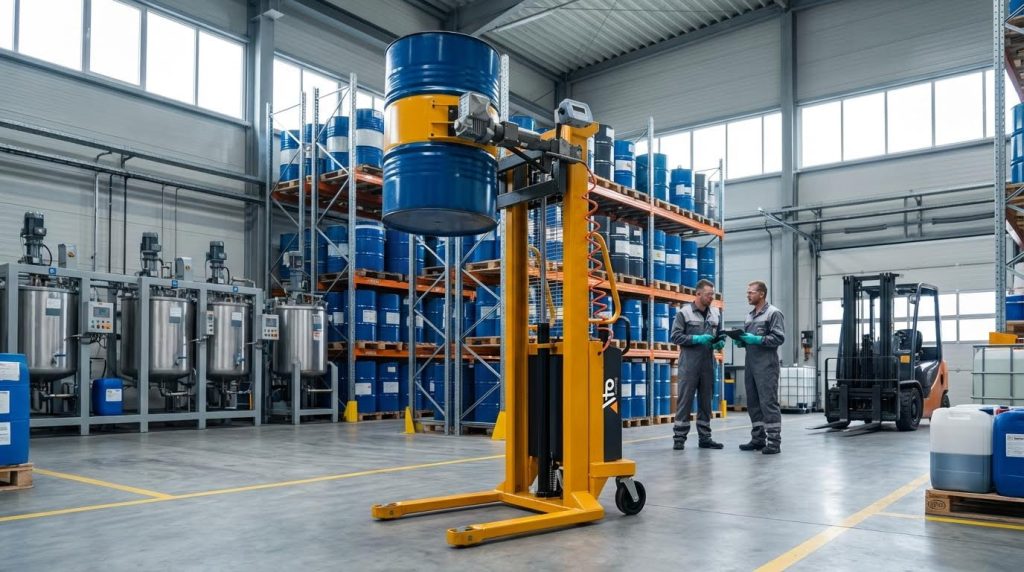
Selecting the right drum handling system means matching equipment capacity, footprint, and controls to drum weight, product hazards, aisle geometry, and floor conditions while meeting OSHA/ANSI requirements and enabling low-maintenance, predictable operations.
💡 Field Engineer’s Note: Most drum incidents I investigate trace back to a mismatch: heavy, high‑CG drums on light dollies, or hard steel wheels on cracked floors. Start with floor and route, not with the catalog.
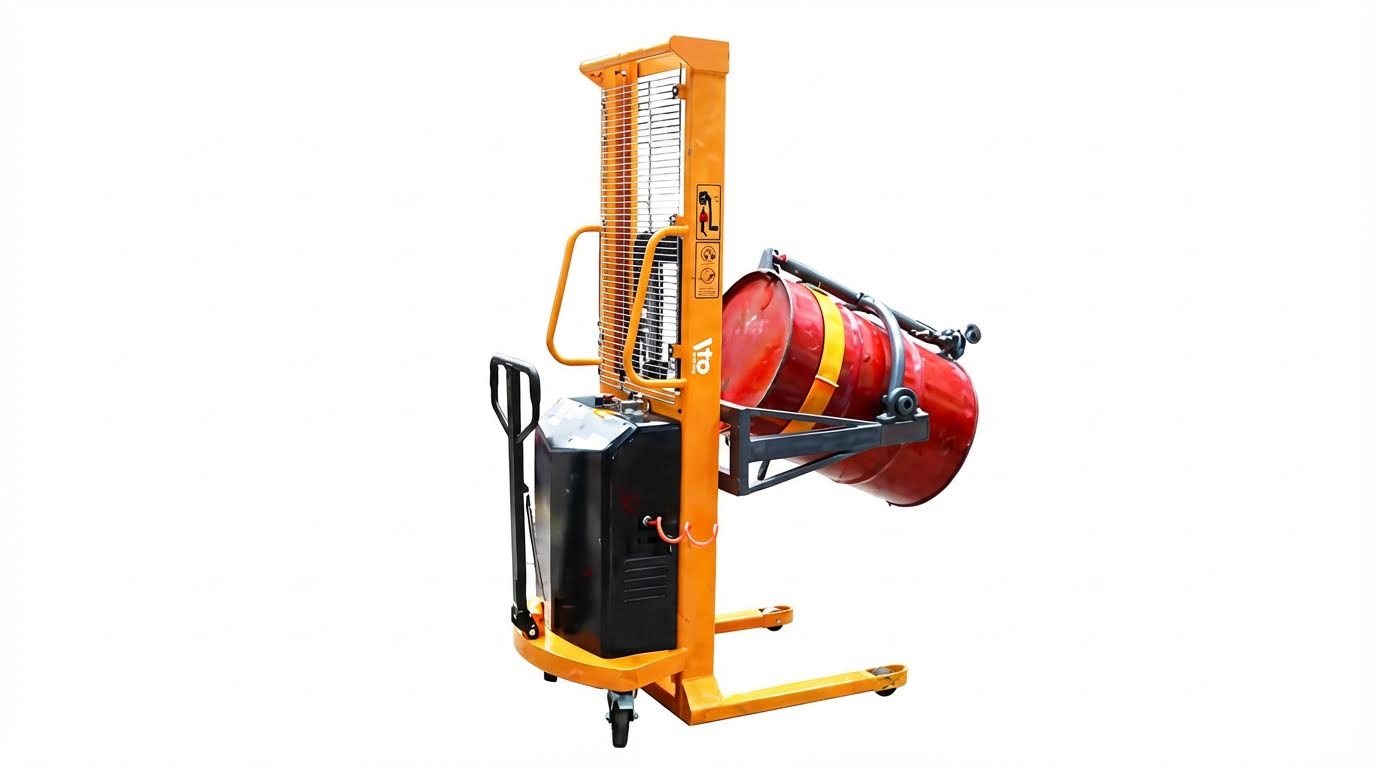
Matching drum equipment to product, aisle, and floor is the core of how to move 55 gallon drums safely, because drum mass, liquid behavior, and ground conditions directly control stability, push force, and tip‑over risk.
| Selection Factor | Typical Options / Ranges | Best Practice for 55-gallon Drums | Field Impact |
|---|---|---|---|
| Drum mass & contents | 180–360 kg full drum range documented for 55-gallon drums | Size equipment for ≥360 kg plus ≥25% safety margin for dense liquids and follow realistic mass estimates | Prevents overload of dollies, trucks, and grabs when density is higher than water. |
| Product hazard class | Water, corrosive, toxic, flammable, incompatible chemicals | Use closed, positive-locking clamps and avoid rolling for hazardous contents per SDS and OSHA 29 CFR 1910 Subpart H | Reduces spill probability and exposure if a drum is bumped or jolted. |
| Aisle width & turning space | Narrow aisles: ~1,0–1,5 m; standard: ≥2,4 m | Use compact drum trucks or mobile carriers in narrow aisles; manual pallet jack in wider lanes | Ensures equipment can rotate the drum without three‑point turns that destabilize the load. |
| Floor condition & slope | Level, cracked, drains, ramps, wet or contaminated areas | Keep routes level, clean, and dry; avoid rolling drums and use four‑wheel bases on imperfect floors as recommended for drum dollies | Minimizes sudden shifts in center of gravity that can cause tip‑overs. |
| Wheel material & size | PU wheels, e.g. Ø200×50 mm front, Ø100×30 mm rear on drum trucks for stability and maneuverability | Use larger diameter polyurethane wheels on hard floors; check that wheelbase fully contains the drum footprint | Lower rolling resistance and shock loads, better over expansion joints and minor defects. |
| Ground clearance | Approx. 150–350 mm on drum trucks depending on drum orientation for vertical and horizontal positions | Verify clearance exceeds thresholds, dock plates, and floor lips along the route | Prevents the frame from striking the floor and jolting the drum over its high center of gravity. |
| Handling task | Short moves, palletizing, decanting, stacking (≤2 high, 2 wide) for stability and access | Select mobile carriers for transport, lifter/tilters or rotators for pouring, and palletized systems for storage | Avoids using transport-only devices (dollies) for decanting or stacking tasks they were not designed for. |
For routine horizontal moves on good floors, drum dollies or mobile drum carriers with four‑wheel bases and ergonomic handles keep push–pull forces within safe limits and avoid manual rolling. Where vertical lift or decanting is required, hydraulic drum lifters, tilters, or rotator modules that provide 180–360° controlled rotation are preferred for precise pouring and pallet loading. These devices combine vertical lift with controlled rotation, allowing one operator to handle full drums without rolling them on the floor.
Why adjustable clamps and correct fit matter
Mechanical adjustable clamps with positive safety latches are recommended because clamp type and fit strongly affect drum stability during transport. Proper sizing and clamp design ensure the drum remains within the equipment’s support footprint, even if the liquid sloshes or the route includes minor floor defects.
Compliance, maintenance, and predictive monitoring keep drum handling systems safe over time by aligning equipment with OSHA/ANSI rules, enforcing inspections, and using condition data to prevent failures before they create spills or injuries.
- Regulatory alignment: Drum handling must comply with OSHA 29 CFR 1910 Subparts H, N, and O, which require rated lifting components, positive-locking attachments, and adherence to Safety Data Sheets for hazardous contents. These regulations govern hazardous materials and powered industrial trucks, so your chosen drum trucks, dollies, and forklift attachments must carry clear load ratings and safety factors.
- Safe operating limits: Ergonomic constraints limit initial push forces on manual equipment to roughly 200 N, and drum dollies are typically designed for single‑operator use. Load ratings must exceed the gross drum mass, including contents, and floor conditions must be level and free of contamination to keep forces and slip risk within safe bounds.
- Pre-use and scheduled inspections: Before each shift, operators should verify frame integrity, wheel condition, brakes, and restraints on dollies and drum trucks, mirroring safe loading and unloading procedures. Correct positioning keeps the drum’s center of gravity within the wheelbase footprint, and restraints such as perimeter rings, straps, or clamps must be applied firmly without crushing the drum wall.
- Planned maintenance: A structured maintenance program should include daily, weekly, and monthly tasks such as debris removal, leak checks, bolt tightening, and cleaning with mild detergent. Lubricating wheel bearings and swivel joints maintains low rolling resistance and controllable steering, directly affecting operator effort and incident rates.
- Predictive monitoring and sensors: Advanced mobile drum carriers and rotator systems increasingly incorporate sensors that track usage, loading, and condition. These systems support predictive maintenance and digital oversight, allowing facilities to prioritize inspections and part replacements before a cracked wheel, worn clamp, or misaligned frame leads to a spill or dropped drum.
- Integration with storage and containment: Drum handling systems must be compatible with your storage layout and secondary containment strategy, including limits on stacking (generally no more than two high and two wide) and the use of spill pallets or bermed areas. Containment capacity should be at least 10–25% of stored volume or the largest drum, and fire protection measures such as separation distances and extinguisher placement must be maintained around drum routes and staging points.
💡 Field Engineer’s Note: Treat maintenance and monitoring as part of your drum handling “system,” not an afterthought. A seized caster or worn clamp turns even the best-designed equipment into a high-risk rig in one shift.

Final Considerations For Drum Handling Programs
Safe drum handling depends on a few linked engineering ideas. You control a tall, heavy load with a high center of gravity. You keep that center of gravity inside a stable wheelbase. You match equipment and routes to real floor and aisle conditions. You then wrap this with clear hazard data, PPE, and firm operating rules.
When you respect drum mass and liquid behavior, you stop relying on manual rolling and guesswork. Correct dollies, drum trucks, pallet systems, and forklift gear keep push forces within ergonomic limits and prevent sudden tip‑overs at joints, slopes, and dock edges. Label checks, SDS use, and short inspections at each move block “mystery drums” and leaks in traffic lanes.
A strong program treats OSHA/ANSI rules, inspections, and maintenance as one system. Rated equipment, pre‑use checks, and simple predictive monitoring keep casters, clamps, and frames in safe condition. Storage rules on stacking and containment then limit the impact of any failure.
The best practice is clear: design your drum handling around physics and standards, not convenience. Map routes, choose gear that fits your heaviest, most hazardous drums, and enforce fast, repeatable checks. This approach cuts injuries, spills, and downtime while keeping operators and your Atomoving equipment in their safe working envelope.
Frequently Asked Questions
How to safely move a 55-gallon drum?
Moving a 55-gallon drum requires the right equipment to ensure safety and efficiency. Forklifts, pallet jacks, and drum dollies are commonly used tools for this task. Attempting to move these containers manually increases the risk of accidents. For lifting, use drum lifting equipment rated for the drum’s full weight. Position the lifter around the drum’s center of gravity, usually at the upper third, and engage the mechanism fully before lifting. Move slowly and maintain good body position. Drum Handling Tips.
What is the best way to handle full 55-gallon drums?
Handling full 55-gallon drums can be challenging due to their weight and size. To move them safely, brace the drum with your foot to prevent sliding and shift your weight to the rear foot. Use the push/pull method by pulling the far chime with one hand while pushing against the wall with the other. This technique helps in maneuvering the drum without straining your body. Always prioritize safety when handling heavy materials. USDA Drum Moving Guide.