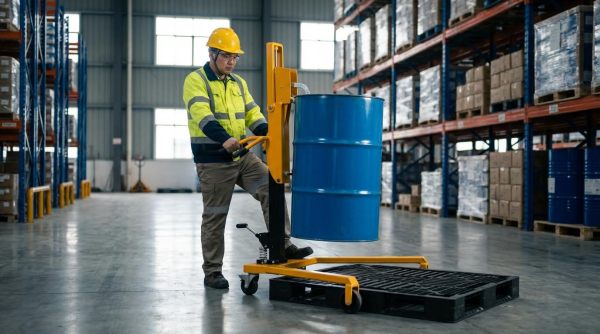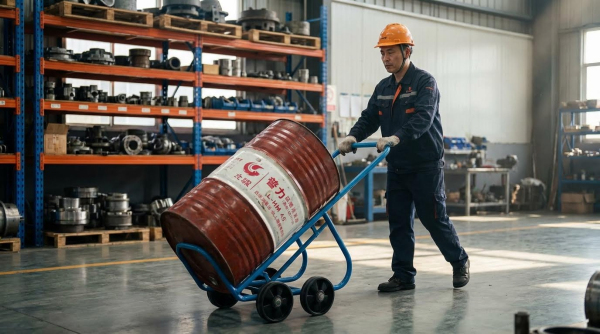
Secure drum transportation relied on the correct combination of compliant packaging, engineered handling equipment, and robust securing systems. This article examined drum types and UN/DOT classifications, formal risk assessment, and how OSHA, DOT, WAC, and EU norms governed safe movement and containment. It then addressed the selection and engineering use of forklifts, trolleys, lifters, rotators, racks, cages, and bunds to control mechanical and spill risks. Finally, it analyzed pallet layouts, lashing systems, reusable devices such as Drumclip, and the role of inspection, predictive maintenance, and digital twins, concluding with practical implementation guidelines for industrial operations.
Drum Types, Regulations, And Risk Assessment
Drum types, regulatory duties, and formal risk assessment formed the foundation of safe drum logistics. Engineers needed to understand container design limits, applicable transport codes, and hazard communication rules before specifying handling or securing solutions. This section linked physical drum characteristics with the regulatory framework that governed their use in real-world operations.
Common Drum Designs And UN/DOT Classifications
Industrial operations used steel, plastic, and fibre drums in standardized capacities, typically 200 L (55 gallons). UN/DOT regulations classified these packagings by material, head type, and function using alphanumeric codes. For plastic drums and jerricans, 49 CFR 178.509 defined 1H1 and 1H2 as non-removable and removable head drums, and 3H1 and 3H2 as non-removable and removable head jerricans. Each design required suitable materials that resisted aging, contents, and ultraviolet radiation, while preventing permeation during transport. The code also limited maximum capacities to 450 L for drums and 60 L for jerricans, with net mass limits of 400 kg and 120 kg respectively. Wall thickness and closure design had to match the intended reuse pattern and hazard level, with gasketed closures mandatory for removable head types unless inherently leak-tight. Engineers used these classifications to match drum selection to product density, hazard class, and route conditions.
Hazard Identification And Labeling Requirements
Effective risk control for drum transport started with accurate hazard identification and labeling. Regulations required that unlabeled drums be treated as hazardous until contents were sampled, identified, and properly marked. Employers had to train personnel to read and interpret drum labels, UN numbers, and hazard pictograms to understand flammability, toxicity, or corrosivity risks. Site-specific health and safety plans (HASP) defined sampling procedures for unknown drums, including use of compatible pumps and non-sparking tools. Operators inspected drums for structural integrity, leaks, and overfilling before movement to prevent rupture during handling. Clear labeling supported selection of compatible drum stacker, spill response materials, and fire protection measures. In emergency scenarios, correct labeling also reduced response time and minimized environmental release.
Regulatory Frameworks: OSHA, DOT, WAC, And EU Norms
Drum transport fell under overlapping safety and transport regulations that addressed different risk dimensions. In the United States, OSHA standards governed worker exposure, equipment use, and emergency preparedness during drum handling. The Washington Administrative Code 296-843-18005 added specific requirements for drums that potentially contained hazardous or radioactive waste, including careful uncovering of buried drums and use of ground-penetrating detection systems. DOT rules, including 49 CFR 178.509, controlled packaging design, performance testing, and UN markings for drums in transport. These rules specified leakproofness, drop, stack, and vibration tests, especially for salvage drums used after spills or container failure. In Europe, standards such as EUMOS 40509 addressed load stability, while DIN EN 12195-1 and DIN EN 12642 defined performance requirements for lashing systems and vehicle bodies. Engineers had to map each step of the drum lifecycle to the relevant regulation and ensure documentation and equipment complied across jurisdictions.
Selecting Salvage And Overpack Drums For Transit
Salvage and overpack drums supported contingency management when primary containers were damaged or non-compliant. Salvage drums were UN-rated packagings, tested under DOT procedures for leakproofness, stacking, dropping, and vibration to contain compromised drums with hazardous contents. They carried specific UN markings and the word “SALVAGE” or “SALVAGE DRUM,” indicating suitability for regulated transport. Typical designs used UV-resistant polyethylene with robust screw-top lids to resist weathering and mechanical shocks. Overpack drums, by contrast, provided secondary containment for intact packagings, often in non-hazardous or storage-only scenarios. All salvage drums functioned as overpacks, but not all overpacks met salvage performance standards for hazardous materials transport. When a drum could not be moved without risk of rupture, regulations required transfer of contents into a sound container, often a certified salvage drum, using compatible pumping equipment. Selection criteria therefore included hazard class, anticipated mechanical loads, need for transport versus static storage, and regulatory labeling requirements.
Handling Equipment For Safe Drum Movement
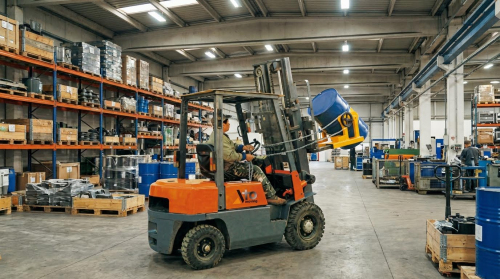
Handling equipment for drums reduced manual effort and controlled load paths during lifting, transport, and emptying. Engineers selected equipment based on drum mass, material, center-of-gravity position, and required motion (vertical lift, rotation, or tilting). Proper integration of trolleys, lifters, forklift attachments, and storage systems improved safety performance and regulatory compliance. The following subsections described key equipment families and their engineering considerations.
Forklift Attachments, Trolleys, And Powered Hand Trucks
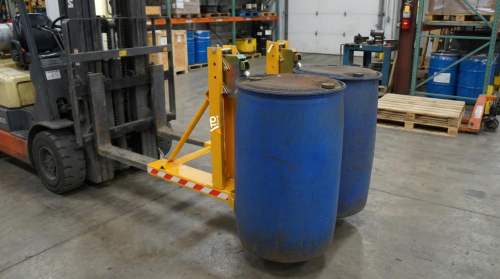
Forklift drum attachments clamped to the forks and allowed secure lifting of single or multiple drums without manual contact. Engineers specified attachments based on rated capacity, drum type (steel, plastic, or fiber), and grip geometry to prevent slippage under dynamic braking. Drum trolleys carried drums on wheeled frames, which reduced push forces and eliminated unsafe rolling or tipping of drums by hand. Models with three wheels and brakes improved maneuverability and stability on uneven floors, especially in loading bays and outdoor yards.
Powered drum hand trucks used motorized assistance to balance 30-gallon and 55-gallon drums on four wheels, with typical capacities up to about 360 kg. Integrated hand brakes and low center-of-gravity frames controlled descent on ramps and avoided runaway loads. Engineers evaluated turning radius, wheel material, and floor bearing pressure when specifying these tools for confined warehouse aisles. Routine inspection of welds, wheels, and clamping mechanisms maintained the manufacturer’s rated load and prevented progressive fatigue failures.
Drum Lifters, Grabbers, Rotators, And Dumpers
Drum lifters attached to cranes or forklifts and provided vertical lifting of heavy drums while maintaining a near-vertical axis. Properly designed lifters distributed clamping forces around the drum chime or body to avoid local wall buckling. Drum grabbers locked onto drum rims and enabled repetitive lifting cycles, which suited high-throughput operations such as filling lines. Engineers selected grabbers with self-centering mechanisms and positive locking indicators to reduce the risk of partial engagement.
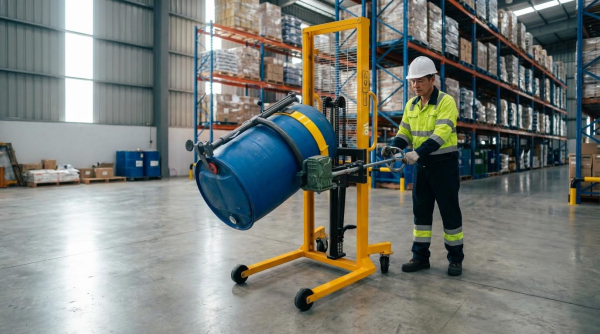
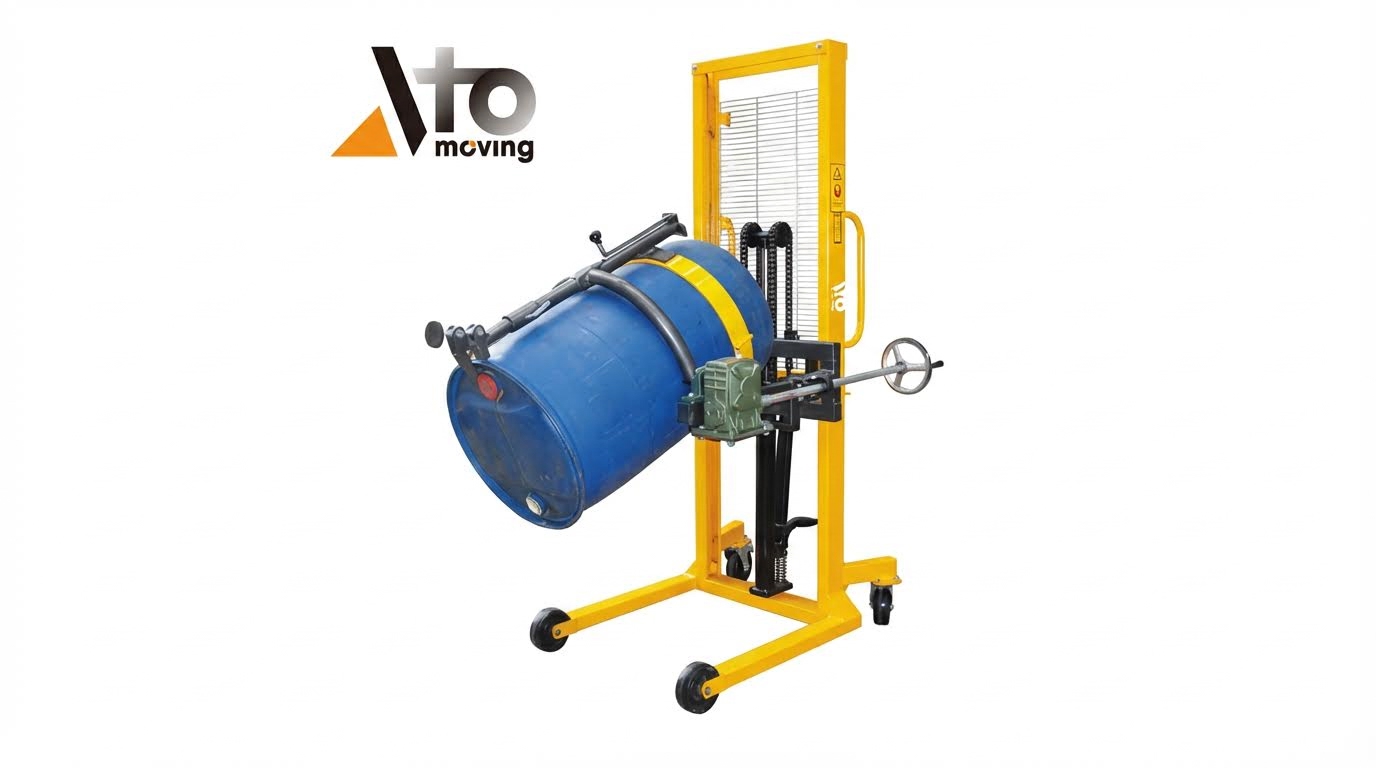
Drum rotators and dumpers controlled rotation for emptying viscous or hazardous contents without manual tilting. Forklift-mounted or hydraulic drum rotators allowed operators to pick up, rotate, and deposit drums while remaining in the cab, which reduced exposure to spills. Hydraulic drum dumpers handled drums up to roughly 680 kg and incorporated upper travel limit switches and velocity fuses to prevent uncontrolled motion. Design verification considered torque requirements, drum diameter, and friction at the support points to ensure smooth, predictable rotation under full load.
Specialized Non-Sparking And Corrosion-Resistant Tools
Non-sparking drum handlers used copper-based or aluminum-bronze alloys for contact components in flammable atmospheres. These tools minimized ignition risk from mechanical impact or friction when handling drums containing volatile solvents. Engineers matched non-sparking equipment to the facility’s hazardous area classification and ensured compatibility with grounding and bonding practices. Corrosion-resistant drum handling tools, often stainless steel or coated steel, were specified for acids, alkalis, or marine environments.
In corrosive service, designers considered crevice geometry, coating thickness, and fastener materials to avoid galvanic corrosion. Regular surface inspections and cleaning programs extended service life and preserved load ratings. Where both non-sparking and corrosion resistance were required, engineers evaluated trade-offs between alloy strength, hardness, and cost. Documented inspection intervals and replacement criteria ensured tools did not degrade to a point where structural integrity or ignition control was compromised.
Design And Use Of Storage Racks, Cages, And Bunds
Storage racks and cages physically restrained drums to prevent tipping, rolling, or accidental displacement during storage and internal transport. Engineers sized rack beams and uprights for the combined mass of fully loaded drums, using appropriate safety factors for seismic or impact loads. Integrated retainer bars, chains, or mesh sides prevented drums from falling when operators loaded or unloaded with forklifts. Secure storage cages also controlled access to hazardous substances and supported compliance with chemical segregation rules.
Bunds and spill pallets provided secondary containment beneath drums to capture leaks or overfills. Designers calculated bund volume to meet regulatory requirements, often at least 110% of the capacity of the largest drum or a defined percentage of the total stored volume. Materials for bunds, such as polyethylene or coated steel, were selected for chemical compatibility with stored liquids. Combining racks or cages with bunded bases created systems
Load Securing Systems And Palletization Methods
Engineered load securing and palletization determined whether drums reached their destination without damage, spills, or regulatory violations. Effective systems combined correct pallet layouts, controlled stacking heights, and quantified stability criteria with appropriate lashing methods. Reusable securing devices such as Drumclip increased repeatability and reduced material waste compared with single-use wrapping. Digital inspection, predictive maintenance, and emerging digital twin approaches further improved reliability and traceability of drum logistics.
Pallet Layout, Stacking Limits, And Stability Criteria
Engineers arranged drums on pallets to achieve a low center of gravity and uniform load distribution. Typical layouts for 200 L drums used square or diamond patterns, avoiding overhang beyond pallet edges to prevent point loading and impact vulnerability. Stacking limits depended on drum type, fill level, pallet strength, and regulatory test data such as ISTA 3E or equivalent stacking tests. Designers considered dynamic loads from braking, cornering, and vibration, not just static vertical loads, when defining maximum stack height.
Stability criteria included resistance to sliding, tipping, and pallet deformation under worst-case transport accelerations. Practitioners often applied longitudinal design accelerations of 0.8 g and lateral accelerations of 0.5 g for road transport, aligned with European cargo-securing concepts. Engineers verified that resultant overturning moments did not exceed restoring moments from drum weight and contact geometry. They also checked that pallet deflection stayed within limits that maintained drum contact area and avoided concentrated stresses in plastic or fiber drums.
Use of anti-slip mats between pallet and drums, or between stacked layers, increased friction coefficients and reduced required lashing pretension. Portable bunds or spill pallets placed under drum pallets provided secondary containment without significantly affecting stability when properly sized and rated. Operators avoided pyramid stacking or mixed drum sizes within a stack unless validated by test or calculation. Regular inspections of pallets for cracks, broken boards, or warped stringers mitigated sudden stability loss during handling.
Straps, Chains, And Lashing Systems For Drum Loads
Straps, chains, and lashing systems converted friction-limited drum stacks into mechanically restrained loads. Polyester or composite straps were common for pallet-level securing because they combined high tensile strength with controlled elongation and corrosion resistance. Engineers sized lashing systems using standards such as DIN EN 12195-1, considering strap lashing capacity, angle, and preload to resist specified transport accelerations. They avoided relying solely on vertical strapping when horizontal restraint against sliding and tipping was critical.
Chains and wire ropes were more typical for heavy industrial loads or fixed trailer-level securing rather than individual drum pallets. In drum applications, chains risked local indentation or damage unless combined with edge protectors or load spreaders. Ratchet tensioners allowed repeatable pretension but required operators to avoid over-tensioning that could deform plastic drums or crush fiber drums. All lashing hardware required compatibility with the strap type and rated strength, including buckles, hooks, and anchor points.
Engineers frequently combined pallet strapping with trailer-level blocking, bracing, and headboards to create redundant restraint paths. They avoided moving unsecured drums on forklifts because braking or uneven floors could destabilize the load before lashing. Periodic checks during transit, especially after emergency braking or rough road sections, verified that lashings remained tight and undamaged. Training programs emphasized correct routing of straps, avoidance of sharp edges, and inspection for cuts, abrasion, or UV degradation.
Drumclip And Similar Reusable Drum Securing Devices
Reusable securing devices such as Drumclip created a mechanical interface between drums and lashing systems, improving load stability and repeatability. Drumclip models matched specific drum geometries, for example DC18A for 200 L tight head steel drums, DC19B for open head and plastic drums, and DC23C for ISO drums. These devices allowed wider lashing straps and optimized contact areas, reducing the number of straps required compared with traditional cross-strapping. Certification under standards such as DIN EN 12642 Annex B, ISTA 3E, and EUMOS 40509 demonstrated compliance with pallet stability and cargo safety requirements.
Typical configurations used two Drumclips per pallet, positioned on opposite sides to clamp the drum group and transmit strap forces uniformly. When combined with certified strap and buckle systems, some solutions achieved compliance with DIN EN 12195-1 load-securing calculations. Reusability over one to two years, depending on wear, reduced packaging waste relative to single-use stretch film or shrink wrapping. Manufacturers produced Drumclips from recycled textiles and
Summary And Practical Implementation Guidelines
Secure drum transportation required an integrated approach that linked packaging design, handling equipment, load restraint systems, and regulatory compliance. Engineering controls addressed both routine logistics and abnormal events such as leaks, drum deformation, or emergency decanting into salvage containers. Standards such as 49 CFR 178.509, DIN EN 12642, ISTA 3E, EUMOS 40509, and DOT salvage-drum test protocols provided quantifiable performance baselines for plastic drums, palletized loads, and recovery packaging. Organizations that aligned internal procedures with these norms reduced incident rates, environmental releases, and non-compliance penalties.
In practice, implementation started with correct drum selection and classification, including appropriate UN/DOT codes, UV-stable materials, and capacity and mass limits within specification. Facilities then specified handling equipment—drum lifters, and rotators—based on drum mass, material, and required operations such as decanting or crushing. Palletization and restraint design used defined stacking limits, pallet integrity checks, and engineered lashing solutions, with reusable devices such as Drumclip improving pallet stability and reducing single-use materials. For damaged or leaking units, certified salvage drums with correct UN markings and tested performance replaced basic overpacks when transport occurred.
Future developments in this field will likely combine reusable securing devices, higher recycled content in plastics, and digital tools such as sensorized pallets and predictive maintenance for handling fleets. Digital twins of logistics chains can model dynamic loads, vibration spectra, and impact scenarios, allowing engineers to optimize drum type, restraint layout, and equipment selection before deployment. A balanced strategy will couple these innovations with robust operator training, site-specific hazard assessments, and periodic audits against OSHA, DOT, WAC 296-843-18005, and comparable EU requirements. This combination supports safer operations, lower life-cycle cost, and measurable reductions in environmental and reputational risk.