
Electric pallet jacks look simple, but their lift height, capacity, and duty cycle limits decide what you can safely do in your warehouse. This guide explains how high an electric lift pallet jack will lift in real operations, what “maximum lift” really means, and how it ties to capacity and mast design. You will see typical lift ranges for low-lift, high-lift, and stacker types, plus how batteries and usage patterns affect performance. Use it as a practical reference when matching equipment to racking, docks, and safety requirements.
Understanding Electric Pallet Jack Lift Ranges
What “Lift Height” Means In Real Operations
In real warehouse work, “lift height” is the maximum vertical distance from the floor to the top surface of the forks when they are fully raised. For low‑lift electric pallet jacks, this is only enough to clear the pallet and travel, typically in the range that gives about 7.5–8 inches of raised fork height on standard designs with 3–4 inches lowered and 7.5–8 inches raised. For high‑lift and stacker types, lift height refers to how high the load can be positioned for racking or ergonomic work, which can reach several meters vertically on electric stackers designed for vertical lifting. When people ask how high will an electric lift pallet jack lift, they usually mean the safe, rated lift height with a full load, not just the mechanical maximum. In operations, you also need to consider pallet height, load overhang, and beam clearances, because these reduce how high you can place product while staying within the rated lift envelope.
Key practical aspects of “lift height”
- Clearance to travel without scraping the floor or dock plates.
- Ability to bridge small slopes or dock levelers.
- Safe stacking height under beams, sprinklers, and door headers.
- Ergonomic working height for picking or feeding lines.
Typical Lift Heights By Pallet Jack Type
Different electric pallet jack designs offer very different lift ranges, so the answer to how high will an electric lift pallet jack lift depends strongly on type. Typical values are:
| Equipment type | Typical lift height range | Main use |
|---|---|---|
| Standard electric pallet jack (low‑lift) | Approx. 180–200 mm (about 7.5–8 in) raised fork height based on common pallet jack dimensions | Ground‑level transport, loading and unloading |
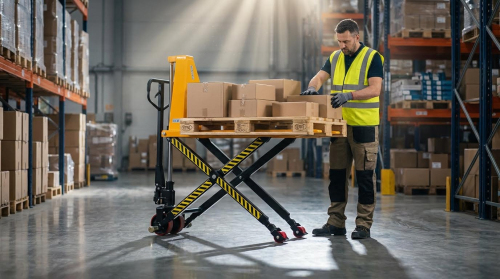
| High‑lift / scissor pallet jack | Up to about 800–1000 mm (32–39 in) working height for scissor‑lift pallet trucks and around 32 in on many high‑lift models used as ergonomic workstations | Feeding workstations, order picking, light stacking at waist height |
| Electric pallet stacker (walk‑behind) | Commonly up to about 3500 mm, with some three‑stage masts reaching around 4500 mm for vertical lifting; other mast stackers can reach roughly 1400–5800 mm depending on configuration across stacker models | Racking, mezzanines, and medium‑height storage |
| Electric pallet truck with short mast | Some powered pallet trucks with masts can lift up to about 4300 mm on certain configurations | Dock work and low to mid‑level racking where a compact chassis is needed |
These ranges show that a basic electric pallet jack only lifts enough to move pallets, while high‑lift and stacker types can work from roughly 800 mm up to around 5.8 m in specialized cases depending on mast design. When planning a project, always match the rated lift height to your top beam level plus pallet and load height, and keep a safety margin below overhead obstructions.
Key Specifications That Define Lift Performance
Rated capacity vs. maximum lift height
When you ask how high will an electric lift pallet jack lift, you must link that question to rated capacity. Electric pallet jacks typically offer capacities from 1000 kg up to about 3600 kg, depending on design and duty class. Typical capacity range is 1000–3600 kg. As a rule, the closer you run to rated capacity, the more conservative you must be with maximum lift height, especially on uneven floors or with high centers of gravity. Engineers size the chassis, mast, and wheelbase so the truck stays stable at full rated load and full rated height, but that assumes level ground, correct pallet size, and correct load placement. To manage risk, many sites derate their “working” lift height for heavy or top‑heavy loads. Operators should also remember that dynamic effects (braking, turning, or hitting floor joints) increase the effective overturning moment at height.
- Check the data plate for the capacity at specific lift heights, not just the headline capacity.
- Use lower heights for tall, unstable, or offset loads even if the weight is below the nameplate rating.
- Avoid side turns or sudden stops when the load is raised.
Mast stages, free lift, and collapsed height
Mast geometry largely answers how high will an electric lift pallet jack lift in real warehouses. Basic electric pallet trucks without a mast only raise loads to work with pallets, usually a few hundred millimetres off the floor, while stacker-style units with masts can reach several metres. Standard electric pallet stackers commonly lift between about 1400 mm and 5800 mm, depending on the mast configuration. Typical mast lift range is 1400–5800 mm. Three-stage masts on stackers and similar equipment can reach around 3500 mm as a standard option, with some designs extending to about 4500 mm and beyond. Common stacker heights are up to 3500 mm, with three-stage masts around 4500 mm. Free lift is another key spec: it defines how far the forks can rise before the mast starts to extend, which matters in low doorways or inside trailers. Collapsed height tells you if the truck will clear your lowest obstruction when the mast is fully lowered. Together, maximum lift height, free lift, and collapsed height determine which racking levels you can serve and where the machine can physically travel.
Practical mast selection tips
- Map your highest pallet position and add clearance for pallet height, beam deflection, and floor unevenness.
- Verify collapsed height against door openings, mezzanines, and low beams.
- Specify enough free lift if you must raise loads inside containers or under low ceilings.
Powertrain, batteries, and duty-cycle impact
The powertrain and battery system do not change the theoretical maximum lift height, but they strongly affect how consistently the truck reaches that height over a shift. Most electric pallet jacks and stackers use a 24 V battery system with capacities around 280 Ah. Typical systems use 24 V batteries around 280 Ah. Under heavy, high-lift cycles, voltage sag and heat in the lift motor reduce lift speed and usable runtime. Typical lift speeds fall in the range of about 90–130 mm/s when loaded and 170–230 mm/s when unloaded, so frequent trips to upper rack levels consume more time and energy than low-level moves. Typical laden lift speeds are 90–130 mm/s and unladen 170–230 mm/s. Lithium-ion batteries can offer higher usable depth of discharge and quicker charging, with some compact units delivering around two hours of runtime per charge in intensive use. Some lithium systems provide roughly 2 hours of runtime per charge. When planning how high will an electric lift pallet jack lift in your process, look beyond the spec sheet maximum and consider:
- Duty cycle: number of lifts per hour to mid and top rack levels.
- Average load weight at height versus near the floor.
- Battery type, charging strategy, and expected runtime between charges.
- Required lift speed to meet throughput targets at upper levels.
Correctly matching powertrain and battery capacity to your duty cycle ensures the truck can repeatedly reach its rated lift height without overheating, voltage drop issues, or unplanned downtime.
Matching Lift Height To Application Needs
Choosing lift height for racking and docks
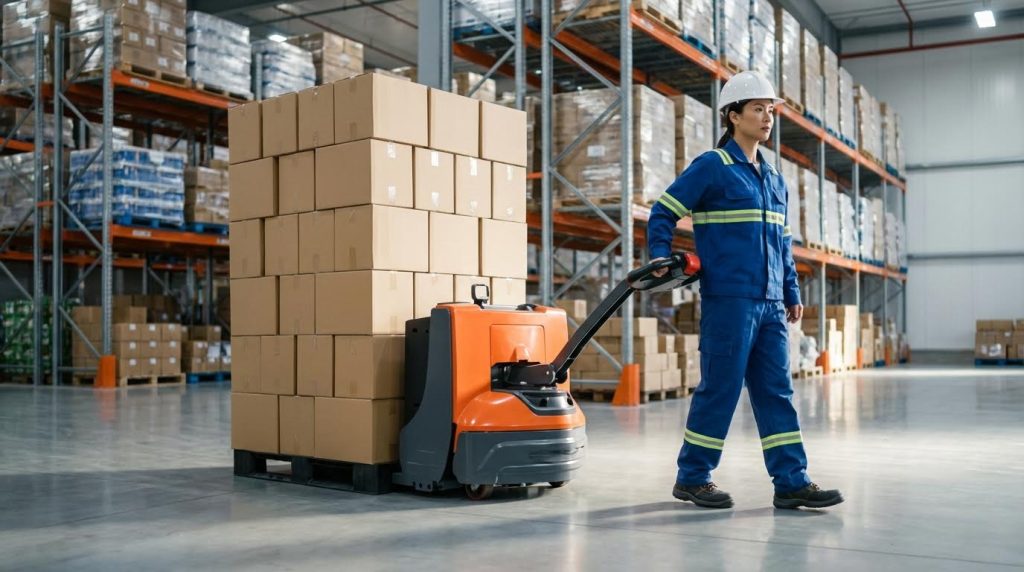
When you ask how high will an electric lift pallet jack lift, you first need to map lift height to your racking and dock geometry. Standard electric pallet jacks without a mast usually only raise loads enough for transport, while mast or stacker versions can lift to about 1400–5800 mm depending on configuration standard lift heights for electric pallet jacks with masts. Always compare the maximum lift height to your top beam height plus pallet and load thickness, then add a clearance margin of 150–200 mm for safe entry and exit.
- Measure: floor to top of beam, pallet height, and typical load height.
- Add: clearance for fork entry, pallet overhang, and uneven floors.
- Check: that the collapsed mast clears doors, tunnels, and low mezzanines.
For dock work, you rarely need full mast height, but you must ensure enough vertical travel to level with truck beds and dock plates. Typical trailer floors sit roughly 1100–1350 mm above ground, so a walkie stacker that can reach at least the highest dock height with margin is preferred. If you are feeding workstations rather than racking, a scissor-lift pallet truck with 800–1000 mm lift can place loads at ergonomic height for operators scissor-lift pallet truck heights. In tight aisles, verify that the turning radius of about 1580–1630 mm fits your aisle width so you can actually reach the rack position you designed for typical turning radius range.
Quick selection checklist
- Confirm “how high will an electric lift pallet jack lift” from the data plate, not just the brochure.
- Match max lift height to highest rack level plus clearance.
- Check mast clearances at doors, tunnels, and under conveyors.
- Validate turning radius against aisle width and rack layout.
Safety, standards, and maintenance planning
Lift height choices directly affect stability and safety. As lift height increases, the load’s center of gravity rises, so you must respect the rated capacity at that height, which for electric pallet jacks typically ranges from about 1000 kg up to 3600 kg depending on design electric pallet jack capacity range. Train operators to keep loads low while traveling and only raise to full height when positioned in front of the rack or workstation. Higher-lift units also demand stricter floor condition control, because small floor defects can create significant mast sway at 4–5 m.
- Follow formal pre-operational inspections to catch fork, wheel, and mast damage before a high-lift cycle pre-operational inspection items.
- Check hydraulics by lifting to maximum height and confirming smooth, controlled motion with no jerks or leaks.
- Verify braking and steering performance before using upper rack levels.
Maintenance frequency should increase with lift height and duty cycle, because tall masts and chains see more stress. Daily checks of forks, mast, and controls help keep lifting performance consistent and reduce the risk of failure at height daily maintenance recommendations. Battery health also matters: many electric pallet jacks use 24 V systems, and weak batteries reduce lift speed and can stall a load partway up, which is a safety hazard typical 24V battery specification. Aligning your chosen lift height with a robust inspection and training program is as important as the specification itself.
Summary: How High Should Your Pallet Jack Lift?
Lift height, capacity, mast geometry, and powertrain all work together to define what your electric pallet jack can safely do. You must treat the published maximum lift as a limit under ideal conditions, not a target for every load. Real safety depends on the actual weight, load shape, pallet quality, and floor condition at that height.
Low-lift electric pallet jacks suit ground transport and docks. High-lift and stacker units cover ergonomic work and racking up to several metres. As lift height rises, stability margins shrink, so you need tighter control of operator habits, inspection routines, and floor quality. The data plate, not the brochure, must guide how high you lift at a given load.
Battery and duty cycle planning also matter. If the truck cannot repeatedly reach top beam levels at the required speed, throughput and safety both suffer. Operations and engineering teams should first map rack geometry, dock heights, and aisle widths, then select equipment, such as Atomoving pallet jacks and stackers, that meets those limits with margin. The best practice is simple: choose the lowest lift height that serves your highest task, build in clearances, and back the choice with strong training and maintenance.
Frequently Asked Questions
How high can an electric pallet jack lift?
An electric pallet jack can typically lift loads to heights ranging from 6 inches to over 20 inches, depending on the model. These machines are commonly used in warehouses and distribution centers where frequent lifting and lowering are necessary. For more details, you can refer to this Pallet Jack Lift Guide.
What factors determine the maximum lift height of an electric pallet jack?
The maximum lift height of an electric pallet jack depends on several factors, including:
- The design and build of the pallet jack
- The type of forks and their positioning
- The load capacity it is designed to handle
For optimal performance, always ensure the pallet jack matches the requirements of your material handling tasks.