Industrial truck classes help you answer a practical question: what class is a walkie stacker, and where can it be used safely and efficiently? This article explains how standards define industrial truck types, how pedestrian walkie stackers fit into those classes, and which design and safety rules apply. You will see how capacity, lift height, power source, and control method link to formal classifications. That structure then becomes a simple tool for selecting, specifying, and operating walkie stackers in line with safety and compliance requirements.
How Walkie Stackers Are Classified
Industrial truck classes in standards
Industrial trucks are grouped into classes so designers, safety teams, and regulators can talk about the same machine in the same way. One widely used framework is the ISO 5053‑1 classification, which organizes trucks by how they move loads, how they are powered, and how operators control them. It considers factors such as mode of action (lifting, stacking, towing), power source (manual, internal combustion, electric), wheel type, control mode (pedestrian, stand‑on, sit‑down), lift height, and travel mode (pedestrian‑propelled or self‑propelled) ISO 5053‑1:2015. In parallel, regional safety standards for pedestrian‑propelled stacker trucks define the detailed design and safety rules for these industrial truck types, including surface conditions, operator forces, and guarding requirements EN 1757‑1:2001. When someone asks what class is a walkie stacker, they are really asking how these international and regional frameworks categorize a pedestrian‑controlled stacking truck so they can align selection, training, and risk assessments.
Key classification dimensions for industrial trucks
- Mode of action: Pallet moving, stacking, order picking, towing, etc.
- Power source: Manual, electric, internal combustion.
- Control mode: Pedestrian (walk‑behind), stand‑on, sit‑down, remote.
- Lift height: Low‑lift vs high‑lift (stacking into racking).
- Travel mode: Pedestrian‑propelled vs self‑propelled ride‑on.
Where a walkie stacker fits in these classes
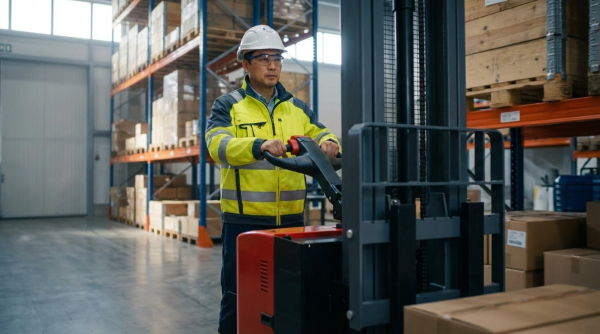
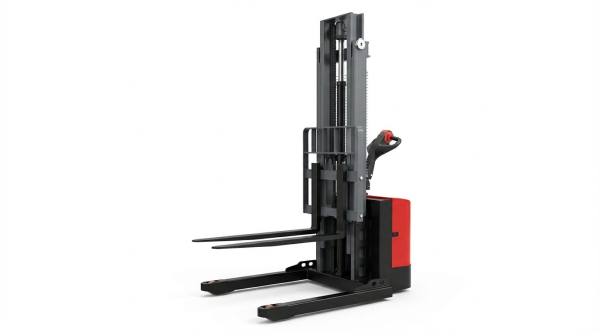
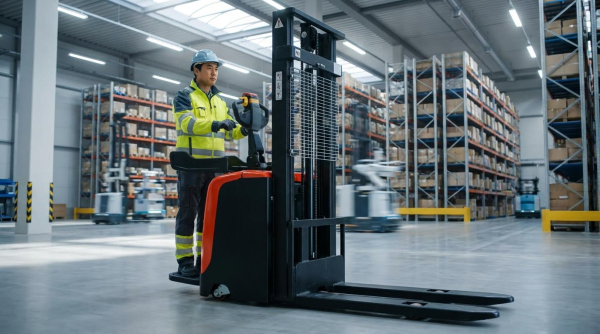
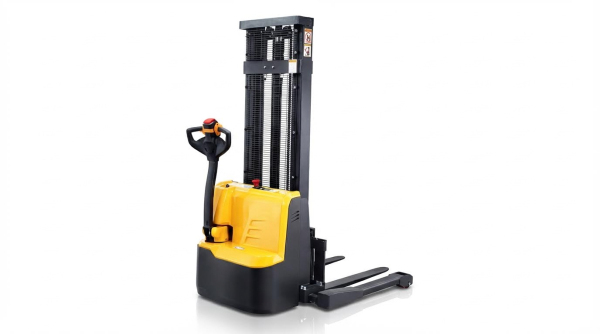
From a standards perspective, a typical walkie stacker is a pedestrian‑controlled, high‑lift, industrial stacker truck. It is designed for an operator walking behind or alongside, controlling the truck via a tiller arm or handle, with lift heights suitable for stacking into racking and capacities that often fall in the 1,200–4,000 kg range typical manufacturer data. In European safety standards, pedestrian‑propelled stacker trucks up to 1,000 kg capacity are explicitly covered, with requirements for smooth, level, hard operating surfaces and limits on push, pull, and steering forces to reduce operator strain EN 1757‑1:2001. That means when you consider what class is a walkie stacker in a practical sense, you are dealing with the family of pedestrian stacker trucks that are either manually propelled or low‑speed powered, with the operator always on foot and protected by specific ergonomic and stability rules.
| Attribute | Typical walkie stacker classification |
|---|---|
| Operator position | Pedestrian (walk‑behind) |
| Main function | High‑lift stacking of pallets or platforms |
| Travel / propulsion | Pedestrian‑propelled or low‑speed powered |
| Standards focus | Industrial truck classification plus pedestrian stacker safety and ergonomics ISO 5053‑1 EN 1757‑1 |
Key Design And Performance Criteria For Walkie Stackers
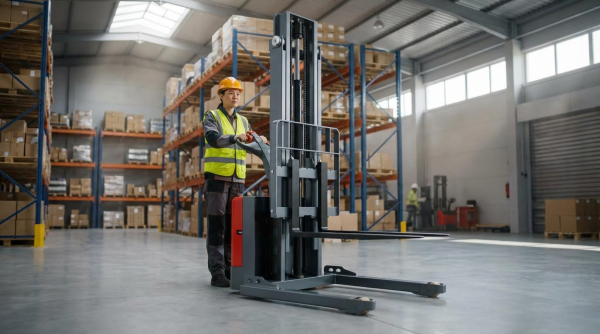
Pedestrian stacker design and safety rules
Pedestrian walkie stackers are designed for use on smooth, level, hard floors and are typically limited to capacities around 1,000 kg in purely pedestrian-propelled form EN 1757‑1:2001. Their design must minimize crushing, shearing, impact, and overload hazards during normal operation and maintenance. This is why standards specify limits on the push, pull, lift, and steering forces an operator can be exposed to at rated capacity. These design and safety rules apply regardless of what class is a walkie stacker in the broader industrial truck classification system, because they directly protect the pedestrian operator.
- At 1,000 kg rated capacity, maximum starting force is limited to 300 N and rolling force to 200 N.
- Maximum hand lifting force is 200 N and foot lifting force is 300 N at rated load.
- Maximum steering effort must keep powered steering systems at or below 300 N at rated load force limits.
Tiller and push/pull interface design is also tightly controlled. Hand grips must fit within a cross-section between 25 mm and 35 mm diameter, with at least 100 mm span per hand to ensure secure grip and reduce strain tiller design. When pulling, the horizontal distance from tiller end to the front of the wheel must exceed 500 mm, and handle height must sit between 700 mm and 1,000 mm to keep the operator clear of the truck. Push/pull bars must be 1,100–1,300 mm high with at least 50 mm clearance to the truck sides, again to protect hands and body from contact with fixed objects push/pull geometry.
Load handling controls
Lift and lower controls may be on the tiller or separate, but if on the tiller they must be operable without releasing the hand grip. The lowering function has to stop as soon as the operator releases the control, and actuating force for these controls must not exceed 150 N at rated capacity control forces. This reduces the risk of unintended movement and operator fatigue.
Hydraulic, lifting, and stability requirements
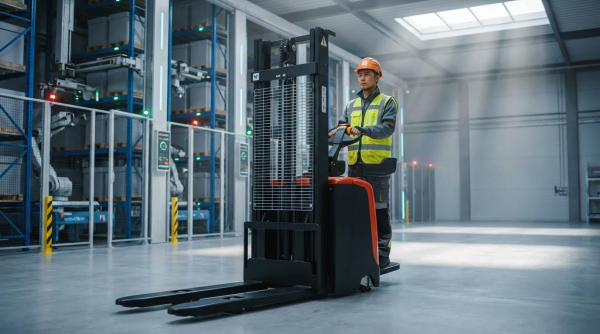
Hydraulic and lifting systems on walkie stackers must maintain control of the load even in fault conditions. Pressure relief valves have to limit system pressure to less than 115% of the preset value so components are not overstressed during overload or shock events hydraulic relief. Internal leakage in cylinders and valves must be low enough that the forks do not sink more than 25 mm in the first 10 minutes under load, which is critical when working near racking or at full lift. Chains in the lifting system need a minimum safety factor of 5:1 relative to the static load at rated capacity, and wire ropes must meet the same 5:1 factor with pulley diameters at least 16 times the rope diameter to avoid fatigue failures lifting safety factors. For chain drives, pulley or sprocket diameters must be at least three times the chain pitch to maintain acceptable wear and service life.
Rated capacity is defined for a uniformly distributed load that covers the full fork or platform width, at a standard lift height and load center distance. If the truck cannot reach the standard height, its rated capacity is based on its actual maximum lift height instead rated capacity definition. In practice, many powered walkie stackers offer capacities from about 1,200 kg up to 4,000 kg with lift heights up to 5,400 mm, so checking the capacity plate against the actual load geometry is essential in every application capacity and height ranges. Stability tests specified in the standards verify that the truck remains upright and controllable during lifting, lowering, and travel with and without load, but they do not cover extreme environments, hazardous materials, or public road use, which must be addressed separately in risk assessments stability and exclusions.
| Design aspect | Typical requirement | Purpose |
|---|---|---|
| Pressure relief | < 115% of preset pressure | Protect hydraulic components |
| Fork sinking under load | ≤ 25 mm in first 10 minutes | Maintain safe clearance at height |
| Chain / rope safety factor | 5:1 vs static load | Prevent mechanical failure |
| Sprocket / pulley size | ≥ 3× chain pitch or 16× rope Ø | Reduce wear and fatigue |
Power, ergonomics, and emerging technologies
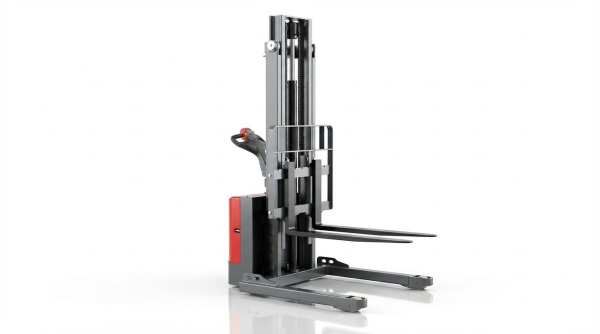
Most modern walkie stackers are electric-powered, operating commonly on 24 V systems with travel speeds around 3.5 mph in typical warehouse configurations voltage and speed. Lift speeds under full load often range from about 27 to 37 feet per minute, with gradeability around 6%, which is adequate for level floors and short dock ramps in most indoor applications lift and grade data. Energy-efficient drive and lift systems can extend run time and reduce power consumption over a shift, and power studies over 2–4 weeks help optimize battery sizing and charging strategy based on real duty cycles energy systems power study.
Ergonomics and safety features have advanced significantly. Typical designs now include ergonomic control handles with dual thumbwheels, electric lift/lower controls on the handle, and speed-sensitive power steering to reduce steering effort in tight aisles control ergonomics maneuverability. Safety systems often include direction-reverse switches in the handle, automatic circuit protection, power-on self-tests, and robust mast guarding to protect the operator from moving components and falling objects safety equipment. As emerging technologies such as advanced energy management and assistive steering become more common, the underlying class rules still focus on limiting operator forces, maintaining stability, and controlling hydraulic performance, which remain the core engineering criteria no matter what class is a walkie stacker in your facility’s documentation.
Applying Class Information To Selection And Specification
Matching walkie stacker class to application
When you ask what class is a walkie stacker, you are really asking how its standardized characteristics line up with your application. Industrial truck classes group equipment by factors such as power source, control type, lift height, and travel mode, as described in ISO 5053-1:2015 industrial truck classification. A typical walkie stacker is a pedestrian-controlled, powered industrial truck with an electric drive and a mast for stacking, so it fits into the pedestrian stacker segment of these classes. Once you know the class, you can screen candidate trucks against the surfaces, gradients, and traffic patterns in your facility.
- Surface and environment: Pedestrian-propelled and walkie stackers in lower capacity ranges are intended for smooth, level, hard floors surface requirements, so they are best suited to warehouses, production areas, and loading zones with good floor quality.
- Capacity and lift height: Many walkie stackers cover roughly 1,200–4,000 kg capacity with lift heights up to about 5,400 mm capacity and lift height. Check that the classed equipment can safely handle your heaviest pallet at the highest required rack level, with an appropriate load center.
- Duty cycle and travel distance: Classed walkie stackers are optimized for short to medium travel distances and frequent starts and stops. Typical travel speeds around 3.5 mph and 24 V power systems travel speed and voltage suit dense storage zones better than long-haul horizontal transport.
- Operator mode and aisle width: Because the operator walks behind or alongside the truck, walkie stackers fit narrow aisles and congested areas where ride-on trucks are impractical. Use the class data for minimum turning radius and required aisle width when checking against your rack layout.
Practical matching checklist
To apply the class in a structured way, define for each application area: maximum pallet weight and dimensions, highest lift point, floor condition, gradients, and required throughput. Then verify that the walkie stacker class you are considering covers those values with margin on capacity, stability, and stopping distances. This keeps the selection process objective and repeatable across sites.
Class-based criteria for procurement and compliance
Once you understand what class is a walkie stacker in your standards framework, you can turn that into hard procurement and compliance criteria. Industrial truck classes tie directly to design and safety requirements for pedestrian stackers, including limits on push/pull forces, control layout, hydraulic integrity, and stability pedestrian-propelled stacker requirements. You can embed these into your specifications so every purchased truck is class-compliant by design.
- Performance and ergonomics criteria: For pedestrian stacker classes, standards cap the forces needed for starting, rolling, lifting, and steering at specified values for a 1,000 kg rated load maximum operating forces. In tenders, require documented compliance with these limits, plus ergonomic tiller design (hand protection, grip geometry, and handle height) tiller specifications.
- Hydraulic and structural safety: For the relevant walkie stacker class, specify that hydraulic systems must include pressure relief valves limiting pressure to less than 115% of the preset value and must restrict load descent from internal leakage to a small, defined amount in the first minutes under load hydraulic requirements. Chains and wire ropes in the lifting system must meet minimum safety factors relative to the rated capacity lifting system safety.
- Rated capacity and stability documentation: Require that the supplier declare rated capacity based on uniformly distributed loads over the full fork width, at a specified lift height and load center rated capacity definition. Ask for evidence that the walkie stacker has passed stability tests appropriate to its class and configuration stability tests.
- Energy and maintenance expectations: Where your selected walkie stacker class uses electric drive, you can benchmark typical run times, travel speeds, and maintenance intervals. For example, some walkie stackers use 24 V systems with lift speeds in the range of 27–37 fpm and gradeability around 6% lift speed and gradeability, and schedule maintenance roughly every 500 operating hours maintenance intervals. Use these as reference points when writing performance-based specifications.
Using class in contracts and training
In procurement documents, state the applicable industrial truck class and reference the associated standards explicitly. This helps ensure that any walkie stacker offered meets the same baseline safety and performance expectations. For training and risk assessments, use the class to define where the truck may operate, what loads it may handle, and which hazards apply, keeping use aligned with its design envelope.
“”
Summary: Using Class To Guide Safe, Efficient Choices
Industrial truck classes turn walkie stackers from “generic pallet lifters” into clearly defined engineering tools. The class tells you how the truck lifts, how it moves, and how the operator controls it. That drives the rules for geometry, forces, hydraulics, and stability. When you respect those limits, you protect people and product.
Design rules on push and steering forces, tiller layout, and operator clearances keep pedestrian operators out of crush zones and within human strength limits. Hydraulic relief, fork sinking limits, and chain safety factors keep the load under control, even when something goes wrong. Capacity definitions and stability tests link the rated load to a real pallet, at a real height, with a real load center.
Operations and engineering teams should start every project by naming the correct walkie stacker class, then matching it to floor quality, gradients, aisle width, and rack height. Use the standards as a checklist for procurement, training, and risk assessment. Treat the capacity plate as a hard boundary, not a guideline. When you apply class data in this way, you get safer layouts, fewer strain injuries, and longer truck life. You also gain a clear, auditable basis for choosing Atomoving walkie stackers for each application zone.
Frequently Asked Questions
What class is a walkie stacker?
A walkie stacker falls under Class III of powered industrial trucks. This class includes electric motor hand trucks or hand/rider trucks, such as electric pallet jacks and walkie stackers. OSHA Forklift Classes.
Is a walkie stacker considered a forklift?
Yes, a walkie stacker is considered a type of forklift. It belongs to Class III, which covers electric motor hand trucks designed for low-lift and high-lift operations. Industrial Truck Guide.
Do you have to be certified to use a walkie stacker?
Yes, operators must be certified to use a walkie stacker, as it is classified under powered industrial trucks by OSHA. Proper training ensures safe operation in warehouse environments. OSHA Certification Info.