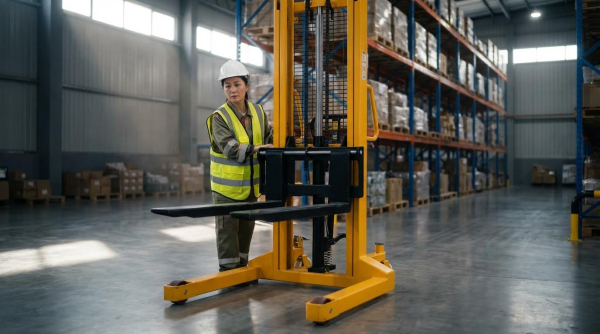
On a straddle stacker, not every wheel is in charge of changing direction. Knowing exactly which wheels steer a straddle stacker helps you understand its turning limits, plan aisle widths, and spot problems before they become safety issues. This guide walks through steering wheel layout, low‑speed steering geometry, and how manual pallet stacker wheel size and material affect control so you can read spec sheets and operate your semi electric order picker stacker with confidence.
Steering Layout Of A Typical Straddle Stacker
Drive, load, and caster wheel functions
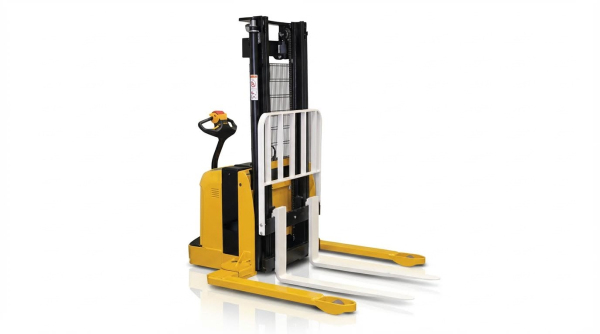
To understand which wheels steer a straddle stacker, you first need to separate the three wheel groups: drive wheel, load wheels, and any auxiliary casters. Each group has a clear job in how the truck supports weight, puts down traction, and responds when you push or turn the tiller.
- Drive wheel (steer wheel)
- Located under the operator end, beneath the tiller / power unit.
- On manual units, this is the main wheel under the steering handle.
- On electric units, it is also the powered traction wheel driven by the motor. Drive wheel selection must match load capacity, material, and diameter.
- Provides most of the braking and acceleration control.
- Load wheels
- Small diameter wheels at the tips or underside of the forks and in the straddle legs.
- Primarily carry pallet and mast weight; they do not normally steer.
- Arranged in pairs to share load and reduce floor point‑loading.
- Shorter forks improve maneuverability in tight spaces where these wheels track. Fork length and width directly affect turning in confined aisles.
- Caster / stabilizer wheels
- Some designs add small swivel casters near the front of the chassis or straddle legs.
- These casters auto‑align in the direction of travel and simply follow the drive wheel path.
- They increase lateral stability and reduce tipping risk when the mast is raised.
- Swivel casters at the front enhance agility in narrow aisles. Front casters were shown to significantly improve maneuverability.
Quick comparison of wheel roles
| Wheel group | Main function | Steers? | Also affects |
|---|---|---|---|
| Drive wheel | Traction and direction control | Yes – primary steering wheel | Braking, acceleration, grade performance |
| Load wheels | Support pallet and mast weight | No – fixed rolling direction | Floor loading, rolling resistance |
| Caster / stabilizers | Extra stability and support | Only self‑align; not operator‑steered | Tip resistance, comfort over floor defects |
From an engineering perspective, the steering axis is effectively the vertical axis through the drive wheel assembly and tiller head. A positive caster angle on this axis helps the wheel self‑center and track straight, improving stability at walking speeds, similar to how caster angle works on vehicles. Positive caster creates a trailing contact patch that naturally pulls the wheel back to center.
Which wheels steer in manual vs. electric units
The answer to which wheels steer a straddle stacker changes slightly between manual and electric designs, but the basic rule stays the same: the single drive wheel under the operator end is the one that actually steers.
| Stacker type | Steered / driven wheel | Load wheel behavior | Casters / other wheels |
|---|---|---|---|
| Manual (push / pump) | One large wheel under the steering handle; operator turns it mechanically via the tiller | Fixed direction; simply roll and carry load, no steering input | Front swivel casters, if fitted, free‑castor and follow the path set by the drive wheel |
| Semi‑electric (electric lift, manual travel) | Same as manual; drive wheel steered by operator, usually not powered | Same as manual | Same as manual |
| Fully electric walkie straddle stacker | Motorized drive wheel under the tiller; steering angle set by tiller rotation and sensed electronically | Non‑steered, load‑carrying only | Stabilizer wheels or casters for balance; do not receive steering commands |
| Advanced electric with differential / omni layouts | May use dual drive wheels or omnidirectional wheels for on‑the‑spot turning and small radius | Still non‑steered; follow the motion generated by the drive system | Additional supports only; steering logic is in the powered drive modules |
Electric designs often add differential or omnidirectional drive at the steering end to shrink turning radius and allow near‑pivoting in place. Dual‑wheel differential drive and omnidirectional wheels were used to achieve on‑the‑spot turning in narrow spaces. In all these cases, the operator still commands direction through the tiller; software and motor control just translate that into precise wheel speeds and angles.
- Manual units – what the operator feels
- Steering effort comes from physically rotating the tiller and drive wheel.
- Larger rear wheel diameter can make turning easier over floor joints. Larger wheels were shown to improve maneuverability over uneven surfaces.
- Swivel casters and front load wheel layout mainly define how tightly the truck can arc around an obstacle.
- Electric units – what the control system handles
- Motor torque and speed control manage how quickly the steered drive wheel responds to tiller angle.
- Electronic steering assist and sensors can limit speed at large steering angles for stability. Electronic control systems monitored steering angle, speed, and load to keep operation safe.
- High‑grip tread on the drive wheel improves directional control on smooth, sometimes dusty warehouse floors. manual pallet jack.
In summary, regardless of power type, the steering layout is built around a single, central drive wheel at the operator end that both supports part of the load and defines the path. Load wheels and casters only follow that path; they do not decide direction. When you evaluate which wheels steer a straddle stacker for your application, always start with the drive wheel design, its material, and how the tiller or electronic system controls its angle and speed.
Steering Geometry And Turning Behavior
Ackermann principles at walkie stacker speeds
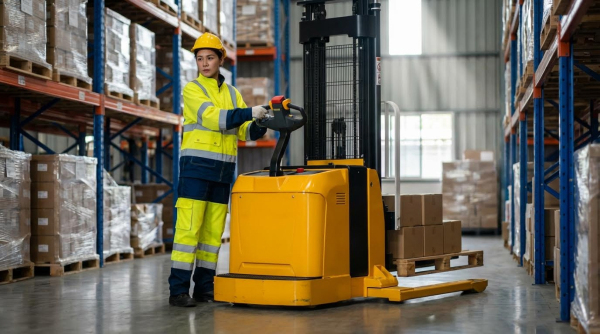
Straddle stackers run at walking speed, but the same basic steering geometry that governs cars still applies. The key difference is that instead of a steered axle, the single drive wheel under the tiller usually does the steering, while the straddle and load wheels mainly follow. Understanding this low‑speed geometry helps explain which wheels steer a manual platform stacker and why it can pivot so tightly without scrubbing tires.
Classic Ackermann steering geometry ensures each wheel rolls around a common turn center instead of sliding sideways. The inner wheel follows a tighter circle than the outer wheel, so the steering angles must be different to avoid scrub and tire wear. Engineers typically derive those angles from turn radius, wheelbase, and track (or straddle) width by relating wheel paths to a shared instantaneous center of curvature.
On a walkie straddle stacker, you do not have two steered front wheels, so it cannot be “pure” Ackermann. Instead, the drive wheel steers and the fixed straddle wheels approximate the correct paths. At low speed and short wheelbase, the small amount of scrub at the straddle wheels stays manageable, which is why these trucks can turn sharply in tight aisles without complex linkages.
Why full Ackermann is unnecessary on walkie stackers
Because walkie stackers move slowly and carry loads over short distances, minimizing tire scrub is less critical than on high‑speed vehicles. The design focuses on compact wheelbase, narrow straddle width, and a highly steerable drive wheel, rather than adding extra linkages to steer the load wheels. This simplification keeps cost, weight, and maintenance down while still giving tight turning behavior.
| Parameter | Typical role in vehicles | Relevance on straddle stackers |
|---|---|---|
| Turn radius | Defines wheel angles so paths share a common turn center and avoid skidding | Used to size wheelbase and straddle width for narrow‑aisle turning |
| Wheelbase | Longer wheelbase increases turning radius | Kept short so the drive wheel can swing the rear of the truck around a tight center |
| Track / straddle width | Wider track typically increases turning radius | Adjustable straddle width balances pallet clearance with aisle width |
| Steered elements | Usually both front wheels on road vehicles | Primarily the single drive wheel; straddle wheels follow |
When operators ask which wheels steer a straddle stacker, the answer in geometric terms is simple: the drive wheel defines the turn center, and all other wheels are placed so their rolling paths are as close as practical to circles around that center. Good steering geometry lets the truck pivot tightly without excessive effort or instability.
Caster angle, trail, and self‑centering of the tiller head
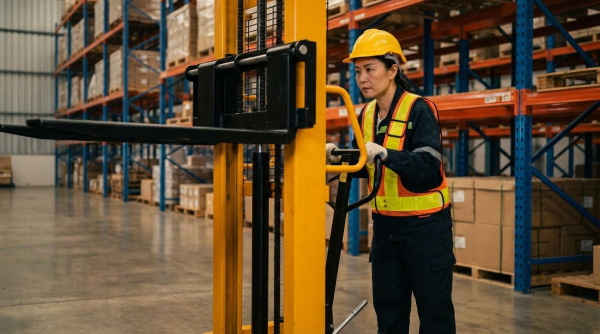
The “feel” of a walkie stacker in your hands comes mainly from the caster‑like behavior of the drive wheel and tiller head. In vehicles, caster angle is the tilt of the steering axis when viewed from the side. A positive caster angle, with the top of the steering axis leaning rearward, improves straight‑line stability and helps the wheels self‑center after a turn by generating a restoring torque.
On a straddle stacker, the steering axis runs through the tiller pivot down to the drive wheel yoke. A small built‑in caster angle and mechanical “trail” between the wheel contact patch and steering axis work together to make the tiller want to align with the direction of travel. This is why, when you let go (on a powered unit with brake applied), the tiller tends to move back toward its neutral, upright position instead of flopping sideways.
Key effects of caster angle and trail on tiller behavior:
- Self‑centering: Positive caster and steering axis inclination help the wheel and tiller return toward straight ahead after a turn by placing the tire contact patch behind the steering axis.
- Stability under load: With a heavy pallet raised, the restoring torque from caster helps resist sudden yaw if the floor is uneven.
- Steering effort: More positive caster increases self‑centering but also raises steering effort; walkie stackers use moderate values because operators steer at low speed and by hand.
- Feedback to the operator: The tiller “talks back” when the drive wheel hits floor joints or slopes, giving the operator early warning of surface issues.
Because the drive wheel both propels and steers, its alignment is critical. Misalignment in the steering axis can behave like incorrect toe or tracking on a truck, causing the stacker to “pull” to one side and increasing tire wear similar to tracking problems on road vehicles. Correct caster and trail are therefore part of safe control, especially when maneuvering in tight aisles where you rely on precise tiller feedback.
How tiller geometry ties back to “which wheels steer a straddle stacker”
The tiller head is mechanically linked only to the drive wheel. Caster angle and trail on that wheel create the self‑centering action you feel in your hands. The load and straddle wheels have fixed axles or simple casters and do not contribute to self‑centering; they only follow the path set by the steered drive wheel.
Wheelbase, straddle width, and turning radius
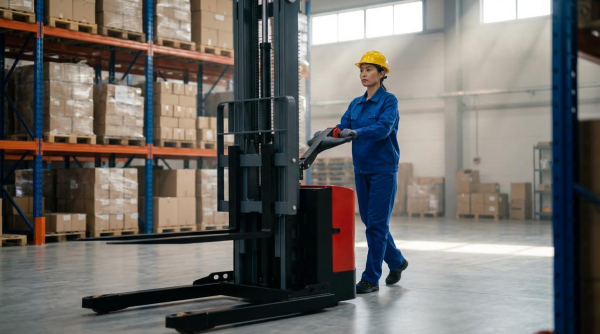
Turning behavior on a straddle stacker is dominated by three geometric dimensions: wheelbase, straddle width, and overall chassis length. Wheelbase is the distance from the drive wheel center to the line through the load wheels. A shorter wheelbase reduces the turning radius and allows the truck to pivot closer to its own footprint, which is why walkie stackers use compact frames for narrow‑aisle maneuvering.
Straddle width is the clear distance between the inside faces of the straddle legs. It must be wide enough to clear the pallet but as narrow as possible to keep the required aisle width down. Typical adjustable ranges of about 0.97–1.27 m let the same truck handle different pallets while still threading into tight rack openings and supporting loads from the floor.
These dimensions combine to set the minimum turning radius and the “right angle stack” aisle requirement. Many walkie straddle stackers use an overall length around 1,800 mm and achieve turning radii near 1,400 mm, which lets them work in aisles significantly narrower than those needed for sit‑down trucks when pallet length and approach angle are considered.
| Geometry factor | Influence on turning behavior | Typical design trade‑off |
|---|---|---|
| Wheelbase (drive wheel to load wheels) | Shorter wheelbase reduces turning radius and improves pivoting | Too short can reduce longitudinal stability with high loads |
| Straddle width | Wider straddle increases lateral stability but widens required aisle | Adjusted to clear pallets while keeping aisles as narrow as possible |
| Overall length | Longer chassis increases “swept path” in a 90° turn | Kept compact for maneuverability, but long enough for operator space and battery |
| Turning radius | Defines how close the truck can turn beside racks or obstacles | Limited by frame, mast, and straddle leg interference similar to steering stop limits on vehicles |
From a practical standpoint, when you evaluate which wheels steer a straddle stacker, you should also look at how wheelbase and straddle geometry shape the actual path those wheels can take. A highly steerable drive wheel is only useful if the frame dimensions allow it to swing without the straddle legs or mast hitting pallets, racks, or walls. That is why spec sheets always pair steering descriptions with turning radius and aisle width data.
Implications for warehouse layout and truck choice
Before selecting a straddle stacker, match its turning radius and required aisle width to your pallet size, rack layout, and load heights. Small differences in wheelbase or straddle width can determine whether the truck can square the pallet in the rack without extra shunting moves, which directly affects productivity and safety.
Maneuvering Techniques And Spec Selection
Reading spec sheets for steering and turning radius
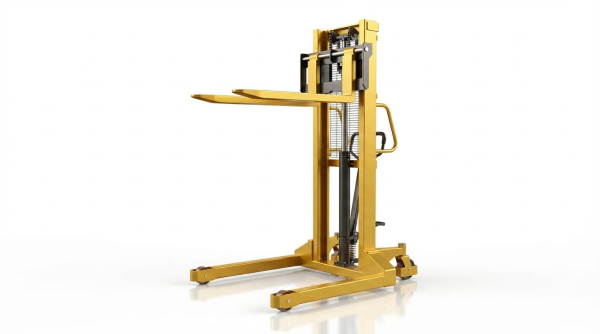
When you read a spec sheet to understand which wheels steer a straddle stacker and how tight it turns, focus on a small group of steering‑related lines, not the whole document. These values tell you how the drive wheel, casters, and straddle geometry will behave in your aisles.
Key steering and maneuvering items to find on a spec sheet:
- Turning radius (often “Wa” or “turning circle”)
- Overall length and head length (truck length excluding forks)
- Straddle width and adjustment range
- Wheelbase (center of drive wheel to center of load wheels)
- Steering type (tiller‑steered single drive wheel, dual drive, or omnidirectional) some stackers use dual‑wheel differential or omnidirectional steering
- Wheel type and diameter (drive, load, and caster wheels)
- Recommended aisle width for 90° pallet stacking
Once you know where these values sit, you can match the numbers to your building and answer in practice which wheels steer a straddle stacker in your application (single drive wheel only, or more advanced multi‑wheel steering).
The table below shows how the main geometry values interact with turning behavior.
| Spec sheet item | What it physically is | Effect on steering / turning | What to check vs. your site |
|---|---|---|---|
| Turning radius | Smallest circle the outermost point of the truck can trace | Lower radius = tighter turns, easier work in short cross‑aisles | Compare to aisle ends, cross‑aisles, and dock space clearances typical walkie stackers turn in roughly 1.4 m radius |
| Overall length / head length | Truck length, with and without forks | Shorter head length reduces “swing‑out” when you turn | Check that you can turn without clipping racks, posts, or dock doors |
| Straddle width | Outside‑to‑outside distance of straddle legs | Wider legs improve side stability but consume aisle width | Confirm pallets, loads, and aisle width all clear the legs common adjustable range is about 0.97–1.27 m |
| Wheelbase | Distance from drive wheel to load wheels | Longer = more straight‑line stability, larger turning radius; shorter = more agile but more weight transfer when braking/turning | Balance tight turning needs against stability with high or heavy loads |
| Steering configuration | Single tiller‑steered drive wheel, twin drive, or omnidirectional | Single wheel steers like a walkie pallet truck; multi‑wheel or omni can spin in place | Decide if you need “on‑the‑spot” turning in extremely narrow transfer aisles |
| Wheel diameters | Drive, load, and caster wheel sizes | Larger wheels climb joints and rough spots better; small wheels feel more “nervous” on poor floors | Match to floor joints, ramps, and dock plates in your building |
To use these values correctly, always compare the turning radius and recommended aisle width to your loaded pallet length and your real operating pattern, not just the bare truck. Steering geometry at low walkie speeds still follows the same principle that each wheel wants to trace its own circle around a common turn center, which is what classic steering geometry aims for to reduce scrubbing and improve control. Steering geometry directs wheel axes toward an instantaneous center of curvature.
Quick checklist: matching stacker specs to your aisles
Use this before you buy or rent a unit.
- Measure narrowest aisle, tightest cross‑aisle, and door clear widths.
- Note your longest pallet length and typical load overhang.
- From the spec sheet, list: turning radius, head length, and recommended aisle width.
- Confirm turning radius + half truck width fits inside your cross‑aisles with margin.
- If you work in drive‑in or very narrow aisles, prioritize smaller turning radius and shorter head length.
Wheel materials, diameters, and tread for control
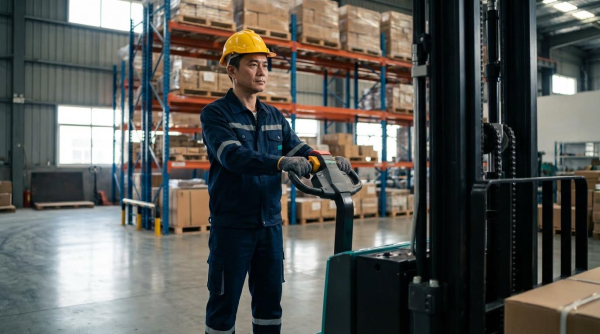
Wheel selection on a straddle stacker strongly affects how precisely you can steer, stop, and hold position, especially on marginal floors. The drive wheel usually does the steering and traction work, while load and caster wheels stabilize the straddle legs and carry pallet weight, so you must size and material‑match all three.
Key wheel selection factors for steering control and maneuverability:
- Material (polyurethane, rubber, nylon, or similar)
- Diameter of drive and load wheels
- Tread pattern (smooth vs. grooved)
- Load capacity per wheel and distribution
- Floor type (smooth, rough, wet, ramps, dock plates)
The table below summarizes how common wheel materials and features influence steering feel and control.
| Wheel feature | Typical options | Effect on steering & control | Best use cases |
|---|---|---|---|
| Material | Polyurethane | Good grip on smooth indoor floors, low noise, good durability poly wheels are widely used indoors | Most warehouses with sealed or epoxy floors |
| Material | Rubber | Better shock absorption and grip on rough surfaces, but faster wear rubber suits rougher ground | Mixed indoor/outdoor, ramps, older concrete with spalling |
| Material | Nylon | Low rolling resistance and high load capacity on smooth floors, but can slip on wet or inclined surfaces nylon prefers smooth, dry floors | Heavy loads on very smooth, dry warehouse floors |
| Drive wheel diameter | Small | Lower center of gravity, stable feel, but more sensitive to floor defects | Flat, smooth floors where turning radius is more critical than obstacle climbing |
| Drive wheel diameter | Large | Rolls over joints and small steps more easily, smoother steering effort larger wheels improve maneuverability over uneven surfaces | Dock plates, ramps, expansion joints, and outdoor transitions |
| Load / caster wheel diameter | Small tandem loads, compact casters | Allow lower fork and straddle profile but can “dig in” to bad joints | Very low pallets and smooth floors with tight clearance |
| Tread | Smooth | Lowest rolling resistance and easiest pivoting, but less grip on dust or moisture | Clean, dry indoor aisles; high‑cycle order picking |
| Tread | Grooved / patterned | Improved traction and braking on uneven or slippery floors patterned treads help on wet or uneven floors | Cold rooms, wet docks, outdoor aprons, dusty production areas |
When you decide which wheels steer a straddle stacker best in your building, remember that the drive wheel is only as effective as the floor contact you give it. High‑grip material and the right tread mean the steering torque you apply at the tiller actually rotates the truck instead of just sliding the tire. Swivel casters at the front of manual stackers also contribute to agility by allowing the straddle legs to align with the path, which improves low‑speed maneuverability in tight aisles. Front swivel casters significantly affect manual stacker maneuverability.
Practical wheel selection rules for better steering
Use these quick rules to tighten control.
- For smooth indoor floors, choose polyurethane drive and load wheels with smooth or fine tread.
- For mixed or rough surfaces, upgrade to larger‑diameter drive wheels and consider rubber or patterned tread.
- Where floors are wet, cold, or dusty, avoid hard, slick nylon drive wheels.
- Check that the drive wheel load rating comfortably exceeds the share of total truck + load weight it carries.
- Specify wheel diameters that can climb your worst floor joint or dock plate without stalling or harsh impacts.
Final Thoughts On Straddle Stacker Steering
Straddle stacker steering always comes back to one core element: the drive wheel under the tiller. Geometry, wheel layout, and materials all work to let that single wheel define the path while the straddle and load wheels follow without overload or instability. When engineers set wheelbase, straddle width, and caster angle, they trade tight turning against tip resistance and straight‑line control. Good designs keep wheel scrub low, self‑centering predictable, and the turning radius small enough for real aisles, not just catalog drawings.
For operations teams, the implication is clear. Do not look at steering in isolation. Match drive wheel material and diameter to your floor, then confirm that turning radius, head length, and straddle width fit your pallet sizes and rack layout. For engineering and maintenance teams, protect steering performance by keeping the drive wheel, tiller linkage, and caster geometry in tolerance, and by replacing worn wheels with the correct hardness and size.
If you follow those rules, a walkie or electric straddle stacker from Atomoving will track true, turn cleanly, and stay stable with rated loads. The result is faster, safer handling in tight spaces, with less tire wear, fewer steering complaints, and better use of every aisle you pay to build.
Frequently Asked Questions
Which wheels steer a straddle stacker?
A straddle stacker typically steers using the rear wheels, similar to how forklifts operate. This design allows for better maneuverability in tight spaces and precise positioning of loads. The rear-wheel steering enables the stacker to rotate around its front wheels, which support most of the load’s weight. Forklift Steering Basics.
What should you do before using a straddle stacker?
Before operating a straddle stacker, it is essential to perform pre-operation safety checks. Inspect the equipment for any visible damage, ensure fluid levels are adequate, and verify that all safety features are functioning correctly. These steps help prevent accidents and ensure smooth operation. Straddle Stacker Safety Tips.
How does rear-wheel steering benefit material handling equipment?
Rear-wheel steering provides several advantages for material handling equipment like straddle stackers. It allows for tighter turns and better control in confined spaces, making it easier to position loads accurately. Additionally, this steering method reduces the risk of tipping by keeping the load centered over the front wheels. Forklift Steering Basics.