Engineers and warehouse planners who ask how high can an electric forklift lift need clear rules that link mast design, truck class, and real-world limits. This article walks through electric forklift lift height limits, from typical ranges by mast type to the way rated capacity falls as height increases.
You will see how mast stages, height classes, and carriage standards define practical design envelopes for counterbalance and reach trucks. The middle sections connect these envelopes to storage layouts, racking geometry, and safety at height, including stability, tilt, and dynamic effects in narrow aisles. The final summary turns these points into practical limits and selection tips for high-lift electric trucks in modern warehouses.
Defining Electric Forklift Lift Height Limits
Engineers asking how high can an electric forklift lift must link mast design, truck class, and real site limits. This section defines practical lift ranges, capacity behavior at height, and how free lift and overall height interact with aisles and ceilings.
The goal is to turn catalog values into safe, usable lift heights in real warehouses. You will see how mast stages, load centers, and building geometry set the true working envelope of an electric forklift.
Typical Lift Ranges By Truck And Mast Type
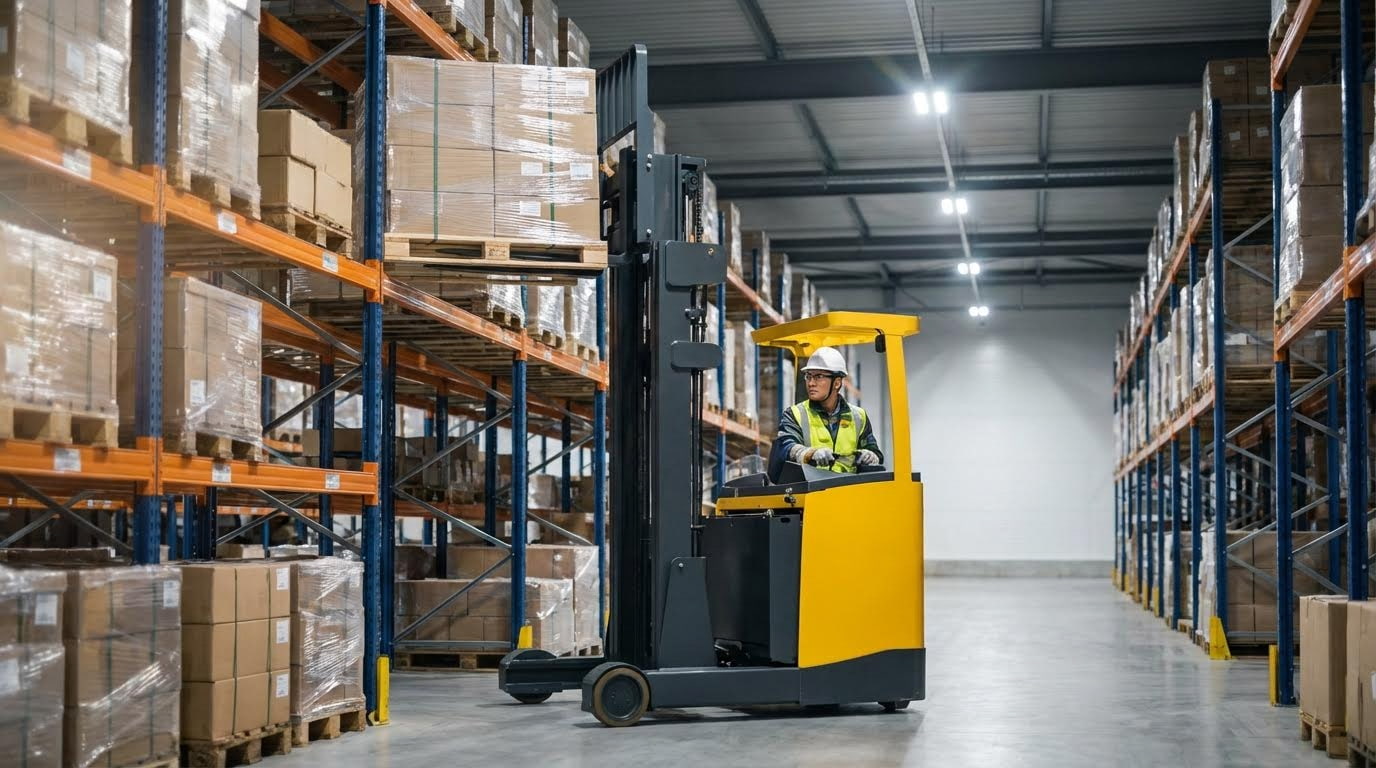
When planning around how high can an electric forklift lift, mast type is the first filter. Standard counterbalance electric forklifts with two-stage masts often lift up to about 3.0 metres. Many warehouse models with higher-spec masts reach about 4.2 to 4.8 metres as a common “standard” range. High-lift and reach-type electric trucks extend this envelope to about 8 to 13 metres for deep racking.
Single-stage masts suit low-bay work and loading docks where lift heights stay below roughly 3.5 metres. Two-stage masts balance closed height and reach for general warehousing. Three and four-stage masts target high-bay storage where ceiling height and racking justify the extra complexity. Higher stage counts add joints and channels, which can reduce forward visibility and increase mast flex at full height.
| Mast type | Typical max lift height | Common use |
|---|---|---|
| Single-stage | ≈2.5–3.5 m | Docks, low racks, outdoor yards |
| Two-stage (standard) | ≈3.0–4.8 m | General indoor warehousing |
| Three-stage | ≈4.5–7.9 m | Medium to high-bay racking |
| High-reach / multi-stage | ≈8–13 m | Very high-bay, narrow aisles |
Always confirm the exact maximum lift on the truck data plate and in the manual. Never assume a mast can reach catalog “family” heights without checking the specific build code.
Rated Capacity, Load Center, And De-Rating At Height
The question how high can an electric forklift lift safely is really about capacity at height. Electric counterbalance trucks often carry rated loads of about 2,000 to 3,500 kilograms at a 500 millimetre load center. That rating normally applies at or near ground level with the mast vertical. As lift height increases, the allowable load drops due to stability limits and mast deflection.
Key engineering checks include:
- Rated capacity at the specified load center on the nameplate.
- Any alternate ratings for different load centers or attachments.
- Capacity curves versus lift height from the manufacturer.
Attachments such as clamps or rotators shift the load center forward and add dead weight. Standards and regulations require the truck to be re-rated when you fit such devices. The new capacity must appear on an updated plate. Operators must treat the truck as partially loaded even when the forks are empty in this case. This aligns with safety rules that addressed trucks with attachments as a special case.
Engineering teams should use conservative margins for high-tier work. They should avoid running at the absolute top of the capacity curve at maximum height.
Free Lift, Overall Height, And Aisle/Ceiling Constraints
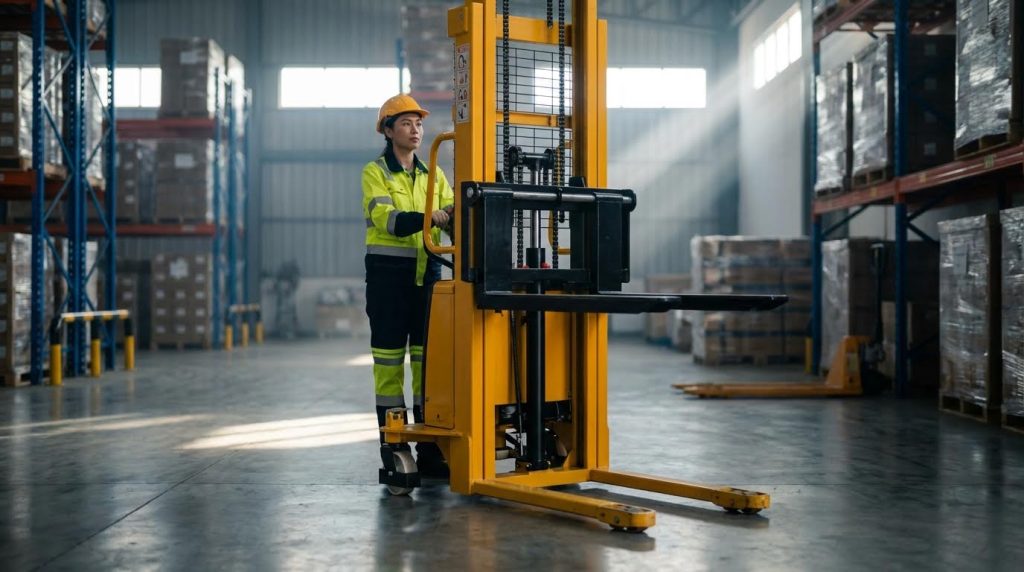
Free lift and overall height decide how high can an electric forklift lift inside tight buildings. Free lift is the fork travel before the mast sections start to extend. A basic two-stage mast may offer only limited free lift, for example about 80 millimetres. Full free-lift masts allow significant fork travel within the mast profile, which helps under low beams or mezzanines.
Engineers must compare three vertical dimensions:
- Closed mast height versus door and mezzanine clearances.
- Extended mast height versus roof, sprinklers, and lighting.
- Required pallet height versus rack beam levels.
Example data showed a mast closed at about 2.01 metres and extended to about 4.15 metres. High-reach trucks can have clearance heights from roughly 2.03 to 3.21 metres for lifts up to about 7.93 metres. In very high-bay sites, extended mast heights can approach or exceed 13 metres.
Aisle width also constrains usable lift. Typical counterbalance electric forklifts have turning radii around 2.30 to 2.35 metres. Narrower aisles push designers toward reach trucks or articulated trucks with higher lift but different stability behavior. The final layout must protect against mast or load striking ceilings, racks, or services when turning or tilting at height.
Mast Stages And Height Classes In Detail
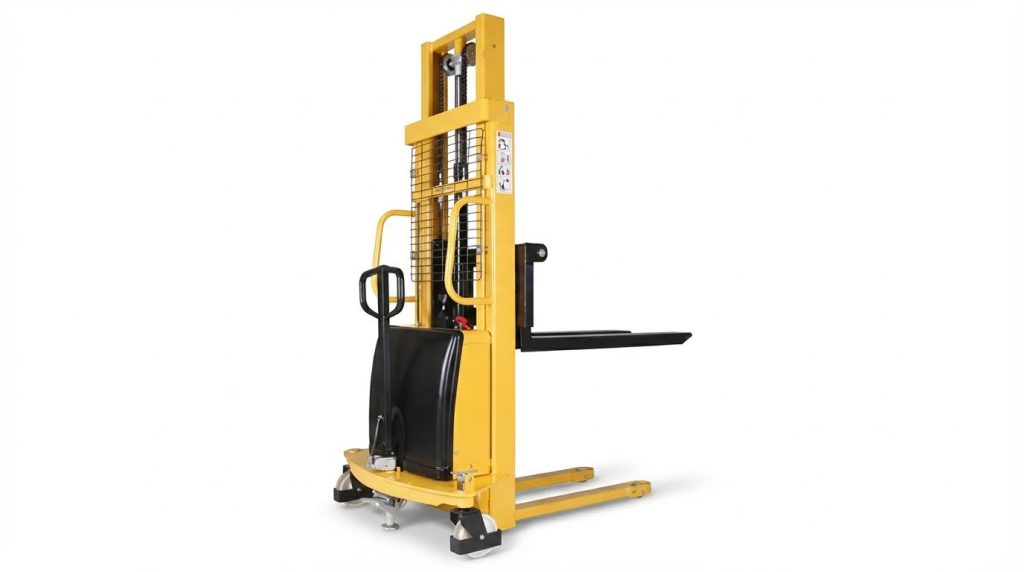
Engineers asking how high can an electric forklift lift must link that question to mast stage design and height classes. Mast geometry sets the real limits on stacking height, closed height, visibility, and stability. This section explains how single to four-stage masts, height classes, and carriage standards interact to define safe, usable lift height in warehouses and distribution centers.
Single, Two, Three, And Four-Stage Mast Designs
Single-stage masts use one fixed channel with no free lift. They offer simple construction and good visibility but limited height. Typical electric counterbalance trucks with single-stage masts work in low-bay areas where racking stays below roughly 3 metres.
Two-stage masts are common in standard warehouse trucks. A typical configuration lifts to about 3.0 metres with a closed height near 2.0 metres. Some models show closed heights around 2010 mm and extended heights around 4145 mm. Free lift in basic two-stage designs can be about 80 mm, enough to clear pallets without raising the mast above the overhead guard.
Three and four-stage masts answer higher rack demands. They use nested channels and hydraulic sequencing to reach 4.5–7.5 metres on standard electric forklifts, and up to about 13 metres on high-reach designs. More stages increase maximum height but add weight, flex, and obstruction in the operator’s view. Engineers must balance lift height against stability, visibility, and maintenance complexity when choosing how high an electric forklift should lift in a given facility.
Standard, High-Lift, And Very-High-Lift Height Classes
Height classes help compare how high an electric forklift can lift across models. Standard-lift counterbalance trucks usually cover about 3.0–4.7 metres. This suits floor stacking, low racks, and dock work. In this range, closed mast heights often stay close to 2.0–2.2 metres, which fits standard doors and container work.
High-lift electric forklifts extend into the 4.7–8.0 metre band. These masts support typical selective pallet racking in modern warehouses. For example, one configuration reached about 7.93 metres with a closed height around 3.21 metres. At these heights, capacity de-rating becomes significant, so engineers must check the data plate rather than assume the base rated load.
Very-high-lift classes include reach trucks and specialized narrow-aisle machines. Current electric reach trucks can lift roughly 8–13 metres depending on model and mast. These trucks answer the question how high can an electric forklift lift in dense storage systems. They require tight control of mast deflection, rail or wire guidance in very narrow aisles, and racking designed for the higher impact and deflection loads at upper beam levels.
Carriage Classes, ITA/ISO Standards, And Attachments
Carriage class defines the interface between the mast and forks or attachments. It also links lift height to safe capacity. The Industrial Truck Association and ISO 2328 set common carriage dimensions so forks and attachments interchange across compliant trucks.
Typical carriage classes follow clear bands. Class 1 carriages handle up to about 900 kg (2,000 lb) with heights near 330 mm. Class 2 covers roughly 900–2,500 kg with about 406 mm carriage height. Class 3 supports about 2,500–5,000 kg at around 508 mm height. Class 4 goes above that range with carriages about 635 mm high. As class increases, the structure becomes heavier and stiffer to manage higher loads at height.
Attachments such as rotators, clamp arms, or fork positioners change how high an electric forklift can lift safely. They add weight in front of the mast and move the load centre forward. This reduces rated capacity at every lift height. Standards require that the data plate reflect any installed attachment. Engineers should check three items before approving high stacking with attachments:
- Attachment weight and lost load distance
- Revised rated capacity at target lift height
- Carriage class compatibility and locking method
Correct pairing of mast stage, height class, carriage class, and attachments gives a realistic answer to how high an electric forklift can lift while staying within structural and stability limits.
Application Engineering And Safety At Height

Engineers who ask how high can an electric forklift lift must connect lift height with layout, stability, and training. Application design at height links mast selection, racking geometry, and aisle width with real truck limits. This section explains how to turn catalog lift charts into safe warehouse designs and operating rules.
Matching Mast Height To Warehouse And Racking Design
Warehouse design should start from the top pallet level and work down to the floor. Typical counterbalance electric forklifts lift about 4.2 m to 7.9 m, while high‑reach trucks can reach about 8 m to 13 m. The answer to how high can an electric forklift lift therefore depends on mast stages, truck class, and rated load. Engineers must check three linked dimensions for every location.
- Maximum fork height versus top beam level and pallet overhang
- Collapsed mast height versus door, mezzanine, and sprinkler clearances
- Required free lift where loads move under low beams or in containers
Racking design should keep at least several hundred millimetres between the highest loaded pallet and the roof structure or sprinklers, as required by local fire codes. Narrower aisles reduce travel distance but demand reach trucks with turning radii near 2.3 m and tighter clearance tolerances. Aisle width should include safety margins for mast sway, steering error, and pallet deflection at full height.
Stability, Tilt Limits, And Dynamic Load Effects
Stability at height depends on the combined centre of gravity of truck and load. As lift height increases, the centre of gravity rises and the stability triangle shrinks. Rated capacity usually assumes a 500 mm load center and a specific mast configuration. High-lift multi-stage masts reduced residual capacity, so safe working loads at 10–13 meters could be far below the base rating. Attachments such as rotators or clamps reduced capacity further and required updated data plates.
Facility design set another group of limits. Clear ceiling height, sprinkler lines, and beam levels constrained maximum fork height and required safety margins. Narrow aisles demanded reach or articulated trucks, with turning radius and mast deflection checked against rack clearances. Operators needed training on slow, smooth control near top tier, mast tilt limits, and de-rating rules.
Future high-lift electric trucks will likely pair taller, lighter masts with better sensors and monitoring. Digital twins, load sensing, and mast position feedback can help enforce safe limits automatically. Even with smarter control, engineers will still balance three basics: real rated capacity at height, building geometry, and operator skill.
High-Reach Trucks, Narrow Aisles, And Training Needs
High‑reach electric trucks answer the question how high can an electric forklift lift for dense storage. They work at heights around 8 m to 13 m with loads often up to about 2.5 tonnes. Moving‑mast and pantograph designs allow operation in aisles about 2.8 m to 3.4 m wide or even less. These layouts increase storage density but raise both complexity and risk.
In narrow aisles, there is less margin for steering error, mast sway, and pallet misalignment. Engineers should specify guide rails or wire guidance when aisles approach the truck’s minimum rating. Rack frames and beams must be checked for impact and uplift forces from deep pallet placement.
High‑reach work requires advanced operator training. Programs should cover:
- Reading capacity plates and de‑rating charts at height
- Using cameras, height selectors, or laser position aids where fitted
- Rescue and evacuation procedures for mast or platform failures
In some regions, such as Australia, high‑reach operation needed a specific high‑risk license. Similar local rules applied elsewhere and should be checked during project design.
Digital Twins, Monitoring, And Predictive Maintenance
Digital tools now help answer how high can an electric forklift lift in real conditions rather than only on paper. A digital twin of the warehouse and truck fleet can simulate different mast heights, aisle widths, and rack layouts. Engineers can test collision risks with ceilings, sprinklers, and conveyors before any steel is installed.
On‑truck sensors measure lift height, mast angle, speed, and load. Fleet systems can then enforce rules such as automatic speed reduction above a set height or blocking lifts beyond rated capacity. Data logs also reveal near‑miss patterns at specific rack bays or heights.
Predictive maintenance is critical for high‑lift masts. Monitoring lift cycles, maximum heights reached, and hydraulic pressure trends helps plan cylinder seal changes, chain replacements, and roller inspections before failure. Regular checks of mast channels, chains, and overhead guards are essential when trucks routinely work above about 4.5 m.
Integrated engineering, monitoring, and maintenance allow facilities to use very high lift heights while keeping risk at an acceptable level.
Summary: Practical Limits For High-Lift Electric Trucks
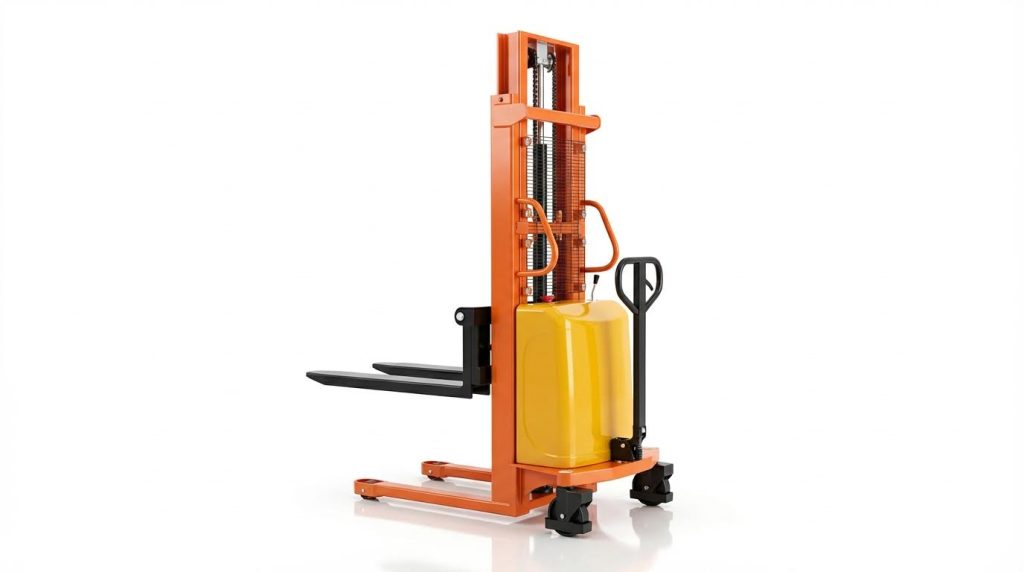
When planners ask how high can an electric forklift lift, the answer depends on mast design, capacity, and layout. Standard electric counterbalance trucks typically worked up to about 4.5–5.0 meters. High-lift and reach truck designs extended this envelope to roughly 8–13 meters in specialized racking.
Engineering teams needed to treat the rated capacity at height as the hard limit. The nameplate rating assumed a defined load center, often 500 millimeters, and a specific mast configuration. High-lift multi-stage masts reduced residual capacity, so safe working loads at 10–13 meters could be far below the base rating. Attachments such as rotators or clamps reduced capacity further and required updated data plates.
Facility design set another group of limits. Clear ceiling height, sprinkler lines, and beam levels constrained maximum fork height and required safety margins. Narrow aisles demanded reach or articulated trucks, with turning radius and mast deflection checked against rack clearances. Operators needed training on slow, smooth control near top tier, mast tilt limits, and de-rating rules.
Future high-lift electric trucks will likely pair taller, lighter masts with better sensors and monitoring. Digital twins, load sensing, and mast position feedback can help enforce safe limits automatically. Even with smarter control, engineers will still balance three basics: real rated capacity at height, building geometry, and operator skill.
,
Frequently Asked Questions
How high can an electric forklift lift?
An electric forklift’s maximum lift height depends on its design and intended use. Standard electric warehouse forklifts with a quad mast can reach heights of up to 20 feet (6 meters). Warehouse Forklift Rentals.
- Electric pallet jacks, often used in warehouses, typically lift loads between 6 inches to 20 inches (15 cm to 50 cm).
- Specialized models like high-capacity reach trucks can extend to heights of up to 45 feet (13.7 meters), making them suitable for high stacking in large warehouses.
What factors determine the lift height of an electric forklift?
The lift height of an electric forklift is influenced by several factors:
- Mast Type: Forklifts with multiple masts (e.g., tri-mast or quad-mast) can reach greater heights.
- Load Capacity: Heavier loads may limit how high the forklift can safely lift.
- Design Purpose: Forklifts designed for indoor warehouse use typically have higher masts compared to those used outdoors on rough terrain.