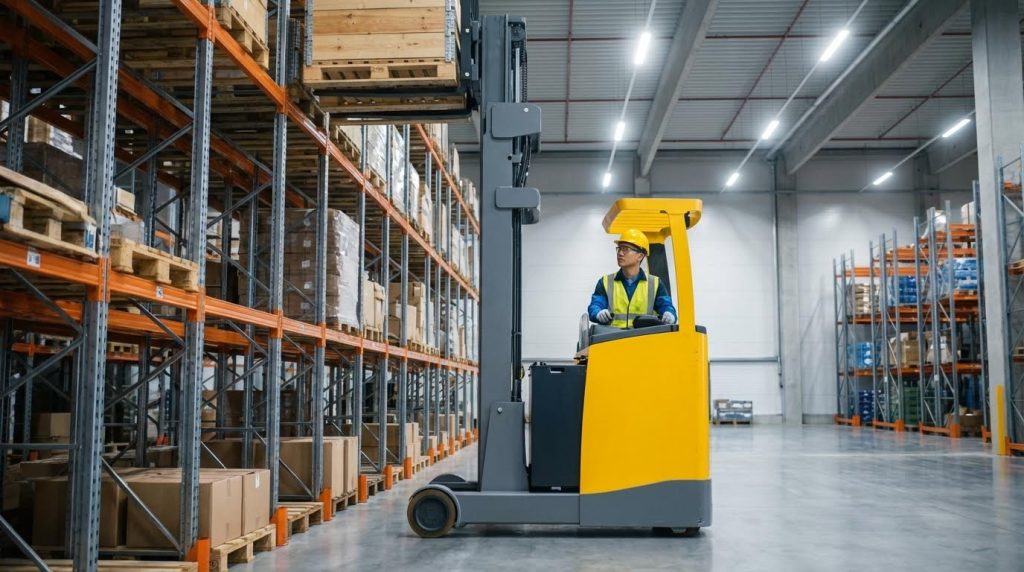
Learning how to lift a pallet with a forklift safely means combining correct load handling, pre‑shift inspections, and disciplined driving techniques to prevent tip‑overs, dropped loads, and injuries. This guide walks operators and supervisors through the physics of load ratings and stability, pallet integrity checks, and the exact step‑by‑step process to approach, lift, travel, and stack pallets in compliance with OSHA and ANSI B56.1 requirements. You will also see how fork positioning, mast tilt, and floor or dock capacity limits affect real‑world safety margins in warehouses, trailers, and on docks. By the end, you will have a practical, engineering‑based checklist you can apply immediately to tighten safety, reduce damage, and improve pallet handling efficiency.
Fundamentals Of Safe Pallet Lifting
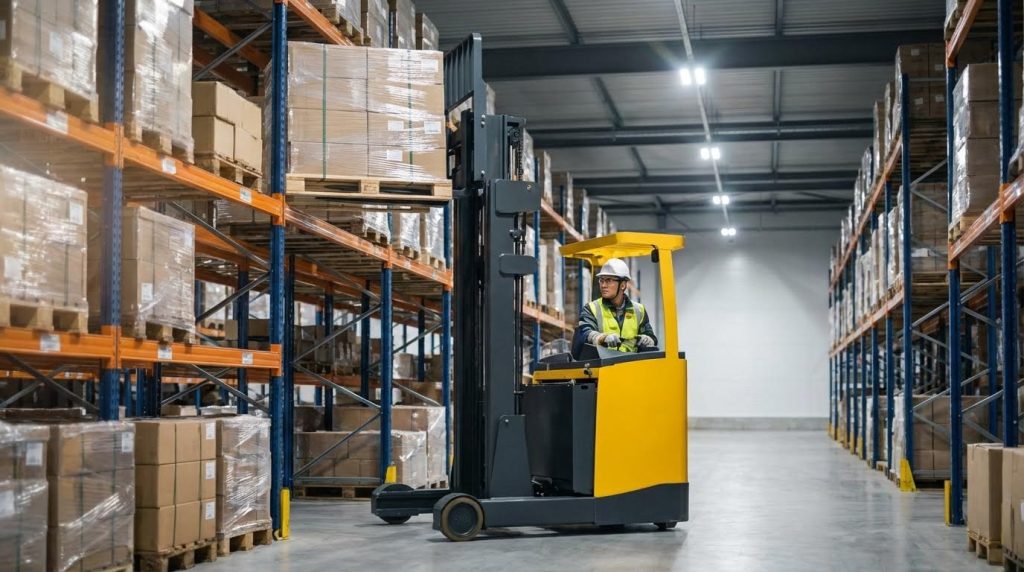
Fundamentals of safe pallet lifting define how the truck, the load, and the pallet behave as one system so operators know exactly how to lift a pallet with a forklift without exceeding stability or structural limits.
When you learn how to lift a pallet with a forklift correctly, you are really learning to control three things: the truck’s stability envelope, the pallet’s structural integrity, and the combined center of gravity. If any one of these three is wrong, the system can fail even when the weight is below the nameplate capacity. This section explains how load ratings and load centers work, and how to judge whether a pallet and its load are structurally sound before you ever move the forks.
💡 Field Engineer’s Note: Most tip‑overs I investigate involve loads that were technically “under capacity” but placed too far out on damaged pallets, pushing the combined center of gravity outside the stability triangle.
Load ratings, load centers, and stability
Load ratings, load centers, and stability describe how much mass a forklift can safely lift at a specified distance from the carriage before the combined center of gravity moves outside the stability triangle and risks a tip‑over.
Every forklift nameplate lists a rated capacity (in kg) at a specified load center distance (typically 500 mm) with the mast vertical. This rating assumes a uniformly distributed load placed with the heaviest part tight against the carriage. As soon as you increase the load center (long pallets, overhanging loads, or poor fork insertion), the effective capacity drops and the risk of forward tip‑over rises sharply. Standards such as ANSI B56.1 treat the truck and load as a lever pivoting around the front axle, with a “stability triangle” defining the safe region for the combined center of gravity. Engineering guidance explains that oversized or uneven pallets can exceed these stability limits even when their mass is under the rated capacity.
| Parameter | Typical Value / Concept | What It Means | Field Impact |
|---|---|---|---|
| Rated capacity | e.g., 2,000 kg at 500 mm load center | Maximum mass the truck may lift at the stated load center with vertical mast. | Do not assume 2,000 kg is safe at any distance; long loads derate capacity. |
| Load center distance | Commonly 500 mm from fork face to load CG | Horizontal distance used to define the capacity rating. | Longer pallets or off‑center loads move CG out, reducing stability margin. |
| Vertical mast condition | Capacity plate assumes mast upright | Tilt angle changes the CG position relative to the stability triangle. | Excessive forward tilt at height dramatically increases tip‑over risk. |
| Stability triangle | Triangle between two front wheels and steer axle pivot | Region within which combined CG must stay to prevent overturn. | Hard cornering or braking with raised loads can push CG outside triangle. |
| Heaviest part against carriage | Load packed tight to load backrest | Minimizes load center and bending moment on mast and forks. | Improves truck stability and reduces fork heel stress in daily operation. |
| Off‑center / one‑fork lifting | Load not centered laterally or on one fork only | Introduces torsion and uneven wheel loading. | Increases risk of side tip‑over and structural damage to forks and mast. |
In practice, knowing how to lift a pallet with a forklift safely means reading the nameplate before unusual loads and mentally checking: “Is this load longer, higher, or further out than the standard 500 mm case?” If yes, you must assume a lower safe capacity, keep the load lower to the ground, and avoid tight turns or sudden braking. Always keep the heaviest side of the load against the carriage, center it between the forks, and avoid lifting with one fork only, which twists the carriage and shifts the center of gravity sideways.
How to quickly estimate if a long pallet derates your capacity
If the pallet length or overhang pushes the center of gravity beyond 500 mm, treat the truck as significantly derated and consult the capacity chart or supervisor. When in doubt, split the load into multiple smaller pallets.
💡 Field Engineer’s Note: A common mistake is lifting stacked, overhanging pallets “just a little bit” higher to clear obstacles; that extra 200–300 mm of height plus forward reach can be enough to cross the stability boundary on a marginal floor.
Pallet integrity and load stability
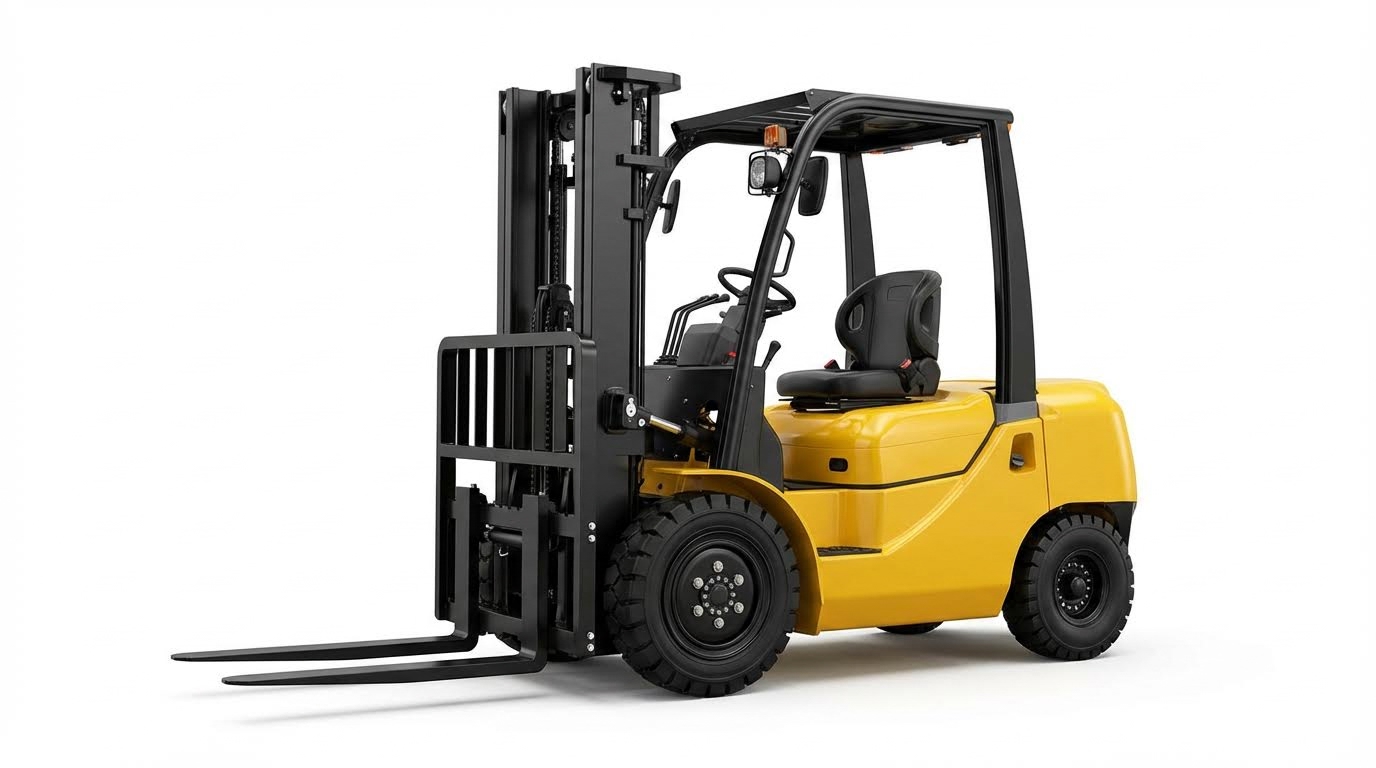
Pallet integrity and load stability ensure the pallet and stacked goods can withstand dynamic forklift forces without breaking, shifting, or collapsing while being lifted, transported, or stacked.
Safe instructions on how to lift a pallet with a forklift always assume the pallet itself is structurally sound. Engineering guidance notes that broken deck boards, split stringers, exposed nails, rot, or severe warping introduce unpredictable failure modes. Under dynamic conditions—braking, turning, hitting floor joints—the pallet can flex, shift the center of gravity, or fail suddenly. Loads must be stacked and secured so they behave as one solid unit, not a loose pile of cartons that can slide or topple.
- Deck boards intact: Broken or missing top or bottom boards reduce support area and can let forks punch through, dropping part of the load.
- Stringers / blocks not split: Damaged stringers cannot transfer load between deck boards and may shear when lifted, especially near fork pockets.
- No severe rot or moisture damage: Rot and waterlogging weaken timber, making rated pallet capacities meaningless under real handling forces.
- Limited pallet deflection: Excessive sag between forks changes the load center and stresses fork heels and mast components.
- Flat, not heavily warped: Warped pallets tilt the load, moving the center of gravity sideways and increasing tip‑over and product‑fall risk.
- Stable stacking pattern: Interlocked or column‑stacked cartons with no big voids reduce internal movement when the truck turns or brakes.
- Load securing (wrap/banding): Shrink wrap, banding, or corner posts keep the load acting as a single rigid mass.
- No overhang beyond pallet edges: Overhanging goods are easily struck by racking, doors, or other pallets and can be knocked off.
Before inserting the forks, the operator should visually scan the pallet and load: look for broken boards, missing blocks, sagging decks, or leaning stacks. If the pallet looks compromised, stop and have it reworked or replaced; do not “gingerly” lift a clearly damaged pallet, because dynamic forces during travel can be several times higher than the static weight. Remember that a pallet that barely holds on the floor may fail completely when lifted, tilted, or driven over a dock plate or floor joint.
Quick field check for questionable pallets
Tap suspect boards with a tool to listen for hollow rot, look along the pallet edge for warping, and check that forks will contact at least two solid stringers or blocks. If you cannot support the load on sound timber, treat the pallet as unsafe.
💡 Field Engineer’s Note: Many “mystery” product drops happen not at the rack but halfway across the warehouse, when a marginal pallet finally cracks as the truck crosses a dock plate or floor joint at speed.
Step‑By‑Step Procedure To Lift And Move A Pallet
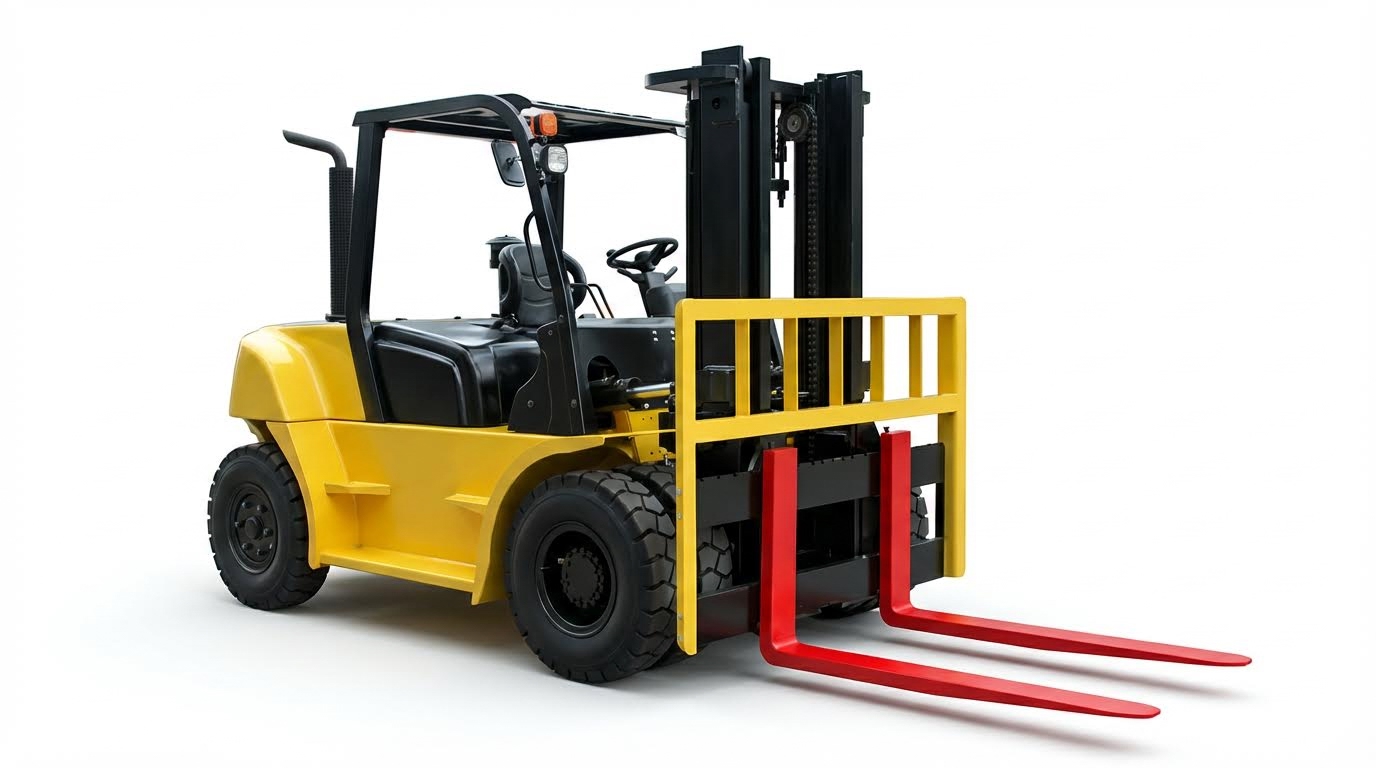
Knowing how to lift a pallet with a forklift safely means following a repeatable pre‑shift inspection, controlled pallet engagement, and disciplined lifting, traveling, and stacking techniques that protect people, product, and equipment.
💡 Field Engineer’s Note: Most incidents I investigate start before the forks ever touch the pallet—rushed inspections, poor approach angles, and lifting while rolling are the three biggest hidden risk multipliers.
Pre‑shift inspection and safety checks
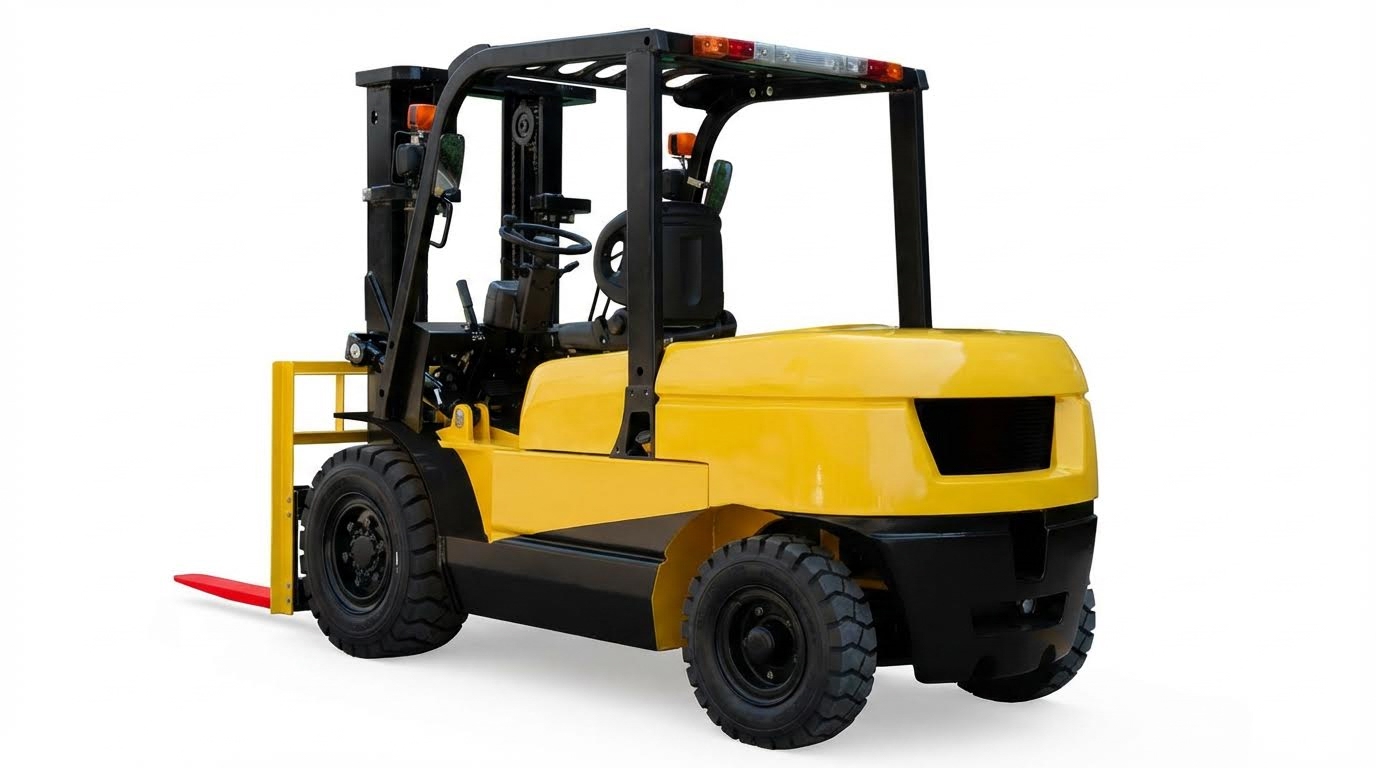
Pre‑shift inspection and safety checks verify that the forklift is mechanically sound and compliant before you even attempt how to lift a pallet with a forklift, preventing failures under load and meeting OSHA/ANSI requirements.
- Verify documentation and nameplate: Confirm the capacity plate is legible and matches the truck and attachments you will use so you do not exceed rated load or load center limits. OSHA requires nameplate legibility.
- Inspect overhead guard and structure: Check that the overhead guard, mast, carriage, and load backrest are present, not bent or cracked, and that warning labels are readable, ensuring protection from falling objects. OSHA checklists highlight guard condition.
- Check floor plates, leaks, and cleanliness: Make sure floor plates/mats are secure and clean, and look under the truck for hydraulic, fuel, or coolant leaks that could signal unsafe operation or create slip hazards. OSHA pre‑operation guidance covers leaks.
- Inspect tires, wheels, forks, and chains: Examine tires for damage and proper inflation, and check forks for cracks, bends, or heel wear (not more than about 10% loss of thickness) plus equal chain tension and lubrication to maintain balanced lifting. Daily safety checklists specify fork wear limits.
- Confirm hydraulic and power systems: Check hydraulic fluid level and hose condition, verify no visible cracks or leaks, and inspect battery or fuel system connections for corrosion or damage before running the truck. OSHA lists these as required checks.
- Test safety devices and controls: With the truck powered, test horn, lights, steering, service brake, and parking brake, confirming smooth response and no pull to one side when braking on level ground. Standard checklists include these control tests.
- Cycle lift and tilt mechanisms: Without a load, raise and lower the forks through their full stroke, tilt forward and back, and hold the forks raised for about 10 seconds to confirm no drift or hydraulic leakage. Daily inspection procedures specify drift checks.
- Inspect propane system if applicable: Make sure the LPG tank is properly seated and clamped, hoses are not kinked or frayed, and immediately shut the valve and tag out the truck if you smell gas. OSHA propane guidance stresses leak response.
- Document findings and tag out if unsafe: Record the inspection with date, operator, and truck ID; if you find critical defects, tag the truck “Out of Service” and report it instead of attempting to lift pallets. OSHA/ANSI require shift‑start inspections.
Why pre‑shift checks matter before lifting pallets
Inspections prevent hydraulic or structural failures right when the mast is stressed most—during lifting and traveling with a pallet—protecting operators and bystanders while keeping you in compliance with OSHA powered industrial truck rules.
Approaching and engaging the pallet
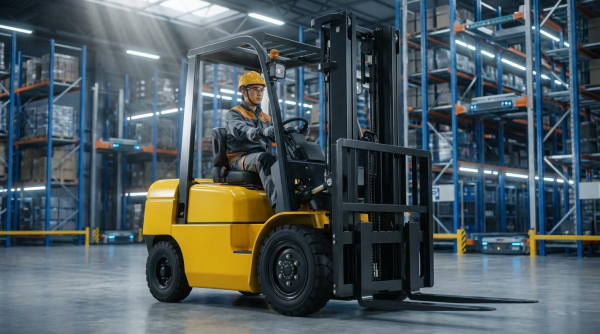
Approaching and engaging the pallet means positioning the truck square to the load, leveling and inserting the forks fully, and stabilizing the pallet before lifting, which is the core of how to lift a pallet with a forklift safely.
- Align square to the pallet: Approach slowly in a straight line so the mast is perpendicular to the pallet face, avoiding angled contact that can break deck boards or twist the load. Engineering guidance stresses square alignment.
- Stop short and level the forks: Halt approximately 0,2–0,3 m before the pallet, then level the forks to the pallet entry height to avoid scraping or punching through deck boards during entry. Approach distance and leveling are defined.
- Set fork spacing correctly: Adjust forks so they are evenly spaced and positioned under the outer stringers or blocks, maximizing support and reducing pallet bending between forks. Engineering notes explain fork spacing.
- Insert forks fully under the load: Drive forward slowly until the forks extend as far as possible—ideally close to the full pallet depth and at least two‑thirds of load length—to keep the effective load center within the truck’s rating. Guides specify minimum insertion depth.
- Confirm pallet and load condition: Before lifting, visually check for broken boards, split stringers, excessive deflection, or unstable stacking that could collapse once the pallet is raised. Engineering guidance defines pallet integrity.
- Center the load against the carriage: Ensure the heaviest part of the load sits against the carriage or load backrest and is centered between the forks to keep the combined center of gravity inside the stability triangle. Stability diagrams show why this matters.
- Lift slightly and re‑check stability: Raise the pallet just 50–100 mm, pause, and look for shifting cartons, pallet sagging, or unusual noises before committing to full travel height.
- Avoid raising or lowering while moving: Keep the truck stopped with the parking brake set when making significant lift or tilt adjustments, reducing dynamic instability and mast sway. Safe‑use guides warn against lifting while rolling.
💡 Field Engineer’s Note: If you hear wood cracking as you insert the forks, stop immediately—forcing entry can punch through deck boards, drop the load, and overload fork heels well beyond design stress.
What if the pallet is damaged or off‑size?
Do not “make it work” with one fork or partial contact. Use an appropriate attachment, re‑palletize the load, or refuse the lift; off‑center or short‑fork lifting drastically reduces rated capacity and tip‑over margin.
Lifting, traveling, and stacking operations
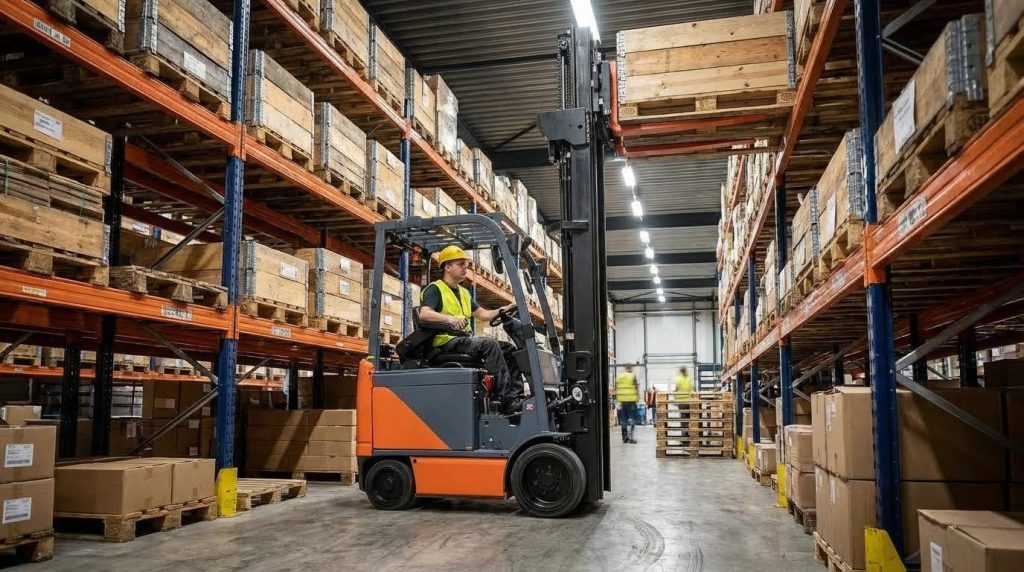
Lifting, traveling, and stacking operations keep the load low, mast slightly tilted back, and movements smooth and deliberate, which is the operational backbone of how to lift a pallet with a forklift without tipping or dropping product.
- Lift to safe travel height: After engaging the pallet, raise it only about 100–150 mm above the floor—just enough to clear bumps—so the center of gravity stays low and stability margins remain high. Travel guidelines specify low load height.
- Apply slight rearward mast tilt: Tilt the mast back a few degrees to bring the load against the backrest, improving resistance to forward tip‑over while avoiding excessive rear tilt that could destabilize the truck at height. Engineering notes explain mast tilt and stability.
- Travel at controlled speed: Drive at a speed that allows you to stop smoothly within your visible distance, slowing further on turns, near pedestrians, and in congested aisles to reduce lateral rollover risk. Guidelines link speed to rollover risk.
- Maintain visibility and use the horn: If the load blocks your forward view, travel in reverse while looking in the direction of travel, sounding the horn at intersections, dock doors, and blind corners. Safe‑travel guides stress reverse driving when blind.
- Avoid turning on slopes or with raised loads: Keep travel straight on ramps, never turn on an incline, and avoid sharp steering inputs with an elevated load to prevent lateral tip‑overs.
- Monitor floor, dock, and trailer conditions: Watch for potholes, dock edges, and transitions that can cause mast sway or load shift, and verify dock plates and trailer floors are rated and secure before entering. Engineering notes cover dock and floor limits.
- Position for stacking or racking: Stop square to the stack or rack, set the parking brake, then raise the pallet just above the target height with the mast vertical before creeping forward to place it. Best‑practice guides describe this sequence.
- Lower the pallet and level forks: Gently set the pallet fully onto the rack beams or stack, ensure it is stable and not overhanging dangerously, then level the forks before slowly backing out to avoid dragging the load.
- Stack heavy to light, bottom to top: Place heaviest pallets on lower levels and lighter ones above to keep the stack’s center of gravity low and within rack or floor load ratings. Stacking guidance explains weight distribution.
- Follow safe truck loading/unloading steps: When working in trailers, confirm brakes or chocks are in place, dock boards are secured and rated, and doorway and interior clearances are adequate before lifting or removing pallets. Engineering And Operational Considerations
Engineering and operational considerations define how the forklift, pallet, and building structure interact so that when you decide how to lift a pallet with a forklift, you stay within safe mechanical and structural limits.
These factors go beyond basic driving skills and focus on how forces flow through forks, mast, tires, and floors. Ignoring them is how you bend forks, crack docks, or tip a truck even when “under capacity” on paper.
💡 Field Engineer’s Note: Most serious incidents I investigate happen with loads technically “under the nameplate capacity” but with poor fork positioning, over-tilt, or weak floors. Capacity is a system property, not just a number on a plate.
Fork positioning, mast tilt, and fork stresses
Correct fork positioning and controlled mast tilt keep the load center inside the stability triangle and limit bending stresses in the forks, which is essential for safely lifting a pallet with a forklift in real-world conditions.
Forks are structural beams; when they are not fully inserted or unevenly loaded, the bending moment at the fork heel spikes, which can permanently deform or crack them over time.
Parameter / Practice Typical Engineering Guidance Field Impact On Operation Fork leveling before entry Forks kept horizontal and aligned with pallet openings Reduces impact on deck boards, prevents pallet damage, and avoids sudden load shifts during entry. Fork spacing Adjusted to support outer pallet stringers or blocks symmetrically Distributes weight evenly across both forks, reducing twisting of the carriage and uneven fork wear. Insertion depth Forks inserted as far as possible, minimum ≈ 2/3 of pallet/load length during approach Limits bending at the fork heel and keeps the effective load center close to the carriage, preserving rated capacity. Load against the carriage Heaviest part of the load positioned tight to the load backrest for stability Reduces load center distance, increasing resistance to forward tip-over and lessening mast and fork stress. Mast tilt during travel Slight rearward tilt with load low (≈100–150 mm above floor) recommended Moves the combined center of gravity back into the stability triangle and helps lock the load to the backrest. Mast tilt at height Return mast to near-vertical before final placement Prevents the center of gravity from moving outside rack supports or stack footprint, reducing risk of toppling. Unequal fork heights Fork tips kept at equal height before entering pallet Prevents racking the pallet and avoids one-fork lifting, which can twist and overload individual forks. Off-center or one-fork lifting Prohibited except under engineered, approved procedures per stability guidance Off-center loading shifts the combined center of gravity sideways, increasing tip-over and fork bending risk. From an engineering standpoint, the forklift and load act like a lever around the front axle; the further the load center, the higher the overturning moment. Fork positioning and mast tilt directly change that moment.
Why partial fork entry is so dangerous
When only half the fork length is under the pallet, the bending moment at the fork heel can roughly double for the same load because the effective cantilever length increases. Over time, this leads to permanent fork droop or sudden fracture under shock loading.
💡 Field Engineer’s Note: If you see forks with a permanent “smile” (tips drooping), that truck has been lifting with short insertion or over-length pallets for years. Treat those forks as suspect and have them gauged and replaced.
Floor, dock, and trailer capacity limits
Floor, dock, and trailer capacity limits set the maximum combined mass and wheel loads a surface can safely carry, and they must be checked whenever you plan how to lift a pallet with a forklift in marginal areas like mezzanines or trailers.
When a 4,000–6,000 kg truck plus a 1,000–2,000 kg load crosses a dock plate or trailer floor, the concentrated wheel loads can exceed what those structures were designed to handle, causing cracking, deflection, or collapse.
Surface / Structure Key Capacity Indicator Operational Requirement Field Impact On Forklift Work Warehouse floor (slab-on-grade) Posted maximum floor loading in kg/m² or kN/m² Verify slab rating vs. combined truck + load mass, including dynamic factors Prevents slab cracking and differential settlement in high-traffic or high-bay storage zones. Mezzanines and elevated platforms Design live load rating and any forklift-specific restrictions Confirm that powered industrial trucks are allowed and within rated loads Avoids overloading light-duty mezzanines designed only for people or manual pallet jack. Dock plates / dockboards Capacity plate showing rated load (truck + load) for operations Ensure rating exceeds the total weight and that plate is secured against movement Prevents dockboard bending, slipping, or collapse when crossing with loaded forklifts. Loading docks (edge and pit) Structural design of dock face, pit, and bumpers Maintain good condition; repair spalled concrete and damaged bumpers Reduces risk of wheel drop, edge failure, or sudden jolts that can destabilize raised loads. Trailer floors Trailer design rating and visible floor condition Check for rot, broken cross-members, or soft spots before entry during loading Weak floors can punch through under concentrated axle loads, dropping the forklift and load. Ramps and slopes Grade percentage and surface friction Observe limits on slope; never turn on a ramp with a raised load Steep or slick ramps reduce stability margins and increase tip-over risk. Dock locking and trailer restraint Wheel chocks or mechanical restraints engaged Secure trailer before entry; verify brakes or chocks are in place Prevents trailer creep or “dock walk” that can open a dangerous gap under the dock plate. Capacity signs and rating plates are not suggestions; they represent the structural design limit of the concrete, steel, and timber supporting your forklift. Exceeding them may not fail immediately but will accumulate damage and suddenly give way under a routine load.
How to think about combined weight
When planning operations, add the truck’s rated operating weight (often 3,000–6,000 kg for a common warehouse unit) plus the heaviest pallet you intend to handle and a safety factor for dynamic effects such as braking or bumps. That total must be below the lowest-rated element in the path: floor, dockboard, or trailer.
💡 Field Engineer’s Note: If your dock plate or mezzanine is only rated in “kg,” train supervisors to think in “truck + load,” not just pallet weight. A 1,200 kg pallet on a 5,000 kg truck is a 6,200 kg problem for your structure, not a 1,200 kg one.
Final Thoughts On Forklift Pallet Lifting Safety
Safe pallet lifting is not one action. It is a system that links truck limits, pallet condition, operator behavior, and building capacity. Load ratings, load centers, and mast tilt define how close the combined center of gravity runs to the stability triangle. Pallet integrity and secure stacking decide whether the load stays as one solid unit when the truck turns, brakes, or crosses joints. Fork positioning and full insertion control fork heel stress and keep effective capacity within what the nameplate promises. Floor, dock, and trailer ratings set the real ceiling for truck plus load weight, not just pallet mass.
Operations and engineering teams should turn these principles into clear rules and checklists. Train operators to read capacity plates, reject damaged pallets, and keep loads low with slight rear tilt. Require pre‑shift inspections and strict “no lifting while rolling” and “no one‑fork lifts” policies. Audit dock plates, mezzanines, and trailers so their ratings match the trucks and loads you actually run. When in doubt, derate the lift, split the load, or choose different equipment from Atomoving. Treat stability, structure, and procedure as one package, and you will cut incidents, extend equipment life, and move pallets faster with less risk.
Frequently Asked Questions
How do forklifts pick up pallets?
To lift a pallet with a forklift, approach the load squarely and insert the forks fully under the pallet. Drive forward until the pallet touches the carriage, then tilt the forks back slightly to secure the load. For unbalanced loads, keep the heavier side closer to the forklift. Lift the load just enough to clear the ground and tilt it back slightly more before moving. Forklift Safety Guide.
What are some alternatives to using a forklift for lifting pallets?
If you don’t have access to a forklift, there are several alternatives to lift pallets safely. Manual pallet jacks or electric pallet jacks are efficient tools for moving pallets in confined spaces like warehouses or trucks. Other options include lift tables, manual material lifts, utility vehicles, tow tractors, and electric stackers. Each tool has specific applications depending on the weight and size of the pallet. Forklift Alternatives Guide.
Why does my pallet jack struggle to lift a pallet?
If your pallet jack is not lifting properly, it could be due to insufficient hydraulic fluid, a damaged pump, or debris blocking the mechanism. Ensure the pallet jack is on a flat surface and that the pallet is correctly aligned with the forks. Regular maintenance can prevent these issues. For heavy pallets, consider using an electric pallet jack or other material handling equipment designed for heavier loads.