Pallet jack lift height is the vertical travel of the forks, and it determines which pallets, docks, and conveyors you can actually serve safely and efficiently. If you are asking “how high can a pallet jack lift,” the realistic answer ranges from roughly 100–120 mm on standard units up to about 800 mm on high‑lift and basic stacker designs, with electric and manual models offering similar height bands but very different ergonomics and duty cycles. This guide compares typical lift ranges for manual and electric pallet jacks, explains the engineering limits behind maximum lift, and shows how to match lift height to pallets, aisles, and applications. By the end, you will know exactly what lift height you need to minimize damage, improve pick rates, and stay aligned with common safety practices and standards in modern warehouses.
Core Lift Ranges For Manual And Electric Jacks
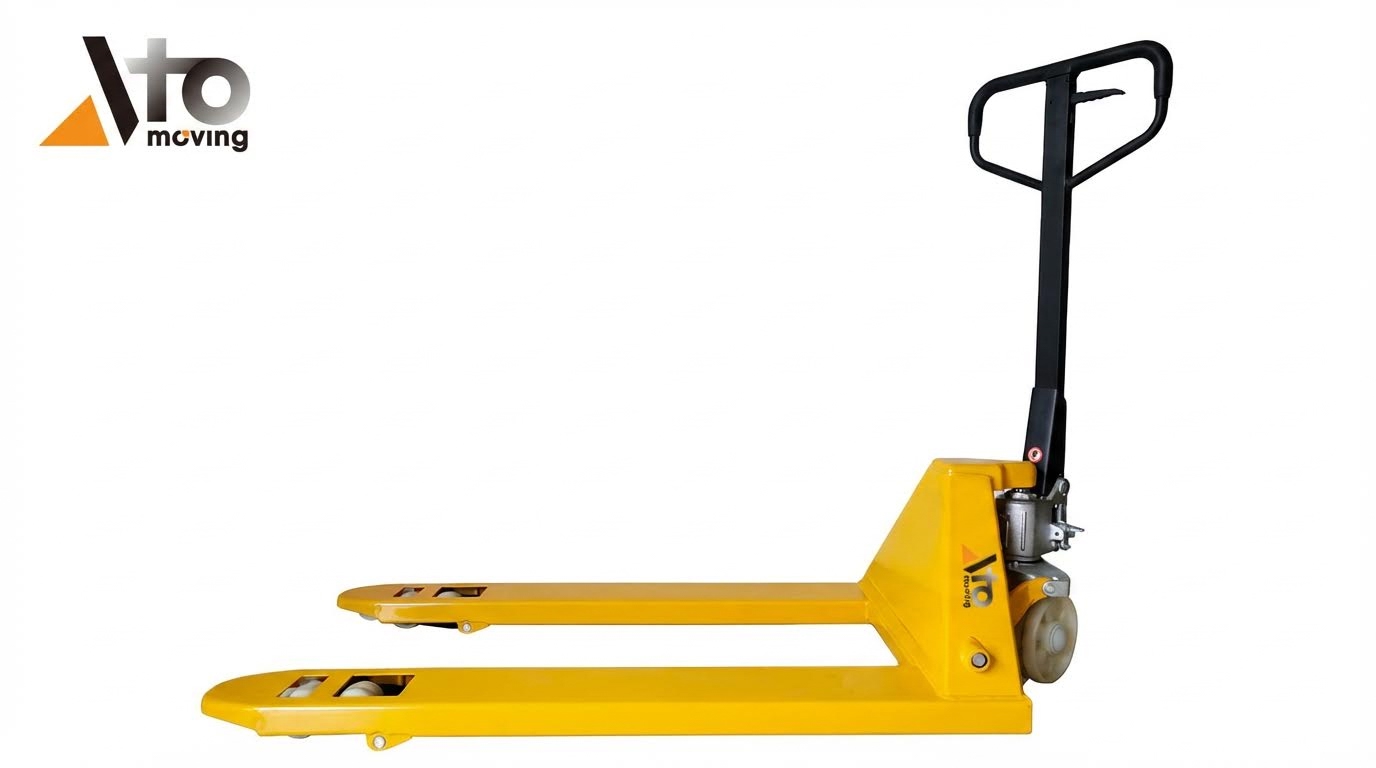
Core pallet jack lift ranges define how high can a manual pallet jack lift in real warehouses, typically around 100–120 mm for standard jacks and up to 800 mm or more for high‑lift and stacker designs.
This section translates catalogue numbers into real fork heights you can use on docks, conveyors, and in racking. We will separate standard manual and electric jacks from high‑lift and stacker units so you can quickly match lift range to your application and aisle layout.
Typical lift heights of manual pallet jacks
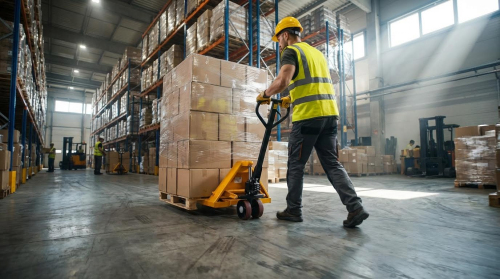
Typical manual pallet jack lift height is roughly 100–120 mm of usable lift, with forks usually traveling from about 80–85 mm lowered to about 185–205 mm raised, just enough to clear and transport standard pallets safely.
When people ask “how high can a manual pallet jack lift,” they usually mean this standard manual truck that just raises a pallet off the floor, not a stacker or high‑lift unit. The key is understanding both minimum and maximum fork heights, because they control pallet compatibility and clearance over thresholds.
| Parameter | Typical Range / Example | What It Means In Practice | Field Impact |
|---|---|---|---|
| Minimum fork height (lowered) | ≈ 85 mm (3.3 in) spec example | Forks sit just low enough to enter standard wooden pallets. | Too high and you cannot enter low‑profile pallets; too low and forks scrape damaged floors. |
| Maximum fork height (raised) | ≈ 195–205 mm (7.7–8.1 in) spec example | Top of fork when fully pumped up. | Gives ~100–120 mm pallet lift, enough to clear floor irregularities and dock plates. |
| Usable lift (pallet rise) | ≈ 100–120 mm (3.9–4.7 in) noted 110 mm | Difference between pallet on floor and pallet in travel position. | Determines whether you clear dock plates, joints, and rough concrete without dragging. |
| Typical load capacity | Up to 2,500 kg (5,500 lbs) capacity example | Maximum rated load at the standard load center. | Running near max capacity increases fork deflection and slightly reduces effective lift clearance. |
| Pump operation | Manual hydraulic pump, handle strokes described | Operator pumps handle to reach desired height. | More height = more strokes; operators tend to stop once pallet clears floor by 25–50 mm. |
| Recommended travel height | ≈ 20–50 mm pallet clearance | Forks not fully raised during travel. | Keeping the load low reduces tipping risk and stress on the hydraulic circuit. |
| Electric pallet truck lift range | ≈ 85 mm to 205 mm example | Very similar minimum and maximum fork heights to manual units. | Switching from manual to electric usually does not change how high you can lift a pallet for simple transport. |
Standard electric pallet jacks are engineered to mimic manual fork geometry, with lowered heights around 85 mm and maximum heights around 205 mm, so your pallet interface stays consistent when you electrify.
💡 Field Engineer’s Note: In real operations, you rarely run at full pump height; train operators to travel with just enough clearance (about 25–30 mm) instead of “maxing out” the jack, which reduces handle effort and extends seal life.
Why 100–120 mm of lift is usually enough
Most standard pallets are about 120–145 mm tall. With an 85 mm fork entry and ~110 mm lift, the pallet ends up roughly 195 mm above the floor, giving you enough room to cross dock plates, small ramps, and expansion joints without the bottom boards catching. Pushing beyond this range on a simple pallet jack adds stress without much real benefit unless you are feeding conveyors or docks at mismatched heights.
Lift heights of high-lift jacks and stackers
High-lift pallet jacks and stackers extend lift height far beyond standard jacks, from roughly 700–800 mm for scissor high‑lifts up to 1,600–3,000 mm for manual stackers, enabling ergonomic work heights and low‑level stacking.
These machines answer a different version of “how high can a high lift pallet truck lift”: instead of just clearing the floor, they position pallets at waist or chest height or even into low racking. That extra height comes with different mechanics, stability behavior, and aisle requirements.
| Equipment Type | Typical Max Lift Height | Use Case | Field Impact |
|---|---|---|---|
| Manual high‑lift pallet jack (scissor type) | Up to ≈ 800 mm (31.5 in) lift example | Raises pallets to working height for picking, packing, or assembly. | Greatly improves ergonomics; usually not used for long‑distance transport when fully raised. |
| Manual pallet stacker – light model | ≈ 1,600 mm (63 in) max height for 500 kg HPT500 | Low‑level stacking and feeding low conveyors. | Allows loading to about eye level for most operators; still manual push/pull effort. |
| Manual pallet stacker – medium/heavy | ≈ 1,600–2,500 mm (63–98 in) lift for 1,000 kg HPT1000 | Feeding mezzanines, low racks, or machinery in one or two levels. | Reaches first beam levels; requires good floor quality and trained operators. |
| Manual pallet stacker – higher lift | Up to ≈ 3,000 mm (118 in) lift for 1,000–1,500 kg HPT1500 | Low‑throughput racking where a full forklift is not justified. | Effectively a “walkie stacker”; stability and operator effort become critical above 2 m. |
| Electric pallet jack – standard | ≈ 205 mm fork height example | Horizontal transport, dock work, truck loading. | Does not “stack”; lift height is similar to manual pallet jacks. |
| Electric pallet stacker (for context) | Often 1,600–3,000 mm+ (not in detail here) | Powered lift and travel for full stacking operations. | Used where you need forklift‑like stacking without a ride‑on truck. |
High‑lift scissor jacks trade travel distance for vertical height: once you approach 700–800 mm, you normally chock or stabilize the jack and use it as a work platform rather than a transport tool.
- Ergonomics: Lifting pallets to 700–800 mm puts the top layer of cartons in a 900–1,100 mm band, which is ideal for reducing bending and improving pick rates.
- Stability: As lift height increases, the center of gravity rises and shifts; high‑lift jacks and stackers rely on wider bases, outriggers, or masts to maintain stability under load.
- Aisle & floor requirements: Taller stackers need flatter floors and slightly wider aisles to remain maneuverable and within safe stability margins.
- Operator effort: Manual stackers with 1,600–3,000 mm lift rely on longer pump strokes or winch systems; for frequent vertical moves, electric lift is usually justified.
💡 Field Engineer’s Note: Once you go above about 800 mm lift, treat the equipment like a small crane, not a simple pallet jack—enforce strict load centering, flat floor zones, and no “riding” the load while positioning.
How to decide between standard, high-lift, and stacker heights
- Map interface heights: List dock, conveyor, table, and rack beam heights in mm.
- Define minimum clearance: Add 20–30 mm safety margin above the highest interface you must reach.
- Check duty cycle: If you lift to that height dozens of times per hour, lean toward powered lift (electric stacker).
- Validate floor and aisle: Confirm floor flatness and aisle width support the chosen lift height and wheelbase.
- Standardize SKUs: Where possible, keep work at standard pallet‑jack height and reserve high‑lift or stackers for clearly defined stations.
Engineering Factors That Limit Maximum Lift
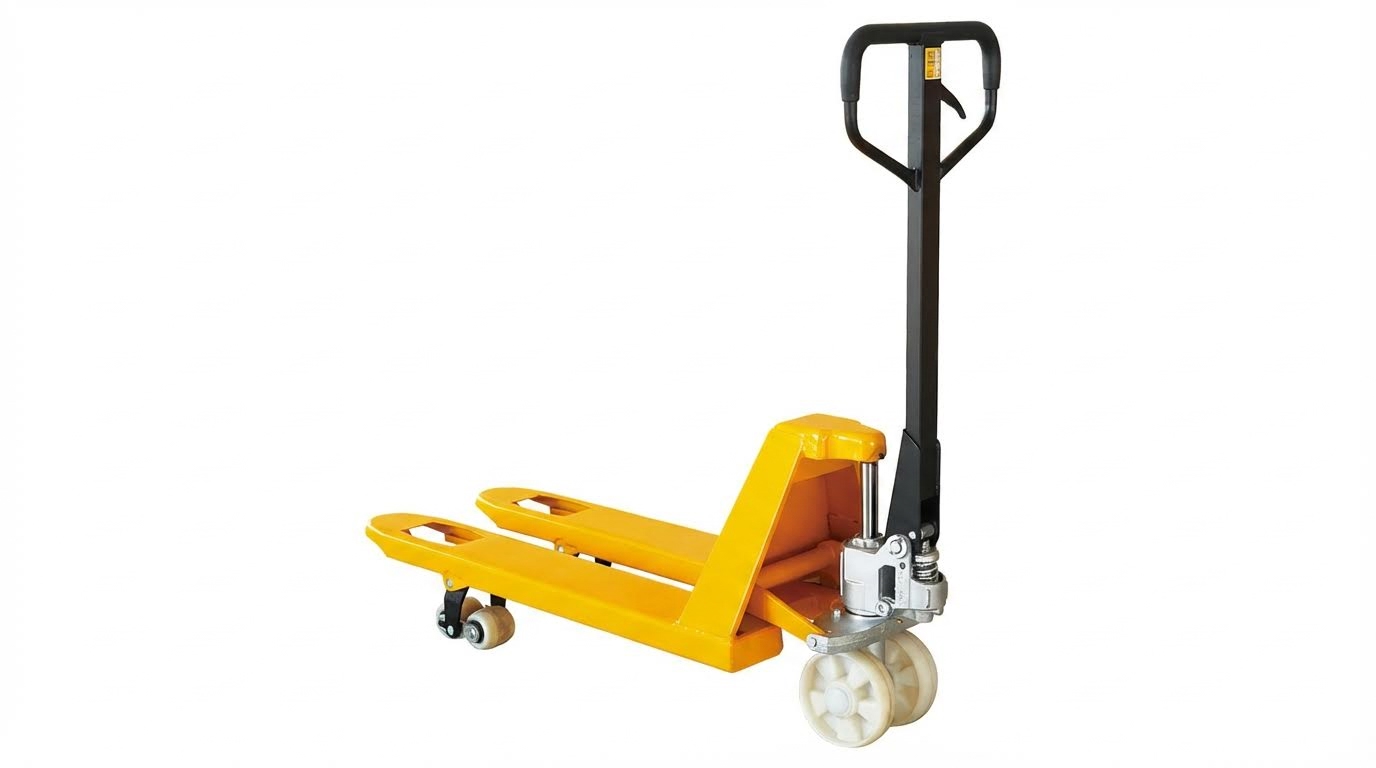
Engineering limits on pallet jack lift height come from fork geometry, wheel size, hydraulic stroke, frame stiffness, and stability rules, and they ultimately answer “how high can a pallet jack lift” safely under standards.
When you ask how high can a pallet jack lift, the honest answer is “only as high as the mechanics and stability allow under load.” That’s why manual jacks sit around 185–210 mm max fork height, while high‑lift and stacker designs stretch into the 800–3,000 mm range under much stricter structural and safety constraints.
💡 Field Engineer’s Note: Any pallet jack can be built to “go higher,” but every extra millimetre multiplies bending forces, fork deflection, and tipping risk. Above about 200 mm you’re firmly in “special design” territory, not standard trucks.
Fork geometry, wheels, and minimum fork height
Fork geometry and wheel size set both the minimum fork height to enter a pallet and the practical maximum lift travel that the linkage can achieve without losing stability or ground clearance.
| Design Factor | Typical Values (from sources) | Engineering Effect on Lift Height | Field Impact |
|---|---|---|---|
| Standard manual jack fork range | Min ≈ 85 mm, max ≈ 195 mm fork height (manual pallet truck data) | About 110 mm of vertical travel is all the rocker linkage can provide without over‑rotating the fork or overstressing the pump. | Operators get just enough lift to clear the pallet and move; not enough to level with docks or conveyors. |
| Minimum fork height vs. pallet clearance | Min fork ≈ 75–85 mm; standard pallet underside ≈ 90 mm | Forks must be low enough to enter but high enough that wheels and fork tips don’t scrape or jam on rough floors. | If floors are uneven, you may need slightly higher minimum height, sacrificing compatibility with very low‑profile pallets. |
| Load wheel diameter | Typical front wheels ≈ Ø85 × 70 mm on electric jacks (electric pallet truck data) | Larger wheels roll better over joints and thresholds but force a higher minimum fork height because the wheel must fit under the fork. | Great for rough docks, but can’t pick very low or damaged pallets; you might need special low‑profile trucks. |
| Fork length and thickness | Common forks 1,150–1,200 mm long, ≈55 mm thick (fork dimensions) | Longer, thicker forks resist bending but add mass and raise the centreline, increasing moment loads as lift height increases. | At higher lifts, long forks feel “springy” under heavy loads; this limits how confidently you can use the full stroke. |
| Linkage kinematics (handle–pump–fork) | Designed around ≈110 mm lift travel for standard jacks (operation description) | Geometry trades off mechanical advantage (effort per stroke) vs. travel (mm per stroke); beyond ~110–120 mm, the angles become inefficient or unstable. | Too much travel makes the handle “dead” at the top of the stroke and can cause sudden, jerky lifting or binding under load. |
Why minimum fork height and floor conditions always go together
A very low minimum fork height looks attractive on paper, but in the field it magnifies every floor defect. On rough or sloped concrete, ultra‑low forks will drag, strike expansion joints, and wedge under broken pallet boards. Engineers therefore match minimum height to both pallet design and measured floor flatness, not just catalog specs.
💡 Field Engineer’s Note: If operators complain “the jack won’t go under some pallets,” it’s often not the pallet – it’s a combination of worn wheels, sagging forks, and a floor that’s out of level by only a few millimetres.
Hydraulic cylinder stroke and structural stiffness
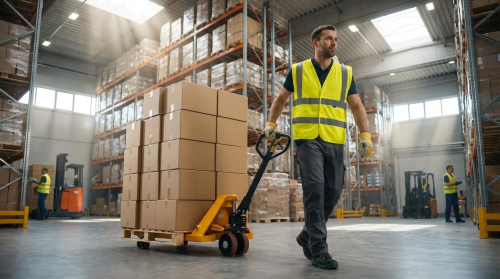
Hydraulic stroke and frame stiffness ultimately cap how high a pallet jack can lift before the cylinder runs out of travel or the forks and mast deflect too much under rated load.
| Component / Spec | Typical Values (from sources) | Engineering Constraint | Field Impact on “How High” |
|---|---|---|---|
| Standard manual jack lift height | ≈110 mm lifting height, ≈195 mm max fork height (lifting height data) (spec data) | Short single‑acting cylinders are compact and stiff, but simply don’t have the stroke to go higher without redesigning the whole frame. | For standard trucks, the practical answer to “how high can a pallet jack lift” is “around 200 mm, not more.” |
| High‑lift pallet jack lift height | Up to ≈800 mm lifting height for high‑lift models (high‑lift height data) | Requires longer‑stroke or multi‑stage cylinders and scissor mechanisms; bending loads on rods and mounts increase sharply with height. | Great for work positioning, but you must respect capacity derating and avoid shock loading at full height. |
| Manual pallet stacker lift height | 1,600–3,000 mm depending on model (manual stacker heights) | Mast and cylinder system behaves more like a small forklift; mast deflection and chain stretch limit safe rated height. | Stackers answer “how high can a pallet jack lift” when you truly need >800 mm, but they are a different equipment class operationally. |
| Electric pallet truck lift range | Min ≈85 mm, max ≈205 mm (electric lift height) | Electric units keep similar stroke to manual jacks to protect stability while focusing power on traction and ease of use. | Electric walkies do not typically lift higher; they just do the same lift range with less operator effort and better control. |
| Frame and fork stiffness under load | Capacities 2,000–3,000 kg for electric jacks (capacity data) | As lift height increases, elastic deflection of forks and mast grows, tilting the load and shifting the centre of gravity outward. | Operators feel this as “sway” at height; excessive flex is why high‑lift units have reinforced frames and sometimes stabilizing legs. |
| Hydraulic sealing and holding ability | Designed to hold static loads over full stroke in both manual and electric systems (manual operation) (electric hydraulics) | Higher stroke means more area for leakage and more leverage on seals; tiny internal leaks cause noticeable “creep” at height. | In production areas, any slow sinking at work height is a red flag for maintenance and a reason to avoid operating near max stroke. |
💡 Field Engineer’s Note: If you routinely lift near the top of stroke at or near rated capacity, expect more frequent seal changes and fork straightening – your maintenance budget will quietly answer “how high is too high.”
Stability, safety margins, and standards
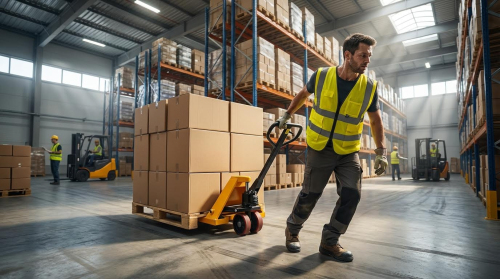
Stability and safety standards restrict maximum pallet jack lift height by requiring a safe centre of gravity, adequate wheel contact, and controlled operator behaviour, especially as height and load increase.
- Low travel height is a safety requirement: Best practice is to travel with forks only 20–50 mm above the floor so the centre of gravity stays low and the truck remains stable on imperfect surfaces; this is why even high‑lift units are meant to move loads low, not at full height.
- Support polygon and wheelbase: Standard pallet jacks rely on a simple triangle of support (two load wheels plus steering wheels). As lift height increases, the combined centre of gravity moves upward and slightly outward, reducing the stability margin inside that triangle.
- High‑lift stabilizers and outriggers: High‑lift pallet jacks around 800 mm often add side stabilizers or front outriggers to widen the support base and keep the truck from tipping as the load rises.
- Stacker masts and derating: Manual pallet stackers lifting 1,600–3,000 mm use masts and counterbalance principles similar to small forklifts and typically derate capacity at higher heights to maintain stability (stacker specs).
- Operator practices under safety codes: Guidance aligned with OSHA/ISO expectations requires stable, centred loads, avoiding stacking too high, and keeping hands and feet inside the operating envelope to mitigate tipping and crush hazards (safety practices).
- Inspection and defect control: Daily or per‑shift inspections are recommended so worn wheels, bent forks, or leaking hydraulics do not erode the built‑in stability and safety margin at height (inspection protocols).
💡 Field Engineer’s Note: From a safety engineer’s perspective, the real question isn’t “how high can a pallet jack lift,” but “at what height do we stop lifting and start moving.” Smart sites lock in a rule: raise only enough to clear the floor, move, then lower before travel speed increases.
Matching Lift Height To Applications And Aisles

Matching pallet jack lift height to applications means sizing minimum and maximum fork height to pallets, docks, conveyors, and aisle constraints so operators can safely answer “how high can a pallet jack lift” for every task.
💡 Field Engineer’s Note: When I troubleshoot dock jams, the root cause is often a 10–20 mm lift mismatch—forks either can’t clear the pallet on a rough floor, or they over-lift and hang up on dock plates or conveyor lips.
Choosing lift height for pallets, docks, and conveyors
Choosing pallet jack lift height for pallets, docks, and conveyors means aligning typical 185–210 mm fork heights (standard jacks) or up to 800 mm (high-lift) with your exact pallet thickness and transfer surface levels.
| Use Case | Typical Required Max Fork Height | Relevant Equipment Range | Engineering Check | Field Impact |
|---|---|---|---|---|
| Standard pallet transport (floor to floor) | ≈ 185–210 mm | Manual pallet trucks: max fork height 195 mm; lift ≈ 110 mm specs. Electric pallet jacks: max ≈ 205 mm data. | Confirm pallet height (typically ≈ 90 mm) + 25–50 mm floor clearance. | Ensures the pallet clears floor bumps without over-stroking the hydraulic system. |
| Feeding low conveyors from floor | Conveyor top height + 20–30 mm safety margin | Standard jacks work only if conveyor is near floor level; otherwise high-lift or stacker needed. | Measure conveyor top surface from floor; compare to jack’s max fork height. | Too-low max height causes hard pushing and edge impacts; too high wastes pump strokes and slows throughput. |
| Dock loading with dock leveler | Dock height + leveler lip thickness + 20–30 mm | Standard jack lift (≈ 195–205 mm) is usually enough for level docks. | Check maximum dock plate angle and lip thickness versus pallet bottom. | Proper match avoids pallets catching on dock lips and reduces handle shock loads. |
| Ergonomic picking / work positioning | 600–800 mm | High-lift pallet jacks: lift up to ≈ 800 mm range. | Confirm operator elbow height and carton reach zone; keep work between hip and knuckle height. | Reduces bending and pick fatigue but changes stability; usually not for traveling with load raised. |
| Low mezzanine or first beam level transfer | 1,600–3,000 mm | Manual pallet stackers: lift 1,600–3,000 mm specs. | Check rack beam height and required under-beam clearance for pallet entry. | Enables basic stacking without a forklift but requires very flat floors and trained operators. |
How high can a pallet jack lift in real-world operations?
In most warehouses, “how high can a pallet jack lift” means ≈ 185–210 mm for standard manual or electric units, ≈ 800 mm for high-lift versions, and up to 1,600–3,000 mm only when you move to stackers with masts.
- Check minimum fork height vs pallet entry: Standard manual and electric jacks start around 85 mm minimum fork height data, matching typical pallet openings; low-profile pallets may need special jacks.
- Keep travel height low: For safety, move loads with forks only 20–50 mm above the floor to keep the center of gravity low and reduce tip risk on uneven surfaces.
- Account for floor imperfections: Add 10–20 mm margin to clear known high spots, dock transitions, and expansion joints without scraping or stalling.
- Coordinate with upstream equipment: Align jack lift height with dock levelers, conveyors, and pallet wrappers to avoid manual re-lifting or pry-bar “fixes.”
Narrow aisle, floor conditions, and TCO considerations
Narrow aisles, floor conditions, and lifecycle cost dictate whether you stay with standard 200 mm-class lift or justify higher-lift pallet trucks and stackers, because maneuverability, wear, and maintenance scale with lift height.
| Constraint / Factor | Typical Value / Range | Design / Spec Consideration | Field Impact on Lift Height Choice |
|---|---|---|---|
| Right-angle aisle width | Electric pallet truck: ≈ 2,410–2,533 mm for common pallet sizes specs. | Verify your aisle width vs truck’s rated right-angle stacking aisle. | In tighter aisles, adding a mast (stacker) may force wider aisles; a low-lift electric jack might be the better TCO choice. |
| Turning radius | Manual stackers: ≈ 1,350–1,600 mm data. Electric jacks: up to ≈ 1,730 mm data. | Higher-lift equipment usually has a larger turning radius due to mast and chassis length. | In very narrow aisles, a high-lift stacker may reach the height you want but simply cannot maneuver to the pick face. |
| Floor quality and slope | Gradeability for electric pallet jacks: ≈ 5–16% depending on load specs. | Poor floors and ramps amplify instability when loads are lifted higher. | Sites with uneven floors should favor standard lift (≈ 200 mm) and limit use of high-lift modes to flat, marked zones. |
| Operator effort and ergonomics | Manual jacks require repeated handle pumping; electric units use 24 V, 240 Ah systems data. | More lift height = more strokes (manual) or more energy (electric) per cycle. | High-lift is justified where it cuts bending and reach; otherwise, extra lift just slows cycles and wears components. |
| Maintenance and lifecycle cost (TCO) | Electric jacks need ~8 h charge + 8 h cooling when fully discharged guidance. | Higher lifts increase stress on frames, wheels, and hydraulics, accelerating wear. | Spec only as much lift as you truly use; every extra centimeter you regularly exploit shows up later as seal, wheel, and fork repairs. |
- Narrow aisle strategy: In aisles close to 2,400–2,500 mm, prioritize compact electric pallet jacks with standard ≈ 205 mm lift over tall stackers unless you must stack above floor level.
- Floor condition rule-of-thumb: The rougher the floor or steeper the ramp, the more you should cap operating lift height during travel and keep “how high can a pallet jack lift” limited to static, flat work zones.
- Energy and battery planning: Frequent full-stroke lifting on electric jacks draws more from the 24 V system and may push you into extra batteries or chargers over the equipment’s life.
- Safety and standards: Align operating practices with OSHA/ISO guidance by traveling with low forks, avoiding stacked loads that exceed visibility, and using high-lift only in controlled, level areas.
Practical spec checklist before you buy
- Map all transfer heights: List floor, dock, conveyor, and first-beam levels, then match to jack or stacker lift specs.
- Measure aisles and turning zones: Compare to manufacturer right-angle aisle and turning radius data.
- Walk the floor: Note slopes, potholes, dock transitions, and expansion joints that affect usable lift height.
- Estimate duty cycle: Count lifts per hour and fraction of lifts near maximum height to model maintenance and TCO.
Final Thoughts On Specifying Pallet Jack Lift Height
Pallet jack lift height is not just a catalogue number. It is a design limit that ties fork geometry, hydraulic stroke, stiffness, and stability into one safety envelope. Standard manual and electric units sit around 200 mm fork height because that range balances pallet clearance, linkage efficiency, and low center of gravity on real warehouse floors. High‑lift jacks and stackers push into the 800–3,000 mm band only by adding stronger frames, longer‑stroke hydraulics, and wider support bases, and they demand tighter controls on floor quality and operator behavior.
Engineering and operations teams should start with measured interface heights, aisle widths, and floor conditions, then select the lowest lift range that still clears every transfer point with a defined safety margin. Use standard jacks for floor‑to‑floor moves, high‑lift units for ergonomic workstations, and stackers only where true vertical transfer is essential. Train operators to travel low, center loads, and avoid running near full stroke except in controlled zones. When in doubt, prioritize stability and lifecycle cost over “extra” height. That approach lets Atomoving pallet trucks and stackers work inside their engineered limits, cut damage and downtime, and keep your warehouse both productive and safe.
Frequently Asked Questions
How high can a standard pallet jack lift?
A standard manual pallet jack can lift loads up to 8 inches off the ground. However, high-lift pallet jacks are capable of lifting loads up to 32 inches high. Pallet Jack Lift Guide.
What is the maximum height for an electric pallet jack?
Electric pallet jacks typically lift to a height of around 6 inches, similar to manual models. However, specialized electric pallet jacks can lift loads to over 20 inches. These are often used in warehouses and distribution centers where frequent lifting is required. Electric Pallet Jack Guide.
What is the maximum safe height for stacking pallets?
As a general rule, pallets can be safely stacked up to a maximum of 60 inches high. Heavier boxes should be placed at the bottom, with lighter ones on top to ensure safety and protect the shipment. Pallet Stacking Safety.