Choosing a machine to lift pallets of stuff required a clear view of both engineering limits and real warehouse constraints. This article outlined how core pallet lifting equipment evolved from simple pallet jacks to forklifts, reach trucks, and pallet inverters. It also examined selection criteria such as load capacity, stability, mast design, fork geometry, power source, and lifecycle costs. Finally, it explored automation, safety systems, digital integration, and concluded with practical guidance for matching pallet lifting technology to specific industrial applications.
Core Types Of Equipment That Lift Pallets
Engineers evaluating a machine to lift pallets of stuff consider four primary equipment families. Manual and electric pallet jacks handle low-lift horizontal moves. Walk-behind and rider pallet stackers bridge the gap to medium-height storage. Forklifts, reach trucks, pallet inverters, and other specialized lifters cover high stacking, heavy loads, and load rotation tasks.
Manual And Electric Pallet Jacks
Manual pallet jack and electric pallet jacks provide the simplest machine to lift pallets of stuff over short distances. Manual jacks used a hydraulic pump actuated by a tiller handle, typically lifting 1–2 tonnes up to about 200 mm. Operators used them for low-level transport between staging areas, docks, and production cells. Electric pallet jacks added powered lift and traction, reducing operator effort and improving throughput for repetitive moves.
Typical electric units carried 1,000–2,500 kg and offered better acceleration and braking control than manual models. Both types remained unsuitable for stacking because their lift height stayed below rack beam levels. However, their compact chassis and small turning radius allowed operation in aisles narrower than 2 m. For facilities prioritizing cost, maneuverability, and low-maintenance design, pallet jacks often delivered the lowest lifecycle cost per moved pallet.
Walk-Behind And Rider Pallet Stackers
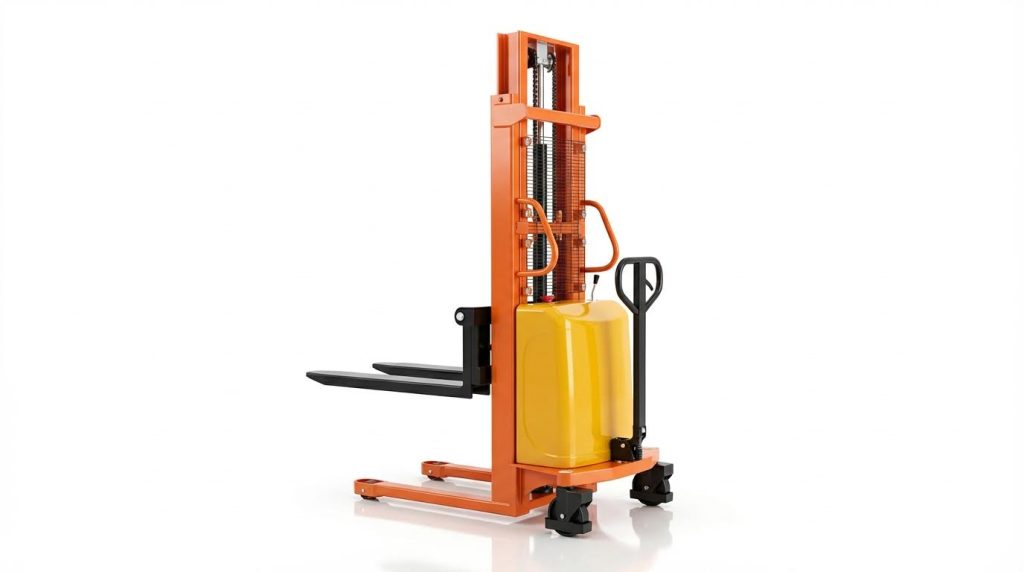
Walk-behind and rider pallet stackers formed the next step up when users needed a machine to lift pallets of stuff into racking. These machines combined pallet truck-style forks with a vertical mast, enabling lift heights of roughly 3–6 m depending on configuration. Typical rated capacities ranged from 1,000–2,500 kg at low lift, derating progressively with height to maintain stability and protect mast structures.
Walk-behind stackers placed the operator on foot behind a tiller arm, which suited short travel distances and tight spaces. Rider stackers added a standing or seated platform, improving productivity in larger warehouses with longer travel runs. Compared with forklifts, stackers offered lower purchase cost, smaller battery systems, and reduced training requirements. Their limitation appeared in outdoor use, rough floors, and very high-bay storage where mast deflection and residual capacity became critical constraints.
Forklifts And Reach Trucks
Forklifts and reach trucks represented the most versatile class of machine to lift pallets of stuff in industrial environments. Counterbalance forklifts carried the load ahead of the front axle and used a rear counterweight to balance moments. Standard electric or internal combustion models handled 1,500–5,000 kg, while heavy-duty variants exceeded 20,000 kg. Lift heights typically ranged from 3 m to above 10 m, depending on mast design.
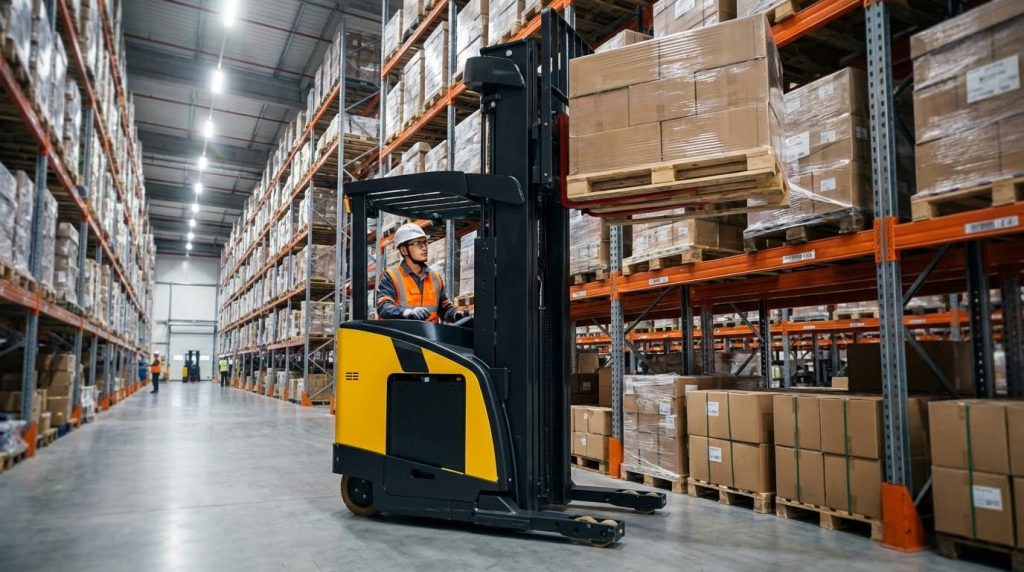
Reach trucks targeted high-density, narrow-aisle racking. They used a pantograph or moving mast to extend forks into the rack while keeping the truck body in the aisle. Typical capacities fell in the 1,000–2,500 kg range with lift heights up to 10–12 m. These trucks required certified operators because of higher kinetic energy, complex stability envelopes, and stringent safety regulations. Engineers selected between counterbalance and reach designs based on aisle width, rack height, floor quality, and required handling speed.
Pallet Inverters And Specialized Lifters
Pallet inverters and specialized pallet lifters addressed non-standard use cases where a conventional machine to lift pallets of stuff was inefficient. Pallet inverters clamped and rotated full pallet loads, usually through 90–180 degrees. Operators used them to replace damaged pallets, switch between in-house and shipping pallets, or reorient loads for freezing and curing processes. Typical inverters handled 1,000–2,000 kg and accepted a range of pallet heights using adjustable clamps.
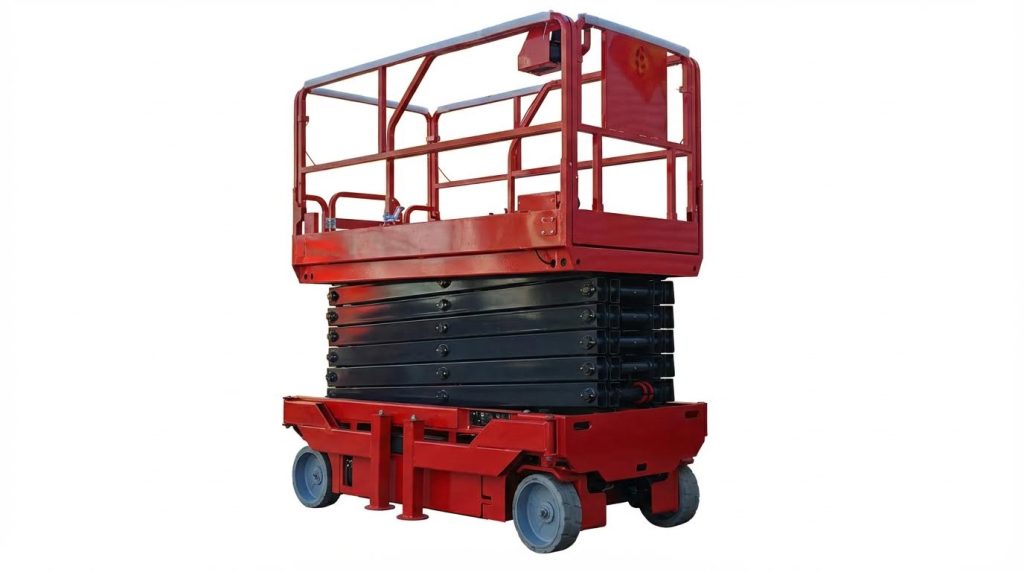
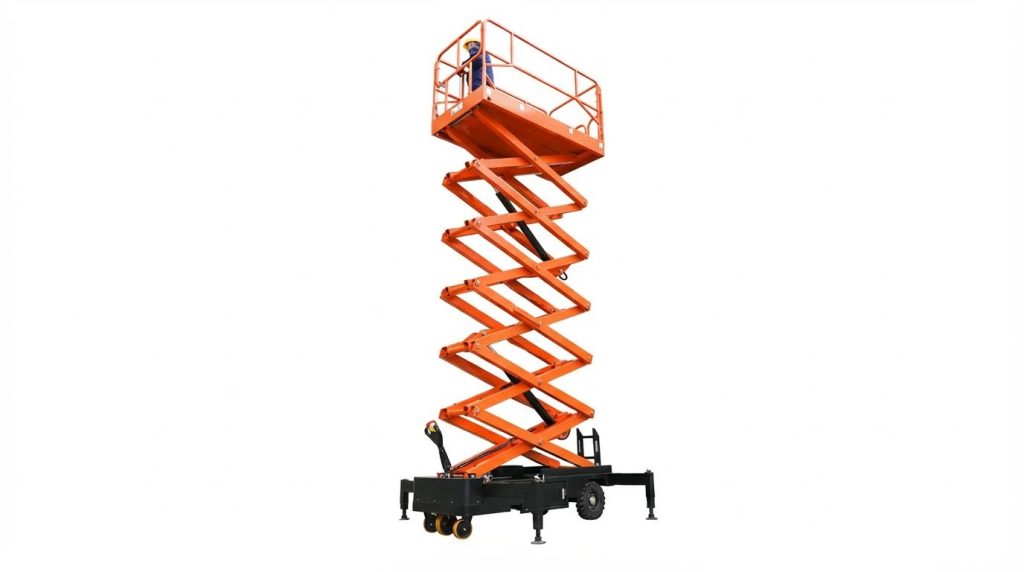
Other specialized lifters included drum handlers, clamp trucks, and scissor-lift tables configured for pallet interfaces. Scissor lifts raised pallets to ergonomic working heights, commonly 800–1,200 mm, to reduce bending during picking or assembly. Clamp attachments allowed handling of unit loads without forks, such as white goods or paper rolls stacked on pallets. These solutions often integrated with conveyors or AS/RS systems, forming part of a broader material handling architecture rather than operating as stand-alone vehicles.
Engineering Selection Criteria And Design Limits
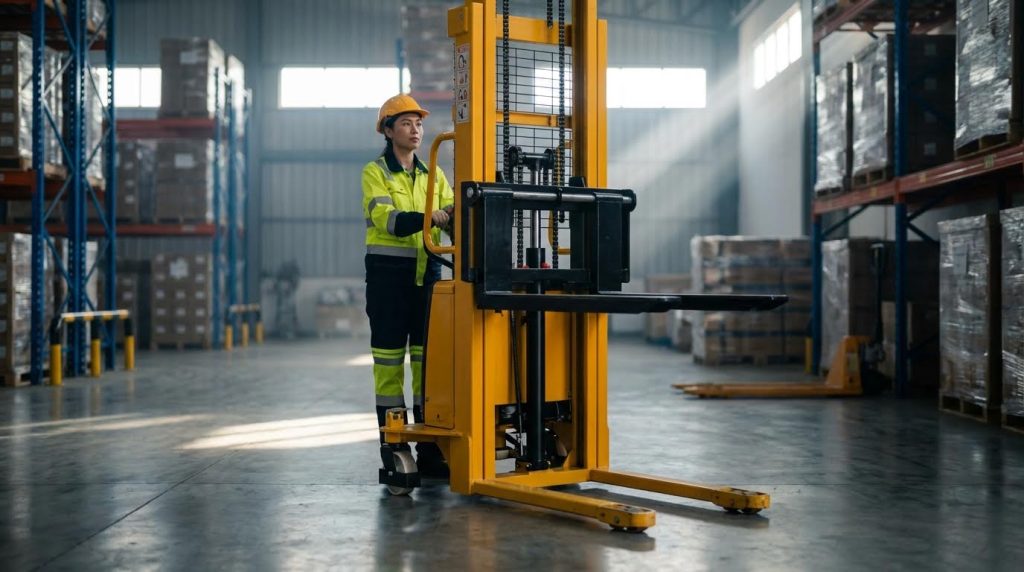
Engineers who specify a machine to lift pallets of stuff must balance capacity, reach, stability, and lifecycle cost. Selection decisions define not only throughput but also safety margins and asset longevity. The following criteria help match pallet jacks, stackers, forklifts, and reach trucks to the real constraints of a warehouse or production line.
Load Capacity, Stability, And Center Of Gravity
Load capacity is the first filter when choosing a machine to lift pallets of stuff. Typical pallet stackers handle 1,000–2,500 kg, while forklifts range from 1,000 kg to more than 20,000 kg. Pallet jacks usually lift between 1,000–2,500 kg and only raise loads about 200 mm, which improves inherent stability but prevents stacking. Engineers must compare rated capacity on the data plate with the actual load, including pallet mass, wrap, and attachments.
Stability depends on the combined center of gravity (CoG) of truck and load. As lift height increases, the CoG rises and shifts, reducing the stability triangle margin. Long or top-heavy loads move the CoG forward, which derates the allowable capacity at a given load center. Standards required that manufacturers publish capacity at a reference load center, often 500 mm, and provide derating curves for higher masts or attachments. Designers should specify equipment with at least 20–30% capacity headroom for worst-case loads, dynamic braking, and minor impacts.
Lift Height, Mast Design, And Aisle Constraints
Required lift height comes directly from racking geometry and clearance rules. Stackers commonly reach 3–4 m, while reach trucks and forklifts can exceed 10 m with specialized masts. Engineers must account for under-beam clearance, pallet deflection, and a safety margin, usually 150–200 mm above the top storage level. Mast type strongly affects both stability and aisle layout.
Single-stage masts suit low lift applications and offer better visibility and stiffness. Two- or three-stage masts enable high stacking but increase mast flex and complexity. In narrow aisles, reach trucks or stackers with compact chassis and high masts handle vertical storage while keeping aisle widths down. Aisle width calculations should include truck length, load overhang, steering angle, and a clearance factor, often 200–300 mm, for maneuvering. If the warehouse uses very narrow aisles, engineers may consider rail- or wire-guided systems or automated stacker cranes instead of conventional forklifts.
Fork Dimensions, Adjustability, And Telescopic Reach
Fork length and width must match pallet standards and any non-palletized loads. Typical fork lengths range from 1,000–1,600 mm, with extended designs reaching about 1,800 mm. Oversized forks help support long loads but increase turning radius and risk of floor contact on ramps. Fork thickness influences entry into low-profile pallets and impacts stress distribution under heavy loads.
Adjustable fork spread, often 500–1,200 mm or up to 450–1,350 mm, allows a single machine to lift pallets of different widths. Engineers should confirm that adjustment does not reduce rated capacity or violate fork arm bending limits. Telescopic forks extend reach into double-deep racking or across truck beds without moving the chassis. However, extension shifts the load center forward, which significantly derates capacity and affects tilt limits. Design reviews must check manufacturer derating charts for every planned reach configuration and include sensors or indicators that prevent lifting beyond safe extension with a given load.
Power Source, Duty Cycle, And Lifecycle Costs
Power source selection for a machine to lift pallets of stuff depends on duty cycle, environment, and total cost of ownership. Manual pallet jacks fit low-duty, short-distance moves with minimal maintenance and no battery infrastructure. Electric pallet jacks and walk-behind stackers suit light to medium-duty warehouse operations, where daily usage hours remain moderate and zero local emissions are required. For intensive multi-shift work, engineers typically specify electric rider forklifts or reach trucks with high-capacity traction batteries or fast opportunity charging.
Internal combustion forklifts historically handled outdoor or rough-terrain work and very high capacities, but indoor use required strict ventilation management. Duty cycle analysis should quantify load mass, travel distance, lift frequency, and peak versus average utilization. This data drives battery sizing, charger count, and spare battery strategy. Lifecycle cost models must include energy consumption, tires, planned maintenance, unscheduled repairs, and operator training, not only purchase price. Equipment with higher efficiency, better access for service, and robust components often reduces cost per pallet moved over a 5–10 year horizon, even when initial investment is higher.
Automation, Safety Systems, And Digital Integration
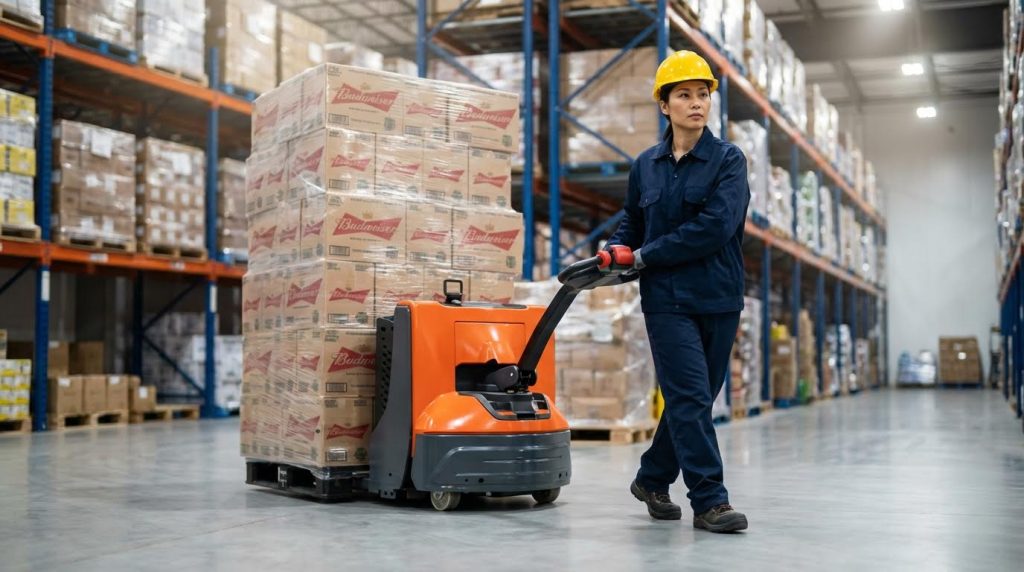
When engineers specify a machine to lift pallets of stuff, automation and digital safety systems now influence as much as raw load capacity. Modern pallet stackers, forklifts, and stacker cranes integrate drives, sensors, and software to control motion, protect operators, and connect to warehouse IT systems. This section explains how semi-automated equipment, advanced sensing, IoT connectivity, and human-factor-based safety design reshape pallet lifting operations.
Semi-Automated Stackers And Stacker Cranes
Semi-automated pallet stackers assisted the operator with powered lift and traction but still required human guidance for steering and load positioning. Engineers selected walk-behind units for short travel distances and confined aisles, while rider stackers suited longer runs and higher throughput. Typical stackers lifted 1,000–2,500 kg to heights of 3–6 m, bridging the gap between pallet jacks and fully automated systems. Stacker cranes, by contrast, operated as part of Automated Storage and Retrieval Systems, running on rails in narrow aisles and controlled by warehouse management software. They handled repetitive, high-density storage tasks with minimal human intervention, making them ideal when a machine to lift pallets of stuff had to operate continuously with high cycle counts.
Sensors, Load Monitoring, And Stability Control
Modern pallet lifting equipment increasingly used sensors to monitor load, position, and stability in real time. Load cells in forks or mast carriages measured actual mass and compared it with the rated capacity, blocking lifts that exceeded design limits. Inclinometers and mast angle sensors fed data to stability control algorithms, which reduced travel speed or limited lift height when the center of gravity approached the stability envelope. Height encoders and fork-position sensors supported precise pallet engagement, especially at 3–10 m lift heights in racking. These sensing systems turned a basic machine to lift pallets of stuff into a controlled platform that actively prevented tip-overs, overloads, and misaligned entries into pallets.
Predictive Maintenance, IoT, And Digital Twins
IoT connectivity allowed engineers and maintenance teams to track pallet lifting equipment usage, faults, and wear indicators remotely. Controllers transmitted data on lift cycles, travel distance, overload events, and battery or hydraulic temperatures to cloud or on-premise systems. Predictive maintenance algorithms then used this data to forecast failures of components such as lift chains, hydraulic seals, or traction motors before breakdowns occurred. For high-value systems like stacker cranes or intensive-duty forklifts, digital twins mirrored the physical machine in software, simulating stress, utilization, and control logic changes. These tools helped optimize duty cycles, right-size fleets, and plan service windows, ensuring that a machine to lift pallets of stuff remained available and safe throughout its design life.
Safety Standards, Training, And Human Factors
Regulatory frameworks, including OSHA rules and ISO material handling standards, defined baseline requirements for pallet lifting equipment design and operation. Engineers had to ensure capacity plates, emergency stops, guarding, and braking systems complied with these standards for every machine to lift pallets of stuff deployed on site. Human factors engineering further shaped control layouts, visibility, and warning systems to reduce operator error. Features such as deadman switches, automatic speed reduction in turns, and audible-visual alarms around pedestrians addressed common accident scenarios. Structured training programs covered load charts, stability principles, pre-use inspections, and emergency procedures, tying the technical safety systems to operator behavior. Together, standards, ergonomics, and training created a layered defense that complemented the automated protections built into modern pallet lifting machines.
Summary And Practical Guidance For Pallet Lifting Choices
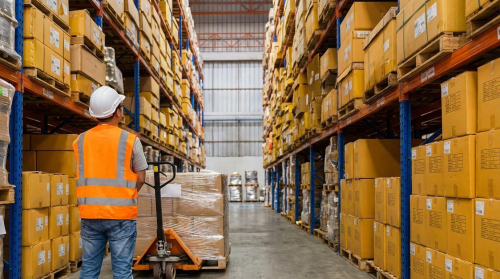
Choosing a machine to lift pallets of stuff requires matching equipment capabilities to real operating constraints. Engineers and warehouse planners should translate throughput, load spectrum, and aisle geometry into clear technical requirements before specifying any solution.
For low lift heights and short horizontal moves, a manual pallet jack often provides the best value. Typical capacities range from about 1,000 kg to 2,500 kg with lift heights below 0.2 m, which suits dock work, staging, and line feeding. Manual units minimize capital cost but rely on operator effort, so they fit low-duty or short-shift operations. Electric pallet jacks reduce fatigue and increase cycle rate, but they introduce battery maintenance and charging infrastructure requirements.
Where you must stack pallets, use gravity racks, or feed multi-level storage, a manual platform stacker or reach-type machine becomes the primary option. Walk-behind stackers fit narrow aisles and lighter pallets, typically up to 2,500 kg and 3–4 m lift. Rider stackers and reach trucks handle higher racking, often up to 6–10 m, and support higher cycle frequencies. Before selection, verify mast height against top beam level plus clearance, check minimum turning radius against aisle width, and confirm that the rated capacity at the maximum lift height covers your heaviest pallet plus packaging.
Forklifts serve as the most versatile machine to lift pallets of stuff when operations include outdoor yards, uneven floors, or very heavy loads. Counterbalance trucks cover a wide capacity band, from about 1,000 kg to more than 20,000 kg, and support attachments such as clamps or booms. However, they require larger aisles, certified operators, and stricter traffic management. In contrast, pallet inverters or specialized lifters suit niche tasks such as rotating full loads, exchanging pallets, or handling unstable packaging. These devices reduce manual rework and product damage but must be justified by the frequency of such tasks.
Across all options, safety and lifecycle cost drive long-term performance. Engineers should compare not only purchase price but also energy consumption, tire and wheel wear, hydraulic maintenance, and expected battery replacement intervals for electric units. Routine inspection of forks, masts, chains, and hydraulics, combined with operator training, prevents overloads and tip-overs. Looking ahead, greater use of sensors, load monitoring, and warehouse management integration will push even basic pallet lifting machines toward semi-automated operation. A balanced strategy often combines simple pallet jacks for flexible tasks with higher-capacity stackers or forklifts for structured storage, ensuring each pallet moves with the safest and most efficient equipment available.