
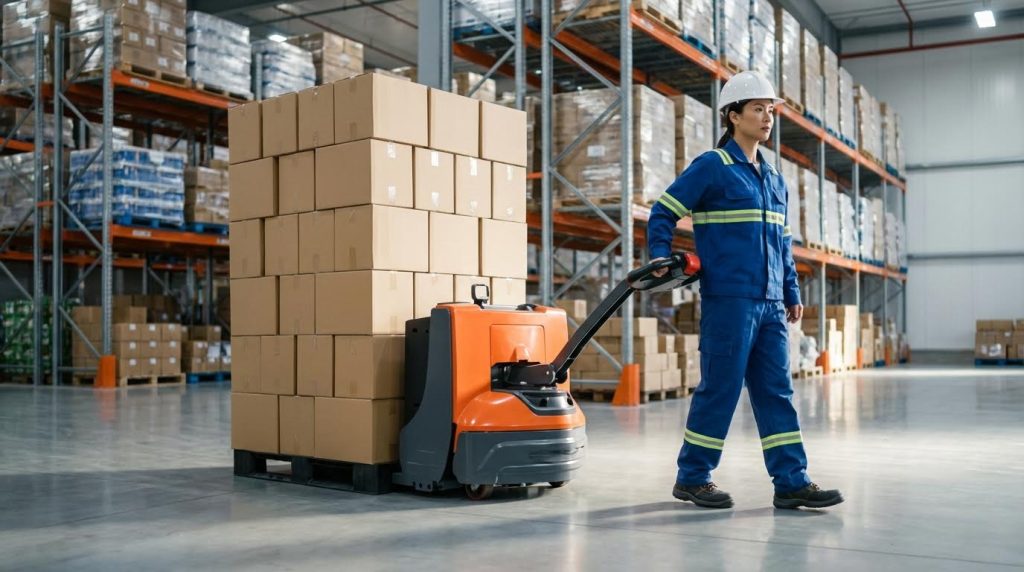
Understanding how a pallet jack lifts is about understanding how a small hand force turns into enough hydraulic pressure to raise 2,000–3,000 kg pallets safely and repeatedly. The core mechanism combines a lever-driven pump, sealed hydraulic circuit, and single-acting lift cylinder that converts oil pressure into vertical fork movement. This article breaks down the force path from handle to pump, the internal hydraulic circuit, and the key components and failure modes that matter in real-world warehouses. You will also see how load ratings, floor conditions, and maintenance practices govern safety, uptime, and compliance in everyday pallet truck operations.
Core Lifting Principle Of A Manual Pallet Jack
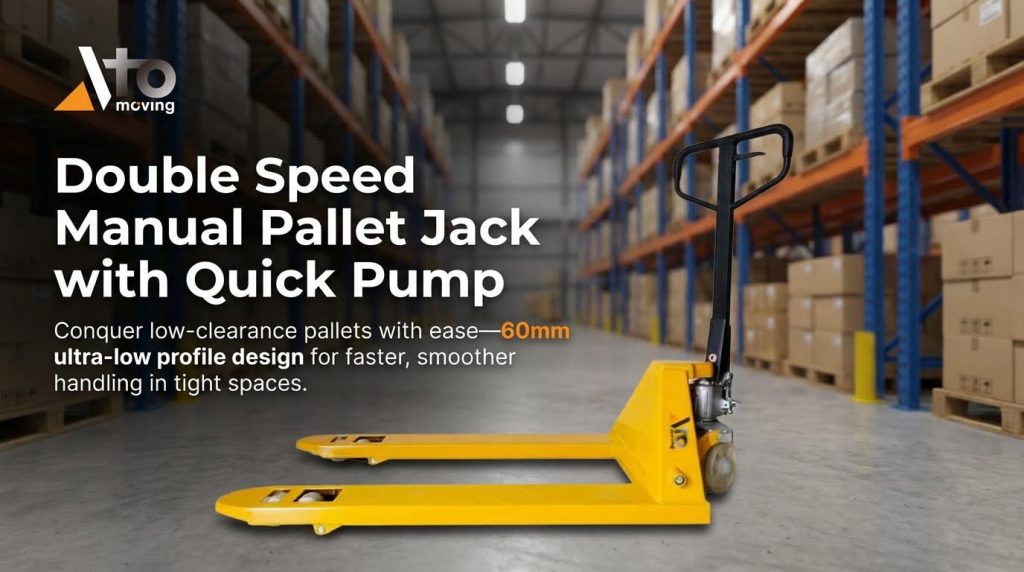
The core lifting principle of a manual pallet jack is that the handle acts as a lever driving a small hydraulic pump, which pressurizes oil in a single‑acting cylinder to raise or lower the forks in a controlled way.
Force multiplication from handle to hydraulic pump
Force multiplication in a pallet jack comes from combining a long handle lever with a small‑bore pump piston so a modest hand force generates high hydraulic pressure to lift loads of 2,000+ kg efficiently.
| Element | Engineering Role | What Actually Happens When You Pump | Field Impact (Operator Experience) |
|---|---|---|---|
| Handle / Tiller Lever | Primary mechanical lever | Operator applies force ~0,2–0,4 m from pivot, creating torque that rotates the base of the handle | Small hand force translates into useful work; operators can lift heavy pallets repeatedly without fatigue |
| Linkage to Pump Piston | Converts rotation to linear stroke | Crank, cam, or link arms turn the handle motion into a short linear push on the pump plunger | Each pump stroke is short and quick, allowing fast cycle times in loading docks and aisles |
| Lever Ratio | Sets mechanical advantage | Long handle vs. short pump arm multiplies input force but reduces piston travel per stroke | Balanced design keeps handle effort low while avoiding excessive strokes per lift |
| Small‑Diameter Pump Plunger | Concentrates force into pressure | Force from the linkage acts on a small area, generating high hydraulic pressure in the oil | Enables lifting of heavy pallets with minimal exertion; critical to how a pallet jack lifts without power |
| Operator Input Speed | Controls oil flow rate | Faster pumping moves more oil per minute into the cylinder | Operators can choose between quick, light pumping or slower, heavier strokes depending on load and ergonomics |
The mechanical side of how a manual pallet jack lifts starts with the handle acting as a classic second‑class lever. The distance from the operator’s hands to the pivot is much larger than the distance from the pivot to the pump link, so torque and force are multiplied at the pump plunger. As the handle is cycled up and down, the linkage converts that angular motion into a reciprocating motion of the pump piston inside the hydraulic block. This small piston pushes hydraulic oil from the reservoir into the high‑pressure side of the circuit with each stroke as described in typical pallet truck designs.
💡 Field Engineer’s Note: If operators complain that “this jack lifts harder than the others,” it’s often not just wear; a slightly bent handle or worn linkage pin changes the effective lever ratio and pump stroke, increasing required effort and slowing lift.
Why lever design matters for ergonomics
Lever geometry directly sets the handle force needed to reach working pressure (often in the 10–20 MPa range for small hydraulic systems). A longer handle or shorter pump arm reduces handle force but increases the number of strokes to full lift. Good designs balance these factors so most operators can lift rated loads repeatedly without exceeding typical ergonomic limits on push/pull forces and shoulder torque.
How the hydraulic circuit raises and lowers the forks
The hydraulic circuit in a pallet jack uses a pump, reservoir, check valves, and a single‑acting cylinder so that pressurized oil raises the forks and a controlled valve opening lets oil return to the tank, lowering the load under gravity.
| Stage | Hydraulic Component Involved | What the Oil Does | Field Impact (How the Forks Behave) |
|---|---|---|---|
| Neutral (Travel) | Reservoir, closed check valves, closed release valve | Oil stays in place; no flow to or from the lift cylinder | Forks stay at current height during travel; no unintended lift or drop |
| Pumping / Lifting | Pump piston, inlet & outlet check valves, single‑acting cylinder | Pump draws oil from reservoir, then pushes it past the outlet check valve into the cylinder chamber | Forks rise smoothly a few millimetres per stroke, lifting the pallet clear of the floor |
| Holding | Cylinder, check valves, seals and O‑rings | Pressurized oil is trapped in the cylinder by closed check valves | Forks maintain height under load; any slow sinking usually means internal leakage past seals |
| Lowering / Descent | Release (directional) valve, return passage to reservoir | Opening the valve lets oil flow back from the cylinder to the reservoir under load weight | Forks lower under gravity at a controlled speed, allowing precise placement and safe unloading |
| Over‑pressure Protection* | Relief valve (where fitted) | Opens if pressure exceeds a set limit, diverting oil back to tank | Prevents structural or seal damage from overload, supporting safe operation |
During lifting, the operator sets the control lever to the “raise” position so the release valve is closed. As the handle pumps, the hydraulic pump draws oil from the small tank and pressurizes it, forcing it through directional/check valves into the single‑acting lift cylinder as outlined for basic hydraulic systems. The pressurized oil acts on the piston area, pushing the ram out and transmitting force through the jack’s linkage to raise the forks.
To lower the load, the control lever moves to the “lower” position, mechanically opening the release (directional) valve in the pump block. This creates a flow path back to the reservoir so the pressurized oil in the cylinder can return to the tank. The load’s weight provides the driving force; the piston retracts and the forks descend under gravity at a rate controlled by the valve orifice size and lever position matching general pallet truck hydraulics. Check valves and seals keep the system closed during holding, which is why trapped air or worn O‑rings quickly show up as “no lift” or slow sinking issues in typical maintenance diagnostics.
💡 Field Engineer’s Note: When operators say “the forks won’t stay up,” don’t just add oil—internal bypass at the cylinder or valve (worn seals, contaminated seats) is usually the real reason the hydraulic circuit can’t hold pressure.
How this explains “how a pallet jack lifts” in simple terms
Mechanically, your hands move the handle; the handle drives a small pump. Hydraulically, that pump squeezes oil into a cylinder, and oil can’t compress, so the force goes into lifting the forks. To come back down, you give the oil a way out through the release valve, and gravity does the rest. That complete loop—lever, pump, oil, cylinder, and valve—is the practical answer to how a pallet jack lifts and lowers heavy pallets safely and repeatably.
Key Components In The Hydraulic And Linkage System
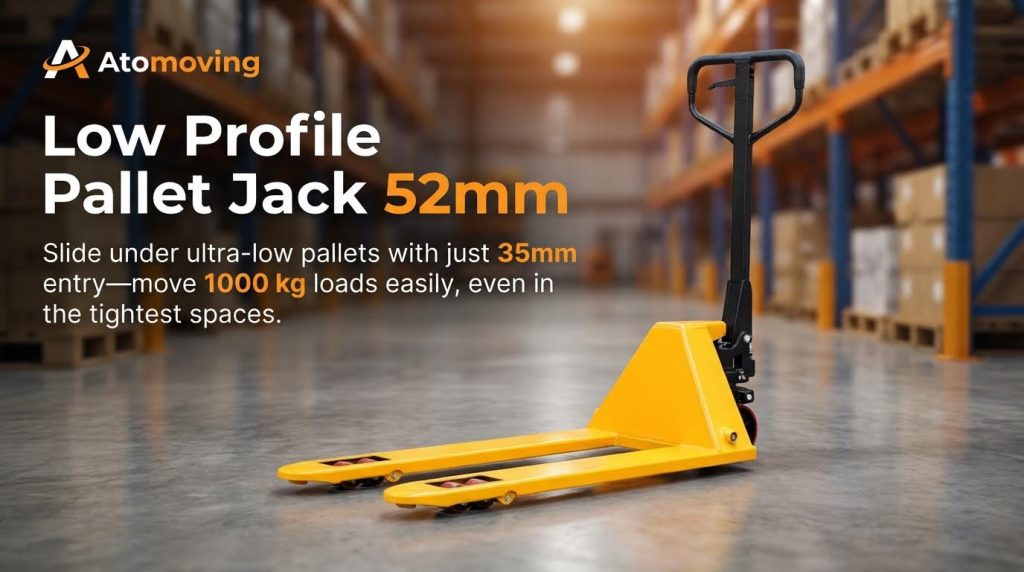
The key components in a pallet jack’s hydraulic and linkage system work together to convert short handle strokes into high-pressure oil flow and controlled fork movement, which is exactly how a pallet jack lifts heavy loads safely.
💡 Field Engineer’s Note: When you understand which component actually holds the load (usually check valves and seals in the pump block), you stop “chasing ghosts” and go straight to the real cause of slow sinking or no-lift complaints.
Pump block, check valves, and single-acting cylinder
The pump block, check valves, and single-acting cylinder</b form the sealed hydraulic core that builds, locks, and converts oil pressure into vertical lift, making them central to how a pallet jack lifts in daily operation.
| Component | Function in the Hydraulic Circuit | Typical Issues | Field Impact on How a Pallet Jack Lifts |
|---|---|---|---|
| Pump block (hydraulic pump body) | Houses the pump piston, inlet/outlet ports, and valve bores; converts handle motion into pressurized oil flow from the reservoir to the lift circuit via the hydraulic pump. | Internal wear, scoring, contamination, or cracked housing; mounting bolt loosening; external oil leaks around joints. | Reduced pressure, longer pump strokes, or total no-lift; operators feel “spongy” pumping and need more strokes to reach full fork height. |
| Check valves (inlet and outlet) | Directional valves that allow oil to enter the pump chamber from the tank and then flow one-way into the cylinder, preventing backflow and holding load height once pressure is built. | Debris on seats, worn balls or poppets, weak springs, or damage from over-pressure events. | Forks slowly sink under load or refuse to build height; jack may lift empty but not at rated load, indicating pressure is bleeding back through the valve. |
| Hydraulic reservoir (oil tank) | Stores hydraulic oil and feeds the pump inlet; often integrated into the pump block casting or attached housing with level checks and fill points. | Low oil level, contaminated oil, moisture ingress, or clogged filler/vent. | Air ingestion leads to “no-lift” or jerky lifting; contaminated fluid accelerates seal wear and valve sticking, increasing downtime and repair cost. |
| Single-acting lift cylinder | Receives high-pressure oil on one side of a piston, pushing the piston rod out to raise the jack’s internal lift link; lowering relies on gravity return as oil flows back to the tank through a valve. | Rod corrosion, internal scoring, sticking due to contaminants, or seal failure causing internal or external leakage. | Slow or uneven lifting, forks that won’t reach full stroke, or forks that drift down; operators may report that the jack “won’t stay up” even after pumping. |
| Relief / over-pressure valve | Limits maximum circuit pressure by bypassing oil back to tank when force exceeds design, protecting the pump, cylinder, and frame through safety relief control. | Incorrect setting, contamination preventing full closure, or spring fatigue. | Jack refuses to lift heavy but within-rated loads if set too low; if stuck closed, overloading can damage components and compromise safety compliance. |
How these components work together during a lift stroke
When the operator pumps the handle, the pump piston in the block draws oil from the reservoir through an inlet check valve, then forces it through an outlet check valve into the single-acting cylinder. As pressure builds, the cylinder piston extends and transfers force into the mechanical lift linkage, raising the forks. The check valves prevent oil from flowing backward, so the forks stay at height until the release path opens. This closed hydraulic core is the heart of how a pallet jack lifts and holds loads with minimal human effort.
Mechanical linkage, control rod, and release valve
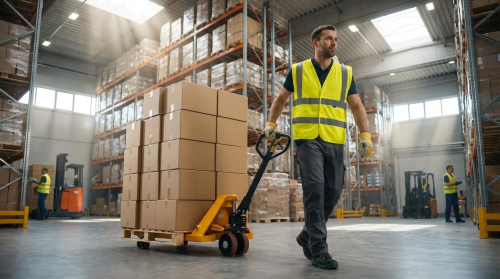
The mechanical linkage, control rod, and release valve</b translate handle motion into pump strokes and controlled oil release, governing how a pallet jack lifts, holds, and lowers with predictable, ergonomic behavior in tight warehouse aisles.
| Element | Role in Motion Transfer and Control | Failure / Misadjustment Modes | Field Impact on Lifting and Lowering |
|---|---|---|---|
| Handle / tow bar | Acts as a long lever to multiply operator input and drive the pump piston, while also steering the jack through combined lifting and steering function. | Bent handle, worn pivot bushings, excessive play, or broken return spring. | Poor leverage and increased operator effort; inconsistent pump stroke length; reduced pick rates and more ergonomic complaints on multi-shift operations. |
| Mechanical linkage (link arms, cams, levers) | Converts the handle’s rotary motion into linear plunger movement on the pump piston and into vertical lift at the fork wheels or internal lift point through lever systems. | Wear at pins and joints, lack of lubrication, bent links, or misalignment. | Shortened effective stroke, jerky lifting, or forks not rising evenly; operator may need many more pumps to reach pallet-clearance height. |
| Control rod / control cable | Connects the handle’s control lever (raise/neutral/lower) to the valve spool or release mechanism inside the pump block so the operator can switch oil flow paths. | Incorrect adjustment, stretching, bending, or seized joints. | Handle positions don’t match behavior: jack may lower while set to neutral, or refuse to lower until the lever is forced, risking sudden drops and safety violations. |
| Release valve / directional valve | Opens a controlled path for oil to return from the cylinder to the reservoir, enabling smooth, gravity-driven lowering of the forks through a managed descent circuit. | Sticking spool, contamination, worn seats, or over-tightened adjustments. | Forks may drop too fast, refuse to lower, or only lower under heavy load; operators lose fine control, increasing product damage and injury risk. |
| Linkage pivots and bearings | Provide low-friction rotation at every joint in the handle and lift mechanism, ensuring efficient transfer of manual input into hydraulic pressure and fork motion when kept lubricated. | Dry joints, corrosion, seized pins, or excessive wear gaps. | Higher push/pull forces, slower cycle times, and uneven lifting; can mask the true health of the hydraulic system during troubleshooting. |
- Why linkage matters to lifting performance: Even with a perfect hydraulic circuit, worn or stiff linkage robs stroke length and force, so the jack “feels weak” and operators blame hydraulics when the root cause is mechanical.
- Ergonomic impact: Optimised lever ratios and free-moving pivots reduce handle force, keeping operator exertion within recommended limits and supporting compliance with manual handling guidelines.
- Control accuracy: Correctly adjusted control rods and release valves allow millimetre-level lowering control, which is critical when positioning loads in tight rack tolerances.
💡 Field Engineer’s Note: When diagnosing “won’t lower” complaints, I always check the control rod adjustment and pivot lubrication before opening the hydraulic unit. A 2-minute linkage tweak often avoids an unnecessary hydraulic teardown.
Seals, fluid, and common hydraulic failure modes
Seals, hydraulic fluid, and typical failure modes</b directly determine how reliably a pallet jack lifts over its life, because they control pressure retention, internal friction, and contamination that can silently degrade lifting performance.
| Item / Failure Mode | Technical Description | Typical Cause | Field Impact on How a Pallet Jack Lifts |
|---|---|---|---|
| Rod seals and O-rings | Elastomeric seals around the cylinder rod, valve spools, and pump components that keep oil inside and air/contaminants out while maintaining pressure. | Ageing, chemical attack, abrasion from dirty oil, or damage during assembly. | Slow sinking under load, oil on the floor, or no-lift conditions from internal bypass; jack may lift empty but fail under working loads. |
| Hydraulic fluid condition | Oil transmits pressure and lubricates moving parts; its viscosity and cleanliness govern efficiency and component life across pump, valves, and cylinder. | Extended change intervals, wrong oil type, water ingress, or lack of filtration. | Jerky lifting, noisy operation, sticking valves, and accelerated seal wear; over time, the jack loses its ability to reach rated lift height smoothly. |
| Low fluid level / air in system | Insufficient oil in the reservoir allows air to enter the pump and cylinder, compressing under load and reducing effective pressure until bled out. | Leaks not topped up, incorrect filling, or lack of periodic level checks. | “Spongy” feel, many strokes with little lift, or complete no-lift; technicians often restore function by bleeding the system with repeated handle strokes under no load. |
| Valve sticking / contamination | Debris or sludge prevents check valves and release valves from sealing or moving freely within the hydraulic block. | Dirty environment, infrequent oil changes, or lack of filtration/cleaning. | Unpredictable lifting and lowering, including sudden drops or refusal to lift; operators lose confidence and may take unsafe shortcuts with loads. |
| Corrosion and external contamination | Rust on cylinder rods and pump components damages seal lips and introduces particles into the oil if cleaning is neglected. | Wet, chemical, or unclean environments without regular washdown and protection. | Increased leakage, rough rod travel, and eventual cylinder failure; forks may stall mid-lift or chatter under load, reducing throughput and increasing repair frequency. |
- Check and maintain fluid level: Lower forks fully, clean around the reservoir, and verify oil level against the mark; top up with the correct oil type at defined intervals to maintain rated lifting performance.
- Bleed air after no-lift reports: With no load, cycle the handle 15–20 times in the lower/neutral position to purge trapped air before assuming major component failure.
- Inspect for external leaks: Look for wet pump housings, oil at the cylinder rod, and spots under the jack; persistent leaks usually indicate worn seals or O-rings that need replacement.
- Replace seals methodically: Support the jack safely, drain fluid, remove the valve cartridge, extract worn O-rings, clean grooves, and install model-correct seals Engineering Considerations For Use And Specification
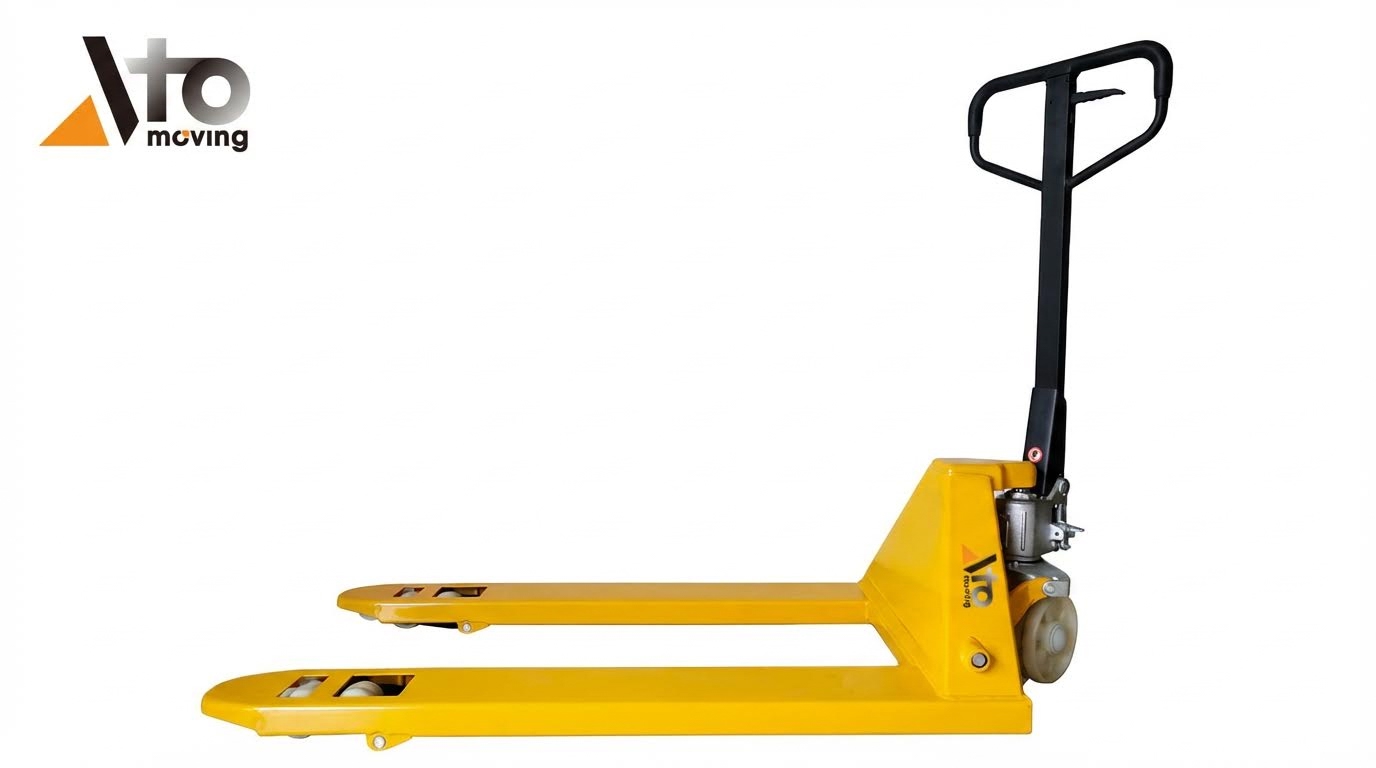
Engineering considerations for how a pallet jack lifts focus on matching load rating, stroke, and wheel/fork design to the floor and duty cycle, then maintaining hydraulics and structure to keep lifting performance within rated limits.
Load ratings, stroke, and lift height requirements
Load rating and stroke determine whether how a pallet jack lifts will safely support your pallets, giving enough fork rise to clear the floor without overstressing the hydraulic circuit or frame.
Parameter Typical Engineering Consideration Field Impact Rated capacity Common manual jacks are designed around concentrated loads in the 2,500–3,000 kg range, requiring robust forks and hydraulic components tested for fatigue. Reference Ensures the jack can repeatedly lift your heaviest pallets without bending forks or overloading the cylinder. Stroke and lift height The hydraulic cylinder stroke is sized so forks rise just enough to clear floor irregularities while keeping the center of gravity low for stability. Too little lift scrapes pallets; too much lift raises the load unnecessarily, increasing tipping risk and pump effort. Handle force vs. capacity The lever ratio of the tow bar is optimized so operators can generate high hydraulic pressure with manageable hand force. Reference Directly affects ergonomics and operator fatigue when lifting near rated load. Hydraulic pressure margin Relief valves and component sizing maintain a safety margin above rated load to prevent over‑pressure damage and sudden failure. Reference Prevents seal blowouts and protects the operator if someone attempts to overload the jack. Fork and frame stiffness High-strength steel forks and frames are engineered to resist bending and cracking under repeated high loads. Reference Limits fork sag and twisting that would otherwise change how the load transfers into the hydraulic system and wheels. 💡 Field Engineer’s Note: When specifying capacity, use your heaviest real pallet plus 10–15% for variability; routinely running at the nameplate limit accelerates fork fatigue and hydraulic seal wear.
How to match lift height to your pallets
Measure pallet deck height loaded on the floor, add at least 30–40 mm clearance for floor unevenness, and verify the jack’s maximum fork height exceeds this by a small margin for safety.
Wheel, frame, and fork design for different floors
Wheel and frame design control how a pallet jack lifts and rolls on different floors by spreading load, limiting point pressure, and balancing noise, traction, and push force for each surface type.
Design Aspect Typical Options / Behavior Field Impact on Floors Wheel material Nylon wheels are hard and durable for abrasive surfaces, while polyurethane wheels provide quieter, smoother rolling. Reference Nylon concentrates load and can mark softer floors; polyurethane reduces noise and vibration in finished or noise‑sensitive areas. Wheel diameter and width Larger diameters and wider tread reduce rolling resistance and spread load over a bigger contact area. Improves travel over joints and rough concrete, and reduces point loading that can spall weak floors. Fork length and tip design Fork arms are engineered for smooth insertion under pallets, with tapered tips to minimize impact. Reference Reduces damage to pallet boards and lowers the push force needed to engage pallets in tight racking. Frame robustness High-quality steel frames endure significant weight without bending or fracturing when used on uneven or sloped floors. Reference Maintains alignment so the hydraulic cylinder pushes squarely, preventing side-loading and premature seal wear. Steering geometry The tow bar doubles as steering and pump handle, with steering wheels optimized for maneuverability under heavy loads. Reference Affects turning radius in narrow aisles and how easily operators can reposition loads without scraping floors. 💡 Field Engineer’s Note: On polished concrete or epoxy, hard nylon wheels can feel “skatey” under heavy loads; switching to polyurethane often cuts push force and near-miss incidents immediately.
Choosing wheels for your environment
For wet or chemical-prone areas, prioritize corrosion-resistant bearings and wheels with good traction; for dry high-throughput warehouses, low-rolling-resistance wheels reduce operator fatigue and cycle time.
Maintenance, inspection, and safety compliance
Maintenance and inspection keep how a pallet jack lifts within design limits by preserving hydraulic pressure, structural integrity, and rolling components, directly supporting OSHA/ISO style safety expectations and reducing failure-based downtime.
- Hydraulic fluid checks and bleeding: Regular level checks, fluid replacement, and air bleeding maintain rated lifting performance and prevent “no‑lift” complaints. Reference
- Seal and O‑ring condition: Worn seals cause internal bypass and external leaks, leading to slow sinking or total lift loss; timely replacement restores full stroke and holding capacity. Reference
- Fork and frame inspection: Weekly checks for bends, cracks, and tip deformation prevent structural failure under load and keep the load centered over the wheels. Reference
- Daily and weekly checklists: Short operator walk-arounds plus deeper weekly tests verify that lifting, lowering, and steering all function correctly before problems become safety incidents. Reference
- Lubrication program: Proper lubricants at wheels and pivot joints reduce friction in the mechanical linkage that drives the pump, keeping handle effort low over thousands of lift cycles. Reference
- Corrosion control: Cleaning and protective coatings around forks, axles, and pump housings prevent rust that can seize moving parts and compromise welds. Reference
- Safety compliance and training: Training operators to respect capacity labels, travel with forks low, and report leaks aligns with general duty safety requirements and extends equipment life. Reference
- Repair vs. replace decisions: Cost-benefit analysis avoids over-investing in units with bent forks or chronic hydraulic issues where replacement is more economical. Reference
💡 Field Engineer’s Note: Any jack that slowly sinks under load is a red flag; tag it out immediately—internal bypass can progress to sudden drop, which violates basic duty-of-care expectations even for “simple” manual equipment.
Link between maintenance and how a pallet jack lifts
Clean oil, intact seals, straight forks, and lubricated linkages ensure that every handle stroke converts into predictable fork rise, which is the practical heart of how a pallet jack lifts safely day after day.
“”
Final Engineering Takeaways On Pallet Jack Lifting
A manual pallet jack lifts safely because simple mechanics and hydraulics work together in a tightly controlled system. The handle multiplies human force into hydraulic pressure, while the sealed pump, valves, and cylinder convert that pressure into stable vertical lift. Geometry, lever ratios, and wheel layout keep loads low, centered, and controllable so the structure and floor see predictable forces.
In practice, this means engineering teams must treat the jack as a complete system. If you overspec load or ignore floor conditions, you shift stresses into forks, seals, and wheels and invite early failure. If you skip fluid care, seal replacement, or linkage lubrication, the system loses pressure, stroke, and fine control, which quickly becomes a safety risk.
The best approach is clear and simple. Specify pallet jacks with rated capacity, stroke, and wheel design matched to your heaviest pallets and worst floors. Then lock in a basic maintenance and inspection program that protects oil quality, seals, forks, and pivots. Do this, and every handle stroke delivers predictable lift, operators stay within ergonomic limits, and your Atomoving pallet jacks run safely and efficiently over their full service life.
Frequently Asked Questions
How does a pallet jack lift?
A pallet jack lifts using either hydraulic pressure or a screw mechanism. In the hydraulic version, a pump generates pressure to push a ram vertically, raising the forks. This pump can be located on the baseplate or connected via a hose. Hydraulic Jack Mechanics.
Do pallet jacks use hydraulics?
Yes, most pallet jacks use hydraulics to lift loads. A manual pallet jack typically has a handle-activated hydraulic pump that raises the forks under the pallet. The hydraulic system simplifies lifting heavy loads efficiently. Pallet Jack Types and Functions.
Why does my pallet jack won’t lift?
If your pallet jack isn’t lifting, it could be due to low hydraulic fluid, air trapped in the system, or a damaged pump. Check these components and ensure they are functioning correctly before attempting repairs.
How high can a pallet jack lift?
Standard pallet jacks usually lift to a height of about 15 cm (6 inches). However, specialized electric models can achieve lift heights exceeding 50 cm (20 inches). These variations depend on the design and intended use of the pallet jack. Lift Height Guide.