Order picking equipment has shifted from simple manual pallet jack to highly automated, software-driven systems that reshape warehouse performance. This article explains how different technologies impact throughput, accuracy, safety, and labor, and how to choose the right mix for your operation. You will see how semi electric order picker, mid- and high-level order pickers, and advanced automation compare in real-world use. Use these insights to build an order picking roadmap that is efficient today and ready for future growth.
Order Picking Methods And Core Equipment Types
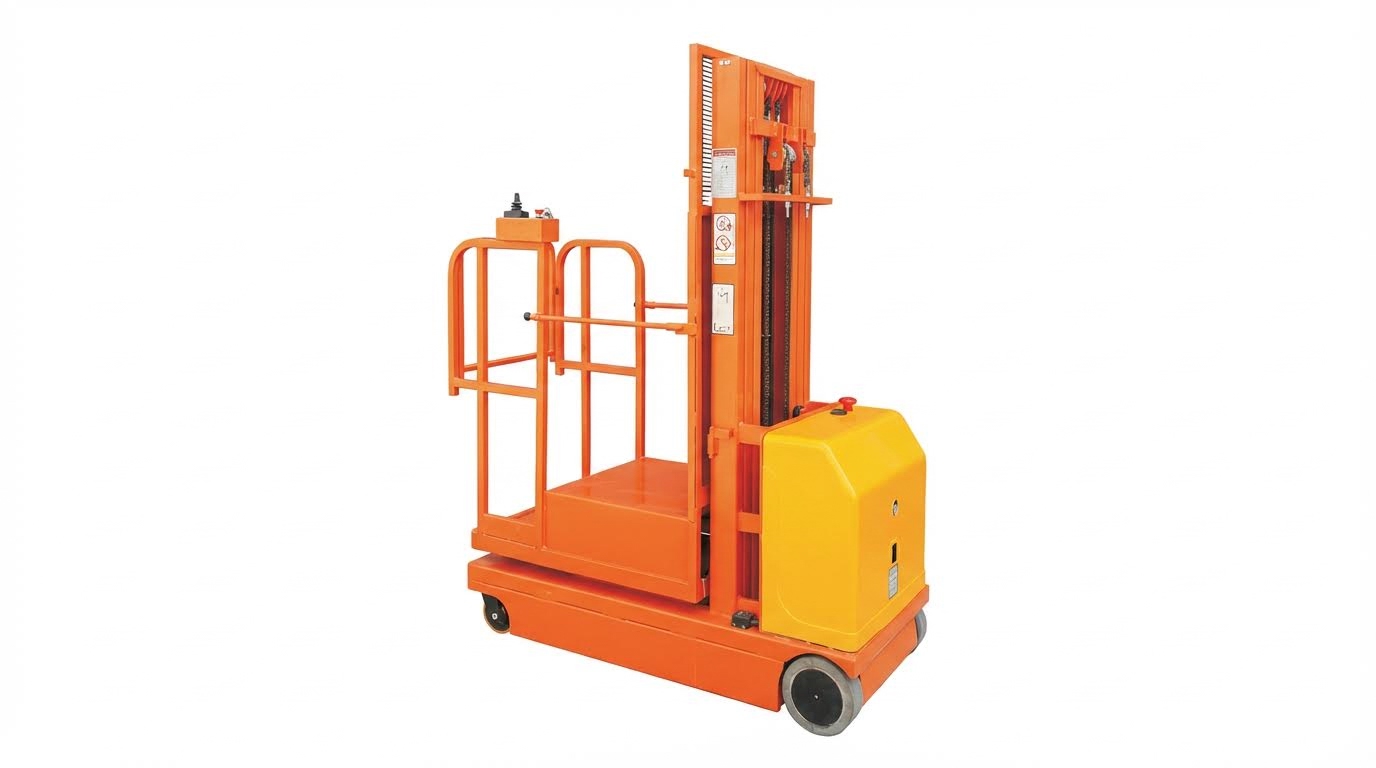
Manual carts, pallet jacks and low-level picking
Manual and low-level order picking equipment covers hand carts, platform trolleys, pallet jacks and low-lift pallet trucks. These solutions keep capital cost low and fit small or variable operations, but they rely heavily on human labor. In a typical manual process, operators push or pull carts or pallet jacks through the aisles, hand-picking items into totes or directly onto pallets. Manual workers usually achieve about 60–100 picks per hour, with error rates above 5% in manual handling environments.
- Manual carts and trolleys: Best for small-item picking in compact areas or for short walking distances. They offer maximum route flexibility but quickly become a bottleneck as order lines per hour increase.
- Pallet jacks and low-lift pallet trucks: Suited for case and pallet picking at floor level. Operators walk behind or ride, but all picks still occur at ground positions, which limits vertical storage use.
- Ergonomics and safety: Repetitive pushing, pulling and bending raises the risk of musculoskeletal injuries and fatigue, and manual material handling has historically been linked to a high share of warehouse injuries compared with automated alternatives.
From an engineering viewpoint, this order picking equipment is simple to maintain and easy to redeploy when layouts change. However, travel time dominates the pick cycle, so throughput and labor productivity remain constrained. Many facilities therefore use manual carts and pallet jacks as a starting point and later migrate to powered low-level order pickers or goods-to-person solutions as volume grows.
Mid- and high-level order pickers explained
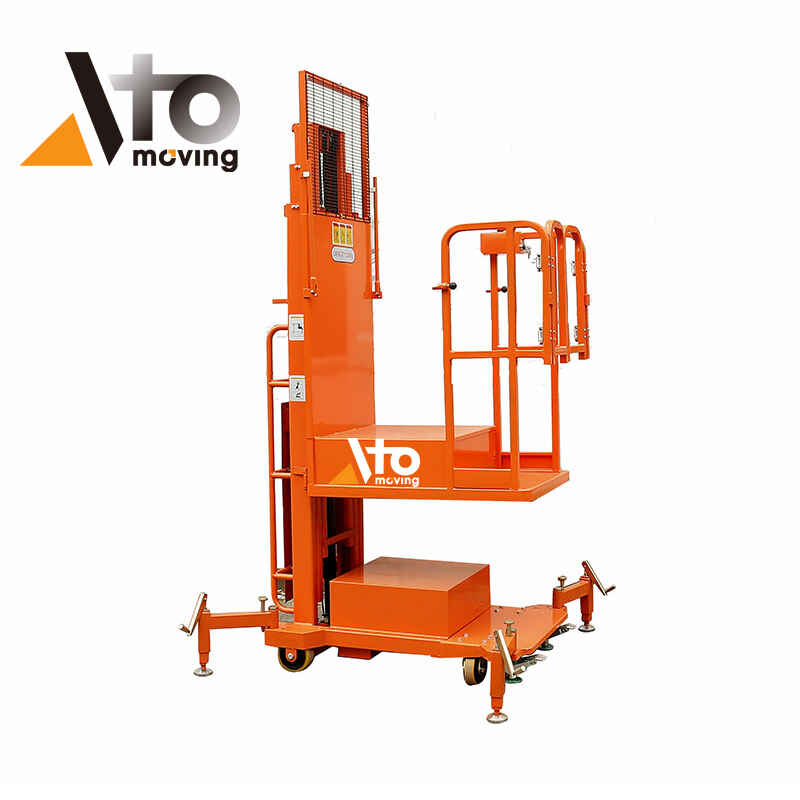
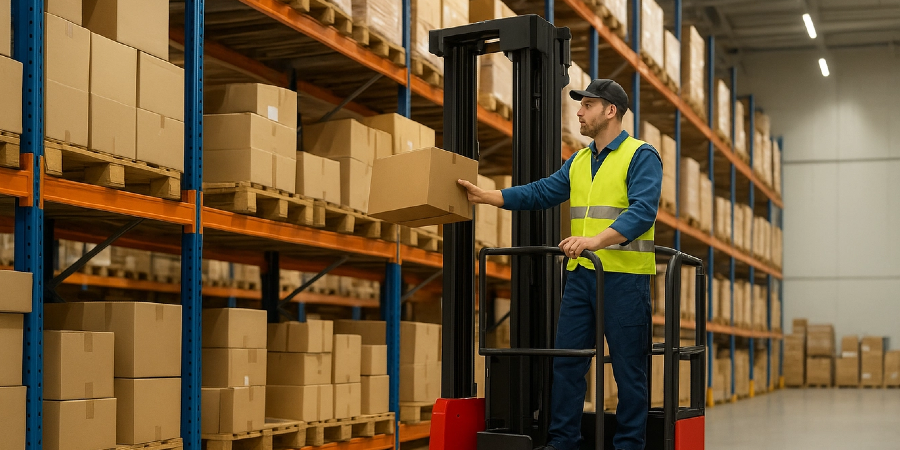
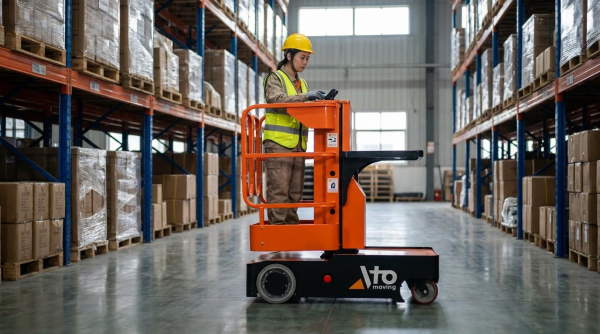
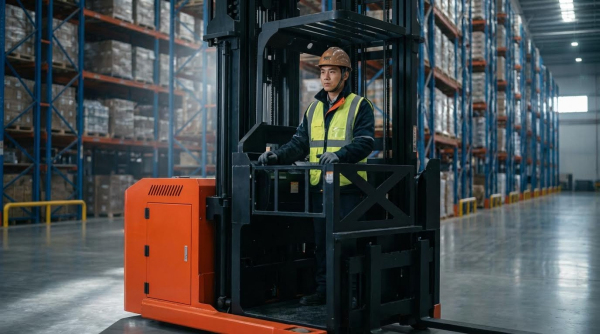
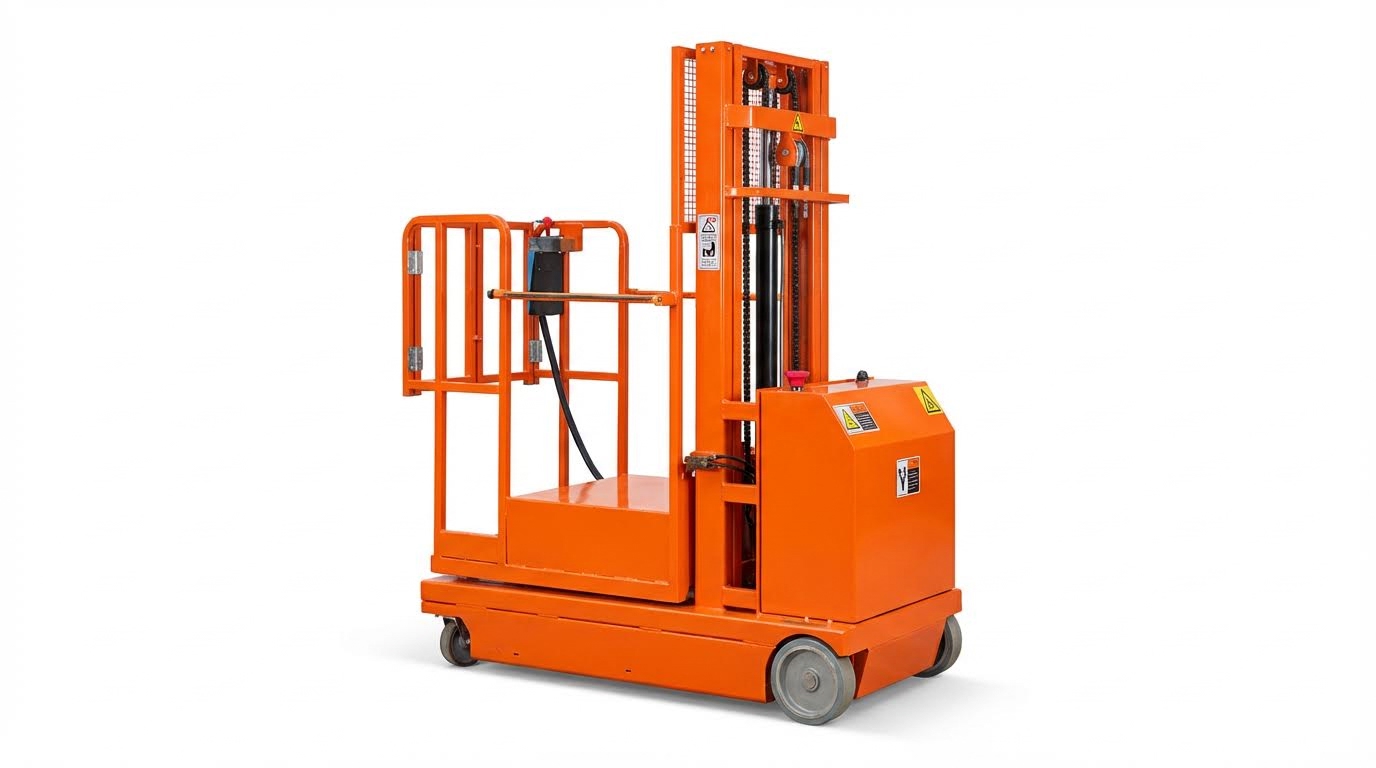
Mid- and high-level order pickers are powered industrial trucks that lift the operator platform, allowing “man-to-goods” picking at multiple beam levels in the rack. This order picking equipment reduces ladder use and walking, and lets operations exploit vertical storage while keeping a person in direct control of picking quality. The operator drives, steers and lifts from the platform, controlling all functions without repeatedly stepping on and off the truck via integrated platform controls.
- Key functional features:
- Simultaneous lift and travel allows slow, controlled truck movement while the mast is raising or lowering, cutting non-value-added repositioning time between pick locations.
- Optional pre-set height selection lets the platform move automatically to frequently used beam levels, improving cycle consistency and reducing operator fatigue in repetitive picking tasks.
- Lift logic technologies monitor mast height and adjust travel speed for stability and safety at elevation during operation.
- Safety and ergonomics:
- Open platforms, emergency descent systems and ground-level emergency stops improve visibility and allow rapid response in abnormal situations for elevated work.
- Full-body harnesses with energy-absorbing tethers protect operators at height when picking above ground level.
- Electronic braking and stable mast designs limit sway and provide controlled deceleration, especially important at high working heights in narrow aisles.
- Typical specification ranges:
Example spec envelope
Parameter Typical range / example Platform capacity Around 200 kg for certain compact models used in light-duty picking Max. working height Up to about 7.7 m on some high-level units for multi-level rack access Aisle width capability Compact wheelbases near 1.6 m support narrow-aisle layouts in dense storage
Energy-efficient AC drive and lift motors with regenerative braking extend runtime and reduce maintenance compared with older DC systems in intensive operations. For many warehouses, mid- and high-level order pickers offer an effective middle step between purely manual carts and fully automated systems, increasing vertical storage utilization and pick rates while keeping human flexibility in the loop.
Technical Comparison: Performance, Safety And Automation
Throughput, accuracy and labor productivity
Throughput is the first major performance divider between manual and automated order picking equipment. Manual cart or pallet jack picking typically delivers around 60–100 picks per hour with error rates above 5% for hand-based methods. Automated systems such as AS/RS shuttles and robotic picking can reach 200–800+ picks per hour, depending on SKU size, handling complexity, and system design compared with manual for automated bin picking. This gap drives both capacity planning and labor sizing in modern warehouses.
Accuracy follows a similar pattern. Manual processes often achieve roughly 95% accuracy, while automated picking solutions approach 99.9% by using sensors, controlled paths, and software validation in comparative studies. Automated bin-picking robots, for example, can keep error rates below 0.5% by combining 3D vision, force sensing, and AI path planning in industrial trials. Higher accuracy translates directly into fewer returns, less rework, and lower customer service costs.
Labor productivity improves when order picking equipment shifts travel and lifting away from people. In one controlled test, manual cart picking took about 17 minutes 35 seconds and 621 steps per task, while AMR-assisted picking cut this to 10 minutes 59 seconds and 276 steps; for experienced workers the gap widened to 13 minutes 54 seconds versus 6 minutes 59 seconds with only 175 steps in comparative timing data. At system level, one automated cell can replace the workload of 2–4 FTEs, cutting annual labor from about $120,000 to $30,000 and reducing error-related cost from $15,000 to $1,500 in cost comparisons. For engineers, these numbers are central when building ROI models for new order picking equipment.
Key performance metrics to compare
- Picks per hour per operator or robot
- Error rate (mis-picks, shortages, overages)
- Steps or travel distance per order line
- Labor hours per 1,000 order lines
Energy systems, maintenance and safety design
Energy systems in modern order picking equipment rely heavily on high-efficiency electric drives. AC drive and lift motors improve efficiency and reduce mechanical wear because they use fewer moving parts than DC systems in technical descriptions. Regenerative braking further extends battery runtime by recovering energy during deceleration on electric order pickers. Lithium-ion batteries maintain more stable voltage over the discharge cycle and support fast opportunity charging, which is valuable for multi-shift operations in battery specifications.
Maintenance requirements depend on mechanical complexity and duty cycle. Modular designs with tool-free cover removal reduce downtime by speeding access to critical components and emergency lowering valves in serviceability notes. Routine tasks for high-level order pickers include mast lubrication, wheel and tire inspection, brake testing, and battery health checks in maintenance guidelines. Sealed electronic disc brakes and polyurethane tires reduce contamination and floor damage, extending service intervals in clean warehouse environments for braking systems for tire choices.
Safety design is critical because order picking equipment often carries operators at height or moves near pedestrians. Features such as full-body harnesses with energy-absorbing tethers, emergency descent systems, anti-trap protection, and ground-level emergency stop buttons protect operators in elevated work on platform safety on integrated harness systems. Lift logic controls that limit travel speed at higher elevations, plus smooth hydraulic mast deceleration, reduce tip and impact risks in control-system descriptions. Compared with manual handling, which accounted for roughly 30% of warehouse injuries, well-designed automated and powered equipment significantly lowers strain and repetitive-motion incidents in safety statistics.
Typical preventive maintenance checklist
- Inspect mast rails, chains, and lubrication points
- Test brakes, steering response, and emergency stops
- Check battery condition, connectors, and charge cycles
- Verify safety harness, tethers, and guardrails
AGVs, AMRs, AS/RS and robotic picking
AGVs and AMRs change the role of human pickers from “walk and search” to “pick and pack at a workstation.” These vehicles navigate using sensors and mapped routes, transporting goods continuously with 30–50% faster performance than manual transport in many facilities in comparative performance data. As part of an order picking equipment fleet, AMRs can cut walking distance per task by more than half, as shown by step reductions from over 600 to under 300 in controlled tests in AMR trials. This directly improves throughput per labor hour and reduces fatigue-related errors.
AS/RS solutions go further by automating both storage and retrieval. Shuttle-based systems can deliver 3–5 times faster order retrieval and up to 50–70% space savings compared with conventional shelving in system comparisons. Performance audits have shown up to a threefold increase in velocity over five years, a 50% reduction in order turnaround time, and an 85% reduction in mean error rates when AS/RS is correctly engineered into the operation in cost-benefit analyses. Reliability targets around 99.99% uptime are common, which supports 24/7 fulfillment models.
Robotic picking cells and robotic palletizers add high-speed, repetitive handling to the mix. These systems typically achieve 400–800 cycles or picks per hour, far above manual rates of 100–200, while holding error rates below 0.5–0.1% depending on application for palletizing for bin picking. When combined with IoT sensors and analytics, operators can monitor equipment health and inventory flow in real time, unlocking 15–25% productivity gains through predictive maintenance and workflow optimization in IoT case studies. For engineers designing future-ready warehouses, the key is to integrate AGVs, AMRs, AS/RS, and robots so that human workers focus on exception handling and value-added tasks rather than travel and lifting.
| Technology | Primary role | Main benefits |
|---|---|---|
| AGVs / AMRs | Goods transport | Reduced walking, higher consistency, 24/7 operation |
| AS/RS | Automated storage & retrieval | High density, fast access, low error rates |
| Robotic picking | Item or case picking | High speed, very high accuracy, reduced labor |
Matching Order Picking Equipment To Your Operation
Application fit by SKU profile and aisle layout
Start by matching order picking equipment to your SKU profile. Many slow‑moving, small items favor man‑to‑goods strategies such as AS/RS and robotic bin picking, which can deliver 3–5 times faster retrieval and 400–800+ picks per hour compared with 100–200 manually. Automated systems also reach nearly 99.9% accuracy versus about 95% for manual handling. Dense SKU storage and high pick accuracy needs usually justify higher automation levels.
- Wide aisles and mixed pallets: pallet jacks and low‑level order pickers remain flexible and low cost.
- Narrow aisles and high racking: mid‑ and high‑level order pickers or AS/RS maximize vertical cube and reduce travel.
- Long travel distances between zones: AGVs and AMRs cut walking time and steps by 40–60% in typical trials. One comparison showed AMR‑assisted picking reducing a task from 17:35 minutes and 621 steps to 10:59 minutes and 276 steps.
Layout and process checkpoints
Check turning radii, clear aisle widths, and transfer points before selecting equipment. High‑level order pickers and AS/RS need consistent, straight aisles and controlled floor conditions, while cart‑based picking tolerates more layout variation. In brownfield sites, you often combine manual carts in tight legacy zones with AMRs or AS/RS in new, high‑density zones. This hybrid approach lets you phase automation without a full building redesign.
TCO, ROI and upgrade paths for automation
Evaluate total cost of ownership (TCO) for each order picking equipment option, not just the purchase price. Include labor, error costs, maintenance, energy, and expected life. Manual operations with 60–100 picks per hour and error rates above 5% carry hidden costs in rework, claims, and overtime. In contrast, automated systems can reach 200–800+ picks per hour with sub‑1% error rates, sharply reducing error‑related expense. A single automated solution can replace the workload of 2–4 workers, cutting labor from about $120,000 to $30,000 annually and lowering error costs from $15,000 to $1,500.
| Aspect | Manual / Low Automation | AGVs / AMRs / AS/RS |
|---|---|---|
| Typical pick rate | 60–100 picks/hour | 200–800+ picks/hour |
| Accuracy | ≈95% | Up to 99.9% |
| Labor demand | High, multi‑shift | Fraction of headcount |
| Injury risk | High (manual handling) | Lower, less strain |
Use a structured ROI calculation: ROI = (Annual Savings – Annual Costs) ÷ Investment × 100. Baseline your current labor, errors, maintenance, and energy, then model improvements from automation such as higher throughput, better space utilization, and fewer injuries. Key ROI drivers include labor savings, order accuracy, space utilization, and scalability. Medium‑sized automation projects in the £10–30 million range often see payback in roughly six to eight years, while very large programs can extend towards ten years. This underscores the importance of a long‑term view on ROI.
Planning upgrade paths
Design your order picking equipment roadmap as modular steps. You might start with low‑level order pickers and basic WMS, then add AMRs for transport, then layer AS/RS or robotic picking for high‑volume SKUs. AS/RS projects, for example, can triple throughput, cut turnaround time by 50%, and reduce mean error rates by about 85%. Pilot projects, robust change management, and continuous KPI tracking help de‑risk each step and keep your TCO and ROI on target.
Final Considerations For Future-Ready Order Picking
Order picking strategy now sits at the center of warehouse performance, safety, and cost. Manual carts and pallet jacks still give low entry cost and layout flexibility, but they cap throughput and keep injury risk and error rates high. Mid- and high-level order pickers raise people to the work, use vertical space better, and add engineered safeguards that cut strain and fall risk.
Advanced automation then shifts the role of people again. AGVs and AMRs remove long travel. AS/RS and robotic picking move core handling into controlled, repeatable systems with near-zero errors. Energy-efficient drives, lithium-ion batteries, and modular designs reduce downtime and service cost across this spectrum.
Engineering and operations teams should not chase technology for its own sake. They should size equipment to SKU profile, aisle geometry, and target service levels, then build a staged roadmap. Start with the highest pain points in labor, travel, or accuracy. Add automation in modular blocks that your WMS and staff can absorb. Use clear KPIs and TCO/ROI models to validate each step.
With this approach, you create a future-ready order picking platform where Atomoving equipment, software, and automation work as one system, not isolated projects.
Frequently Asked Questions
What is Order Picking Equipment?
Order picking equipment refers to specialized machinery used in warehouses to retrieve and move items from shelving or pallet racks for order fulfillment. This equipment provides a safer and more efficient alternative to ladders and scissor lifts when accessing stock manually Order Picker Safety Guide.
How Does an Order Picker Work?
An order picker works by allowing the operator to stand on a platform that can be lifted to various heights, typically up to 6 meters (20 feet), enabling them to access items stored on high shelves. The equipment can be driven forward, backward, or steered side-to-side, making it versatile for navigating warehouse aisles Order Picker Equipment Guide.
Is Order Picking a Stressful Job?
Order picking can be physically demanding and stressful due to factors like high order volumes, long walking distances, and time pressures. Workers often walk 9 to 16 kilometers (6 to 10 miles) per day on hard floors while lifting heavy loads. Proper training and ergonomic practices can help reduce stress Warehouse Picking Challenges.
What Skills Do You Need to Be an Order Picker?
To be an effective order picker, you need strong attention to detail, basic math skills for inventory counts, physical stamina to lift up to 23 kg (50 lbs), and familiarity with warehouse operations or picking systems. Training in safety protocols and equipment operation is also essential Order Picker Skills Guide.