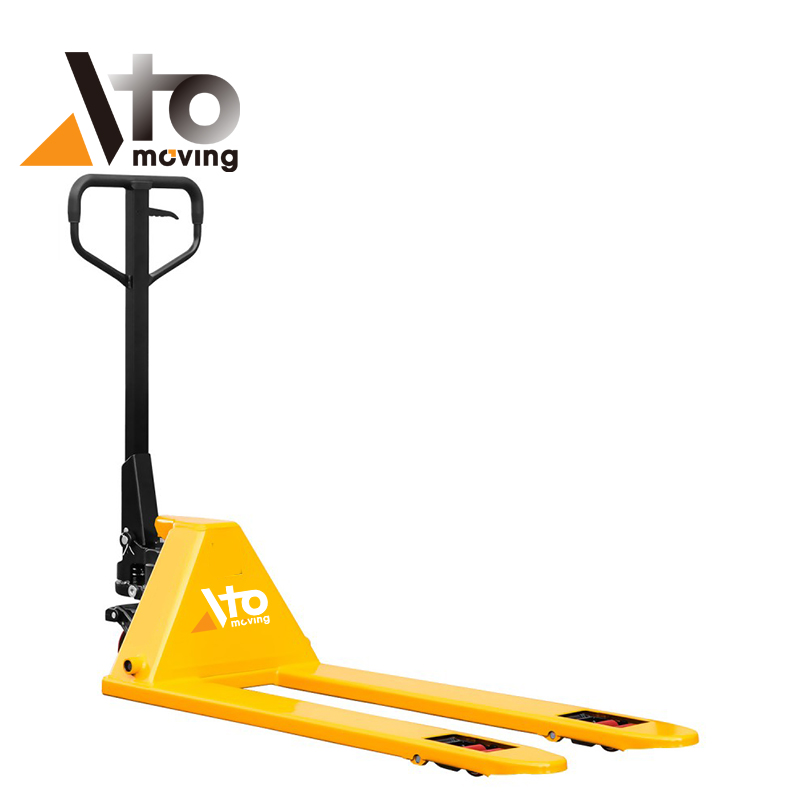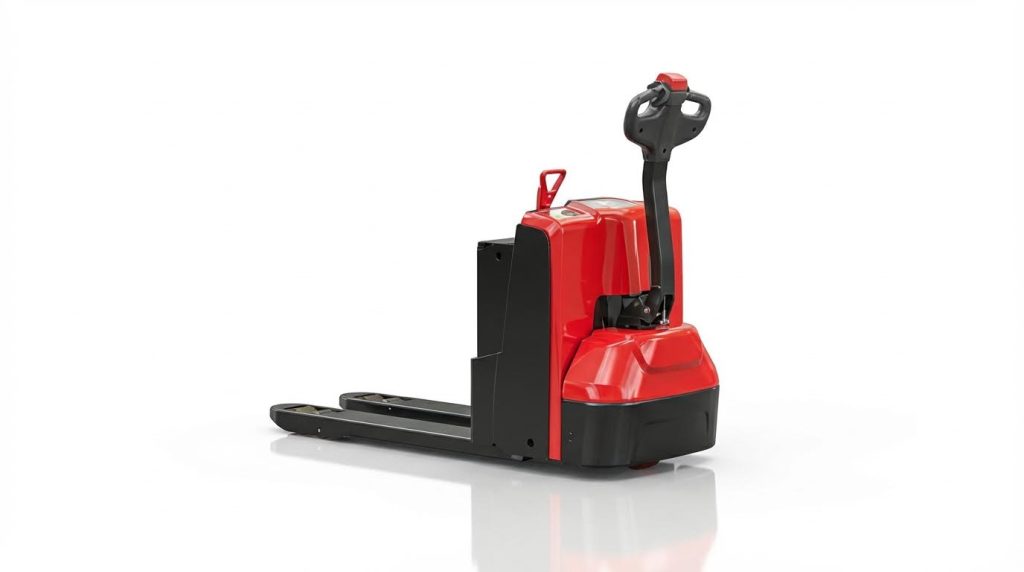
Choosing the right pallet jack fork width starts with one simple question: how wide are pallet jack forks for your pallets, aisles, and loads. This guide breaks fork width down into clear dimensions, regional pallet standards, and the engineering impact on stability and maneuverability. You will see typical width ranges, how they interact with pallets and floors, and when to use narrow, standard, or custom forks. Use this as a practical engineering reference to specify safer, more efficient pallet trucks for any material handling layout.
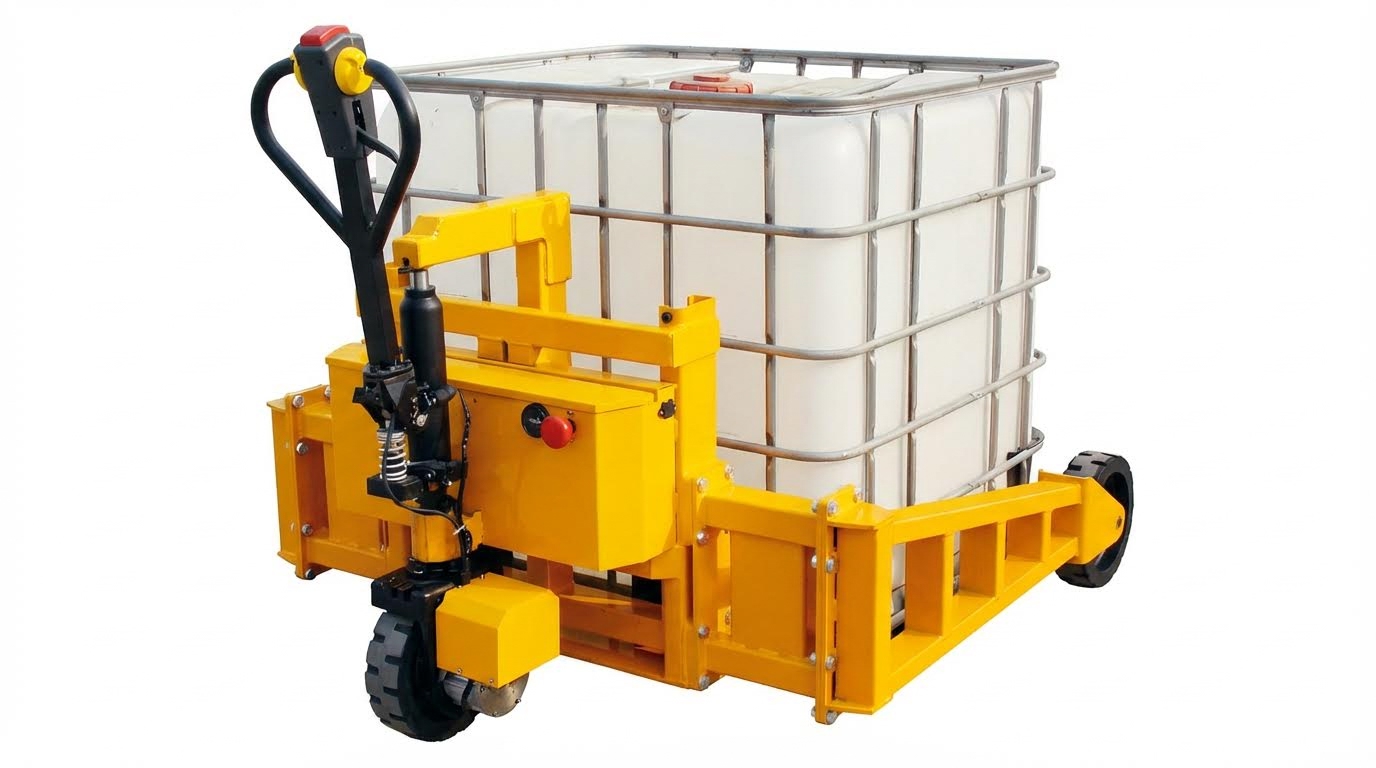
Defining Pallet Jack Fork Width And Key Dimensions
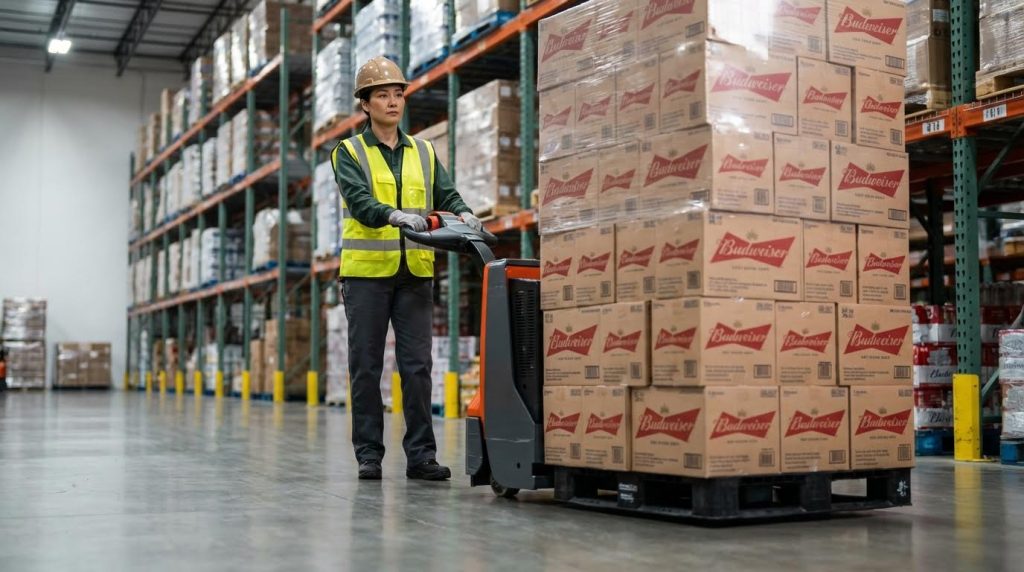
Overall width vs. between-fork spacing
When people ask “how wide are pallet jack forks,” they often mix up three different measurements. For engineering and layout work, you must separate overall width, between-fork spacing, and individual fork width. These control pallet fit, stability, and aisle clearance.
| Dimension | What it measures | Typical values | Why it matters |
|---|---|---|---|
| Overall width | Outside-to-outside at the forks (or frame) | Commonly about 27 in for standard jacks (also matches typical fork width) | Checks fit through aisles, doors, and pallet openings |
| Between-fork spacing | Clear gap from inside face of one fork to the other | Usually in the 14–16 in range for a 27 in frame, with total fork spread (center-to-center) around 20–21 in for standard pallets | Must align under pallet stringers or blocks |
| Individual fork width | Side-to-side width of a single fork blade | About 6.3 in [160 mm] on a typical 27 in frame (two forks plus gap give the overall width) | Affects contact area and bearing stress into deck boards |
In practice, “overall width” is the number you use when checking how a jack passes through a 32 in door or a 42 in aisle. “Between-fork spacing” is the number you match to pallet opening geometry so both forks sit fully on stringers or blocks.
How these dimensions add up on a common 27 in jack
A typical 27 in [685 mm] frame uses forks about 6.3 in [160 mm] wide with a gap around 14.4 in [366 mm] between them. Two fork widths plus the gap give the 27 in overall width, and the fork centers land under the two outer stringers of a 48 x 40 in pallet for stable support. This geometry is intentional for GMA/CBA pallets.
When you specify or compare units, always confirm which “width” is being quoted. Many catalogs list “width over forks,” which is the overall width across both forks, not the gap between them.
Standard fork widths for global pallet sizes
To answer “how wide are pallet jack forks” correctly, you need to tie fork width to pallet standards by region. Most hand pallet jacks fall into a few repeatable width families that align with GMA/CBA, Euro, and UK pallets.
| Pallet standard / region | Typical pallet size | Common pallet jack fork width (overall over forks) | Typical fork length | Notes on fit |
|---|---|---|---|---|
| North American GMA / CBA | 48 x 40 in [1219 x 1016 mm] | 27 in [≈685 mm] overall width (most common “standard” size) | 36, 42, or 48 in [914, 1067, or 1219 mm] | 27 in width places forks under the two outer stringers for stable lifting |
| Euro pallet (EUR / EPAL) | 1200 x 800 mm [≈47.2 x 31.5 in] | 520–540 mm [20.5–21.3 in] overall width used for stringer/block layout | 1150 mm [≈45.3 in] | Narrower frame so forks land between blocks without interference |
| UK pallet (commonly 1200 x 1000 mm) | 1200 x 1000 mm [≈47.2 x 39.4 in] | 540 or 680 mm [≈21.3 or 26.8 in] overall width depending on entry side and support pattern | 1150 mm [≈45.3 in] | 540 mm suits Euro and many UK pallets; 680 mm targets 1000 mm side entry |
| General “standard” jack (imperial) | Designed for 48 x 40 in pallets | 27 in fork width is widely used in North America and matches typical overall width | 48 in fork length | “27 x 48” has become the default spec in many warehouses |
| Narrow models | Non-standard or half pallets, tight aisles | About 20–22 in (≈450–540 mm) overall width for narrow or Euro applications | 36–48 in | Improves maneuverability and fits smaller openings, but reduces lateral stability if misapplied |
| Wide / special models | Display pallets, beverage, oversized skids | Up to about 30–33 in [≈760–838 mm] or 680 mm in metric ranges for wider loads | Up to 60 in or more | Used where the pallet deck or load footprint is wider than standard |
If you reduce the question to a single number, most standard warehouse users asking “how wide are pallet jack forks” will be dealing with 27 in fork width for GMA-style pallets, or 520–540 mm for Euro pallets. Narrow and wide variants exist, but they are application-specific.
- Standard fork width range for common hand pallet jacks runs roughly from 20 to 27 in overall, depending on model and region. This covers most warehouse pallets.
- Metric families of about 450 mm, 540 mm, and 680 mm fork widths are used to align with the main European and UK pallet footprints. These three sizes cover the bulk of regional standards.
- For mixed fleets and mixed pallets, compromise widths such as 540 mm x 1150 mm are often chosen so one jack can handle both Euro and UK pallets with acceptable stability and clearances. This reduces equipment count at the cost of some optimization.
From an engineering standpoint, you always start with pallet geometry, then pick fork width and length. Only after that do you confirm the overall jack width against aisle and doorway constraints, keeping safety factors and stability margins in mind.
Engineering Impacts Of Fork Width On Performance
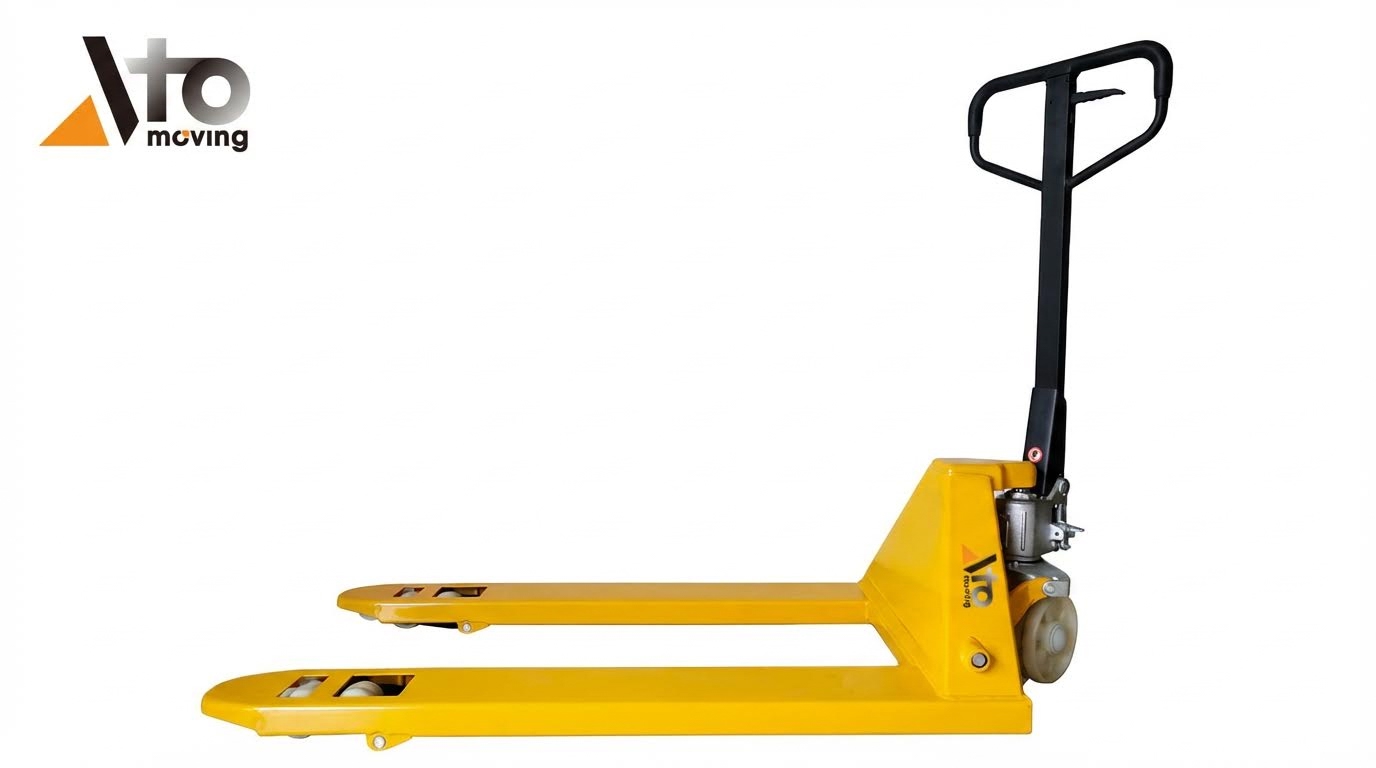
Load stability, deflection, and safety margins
Fork width directly affects how the pallet jack carries the load, how much the forks bend, and how much safety margin you actually have versus the nameplate rating. When people ask “how wide are pallet jack forks,” the real engineering question is how that width controls support points under the pallet deck and the stress in the steel section.
- Wider fork spread = larger base of support and lower tipping risk.
- Narrower fork spread = higher tipping risk if load center shifts or pallet is damaged.
- Incorrect width can leave stringers unsupported and overload individual deck boards.
- Fork section size and spacing control deflection under heavy loads.
| Typical configuration | Overall fork width | Typical capacity range | Stability / deflection notes |
|---|---|---|---|
| Standard hand pallet jack for 48 x 40 in pallets | 27 in overall; about 6.3 in individual fork width, 14.4 in gap between forks (685 mm frame, 160 mm forks, 366 mm gap) | 2,000–5,000 lb typical, up to 10,000 lb on heavy-duty units (2,000–5,000 lb, some to 10,000 lb) | Good lateral stability when fully under pallet; deflection acceptable if within capacity. |
| Narrow models for tight pallets / aisles | About 20–22 in overall width for Euro pallets (20–27 in between-fork width range) | Often 2,000–4,000 lb | Lower lateral stability; requires correct engagement under stringers or blocks to avoid twisting and tipping. |
| Wide / heavy-duty frames | Up to ~30–33 in overall width for special applications (30 in heavy-duty width) (33 in wide frames) | Up to 5,000 lb and higher | Very good lateral stability; deflection controlled by heavier fork sections and wider spread, but needs wider pallets or custom loads. |
From a strength point of view, the distance between forks controls how the load distributes into the pallet stringers or blocks. If the forks sit directly under the longitudinal stringers, the load path is short and vertical, which reduces bending in the deck boards and lowers the risk of punch-through. If the forks are too close together or too far apart for that pallet pattern, one side of the pallet can see higher stress, which reduces safety margin even if the total weight is under the rated capacity.
Deflection is a function of fork section size, span, and load. Longer forks or higher capacities increase bending, and too much sag can cause the pallet to drag on the floor or shift the load center forward. Standard fork lengths around 48 in are chosen to support at least two-thirds of the pallet length while keeping deflection under control for 2,000–5,000 lb loads. Standard 48 in fork length guidance
Practical safety checks related to fork width
Before lifting at or near rated capacity, operators should confirm three things: that both forks are fully under the load, that each fork sits under a structural element (stringer or block) rather than only deck boards, and that the load does not overhang so far to one side that it shifts the overall center of gravity outside the fork spread. These checks matter more as fork width narrows or as loads become tall and top-heavy.
Maneuverability, aisle design, and turning clearance
Fork width also controls how easily the drum dolly moves in real aisles and doorways. A wider frame improves stability but increases the required clear aisle and turning space; a narrow frame does the opposite. When people evaluate how wide are pallet jack forks, they need to balance this handling requirement against pallet compatibility.
- Overall width drives the minimum aisle and doorway clearances.
- Fork length plus width together set the turning radius and “swing-out” in corners.
- Narrow frames help in tight aisles but may not match all pallet standards.
| Type | Typical overall width | Typical fork length | Clearance / maneuverability impact |
|---|---|---|---|
| Standard manual pallet jack | About 27 in overall width (matches standard fork width) | 48 in typical (27 in wide, 48 in long) | Needs at least about 6 in side clearance and ~12 in turning radius to operate efficiently in standard warehouse aisles. Clearance and turning radius data |
| Narrow-aisle hand pallet jack | As slim as ~20 in overall width (20 in narrow-aisle width) | Often 42–48 in | Better in tight aisles; reduced side clearance needed, but turning still limited by fork length and load overhang. |
| Electric pallet truck | Similar fork width, but extra operator platform width | Varies; often 45–48 in | Requires aisles around 2.4–2.7 m wide for safe operation and extra 8–10 in for operator standing area. Aisle width guidance Additional clearance for electric models |
In a layout design, engineers normally start from the pallet size and racking geometry, then back into required pallet jack width and aisle clearance. For a 27 in wide pallet jack, at least 6 in of lateral clearance is recommended to avoid contact with rack uprights and to allow steering corrections. Turning at aisle ends also depends on the combined length of the pallet plus jack; a longer or wider jack needs more “headroom” at the end of the rack run to complete a 90° turn.
Checklist: matching fork width to aisle design
- Confirm pallet width and overhang so you know the true handled load width.
- Select a fork width that fits the pallet openings but does not exceed aisle design limits.
- Check doorways, columns, and any pinch points against the overall jack width.
- Verify turning space at aisle ends using the worst-case load length and jack length.
- Add a safety margin (typically several inches per side) for operator steering error and pallet skew.
Fork width, wheel layout, and floor interaction
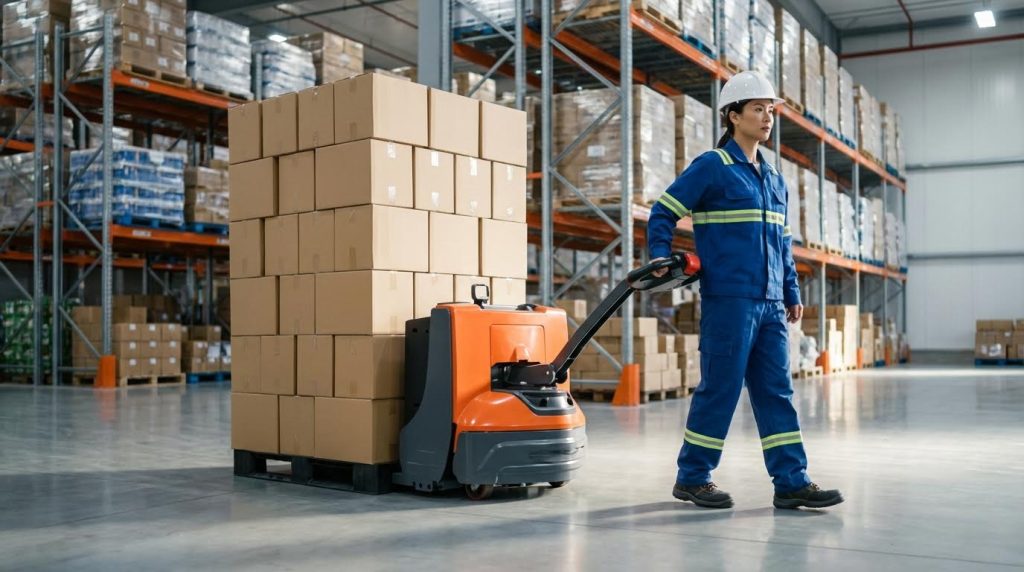
Fork width ties directly into wheel spacing and how the hydraulic pallet truck interacts with the floor. The distance between forks sets the track width of the load rollers, which affects how the jack rides over joints, drains, and damaged slabs. It also changes point loads on the floor and on dock plates.
- Wider fork spacing spreads wheel loads sideways and reduces point pressure.
- Narrow spacing concentrates load into a smaller footprint, which can mark or damage weak floors.
- Wheel layout must still align with pallet entry points so rollers do not strike blocks or stringers.
| Parameter | Typical values | Effect on floor interaction |
|---|---|---|
| Individual fork width | About 6.3 in on a 27 in frame (160 mm) | Wider forks distribute load over more deck boards and slightly larger floor contact patch via the load rollers. |
| Gap between forks (center spacing) | About 14.4 in on standard 27 in units (366 mm gap) | Controls where the load rollers run relative to pallet stringers and floor joints; too narrow or wide can increase impact and vibration. |
| Typical wheel sizes | About 7 in steer wheels and 3 in load rollers (178 mm and 76 mm) | Small rollers are sensitive to floor defects; wider fork / roller spacing helps bridge some gaps but increases required clear width. |
Standard lowered heights around 2.9–3.3 in and raised heights around 7–8 in mean the load rollers work close to the floor. On rough or sloped slabs, a narrow fork spread can cause more rocking because both rollers run closer to the centerline of the pallet, so any local dip or hump affects the whole load. A wider spread tends to “average out” small irregularities, but it also increases the chance that one roller hits a crack or dock plate edge first, creating a twisting moment on the frame. Typical lift heights and wheel sizes
Floor and dock design tips influenced by fork width
- Specify dock plates and thresholds wide enough to keep both load rollers fully supported for the chosen fork width.
- For weak or decorative floors, consider wider fork / roller spacing to lower wheel contact pressure.
- On very uneven floors, use fork widths that keep rollers away from known joints or drains where possible.
- Combine correct fork width with appropriate wheel material to reduce noise and surface damage.
Selecting Fork Widths For Pallets And Applications
Matching fork width to pallet standards by region
Fork width must match the pallet’s deck opening and stringer layout. This is the most reliable way to answer “how wide are pallet jack forks” for a given region and pallet standard.
| Region / pallet standard | Typical pallet size | Recommended pallet jack width | Typical fork length | Notes |
|---|---|---|---|---|
| North America – GMA/CHEP style | 48 x 40 in (1219 x 1016 mm) | 27 in (≈685 mm) overall frame width (typical spec) | 36, 42, or 48 in (914, 1067, 1219 mm) (common options) | 27 x 48 in is the “standard” warehouse size. |
| Continental Europe – Euro pallet | 1200 x 800 mm (≈47.2 x 31.5 in) | 520–540 mm (≈20.5–21.3 in) overall width (typical range) | 1150 mm (≈45.3 in) (standard) | Forks enter on 800 mm side; width tuned to block positions. |
| UK – UK standard pallet | 1200 x 1000 mm (≈47.2 x 39.4 in) | 540 or 680 mm (≈21.3 or 26.8 in) overall width (recommended) | 1150 mm (≈45.3 in) | 540 mm suits Euro + UK mix; 680 mm optimizes UK-only pallets. |
| Global “standard” hand pallet jack | Common 48 x 40 in or 1200 x 1000 mm pallets | 27 in (≈685 mm) overall width (typical) | 48 in (1219 mm) | Most common answer when people ask “how wide are pallet jack forks.” |
Quick selection rules by region
- North America: default to 27 in wide x 48 in long for 48 x 40 in pallets.
- Euro-focused operations: 520–540 mm wide x 1150 mm long fits 1200 x 800 mm pallets efficiently.
- UK mixed fleet (Euro + UK): 540 mm wide x 1150 mm long is a good compromise. (industry practice)
- UK only, high stability: 680 mm wide x 1150 mm long for 1200 x 1000 mm pallets.
To finalize fork width selection for a region, measure your dominant pallet standard and check the distance between entry openings. Then confirm that the jack’s between-fork spacing and fork tip positions sit fully under the deck boards or blocks.
Narrow, wide, and custom forks for special loads
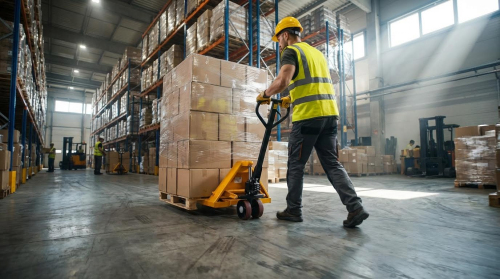
Beyond regional standards, you choose narrow, wide, or custom forks based on load geometry, aisle clearance, and stability requirements.
| Fork width type | Typical overall width range | Typical use cases | Key engineering pros | Key engineering risks |
|---|---|---|---|---|
| Narrow frame | 16–21 in (≈406–533 mm) overall width (examples: 16 in, 20.5 in) | Small custom pallets, half-pallets, tight rack tunnels, very narrow aisles. |
|
|
| Standard width | 20–27 in (≈520–685 mm) overall width (typical range) | Most 48 x 40 in, Euro, and UK pallets, general warehousing. |
|
|
| Wide frame | 27–33 in (≈685–838 mm) overall width (e.g., 33 in) | Food and beverage, large display pallets, wider custom skids. |
|
|
| Custom width | Ultra-narrow ≈16 in to extra-wide 32+ in (example ranges) | Non-standard pallets, machinery bases, long crates, multi-pallet handling. |
|
|
When you evaluate how wide are pallet jack forks for special loads, work from the load backward: start with pallet or skid width, then define the support points and stability envelope, and only then pick the frame width.
- For tall / top-heavy loads: favor standard or wide frames to increase the base of support and reduce tipping risk.
- For tight aisles or narrow tunnels: use narrow frames but derate stack height and speed to compensate for reduced lateral stability.
- For mixed fleets: prioritize the dominant pallet type, then validate that minority pallets can still be lifted without fork overhang or missed stringers.
- For one-off special projects: consider custom forks rather than forcing an ill-fitting standard size; the engineering cost is often less than damage and downtime.
Engineering checklist before ordering non-standard fork width
- Measure pallet/skid: overall width, entry opening width, and stringer/block positions.
- Define maximum load: weight, center of gravity height, and any overhang.
- Check aisles and doors: minimum clear width and turning space. (clearance considerations)
- Confirm compatibility with existing pallets in all locations where the jack will operate.
- Review cost vs. benefit: factor in the 20–30% premium typical for custom sizes against damage reduction and throughput gains.
By combining regional pallet standards with a clear view of your special loads, you can select pallet jack fork widths that maximize stability, minimize damage, and still fit the aisles and docks you already have.
Final Considerations On Fork Width Specification
Fork width specification is not just a catalog choice. It sets how every pallet, aisle, and floor detail works together in your operation. When you match fork spacing to pallet stringers, you keep loads on structural members, limit deck board failure, and preserve the full safety margin of the truck rating.
Correct width also stabilizes tall loads and controls fork deflection. A wider spread increases the base of support and reduces tipping risk, while a poorly matched narrow frame can turn minor pallet damage into a serious incident. At the same time, overall width must still pass through real aisles, doors, docks, and lift gates without constant impacts.
Engineers and operations teams should therefore work in a fixed order. First, lock in pallet standards and dominant load geometry. Second, select fork width and length that place rollers and blades under strong pallet elements. Third, verify aisle, doorway, and dock clearances, then adjust layout or width as needed. Finally, use custom widths only when a clear, repeatable use case justifies the added cost.
Teams that follow this sequence, and document it in their purchase specs with Atomoving or any supplier, get safer handling, fewer pallet failures, and higher throughput from the same floor space.
Frequently Asked Questions
How wide are pallet jack forks?
Pallet jack forks typically come in different widths to accommodate various pallet sizes. The most common width is 540mm, which works well with standard pallets measuring 800mm x 1200mm. However, for specialized industries like printing, narrower forks of 450mm may be used. Pallet Truck Guide.
What is the standard pallet size?
The standard pallet size in most regions is 1200mm x 800mm (48″x40″). This size is widely used in North America and Europe. Deck boards on these pallets are typically 90mm (3.5 inches) wide. For specific applications, other sizes such as 400mm x 600mm or 1000mm x 1200mm may also be used. Standard Pallet Size Info.