Operations teams searching how to load a truck with pallets need a method that is safe, repeatable, and space efficient. This article walks through the key trailer and pallet parameters, then applies simple layout math so engineers and planners can predict capacity before a truck reaches the dock.
You will see how straight, turned, sideways, and pinwheel patterns change pallet counts in 26‑, 48‑, and 53‑foot vehicles, including when to add stacking. The article then links loading patterns to stability, weight distribution, and axle balance, and shows how digital tools and Atomoving solutions help plan safe, high‑throughput loading in daily practice.
Key Trailer And Pallet Parameters For Planning
Planning how to load a truck with pallets starts with hard dimensions and legal limits. Trailer size, usable internal space, and pallet footprint define the ceiling for any loading pattern. Material choice and pallet height then control stacking options and stability. This section builds the engineering baseline before you decide on straight, turned, or stacked patterns.
Common Trailer Sizes And Usable Cargo Space
Engineers should treat external trailer length as a guide, not a usable value. Internal cargo length is lower due to front wall thickness and door structure. Typical dry van and box truck internal dimensions are:
| Truck type | Usable length (mm) | Usable width (mm) | Usable height (mm) |
|---|---|---|---|
| 53 ft trailer | ≈16 150 | ≈2 490–2 540 | ≈2 740–2 790 |
| 48 ft trailer | ≈14 630 | ≈2 490–2 540 | ≈2 740–2 790 |
| 26 ft box truck | ≈7 930 | ≈2 440 | varies, often ≈2 400–2 600 |
When planning how to load a truck with pallets, use the narrowest inside width along the floor. Wheel boxes, posts, and rub rails can reduce local width and block some patterns. Always confirm internal height at the rear door since roof bows or lift-over frames can limit stacking. For mixed fleets, build a standard planning sheet for each body type to avoid overestimating capacity.
Standard Pallet Footprints And Materials
Pallet footprint drives how many units fit across and along the trailer. Common footprints include:
- 1 219 × 1 016 mm (48 × 40 in) North American standard.
- 1 067 × 1 067 mm (42 × 42 in) for drums and totes.
- 1 200 × 800 mm and 1 200 × 1 000 mm Euro-style sizes.
Material choice changes tare weight, stiffness, and friction. Wood pallets are cheap and easy to repair but vary in quality and moisture. Plastic pallets are lighter, consistent, and resist water and chemicals, but they can be more slippery, so anti-slip sheets or extra wrapping may be needed. Metal pallets carry heavy loads and keep geometry under high stress but increase trailer tare and may push loads toward weight limits before volume limits.
For safe loading, standardize a small set of pallet types whenever possible. Mixed footprints inside one truck complicate gap control and weight distribution. Use clear specs for maximum pallet height and rated load for each pallet family, then lock these into your loading rules.
Calculating Single- And Double-Stack Capacity
Capacity math for how to load a truck with pallets starts with a simple area ratio. For one layer, use:
Floor pallets ≈ floor length ÷ pallet length × floor width ÷ pallet width.
For a 53 ft trailer with 48 × 40 in pallets in straight loading, this gives 2 pallets across and 13 rows, or 26 pallets. Turned or pinwheel patterns can raise this to about 28–30 pallets, depending on clearances and overhang rules. A 48 ft trailer usually fits 24 pallets straight, about 26 pinwheel, and up to 28 sideways.
Double stacking multiplies floor count by the number of safe layers. A 53 ft trailer that holds 26 pallets in one layer can hold 52 if every pallet is stackable and height allows. Use this simple check:
- Trailer internal height ÷ loaded pallet height ≥ number of layers.
- Stack weight per pallet ≤ lower pallet rating and product crush limit.
Always confirm that stacked height still clears the door header and any internal obstructions. For mixed heights, design a clear rule set instead of ad hoc decisions at the dock.
Legal Weight, Axle Loads, And “Weigh Out” Limits
Trucks often reach legal weight before they fill all pallet positions. In many regions, a typical five-axle tractor–trailer combination had a gross legal limit of about 36 000 kg. The tractor and empty trailer together often weighed around 15 000–16 000 kg. That left roughly 20 000–21 000 kg for cargo, subject to local rules.
Axle group limits then control where you place heavy pallets. Tandem trailer axles often had lower allowable loads than the gross limit would suggest if weight shifted too far rearward. When you plan how to load a truck with pallets, compare three values:
- Gross allowable weight.
- Steer, drive, and trailer axle limits.
- Expected total pallet weight at full cube.
If a full floor of pallets would exceed any of these, you will “weigh out” before you “cube out.” In that case, reduce pallet count, use lighter packaging, or switch to higher capacity equipment. Keep heavy pallets near the trailer center between axles to improve balance, and avoid clustering dense loads at the nose or tail, which can cause steering or braking issues.
Core Pallet Loading Patterns And Layout Math
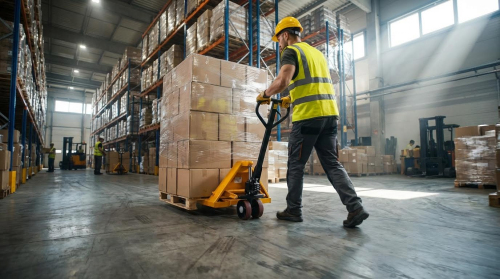
This section explains how to load a truck with pallets using repeatable patterns and simple math. The goal is safe loading, full use of trailer space, and predictable capacity. Engineers and planners can then create standard diagrams for 26‑, 48‑, and 53‑foot vehicles and avoid trial‑and‑error at the dock.
Straight, Turned, And Sideways Loading Explained
Straight loading sets the 1 219 millimetre pallet length along the trailer length. Two 1 016 millimetre pallet widths sit side by side in a typical 2 438 millimetre wide body. This pattern is fast to load and easy to teach. It is the default answer for how to load a truck with pallets when speed matters more than absolute capacity.
Turned or sideways loading rotates the pallet so the 1 016 millimetre side runs along the trailer. This often lets planners add extra rows in the same trailer length. Sideways loading can increase count but needs careful fork access and sometimes side‑entry pallets. It suits operations that chase every extra pallet and can accept slightly slower loading.
For layout math, use this basic formula for a single layer: (usable trailer length ÷ pallet length in loading direction) × (usable trailer width ÷ pallet width across). Always use internal cargo dimensions, not external trailer size.
Pinwheel And Mixed Patterns To Close Gaps
Pinwheel patterns alternate pallet orientation in each row. One pallet sits straight, the neighbour sits turned. This creates a “lock” that closes gaps at the corners and along the sides. In a 53‑foot trailer, pinwheel loading of 1 219 × 1 016 millimetre pallets often increases capacity from 26 to about 28 pallets.
Mixed patterns combine straight rows near the doors with pinwheel rows deeper inside. This keeps unloading simple while still gaining one or two extra pallet spaces. Planners should sketch patterns to check that fork aisles and turning space remain workable. Misaligned pinwheel rows can create snag points and damage wrap or cartons.
Use pinwheel patterns when freight is stable, stack height is moderate, and loading time is less critical. For fragile or high‑value goods, a simpler straight pattern with more dunnage often gives better protection than chasing maximum count.
Floor-Only Vs. Stackable Loading Strategies
Floor‑only loading keeps pallets in a single layer. It suits crush‑sensitive products, unstable stacks, or low roof trailers. For a 53‑foot trailer, floor‑only straight loading typically gives 26 pallets. This is the baseline when defining how to load a truck with pallets for a new lane or product.
Stackable loading uses two pallet layers when product strength and trailer height allow it. A 53‑foot unit that holds 26 floor pallets can often carry 52 when fully stacked. Planners must check three limits before stacking:
- Trailer height versus combined pallet and load height.
- Product compressive strength and packaging design.
- Gross and axle weight versus legal limits.
Stacking works best with uniform pallet heights, rigid packaging, and good top deck boards. Where only some pallets are stackable, use a mixed plan. Stack robust SKUs and keep fragile SKUs floor‑only, while still maintaining even weight distribution along the trailer.
Worked Examples For 26‑, 48‑, And 53‑Foot Trucks
Worked examples help turn theory into clear rules for dispatch teams. The figures below assume standard 1 219 × 1 016 millimetre pallets and typical internal trailer dimensions.
| Vehicle | Pattern | Approx. pallet count |
|---|---|---|
| 26‑foot box truck | Straight floor‑only | 12 |
| 26‑foot box truck | Turned floor‑only | 14 |
| 48‑foot trailer | Straight floor‑only | 24 |
| 48‑foot trailer | Pinwheel floor‑only | 26 |
| 48‑foot trailer | Sideways floor‑only | 28 |
| 53‑foot trailer | Straight floor‑only | 26 |
| 53‑foot trailer | Pinwheel floor‑only | ≈28 |
| 53‑foot trailer | Turned floor‑only | 30 |
For stackable freight, multiply these counts by two if height and weight allow. For example, a 26‑foot truck can move 24 to 28 pallets when safely stacked. A 53‑foot trailer can move up to 52 to 60 pallets, depending on the chosen pattern.
When teaching teams how to load a truck with pallets, convert these examples into standard diagrams. Mark pallet positions, row counts, and any pinwheel rows. Add notes on maximum stack height and target pallet counts. This turns engineering math into a simple, repeatable dock procedure.
Engineering For Stability, Safety, And Throughput
Engineering how to load a truck with pallets is not only about pallet counts. It also covers weight balance, restraint, equipment practice, and digital planning. This section explains how to keep loads stable, protect assets, and raise loading throughput while staying within legal and axle limits.
Weight Distribution, CG, And Axle Balance
Stable pallet loading starts with a controlled center of gravity. Heavy pallets should sit low and close to the trailer mid-length. This reduces roll risk and limits pitching during braking. Place the densest product over or just ahead of the trailer axles. Keep the front and rear sections from being either empty or overloaded.
Engineers plan longitudinal weight distribution to stay within axle group ratings. For a typical articulated truck, total gross mass often approached 36 000 kilograms, but road rules limited axle groups. A simple workflow helps:
- Estimate total pallet mass and compare with trailer payload rating.
- Group pallets by weight band, not only by SKU.
- Lay out a side view sketch and assign pallet masses to positions.
- Check axle loads using manufacturer load charts or software.
Transverse balance matters as well. Avoid a heavy row on one side and light pallets opposite. Aim for mirrored patterns left to right. In mixed-height loads, keep tall but light pallets between heavier stacks. This keeps the combined CG near the trailer centerline and reduces sway.
Securing Loads: Wrapping, Dunnage, And Restraints
Even a well balanced pallet pattern can fail without proper restraint. Unitize each pallet before loading. Stretch wrap or straps should lock cartons to the deck boards and to each other. Film tension must be enough to stop shifting but not crush packaging. Corner boards help spread strap pressure on fragile cartons.
Inside the trailer, dunnage fills gaps that layout patterns cannot remove. Common options include:
- Inflatable airbags between pallet blocks.
- Timber blocks or load bars at the rear and mid-length.
- Anti-slip sheets under high-risk pallets.
Use blocking to stop fore–aft motion during braking, which creates the highest forces. Side restraints limit lateral movement during lane changes and ramps. Always keep door-end pallets locked so they cannot lean on the doors. Check that restraints do not exceed product crush limits by using wide contact areas and controlled tension.
Forklift Practices, Aisle Clearance, And PPE
Safe loading practice strongly affects how to load a truck with pallets at scale. Forklift operators should lift only enough to clear the deck and travel at low speed inside trailers. They must keep the mast tilted back slightly to keep the pallet CG inside the wheelbase. Sudden steering or braking inside the box can topple a tall stack.
Aisle clearance near the dock should match the truck type and pallet length. Allow enough space for turning with 1.2 metre pallets without clipping door frames or dock edges. Keep the dock area free of loose dunnage, wrap tails, and broken boards. This reduces puncture risk for tyres and slipping hazards for staff.
Personal protective equipment is mandatory around loading zones. Typical items include safety shoes, high-visibility vests, gloves, and eye protection. Hearing protection may be needed in busy docks. Train spotters to guide forklifts into trailers using clear hand signals or radios. Clear rules about exclusion zones around moving forklifts cut collision risk.
Digital Twins, Algorithms, And Atomoving Solutions
Digital tools now shape how to load a truck with pallets before the first pallet moves. Load planning algorithms build 3D models of pallets, stacks, and trailers. They test patterns such as straight, turned, and pinwheel layouts against trailer dimensions and stack limits. The software can flag “weigh out” risks when mass reaches legal limits before volume is full.
Digital twins extend this concept. They mirror the dock, trailers, and material flows in a virtual model. Engineers can simulate different loading rules, pallet mixes, and sequence plans. They compare trailer fill rate, axle loads, and loading time. This allows data-based trade-offs between maximum pallet count and safe handling time.
Atomoving solutions can link these planning models with real handling equipment. They can guide operators with on-screen pallet diagrams and step-by-step loading orders. Integration with transport management systems lets planners reserve the right trailer type for each pattern. Over time, feedback from completed loads refines the algorithms and raises both safety and throughput.
Summary: Safe, Efficient Pallet Loading In Practice
Teams that search how to load a truck with pallets need a repeatable method,
Frequently Asked Questions
How to load pallets onto a truck?
Loading pallets onto a truck requires planning and proper equipment. Start by knowing the weight limits of the truck to avoid overloading. Use a forklift or pallet jack to move pallets into the truck efficiently. Distribute the weight evenly, placing heavier pallets in the center of the trailer, just forward of the rear axle. Secure the pallets with straps or nets to prevent shifting during transit. For more tips, see Truck Loading Tips.
What is the best way to distribute weight when loading a truck with pallets?
To ensure safe handling and stability, follow the 60/40 rule: place approximately 60% of the total cargo weight in the front half of the truck, ahead of the rear axle. Heavier pallets should be loaded first and positioned close to the center of the trailer. Lighter pallets can go on top or around the heavier ones. This approach improves steering, traction, and overall safety. Learn more about proper weight distribution at Weight Distribution Guide.