
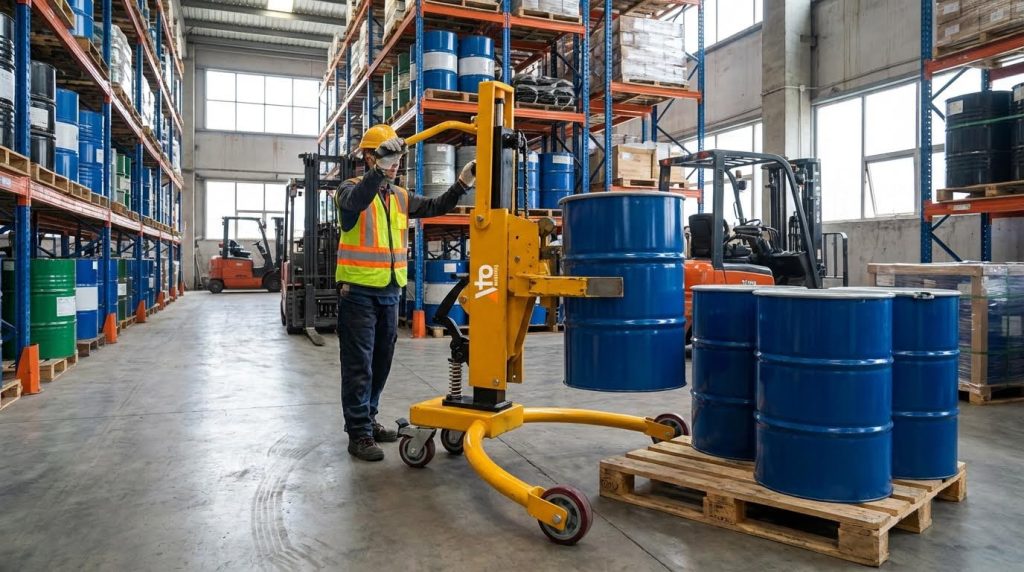
Specialized barrel hand trucks let you move two or more heavy drums safely, but only when design limits, floor conditions, and procedures are respected. This guide explains how to choose, inspect, and operate multi‑barrel hand trucks to control real‑world risks like tipping, runaway loads, and drum damage. You will see how frame strength, wheel selection, and restraints work together so a hand truck is used to move two barrels efficiently without overloading operators or equipment. Use it as a practical engineering checklist for safer drum handling in warehouses, plants, and loading areas.
Understanding Multi‑Barrel Hand Trucks And Risks
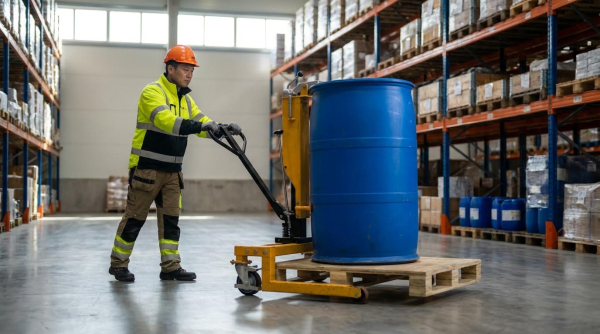
This section explains how a hand truck is used to move two barrels safely and why the risk profile changes compared with single-drum handling. The focus is on common configurations and the main failure modes to control.
💡 Field Engineer’s Note: The moment you move from one to two full 200 L drums, your combined mass often exceeds 400–500 kg, so small floor defects, slopes over 2%, or abrupt steering inputs can generate enough lateral force to tip a poorly designed or poorly loaded truck.
Typical hand truck configurations for two barrels
When a hand truck is used to move two barrels, it typically uses an extended frame and extra wheels to keep the higher, deeper load stable. The main design differences versus single-drum trucks are wheel layout, support points, and restraint options.
- Inline two‑drum truck: Drums sit one behind the other – keeps width narrow for 1.0–1.2 m doors and aisles.
- Side‑by‑side two‑drum truck: Drums sit next to each other – lower centre of gravity and better lateral stability on turns.
- Convertible 2‑/4‑wheel design: Starts as a 2‑wheel tilt truck, then rests on rear castors – reduces operator effort over longer distances.
- Cradle‑type frame: Curved supports match drum radius – spreads contact load and reduces denting of thin steel or plastic drums.
- Multi‑position handle: Allows high or low grip – lets short and tall operators keep a safe back posture when tilting two drums.
| Feature | Typical Value / Option | Operational Impact |
|---|---|---|
| Load capacity (2 drums) | Up to 300 kg for many drum hand trucks for single-drum models | Two 200 L drums with dense product may exceed 500 kg, so a dedicated multi‑drum truck or powered unit is often required. |
| Typical frame height | Around 1,600 mm for drum hand trucks (example model 1,600 mm high) | Gives leverage to tilt two stacked or inline drums while keeping hands above drum tops. |
| Wheel layout | 2 main wheels (Ø ≈ 260 mm) plus 2 rear castors or stabilisers (example external width 680 mm) | Four‑point contact improves stability when parking two loaded drums. |
| Wheel type | Pneumatic 260×85 mm, solid rubber, or nylon wheels (example dimensions) and wheel options | Pneumatic suits rough yards; solid or nylon suits smooth factory floors and clean areas. |
| Securing mechanisms | Spring‑loaded chime hooks and optional ratchet straps with up to 400 kg lashing capacity (chime hooks) (ratchet straps) | Prevents either drum from sliding or bouncing free on ramps or over thresholds. |
| Construction | Heavy‑duty steel with continuous welds (steel frame, continuous welds) | Resists frame twist when two full drums are tilted and braked. |
How a hand truck is used to move two barrels in practice
In a typical inline configuration, the operator loads the first 200 L drum against the toe plate and secures it with a chime hook or strap. The second drum then nests behind or slightly above, using a second cradle or intermediate support. Once both drums are restrained, the operator tilts the truck back to bring the combined centre of gravity over the wheel axle, then moves with small, controlled steps. On four‑wheel designs, the rear castors take part of the load once the frame is past a set tilt angle, which reduces handle force but increases overall length.
Key hazards when moving multiple loaded drums
When a hand truck is used to move two barrels, the main hazards are overload, loss of stability, and loss of control on slopes or poor floors. These risks grow quickly with drum mass, liquid movement, and operator fatigue.
- Overloading the truck frame: Two full 200 L drums with dense product can exceed 500 kg – using a 250–300 kg-rated truck risks structural failure.
- High and offset centre of gravity: Stacking or side‑by‑side loading raises the load centre – small sideways pushes or potholes can cause sudden tipping.
- Insufficient restraint: Relying only on friction without chime hooks or straps – drums can slide off when braking or crossing a 10–20 mm floor lip.
- Liquid surge inside drums: Part‑filled drums allow sloshing – dynamic load shift can pull the truck out of the operator’s hands during turns.
- Wheel mismatch to floor: Hard nylon on rough concrete or ramps – high vibration, poor grip, and increased stopping distance.
- Gradients and ramps: Pushing two drums up a ramp steeper than 5–6% – excessive handle force and high runaway risk if grip is lost.
- Pinch and crush zones: Two drums plus frame narrow the clearance at door jambs – hands, feet, and shins are at greater risk when manoeuvring.
- Incompatible drum types: Using steel‑drum chime hooks on thin plastic rims (plastic and fibre drum adaptations) – hooks may slip or cut into the rim under dynamic load.
- Operator overexertion: Repeated tilting of twin loads – high risk of back and shoulder strain, especially if handles are too low.
- Hazardous contents release: A tipped drum containing chemicals or flammables – can escalate quickly into a spill or fire scenario.
Human factors that amplify risk with two‑drum moves
Most incidents with multi‑barrel hand trucks involve a combination of marginal equipment and rushed behaviour. Common patterns include operators trying to “make one trip instead of two,” using a single‑drum truck for two smaller barrels, or pushing instead of pulling on down‑slopes. Fatigue late in the shift, poor lighting near yard ramps, and wet or dusty floors further reduce reaction time and traction. Formal training on two‑drum handling, clear rules on maximum gradients, and simple visual SWL labels on the truck all help to keep these human factors under control.
Engineering Features That Improve Barrel Handling Safety
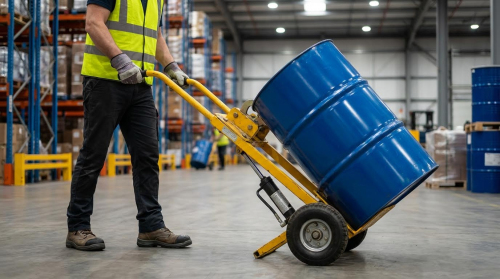
Engineering features on specialized drum hand trucks control load, stability, and restraint so a hand truck is used to move two barrels without exceeding safe limits or losing control. This section explains which design details matter most.
Frame design, SWL, and proof load considerations
Frame design, Safe Working Load (SWL), and proof testing ensure the truck structure safely carries two full drums with a realistic safety margin.
For multi‑barrel hand trucks, the frame is your primary safety component. Heavy‑duty steel frames with continuous welds resist twisting when you tilt and turn two loaded drums together. Typical single‑drum units handle about 250–300 kg, with frame heights around 1,600 mm and widths near 680 mm, and self‑weight about 21 kg, giving a good reference envelope for robust construction. When a hand truck is used to move two barrels, the combined drum mass and any accessories must stay below the marked SWL.
| Design Aspect | Typical Value / Practice | Operational Impact |
|---|---|---|
| Frame material | Welded steel, heavy‑duty sections | Resists bending when tilting two 200 L drums together |
| Typical capacity (single‑drum truck) | 250–300 kg capacity data | Baseline for sizing; multi‑drum versions must be rated for combined drum mass |
| Example overall size | ≈ 725 mm L × 680 mm W × 1,600 mm H dimensional data | Defines leverage and operator reach when tipping back two drums |
| SWL marking | Clearly stamped/labelled on frame | Prevents overloading when mixing drum sizes or densities |
| Proof load (typical practice) | 10–25% above SWL for lifting gear | Shows structure can survive occasional overloads and dynamic shocks |
- Wide, braced frame: Spreads wheel track and drum support – Improves lateral stability when cornering with two drums.
- Low drum cradle height: Keeps drum centres of gravity closer to floor – Reduces overturning moment if a wheel hits an obstacle.
- Reinforced toe plate / cradle: Gussets and deep section under drum – Prevents bending when initially prying drums off the floor.
- Redundant restraints: Frame plus hooks plus straps – Maintains containment if one element loosens.
Why proof load matters on a “simple” hand truck
Even though many standards focus on lifting gear, proof‑style thinking still applies. When you bounce over thresholds or slopes with two drums, peak forces can exceed static weight. A design tested well above its SWL is far less likely to crack at weld toes or buckle at the axle brackets in real use.
💡 Field Engineer’s Note: When specifying multi‑drum trucks, I treat SWL as a planning limit and then de‑rate another 10–15% if drums may contain high‑density liquids or if operators routinely push over dock plates and expansion joints. This buffer compensates for dynamic impacts and less‑than‑perfect handling.
Wheel selection for floor conditions and gradients
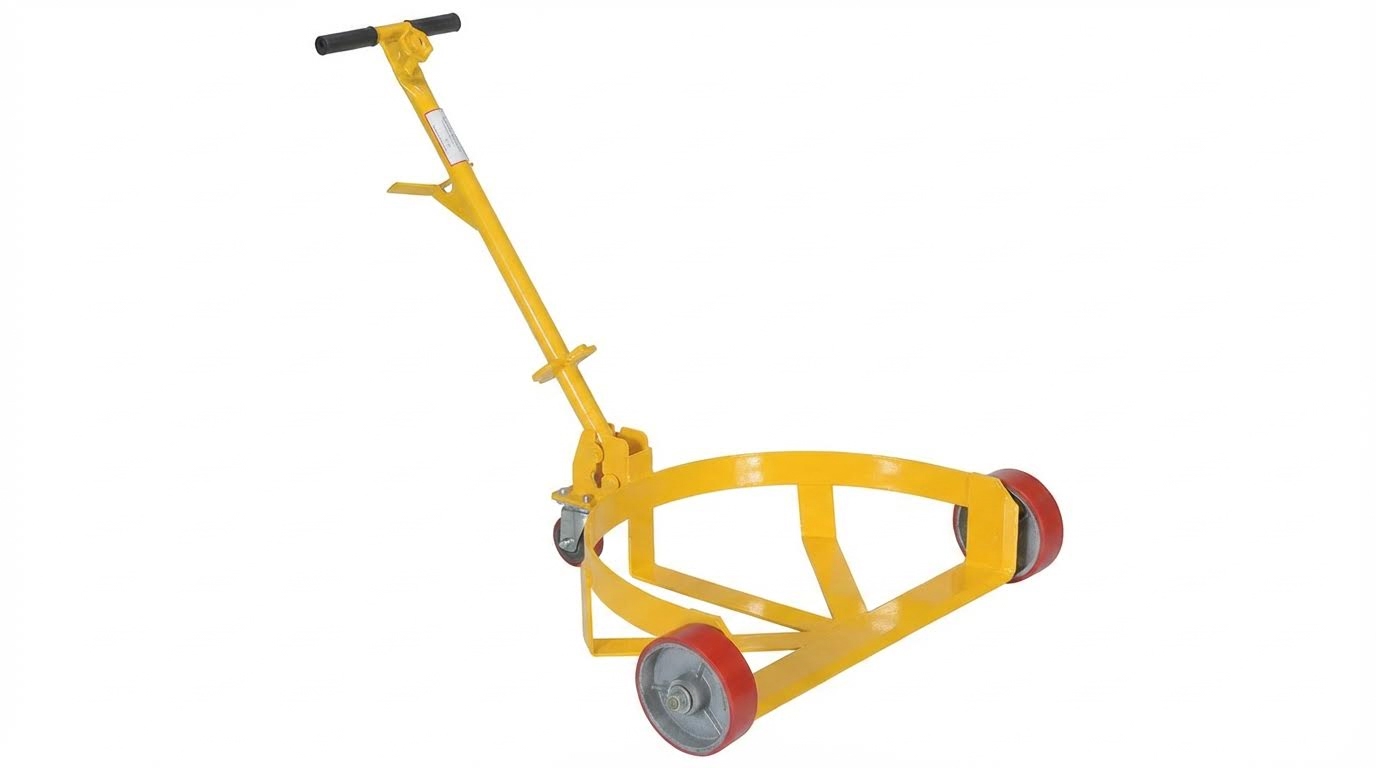
Wheel type, size, and layout determine how safely you can move two loaded drums over real floors, thresholds, and ramps.
Wheel choice directly controls push force, vibration, and stability. Pneumatic wheels around 260 × 85 mm roll more easily over rough or broken concrete and absorb shocks, which protects both the frame and drum contents. Solid rubber or nylon wheels suit smoother indoor floors and resist damage from oils and chemicals, but they transmit more vibration and can skid on wet surfaces. When a hand truck is used to move two barrels, the extra combined mass makes undersized wheels a serious risk on any gradient.
| Wheel Type | Typical Size / Feature | Best For… |
|---|---|---|
| Pneumatic | ≈ 260 × 85 mm wheel data | Uneven yards, dock plates, expansion joints; reduces shock to two full drums. |
| Solid rubber | Medium diameter, non‑marking options | Indoor concrete, light ramps; lower maintenance than pneumatic. |
| Nylon / hard plastic | High hardness, smaller contact patch wheel materials | Clean, smooth floors in dry areas; easiest rolling but harsher ride. |
| Two‑wheel layout | Classic hand truck format | Tight spaces, short moves; requires more operator balance with two drums. |
| Four‑wheel layout | Additional rear castors | Heavier loads and longer distances; truck can stand without operator support. |
- Large diameter wheels: Better at climbing small steps and gaps – Reduces sudden jolts that can break drum seals.
- Wide wheel track: Increases lateral stability – Helps prevent tipping if one wheel drops into a floor drain.
- Hand brake options: Integrated drum truck brakes – Control descent on short ramps or truck tail lifts.
- Chemical‑resistant treads: Rubber or nylon compatible with site chemicals – Prevents swelling or cracking that could lock a wheel.
Gradients and push force with two drums
Even a 2–3% slope multiplies the push or restraint force when moving two 200 L drums. On smooth indoor ramps, hard wheels may roll too freely, making it hard to stop. On rough exterior ramps, pneumatic wheels reduce shock but can bounce; combine them with brakes and clear procedures for chocking at rest points.
💡 Field Engineer’s Note: In plants with mixed floors, I favour pneumatic main wheels plus small solid rear castors on multi‑drum trucks. Operators get shock absorption on rough sections but still have precise steering and stable parking in smooth loading bays.
Clamping, chime hooks, and restraint systems
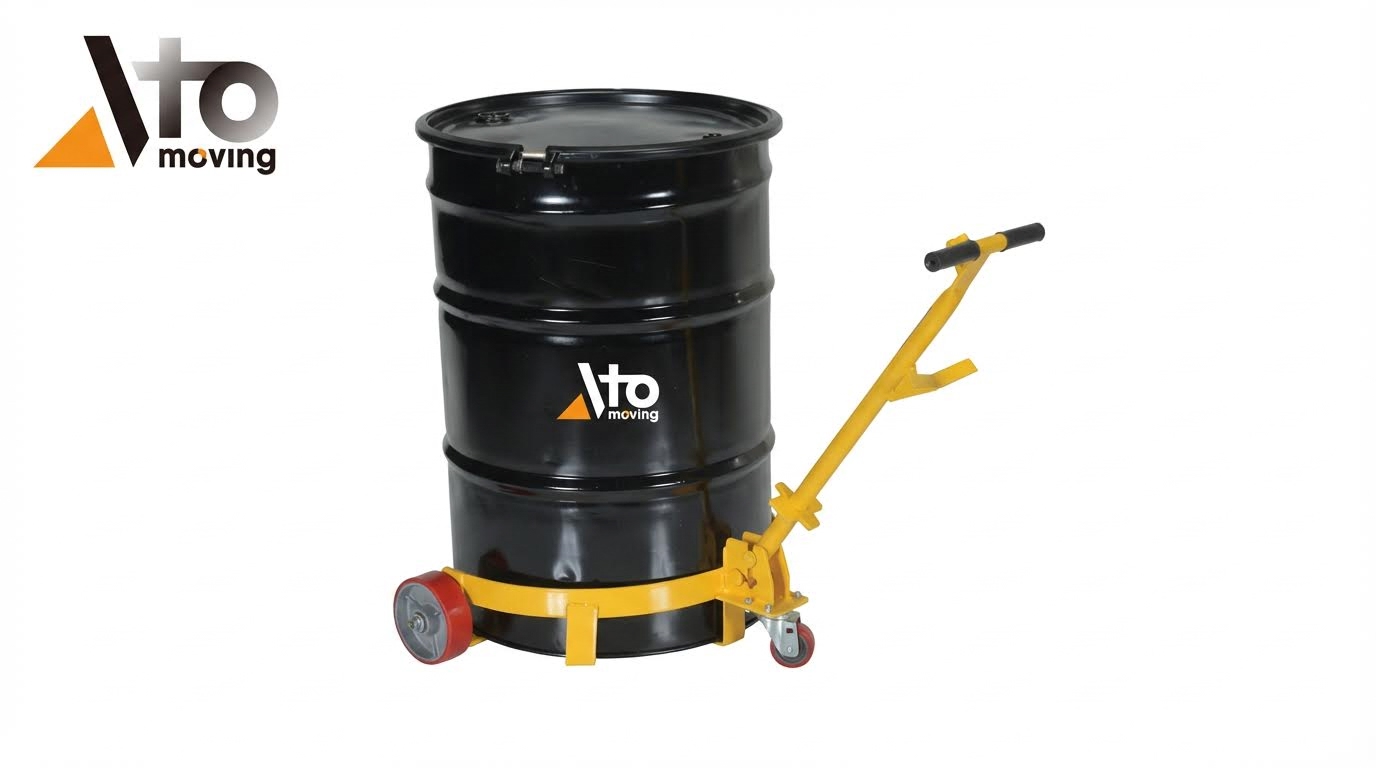
Clamps, chime hooks, and straps keep each drum positively restrained so two barrels stay locked to the truck through bumps, turns, and ramps.
Good restraint systems turn a hand truck into a controlled fixture instead of a balancing act. Spring‑loaded chime hooks automatically engage the drum rim and hold without continuous hand contact, which is critical when managing two drums at once. On some models, hooks are shaped or positioned to work with steel, plastic, or fibre drums, including designs that catch over bung projections on plastic drums. Ratchet straps with lashing capacities around 400 kg and maximum capacities near 800 kg add a secondary restraint over the drum body.
| Restraint Element | Typical Spec / Feature | Operational Impact |
|---|---|---|
| Spring‑loaded chime hooks | Automatic engagement on drum rim hook design | Hands‑free retention; drum stays attached if operator slips. |
| Plastic‑drum‑compatible hooks | Forms over bung projections application detail | Prevents slippage on smooth plastic rims when tilting. |
| Ratchet strap | Lashing ≈ 400 kg, max ≈ 800 kg, length 3–5 m strap data | Secondary tie‑down for two drums across the frame. |
| Cradle profile | Curved or V‑shaped supports | Holds cylindrical drums concentric with frame, improving balance. |
| Handle grips | Ergonomic, non‑slip safety features | Allows precise tilting of two drums without losing grip. |
- Independent restraints per drum: One hook/strap per barrel – Prevents one loose drum from destabilizing the other.
- Positive “click‑in” feedback: Hooks that audibly snap into place – Lets operators confirm engagement even with gloves or poor visibility.
- Redundant systems: Chime hooks plus strap – Maintains control if a rim deforms or a hook partially releases.
- Quick‑release but guarded: Releases protected from accidental knocks – Avoids unintentional opening when passing door frames or obstacles.
Setting up restraints for two‑barrel moves
When a hand truck is used to move two barrels, position each drum so its chime sits fully in the cradle, engage each hook separately, then apply a shared strap across both drums and the frame. This way, each barrel is individually captured, and the strap acts as a global safety belt.
💡 Field Engineer’s Note: I always check that chime hooks still spring fully closed on older trucks. Weak springs or bent hooks are a hidden risk; with two drums, one disengaged hook can shift the centre of gravity enough to pull the whole unit over on a bump.
Operating Procedures And Equipment Selection Criteria
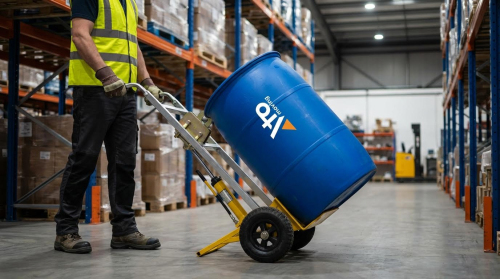
This section explains how to inspect, operate, and choose specialized hand trucks when a hand truck is used to move two barrels so you control risk, not just weight.
Pre‑use inspection and regulatory compliance checks
Pre‑use checks ensure the truck, restraints, and route are safe before any attempt to move one or two loaded barrels. Treat this like a mini lifting-equipment inspection, even if it is “just a hand truck.”
- Check identification and SWL tag: Confirm the rated capacity in kg is visible and legible – prevents accidental overload when both barrels are full.
- Verify frame and weld integrity: Inspect the steel frame, continuous welds, and handle junctions for cracks, corrosion, or deformation – avoids sudden structural failure under dynamic loads.
- Inspect wheels and axles: Spin each wheel and check for flat spots, loose bearings, and bent axles – reduces steering effort and the risk of the truck “snatching” under load.
- Confirm wheel type matches route: Use pneumatic wheels for rough yards and solid or nylon wheels for smooth indoor floors – improves traction and reduces shock into the drums.
- Test brakes and parking ability: If fitted, operate the hand brake several times and confirm it holds on the steepest gradient in your route – prevents runaways on ramps.
- Inspect chime hooks and clamps: Check spring‑loaded chime hooks, ratchets, and latch pins for free movement and full engagement – keeps both barrels positively restrained during tilting.
- Check straps and lashing gear: Inspect ratchet straps (e.g., 400 kg lashing capacity, 800 kg max) for cuts, abrasion, or damaged hooks – maintains rated restraint strength during sudden stops.
- Verify drum condition: Look for bulging, leaks, dented chimes, or loose bungs on each barrel – prevents product release when the drums are tilted.
- Confirm route is clear and rated: Check floor loading limits, gradients, and door widths along the path – avoids getting stuck with two unstable barrels on a slope.
- Compliance documentation: Ensure inspection records and any required proof tests for special attachments are current – demonstrates alignment with safety and handling regulations.
How to judge if two full barrels exceed SWL
Estimate each full barrel’s mass (contents + drum). If the hand truck is rated 300 kg and each full 200 L drum is about 200–220 kg, then two full drums exceed SWL. In that case, move one at a time or use powered or forklift‑mounted equipment.
💡 Field Engineer’s Note: When operators rush, they often ignore minor wheel damage. On a 2–3% ramp, a seized or flat‑spotted wheel can twist the frame as you tilt two heavy drums, over‑stressing welds long before you reach the SWL on paper.
Step‑by‑step method for loading, tilting, and transporting
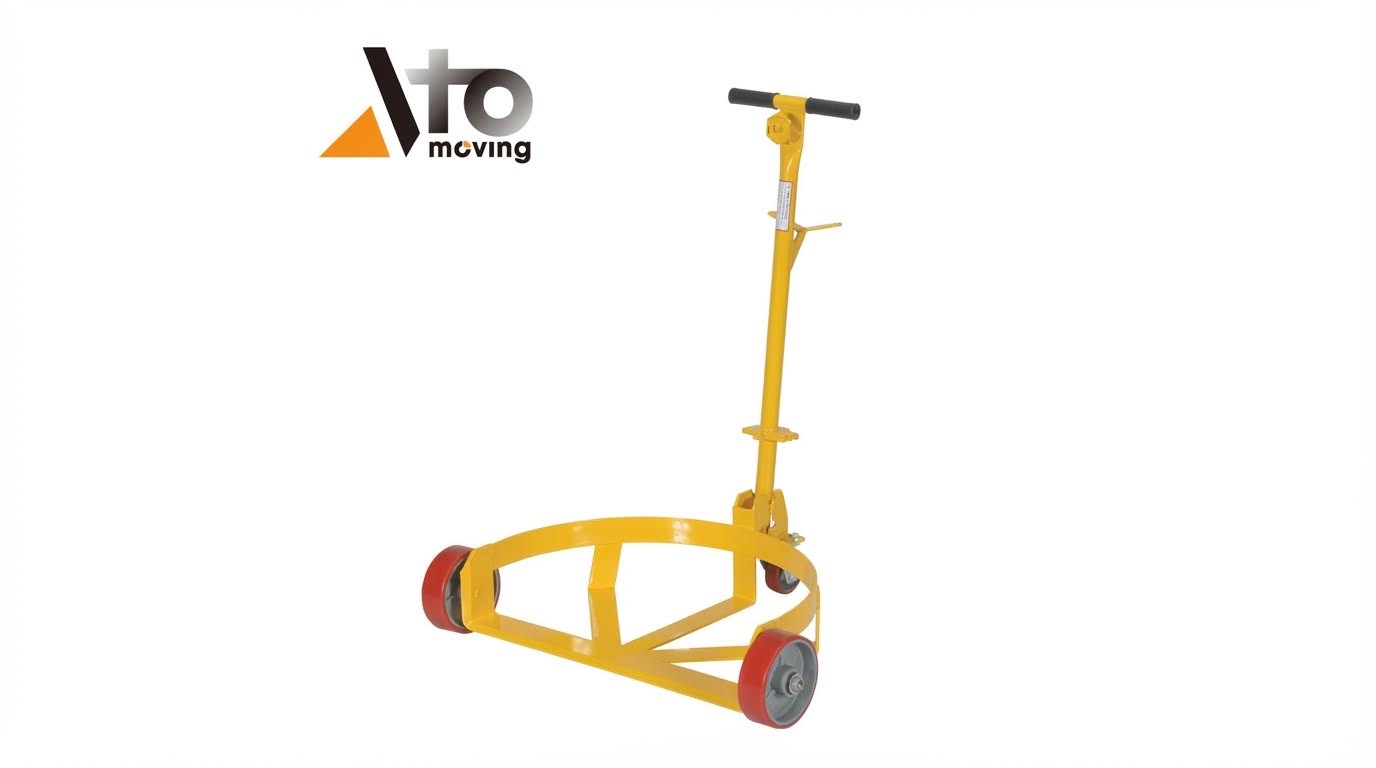
Using a hand truck to move two barrels safely depends on a disciplined, repeatable sequence that keeps the combined center of gravity inside the wheelbase at all times.
- Step 1: Plan the move and route – Reduces surprises like tight corners or unexpected slopes when the truck is already loaded.
- Step 2: Park truck on level, braked position – Prevents the truck from rolling while you load the first and second barrel.
- Step 3: Position first barrel at the nose – Roll the drum to the truck rather than pushing the truck to the drum – keeps manual forces low and controlled.
- Step 4: Engage lower cradle or toe plate – Slide the nose under the first drum until it contacts the cradle – maximizes surface contact and stability.
- Step 5: Hook the chime or clamp – Engage spring‑loaded chime hooks or body clamps around the rim – prevents the barrel from slipping off during tilt.
- Step 6: Partial tilt of first barrel – Pull the handles toward you just enough to bring the drum slightly off vertical – reduces effort to add the second barrel without over‑loading your back.
- Step 7: Load the second barrel against the first – Bring the second drum into position, ensuring both sit square on the support – creates a compact “block” load rather than two independent, rocking masses.
- Step 8: Secure both barrels with straps – Apply ratchet straps around both barrels and the frame, tensioning evenly – ties the drums together and into the frame to resist side loads.
- Step 9: Final controlled tilt to transport angle – With feet staggered, use leg drive and body weight to tilt until the load is comfortably balanced over the wheels – keeps the combined center of gravity within the wheelbase.
- Step 10: Test balance before moving – Gently rock the truck forward and back – confirms no loose movement or tendency to tip sideways.
- Step 11: Walk, don’t run – Move at walking speed, keeping the load slightly tilted toward you – gives time to react if a wheel hits an obstacle.
- Step 12: Approach ramps straight on – Go up or down gradients in line with the slope, never sideways – prevents side‑tipping when the two‑barrel mass shifts.
- Step 13: Parking and unloading – Stop on level ground, secure the truck, then reverse the loading sequence one barrel at a time – avoids sudden shifts as restraints are removed.
Body mechanics when tilting two heavy barrels
Keep the hand truck close to your body, feet shoulder‑width apart, one foot slightly forward. Bend hips and knees, not your back. Use a smooth pull with leg drive and body weight, avoiding any twisting; turn your feet instead.
💡 Field Engineer’s Note: If you ever feel the handles “run away” from you when tilting two drums, stop and reset. That sensation means the center of gravity has passed the wheel line and the load can slam down or tip unexpectedly.
Choosing between manual and powered multi‑drum trucks
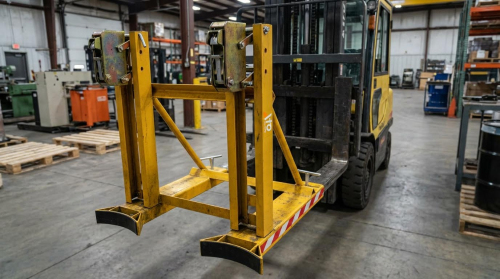
Choosing between manual and powered multi‑drum hand trucks depends on total load, route conditions, and how often a hand truck is used to move two barrels in your facility.
| Option | Typical Capacity | Best For… | Operational Impact |
|---|---|---|---|
| Manual two‑barrel hand truck | 250–300 kg per truck | Occasional moves, short, level routes | Low cost, but limited when both barrels are near full mass. |
| Four‑wheel drum cart | Up to ~300 kg | Heavier loads on level floors | Higher stability and lower operator effort, but larger turning radius. |
| Powered hand truck | ≈360 kg (800 lb) | Frequent moves, long distances, mild ramps | Battery drive and variable speed reduce strain and improve throughput. |
| Forklift or stacker with drum clamp | Above 500 kg (application‑dependent) | High‑throughput loading, stacking, or outdoor yards | Removes manual handling but needs trained operators and clear aisles. |
- Manual multi‑drum truck: Choose when drums are often part‑filled, routes are flat, and usage is low – keeps capital cost and maintenance simple.
- Wheel and frame sizing: Look for robust steel frames with dimensions around 700–800 mm wide and 1,500–1,700 mm high – gives enough height for leverage while fitting standard doors.
- Powered assistance: For frequent two‑barrel moves or ramps, consider 24 V powered units with variable speed up to about 1.1 m/s – cuts fatigue and reduces over‑exertion injuries.
- Environment compatibility: Use stainless frames and nylon wheels in corrosive or clean environments – prevents rust and particle shedding.
- Future throughput: If production is increasing, design for the “next” workload – avoids replacing under‑sized manual gear within a year.
Quick rule of thumb for equipment choice
If one person cannot comfortably tilt and control two typical production barrels on a level test area, step up to a powered hand truck or a forklift‑mounted drum handler. Human strength is not a substitute for proper mechanical advantage.
💡 Field Engineer’s Note: Many sites buy a powered unit only after the first back injury. If more than 20–30 two‑barrel moves happen per shift, powered assistance usually pays for itself quickly in reduced strain and fewer micro‑incidents.
Final Considerations For Safe Multi‑Barrel Handling
Safe multi‑barrel handling depends on matching equipment design, floor conditions, and operating discipline as a single system. Frame strength, correct SWL, and proof‑style thinking give a structural safety reserve when two 200 L drums approach 500 kg. Wheel type and layout then decide how that mass behaves on real floors, thresholds, and gradients; the wrong wheels can turn a stable frame into a runaway risk. Positive restraints, such as chime hooks and straps, convert two loose cylinders into one controlled load so shocks and liquid surge do not shift the centre of gravity outside the wheelbase.
Procedures close the loop. Planned routes, pre‑use checks, and a fixed loading sequence keep the operator ahead of hazards instead of reacting to them. Selection of manual, powered, or forklift‑mounted solutions must reflect real duty cycles, slopes, and drum density, not just purchase price. As a practical rule, treat two‑drum moves like low‑level lifting operations: respect SWL, control dynamics, and de‑rate for poor floors and fatigue. If operators struggle to tilt or stop the load, upgrade to powered or higher‑capacity equipment from Atomoving and revise the method. This approach keeps productivity high while keeping tipping, injury, and spills within a controlled, engineered envelope.
Frequently Asked Questions
What is a hand truck?
A hand truck is a wheeled cart with long handles designed to move heavy objects. It is also commonly referred to as a dolly or two-wheeler. Using a hand truck makes it easier to transport items that are too heavy to carry by hand. Hand Truck Definition.
How to properly use a hand truck?
To use a hand truck properly, tilt the load slightly forward and slide the hand truck’s ledge underneath the object. Then, carefully tilt the hand truck and the load backward while holding the hand truck firmly. This method ensures stability and control while moving heavy items like barrels. Using Dollies and Hand Trucks.
Should you push or pull a hand truck?
It is safer to push a hand truck rather than pull it. Pushing allows you to see where you are going and lets you use your body weight and larger muscles effectively. This technique reduces strain on your shoulders and back. Push Don’t Pull Guide.
How to move something heavy with a dolly?
When moving something heavy with a dolly, ensure the load is balanced and secure. Tilt the object onto the dolly and use your body weight to control the movement. Always push rather than pull to maintain better control and visibility. Basics of Dollies and Hand Trucks.