
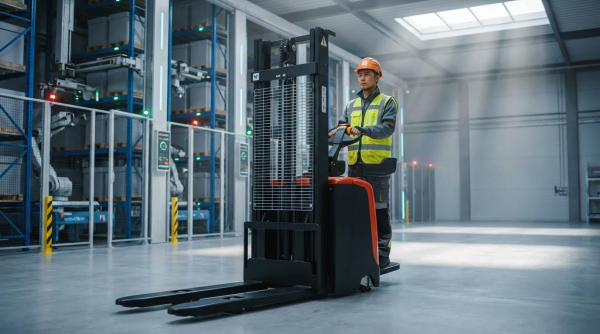
Walkie stackers operated as pedestrian lift trucks sat in a regulatory grey area between pallet jacks and ride‑on forklifts. Jurisdictions treated them as high‑risk plant, yet usually did not mandate a national high risk work (HRW) licence. This article mapped how that gap was managed through employer and PCBU duties, equipment standards, and structured operator training. It walked through legal status, core competency requirements, records and certification practices, and realistic licensing expectations for safe, compliant walkie stacker operation.
Legal Status And Compliance Obligations
Why No National HRW Licence Is Required
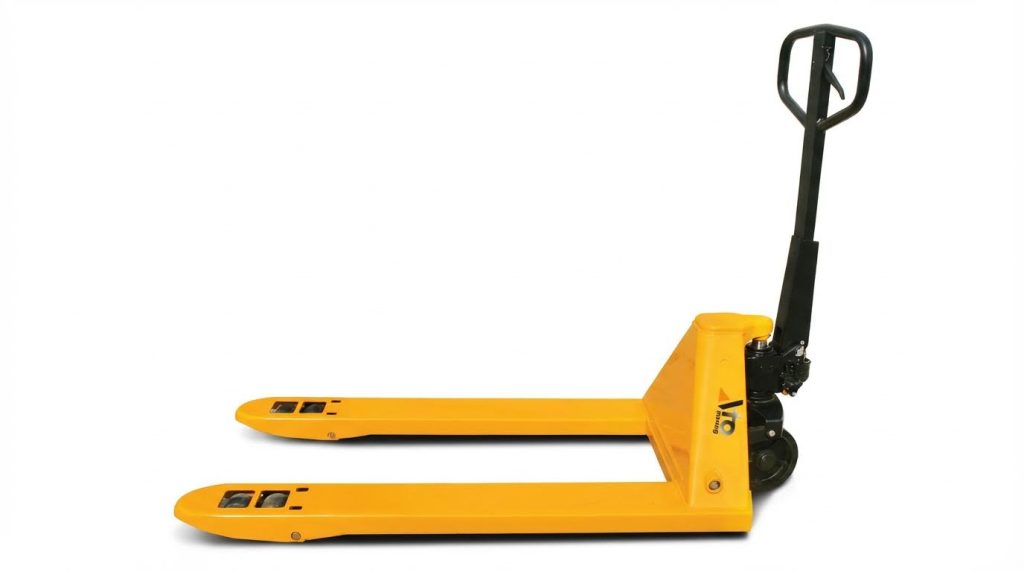
Walkie stackers were classified as pedestrian-operated lift trucks rather than ride-on forklifts. Regulators therefore did not treat them as high-risk work (HRW) equipment requiring a national licence. Operators walked behind or alongside the unit and controlled travel and lift via a tiller arm, which reduced typical forklift exposure scenarios. Despite the absence of an HRW licence requirement, duty holders still had to ensure operators were trained and competent. Training outcomes usually aligned with local occupational health and safety legislation and referenced manufacturer instructions and data plates.
Role Of Employers And PCBUs In Compliance
Employers and PCBUs held the primary legal duty to manage walkie stacker risks. They had to provide task-specific training, supervision, and safe systems of work for authorised operators. Guidance from different jurisdictions stated that employers or PCBUs must maintain training records and verification of competency (VOC). These records supported internal audits, regulator inspections, and incident investigations. Duty holders also had to provide suitable equipment, safe workplaces, and pre-use inspection regimes. They were responsible for enforcing rules such as prohibiting operation under the influence, restricting unauthorised use, and controlling pedestrian interaction zones.
Applicable Standards (AS 2359.2, CSA B335, OHSA)
Walkie stacker training programs referenced several standards and regulations depending on jurisdiction. In Australia, courses aligned with AS 2359.2, which covered operation of industrial trucks, routine checks, load handling, shutdown, and battery maintenance. Canadian providers based content on CSA B335-15, which addressed powered industrial truck design, safe operation, and operator training requirements. They also incorporated provincial obligations under OHSA and Regulation 851, including hazard identification, workplace inspections, and role responsibilities. Training mapped theory and practical components to these documents, covering stability principles, load charts, and pre-shift inspections. Using recognised standards helped organisations demonstrate due diligence and regulatory compliance even without a formal HRW licence.
Core Training And Competency Requirements
Mandatory Theory Topics And Safety Principles
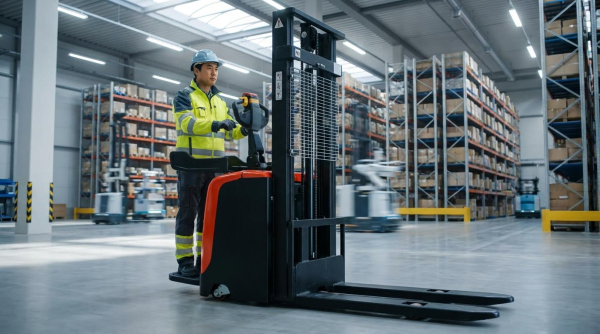
Walkie stacker theory training covered the legal framework, equipment classification, and employer obligations. Providers aligned course content with standards such as AS 2359.2, CSA B335-15, and OHSA Regulation 851. Trainees studied roles and responsibilities of operators, supervisors, and PCBUs or employers. Core safety principles included stability triangle concepts, load moment, and reading the manufacturer’s data plate. Courses addressed typical accident types: tip-overs, falling loads, loss of steering, and pedestrian impacts. Theory modules also explained pedestrian exclusion zones, including minimum 1 m clearance around raised or lowering forks. Operators learned safe travel rules, such as speed control in aisles, intersections, and on slopes greater than 7°. Programs emphasised prohibitions on riding passengers, standing on forks, and transporting people. Trainees reviewed safe parking, including fork lowering, neutral controls, and circuit isolation after shutdown. Many courses incorporated job site hazard analysis and general aisle rules as mandatory theoretical content.
Practical Skills: Driving, Load Handling, Inspections
Competency-based training required operators to demonstrate controlled driving and precise load handling. Practical modules covered smooth acceleration, deceleration, and turning without sudden braking or high-speed cornering. Operators practised correct fork positioning: forks fully under the pallet, load balanced across both forks, and small items in containers. Instructors enforced travel with forks at the lowest position when unloaded, and approximately 300–400 mm height with the mast tilted back when loaded. Trainees drove on flat surfaces and controlled slopes, driving forward uphill and reversing downhill on gradients above 7°. Programs prohibited turning or braking on slopes and required speed reduction on wet or narrow surfaces. Pre-use inspections formed a core skill set, including checks on wheels, brakes, horns, steering, hydraulic cylinders, hoses, forks, guards, and warning devices. Operators verified battery charge, hydraulic oil, and battery water levels, and responded correctly to low-voltage indications by stopping operation. Practical drills also covered safe parking, isolating controls, and securing equipment away from exits and emergency routes.
Hazard Identification, Risk Assessment, Controls
Walkie stacker courses integrated structured hazard identification and risk assessment methods. Trainees identified principal hazards: being run over, struck-by events, tip-overs, falling loads, and collisions with structures or products. Programs taught operators to recognise environmental hazards such as congested aisles, poor lighting, uneven floors, and steep or slippery ramps. Risk assessment exercises applied hierarchy of controls, combining engineering controls, administrative measures, and personal protective equipment. Typical controls included defined pedestrian exclusion zones, marked travel paths, and restricted parking near emergency passages or firefighting equipment. Operators learned to reject unstable or unsecured loads and to avoid dangerous goods unless specific procedures existed. Training emphasised behavioural controls: no operation under drugs or alcohol, no eating, drinking, or phone use during driving, and mandatory helmet or appropriate PPE where required. Trainees practised pre-task risk reviews, adjusting driving patterns, speeds, and load heights to current site conditions.
Assessment Methods And Course Duration
Providers used blended assessment methods to verify competency. Written theory evaluations tested understanding of standards, hazard controls, load charts, and stability concepts. Some programs included calculation questions, such as verifying allowable load based on data plate and load centre. Practical driving tests assessed pre-use inspection performance, safe manoeuvring, slope techniques, and controlled load stacking or retrieval. Assessors observed compliance with speed limits, horn use at intersections, and correct shutdown procedures. Training duration varied by jurisdiction and provider. Crown’s walkie stacker sessions typically ran for 3 hours with up to 5 trainees or one-on-one formats. Other providers, such as Leavitt Machinery and Levac Safety, delivered courses of up to 8 hours, often combining half-day classroom theory with half-day practical assessment. Some organisations offered online theory modules with on-site practical tests and annual refresher or re-certification sessions. Course structures accommodated new operators with extended practical time and shorter update sessions for experienced staff.
Records, Certification, And Refresher Training
Training Records, VOC, And Audit Readiness
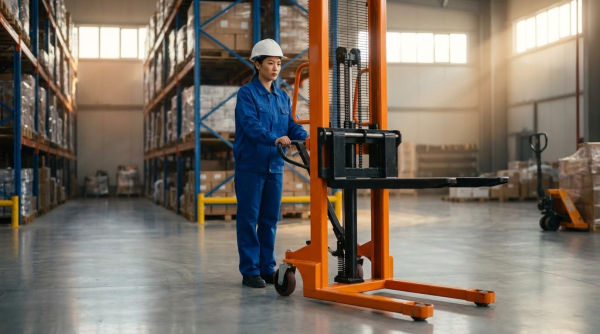
Walkie stackers were classified as pedestrian-operated lift trucks and typically did not require a national HRW licence. Despite this, regulators expected documented evidence of operator competence. Employers or PCBUs had to maintain training records, including attendance sheets, assessment results, and copies of certificates. These records supported Verification of Competency (VOC) processes and demonstrated due diligence during audits or incident investigations. A robust VOC system documented the model of equipment, operating environment, assessed tasks, and assessor credentials. Organisations often aligned record formats with AS 2359.2 or CSA B335 documentation expectations to support regulatory compliance. Proper record retention allowed safety teams to track expiry dates, refresher needs, and high-risk operators.
Non-National Certificates And Validity Periods
Walkie stacker training certificates usually confirmed the operator’s skills and knowledge for a specific employer or site. These certificates were not nationally recognised licences, even when issued by accredited trainers. Providers such as Crown issued statements of attainment aligned with AS 2359.2, while others used CSA B335 and OHSA-based formats. Validity periods varied by provider and jurisdiction. Some in-house certificates remained valid for 12 months, while other programs used a one-day or multi-year cycle supplemented by annual refreshers. Safety regulators generally focused on current competence rather than the nominal expiry date alone. Employers therefore treated certificates as one element within a broader competency management system that included supervision, incident review, and periodic re-evaluation.
Recertification, Refresher Triggers, And In-House Trainers
Refresher and recertification practices aimed to keep operators aligned with current standards and site conditions. Providers such as Leavitt Machinery and Levac Safety offered formal re-certification pathways for previously trained operators. Common triggers for refresher training included certificate expiry, involvement in incidents, near misses, or observed unsafe behaviour. Significant changes to equipment, attachments, layout, or operating procedures also justified immediate re-training. Some organisations developed in-house trainer programs so internal staff could deliver ongoing VOC checks and site-specific refreshers. These in-house trainers typically completed higher-level courses covering adult learning principles, assessment methods, and regulatory expectations. A structured recertification schedule, combined with competent internal trainers, improved consistency, reduced skill fade, and supported continuous improvement of walkie stacker safety performance.
Summary Of Walkie Stacker Licensing Expectations
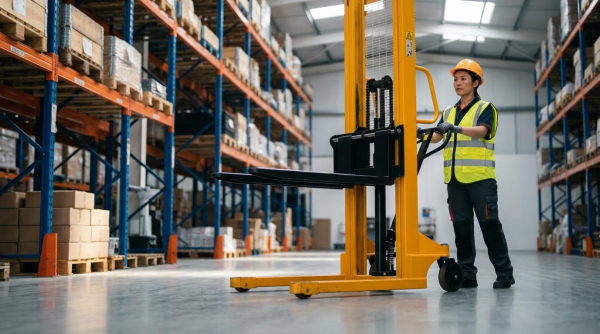
Walkie stackers were classified as pedestrian-operated lift trucks, so operators did not require a National High Risk Work (HRW) Licence. This exemption did not remove the duty to ensure operators were competent. Employers and PCBUs remained legally responsible for providing training, supervision, and a safe system of work under WHS or OH&S laws. Regulators expected documented evidence that only trained and verified operators used the equipment.
Industry practice aligned training content with standards such as AS 2359.2 in Australia and CSA B335 with OHSA Regulation 851 in Canada. Courses covered theory on stability, load capacity, hazard awareness, and regulatory roles, plus practical driving, load handling, and pre-use inspections. Providers used written tests, calculations, and on-truck assessments to verify competence. Typical course durations ranged from short 3-hour sessions for experienced staff to full 8-hour programs for initial training.
Certificates issued on completion documented walkie pallet truck skills but did not constitute nationally recognised HRW licences. Validity periods were usually defined by company policy or provider guidance, often around 1 year, with refresher training triggered by expiry, incidents, or task changes. Organisations needed robust training records, verification-of-competency processes, and periodic refreshers to remain audit-ready and manage risk. Overall, the licensing expectation was clear: no HRW licence, but structured, standard-aligned training and documented competency were mandatory for safe and compliant walkie stacker operation.