Voice-directed systems are changing how warehouses pick, pack, and move inventory by combining real-time software with simple spoken instructions. This article explains what voice picking is, how it works in practice, and how does warehouse voice picking work alongside your existing WMS to raise accuracy, throughput, and safety. You will see typical performance benchmarks, ergonomic and compliance considerations, and a practical ROI view for new projects. The final section walks through key use cases and selection criteria so you can plan and implement the right voice solution for your operation.
What Voice Picking Is And How It Works

Core components of a voice picking system
To understand how does warehouse voice picking work in practice, it helps to break the system into core components. A typical setup combines software, hardware, and network infrastructure to create a closed loop between the warehouse management system (WMS) and the picker on the floor. Each element must integrate cleanly to keep instructions, confirmations, and inventory updates flowing in real time.
- Voice software and speech engine – The voice layer sits between the WMS and the operator. It converts WMS tasks into spoken prompts and turns worker responses into digital confirmations. Modern systems support more than 40 languages, so operators can work in their native language, which speeds up adaptation and reduces training time and cultural barriers.
- WMS integration layer – An interface (API, middleware, or direct connector) links the voice system to the WMS. This allows task creation, inventory updates, and exception handling to stay synchronized without major infrastructure changes, enabling deployments in a matter of weeks in many operations with existing WMS environments.
- Mobile device and battery system – Each picker typically carries a small, rugged mobile computer on a belt or harness. The device runs the voice client, connects to the network, and manages audio processing. Many solutions run on standard industrial hardware, so sites can often reuse existing devices instead of buying new ones to keep capital costs down.
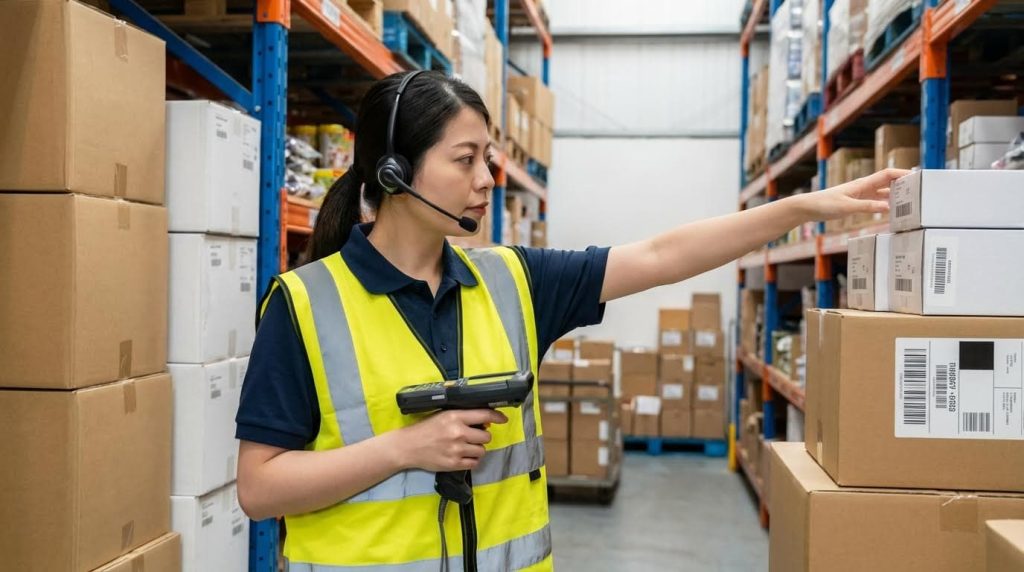
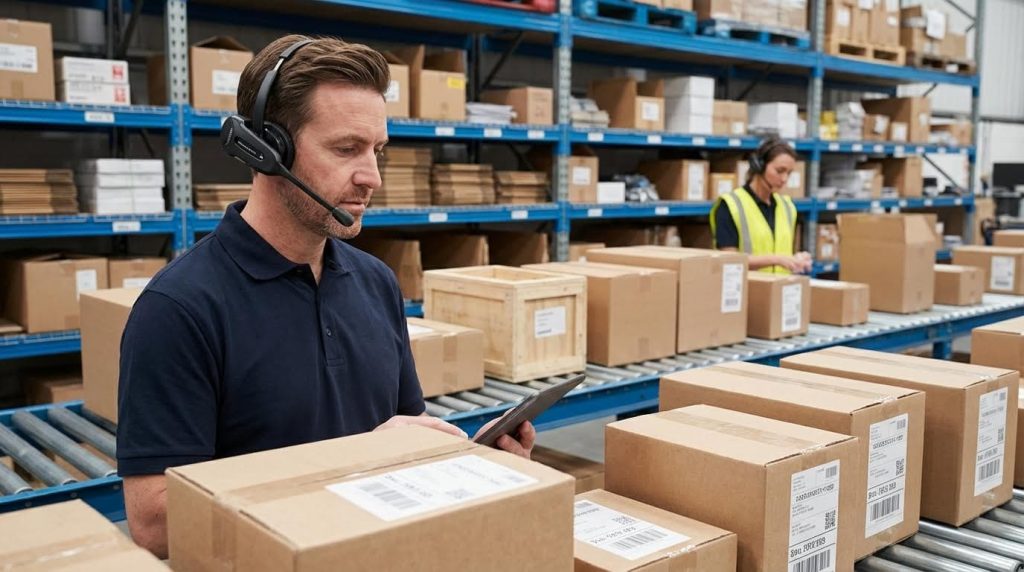
- Headset and microphone – A robust, noise-cancelling headset delivers instructions and captures responses. This frees both hands and keeps eyes on the travel path and load, which improves ergonomics and safety while workers handle equipment and fragile items during picking and transport.
- Wireless network and backend servers – A stable Wi‑Fi or similar network connects devices to application servers. These servers host the voice software, manage user profiles, log transactions, and feed dashboards that provide supervisors with real-time visibility into productivity, exceptions, and work status for better resource allocation.
Why these components matter for performance
When these components are tuned correctly, operations see large gains. Hands-free, voice-directed work has raised picking accuracy from around 95% with handheld systems to about 99.99%, while cutting errors by up to 80% and boosting productivity by as much as 30% in some deployments based on field results.
Step-by-step voice-directed picking workflow
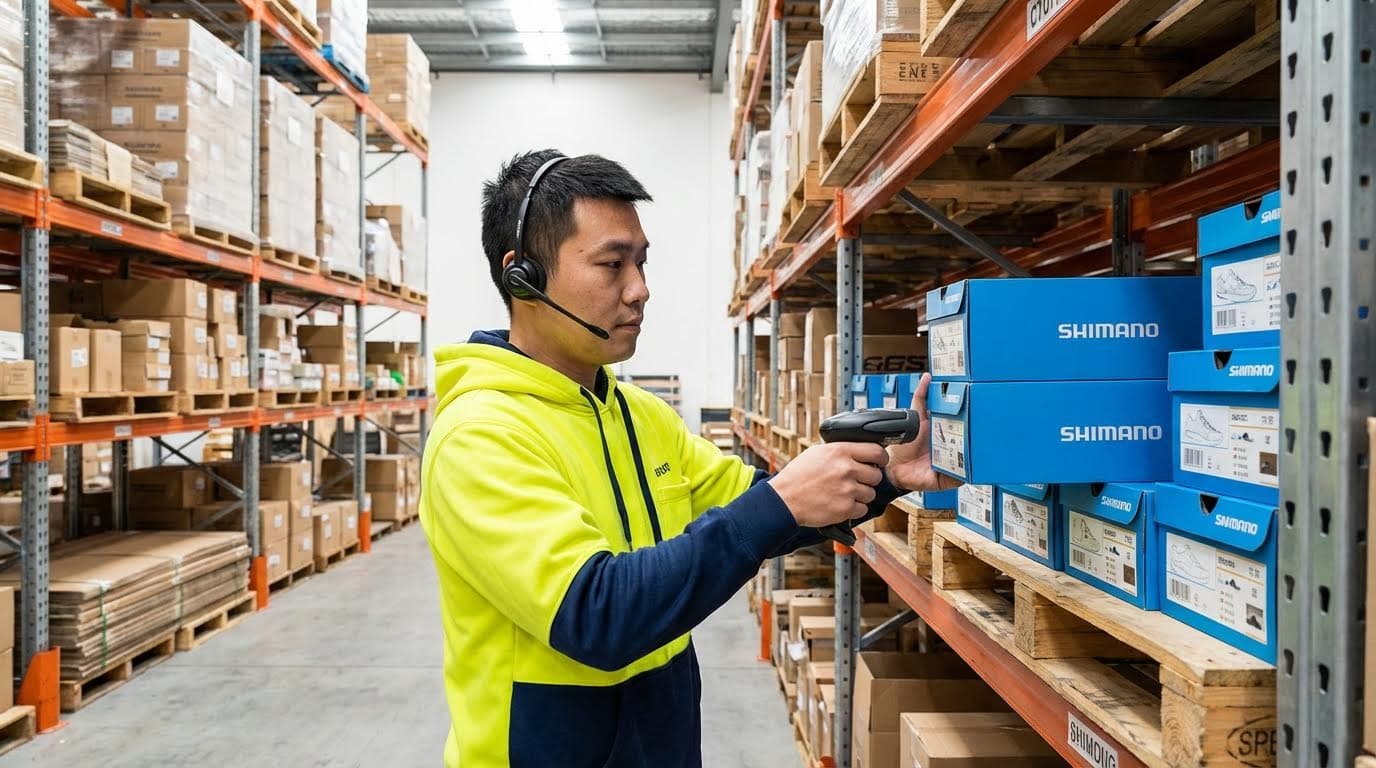
From an operator’s point of view, how does warehouse voice picking work day to day? The process follows a consistent, voice-driven loop that replaces paper lists or handheld scanning. This loop minimizes dead time, walking, and rework while keeping data accurate at the source.
- Assignment and login – The WMS generates picking tasks and passes them to the voice system. The picker logs in on the device, confirms their assignment, and the system loads their route and priority rules in the background.
- Travel to first location – The voice system speaks the first location, aisle, and zone. Some platforms layer AI-based travel optimization on top of the WMS logic to cut seconds from each move, contributing to 15–40% gains in picking productivity in optimized sites through smarter pathing.
- Location confirmation – At the slot, the worker confirms the location using a check digit, location code, or similar verbal response. This step is critical for accuracy and is one reason voice processes have pushed error rates down by 35–80% in documented projects compared with prior methods.
- Pick execution and confirmation – The system announces item, quantity, and any handling notes. The operator picks the product, places it in the correct container or pallet, and verbally confirms the quantity. Some setups also allow spoken container IDs and pallet placement instructions to be captured for better load building and tracking during selection.
- Real-time inventory update – Confirmations flow back to the WMS immediately. This supports accurate on-hand balances, timely replenishment, and continuous inventory monitoring without adding separate cycle-count labor to the shift as part of normal picking.
- Next task and dynamic reprioritization – The system then issues the next best location based on rules such as rush orders, trailer cut times, or consolidation needs. In real deployments, this streamlined, continuous flow has lifted selection speed by about 25% in units per hour and around 9% in lines per hour compared with pre-voice baselines in measured case studies.
Training and ramp-up in a voice-directed workflow
Because prompts are intuitive and consistent, new hires learn the workflow quickly. Documented projects reported training time reductions of 57–85%, with some sites cutting onboarding from a week to just a few days while still achieving near-100% accuracy and significant productivity gains across diverse workforces.
Technical Performance, Safety, And ROI Analysis
Accuracy, productivity, and error-rate benchmarks
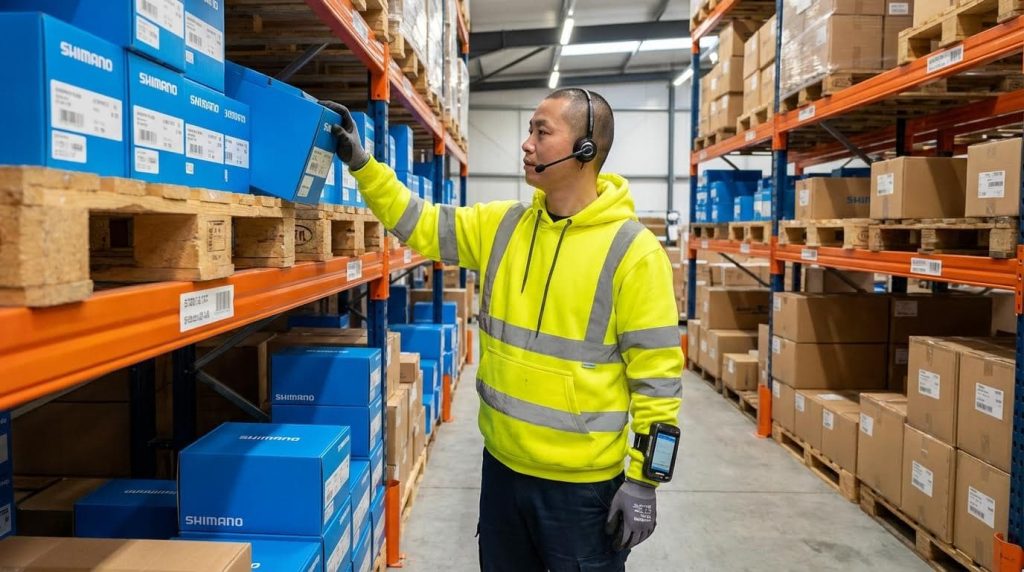
When operations teams ask how does warehouse voice picking work in practice, they usually focus on three metrics: accuracy, throughput, and error rate. Voice-directed workflows keep operators’ hands and eyes free, which removes time lost to handling devices and reading screens. In real projects, this has pushed picking accuracy from around 95% with handheld or paper processes to as high as 99.99% picking accuracy to 99.99% compared to 95%. Fewer errors mean less rework, fewer returns, and more stable service levels.
- Productivity gains of 15–40% are typical when you combine voice with optimized travel paths 15-40% increase in picking productivity.
- Some deployments reported up to 30–35% higher productivity versus paper, RF, or pick-to-light methods improve productivity by up to 35%.
- Individual case studies showed selection speed gains of 17–25% in units picked per hour 17% increase in productivity 25% increase in selection speed.
Error reduction is the other critical benchmark. By guiding pickers step by step and confirming check digits or quantities by voice, error rates have dropped by 35–80% in documented projects reduces picking errors by up to 80% reduced the number of errors by 35%. Some voice-automated operations now work at near‑100% accuracy levels accuracy rates improving to nearly 100%. This is the performance baseline you should use when modeling upgrades from paper, RF, or handheld processes.
Ergonomics, safety, and regulatory compliance
To understand how does warehouse voice picking work from a safety and ergonomics angle, look at what it removes: clipboards, scanners, and constant screen checking. With a headset-based workflow, operators keep their hands on pallets, cartons, and truck controls, which improves load stability and handling of fragile or bulky items move fragile or bulky loads safely. Eyes-up operation also increases awareness of forklift traffic and pedestrians, reducing collision risks reducing distractions from paper orders or mobile device screens.
- Hands-free work reduces awkward reaches to holsters or terminals, which lowers musculoskeletal strain over a shift.
- Training time for new staff has dropped by 57–85% in some projects thanks to intuitive voice dialogs training is reduced by up to 85% training time reduced by 57%.
- Multi-lingual support in 40+ languages lets workers operate in their native language, which reduces misunderstandings in safety‑critical instructions support over 40 languages.
From a compliance standpoint, voice workflows can enforce mandatory data capture at the point of work. Systems can prompt for batch, lot, or serial numbers and time stamps, helping maintain traceability and audit trails for regulated sectors such as food, pharma, and chemicals collecting key tracking information such as production batches, lot numbers, and serial numbers. Because the process is guided by the system, it becomes easier to standardize work instructions across shifts and sites, which supports ISO and industry-specific quality frameworks.
Cost, TCO, and ROI modeling for voice projects
When you evaluate how does warehouse voice picking work financially, you need to look beyond licenses and headsets to full total cost of ownership (TCO). Direct savings come from higher productivity, fewer picking errors, and lower quality-assurance effort savings through accurate order fulfillment, increased picker efficiency, reduced quality assurance staffing. Indirect savings include lower training costs, less paper and label usage, and optimized inventory holding through better real-time data real-time inventory management.
| Cost / Benefit Element | Impact Direction | Typical Effect |
|---|---|---|
| Licenses, devices, headsets | Cost | Initial capex / subscription plus support |
| Labor productivity | Benefit | 15–35% more picks per hour |
| Error-related costs | Benefit | 35–80% fewer errors, lower returns and credits |
| Training time | Benefit | 50–80% faster onboarding |
| Paper, labels, printing | Benefit | Reduced or eliminated, supporting sustainability goals supports sustainability goals |
Standard investment appraisals for voice projects use break-even in months, NPV, IRR, and cash-flow projections common methods to calculate return on investment. Many warehouses have achieved payback in under ten months return on investment within less than ten months. Because modern solutions often run on existing rugged hardware operates on a variety of rugged industrial devices and integrate with current WMS platforms without major infrastructure changes integrate seamlessly with existing Warehouse Management Systems, upfront costs are lower than many automation alternatives. The net result is a relatively short payback window and a strong, quantifiable ROI for most medium to high-volume DCs.
Applying Voice Picking And Choosing The Right System
Key use cases and integration with your WMS
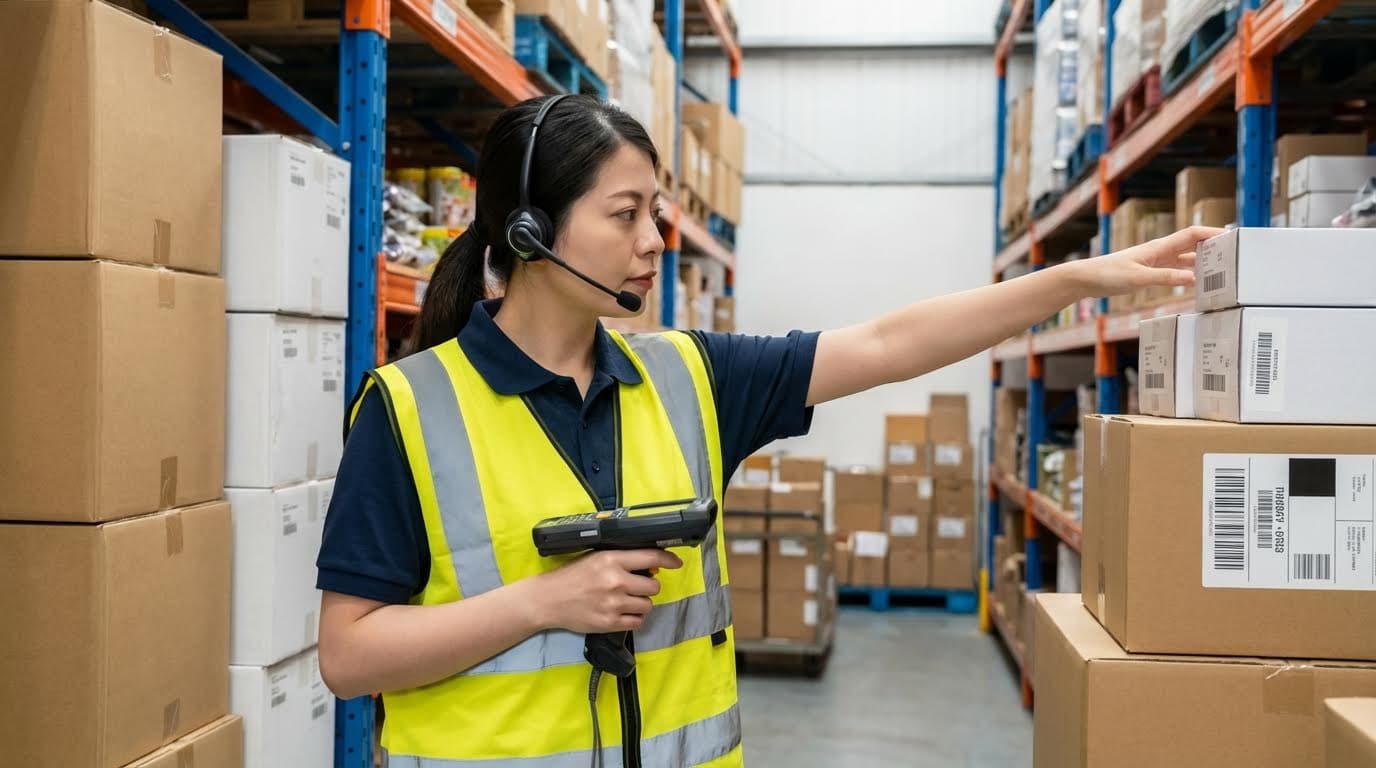
Voice-directed solutions are most effective where order profiles are repetitive and time-sensitive, and where the cost of an error is high. Typical use cases include fast-moving B2C e‑commerce, grocery, pharma, and spare parts distribution, where thousands of small lines must ship same day. Sites that move from bulk to unit picking have used voice to lift capacity to around 10,000 picks per hour while handling roughly 400 containers per hour, with productivity gains of about 17% compared to prior methods. Documented case studies show this kind of uplift. These environments benefit most because they answer the question “how does warehouse voice picking work in practice?” with clear gains in throughput, accuracy, and labor stability.
From a systems perspective, modern voice platforms usually sit as a real-time execution layer on top of your Warehouse Management System. They exchange tasks, confirmations, and inventory updates with the WMS via APIs or middleware without forcing a redesign of core data structures. Many solutions integrate with existing WMS and other logistics systems without major infrastructure changes, allowing go‑live in a matter of weeks rather than months. Vendors report seamless integration and rapid deployment on top of current WMS platforms. This is key to minimizing risk and shortening the payback period.
For operations planning a broader optimization, voice can also coordinate with AI-based travel algorithms and workload balancing tools. These engines reduce seconds from every pick and move, delivering 15–40% increases in picking productivity by optimizing walk paths and batching. AI-based travel optimization is a standard feature in advanced voice suites. Combined with real-time dashboards, supervisors gain continuous visibility into exceptions, idle time, and zone congestion, which helps them fine-tune staffing and slotting.
- Best-fit use cases: high-volume piece picking, store replenishment, cross-docking support, cycle counting, and value-added services.
- WMS integration: real-time task exchange, confirmation capture, and inventory updates without re‑platforming.
- Operational impact: double-digit gains in productivity and capacity in well-suited environments.
Selection criteria, KPIs, and implementation roadmap
When selecting a system, start with functional fit and integration depth rather than hardware. Confirm that the solution supports your core workflows (single-order, batch, cluster, pallet build) and can run on your existing rugged devices to avoid new capital spend. Many voice platforms operate on a wide range of industrial terminals and mobile computers, which reduces upfront investment and speeds rollout. Compatibility with current hardware is a documented capability of leading systems. Also check for multi‑lingual support, as some solutions handle more than 40 languages, making it easier to train diverse workforces and reduce cultural barriers. Multi-language voice dialogs are a proven way to speed user adoption.
Define clear KPIs before you evaluate vendors so you can measure how does warehouse voice picking work against your baseline. Typical benchmarks include:
- Selection speed: lines per hour and units per hour. One project showed a 25% increase in units per hour (113 to 151) and a 9% increase in lines per hour (67 to 74). This illustrates realistic productivity gains.
- Error rate: defects per order or per line. Voice operations have reduced errors by 35%, from 0.46% to 0.30% in real deployments. This reduction directly cuts rework and returns.
- Training time: days to reach target productivity. Some sites reduced onboarding time for new workers by 57%, from 7 to 3 days. This matters in high-turnover operations.
- Safety and ergonomics: incident rate, near-miss reports, and operator feedback on fatigue. Hands-free, eyes-up work reduces distractions from screens and paper, which improves awareness around equipment traffic. Studies link voice workflows to fewer injuries and better ergonomics.
From a financial perspective, model payback using your own labor and error-cost data. Industry experience shows voice picking can improve productivity by up to 30–35% versus RF or paper-based methods, while pushing accuracy close to 100%. These gains translate into lower labor per shipped unit and fewer costly mistakes. Many projects recover their investment in less than ten months when you include savings from labor, quality assurance, admin overhead, and inventory holding costs. Short ROI timelines are common in multi-process voice deployments.
Practical implementation roadmap
A structured roadmap reduces risk and keeps stakeholders aligned. A typical sequence looks like this:
- Diagnostic and business case: Map current picking flows, measure baseline KPIs, and quantify error costs and training time.
- Vendor shortlisting: Filter options based on WMS compatibility, hardware support, language coverage, and proven results in similar industries.
- Pilot design: Select one warehouse area or customer segment. Define success thresholds for speed, accuracy, and user adoption.
- Configuration and integration: Connect to the WMS, configure dialogs and task logic, and test exception handling (short picks, substitutions, damages).
- Training and go‑live: Use short, scenario-based training sessions. Many teams see new hires become productive within a few days due to intuitive voice dialogs. Voice guidance significantly shortens the learning curve.
- Scale-up and continuous improvement: Roll out to more zones and processes such as replenishment and cycle counting. Use dashboards to spot bottlenecks and fine-tune slotting and travel paths. Real-time visibility tools help sustain performance gains.
This roadmap turns the theory of how does warehouse voice picking work into a controlled, measurable change program that operations, IT, and finance can all support.
“”
Final Thoughts On Voice-Directed Warehouse Operations
Voice-directed picking works because it aligns people, process, and systems around a single, real-time data flow. The WMS, voice engine, and network push precise tasks to the operator, then capture confirmations at the slot. This closes the loop on every pick, which drives near‑perfect accuracy and stable inventory records.
Hands-free, eyes-up work changes safety and ergonomics, not just speed. Operators keep focus on loads, racking, and traffic instead of screens. This reduces handling errors, strain from repeated reaching, and distraction around lift trucks. Built‑in prompts for lots, batches, and serials also hard‑wire traceability into daily work, which supports audits and regulated industries.
Financially, the same design cuts touches, errors, and training time, so labor cost per shipped unit drops. Because modern platforms integrate with existing WMS and often reuse rugged devices, upfront spend stays controlled and payback is short.
The best practice is clear: treat voice as a strategic execution layer, not a gadget purchase. Start with KPIs, map current flows, and run a focused pilot. Then scale across picking, replenishment, and counting. With the right design and partner such as Atomoving, voice picking becomes a durable advantage in accuracy, throughput, and worker safety.
Frequently Asked Questions
What is voice picking in a warehouse?
Voice picking is a paperless, hands-free solution for order fulfillment workers. Voice prompts direct them to the right locations around the warehouse and instruct them on what products to pick to complete customer orders. This system is also known as an “eyes-free” solution, particularly beneficial in bulk picking industries. Voice Picking Guide.
How does voice picking improve warehouse efficiency?
Voice picking improves warehouse efficiency by allowing workers to focus on their tasks without needing to handle paper or devices. Workers receive clear instructions via voice prompts, reducing errors and increasing speed. However, it’s important to avoid cognitive overload, where workers struggle to block background noise to hear instructions clearly. Proper implementation ensures smooth operations. Pick-by-Voice Insights.
What are the potential challenges of using voice picking systems?
Potential challenges of voice picking systems include cognitive overload for employees who must focus intensely to hear instructions over background noise. Additionally, ensuring that the system is user-friendly and integrates well with existing workflows is crucial for maximizing productivity. Proper training can mitigate these issues, leading to more efficient operations.