
Aerial work platform training is a structured program that teaches workers how to safely inspect, operate, and supervise Mobile Elevating Work Platforms (MEWPs) and aerial platform in line with OSHA and ANSI/SAIA standards. If you are asking what is aerial work platform training, it is the combination of classroom theory, practical evaluation, and documented certification that proves operators and supervisors can control hazards, respect load limits, and comply with legal requirements on every jobsite.
This article explains what aerial work platform training must cover, how courses are structured and assessed, which roles need certification, and when retraining is mandatory. You will also see how proper documentation and role clarity reduce legal exposure and prevent avoidable incidents on site.
Who Needs MEWP Training And When Retraining Applies
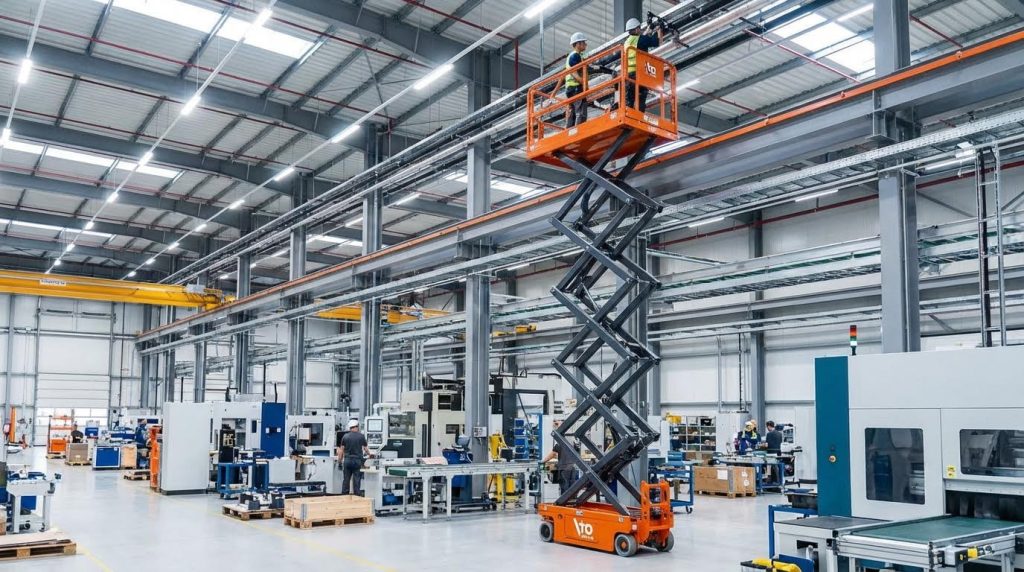
All Mobile Elevating Work Platform (MEWP) and aerial platform operators, plus key supervisors, need documented, equipment‑specific training, and retraining is mandatory whenever competence, equipment type, or jobsite hazards change or an incident occurs. Understanding what is aerial work platform training helps define who must be certified and when.
Regulators treat MEWPs as high‑risk equipment, so training links directly to legal compliance, accident prevention, and liability control. The roles below show who must be trained, on what, and how often they must refresh skills.
Roles Requiring Certification And Prerequisites
Any person who operates, directs, or evaluates work on a MEWP or aerial platform requires formal, documented training and evaluation, and some programs require fall‑protection certification as a prerequisite. This goes far beyond “just the driver.”
OSHA requires scissor platform operators to receive OSHA‑compliant training that covers equipment operation, hazard recognition, and hands‑on evaluation for all mobile elevated work platforms, including scissor lifts and boom lifts. Documentation must include operator names, training dates, equipment covered, and trainer qualifications. This requirement applies to all MEWP types. Some advanced boomlift courses also require fall‑protection certification before enrolling. One example specifies fall‑protection as a prerequisite.
| Role | Training / Certification Need | Key Content Required | Operational Impact |
|---|---|---|---|
| MEWP / Aerial Lift Operator | Full OSHA‑compliant training with hands‑on evaluation and documented certification | Safe operation, hazard recognition, pre‑use inspection, load capacity, emergency response | Reduces tip‑overs, entrapment, and contact with power lines; meets OSHA and ANSI/SAIA expectations |
| Spotter / Ground Person | Task‑specific training on hazards and communication | Exclusion zones, fall and falling‑object hazards, hand signals, emergency lowering | Improves rescue response and prevents people entering crush or drop zones |
| Supervisors / Foremen | Awareness‑level MEWP training plus ability to verify operator competence | Regulatory basics, documentation, recognizing unsafe operation, when to pull certification | Enables supervisors to stop unsafe work and trigger retraining before incidents |
| Safety / Training Managers | Advanced understanding of standards and program design | OSHA Subpart F, ANSI/SAIA A92 series, recordkeeping, course content, evaluation methods | Ensures the company’s program can withstand audits and legal scrutiny |
| Maintenance Technicians | Equipment‑specific familiarization; not full operator cert unless they operate at height | Lockout/tagout, function checks, emergency systems, stability interlocks | Reduces maintenance‑related failures that could cause in‑service accidents |
| New Hires Assigned to MEWP Tasks | Must be trained and evaluated before first use | Core theory plus practical evaluation on the actual equipment type | Prevents “learning on the job” at height, a major accident driver |
- Operator certification: Formal training, written exam, and practical evaluation are mandatory – this proves the person can control the machine and read the jobsite correctly.
- Equipment coverage: Certification must match the MEWP type (e.g., scissor vs. boom) – wrong‑type training is treated as untrained in many investigations.
- Prerequisite fall‑protection training: Some boomlift courses require prior fall‑protection certification – this ensures operators already understand harnesses, lanyards, and anchor points.
- Evaluation standards: Typical programs require at least 70% on a theory exam and 80% on a practical test, plus pre‑use inspection and work‑area assessment skills – this weeds out marginal operators before they go to height.
- Certification validity: One example MEWP program certifies for three years and recommends annual review – this keeps skills and regulation knowledge from going stale.
In practice, what is aerial work platform training means a structured process that proves each named person can safely run a specific class of MEWP under current standards, not a generic toolbox talk.
💡 Field Engineer’s Note: On real jobsites, I treat any unlisted “casual user” (electrician, painter, rigger) as an operator if they touch the controls. If they can move the platform, they need their name on a certificate.
Equipment-Specific Training And Jobsite Conditions
MEWP training must be specific to the exact equipment type and must address the real jobsite conditions, because many accidents come from choosing the wrong machine or misreading site hazards. A one‑size‑fits‑all class is not enough.
OSHA requires that operators be trained on the specific equipment they will use, and employers must verify that employees are competent to operate that equipment. This applies across all MEWPs. Accident investigations have shown that many aerial lift incidents occurred because operators selected the wrong lift or failed to analyze jobsite hazards such as voids or unstable ground. One case involved a lift tipping after being driven onto plywood covering a hole.
| Equipment / Condition | Specific Training Focus | Key Hazards Addressed | Operational Impact |
|---|---|---|---|
| Scissor lift (vertical MEWP) | Vertical movement, guardrails, platform loading, pothole protection | Tip‑over, crush hazards under overhead structures, overloading platform | Safe for straight‑up work in flat, firm areas such as warehouses |
| Articulating / telescopic boomlift | Outreach, slewing, platform positioning, fall‑arrest use | Tip‑over from over‑reaching, entanglement, fall from height | Allows access over obstacles but requires stronger hazard assessment skills |
| Rough‑terrain MEWP | Gradeability, ground conditions, outrigger setup (if fitted) | Soft ground collapse, side‑slope instability, inadequate outrigger support | Suited to construction sites but only with solid pad and slope assessment |
| Indoor MEWP near overhead power | Electrical hazard recognition, minimum approach distances | Electrocution, arcing from contact with energized conductors | Requires strict planning of travel paths and work positions |
| Confined or congested areas | Clearance checks, slow travel, spotter use | Crush / entrapment between basket and structure | Often dictates smaller platform or different MEWP type |
| Shared worksite (other trades, cranes, traffic) | Communication protocols, exclusion zones, sequence of work | Struck‑by, falling objects, interference with other equipment | Improves coordination and reduces multi‑employer conflicts |
- Equipment‑specific content: Training must match the MEWP category (e.g., Type 3, Group B aerial boomlifts) and relevant standards such as ANSI/SAIA A92.22 and A92.24 – this aligns theory with the machine’s real behavior.
- Jobsite hazard assessment: Good programs teach operators to read ground conditions, slopes, openings, and overhead obstructions – this directly prevents tip‑overs and entrapment.
- Pre‑use inspection and work‑area assessment: Certification exams often require both tasks in addition to theory – this ensures operators can spot defects and hazards before elevating.
- Environment‑driven choices: Training should explain when to switch from one MEWP type to another – wrong equipment selection is a proven root cause in many incidents.
- Link to documentation: Training records must list which specific MEWP types were covered – this protects you in audits and incident investigations.
How equipment type links back to “what is aerial work platform training”
When safety professionals ask what is aerial work platform training, the precise answer includes matching operators to defined MEWP groups and jobsite conditions, not just teaching generic lift controls. That alignment is what regulators and courts look for.
💡 Field Engineer’s Note: During site audits, I compare the model on the MEWP data plate to the types listed on training records. If they do not match, I treat the operator as untrained for that machine, even if they “have experience.”
Triggers For Retraining And Ongoing Competence
Retraining is required whenever an operator’s behavior, incident history, equipment type, or workplace hazards change in a way that could affect safe MEWP operation. It is not just a calendar‑based refresher.
OSHA requires retraining when operators demonstrate unsafe practices, experience near‑miss incidents, or encounter different equipment types. Training programs must address these triggers. Another reference notes that retraining is required if an accident occurs during aerial lift use, if workplace hazards involving an aerial lift are discovered, if a different type of aerial lift is used, or if improper operation is observed by employers. These conditions reset the training clock. Employers must also verify that employees remain competent and retrain those who were inadequately trained or are no longer competent. This is central to ongoing safety.
| Retraining Trigger | What It Means in Practice | Required Response | Operational Impact |
|---|---|---|---|
| Accident involving a MEWP | Any incident where a MEWP contributed to injury, damage, or tip‑over | Investigate root cause and retrain involved operators on relevant topics | Demonstrates due diligence and reduces repeat events |
| Near‑miss or observed unsafe operation | Operator hits structures, bypasses procedures, or has close calls | Immediate coaching plus formal refresher on violated procedures | Stops bad habits before they become recordable accidents |
| New MEWP type or major configuration change | Switching from scissor to boomlift, or adding outriggers / new controls | Equipment‑specific familiarization and, if needed, full re‑evaluation | Ensures operators understand new stability limits and control layouts |
| New or changed workplace hazards | New overhead power lines, excavations, traffic routes, or floor openings | Site‑specific training on updated hazard controls and work methods | Keeps risk assessments current with jobsite evolution |
| Evidence of inadequate initial training | Audit or incident shows gaps in past training content or methods | Rebuild training program; retrain affected operators formally | Protects against legal claims that training was “paper only” |
| Certification expiry / scheduled review | End of defined validity period, e.g., three years with annual review | Refresher course plus updated exam and practical check | Refreshes knowledge of new standards and best practices |
- Incident‑driven retraining: Any accident or serious near‑miss involving a MEWP is a mandatory retraining trigger – this proves you responded to a known safety signal.
- Behavior‑driven retraining: If supervisors see improper operation, they must pull the operator from service for retraining – this is cheaper than defending a preventable accident.
- Equipment‑change retraining: Moving operators to a different MEWP type requires new training and evaluation – controls, stability, and hazards change with the machine.
- Hazard‑change retraining: New site conditions (holes, slopes, power lines) require updated instructions – old risk assessments do not protect you on a changed jobsite.
- Periodic refreshers: Programs with three‑year validity and annual review keep skills and standards current – this helps in court when attorneys question how you ensured ongoing competence.
How retraining supports a defensible MEWP program
Legal cases often focus on whether training was adequate, how long it lasted, and whether both written and practical tests were used. Inadequate, rushed sessions (for example, a two‑hour class in a parking lot) have been linked to accidents and used against employers. Robust retraining and documentation show that what is aerial work platform training in your company is a serious, continuous process, not a checkbox.
💡 Field Engineer’s Note: I tell managers to treat every MEWP incident report as a training audit. If you only fix the damaged railing and do not adjust the training, you have not really fixed the problem.
Final Thoughts On Building A Compliant MEWP Program
A compliant MEWP program is a structured system that answers “what is aerial work platform training” in practice: clear scope, defined roles, documented proof, and repeatable processes that survive both OSHA inspections and courtroom scrutiny.
To close the loop, you need to tie together content, structure, people, and records into one auditable framework that actually changes behavior on the jobsite, not just produces certificates.
| Program Element | Minimum Expectation | Better Practice | Operational Impact |
|---|---|---|---|
| Training Content | Basic operation and hazards only (OSHA topics) | Includes equipment selection, jobsite assessment, and emergency response | Fewer tip-overs, fewer “wrong machine for the job” incidents, smoother daily operations |
| Course Duration | Short online module, ~30–360 minutes depending on provider (example 6 hours) | Blended theory + hands-on, typically a half to full day for new operators | Enough time for real pre-use inspections, work area assessments, and practical drills |
| Assessment | Single written test | Written exam ≥70% plus practical exam ≥80% with jobsite assessment and pre-use inspection (example standard) | Confirms operators can apply rules under real conditions, not just memorize them |
| Equipment Scope | Generic “aerial lift” training only | Specific to each MEWP type and group (e.g., scissor vs boom, indoor vs rough terrain) (OSHA requirement) | Reduces misuse, such as using vertical lifts where outreach booms are needed |
| Documentation | Certificates stored somewhere | Full records: names, dates, equipment covered, trainer qualifications, test scores, evaluations (OSHA 1926.503(b)(1)) | Lets you prove compliance in audits and quickly identify who needs retraining |
| Retraining Triggers | After serious accidents only | After accidents, near-misses, unsafe operation, or new equipment/hazards (OSHA-based) | Keeps skills current and prevents repeat incidents when conditions change |
| Standards Alignment | OSHA compliance only | OSHA plus ANSI/SAIA A92 and relevant CSA standards for MEWPs (A92.22, A92.24, B354) | Future-proofs your program and supports multi-jurisdiction or cross-border work |
Turning “What Is Aerial Work Platform Training” Into A Concrete Program
In practical terms, “what is aerial work platform training” becomes a defined, repeatable process that every operator, supervisor, and safety manager can follow and audit.
The goal is to move from ad‑hoc toolbox talks to a documented MEWP training system that can withstand both OSHA inspections and plaintiff attorneys’ questions about duration, content, and evaluation quality.
- Define clear scope: Cover all MEWP types you use (scissor, boom, vertical, vehicle-mounted) and typical site conditions – this avoids gaps where “unusual” lifts fall outside the program.
- Standardize course structure: Blend theory (standards, hazards, load limits) with hands-on practice – operators learn both the “why” and the “how” before they touch controls at height.
- Set hard assessment thresholds: Require minimum written and practical scores, like 70% theory and 80% practical (example benchmark) – this filters out marginally competent operators.
- Integrate jobsite assessment: Make every course include a work area survey and pre-use inspection – this addresses a major root cause of accidents: poor hazard analysis and wrong equipment choice (case examples).
- Codify retraining rules: Write down triggers like accidents, near-misses, unsafe acts, or new lift types – this prevents retraining decisions from being subjective or inconsistent.
- Harden documentation: Maintain a central log with operator names, dates, equipment, trainer credentials, and test scores – this is what OSHA and courts look for when judging program adequacy (legal guidance).
- Align with standards: Build your materials around OSHA Subpart F plus ANSI/SAIA A92 and, where applicable, CSA B354 – this anchors your program in recognized best practice, not personal preference.
💡 Field Engineer’s Note: When you review your MEWP program, do a mock “cross-examination” on one recent incident or near-miss: Could you prove the operator was trained on that exact lift type, that those specific hazards were covered, and that they passed both written and practical tests? If the answer is anything but a confident “yes,” your next priority is tightening records, not buying new equipment.
A compliant MEWP program does more than satisfy regulations. It turns “what is aerial work platform training” into a repeatable system that prevents falls, tip‑overs, and legal exposure. When you link roles, equipment types, jobsite hazards, and retraining triggers, you create a closed loop that keeps risk under control instead of leaving it to operator habit or guesswork.
Engineering logic sits behind each training rule. Equipment‑specific content respects different stability limits and control layouts. Jobsite assessment addresses ground strength, slopes, openings, and overhead power, which drive most serious incidents. Clear pass marks on written and practical tests filter out weak operators before they work at height. Documented retraining after incidents or unsafe behavior proves you react when risk signals appear.
The best practice is simple. Treat every person who can move a platform as an operator who needs named certification. Match training to the exact MEWP group and site conditions. Lock in hard rules for retraining and keep complete, central records. When you build your program this way, your aerial work platforms and Atomoving equipment operate inside known limits, your supervisors can defend decisions, and your sites stay far safer day to day.
Frequently Asked Questions
What is an aerial work platform?
An aerial work platform (AWP), also known as a boom lift, cherry picker, or scissor lift, is a mechanical device used to provide temporary access for people or equipment to inaccessible areas, usually at height. These platforms are commonly used in construction, maintenance, and other industries. Aerial Work Platform Overview.
What does aerial work platform training involve?
Aerial work platform training involves learning how to safely operate devices like boom lifts, scissor lifts, and other elevated work platforms. The training typically covers operational controls, safety protocols, hazard recognition, and emergency procedures. Training ensures compliance with standards like OSHA and ANSI. MEWP Safety Training.
What are examples of tasks performed using aerial work platforms?
Aerial work platforms are used for a variety of tasks that require working at height. Common examples include building maintenance, window cleaning, electrical repairs, tree trimming, and safety inspections. They are essential in improving efficiency and safety for elevated work. Aerial Lift Applications.