
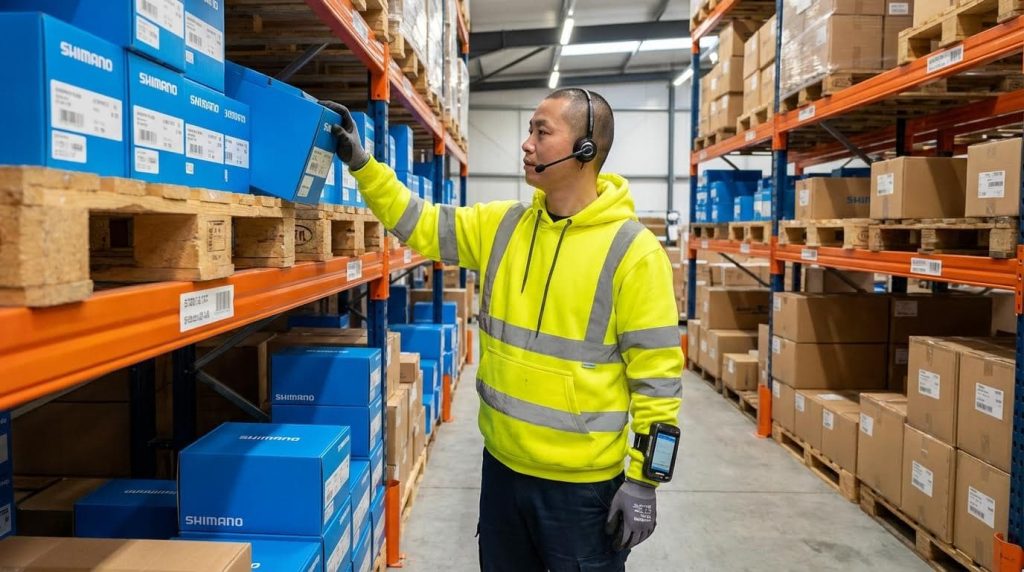
Voice-directed picking is one of the fastest, most reliable answers to how voice picking slashes warehouse costs while driving near-perfect accuracy. This guide explains the engineering behind the savings, from labor and travel distance to safety and ergonomics, so you can decide where it fits in your operation.
What Voice Picking Is And How It Works
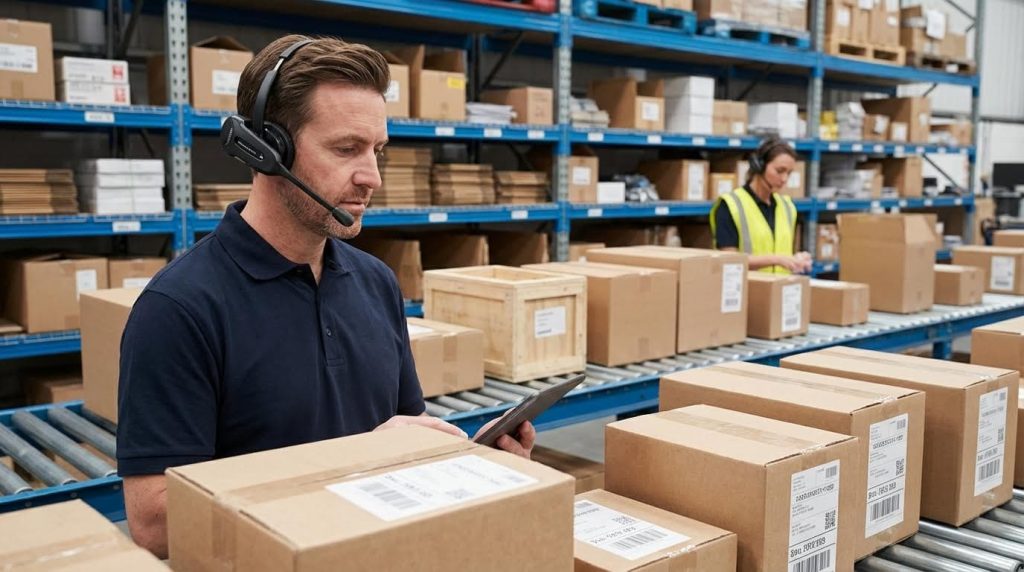
Voice picking is a paperless, hands-free picking method where a WMS sends tasks to a wearable device that guides operators by spoken instructions and validates each pick by check digits or scans. Understanding how it works is the first step in seeing how voice picking slashes warehouse costs and errors.
Instead of paper lists or handheld terminals, operators wear a small mobile computer, headset, and often a ring or glove scanner. The system converts WMS tasks into voice prompts, then confirms each pick in real time to keep inventory and labor records accurate.
Core Components Of A Voice Picking System
A modern voice picking system combines software, wearables, and wireless infrastructure to turn WMS tasks into accurate, hands-free instructions at the pick face.
- Warehouse Management / Execution Software: WMS or WES allocates orders, creates waves, and sends pick tasks with location maps and priorities – This is the “brain” that decides what must be picked and when.
- Voice Middleware / Voice Engine: Converts digital tasks into spoken prompts and interprets operator responses – Bridges IT data with human speech so work flows continuously.
- Wearable Mobile Computer: Small, lightweight device worn on belt or harness – Runs the voice client and maintains live connection to WMS/WES over Wi-Fi.
- Wireless Headset / Microphone: Industrial headset optimized for noisy environments – Delivers clear prompts and captures responses without operators stopping to read or type.
- Hands-Free Barcode Scanner: Ring, glove, or small handheld scanner – Adds barcode verification to voice so each location and item is confirmed before picking.
- Wi‑Fi Network: Robust wireless coverage across aisles and docks – Ensures real-time task updates and inventory posting with no dead spots.
- Labor Management & Analytics: Reporting tools track pick rates and accuracy – Quantifies how voice picking slashes warehouse costs by showing productivity and error trends.
| Component | Primary Function | Operational Impact |
|---|---|---|
| WMS / WES | Create and release pick tasks, manage inventory | Feeds optimized waves and routes to voice, preventing bottlenecks and stock-outs |
| Voice Engine | Text-to-speech and speech recognition | Removes paper and RF screens, cutting training time to minutes for new staff (speaker-independent voice) |
| Wearable Computer | Runs client, connects to Wi‑Fi | Keeps both hands free for cases, totes, and pallets, speeding each pick movement |
| Headset | Deliver prompts, capture responses | “Heads-up” operation reduces distractions and improves situational awareness around forklifts |
| Hands-Free Scanner | Scan locations and items | Combines voice with barcode verification to reach 99.98–99.99% accuracy (1–2 errors per 1,000 picks) |
| Wi‑Fi Network | Real-time communication | Enables instant task changes for rush orders and live inventory updates to ERP |
| Analytics / LMS | Track performance and errors | Supports incentive programs and continuous improvement on pick rates and accuracy (real-time stats) |
💡 Field Engineer’s Note: In retrofits, budget time to test headsets and speech models in your noisiest zones (conveyors, docks). Poor audio in one 50 m stretch of racking can quietly erode both speed and accuracy until you tune mic placement and Wi‑Fi coverage.
How voice picking differs from RF scanners and paper lists
Paper and RF methods force operators to stop, read, and key data. Voice keeps their eyes on product and traffic while the system captures confirmations verbally or by scan. That shift from “stop-and-go” to continuous movement is a major reason why documented productivity gains reach 25–35% and more (with up to 99.99% accuracy).
Workflow From WMS To Picker Headset
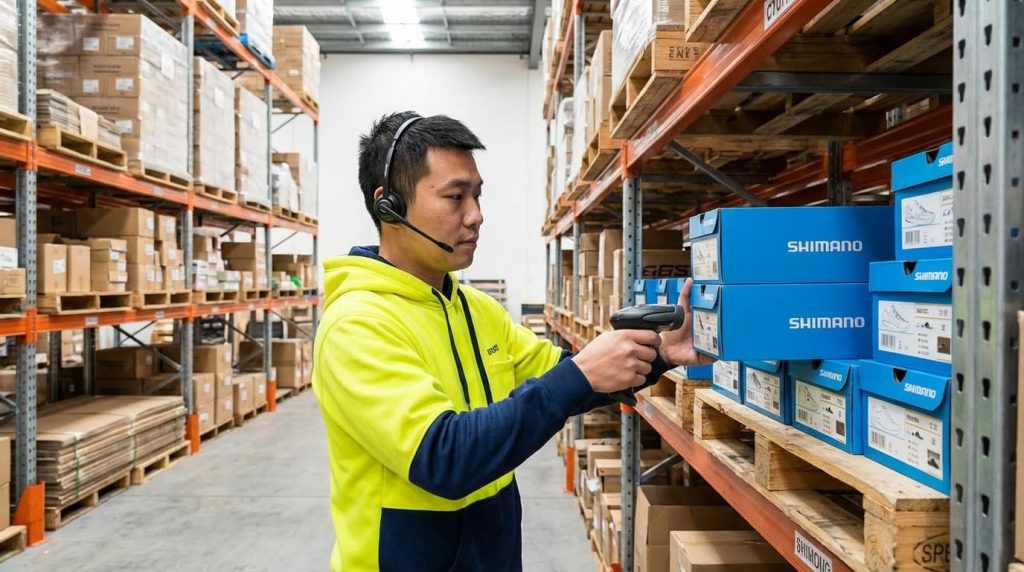
The workflow from WMS to headset is a closed loop: the WMS sends tasks, the picker executes by voice and scan, and confirmations flow back instantly for inventory and labor tracking.
- Step 1: WMS releases orders to WES / voice system – Ensures tasks are batched and sequenced for minimal walking and truck travel.
- Step 2: WES builds optimized waves and routes – Creates pick paths and batch carts (often 1–6 orders) to cut travel distance by up to 40% (reduced walk time).
- Step 3: Tasks download to wearable device – Picker logs in, selects assignment, and the device queues instructions for that shift.
- Step 4: Voice prompts guide the picker to first location – System speaks aisle, bay, level, and side, so the picker moves without checking a screen.
- Step 5: Location verification via check digit or scan – Picker reads a random check digit or scans the slot; if it does not match, the system blocks the pick, enforcing accuracy (nearly 100% accuracy).
- Step 6: System speaks item and quantity – Picker grabs units or cases with both hands free, then confirms by voice (“ten”) or scan.
- Step 7: Placement confirmation – For batch carts or totes, voice tells which tote or position; picker confirms, creating a single-touch process.
- Step 8: Real-time update back to WMS – Each confirmation posts inventory moves and labor time, enabling live visibility and reporting.
- Step 9: Exception handling by voice – Shortages, damages, or substitutions are recorded verbally, cutting paperwork and rekeying.
| Workflow Stage | Key Control | How It Cuts Cost / Errors |
|---|---|---|
| Order release | Wave and route optimization | Reduces walking and truck drive time by up to 40%, lowering labor hours and fuel use (travel reduction) |
| Location confirm | Random check digits or barcode scan | Prevents picking from the wrong slot, driving accuracy toward 99.98–99.99% and slashing reships and credits |
| Quantity confirm | Spoken or scanned confirmation | Eliminates manual keying errors common with RF guns and paper tallies |
| Placement confirm | Tote / position prompts | Supports dense batch picking without carton cross-mix, reducing downstream sortation errors |
| Real-time posting | Instant WMS update | Improves inventory accuracy and supports same-day ship promises for priority orders (on-time high-priority orders) |
| Performance tracking | Per-operator stats | Enables incentive plans where workers hitting 30% above standard and ≥99.6% accuracy earn more, reinforcing best practices (labor tracking) |
💡 Field Engineer’s Note: When you map this workflow, walk the actual 100–200 m paths with a headset before go-live. You will often spot slotting tweaks that remove 2–3 unnecessary turns per aisle, which compounds into thousands of meters of travel eliminated per shift.
Typical performance impact you can expect
Documented projects reported 20–35% productivity gains in weeks, with some workers hitting 60% above baseline, and order accuracy rising to 99.8–99.99% (case study) (industry overview). Combined with reduced training time—often cut by 30–50%—this is the practical engine behind how voice picking slashes warehouse costs year over year.
Engineering The Cost And Error Reductions
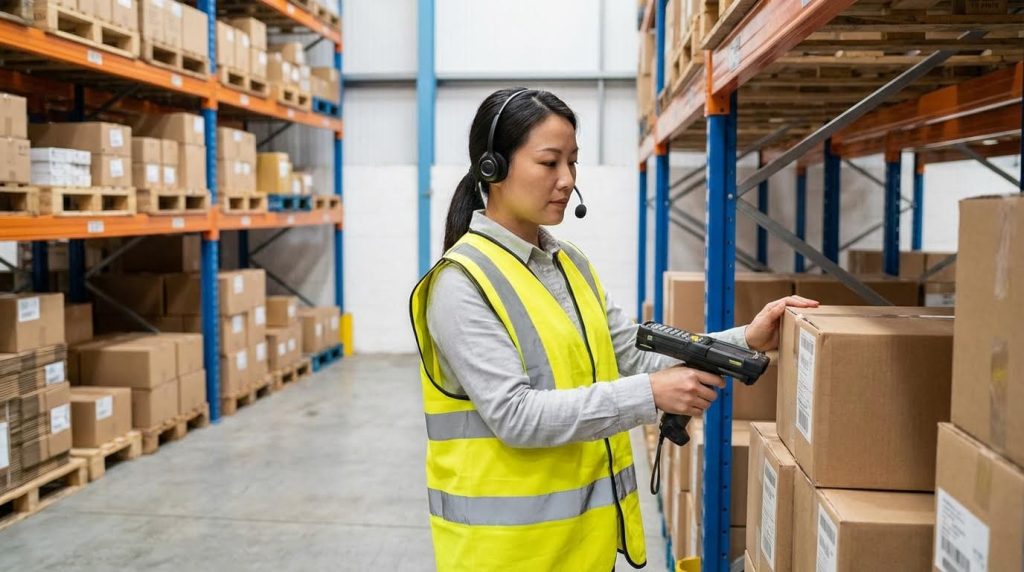
This section explains how voice systems turn abstract “digital” features into hard numbers: fewer labour hours, shorter walk paths, higher accuracy, and lower total cost of ownership (TCO). If you want to show stakeholders how voice picking slashes warehouse costs, this is where the business case becomes engineering math.
Labor Time, Travel Distance, And TCO Metrics
Voice-directed workflows cut wasted motion and admin time, so you move more cartons per labour hour with less hardware and training cost. This is the mechanical core of how voice picking slashes warehouse costs in day‑to‑day operations.
Traditional manual picking burns labour on three non-value tasks: reading paper or screens, keying confirmations, and walking inefficient routes. Voice removes the first two and compresses the third by driving optimised pathing and batch picking.
| Metric | Typical Manual / RF Picking | With Voice Picking | Operational Impact |
|---|---|---|---|
| Share of DC labour in picking | ≥50% of total labour spend | Up to 50% reduction in picking labour cost documented in voice-directed suites | Frees budget for automation, value‑add, or rate increases |
| Productivity (lines/picks per hour) | Baseline 100% | +25–35% typical; up to 50% vs manual or RF-only methods reported for voice-enabled warehouses | Same volume with 20–35% fewer pickers, or more throughput with same headcount |
| Travel distance / walk & drive time | 100% baseline walk/drive time | Up to 40% reduction in daily walk and fork truck drive time with voice-directed routing | Shorter routes, less fatigue, higher sustainable pick rates |
| Training time to basic productivity | Several hours to multiple shifts | 15–20 minutes to productive for new workers using modern voice systems | Lower onboarding cost; easier to flex for seasonal peaks |
| Overall productivity gain in case study | Baseline pre‑voice | 20% gain on day one, stabilising at 35% average, up to 60% for top performers in a retailer pilot | Fast ROI and strong business case for rollout |
| Capital equipment spend | More handhelds, more spares, more charging bays | Annual savings >$30,000 in capital equipment for some sites when shifting to voice | Lower TCO per active picker |
| Implementation cost | N/A | About $2,000–$4,000 per user for hardware and software depending on scale and provider | Useful input for ROI and payback calculations |
From an engineering economics view, the TCO story combines fewer devices, shorter training, and higher throughput. If you lift pick productivity by 30% and cut training time by half, you compress your cost per shipped line even if wages rise.
How to frame TCO for voice picking in a business case
Model three buckets: 1) labour (hours per 1,000 order lines including training), 2) hardware and support (devices, batteries, MDM, spares), and 3) quality cost (returns, re‑picks, customer penalties). Then plug in the documented improvements above to show the delta between “as‑is” and “future state”.
💡 Field Engineer’s Note: When you model labour savings, do not just divide current pick hours by 1.3 and call it done. Voice often exposes upstream issues (slotting, replenishment delays) that cap gains. Run a short pilot in one zone, measure actual picks per labour hour and walk distance with and without voice, then scale only the measured delta into your ROI.
Accuracy Controls, Check Digits, And Scan Validation
Voice systems drive near‑perfect accuracy by forcing a location or item check (via spoken digits or barcode scan) before they let the picker confirm the quantity. This is where error prevention, not error detection, starts to pay back in hard currency.
Traditional paper or RF methods typically accept a keyed confirmation with minimal validation. That means slot misreads, transposed SKUs, and quantity slips turn into returns, re‑work, and chargebacks.
| Accuracy Metric | Legacy Methods (Paper / RF) | Voice + Check Digit / Scan | Operational Impact |
|---|---|---|---|
| Typical error rate | 0.75–0.90% (≈12 errors per shift) for traditional picking | Accuracy 99.98–99.99% (1–2 errors per 1,000 picks) with voice-directed processes | Fewer returns, less re‑picking, higher customer OTIF scores |
| Enhanced accuracy with scan+voice | Single‑mode (scan or key) checks | Up to 99.9–99.99% order accuracy when combining voice commands with barcode scanning in a single-touch flow in real deployments | Removes need for secondary inspection on most orders |
| Check digit control | Visual slot check only; easy to mis‑read under pressure | System requires random check digits at locations; if digits do not match, workflow halts to enforce correct position | Prevents wrong‑location picks even in dense racking |
| Quality cost | Hidden: re‑ship, re‑pick, freight, penalties | Sharply reduced due to near‑zero error rates | Direct margin protection on every shipped order |
- Spoken confirmations: The picker confirms quantities and tote IDs by voice – this keeps both hands on the product and eyes on the slot.
- Scan validation: Many workflows add a quick barcode scan at the location or item – this adds a second, independent check without adding paperwork.
- System-enforced logic: If the check digit or scan does not match, the system will not advance – this stops errors at the source instead of relying on QC sampling.
- Labour analytics: Systems track individual accuracy and speed – this supports incentive programs that reward both speed and precision, not just one or the other.
How check digits actually work on the floor
Each pick face or bin carries a short code (often 2–4 digits) separate from the SKU. The voice system calls for “location 3‑7‑2, check digits 4‑9.” If the operator does not read “4‑9,” or reads a wrong pair, the workflow stops, forcing them to re‑locate the correct slot before they can proceed.
💡 Field Engineer’s Note: In high‑bay or very dense pick modules, print check digits large and high‑contrast. Poor label design or placement can slow pickers and cancel the accuracy gains. During pilot, watch for any slot where operators consistently hesitate or mis‑read, then fix the label, not the voice script.
Ergonomics, Safety, And OSHA-Oriented Risk Reduction
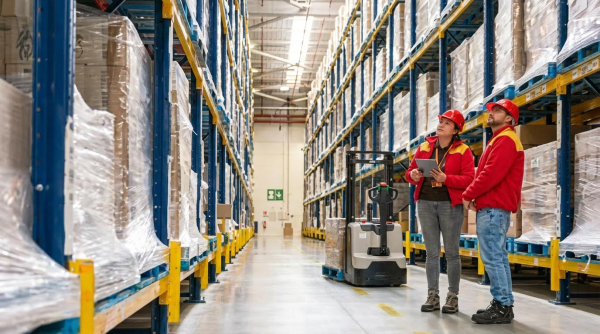
Voice picking improves ergonomics and safety by keeping operators hands‑free and heads‑up, reducing strain, distraction, and forklift exposure. This translates into fewer recordable incidents and more sustainable pick rates under OSHA‑style safety programs.
Mechanically, the difference is simple: clipboards, RF guns, and paper force awkward grips, one‑handed lifting, and constant head‑down reading. Voice lets operators carry, lift, and drive with both hands while listening to instructions.
- Reduced repetitive strain: Voice workflows remove constant device handling and keying – this cuts micro‑motions that drive wrist, shoulder, and neck issues over millions of picks.
- Lower fatigue: Intelligent batching and 40% less walking and driving time reduce end‑of‑shift exhaustion – tired operators make more mistakes and have more near‑misses.
- Heads-up, eyes-forward: Workers are not staring at screens while walking or driving – this directly mitigates struck‑by and trip hazards that safety audits often flag.
- Forklift risk reduction: Pairing voice with AMRs can cut fork truck usage by up to 50% and lift picking rates by 30–40% in documented deployments – fewer trucks and less travel means fewer chances for OSHA‑recordable incidents.
- Safety incident reduction: Some operations report up to 50% fewer incidents tied to inattention or distraction after implementing voice in their picking areas – this directly supports corporate safety KPIs.
| Ergonomic / Safety Factor | Legacy Picking | With Voice Picking | Operational Impact |
|---|---|---|---|
| Hand / wrist posture | Frequent gripping of RF guns or clipboards | Hands free for lifting and steering | Lower risk of repetitive strain injuries |
| Neck / eye posture | Constant down‑glance to paper or screens | Eyes forward; audio instructions | Better situational awareness around vehicles and pedestrians |
| Walking exposure | Long, unoptimised walk paths | Up to 40% less walking and driving time through batching and routing | Fewer slips, trips, and fatigue‑related errors |
| Forklift interaction | High reliance on fork trucks for case movements | Up to 50% less fork truck usage with voice+AMR workflows in some DCs | Lower risk of OSHA‑cited powered industrial truck incidents |
| Training for safe operation | Long learning curves; more shadowing on the floor | Speaker‑independent voice enables safe productivity in under 15–20 minutes even for temps | New hires reach safe competence faster |
Linking voice picking to OSHA-style programs
While OSHA does not prescribe specific picking technologies, its focus on eliminating recognised hazards aligns well with voice: fewer distractions while walking or driving, less manual handling of devices, and reduced forklift exposure. Many sites fold voice metrics (walk distance, near‑miss counts, strain reports) into their safety committees and annual reviews.
💡 Field Engineer’s Note: When you deploy voice in mixed pedestrian–forklift aisles, tune the audio prompts so they do not mask horn signals or spotter calls. Run a sound survey in dB(A) at typical ear height, then adjust headset volume and select ear‑cup style to keep workers aware of ambient warning sounds.
Applying Voice Picking In Real-World Operations

Applying voice picking in real-world operations means engineering how voice, data, and people work together on your floor so you actually see how voice picking slashes warehouse costs and errors in day-to-day workflows.
In this section we move from theory to practice: how the system connects to WMS/WES and devices, which facilities benefit most, and what selection criteria matter before you spend a single euro or dollar.
Integrating With WMS, WES, And Mobile Hardware
Integrating voice picking with WMS, WES, and mobile hardware is about creating a closed loop where orders, locations, and confirmations flow in real time with minimal human keystrokes.
Modern voice solutions sit as a thin execution layer between your WMS and the operators, using wearable computers, headsets, and scanners to push tasks to the floor and pull back confirmations instantly. That is the backbone of how voice picking slashes warehouse costs: you remove paper, redundant scans, and walking, while increasing control.
| Layer | Typical Role In Voice Picking | Key Technical Requirements | Operational Impact |
|---|---|---|---|
| WMS (Warehouse Management System) | Owns orders, inventory, locations, and business rules | Standard APIs or file interfaces; real-time or near real-time task updates | Feeds accurate order and location data to voice so picks are directed correctly and inventory stays in sync |
| WES (Warehouse Execution System) | Optimizes work release, batching, and routing | Ability to build waves/batches and assign tasks to users or zones | Reduces travel and congestion by building efficient pick paths and batches for voice workers |
| Voice Middleware / Suite | Converts tasks into voice dialogs and manages confirmations | Speaker-independent recognition, task scripting, integration adaptors | Enforces process discipline, captures pick confirmations, and drives 99.98–99.99% accuracy |
| Wearable Mobile Computer | Runs the voice client and connects to WLAN | Rugged design, long battery life, Wi‑Fi roaming | Enables full-shift, hands-free operation without returning to fixed terminals |
| Headset / Microphone | Delivers instructions and captures responses | Noise-cancelling, comfortable fit, clear audio in >80 dB environments | Allows reliable voice recognition around conveyors and forklifts in noisy DCs |
| Barcode Scanner (ring or finger) | Verifies locations and items | 1D/2D support, fast read, Bluetooth or cable | Adds scan validation on top of voice, preventing mis-picks and secondary inspection |
In a typical deployment, the WMS sends order and location data to a WES, which then builds optimized pick waves and paths before pushing work to voice devices. One documented implementation had the WMS send store order details and item location maps to a WES, which then built waves of one to six store batch carts optimized for walk paths; operators received voice instructions via headsets and wearable computers, confirmed locations with check-digit scans, and the system returned all transactions to the WMS for inventory and labor reporting. This workflow delivered a 35% productivity increase and 99.9% accuracy.
- Closed-loop confirmations: Every pick has a voice prompt, a check digit or scan, and a voice confirmation – this removes manual keying and reduces rework.
- Real-time inventory updates: The WES/voice layer immediately posts confirmations back to the WMS – stock levels stay accurate for replenishment and cycle counts.
- Speaker-independent tech: Modern systems do not require voice training – temporary workers can be productive in under 15–20 minutes.
- Multi-process coverage: The same stack can handle picking, putaway, direct pick/pack/ship, and inspection – you reuse the same hardware and licenses across tasks.
Several deployments reported that speaker-independent voice technology allowed operators to be productive within minutes, and temporary workers could be trained in under 15 minutes, regardless of accents or languages. This enabled flexible labor utilization across picking, replenishment, and cycle counting.
What a real voice-directed picking cycle looks like
The WMS sends order lines and location maps to the WES. The WES builds optimized cart batches and assigns them to operators. The voice client tells the operator which cart and zone to start in. At each location, the operator reads a check digit or scans a barcode to verify, hears the required quantity, picks, and then confirms by voice. The system directs placement into store or order-specific totes and posts each transaction back to the WMS for inventory and labor management. This single-touch process improved productivity by up to 35% and accuracy to 99.9%.
💡 Field Engineer’s Note: Treat Wi‑Fi like any other critical conveyor: design for load and redundancy. Voice traffic is light per packet, but constant. Dead zones at pick faces cause retries, frustrated operators, and “shadow paper lists” that quietly destroy your ROI.
Use Cases, Facility Types, And Selection Criteria

Voice picking fits best where you have repeatable walking and picking patterns, high order volumes, and a strong need to cut labor and errors without overbuilding automation.
When you map your facility type, SKU profile, and order mix against voice capabilities, you can see very quickly how voice picking slashes warehouse costs compared with paper, RF-only, or light-directed systems.
| Facility / Use Case | Typical Characteristics | Voice Picking Fit | Expected Gains (From Sources) |
|---|---|---|---|
| Retail DC (case & each picking) | High SKU count, store orders, batch carts, seasonal peaks | Excellent – batch picking, pick-and-pass, store totes | 20–35% productivity gain and 99.8–99.9% accuracy reported in case studies |
| E‑commerce fulfillment | High order lines, many each picks, strict SLAs | Excellent – hands-free, heads-up, low training time | 25–35% productivity boost and up to 99.99% accuracy reported |
| Grocery / Food DC | Mixed temperature zones, high volume cases | Very good – robust headsets, scan checks for date/lot | Travel-time cuts and error reduction reduce spoilage and returns |
| 3PL multi-client warehouse | Frequent process and client changes | Strong – scriptable workflows, fast onboarding | Training time reductions of 30–50% and flexible labor allocation |
| Manufacturing kitting & line feeding | Component kits, line-side sequencing | Good – voice-directed kitting and inspection | Fewer line shortages and better traceability |
| Small parts / MRO stores | High SKU count, low lines per order | Good – especially with batch picking | Accuracy improvements limit stockouts and emergency buys |
Evidence from multiple implementations shows that manual order-picking can consume 50% or more of a distribution center’s labor, and voice-directed systems have cut that labor spend by roughly half while maintaining on-time shipment of same-day, high-priority orders. Documented sites reported 30–50% higher performance than paper or handheld-only methods.
Similarly, companies using voice picking reported a 25–35% productivity boost, up to 99.99% order accuracy, and a 30–50% reduction in training time, with safety incidents related to inattention or distraction reduced by about 50%. These metrics show how voice supports leaner operations with fewer supervisors and less rework.
Key selection criteria before you choose a voice solution
- Process coverage: Confirm support for picking, replenishment, putaway, cycle counting, and inspection – you want to reuse hardware and licenses.
- Speaker independence: Systems that require no voice training reduce onboarding to 15–20 minutes – critical for seasonal peaks.
- Integration approach: Look for prebuilt connectors to your WMS/WES – this lowers project risk and timeline.
- Noise handling: Verify recognition performance in your loudest zones – forklift aisles and conveyor lines are worst case.
- Validation logic: Ensure support for check digits and barcode scans – this is how you reach 99.9%+ accuracy.
- Scalability: Confirm the platform can scale from tens to hundreds of users without redesigning the network – important for multi-site rollouts.
- High-labor environments: If picking is 50%+ of your labor spend, voice is a primary lever – case studies show up to 50% labor cost reduction in picking.
- High error cost: If mis-picks trigger expensive reships or penalties, the 99.98–99.99% accuracy seen with voice plus scanning justifies the investment – 1–2 errors per 1,000 picks versus ~12 per shift previously.
- Dynamic workforces: Sites with many temps or cross-trained staff benefit from short training times – voice makes new hires productive in minutes, not days.
- Safety-critical operations: Where forklifts and pedestrians mix, heads-up, hands-free picking reduces distraction – paired with AMRs, some sites cut fork truck usage by up to 50%.
💡 Field Engineer’s Note: Walk your longest pick path with a stopwatch before and after a pilot. In many DCs we measured 30–40% less walking once voice batching and routing went live – that is where the real labor savings hide, not in “talking headsets” alone.
Final Thoughts On Voice-Directed Warehouse Picking
Voice-directed picking works because it applies simple engineering rules to messy warehouse reality. It shortens paths, enforces checks at the slot, and keeps operators’ hands and eyes on the load and traffic. The result is higher throughput, near-zero mis-picks, and lower strain on people and equipment.
When you design voice as a closed loop with your WMS or WES, every pick has a clear instruction, a hard validation, and an instant confirmation. That structure turns labour, travel distance, and quality into measurable, controllable variables. Safety improves in parallel, because workers walk less, handle fewer devices, and stay heads-up around trucks.
The best results come when engineering and operations teams treat voice as a process redesign, not a headset purchase. Map walk paths, tune slotting, test audio in noisy zones, and instrument before-and-after performance. Start with one zone, prove the gains, then scale.
For most high-labour DCs, voice picking should now sit on the short list beside conveyors, AMRs, and racking changes. If you build it on solid data, integrate it cleanly, and train supervisors as well as pickers, voice becomes a durable lever for Atomoving to cut cost per line, error rates, and safety risk at the same time.
Frequently Asked Questions
What is voice picking in a warehouse?
Voice picking is a paperless, hands-free solution for order fulfillment. It uses voice prompts to guide workers to the correct locations and instruct them on what products to pick. This system allows operators’ hands and eyes to remain free, improving efficiency. Warehouse Technology Guide.
How does voice picking reduce warehouse costs?
Voice picking slashes warehouse costs by increasing picking accuracy and efficiency. The system provides automated instructions through a headset, enabling employees to locate and retrieve items faster. It also helps track inventory levels and speeds up order fulfillment. Improved accuracy reduces errors and returns, saving money. Voice Picking Benefits.
What are the benefits of implementing voice picking?
- Improves picking speed and overall productivity.
- Reduces errors, leading to fewer returns and customer complaints.
- Enhances worker safety by allowing hands-free operation.
- Enables better inventory management with real-time tracking.