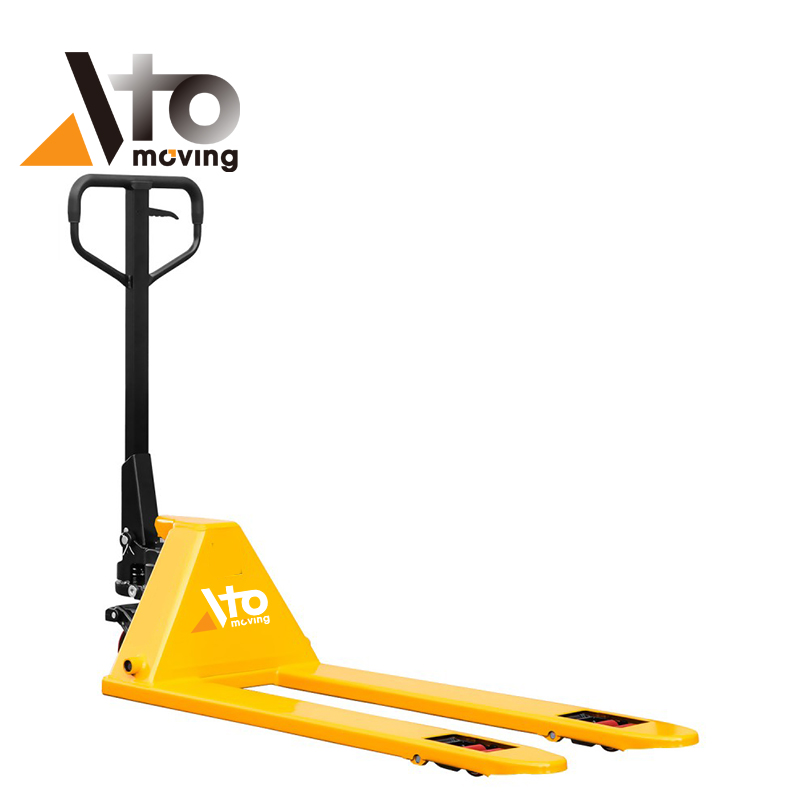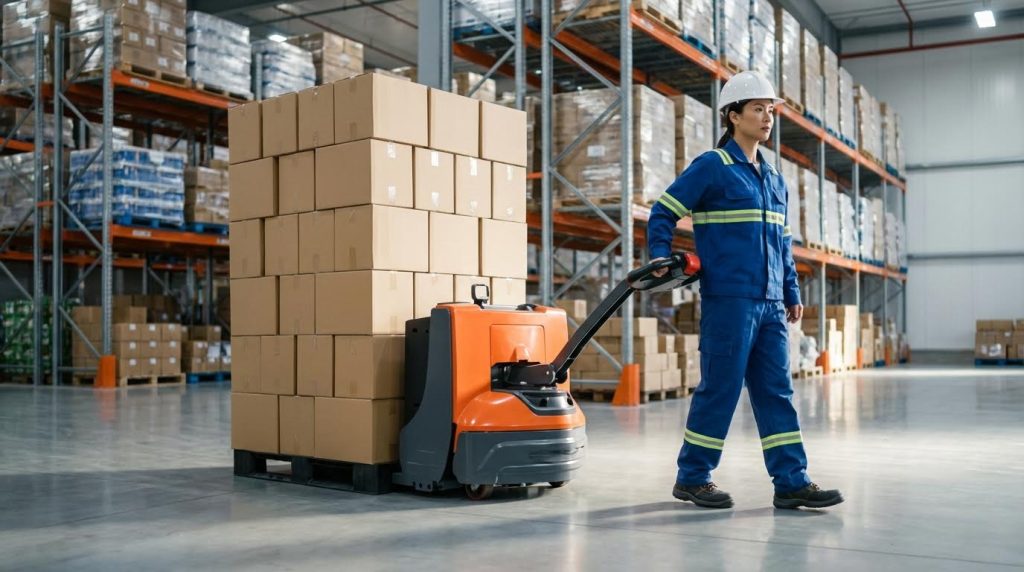
This guide explains how to know, before you pump the handle, whether your pallet jack will safely lift a specific pallet. You’ll learn how capacity, fork height, and pallet design interact so you avoid stuck loads, broken pallets, and tip-overs. Along the way, we’ll translate key dimensions into simple, on-floor checks you can apply in any warehouse.
Core Checks Before Lifting Any Pallet

Before you ask “will pallet jack lift this load?”, you must confirm capacity, safety margin, and pallet fit so the forks fully support the load without overstressing the jack or the pallet.
- Rated Capacity First: Check the pallet jack’s data plate and compare with real pallet weight – prevents overload and structural failure.
- Safety Margin: Add at least 15–20% above your heaviest regular load – covers weight variation and dynamic forces when stopping or turning.
- Fork Fit: Match fork length and width to pallet size and entry openings – ensures the pallet sits stable with no overhang or broken deckboards.
- Environment: Consider slopes, rough floors, and tight aisles – these increase effective load on the jack and operator.
💡 Field Engineer’s Note: Many “mystery” failures happen because the pallet is heavier than paperwork says. Always verify actual load weight (scales, load cells, or upstream process data) before assuming a pallet jack will cope.
Verifying Rated Capacity And Safety Margin
To know if your pallet jack will lift a load safely, you must compare real pallet weight to the jack’s rated capacity and then apply a safety margin for dynamic handling and uneven floors.
- Find the Nameplate: Locate the rated load (for example 1,000–2,500 kg) on the jack’s label – this is the maximum load under ideal conditions, not a target.
- Classify Duty: Light-duty ≤1,000 kg, medium 1,000–2,000 kg, heavy ≥2,000 kg – helps you pick the right jack class for your operation based on typical load ranges.
- Apply 20% Margin: If your regular pallet is 1,000 kg, choose ≥1,200 kg rated capacity – absorbs weight variation and shock loads when braking or hitting joints as commonly recommended.
- Account for Gradients: Any slope or ramp increases effective load on the operator and frame – what is safe on level ground can become marginal on a 2–3% slope.
- Check Pallet Condition: Cracked boards, loose blocks, or protruding nails reduce real capacity – the pallet may fail before the jack does and should be removed from service.
How to estimate if a pallet jack will lift without a scale
If you do not have a floor scale, approximate pallet weight by summing known carton weights from packing lists or product specs. Add 10–15% to cover packaging and variation. If the result comes close to the jack’s rating, treat it as overloaded and upgrade to a higher-capacity unit or powered equipment.
When you combine jack rating, safety margin, and pallet condition, you can answer the key question “will pallet jack lift this safely?” instead of only “can it just get off the floor?”. A marginally sized jack may raise the pallet but struggle to steer, stop, or hold on a slope, which is where most incidents occur.
💡 Field Engineer’s Note: In busy docks, I treat 80% of rated capacity as the real working limit. Above that, small issues like soft tires, ruts, or a slightly damaged pallet multiply your risk very quickly.
Matching Fork Length And Width To Pallet Size
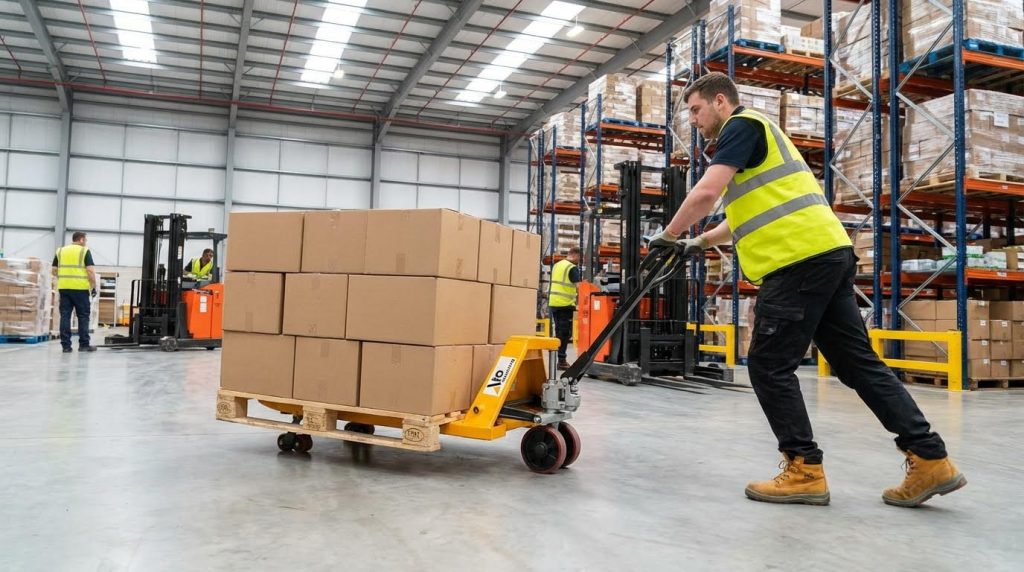
The pallet jack will only lift and carry safely if fork length and width match the pallet footprint and entry openings so the load is fully supported along its bearers.
| Pallet Type / Size | Recommended Fork Length (mm) | Recommended Overall Fork Width (mm) | Operational Impact |
|---|---|---|---|
| Euro pallet 1,200 × 800 mm | ≥1,150 mm | ≈520–550 mm | Covers stringers along full length; allows turning in standard European aisles |
| US pallet 1,200 × 1,000 mm | ≥1,200 mm | ≈540–685 mm (depending on openings) | Reaches far bearers for stability on wider pallets |
| CHEP-style 1,200 × 1,000 mm | ≈1,220 mm | 520–550 mm | Ensures forks reach far bearers and fit between bottom deck blocks |
For standard European and US pallets, using a fork length of at least 1,150–1,200 mm ensures the tips reach the far bearers, which keeps the pallet flat and reduces tipping risk when moving or braking according to common sizing guidance. For CHEP-style pallets, a fork width around 520–550 mm and length around 1,220 mm helps the forks engage the outer bearers correctly and improves stability in transit as recommended for these pallet types.
- Length Too Short: Forks stop before the far bearers – pallet may sag or tip forward when crossing thresholds.
- Length Too Long: Fork tips stick out of the pallet – risk of spearing other loads or racking when turning.
- Width Too Narrow: Forks sit inside the strongest load paths – more stress on thin deckboards and higher break risk.
- Width Too Wide: Forks clash with blocks or cannot enter openings – operator may “ram” the pallet and damage it.
Checking fork fit on an unknown pallet
Measure pallet length and width in mm. Subtract 50–100 mm from pallet length to find a safe fork length that stays inside the pallet perimeter. For width, measure the clear distance between inner faces of the entry openings. The overall fork width should be at least 50 mm less than this opening to allow easy entry without rubbing as typical guidance suggests.
💡 Field Engineer’s Note: If operators constantly “fight” a pallet at entry, the issue is usually fork geometry, not technique. Standardizing pallet sizes or buying a second jack with different fork dimensions is cheaper than the damage and downtime from daily wrestling matches.
Fork Height, Ground Clearance, And Pallet Design
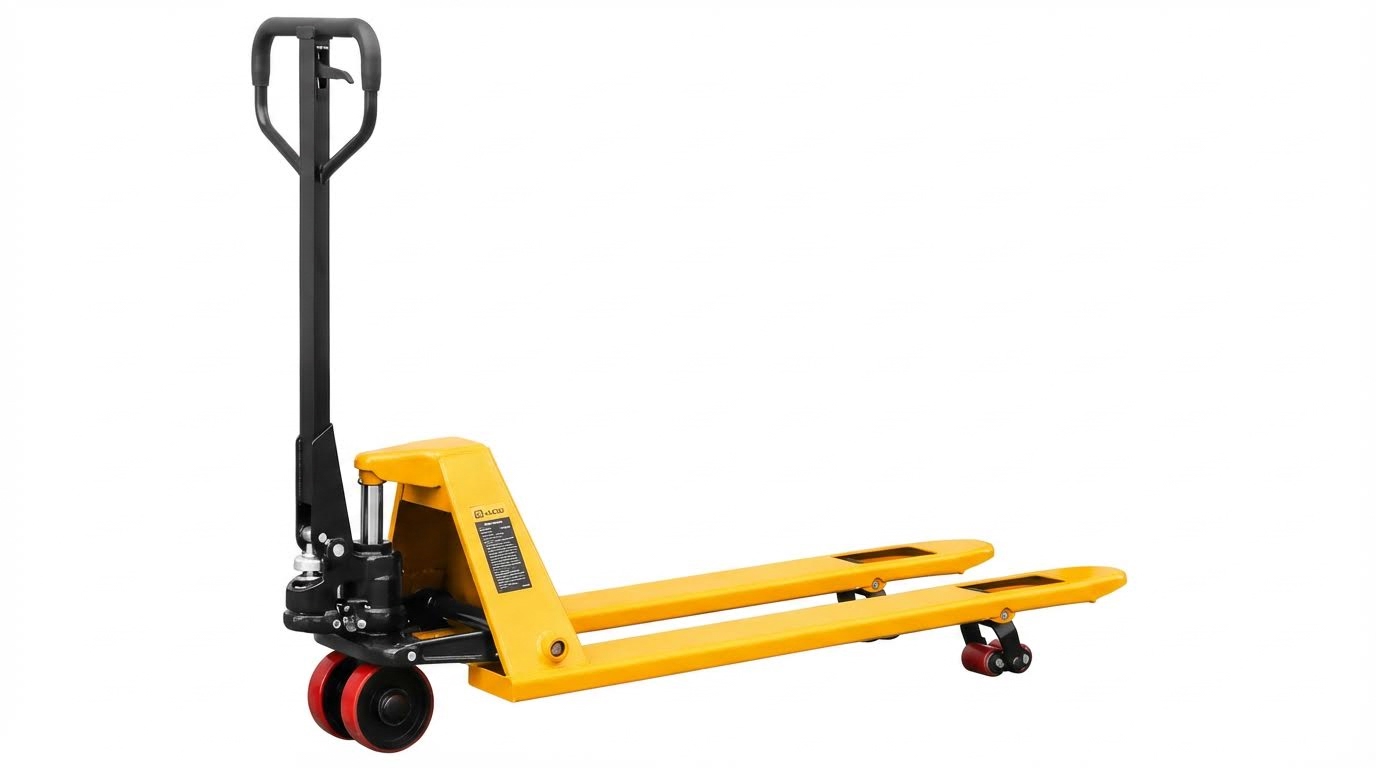
Fork height and pallet design decide whether your pallet jack will pallet jack lift cleanly or jam, drag, or tip the load. This section links real dimensions to real-world pallet compatibility and floor conditions.
💡 Field Engineer’s Note: Never size fork height off brochure numbers alone. Measure your lowest pallet openings and worst floor dips; 5–10 mm miscalculation can turn every move into a grinding, high-effort safety risk.
Minimum Fork Height And Low-Profile Requirements
Minimum fork height determines if the pallet jack can physically enter the pallet opening without scraping or jacking the load. For tight pallets, low-profile models are often the only safe option.
| Parameter | Typical Value / Range | Operational Impact |
|---|---|---|
| Standard pallet jack minimum fork height | 75–85 mm | Slides under standard wooden pallets with ≈90 mm bottom deck clearance for smooth entry without scraping (source) |
| Low-profile pallet jack minimum fork height | ≈60–65 mm | Enters low openings on four-way pallets and CHEP-style pallets, enabling true four-way access (source) |
| CHEP pallet low-side opening height | ≈65–70 mm | Standard 75–80 mm jacks cannot enter from these two sides; only low-profile jacks will pallet jack lift from all four directions (source) |
| CHEP pallet high-side opening height | ≈98 mm | Standard jacks can enter from these two sides; approach direction becomes critical for productivity (source) |
| Recommended general minimum height spec | ≤85 mm | Matches most standard pallets; anything higher starts to limit compatibility (source) |
- Check pallet openings on-site: Measure the lowest entry height in mm – this tells you directly if your current jack will pallet jack lift that pallet or get stuck.
- Match jack type to pallet type: Use low-profile jacks for CHEP and similar four-way pallets – prevents operators forcing jacks and damaging deckboards.
- Account for damaged pallets: Bent or sagging boards can steal 5–10 mm of real clearance – standard jacks that “fit on paper” may jam in reality.
- Consider wheel diameter vs. height: Larger load wheels ride better but raise minimum fork height – this can suddenly make low pallets inaccessible.
How to quickly test if a pallet jack will enter a pallet
Use a tape measure to check the pallet’s entry opening at several points. If your pallet jack’s published minimum fork height is even 3–5 mm higher than the smallest opening you measure, treat that pallet as incompatible unless you switch to a low-profile model.
Maximum Fork Height, Stroke, And Ground Clearance
Maximum fork height and hydraulic stroke define how much ground clearance you get under a loaded pallet and how safely you can travel over imperfect floors.
| Parameter | Typical Value / Range | Operational Impact |
|---|---|---|
| Standard maximum fork height | 185–210 mm | Provides ample lift to clear pallet bottom boards while keeping the center of gravity low (source) |
| Usable lift range | ≈100–120 mm | Difference between min and max heights; determines how far you can raise the load (source) |
| Recommended ground clearance under pallet when traveling | ≈25–40 mm | Clears small floor joints and debris without raising the load so high that it becomes unstable (source) |
| Typical load wheel diameter | ≈80 mm | Balances low minimum height with the ability to roll across joints and minor defects (source) |
| Typical hydraulic cylinder stroke | ≈110–120 mm | Combined with linkage, this stroke produces the 185–210 mm max fork height (source) |
| Fork steel thickness | ≈3.75–6 mm | Controls deflection; excessive flex reduces real ground clearance under load (source) |
- Lift only as high as needed: Raise until you see 25–40 mm clearance under the lowest deckboard – this keeps the center of gravity low and reduces tipping risk.
- Watch for fork flex: Heavy loads on long forks can bow the tips down – even if the pump hits max stroke, the pallet may still scrape expansion joints.
- Respect stroke limits: Over-pumping against the stop does not add lift – it only stresses the hydraulic seals and linkage.
- Check floor conditions: Deep potholes, dock plates, and ramps may need higher travel clearance – if you routinely bottom out, consider a jack with a slightly higher max height and stronger forks.
Quick field check for safe travel height
With the pallet raised, place a 25 mm block (or two stacked 12 mm offcuts) on the floor beside a load wheel. If the pallet underside clears that block but not a 50 mm block, you are in the practical 25–40 mm travel window.
Pallet Types, Entry Heights, And Four-Way Access
Pallet type, entry height, and deck design decide from which directions a pallet jack can safely enter and whether it will pallet jack lift without damage.
| Pallet / Setup | Key Dimensions / Features | Best-Fit Pallet Jack & Impact |
|---|---|---|
| Standard wooden pallet (typical warehouse) | Bottom deck clearance ≈90 mm | Standard 75–85 mm minimum-height jacks enter easily and will pallet jack lift from the designed sides (source) |
| CHEP-style four-way pallet | Two sides ≈98 mm openings; two sides ≈65–70 mm openings | Standard jacks can only use the higher openings; low-profile jacks (60–65 mm min) provide true four-way access (source) |
| CHEP pallet – recommended fork size | Fork width 520–550 mm; fork length ≈1,220 mm | Ensures forks fully reach far bearers, improving stability and reducing tipping risk during transport (source) |
| Euro pallet (1,200 × 800 mm) | Optimized for ≈1,150 mm fork length | Correct fork length supports both stringers; improves balance when turning in 1.6 m aisles (source) |
| US pallet (1,200 × 1,000 mm) | Needs ≥1,200 mm fork length | Shorter forks leave weight unsupported at the far end, increasing risk of nose-diving when moving (source) |
- Map pallet types in your site: List each pallet family and its entry heights – this quickly shows where standard jacks will pallet jack lift and where low-profile units are mandatory.
- Plan for four-way access zones: In tight aisles and cross-docks, four-way entry saves turning space – but only if fork height and length match the pallet design.
- Watch pallet condition: Cracked blocks and sagging boards reduce real entry height – forcing forks in can break the pallet and drop the load.
- Align fork width to pallet openings: Keep overall fork width at least 50 mm narrower than the pallet opening – avoids rubbing on stringers and makes entry smoother.
Simple checklist: will this pallet jack lift that pallet?
Ask four questions: 1) Is the jack’s minimum fork height lower than the pallet’s smallest opening? 2) Is the fork length long enough to reach the far bearers? 3) Is there at least 25 mm travel clearance once raised? 4) Are pallet boards sound and not sagging? If you answer “no” to any, change jack, pallet, or route before moving the load.
Selecting The Right Pallet Jack For Your Operation
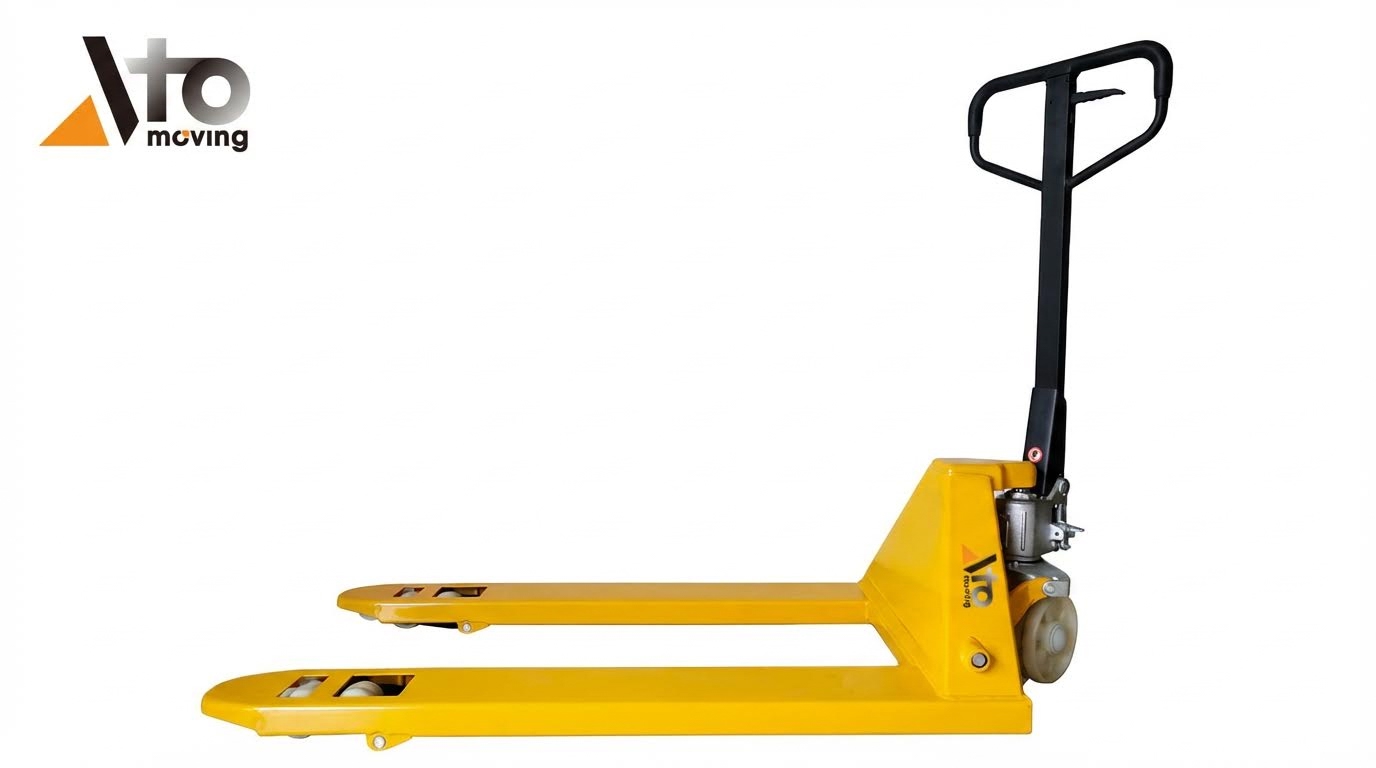
Selecting the right pallet jack starts with how many pallets you move, their weight, and your floor layout; only then can you answer “will pallet jack lift this load safely and efficiently?”
The two biggest selection mistakes are underspecifying capacity and ignoring duty cycle. The third is forgetting pallet condition and load stability, which directly drives accidents and product damage.
💡 Field Engineer’s Note: When a site grows from 30–40 to 150+ pallet moves per shift, operators often “lean” on manual jacks to keep up. That is when shoulder injuries and bent forks spike; upgrade to electric before you reach that breaking point.
Manual Vs. Electric Jacks And Duty Cycles
Manual vs electric comes down to daily pallet moves, travel distance, and peak load weight; this is where you decide if a manual pallet jack will pallet jack lift your workload without overstraining people.
Use manual jacks for low-volume, short-haul work, and electric jacks for high-frequency, longer-distance handling where fatigue and time losses add up fast.
| Type | Typical Rated Capacity | Best Daily Move Volume | Typical Use Distance | Operational Impact / Best For… |
|---|---|---|---|---|
| Manual pallet jack | 1,000–2,000 kg (light/medium duty) | Up to ~50 pallet moves per day (duty guidance) | Short runs, typically <20–30 m per move | Simple layouts, small warehouses; low capital cost but higher operator effort. |
| Electric pallet jack | 1,500–3,000 kg (medium/heavy duty) | More than ~50 pallet moves per day (duty guidance) | Medium/long runs, 20–80 m+ per move | Busy docks, cross-docking, production lines; minimizes fatigue and speeds cycle times. |
- Check duty cycle honestly: Count pallets per shift – this tells you if a manual will pallet jack lift workload safely or if you need powered assistance.
- Match capacity to heaviest pallet: Use light-duty ≤1,000 kg, medium 1,000–2,000 kg, heavy ≥2,000 kg ranges (capacity guidance) – prevents chronic overloading.
- Add a 20% safety margin: If your regular pallet is 1,000 kg, choose ≥1,200 kg rating (safety margin) – covers weight variation and wet or over-packed loads.
- Consider operator ergonomics: Electric units reduce pushing, pulling, and pumping effort (manual vs electric) – cuts fatigue and injury risk on busy shifts.
- Look at aisle layout and slopes: Electric jacks handle ramps and rough floors better – manual units struggle on long 2–3% gradients when fully loaded.
How to decide in under 2 minutes
Step 1: Count average pallets per shift (not per day). If you exceed ~50 moves per operator, shortlist electric. Step 2: Identify your heaviest pallet. Add 20% and pick the next capacity class up. Step 3: Map the longest travel path. If you routinely push more than 20–30 m loaded, powered travel quickly pays back in time and fewer strains.
Load Distribution, Pallet Condition, And Stability
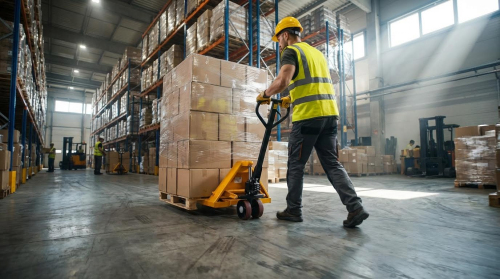
Even if the nameplate says “yes,” poor load distribution or damaged pallets can turn “will pallet jack lift this?” into a tip-over, dropped load, or broken fork situation.
Safe lifting depends on sound pallets, centered weight, and keeping the load within the jack’s designed footprint and lift range.
- Inspect pallet condition: Reject pallets with cracks, missing boards, loose blocks, or protruding nails (pallet condition) – prevents sudden collapse under load.
- Store pallets correctly: Keep them off damp floors and segregate damaged ones in a marked zone (storage practices) – maintains strength and reduces surprise failures.
- Center the load on the pallet: Keep weight even front-to-back and side-to-side (weight distribution) – reduces tipping in turns or emergency stops.
- Put heavy items low and central: Stack heavier cartons at the bottom and near the pallet center (stacking guidance) – lowers the center of gravity and improves stability.
- Respect fork coverage: Make sure forks extend close to the far stringer/bearer – short forks under long pallets cause nose-diving and board breakage.
- Use proper ergonomics: Keep the load close to the body and within mid-thigh to shoulder height when hand-stacking (ergonomics) – reduces back and shoulder strain.
| Check | What to Look For | Risk if Ignored | Operational Impact |
|---|---|---|---|
| Pallet deck boards | No cracks, rot, or missing boards | Board snaps when lifted | Load drops onto floor; product damage and injury risk. |
| Blocks / stringers | Firmly attached, not crushed | Pallet leans or collapses | Unstable travel; jack may twist or jam. |
| Load wrapping / strapping | Film intact, no leaning columns | Boxes fall during travel | Clean-up delays and potential line stoppages. |
| Fork engagement | Forks fully under pallet, not just at tips | Pallet noses down on lifting | Operator must reset, increasing cycle time and risk. |
💡 Field Engineer’s Note: Many “mystery” tip-overs traced back to wet or repaired pallets where only one stringer actually carried the weight. Train operators to pause and visually confirm that both forks sit under solid bearers before pumping the handle.
Quick stability checklist before you lift
Step 1: Scan pallet boards and blocks for visible damage. Reject anything doubtful. Step 2: Confirm forks are centered and reach near the far side. Step 3: Check that the load is wrapped, not leaning, and heavier items sit low. If any of these fail, fix the issue before you test whether the pallet jack will pallet jack lift that load.
Final Thoughts On Ensuring A Pallet Jack Will Lift Your Load
Safe pallet jack use depends on more than the nameplate number. Capacity, fork geometry, pallet design, and floor conditions all work together. When you size and use a jack as a system with the pallet and environment, you prevent overload, jamming, and tip-over events.
Start with honest load data and duty cycle. Choose a jack that carries your heaviest pallet with at least a 20% margin and fits your daily move count. Then match fork length, width, and minimum height to your actual pallet families and entry heights, not just catalog drawings.
On the floor, operators must check three things before lifting. The pallet must be sound. The forks must sit fully under the load within the pallet footprint. The raised pallet must clear the floor by about 25–40 mm without excessive fork flex. If any of these fail, change the pallet, route, or equipment.
Operations that follow these checks cut product damage, strain injuries, and unplanned downtime. Standardize a simple site checklist, train to it, and review when layouts or pallets change. When in doubt, step up to low-profile or powered units from Atomoving so the question is not “will it just lift?” but “will it lift safely, every time?”
Frequently Asked Questions
How much weight can a standard pallet jack lift?
A standard pallet jack typically has a lifting capacity ranging from 5,000 to 5,500 pounds (approximately 2,268 to 2,495 kilograms). However, the exact capacity depends on the model and manufacturer. For specialized applications, heavy-duty pallet jacks may handle up to 10,000 pounds (about 4,536 kilograms).
Can a pallet jack lift a car?
No, a pallet jack is not designed to lift a car. While it might technically be possible under cautious conditions, pallet jacks are not equipped for such heavy loads or uneven weight distribution. Cars weigh significantly more than the typical capacity of a pallet jack, which ranges from 5,000 to 10,000 pounds (2,268 to 4,536 kilograms) depending on the model. Pallet Jack Safety Guide.
What should you never do with a pallet jack?
Never exceed the posted load capacity of a pallet jack, as this risks equipment failure and accidents. Additionally, avoid placing hands or feet under the pallet jack while in use, and always move loads slowly to ensure safety. Pushing rather than pulling the load is recommended to reduce strain and maintain better control. Pallet Jack Safety Tips.
How high can a pallet jack lift?
A standard manual pallet jack can lift loads up to 8 inches (approximately 20 centimeters) off the ground. High-lift pallet jacks, on the other hand, can raise loads to heights of up to 32 inches (about 81 centimeters). Electric models may offer even greater lift heights, often exceeding 20 inches (51 centimeters), depending on the design. Pallet Jack Lift Height Guide.