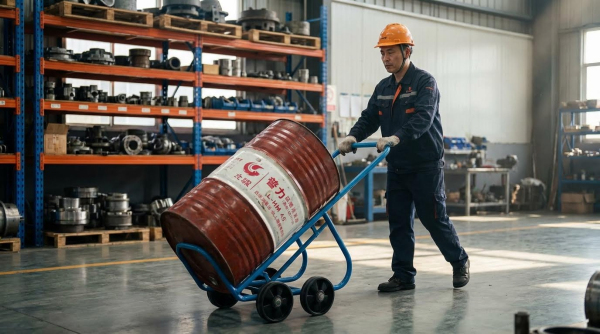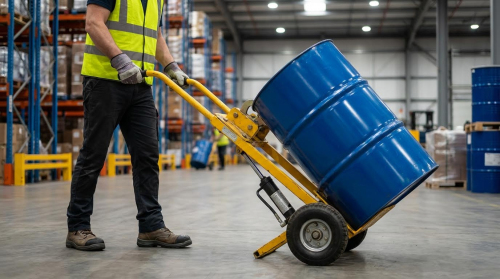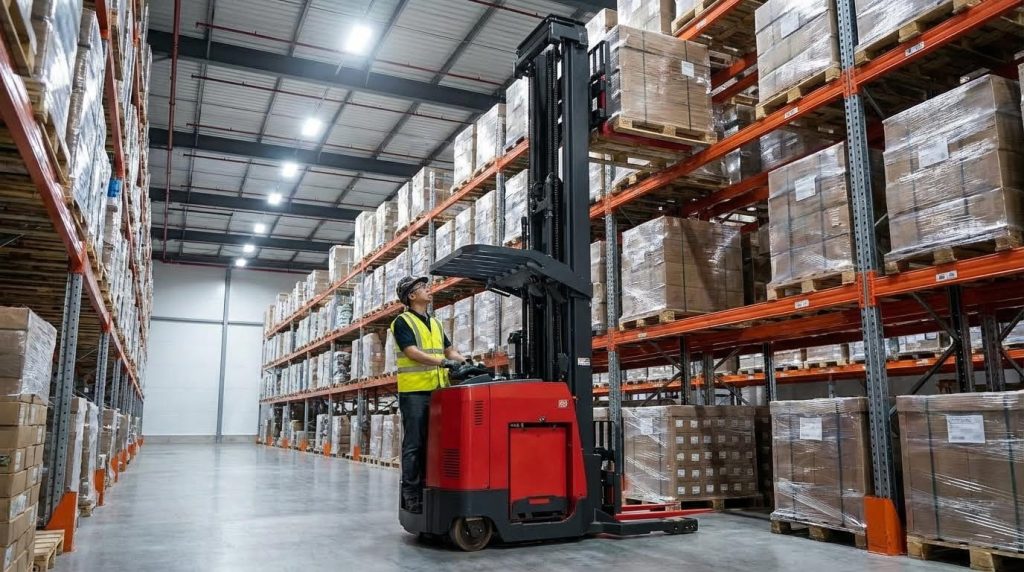
Safe travel with loaded pallets is about controlling the load’s center of gravity, truck stability, and operator behavior every second of the move. This guide explains how should a lift operator travel with a full pallet to avoid tip-overs, product damage, and pedestrian strikes. You will see how load height, speed, ramps, and pallet condition all translate into real-world risks. Use it as a training-ready reference for both forklifts and pallet trucks in any warehouse layout.
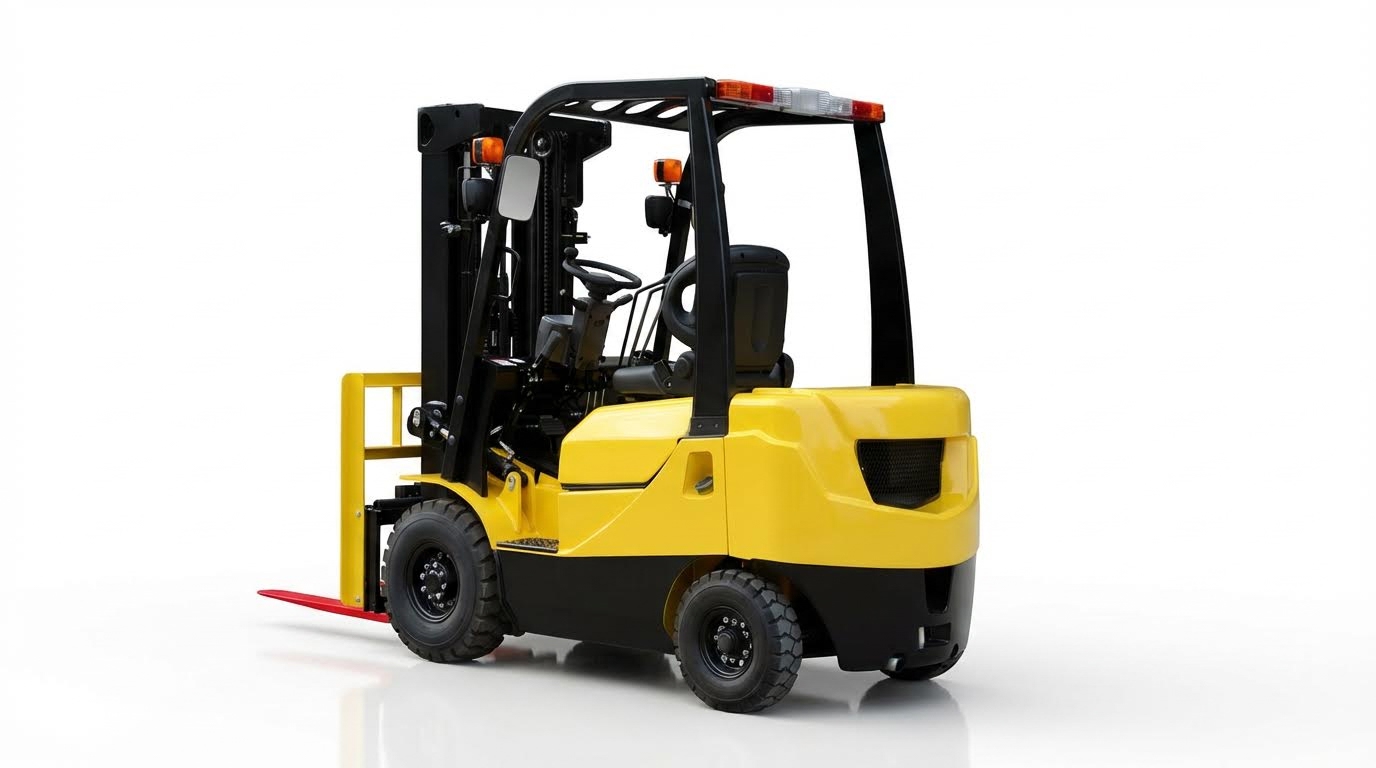
Core Principles Of Traveling With A Loaded Pallet
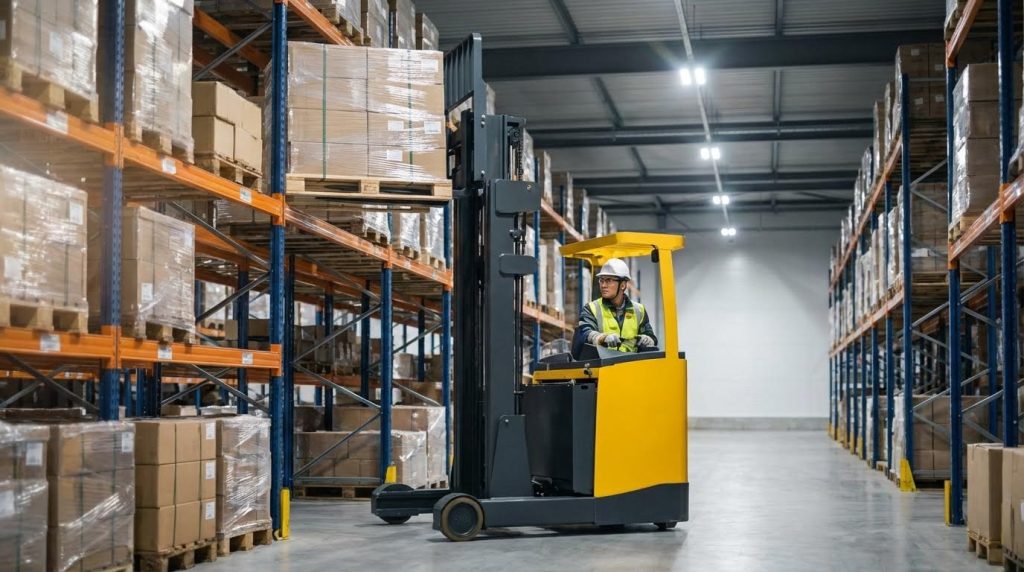
Core principles for traveling with a loaded pallet focus on keeping the combined center of gravity inside the truck’s stability triangle, matching load center to rated capacity, and ensuring the pallet and forks form a rigid, secure unit before moving. These rules define how should a lift operator travel with a full pallet without risking a tip-over or sudden load loss.
Load center, capacity, and the stability triangle
Load center, capacity, and the stability triangle work together to decide how much weight you can move and how fast before the truck becomes unstable. If you ignore any of the three, the truck can tip without warning.
| Concept | Typical Value / Definition | What It Controls | Operational Impact |
|---|---|---|---|
| Rated load center | About 500 mm (standard pallet) or 600 mm for larger loads Rated load center reference | Distance from fork face to load CG | Determines how far you can let the pallet overhang before derating capacity. |
| Truck rated capacity | Given on data plate at a stated load center Capacity vs load center | Maximum safe load for that geometry | Exceeding it can cause forward tip even if hydraulics can lift the load. |
| Actual load center | Horizontal distance from fork face to real CG Load moment explanation | Real “lever arm” of the load | Oversized or off-center pallets push CG forward and reduce stability margin. |
| Stability triangle | Triangle between two front wheels and steer axle pivot Stability triangle concept | Region where combined CG must stay | Hard braking, fast turns, or high loads can move CG outside and tip the truck. |
- Know the data plate: Always read the truck’s rated capacity at its specified load center – this tells you the maximum safe pallet weight and length combination.
- Control the load center: Keep the pallet’s center of gravity as close to the fork face as possible – shorter load center equals higher stability.
- Derate for long pallets: Reduce load weight when the load center exceeds the rating – prevents forward tip on long or uneven loads.
- Respect the stability triangle: Avoid rapid acceleration, hard braking, or sharp turns – keeps the combined center of gravity inside the triangle.
- Think in “load moment”: Remember that weight × distance from axle is what really matters – even a “light” pallet can be unsafe if it is far out.
How to estimate safe capacity for an extended load center
If the actual load center is greater than the rated value, a simple rule-of-thumb is: Safe capacity ≈ (Rated load center ÷ Actual load center) × Rated capacity. For example, a truck rated 2,000 kg at 500 mm might only handle about 1,785 kg at 560 mm, because the longer lever arm increases overturning moment. This follows the same logic as the OSHA example where capacity dropped when the load center increased from 610 mm to 910 mm. Load moment calculation example
💡 Field Engineer’s Note: In real warehouses, most tip-overs with “normal” pallets happened when operators assumed that if the mast could lift it, the truck could carry it. Always treat the data plate, not hydraulic muscle, as your limit—especially with long or poorly wrapped pallets that push the center of gravity forward.
Correct fork engagement and pallet condition
Correct fork engagement and pallet condition ensure the pallet behaves like a solid part of the truck instead of a loose, sliding object. This is the mechanical foundation of how should a lift operator travel with a full pallet safely.
| Check Item | Good Practice | Risk If Ignored | Operational Impact |
|---|---|---|---|
| Fork spacing | Spread forks as wide as pallet openings allow, equidistant from centerline Fork spacing guidance | Concentrated stress, broken deck boards | Improves lateral stability and reduces pallet damage on rough floors. |
| Fork insertion depth | At least 2/3 of pallet length, preferably full depth Minimum fork engagement | Pallet tipping off forks during braking or on bumps | Allows controlled braking and travel over joints or thresholds. |
| Fork leveling | Level forks before entry, then lift and slightly tilt back Fork leveling and tilt | Forks punch through pallet or drag on floor | Reduces impact damage and keeps the load tight to the backrest. |
| Pallet integrity | No cracked stringers, broken deck boards, or severe warping Pallet condition checks | Sudden collapse and load spill | Prevents unplanned product drops in aisles, docks, or trailers. |
| Load securing | Shrink wrap or strapping to bind cartons or items together Load securing guidance | Cartons shift or fall during braking or turning | Allows smoother deceleration without risk of load shift. |
- Approach the pallet squarely: Stop about 200–300 mm in front, align the truck, and level the forks – this avoids skewed engagement that twists or splits boards. Approach distance and alignment
- Insert fully before lifting: Drive in until the heel of the forks nearly touches the pallet – partial entry is one of the most common causes of sudden pallet drop.
- Center the load between forks: Adjust fork spacing so the pallet is centered, not hanging off one side – this keeps the load’s center of gravity on the truck centerline.
- Inspect the pallet before travel: Look for cracked boards, loose blocks, and leaning stacks – a 10-second check can prevent a full-aisle spill.
- Lift, then tilt back slightly: Raise the pallet clear of the floor and apply slight rear tilt so it rests against the backrest – this locks the load against the truck and lowers the effective load center. Lift and tilt best practice
Key fork and pallet checks before moving a full pallet
Before traveling with any full pallet, confirm: forks are locked in position, blades are not bent or cracked, and the mast and carriage show no visible damage or misalignment. Check the pallet sits flat on both forks with no visible rocking. Verify that wrap or banding is intact and that no product overhangs into the wheel path or can snag on racking. These checks align with pre-use inspection and load positioning guidance for pallet trucks and forklifts. Daily inspection checklist
💡 Field Engineer’s Note: On rough or uneven floors, the weak link is usually the pallet, not the truck. If you regularly see broken deck boards near dock doors or expansion joints, shorten fork travel height to around 100–150 mm, slow to below walking speed, and reject any pallet with visible cracking before you ever lift it.
Operating Techniques For Safe, Stable Travel
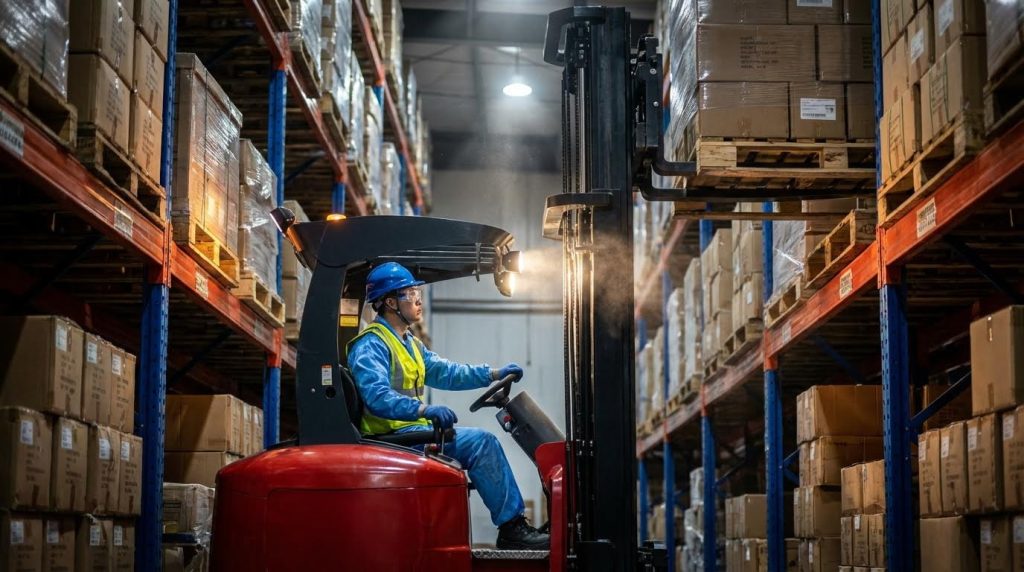
Safe, stable travel with a full pallet means low forks, slight back tilt, controlled speed, and no sudden steering or braking so the combined center of gravity stays inside the truck’s stability triangle. This is the practical core of how should a lift operator travel with a full pallet during everyday warehouse work.
- Keep forks low: 100–150 mm above floor – Clears defects while minimizing tip-over risk.
- Use slight back tilt: Load just leaning to the mast – Keeps center of gravity inside stability triangle.
- Control speed: At or below fast walking pace – Reduces load shift and stopping distance.
- Avoid sudden moves: No harsh braking or sharp turns – Prevents pallet slide and lateral tip-over.
- Match technique to surface: Ramps, wet floors, and rough concrete need slower, straighter travel – Maintains traction and stability.
💡 Field Engineer’s Note: If operators consistently complain that “the truck feels top-heavy,” it is almost always forks too high, too much rear tilt, or excessive speed over poor floors—fix those three before blaming the machine.
Travel height, mast tilt, and load backrest use
Travel height and mast tilt control how close the load’s center of gravity stays to the truck, and the load backrest keeps that load from shifting backward into the mast or operator area.
- Fork height for travel: Keep forks about 100–150 mm above the floor when moving with a full pallet. This clears minor bumps and joints without raising the center of gravity too high. Reference
- Slight rear tilt only: Tilt the mast slightly back so the pallet leans toward the truck, just enough to rest on the backrest. This keeps the combined center of gravity inside the stability triangle without lifting the load unnecessarily high. Reference
- Never travel tilted forward: Do not travel with the mast tilted forward; this pushes the load center away from the front axle and quickly eats up capacity margin. Tip-over risk increases sharply, especially during braking or on bumps. Reference
- Use backrest contact: After lifting about 100 mm, tilt slightly back so the pallet rests against the load backrest extension. This prevents cartons from falling toward the mast and stabilizes tall stacks during acceleration or braking. Reference
- Avoid high travel: Do not travel with the pallet lifted high, except at crawl speed for very short repositioning. Height amplifies sway and makes tip-overs much more likely on uneven floors. Reference
Why low forks matter for stability
Keeping the load low reduces the overturning moment around the front axle. When the pallet is high, any small lateral movement or floor defect creates a larger tipping torque. Low forks give the operator more margin before the center of gravity exits the stability triangle defined in powered industrial truck standards. Reference
Speed control, maneuvering, and rear-end swing
Speed control, smooth maneuvering, and awareness of rear-end swing determine whether a full pallet stays stable and whether the truck avoids striking racking, columns, or pedestrians.
- Match speed to conditions: Inside warehouses, keep speed at or below a fast walking pace, slower in congested zones. Heavier pallets and wet or damaged floors demand further speed reduction. Reference
- Progressive braking: Avoid sudden, hard braking with a full pallet. Use smooth deceleration to prevent load shift, broken pallet boards, or cartons sliding off the forks. Reference
- Slow for corners and intersections: Reduce speed well before corners, rack ends, or doorways, sound the horn, and keep forks low (about 0.10–0.15 m). This limits lateral forces and gives time to react to pedestrians or other trucks. Reference
- Control rear-end swing: Remember the rear of the forklift swings wide when steering because the front axle is the pivot. Leave extra clearance from racking, columns, and pedestrians when turning with a full pallet. Reference
- Visibility and direction: If the pallet blocks forward view, travel in reverse at low speed while keeping a clear line of sight and ergonomic posture. Never “drive blind” around corners or through intersections. Reference
| Operating Situation | Recommended Speed Behavior | Fork Height (Typical) | Operational Impact |
|---|---|---|---|
| Straight travel, clear aisle | At or below fast walking pace | 100–150 mm | Balanced productivity and stability on level floors. |
| Approaching corner or intersection | Reduce to slow walking pace, horn on | 100–150 mm | More time to react, limits lateral tipping forces. |
| Dense pedestrian traffic | Crawl speed or stop-and-go | 100–150 mm | Prevents collisions, allows eye contact and signaling. |
| Entering/exiting trailers or docks | Very low, controlled speed | 100–150 mm | Minimizes bounce on dock plates and trailer floors. |
Rear-end swing: what new operators miss
Because the front axle acts as the pivot, the counterweight can sweep a wide arc during tight turns. With a full pallet, operators often focus only on the forks and forget the rear clearance, striking uprights or pedestrians standing near rack ends. Training should include slow-motion practice turns in marked zones so drivers learn the true swing envelope.
💡 Field Engineer’s Note: Most “mystery” rack damage in clean aisles comes from rear-end swing, not the forks—paint scuffs on the counterweight are your first diagnostic clue.
Grades, ramps, and uneven floor conditions
On grades, ramps, and rough floors, a lift operator should travel with a full pallet by keeping the loaded end uphill, forks low, speed very low, and steering changes to an absolute minimum.
- Loaded end uphill: On slopes above roughly 5% grade, always travel with the loaded end pointing uphill. This keeps the pallet pressed into the mast and reduces the chance of it sliding off the forks. Reference
- Low forks on ramps: Keep forks around 100–150 mm above the ramp surface when moving. This limits instability while still clearing joints, dock plates, and transitions. Reference
- No turning on slopes: Avoid turning on ramps or steep grades. Side forces on a slope can push the center of gravity outside the stability triangle and cause a lateral tip-over. Reference
- Never raise on a slope: Do not lift, stack, or tilt significantly while the truck is on an incline. Mast movement shifts the center of gravity unpredictably and can quickly exceed safe limits. Reference
- Very low speed on poor floors: On cracked concrete, potholes, rail crossings, or wet/contaminated areas, drop to crawl speed. Slow travel reduces bounce and sudden shifts that can damage pallets or destabilize the truck. Reference
| Surface / Condition | Travel Orientation | Typical Fork Height | Best For… |
|---|---|---|---|
| Up ramp (>5% grade) | Load uphill, drive forward | 100–150 mm | Keeping pallet against mast and preventing slide-off. |
| Down ramp (>5% grade) | Load uphill, drive in reverse | 100–150 mm | Maintaining control and avoiding runaway loads. |
| Rail crossings / floor joints | Straight, no steering input | 100–150 mm | Crossing without lifting both wheels simultaneously. |
| Wet or dusty floors | Straight, reduced speed | 100–150 mm | Maximizing tire grip and braking control. |
Handling dock plates and trailer thresholds
When crossing dock plates or entering trailers with a full pallet, keep forks low and speed very low. Drive straight across plates to avoid twisting, since diagonal crossing can momentarily unload one wheel pair and reduce stability. Before entry, verify the trailer or railcar is blocked and the floor can support combined truck and load weight. Reference
💡 Field Engineer’s Note: Most ramp incidents I have investigated started with “just a quick turn” to correct alignment—train operators that any steering correction on a steep grade is a red flag, not a routine move.
Applying Best Practices In Real Warehouse Scenarios
Applying best practices in real warehouse scenarios means adapting core forklift and pallet truck rules to tight aisles, mixed traffic, and unstable trailer or dock conditions without ever compromising load stability or pedestrian safety.
In other words, how should a lift operator travel with a full pallet changes slightly between racked aisles, busy cross-aisles, and flexible trailer floors, but the fundamentals—low forks, centered load, controlled speed, and clear visibility—stay constant.
- Center and secure the load: Always center the pallet on the forks and secure cartons with wrap or strapping – Prevents shift when braking or turning.
- Keep forks low: Travel with forks about 100–150 mm above the floor – Clears defects while minimizing tip‑over risk.
- Respect capacity plate: Never exceed the rated capacity at the specified load center – Hydraulics may lift, but stability can still fail.
- Match speed to environment: Use walking pace or less in aisles and busy zones – Reduces stopping distance and impact energy.
- Protect pedestrians: Yield, communicate, and maintain clear sightlines – People are always the priority over productivity.
💡 Field Engineer’s Note: In real warehouses, the worst incidents with full pallets usually combine three factors: restricted space, poor visibility, and just a bit too much speed. Fix any one of those and your incident rate drops sharply.
Narrow aisles, congestion, and pedestrian traffic
In narrow aisles and congested traffic, a lift operator should travel with a full pallet at very low height and walking speed, with aggressive visibility and right‑of‑way discipline to protect pedestrians and racking.
- Low fork travel height: Maintain forks around 100–150 mm above the floor – Limits overturning moment if you brake or strike a defect. This aligns with best practice for stable travel with loaded pallets. Travel height guidance
- Centered, fully engaged pallet: Ensure the pallet is centered, forks spread to suit the openings, and inserted at least two‑thirds of pallet length – Prevents sudden drop if a board fails. Fork engagement and pallet checks
- Slow, predictable speed: Keep speed at or below a fast walking pace, slower in tight or blind spots – Gives time to react to pedestrians and other trucks. Speed control recommendations
- Rear‑end swing awareness: Allow extra clearance from racks and columns when turning – Forklift counterweight swings wide and can strike structures or people. Maneuvering and swing risk
- Horn and eye contact: Sound the horn at intersections and rack ends, then make eye contact with pedestrians – Confirms they see you before you commit to the move. Pedestrian safety expectations
- Travel direction for visibility: If the full pallet blocks forward view, travel in reverse while keeping a clear line of sight – Maintains continuous visual control of the path. Visibility and travel direction
- Stop‑and‑scan technique: In very tight aisles, pause periodically to scan ahead and above – Catches pedestrians stepping out, low beams, or protruding loads. Scanning for hazards
- Progressive braking: Avoid sudden stops with a full pallet – Reduces risk of load shift or cartons toppling into the aisle. Deceleration guidance
How this changes between forklifts and pallet trucks
With ride‑on forklifts, rear‑end swing and mast tilt add extra risk in narrow aisles, so operators must use tighter speed control and steering discipline. With manual or powered pallet trucks, speeds are usually lower, but operators are on foot, so any sudden pallet shift can directly strike the legs. In both cases, forks should stay low, the pallet must be centered and secure, and pedestrians always have practical right‑of‑way.
Trailers, docks, and railcars with full pallets
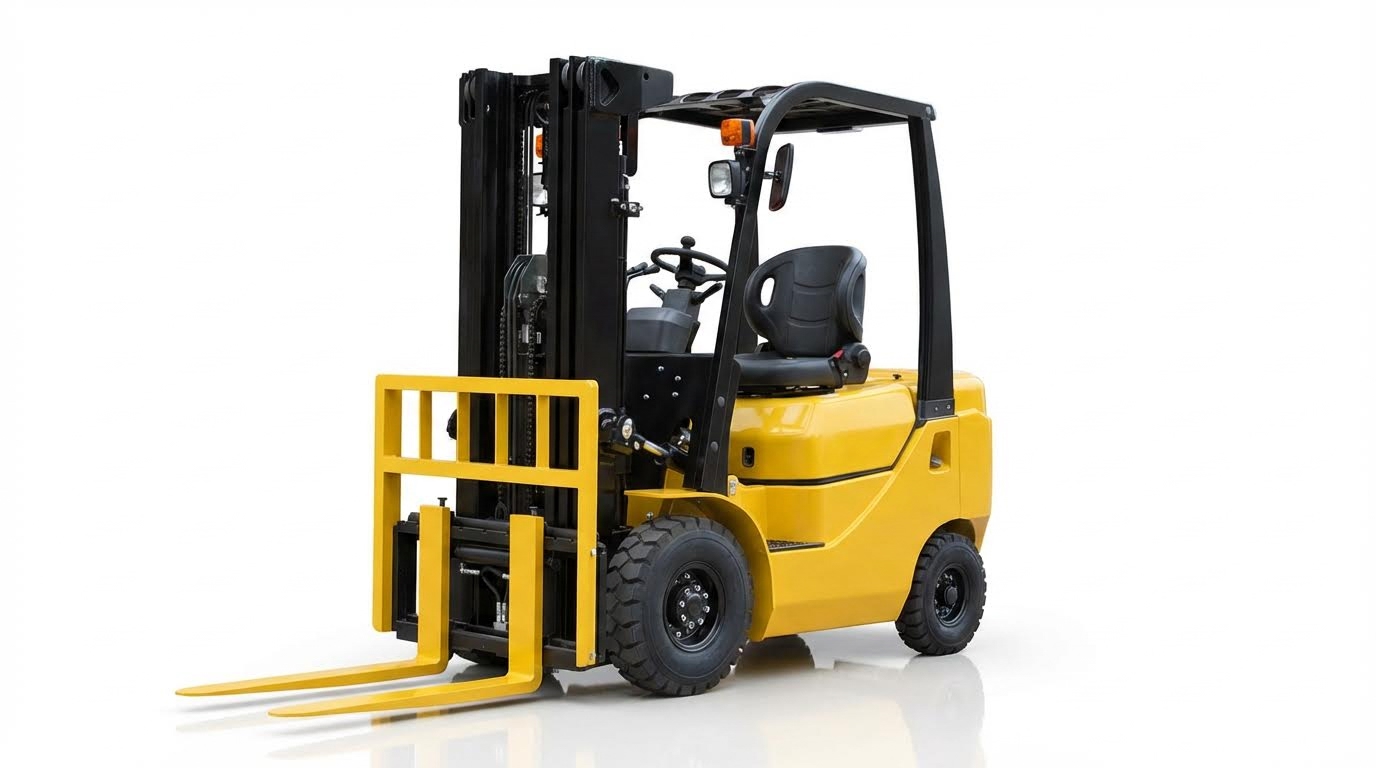
On trailers, docks, and railcars, a lift operator should travel with a full pallet only after securing vehicles, verifying floor capacity, and keeping forks low while driving straight across bridge plates to avoid tipping or floor failure.
- Secure the vehicle first: Chock truck wheels and set brakes before entering trailers or railcars – Prevents movement under the forklift and pallet load. Trailer and railcar precautions
- Inspect trailer floor: Check for rot, broken boards, or weak spots before driving in – A full pallet plus truck weight can punch through a damaged deck. Floor inspection guidance
- Drive straight over bridge plates: Cross dock plates or levelers in a straight line, not at an angle – Spreads load evenly and avoids side‑loading the plate. Bridge plate use
- Keep forks low inside trailers: Maintain travel height around 100–150 mm, with slight back tilt – Controls center of gravity on flexible or uneven trailer floors. Recommended travel height
- Respect grade rules on dock approaches: On ramps to docks, keep the loaded end uphill and avoid turning – Prevents the pallet sliding off and reduces tip‑over risk. Grade and ramp travel
- Control speed even more tightly: Use well below walking pace inside trailers or railcars – Stopping distances increase on worn floors and steel plates. Speed and floor condition
- Check overhead clearance: Before lifting inside trailers, confirm roof and door header clearances – Prevents striking structures when stacking or unstacking full pallets. Overhead clearance checks
- No elevated parking: Never leave a truck unattended with a raised pallet on a dock or in a trailer – Eliminates uncontrolled roll‑away or tip‑over hazards. Parking and shutdown rules
Quick checklist: Trailer and dock travel with full pallets
- Step 1: Chock wheels, set brakes, and secure dock plate – Prevents unexpected movement under load.
- Step 2: Inspect floor and overhead clearances – Confirms structure can carry truck plus pallet.
- Step 3: Center and secure the pallet, forks fully inserted – Reduces risk of sudden load loss during entry.
- Step 4: Enter straight, forks 100–150 mm high, mast slightly back – Keeps stability triangle intact over transitions.
- Step 5: Travel at very low speed, avoid sharp turns or sudden braking – Controls dynamic forces on flexible floors.
Final Thoughts On Safe Loaded-Pallet Travel
Safe travel with loaded pallets depends on one simple idea: keep the combined center of gravity inside the truck’s stability triangle at all times. Load geometry, fork engagement, and pallet condition decide whether the pallet behaves like a solid part of the truck or a loose, shifting mass. Travel height, mast tilt, and speed then control how close that mass stays to the truck and how much dynamic force you create during each move.
When operators keep forks low, use only slight back tilt, and match speed to floor and traffic conditions, they protect both stability and product. On ramps, docks, and flexible trailer floors, keeping the loaded end uphill, avoiding turns, and crossing plates straight prevents sudden loss of control. In tight aisles and pedestrian zones, visibility, right‑of‑way discipline, and predictable speed prevent strikes and rear‑end swing damage.
The best practice for any warehouse is clear: treat the data plate as law, reject weak pallets, standardize fork height and speed limits, and train operators to think in terms of load moment, not just weight. Build these rules into daily checks and site procedures, and Atomoving equipment will run safer, longer, and with far fewer incidents.
Frequently Asked Questions
How should a lift operator travel with a full pallet on the forks?
To safely travel with a full pallet, approach the load squarely and insert the forks fully under the pallet. Lift the load slightly and tilt the forks back to stabilize it. For unbalanced loads, keep the heavier side closer to the forklift. Before moving, ensure the load is secure and tilted slightly backward. Always maintain a safe speed and watch for obstacles or pedestrians in the area. Forklift Safety Guide.
What safety precautions should a lift operator follow when moving a pallet?
Operators should separate forklift traffic from pedestrians and always yield the right of way to people on foot. Stop whenever someone crosses your path. Ensure the load is stable and lifted off the ground before moving. Travel at a safe speed and be vigilant about obstacles or other workers nearby. OSHA Pedestrian Safety.
How can a lift operator ensure the pallet is secure before traveling?
Before moving, the operator should lift the pallet slightly off the ground and tilt the forks back to secure the load against the carriage. Check that the pallet is centered and balanced. If the load is uneven, position the heavier side closer to the forklift. Always confirm the load is stable before proceeding. Forklift Operation Tips.