In regulatory language, walkie stackers and forklifts are both powered industrial trucks, but mechanically they are very different tools. This guide answers the core question “is a walkie stacker a forklift” using OSHA classes, load charts, stability, and total cost to help you pick the right machine for your warehouse or plant.
How Walkie Stackers Fit Forklift And PIT Definitions
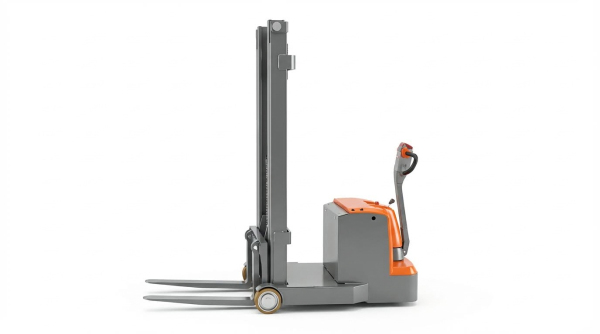
Walkie stackers and forklifts are both powered industrial trucks, but they sit in different OSHA/ANSI classes and use different stability principles, which changes how, where, and by whom they should be used. If you are asking “is a walkie stacker a forklift,” the precise answer is that it is a type of powered industrial truck with forklift-like functions, but not a counterbalanced forklift in the classic sense.
- Key Point: Both are regulated as powered industrial trucks – they share core safety, training, and inspection requirements.
- Key Point: They fall into different OSHA/ANSI classes – this affects how they are described in procedures and risk assessments.
- Key Point: Their mechanical layouts differ – this drives capacity, aisle width, and floor-condition limits.
💡 Field Engineer’s Note: When writing site SOPs, I always define “forklifts” and “walkie stackers” separately. It avoids confusion during audits and makes sure walkie training does not get watered down under a generic “forklift” label.
OSHA/ANSI powered industrial truck classes
Walkie stackers and forklifts are both “powered industrial trucks” under OSHA, but they usually fall into different equipment classes that reflect how they are controlled and what environment they work in. Understanding these classes clarifies why many safety officers answer “yes, but with a qualifier” when asked is a walkie stacker a forklift.
| PIT Class (OSHA/ANSI) | Typical Equipment | Walkie Stackers? | Counterbalanced Forklifts? | Operational Impact |
|---|---|---|---|---|
| Class I | Electric rider trucks | No | Yes (electric sit/stand-on) | Higher speeds, seated/standing operator for longer runs |
| Class II | Electric narrow aisle trucks | Often (reach / straddle / walkie stackers) | Sometimes (very narrow-aisle types) | Optimized for 1.5–2.5 m aisles and high-density racking |
| Class III | manual pallet jack, walkies, stackers | Yes (pedestrian-controlled) | No | Operator on foot, low travel speed, short-shuttle work |
| Class IV | IC engine trucks, solid tires | No | Yes | Indoor/outdoor, heavy loads on smooth floors |
| Class V | IC engine trucks, pneumatic tires | No | Yes | Yard work, ramps, rougher outdoor surfaces |
OSHA 29 CFR 1910.178 groups both walkie stackers and forklifts under powered industrial trucks, and walkie stackers typically fall into Class II or Class III as pedestrian-controlled units, while counterbalanced forklifts are usually in Classes I, IV, or V depending on power source and tire type. Both categories require the same core OSHA training, inspections, and maintenance documentation. Class II–III descriptions explicitly cover pedestrian-controlled stackers and pallet trucks.
- Classification: Walkie stacker = Class II/III PIT – legally treated as powered industrial truck, not a “hydraulic pallet truck toy.”
- Training: Same OSHA PIT framework – site can run separate modules but must meet the same regulation.
- Risk profile: Operator on foot in crush zones – training must stress pedestrian awareness and speed control.
How this affects your documentation and signage
In written programs, many facilities define “forklifts” as Classes I, IV, V and “walkie equipment” as Classes II–III. That way, pre-use checklists, speed limits, and pedestrian rules can be tuned to the different risk patterns while still meeting the single OSHA PIT standard.
💡 Field Engineer’s Note: During audits, inspectors often ask operators what class of truck they drive. If your walkie stacker drivers answer “just a pallet thing,” that is a red flag that training blurred the PIT classification message.
Mechanical architecture of walkie stackers vs forklifts
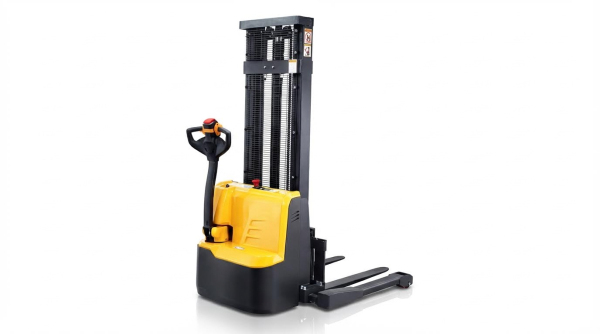
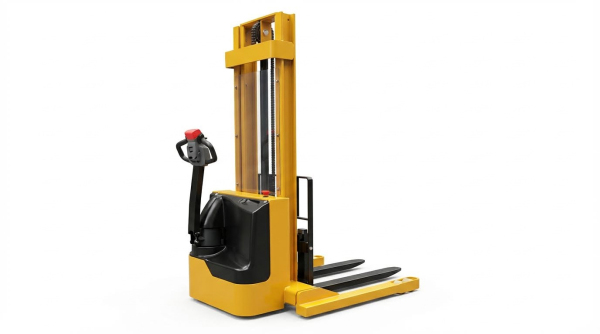
Walkie stackers and forklifts both lift pallets on forks, but forklifts use a counterbalanced chassis while stackers push load into the floor through outriggers, which limits capacity, ground clearance, and where they can safely operate. This is why many engineers say a walkie stacker is functionally forklift-like but mechanically a different tool.
| Feature | Walkie Stacker (Typical) | Counterbalanced Forklift (Typical) | Operational Impact |
|---|---|---|---|
| Primary stability method | Outriggers / straddle legs share load with drive wheel | Heavy rear counterweight balances load in front of axle | Stacker needs good floor and straight approaches; forklift handles uneven ground better |
| Rated capacity range | ≈500–2,000 kg | ≈1,500–8,000+ kg | Forklift covers heavier pallets and attachments |
| Typical lift height | Up to 5–6 m (some to 8 m) | 3–7 m (special units >10 m) | Forklift better for high-bay and outdoor stacking |
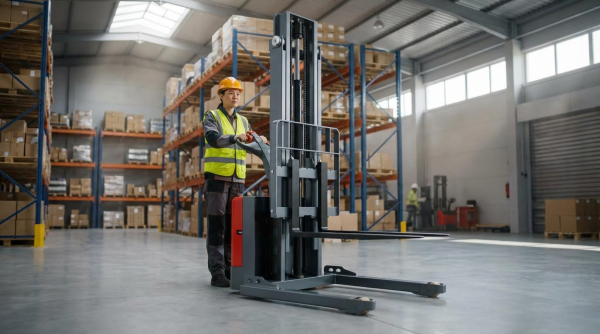
| Operator position | On foot, walking behind or beside tiller | On-board seat or stand-on platform | Stacker = more walking, lower speed; forklift = faster, longer runs |
| Powertrain | Electric only, compact drive unit | Electric or IC (diesel/LPG) | Stacker ideal indoors; forklift can work indoors and outdoors |
| Ground clearance | Low, limited by outriggers | Moderate to high, especially pneumatic-tire units | Stacker restricted to smooth, flat floors |
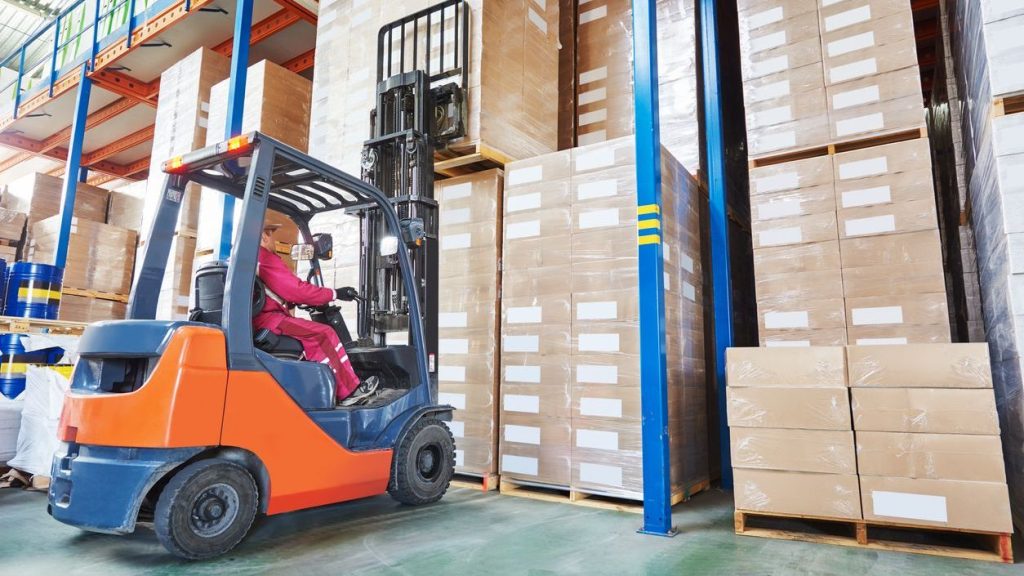
A classic forklift combines a counterbalanced chassis, vertical mast, and powered carriage that raises, lowers, and tilts forks while supporting the entire load between the drive axle and fork tips using a rear counterweight, enabling capacities from about 1,500 kg up to over 8,000 kg and lift heights beyond 6 m. Walkie stackers instead route part of the load directly into the floor via outriggers or straddle legs, which typically limits capacities to around 1,000–2,000 kg and optimizes them for short horizontal travel and vertical stacking. This design reduces required counterweight mass but also limits under-clearance and off-rack maneuvering.
- Structure: Forklift = counterweight plus mast; stacker = mast plus outriggers – different stability triangles and tip-over modes.
- Environment: Stacker is engineered for smooth indoor floors – forklift tolerates ramps, docks, and outdoor yards better.
- Speed and range: Stacker runs around walking speed (≈4–6 km/h) – forklift commonly runs 10–16 km/h for longer routes as documented in typical performance data.
Why “is a walkie stacker a forklift” causes confusion
From a load’s point of view, both machines put forks under a pallet and lift it. Legally, both sit under the powered industrial truck umbrella. Mechanically, though, the walkie stacker’s outrigger-based stability, low ground clearance, and walk-behind control make it behave much closer to a powered pallet truck than to a yard forklift. That is why many safety manuals treat them in separate sections even though OSHA groups them under the same PIT standard.
💡 Field Engineer’s Note: When I size equipment for a new warehouse, I treat walkie stackers as “vertical extension” of pallet trucks, not as mini-forklifts. If you try to use them like small counterbalanced forklifts—on ramps, broken concrete, or heavy offset loads—you quickly hit stability and ground-clearance limits.
Engineering Differences: Capacity, Stability, And Power
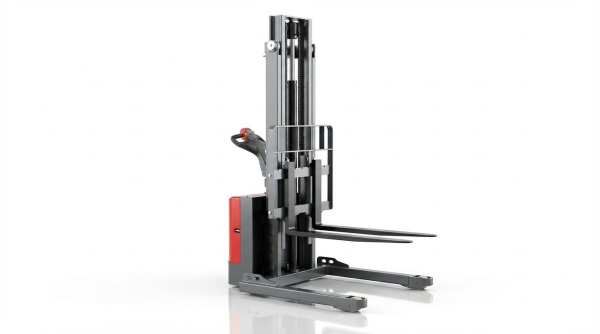
Walkie stackers and forklifts share powered industrial truck status, but they differ sharply in capacity, stability strategy, and power systems, which directly answers “is a walkie stacker a forklift” from an engineering and application standpoint.
These differences decide how high you can lift, how much you can carry, and how far and fast you can safely move loads in your facility.
Load charts, load centers, and rated capacity ranges
Load charts and capacity ranges show that counterbalanced stacker are optimized for 1,000–2,000 kg in short, controlled moves, while forklifts cover much higher capacities and more variable load positions. This is the first technical layer in deciding if a walkie stacker can replace a forklift in your use case.
| Parameter | Typical Walkie Stacker | Typical Counterbalanced Forklift | Operational Impact |
|---|---|---|---|
| Rated capacity band | ≈ 500–2,000 kg (often 1.0–2.0 tonnes) | ≈ 1,000–5,000+ kg, heavy units far higher (2.0–5.0 tonnes common) | Forklifts handle heavier pallets, oversized loads, and attachments without derating below your requirement. |
| Typical lift height band | Up to about 5–6 m, heavy-duty models 8+ m (stability more critical above 6 m) | ≈ 3–7 m, special masts 10+ m (higher with custom designs) | Forklifts better for high-bay racking or mezzanine loading; stackers suit mid-level storage. |
| Load center assumptions | Usually 500 mm load center for EUR/ISO pallets; strict limits on overhang | 500 mm standard, but more tolerant of variable centers due to counterweight and wheelbase | Off-center or long loads quickly derate a walkie stacker; forklifts keep more usable capacity. |
| Stability method | Outriggers/straddle legs share load with floor (no large counterweight) | Rear counterweight balances load cantilevered in front axle (classic forklift design) | Stacker stability collapses quickly if pallet is not fully supported; forklifts tolerate more variation but still rely on the “stability triangle.” |
| Typical use envelope | Light–medium pallets, controlled load geometry, repeatable SKUs | Medium–heavy pallets, mixed load sizes, attachments, outdoor work | Stackers shine in standardized warehouse lanes; forklifts cover docks, yards, and mixed production areas. |
- Key point for “is a walkie stacker a forklift”: In OSHA terms both are powered industrial trucks, but this capacity band means a walkie stacker is not an engineering substitute for a 3,000–5,000 kg counterbalanced forklift.
- Engineering rule of thumb: Size to your heaviest pallet at its worst-case load center, then add 10–20% margin as recommended in application-based selection – this often pushes you from stacker into forklift territory.
How to read a load chart in practice
Always check three items together on the data plate: rated capacity (kg), load center (mm), and lift height (m). If any one exceeds the chart, treat the capacity as zero, not “a bit unsafe.”
💡 Field Engineer’s Note: When customers swap a 3,000 kg forklift for a 1,500 kg walkie stacker “just for racking,” they often forget pallet overhang and add-on attachments. The real working capacity can drop below 1,000 kg at upper beam levels, creating a hidden tip-over risk.
Mast design, lift height, and stability control
Mast and chassis design explain why forklifts safely reach higher and handle dynamic loads, while walkie stackers prioritize compactness and low-speed stability in tight aisles.
| Design Aspect | Walkie Stacker | Forklift | Best For… |
|---|---|---|---|
| Mast robustness | Light to medium-duty mast sections sized for 500–2,000 kg and moderate heights (stability critical above 6 m) | Heavier mast rails, larger rollers, higher hydraulic pressures for 1,000–5,000+ kg and 3–10+ m | Forklifts for intensive multi-shift high stacking; stackers for occasional or mid-height stacking. |
| Stability concept | Outriggers form a wide polygon on the floor; load partly sits over these legs (reduced counterweight mass) | Stability triangle between front axle and steer axle pivot; rear counterweight balances moment (classic forklift) | Stackers on flat, smooth floors; forklifts where floors are less perfect or slopes exist. |
| Lift height vs stability | Standard up to ≈ 5–6 m; above this often needs guidance (rails) to keep mast tracking true (stability becomes critical) | Comfortable 6–7 m with free-lift masts; special designs exceed 10 m in VNA or high-bay roles | Forklifts or specialized trucks for high-bay; stackers for ground + first/second beam levels. |
| Speed and dynamics | Walking speed operation, 4–6 km/h typical (low kinetic energy) | Travel speeds 10–16 km/h common (higher kinetic energy, more dynamic instability) | Stackers for dense, pedestrian-heavy zones; forklifts for long runs and dock work. |
| Safety features focus | Load weight sensors, mast tilt limiters, speed reduction with elevated loads (to mitigate forward tip) | Tilt angle sensors, overload indicators, overhead guards; strong focus on tip-over and pedestrian impact risk | Both platforms mitigate different dominant risks based on their speed and geometry. |
- Mast design takeaway: If your racking exceeds about 6 m, or you need to tilt and travel with elevated loads, a conventional forklift or specialized high-lift truck is usually safer than stretching a walkie stacker to its design limits.
- Floor condition constraint: Walkie stackers assume flat, smooth floors; small wheels and outriggers do not tolerate potholes, ramps, or dock plates the way forklifts on larger tires do (indoor vs outdoor suitability).
Why outriggers limit “real-world” stacking
Outriggers must sit under or beside the pallet. If your racking has low bottom beams, drive-in lanes, or block-stacked product, those legs can clash with beams or product, effectively reducing usable lift height even if the spec sheet says 5–6 m.
💡 Field Engineer’s Note: In narrow aisles, operators often “crab” walkie stackers to reach awkward pallets. Side loading shifts the center of gravity outside the outrigger footprint much faster than most people expect, so I always derate practical stacking height by at least one beam level in tight, real-world layouts.
Energy use, batteries, and predictive maintenance
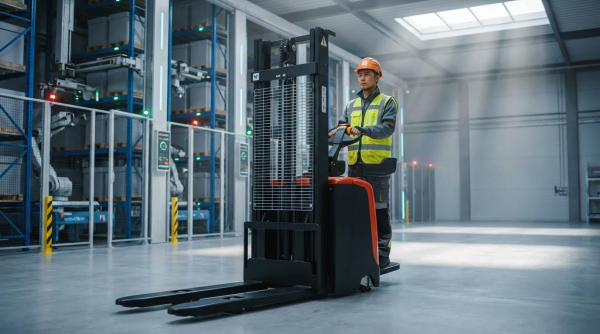
Energy systems and maintenance technology make walkie stackers cheaper to run per shift in short, indoor moves, while forklifts justify their higher energy and maintenance cost with throughput and versatility.
| Aspect | Walkie Stacker | Forklift | Operational Impact | |||||||||||||||||||||||||||||||||||||||||||||||||||||||
|---|---|---|---|---|---|---|---|---|---|---|---|---|---|---|---|---|---|---|---|---|---|---|---|---|---|---|---|---|---|---|---|---|---|---|---|---|---|---|---|---|---|---|---|---|---|---|---|---|---|---|---|---|---|---|---|---|---|---|
| Powertrain | Compact electric drive units only, using lead-acid or lithium-ion batteries (zero local emissions) | Electric, LPG, or diesel options; electric units still larger motors and pumps (higher power) | Stackers simplify charging and ventilation; forklifts give more flexibility outdoors or on ramps. | |||||||||||||||||||||||||||||||||||||||||||||||||||||||
| Energy demand | Lower nominal power, lower peak current draw (smaller chargers, lighter cables) | Higher-power traction motors and hydraulic pumps (faster cycles but more kWh/shift) | Stackers are efficient for short shuttle moves; forklifts win where cycle time and distance dominate. | |||||||||||||||||||||||||||||||||||||||||||||||||||||||
| Energy per pallet moved | Better in short shuttle and light–medium loads (lower mass and speed) | Better in heavy-load, long-distance duty where one forklift replaces several walk-behind units | Choice depends on travel distance and duty cycle, not just “electric vs electric.” | |||||||||||||||||||||||||||||||||||||||||||||||||||||||
| Maintenance focus | Batteries, wheels, and hydraulic components; daily checks mainly visual and SoC verification (simpler routines) | More complex: oil changes, brakes, engine components (for IC), plus mast and hydraulics Matching Equipment To Application And Total Cost
Matching walkie stackers or forklifts to your application starts with space, load profile, and hours of use, then extends into total cost of ownership over 5–10 years, not just purchase price. From an engineering and finance view, the answer to “is a walkie stacker a forklift” becomes less important than whether the machine fits your pallets, aisles, gradients, and budgeted cost per pallet moved.
Aisle width, travel distance, and duty cycleAisle width, travel distance, and duty cycle decide whether a walkie stacker or forklift will move more pallets per hour safely, and at what lifetime cost. At this stage, you are not asking “is a walkie stacker a forklift,” you are asking “which powered industrial truck geometry and speed profile fits my building and workload best.”
How to quickly check if a walkie stacker fits your aisles1. Measure clear aisle between pallet faces in mm. 2. Add pallet length plus 200–300 mm clearance for steering. 3. Compare to manufacturer’s “AST” (right‑angle stacking aisle). If your clear aisle is below the AST for a forklift but above that for a stacker, the stacker is the safer, more efficient choice. TCO modeling and mixed-fleet optimizationTotal cost of ownership (TCO) modeling proves that walkie stackers usually win on capital and energy cost, while forklifts win on throughput in heavy, long‑travel work. Once you understand that both are powered industrial trucks, the “is a walkie stacker a forklift” question feeds into TCO: they sit in different cost–productivity zones within the same PIT family.
|