Modern facilities relied on a spectrum of powered industrial trucks, from compact walkie stackers to high-capacity forklifts. Understanding how these machines differed in classification, mechanics, and operating modes helped engineers and managers specify the right equipment for each task.
This article examined OSHA definitions, core mechanical design differences, and use cases for lift stackers and forklifts. It then compared performance, maneuverability, powertrains, and structural load paths, before addressing selection, safety, maintenance, and lifecycle economics. Finally, it provided a concise framework for choosing between walkie stackers and forklift barrel grabbers in contemporary material handling operations.
Defining Walkie Stackers And Forklifts
Walkie stackers and forklifts belonged to the same regulatory family of powered industrial trucks, but they filled different technical roles inside facilities. Engineers and operations managers evaluated them by classification, mechanical layout, operating mode, and fit to specific workflows. Understanding these distinctions helped match equipment to throughput targets, aisle geometry, and safety requirements. This section framed walkie stackers as a subset of forklifts while clarifying where their capabilities diverged.
OSHA Classification And Regulatory Context
Walkie stackers fell under the powered industrial truck definition in OSHA 29 CFR 1910.178. Regulators therefore treated them as forklifts for training, inspection, and operating rule purposes. Facilities had to provide the same type of formal instruction, practical evaluation, and three‑year re‑certification for walkie stacker operators as for other forklift classes. Daily inspections, required by OSHA 1910.178(q)(7), applied equally and covered hydraulic function, controls, forks, and tires. From a compliance standpoint, the key difference was not classification but how site‑specific training addressed walking operation, tighter spaces, and pedestrian interaction.
Core Mechanical Design Differences
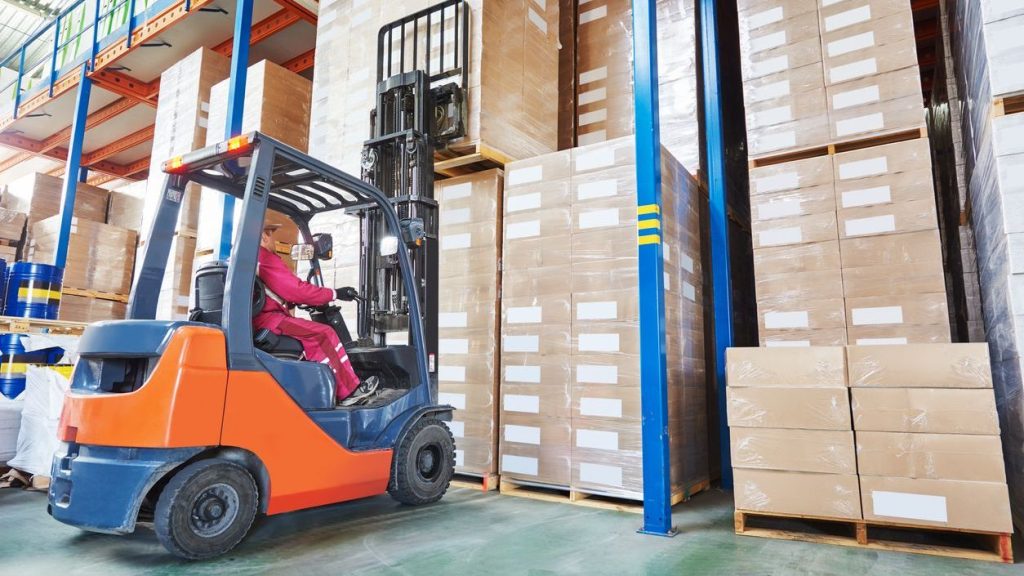
Forklifts, especially counterbalanced stacker types, used a heavy rear counterweight to balance loads cantilevered in front of the front axle. This architecture allowed them to “float” loads without outriggers and to handle several‑ton pallets at higher lift heights. Walkie stackers instead carried part of the load through front outriggers and wheels, which shortened the load moment arm but limited true free‑lift and travel on uneven ground. Their frames were lighter and more compact, optimized for indoor, short‑distance stacking rather than long‑haul transport. These structural differences directly constrained capacity, lift height, and surface tolerance.
Operating Modes: Walk-Behind, Stand-On, Sit-Down
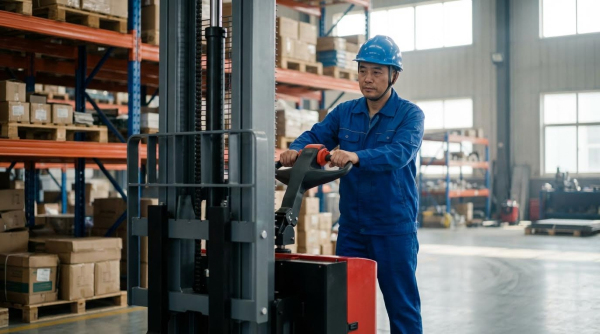
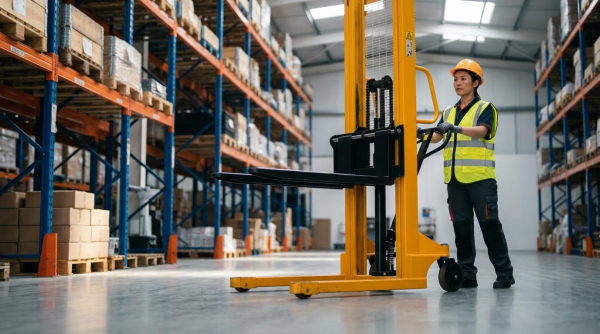
Walkie stackers primarily operated in walk‑behind or walk‑along mode, where the operator controlled the truck via a tiller arm while walking. Some variants offered a fold‑down platform, enabling a stand‑on ride for longer internal runs while preserving a small footprint. Traditional forklifts typically used a sit‑down configuration, placing the operator in a cab with steering wheel and pedals similar to road vehicles. This seated position supported higher travel speeds, longer shifts, and heavier loads but required wider aisles and larger clearances. The chosen operating mode affected operator fatigue, visibility, and safe speed limits in mixed‑traffic areas.
Typical Use Cases Across Facility Types
Walkie stackers excelled in tight warehouse aisles, retail backrooms, and light manufacturing cells where space was restricted and travel distances were short. Operators used them for vertical pallet stacking, order picking machines support, and truck loading in confined docks. Forklifts suited higher‑throughput distribution centers, heavy manufacturing, and outdoor yards, where they moved multi‑ton loads over longer distances and serviced high‑bay racking. In mixed fleets, facilities often assigned walkie stackers to dense storage zones and forklifts to cross‑dock or bulk handling areas. The decision typically balanced load mass, lift height, aisle width, and required cycle times across the operation.
Engineering Comparison: Performance And Design
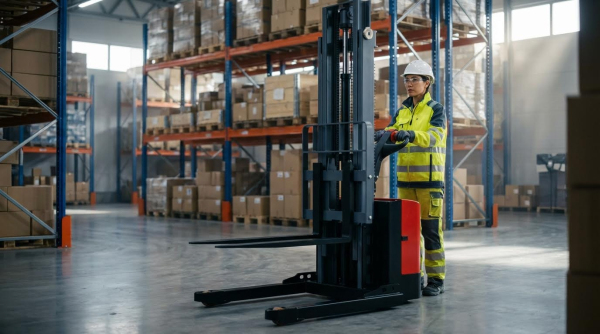
Engineering comparisons between walkie stackers and forklifts focused on quantifiable performance and design parameters. Engineers evaluated load capacity, lift height, stability, maneuverability, energy efficiency, and structural load paths. These factors determined which platform suited a given facility layout and throughput requirement. Understanding these differences allowed modern operations to match equipment precisely to task and environment.
Load Capacity, Lift Height, And Stability Limits
Walkie stackers typically handled light to moderate loads, often between 1.0 tonnes and 2.0 tonnes. Standard counterbalanced forklifts frequently operated in the 2.0 tonnes to 5.0 tonnes range, with heavy-duty units far above that. Forklifts used robust masts and higher system pressures, so they reached greater lift heights and served high-bay racking. Walkie stackers usually worked at moderate rack levels, prioritizing compactness over extreme height. Stability limits differed because stackers distributed load through outriggers, while forklifts relied on a stability triangle and rear counterweight. Engineers therefore defined strict rated capacities at specific load centers and heights for each platform.
Maneuverability, Aisle Widths, And Turning Radius
Walkie stackers offered very tight turning radii because operators walked or stood close to the steer point. Their chassis lengths remained short, so they operated effectively in narrow aisles and dense storage zones. Typical aisle requirements for walkie stackers were significantly below those for sit-down counterbalanced forklifts handling the same pallet size. Forklifts, especially sit-down models, required wider aisles to accommodate the vehicle length and steering geometry. Reach and articulated forklift designs reduced aisle width requirements but still exceeded those of compact walk-behind stackers. Facility planners therefore used aisle width, pallet orientation, and crossing traffic patterns as primary inputs when selecting between platforms.
Powertrains, Batteries, And Energy Efficiency
Walkie stackers generally used electric powertrains with smaller traction motors and hydraulic pumps. Their battery packs typically had lower ampere-hour ratings than electric forklifts, reflecting shorter travel distances and lighter duty cycles. This configuration reduced energy consumption per operating hour in confined, low-speed environments. Electric forklifts used higher-capacity batteries and more powerful drive systems to support continuous travel, ramp work, and frequent lifting at higher heights. Proper battery maintenance, including watering and equalization charging, extended service life to roughly 1,500–2,000 cycles for both platforms. Engineers optimized charging infrastructure, shift patterns, and opportunity charging strategies to minimize downtime and peak electrical demand.
Structural Load Paths: Outriggers Vs Counterweights
Walkie stackers carried loads using front outriggers and load wheels, which shared the vertical and horizontal forces from the pallet. This layout created a stable base within a compact footprint but limited the ability to reach under trailers or perform “free-floating” load handling. Counterbalanced forklifts transmitted load reactions through the drive axle and chassis into a rear counterweight. This design allowed the forks to project beyond the wheelbase without outriggers, enabling dock work and truck loading. However, it required heavier frames and larger turning envelopes. Structural engineering for both platforms considered fatigue, mast deflection, and floor loading, but the load paths and failure modes differed significantly between outrigger-supported and counterbalanced architectures.
Selection, Safety, And Lifecycle Management
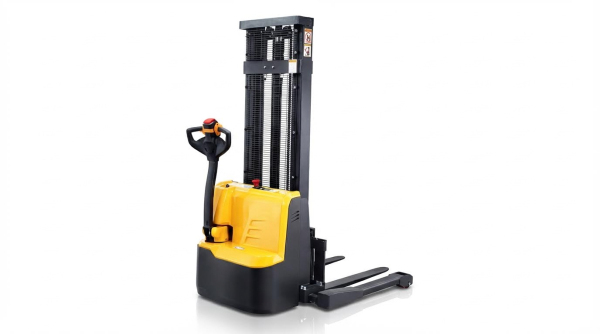
Selection, safety, and lifecycle management determined the real value of walkie stackers and forklifts in modern facilities. Engineers and operations managers evaluated not only lifting performance but also risk, uptime, and cost over the full service life. A structured approach linked application requirements to equipment class, safety controls, and maintenance strategy. This section outlined how to specify, operate, and manage both technologies as integrated assets in a material handling system.
Application-Based Selection Criteria And Sizing
Application-based selection started with quantifying load characteristics and duty cycles. Engineers specified maximum pallet mass, load center distance, and required lift height, then applied a 10–20% engineering margin to account for variability. For lift stackers, typical working capacities suited light to medium loads in narrow aisles and short horizontal travel, while forklifts supported higher masses, extended lift heights, and frequent truck loading. Aisle width, turning radius, and floor bearing capacity further constrained the choice, since outriggers on stackers redistributed loads differently from counterbalanced trucks. Finally, planners considered utilization hours per shift, charging infrastructure, and environmental constraints such as indoor air quality to size fleet quantities and battery capacity.
Safety Standards, Training, And Risk Controls
Both walkie stackers and forklifts fell under the same powered industrial truck regulations, including OSHA 29 CFR 1910.178 and related consensus standards. This meant facilities needed documented operator training, site-specific evaluations, and recertification at defined intervals, typically every three years. Risk controls combined engineered measures such as speed limiters, horns, lights, and guarded masts with administrative rules like pedestrian exclusion zones and one-way traffic patterns. Daily pre-use inspections checked brakes, steering, forks, mast function, and safety devices to prevent operation with known defects. Facilities also integrated visibility management, including mirror placement and marked walkways, to mitigate collision risks in congested zones and blind intersections.
Maintenance Programs And Predictive Technologies
Effective maintenance programs reduced unplanned downtime and total repair costs across both equipment classes. Industry data indicated structured preventive maintenance could cut repair costs by roughly 25–40% and extend service life by several years. Programs typically combined daily operator checks, weekly tire and chain inspections, and scheduled hydraulic and lubrication service based on operating hours. For electric walkie stackers and forklifts, battery care remained critical, including correct watering, equalization charging, and temperature management to achieve 1,500–2,000 charge cycles. Predictive technologies such as telematics, hour-meter analytics, and condition monitoring of hydraulic pressures and motor currents allowed maintenance teams to detect trends, plan interventions, and minimize disruptive failures.
Total Cost Of Ownership And Fleet Optimization
Total cost of ownership analysis captured purchase price, energy, maintenance, labor, and downtime impacts over the asset life. Walkie stackers generally offered lower acquisition and energy costs but higher operator walking time, while forklifts delivered greater throughput for heavy and long-distance moves at higher capital and maintenance expense. Facilities modeled utilization profiles to right-size fleets, avoid underused units, and match duty cycles with appropriate equipment classes. Digital maintenance records and telematics data supported decisions on overhaul versus replacement thresholds, often based on cumulative operating hours and cost-per-hour trends. Fleet optimization also considered standardization around a limited set of models to simplify training, spare parts, and safety procedures while still meeting diverse application needs.
Summary: Choosing Between Walkie Stackers And Forklifts
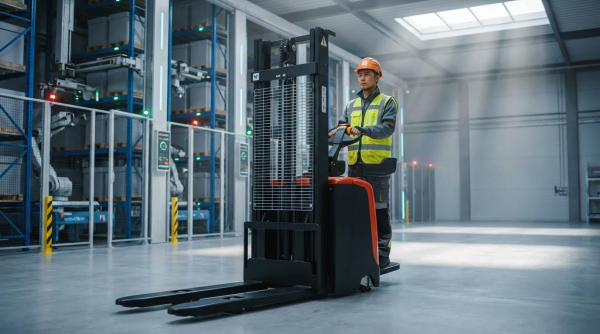
Walkie stackers and forklifts both belonged to the powered industrial truck family, but they served distinct roles in material handling strategies. Walkie stackers operated as compact, electric, walk-behind or ride-on machines that prioritized maneuverability and vertical stacking in confined aisles over long-distance travel or extreme loads. Forklifts, especially counterbalanced models, delivered higher capacities, greater lift heights, and better performance over distance, making them suited to docks, yards, and high-bay racking.
Engineering differences drove these roles. Walkie stackers transferred load through outriggers and drive wheels, which limited “free-ranging” operation and ultimate capacity but enabled very tight turning radii and small chassis envelopes. Forklifts relied on a heavy counterweight and more robust mast and chassis structures, which allowed multi-ton loads and truck loading but required wider aisles and stronger floors. Electric powertrains dominated walkie stackers and a growing share of forklifts, with battery technology and charging strategies increasingly shaping energy efficiency and lifecycle cost.
Future trends pointed toward higher automation levels, integrated telematics, and data-driven maintenance across both equipment types. Facilities used sensor data, digital maintenance records, and predictive algorithms to cut hydraulic failures, extend battery life, and reduce unplanned downtime. Safety expectations continued to tighten, with regulators and insurers emphasizing standardized operator training, application-specific risk assessments, and strict adherence to capacity and stability limits.
In practice, most modern facilities benefited from a mixed fleet. Narrow-aisle storage, back-of-store areas, and light manufacturing cells favored walkie stackers, while heavy pallet movements, truck interface zones, and long internal transport runs justified forklifts. The optimal choice depended on quantified requirements: load mass and geometry, racking height, aisle width, duty cycle, and budget over the full lifecycle. Organizations that periodically reassessed these parameters, and aligned equipment choice with evolving layouts and throughput targets, achieved the best balance between safety, productivity, and total cost of ownership.