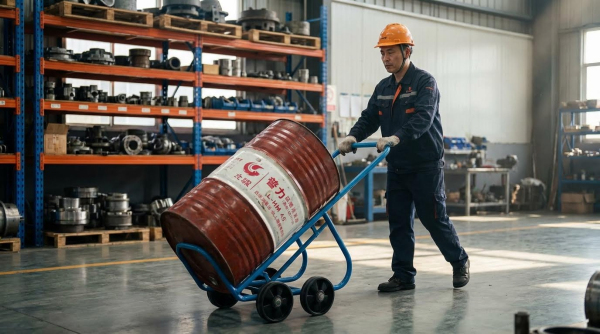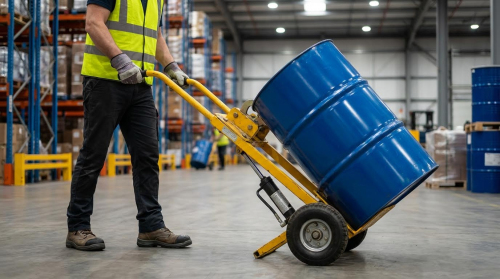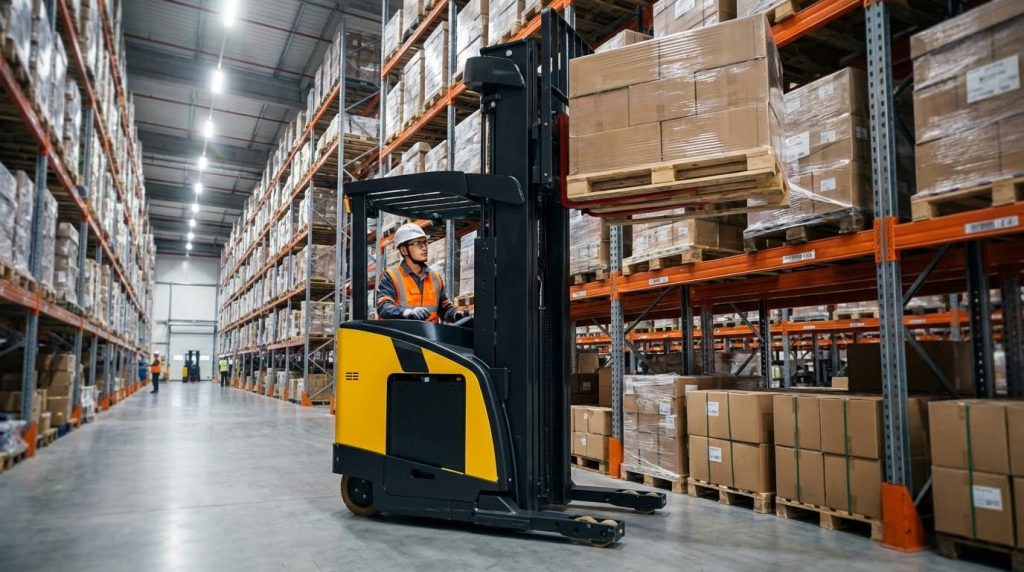
Operators who search for how to lift a pallet with a forklift usually face the same core issues. They must control load center, fork insertion depth, and pallet orientation while keeping the truck inside its rated capacity and stability limits. This article explains the core principles of safe pallet lifting, correct fork positioning and pallet entry, and practical methods for lifting, stacking, and working in racks, docks, and tight spaces.
You will see how entry depth, two-way versus four-way pallet design, and mast tilt affect stability and tip-over risk. The article also links these practices to regulatory expectations and training needs so safety teams, supervisors, and engineers can build consistent, enforceable forklift standards across their sites.
Core Principles Of Safe Pallet Lifting
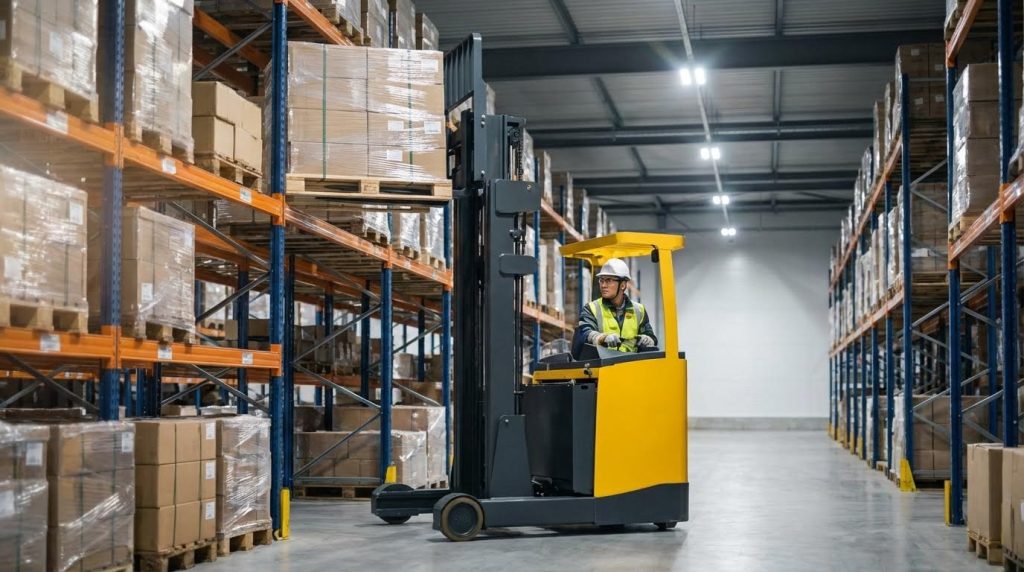
This section explains how to lift a pallet with a forklift without losing stability or capacity. It links basic physics, rated load charts, and real warehouse constraints into one method. You will see how load center, fork spacing, mast tilt, and overhead clearance work together. These principles apply in aisles, racks, docks, and trailers.
Understanding Load Center And Rated Capacity
The core rule for how to lift a pallet with a forklift is to keep the load center within the truck rating. The load center is the horizontal distance from the fork face to the load’s center of gravity. Many counterbalanced stacker forklifts were rated at a 600 mm load center. If the actual load center moves out, the effective capacity drops fast.
Key checks before lifting a pallet:
- Read the data plate and note rated capacity and load center.
- Place the heaviest part of the pallet closest to the carriage.
- Do not lift damaged or loose loads unless they are banded or wrapped.
- Reject any lift that would exceed the rated capacity at that height.
When forks do not enter deep enough, the load center shifts forward. This increases overturning moment and stresses the mast, steering axle, and front tires. Operators should keep the load centered between the forks and low to the ground when traveling to stay inside the stability envelope.
Fork Spacing, Depth, And Load Positioning
Correct fork setup is a direct answer to how to lift a pallet with a forklift safely. Fork spacing should match pallet stringers or blocks so each fork carries similar load. Wide spacing reduces bending on deck boards and gives better lateral stability.
For depth, forks should enter as far as possible into the pallet. Industry guidance recommended:
- Target full fork insertion to the pallet’s back stringer.
- Never less than about 80% of pallet depth for standard loads.
- At least two‑thirds of the load length under the forks for non‑palletized loads.
Shallow fork entry caused rocking pallets, cracked boards, and dropped loads. It also pushed the center of gravity forward and reduced truck capacity. Operators should level the forks, align square to the pallet, enter to full depth, then tilt back slightly so the load rests on the backrest before lifting clear.
Mast Tilt, Stability Triangle, And Tip-Over Risks
Every counterbalance truck worked inside a stability triangle formed by the front axle and steer axle. The combined center of gravity of truck plus load had to stay inside that triangle. Mast tilt and load height strongly affected this point.
Safe use of mast tilt when lifting a pallet includes:
- Tilt slightly back before lifting to lock the load against the backrest.
- Keep the mast tilted back while traveling, especially on uneven floors.
- Avoid forward tilt with elevated forks except to place or pick a load.
- Never travel with the mast forward and the load high.
A moving forklift with a raised load became very unstable. Sudden braking or sharp turns shifted the combined center of gravity outside the stability triangle and led to tip‑overs. Loads near the rated capacity required extra care, slower movements, and minimum lift height during travel.
Overhead Clearance And Work Area Assessment
Knowing how to lift a pallet with a forklift also means knowing when not to lift. Overhead clearance limits safe lift height. Operators must scan for sprinklers, lights, HVAC ducts, door headers, and rack bracing before raising the mast.
A basic work area check should cover:
- Overhead obstructions along the full travel path and stacking point.
- Floor conditions such as potholes, dock plates, and transitions.
- Other traffic, including pedestrians and trucks, in the same aisle.
- Space to turn and square to the pallet without side loading.
The truck should remain stationary while lifting or lowering. The parking brake should be set for high lifts or precision stacking. Keeping the load about 100–200 mm above the floor while traveling reduced impact risk and helped maintain control. Regular visual scans during operation helped detect layout changes, temporary obstacles, or damaged rack components before they caused incidents.
Fork Positioning And Pallet Entry Techniques
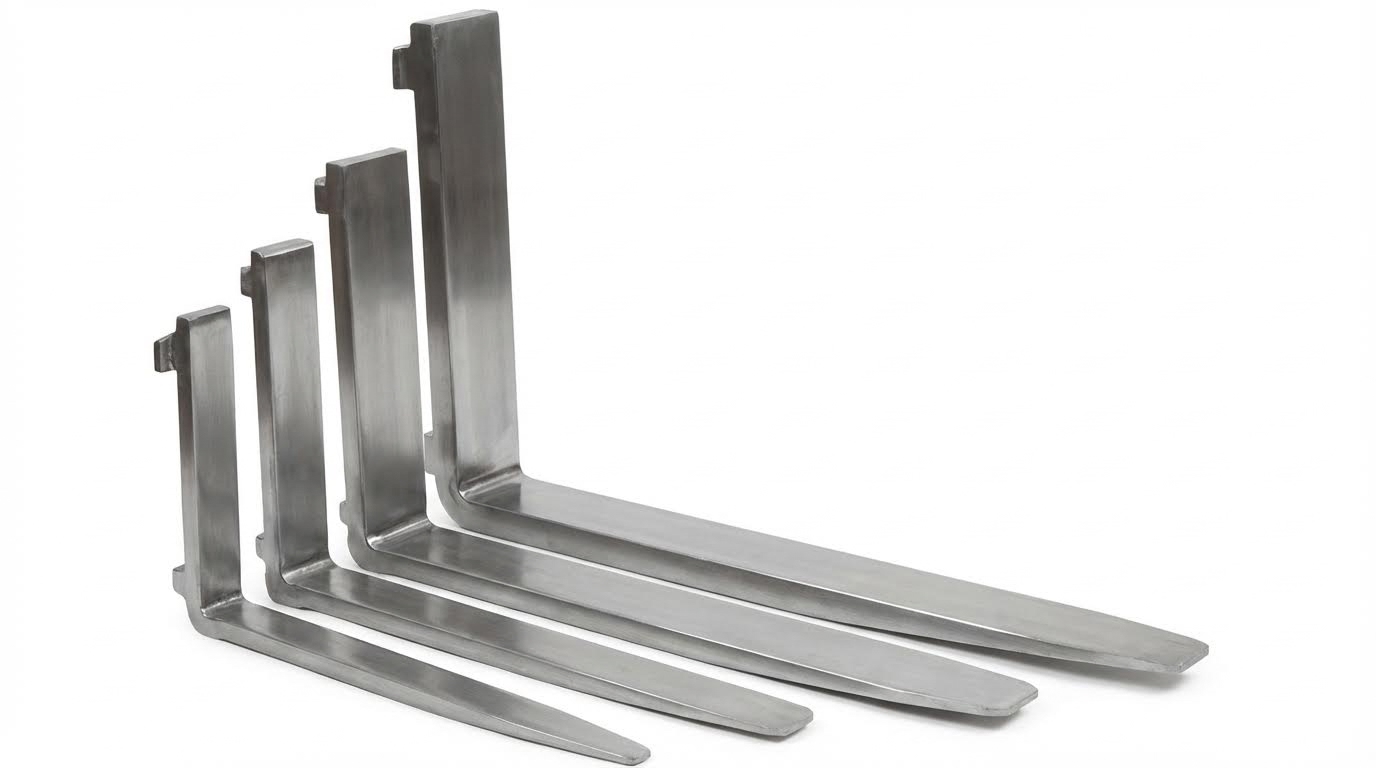
Safe fork positioning is the core of how to lift a pallet with a forklift without damage or instability. This section explains how to approach, align, and insert the forks so the pallet and load stay stable from pickup to travel. It links pallet type, fork depth, and visual guidance tools to practical warehouse workflows and compliance needs. Engineers and supervisors can use these points to set clear site rules and operator training standards.
Approaching And Squaring To The Pallet
Always approach the pallet in a straight line. Do not angle in. Stop with the forklift 20–30 cm in front of the pallet and keep the mast vertical. This position lets the operator fine‑tune fork height and spacing without pushing the pallet.
The truck must sit square to the pallet face. If the truck is skewed, one fork contacts first and twists the pallet deck. That twist stresses deck boards and shifts the load center sideways. Over time this causes broken boards and unstable loads.
Good practice when deciding how to lift a pallet with a manual pallet jack includes three checks before entry: truck straight, forks level, and correct fork height. The forks should align with the pallet openings, not the deck boards. Set the direction control to neutral and the parking brake before lifting. This prevents creep while the mast raises and reduces risk of striking nearby pallets or rack uprights.
Two-Way Vs Four-Way Pallets And Entry Sides
Pallet design limits where forks can enter. Two‑way pallets allow entry from only the front and rear. Four‑way pallets allow entry from all four sides. Block pallets usually behave as four‑way units, while stringer pallets may only allow two‑way entry or restricted side entry through notches.
With two‑way pallets, operators must line up exactly with the fork pockets. Side entry is not possible. This makes squaring even more critical in tight aisles or near walls. Four‑way pallets give more options for approach paths and staging layouts, which improves traffic flow.
When planning how to lift a pallet with a forklift in a real facility, engineers should standardize pallet types in each zone. Mixed two‑way and four‑way pallets in the same rack bay often cause mis‑entry and damage. Clear floor markings that show allowed entry sides at staging lanes help operators choose safe approach directions.
Minimum Fork Insertion Depth And Load Balance
Forks must support the load across enough depth to keep the center of gravity close to the carriage. Shallow fork entry pushes the load center forward and cuts the effective capacity of the truck. This increases tip‑over risk even when the nameplate capacity is not exceeded.
Industry guidance for how to lift a pallet with a forklift safely is:
- Target full fork insertion to the back of the pallet.
- Achieve at least 80% of pallet depth as a minimum.
- Keep fork tips clear of product or stacked pallets behind.
For a pallet depth of 1 165 mm, recommended fork entry is about 900–1 165 mm. Less than this range leaves a large overhang beyond the fork tips. That overhang bends deck boards and allows the load to rock when the truck moves or stops.
After insertion, center the load between the forks and place the heaviest items closest to the load backrest. Tilt the mast slightly back only after full insertion. This sequence locks the load against the backrest and keeps the stability triangle margin as wide as possible.
Visual Guides And Fork Alignment Aids
Visual guides reduce guesswork and speed up accurate fork entry. Simple paint or tape lines on floors at high‑volume lanes show ideal truck stop points and fork paths. Entry guides on pallet flow racks also help the operator center the pallet with the lane rails before insertion.
Common visual and alignment aids include:
- Painted center lines on rack beams or floor staging zones.
- Colored markers at recommended fork height for specific pallets.
- Entry guides at pallet flow rack openings for centering.
- Fork guidance lights on trucks in low‑light areas.
Sites that implemented clear fork positioning guides reported time savings of several seconds per pallet handled. Over a shift, this equaled more than one hour of extra productive time per truck. At the same time, mis‑hits on pallets and rack components dropped.
When defining site rules for how to lift a pallet with a hydraulic pallet truck, supervisors should pair these guides with operator training. Operators learn to line up the truck with the visual marks, level the forks, insert to full depth, then lift only after confirming balance. This blend of visual control and skill training produces consistent, repeatable pallet entry and fewer near‑miss events.
Lifting, Stacking, And Rack System Operations
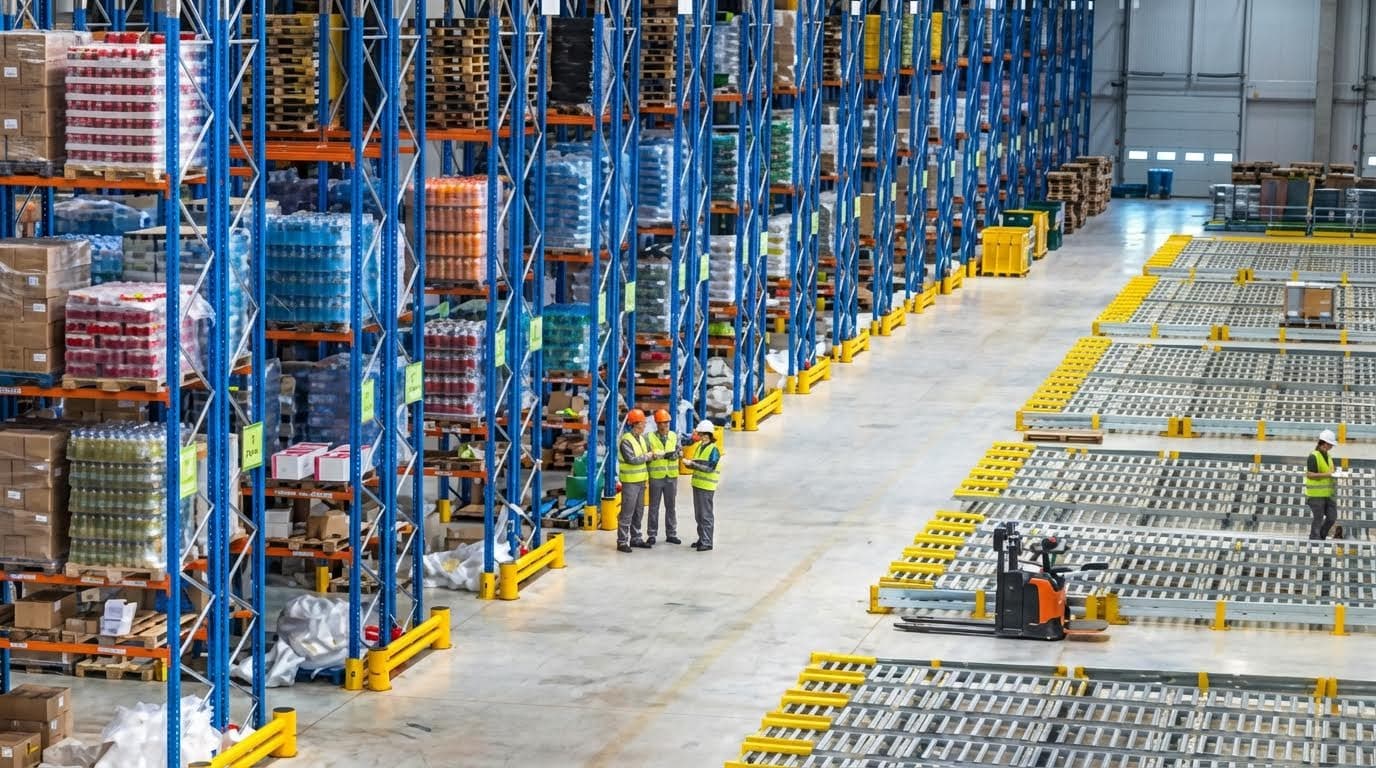
This section explains how to lift a pallet with a forklift in real operating conditions. It links basic lifting steps with stacking, rack work, and difficult load shapes. The goal is to keep the truck inside its stability limits while protecting pallets, racking, and people.
Step-By-Step: Lifting And Traveling With Loads
Operators should approach the pallet slowly and stop about 200 to 300 mm from it. The truck must sit square to the pallet, with forks level and spaced to support the full width. Insert the forks as far as possible, at least two-thirds of the load length, and ideally close to full pallet depth. This keeps the load center close to the carriage and within the rated capacity.
Before lifting, set the parking brake and keep the truck still. Raise the pallet only enough to clear the floor or stack, then tilt the mast slightly back so the load rests on the backrest. Travel with the pallet low, typically 100 to 200 mm above the floor, to keep the center of gravity low. Never drive with the load raised high or tilted forward, because this moves the combined center of gravity toward the edge of the stability triangle and raises tip-over risk.
When reaching the destination, stop, check overhead clearance, and level the mast before placing the pallet. Move forward slowly, lower the pallet onto the support, then return the mast to vertical. Only then back away 200 to 300 mm before lowering the empty forks to travel height.
Loading And Unloading Pallet Flow Racks
Work in pallet flow racks requires tighter control because the load sits on sloped rails and can move. To load, position the forklift square to the charge side and align the pallet center with the lane center or entry guides. Raise the pallet about 75 to 100 mm above the rails, then enter the lane slowly while keeping the mast vertical.
Set the pallet down gently on the rails with the pallet fully supported and centered. Avoid striking speed controllers, separators, or ramp stops. After the pallet sits stable, back straight out before turning. If the system uses entry guides, use them as visual aids to keep the pallet aligned and avoid side loading the rails.
To unload, square the truck to the pick face and insert the forks fully under the front pallet. Lift only 75 to 100 mm to clear the front beam and rails. Back out slowly and watch the rear pallets advance. If they do not flow, the operator may gently bump the front pallet to start movement, but must never climb into the lane. If plugging does not clear the hang-up, reload the pallet and tag the lane for inspection.
Working At Docks, Trailers, And Confined Spaces
Dock work adds extra hazards from trailer movement, weak floors, and tight clearances. Before entering a trailer, chock the wheels and confirm dock locks or other restraints hold the trailer. Check that dockboards or bridge plates are rated for the combined weight of truck and load and that they sit secured against slipping. Inspect the trailer floor for rot or damage, especially near rear doors and between cross-members.
When learning how to lift a pallet with a walkie pallet truck inside trailers, operators must watch both overhead and side clearances. Use dock lights and horn signals at every entry and exit. Drive straight across dockboards, avoid turning on them, and keep speed low. In confined spaces, keep the pallet as low as possible and travel in reverse if the load blocks forward view.
For railcars, similar rules apply, but movement control is even more critical. Railcar brakes and physical stops must be set before any forklift entry. Operators must never use the forks to force doors unless the truck has a purpose-built device and they have training for that task.
Handling Irregular Or Inconsistent Pallet Loads
Irregular or unstable loads change the effective load center and can overload the mast even when weight seems within rating. Examples include tall, lightly wrapped stacks, uneven weight distribution, or mixed carton sizes. Before lifting, operators should assess if the load is stable enough to move. Wrapping, banding, or re-stacking may be needed to prevent shift during travel.
Place the heaviest items close to the carriage and center the mass between the forks. If the pallet overhangs, ensure fork length still covers at least two-thirds of the actual load depth. Avoid sudden acceleration, braking, or sharp turns because irregular loads react more to inertia. When stacking, put heavier, more rigid pallets on lower tiers and lighter or fragile pallets higher.
Facilities should standardize pallet build patterns and wrapping rules to reduce variation. Simple go/no-go gauges for height at doorways and rack beams help stop unsafe loads before they reach tight areas. Training should stress that operators may refuse to move a load that looks unsafe until it is corrected, even if this slows short-term throughput. For operations involving manual pallet jack or hydraulic pallet truck, additional care is required to ensure stability and safety.
Summary Of Best Practices And Compliance Considerations
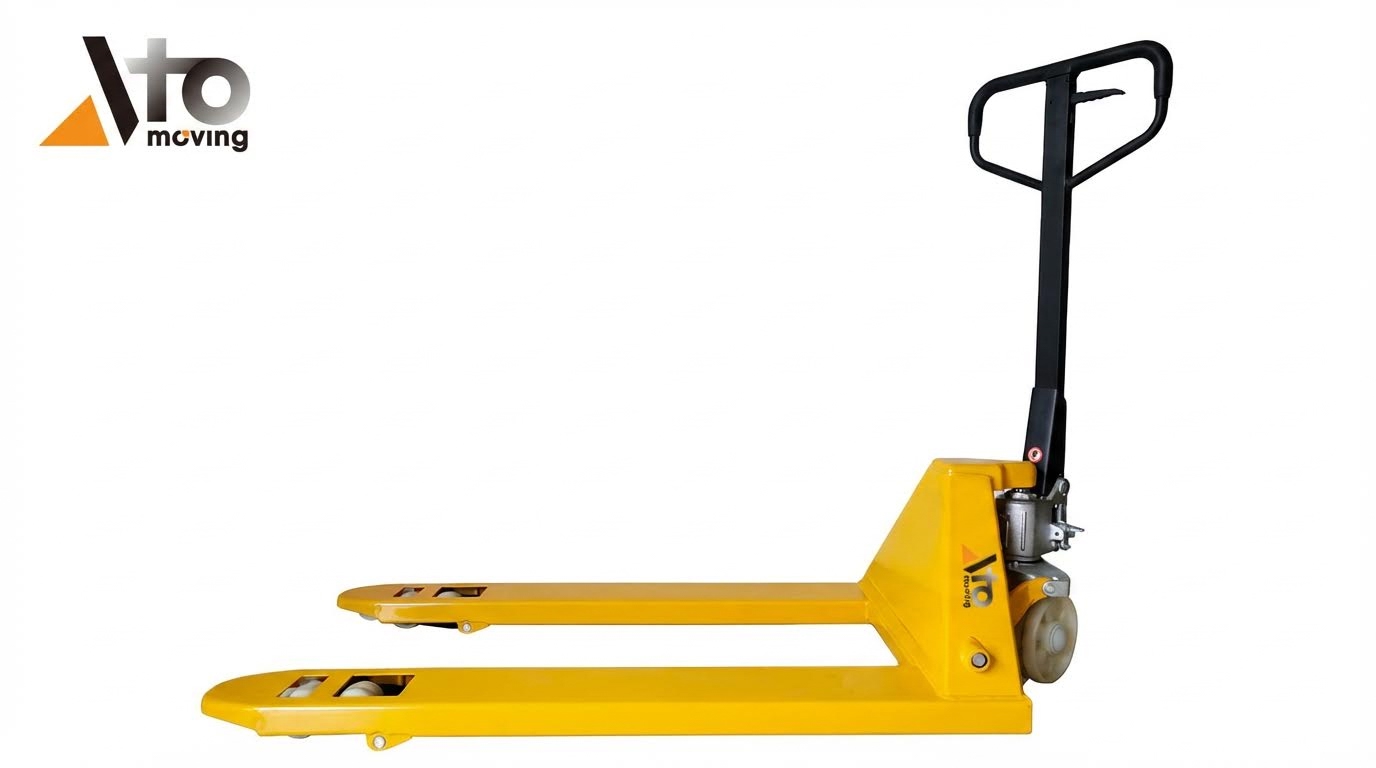
Operators who search for how to lift a pallet with a manual pallet jack need a clear, repeatable method. The goal is stable loads, predictable truck behavior, and compliance with safety rules. This section links the core principles, fork positioning, and rack operations into one practical checklist.
Safe work starts with the rated capacity and load center on the data plate. Keep the load center within the rated distance and place the heaviest part toward the mast. Insert the forks as deep as possible into the pallet, with at least 80% of pallet depth engaged. Level forks before entry, center the load between forks, then tilt the mast slightly back before lifting. Keep the truck stationary while lifting or lowering and check overhead clearance before every raise.
During travel, keep forks low, usually 100–150 mm above the floor, and never move with a high or forward‑tilted load. Approach racks, docks, and trailers square to the opening and lift only 70–100 mm above beams or rails to avoid impact. For pallet flow racks, control the flow by slow, straight extraction and stop work if pallets do not advance as designed. At docks, use wheel chocks, secure dockboards, and confirm trailer floor capacity before entry.
Compliance depends on formal training, site‑specific procedures, and regular refreshers. OSHA required operator certification, evaluation at least every three years, and extra training after incidents or layout changes. Programs should stress the stability triangle, tip‑over prevention, and pedestrian protection. Future improvements will combine these fundamentals with visual fork guides, simple height gauges, and data from warehouse systems to reduce handling time without relaxing safety margins.