Knowing how much diesel in full tank of forklift your fleet actually holds is the starting point for safe planning, accurate runtime estimates, and cost control. This guide explains typical tank sizes by truck class and capacity, then walks through simple formulas to convert gallons or liters into real working hours. You will also see the key engineering, safety, and regulatory factors that drive tank sizing choices, plus how diesel compares with LPG and hybrid options. Use it as a practical reference to right‑size tanks, plan refueling, and minimize unplanned downtime in your operation.
Typical Diesel Forklift Tank Sizes And Ranges
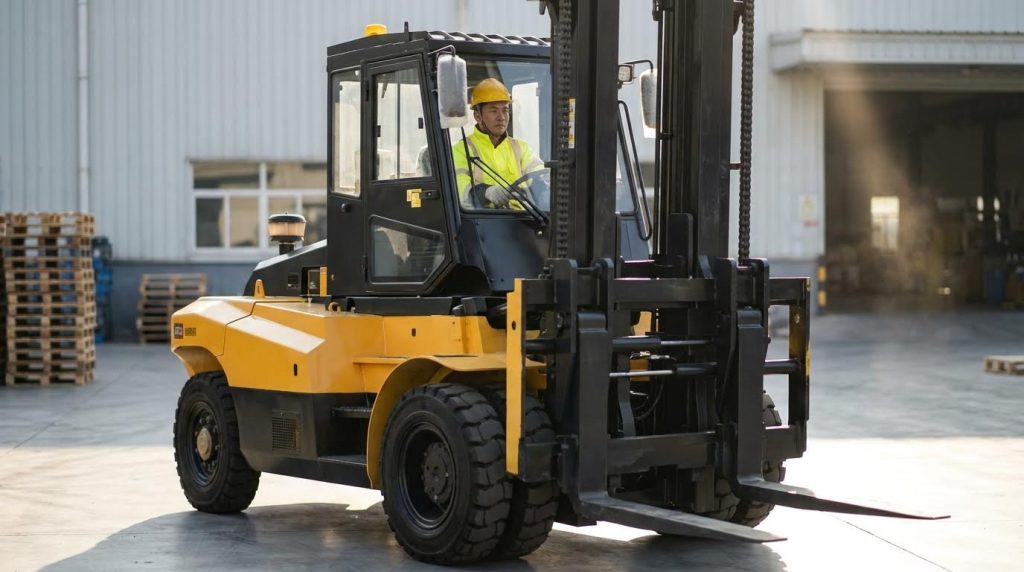
Capacity by weight class and lift capacity
For most fleets, fuel tank volume scales with the truck’s rated capacity. Light-duty diesel forklifts in the 3,000–5,000 lb range typically use tanks of about 15–20 gallons (roughly 57–76 liters). Medium-duty units rated 6,000–15,000 lb usually carry 20–30 gallons, while heavy-duty forklifts above 15,000 lb often need 30–35 gallons or more to support higher fuel burn. When planning how much diesel in full tank of forklift you need for a shift, start with capacity class, then adjust for duty cycle and environment.
| Rated lift capacity | Typical tank size (gal) | Typical tank size (L) |
|---|---|---|
| 3,000–5,000 lb | 15–20 | ≈ 57–76 |
| 6,000–15,000 lb | 20–30 | ≈ 76–114 |
| > 15,000 lb | 30–35+ | ≈ 114–132+ |
Why lift capacity and tank size are linked
Higher-capacity trucks use larger engines and hydraulics, so they consume more fuel per hour. Engineers scale tank volume so a typical duty cycle still achieves at least one full shift between refuels.
Capacity by truck class (IV, V, VII, VIII)
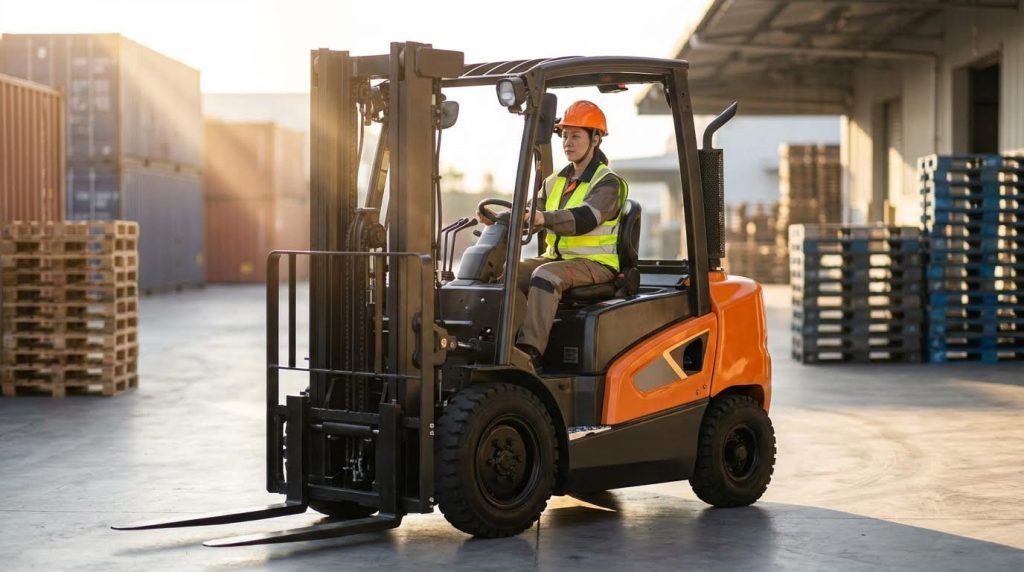
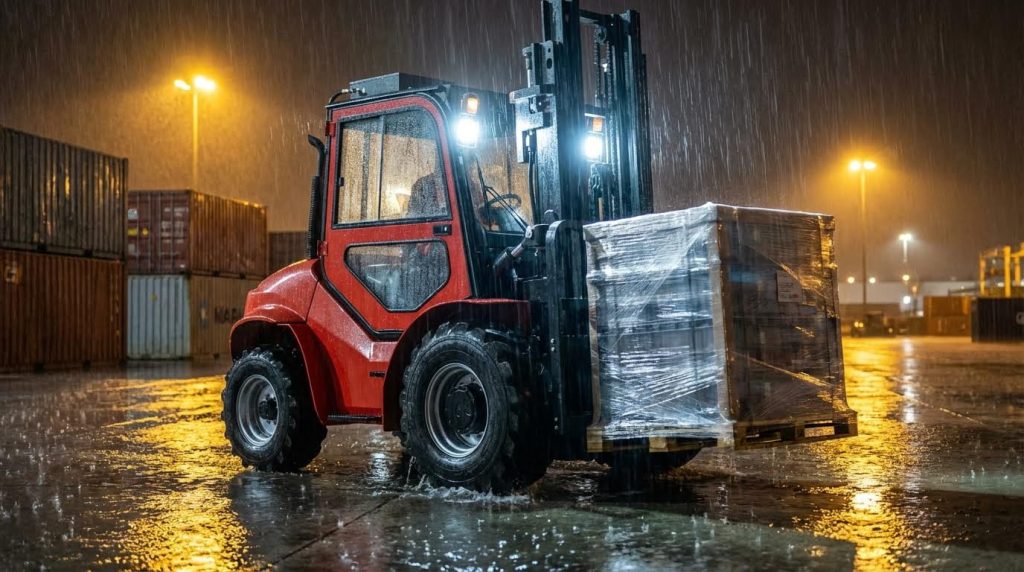
Forklift class also gives a useful range for tank sizing. In recent industry data, Class V diesel pneumatic-tire forklifts generally fall between about 60–110 liters (16–30 gallons) depending on capacity and engine size. Rough-terrain Class VII machines typically run 80–120 liters (21–32 gallons), while heavy Class VIII container handlers can carry 200–450 liters (53–119 gallons) to support long, high-load duty cycles without mid-shift refueling. These class-based bands help facilities benchmark whether their tanks are undersized or oversized for the application.
| Forklift class | Typical application | Typical tank range |
|---|---|---|
| Class IV | Cushion, mainly indoor IC | ≈ 57–76 L (15–20 gal) (IC reference range) |
| Class V | Pneumatic, outdoor IC | 60–110 L (16–30 gal) |
| Class VII | Rough terrain | 80–120 L (21–32 gal) |
| Class VIII | Container handlers | 200–450 L (53–119 gal) |
How class-based sizing supports planning
Using class ranges, you can quickly estimate how much diesel in full tank of forklift fleets you will store onsite. This helps with fuel bunker sizing, delivery frequency, and safety zoning.
How much fuel a “full tank” usually holds
Across most standard diesel forklifts, a full tank usually means roughly 15–35 gallons of usable diesel depending on size and duty. Smaller indoor or light outdoor units sit toward 15–20 gallons, while heavy industrial and port trucks push toward 30–35 gallons or more. Engineers rarely allow the tank to be filled to 100% of geometric volume; safe-fill is usually about 95% to leave expansion space and reduce spill risk. When you ask how much diesel in full tank of forklift for runtime calculations, use the safe-fill volume, not the nominal tank rating, to avoid overestimating shift coverage.
- Small diesel forklifts: typically around 15–20 gal full.
- Mid-size diesel forklifts: commonly 20–30 gal full.
- Large / heavy-duty diesel forklifts: 30–35+ gal full.
Why “full” is less than 100% of tank volume
Standards and good practice require ullage (air space) for thermal expansion and slosh. Using safe-fill volume in your calculations keeps runtime estimates realistic and improves safety during refueling.
How To Estimate Diesel Forklift Runtime
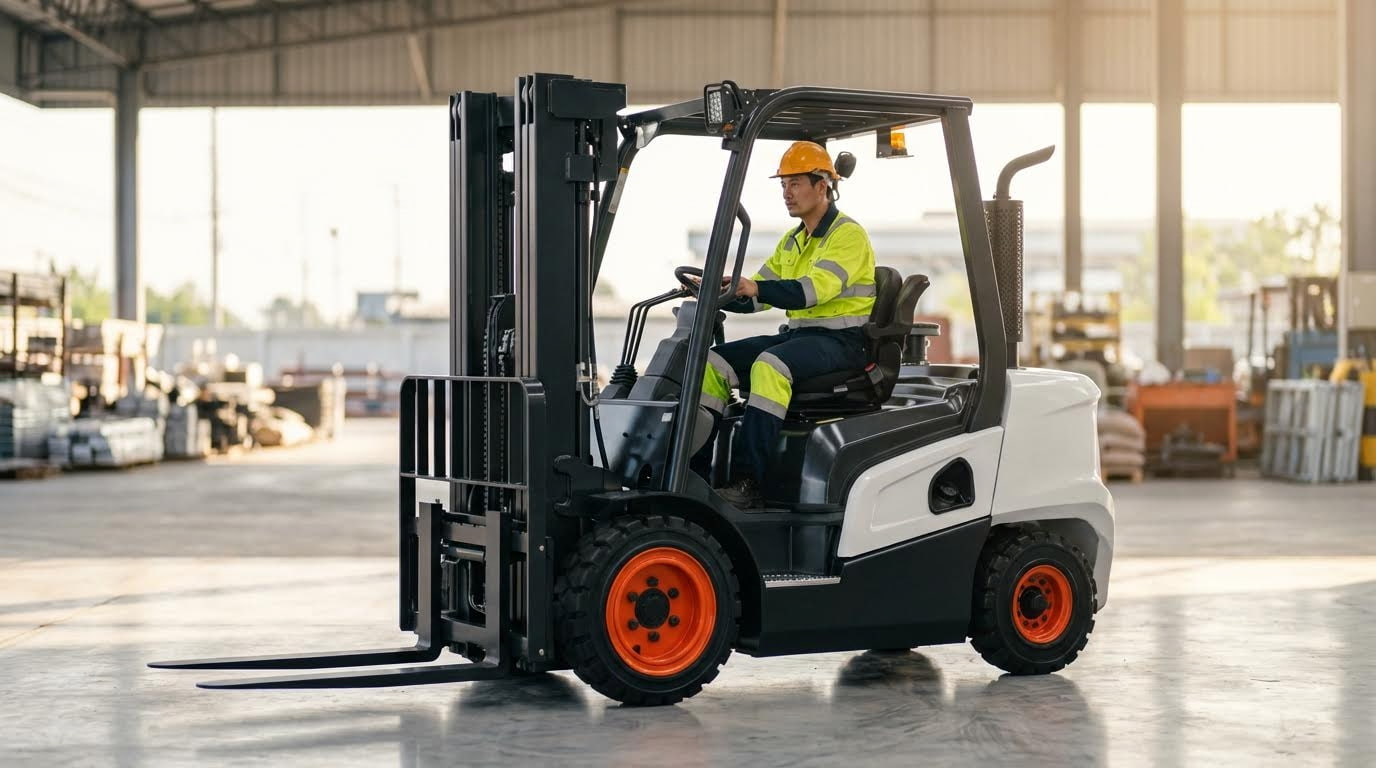
Core runtime formula and quick rules of thumb
The core engineering relationship for runtime is simple: Fuel Time = Fuel Quantity ÷ Fuel Consumption Rate. This is the same formula used in generic fuel time calculators for trucks and boats. A vehicle with 100 gallons of fuel and a burn rate of 10 gallons per hour runs for 10 hours before refueling. Fuel Time = Fuel Quantity / Fuel Consumption Rate applies directly to diesel forklifts.
- Typical diesel forklifts consume about 1.5–3.0 gallons per hour under normal operation. Most diesel forklifts fall in this range.
- Common tank capacities are roughly 15–35 gallons on standard units, so a full tank often supports a full shift. Smaller indoor/outdoor trucks sit at the low end; heavy-duty units at the high end.
- As a quick rule of thumb for planning, assume 2–2.5 gallons per hour for a mid-size diesel forklift unless you have site data.
When facility managers ask how much diesel in full tank of forklift is needed for one shift, the practical answer is: choose a tank that covers shift hours at your typical burn rate with a 10–20% safety margin. This keeps runtime predictable and avoids mid-shift refueling.
Step‑by‑step runtime calculation examples
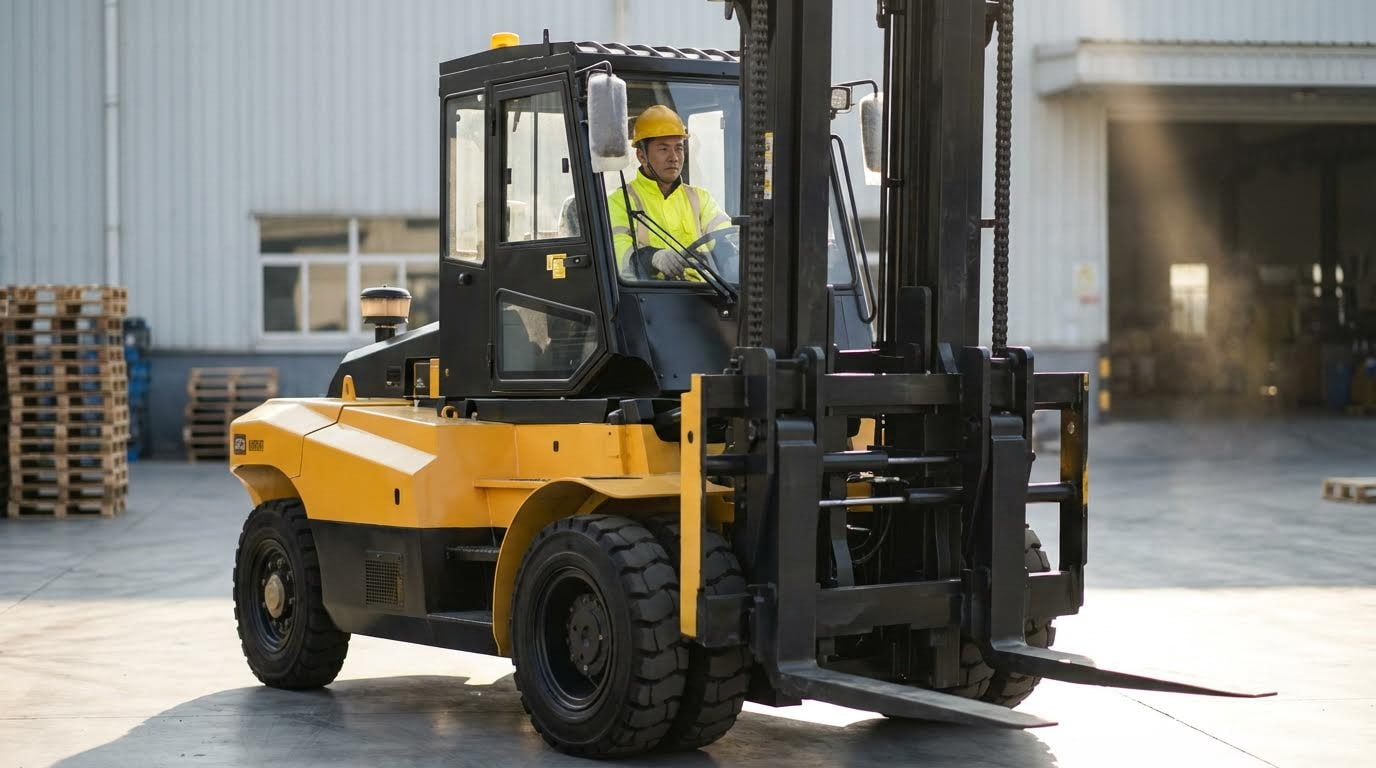
You can standardize runtime estimation across your fleet with a simple procedure. The steps below use realistic numbers drawn from published tank sizes and consumption rates for diesel forklifts. Typical Class V diesel forklifts have 60–110 liter (16–30 gallon) tanks, and many consume around 2.0–2.5 liters per hour in moderate duty.
- Collect inputs
- Tank usable volume (gallons or liters).
- Average fuel consumption (per hour), ideally from telematics or fuel logs.
- Required continuous operating time (hours per shift).
- Apply the formula
- Runtime (hours) = Usable tank volume ÷ Average consumption rate.
- Example in metric: a forklift using 2.5 L/h needs about 18 liters for an 8‑hour shift. This matches published engineering examples.
- Add a safety factor
- Increase the required volume by 10–15% to cover idle time, traffic, and heavier loads.
- Engineering guidance often uses: Tank liters = (consumption L/h × shift hours × 1.1 safety) ÷ 0.95 safe‑fill. This formula is recommended for sizing to a target shift length.
Worked example: mid‑size diesel forklift
Assume a 3.5‑ton diesel forklift with a 70‑liter tank and an average fuel consumption of 2.2 L/h running two 8‑hour shifts per day. Published data showed that such a truck needed refueling roughly every 1.9 days, resulting in about 132 refueling events per year for a 20‑truck fleet. This example quantified labor and cost impacts of tank size. The same logic applies if you convert to gallons and use your own site consumption.
Using this method, you can answer operational questions such as how much diesel in full tank of forklift is required to cover one or two shifts without guesswork, and you can compare different tank sizes on a cost and downtime basis.
Factors that increase real‑world fuel consumption
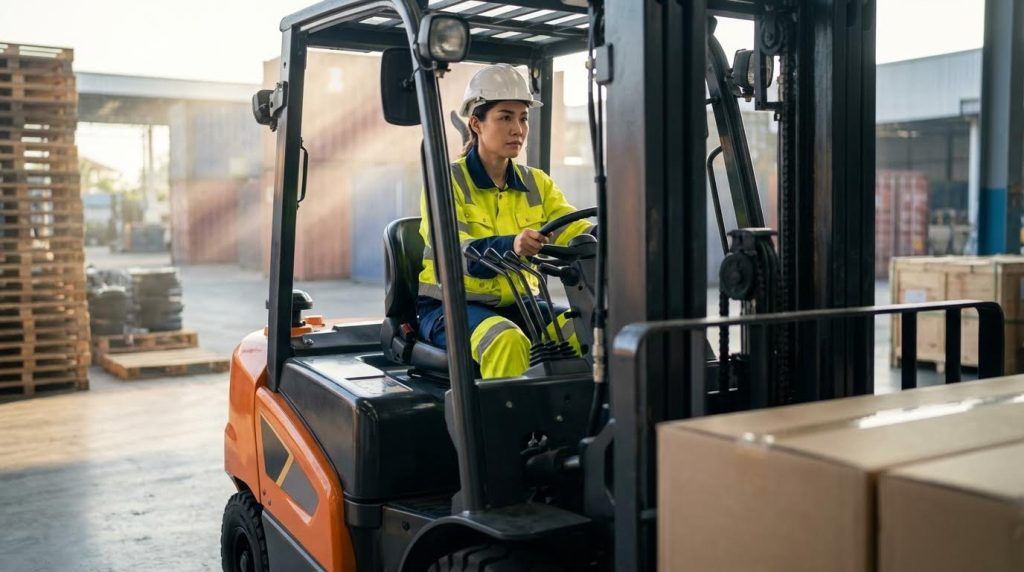
Real runtime is usually lower than the theoretical value because actual fuel burn is higher than the catalog number. Several site and operator factors push a forklift toward the upper end of the 1.5–3.0 gallons per hour range. Studies of diesel forklift use highlighted this spread.
- Load and duty cycle
- Handling near rated capacity, frequent lifting, and continuous travel all raise fuel burn.
- Medium‑duty models handling 6,000–15,000 lb loads typically need 20–30 gallon tanks to maintain autonomy. This reflects the link between capacity, tank size, and consumption.
- Terrain and environment
- Rough yards, ramps, and long outdoor runs increase throttle use and rolling resistance.
- Forklifts designed for construction sites, lumber yards, or ports therefore use larger tanks to preserve runtime. Outdoor applications were documented with higher capacity tanks.
- Engine size and maintenance condition
- Larger displacement engines naturally burn more fuel per hour at similar workloads. Industrial models with powerful engines require more fuel storage.
- Poor maintenance, clogged filters, and low tire pressure further increase consumption.
- Operator behavior
- Hard acceleration, excessive idling, and abrupt braking all raise hourly fuel use.
- Smoother driving and proper load distribution improve fuel efficiency and extend runtime. manual pallet jack.
When you estimate how much diesel in full tank of forklift is needed for your site, adjust the theoretical runtime down based on these factors. In heavy outdoor duty or poor maintenance conditions, planning with a higher assumed burn rate is safer and reduces the risk of mid‑shift stoppages.
Engineering Considerations For Tank Sizing And Selection
Matching tank size to shifts, duty cycle, and environment
Engineers size diesel forklift tanks starting from shift length and average consumption, not just from how much diesel in full tank of forklift marketing brochures claim. A practical design rule is: Tank volume = (average burn rate × longest planned shift × 1.1 safety factor) ÷ safe‑fill ratio, where safe‑fill is typically about 95% of geometric volume to allow for expansion. For example, a truck burning 2.5 liters per hour needs roughly an 18‑liter tank to cover an 8‑hour shift with daily refueling and a safety margin. A diesel forklift consuming 2.5 liters per hour required about 18 liters of tank volume for an 8‑hour shift.
Duty cycle also drives tank size. Trucks doing continuous heavy lifting, long travel distances, or operating on gradients will sit at the upper end of the typical 1.5–3 gallons per hour range, while light warehouse shuttling stays lower. Outdoor applications such as construction sites, lumber yards, and ports usually justify larger tanks because of longer travel, rough terrain, and fewer chances to refuel. Forklifts built for outdoor environments typically have larger tanks than indoor warehouse units.
Weight class and lift capacity give a first sizing envelope. Light‑duty 3,000–5,000 lb forklifts usually carry 15–20 gallon tanks, medium‑duty 6,000–15,000 lb models 20–30 gallons, and heavy‑duty units over 15,000 lb capacity 30–35 gallons or more. These ranges reflect the correlation between lifting capacity and tank size. Engineers then refine the volume based on how many shifts per day are planned, whether end‑of‑shift refueling is standard practice, and how much buffer is needed for disruptions.
Quick engineering checklist for tank sizing
- Confirm average and peak fuel burn (L/h or gal/h) from tests or OEM data.
- Define maximum uninterrupted operating window (single or multiple shifts).
- Apply at least 10% runtime safety margin and 95% safe‑fill limit.
- Adjust for environment: long outdoor runs and rough terrain need more buffer.
- Verify available space, weight limits, and counterbalance effects of a larger tank.
Regulatory, safety, and maintenance constraints
Tank selection is constrained by codes, not just operations. Stationary or bulk diesel tanks over about 60 gallons often must provide 110% secondary containment to comply with rules similar to UL 142 requirements. UL 142 specified 110% containment for tanks above 60 gallons, which affects how large on‑site storage and day tanks can be in a given footprint. For on‑truck tanks, emissions regulations like EPA Tier 4 Final and EU Stage V add space and volume penalties for exhaust after‑treatment and AdBlue/DEF.
Modern diesel forklifts with SCR typically need an AdBlue/DEF tank sized at roughly 3–5% of the diesel tank volume. Guidance indicated AdBlue tank volumes of 3–5% of diesel volume for Tier 4 and Stage V systems. This must be considered in frame layout, access for refilling, and cold‑weather protection. Safety engineering also limits how much diesel in full tank of forklift you can actually use: safe‑fill is normally capped below 100% to prevent thermal expansion from causing spills, and venting must keep vapors and pressure within design limits.
Maintenance and inspection requirements also influence tank design. Tanks, lines, and mounting points need regular checks for leaks, corrosion, and damage to avoid both fire risk and effective capacity loss. Regular inspection of diesel tanks for leaks, corrosion, and ventilation issues was recommended. Fuel quality management—filtration, water separation, and clean filling practices—helps maintain usable volume and prevent downtime from clogged filters or injector problems.
Key regulatory and safety design points
- Respect safe‑fill limits (often ~95% of nominal volume) to prevent overfilling.
- Provide adequate venting and routing away from ignition sources.
- Design for secure mounting and protection from impact or ground strikes.
- Plan access for periodic internal and external inspection.
- Include space and routing for DEF/AdBlue tanks where required.
Comparing diesel to LPG and emerging hybrid options
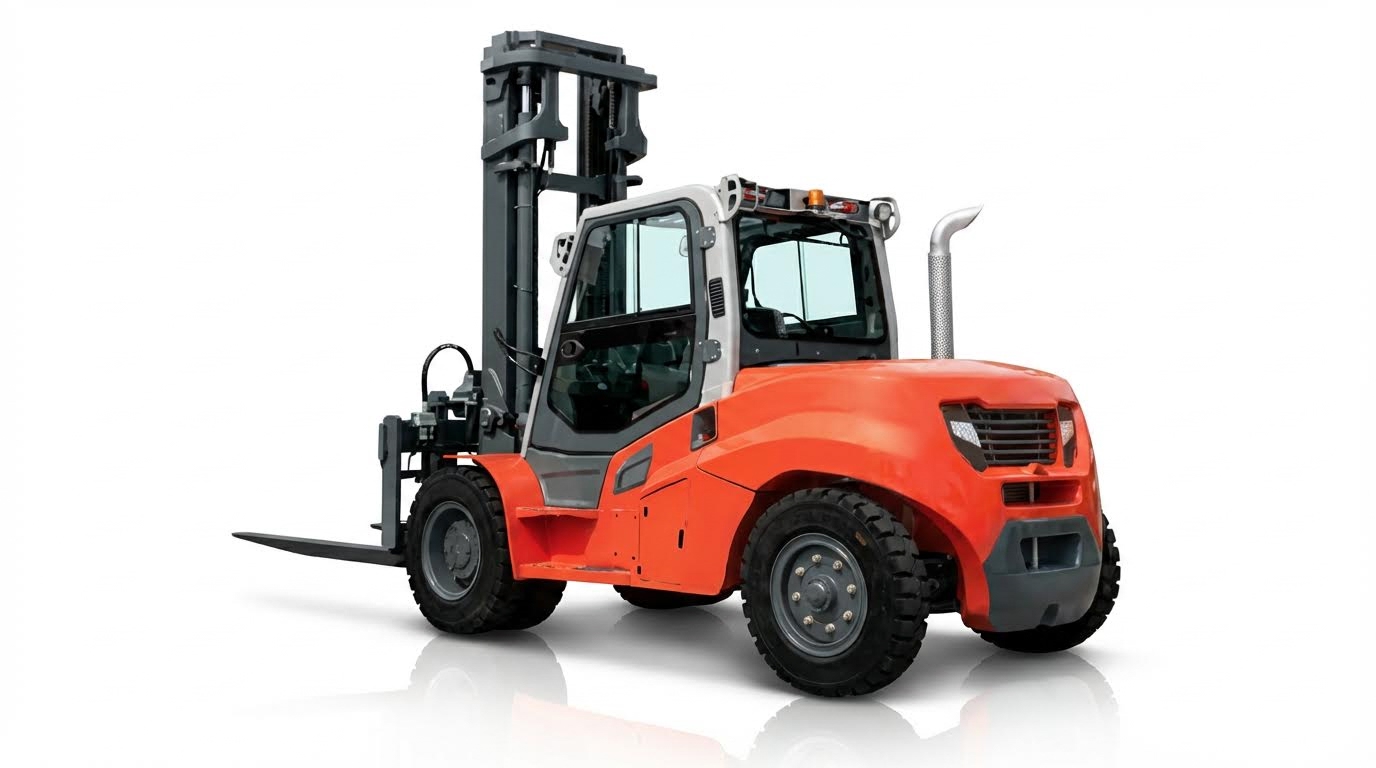
When engineers compare diesel to LPG and hybrid options, energy density and tank volume are central. Diesel contains about 36.2 MJ per liter, while LPG holds roughly 23.5 MJ per liter, so an LPG truck needs more tank volume for the same runtime. One comparison showed a diesel forklift using 18 liters for an 8‑hour shift, versus 28 liters of LPG for similar energy. This explains why LPG cushion‑tire trucks often carry relatively bulky cylinders for a given shift length.
Typical tank ranges by class illustrate these trade‑offs. Class V diesel pneumatic forklifts often use about 60–110 liters (16–30 gallons), while rough‑terrain Class VII units run with 80–120 liters (21–32 gallons) to achieve 10–12 hours of autonomy. Heavy container handlers in Class VIII can require 200–450 liters (53–119 gallons) to match long duty cycles without mid‑shift refueling. 2025 data reported these tank ranges by ITA class.
Emerging hybrid and dual‑fuel designs change the sizing logic. Battery‑hybrid diesel forklifts can downsize the diesel tank because the battery handles peaks and part of the daily energy, with some examples using about 25 liters of diesel while still covering an 8‑hour shift. A hybrid Class V example paired a 10 kWh battery with a small diesel genset and a 25‑liter tank while maintaining 8‑hour autonomy. Dual‑fuel diesel‑hydrogen systems, by contrast, can require very large physical storage volume for hydrogen relative to the energy delivered, so engineers must balance tank space, runtime, and chassis layout carefully.
| System | Relative tank volume for same runtime | Design implication |
|---|---|---|
| Diesel | Base case (smallest volume) | Compact tank, high energy density, simpler packaging. |
| LPG | ~1.5× diesel volume | Larger or multiple cylinders needed for long shifts. |
| Diesel‑battery hybrid | Smaller diesel tank than conventional | Battery absorbs peaks; tank sized for average load. |
| Diesel‑H₂ dual‑fuel | Much larger physical H₂ storage | Complex packaging; often pilot or niche applications. |
Key Takeaways For Fleet And Facility Managers
Diesel forklift tank sizing is not just a catalog choice. It is an engineering decision that locks in runtime, safety margins, and refueling labor for years. Capacity must match shift length, duty cycle, terrain, and environment, with safe‑fill limits and regulatory rules always in view. When you size tanks from real fuel burn and required hours, you avoid mid‑shift stoppages and oversize storage that adds cost and risk.
Runtime estimation stays simple if you treat it as a controlled calculation. Use usable volume, not nominal capacity. Apply Fuel Time = Fuel Quantity ÷ Consumption Rate with a realistic burn range and at least a 10–15% safety factor. Then adjust down for heavy loads, rough yards, poor maintenance, and aggressive driving. This approach turns “how much diesel in full tank of forklift” from guesswork into a repeatable planning tool.
For operations and engineering teams, the best practice is clear. Standardize runtime calculations, enforce safe‑fill and inspection routines, and choose between diesel, LPG, or hybrid based on energy density, tank space, and shift profile. When you follow these principles, your Atomoving diesel forklifts deliver predictable shifts, controlled fuel costs, and a safer yard or warehouse.
Frequently Asked Questions
How much diesel does a forklift fuel tank hold?
The amount of diesel a forklift can hold depends on the model and manufacturer. For example, some heavy-duty forklifts may have a fuel tank capacity of approximately 27.7 gallons (105 liters). This allows for extended operating hours without frequent refueling. Forklift Fuel Capacity Guide.
What factors influence the fuel capacity of a forklift?
Several factors influence the fuel capacity of a forklift, including its size, engine type, and intended use. Larger forklifts designed for heavy loads or outdoor use typically have bigger fuel tanks to support longer operation times. Here are some key considerations:
- Engine Type: Diesel engines often require larger tanks compared to electric or propane models.
- Operating Environment: Outdoor or rough terrain forklifts may need more fuel for extended use.
- Load Capacity: Heavier lifting tasks may increase fuel consumption, requiring a larger tank.