A well-specified warehouse order picker can double picking productivity while cutting aisle space and energy use. This guide walks through core truck configurations, realistic load and lift ranges, and how these order picking machines interact with aisle width, slotting, and warehouse layout. You will see how capacities and geometry drive safety margins, turning radii, and vertical storage choices. Use it as a practical checklist when matching picker trucks to your building, inventory profile, and WMS strategy.
Core Concepts Of Warehouse Picker Trucks
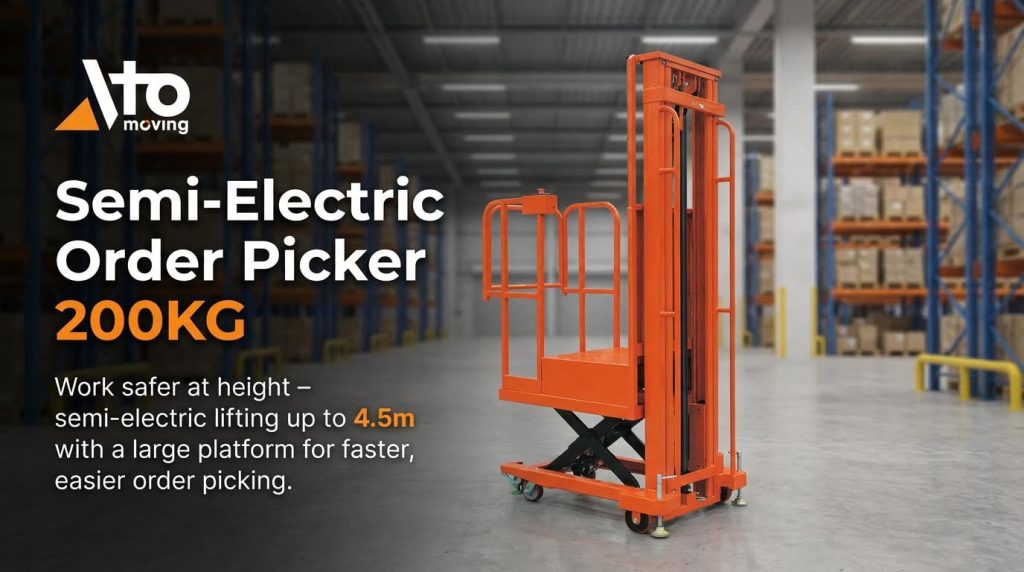
Definitions: Picker Trucks vs. Forklifts And Carts
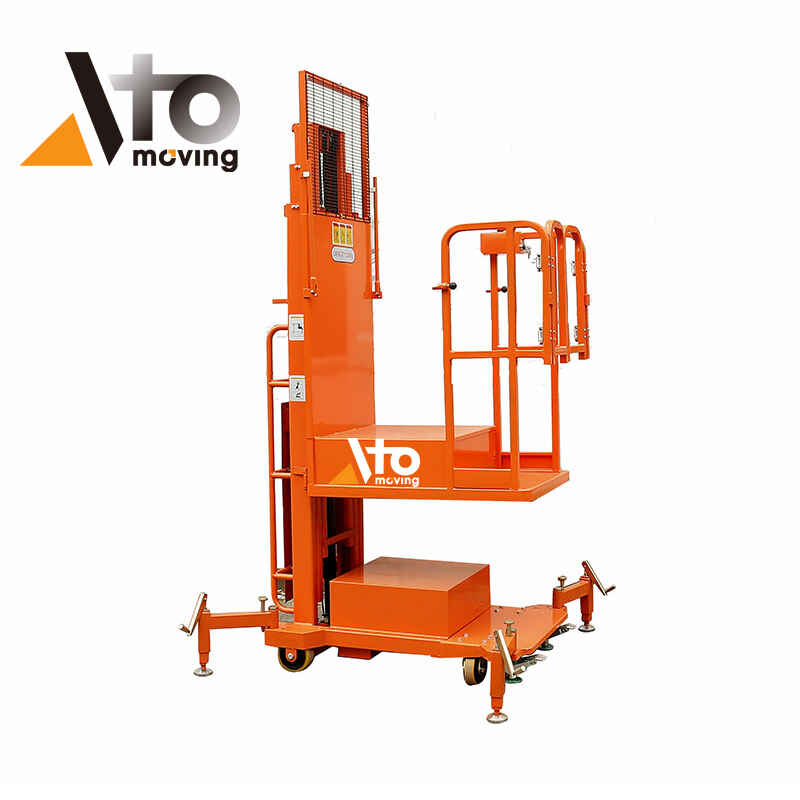
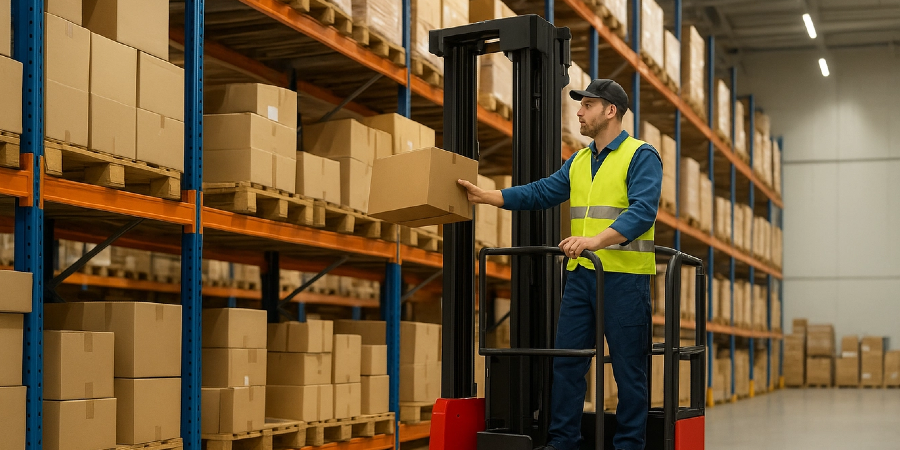
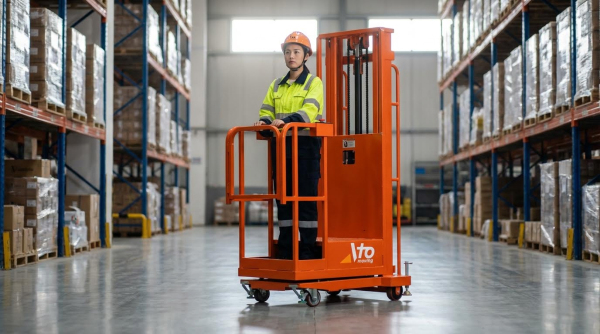
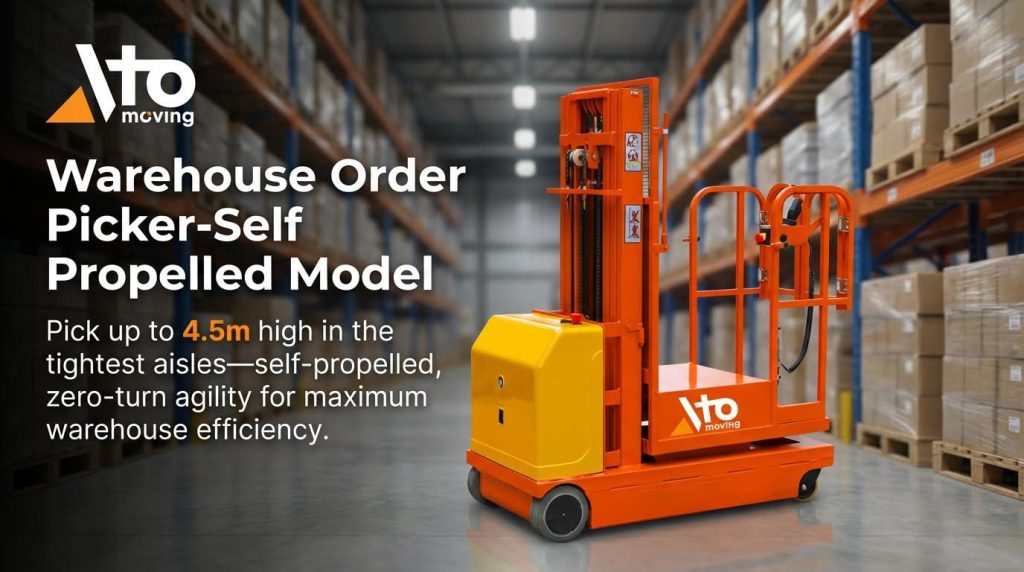
A warehouse picker truck sits between a forklift and a manual cart. It is designed to move the operator to the pick face and carry relatively light unit loads or cartons, not full pallet loads at floor level only.
- Warehouse picker truck (order picker): Rider platform lifts with or without an auxiliary load platform or forks. Optimized for piece or case picking in racking, often in narrow aisles and at multiple levels.
- Forklift (counterbalance / reach): Operator usually stays at ground level while forks lift full pallets. Counterbalance trucks need wider aisles and handle heavier loads, while reach-style trucks work in narrower aisles and higher racking with pallet loads. Reach trucks typically lift up to about 15 m with 1000–1500 kg loads.
- Picking carts / pick-pack trucks: Manually pushed or light-duty powered carts used on the floor or mezzanines. Typical examples carry around 1600–2000 lb with fixed shelves and small casters. Some models use 6×2 in polyurethane or rubber wheels and weigh roughly 217–285 lb.
Where a warehouse picker truck makes most sense
You typically choose a warehouse picker truck when you need: medium load capacity, vertical access to multiple rack levels, high pick density in narrow aisles, and more flexibility than fixed pick modules or manual carts can provide.
Typical Configurations: Low, Medium, And High-Level
Warehouse picker truck designs group broadly into low, medium, and high-level configurations. Each range balances lift height, capacity, and aisle width requirements.
| Configuration | Typical Operator Lift Height | Typical Load Capacity Range | Typical Aisle Environment | Best Use Cases |
|---|---|---|---|---|
| Low-level picker truck | Floor to ~2 m platform height | Approx. 900–1500 kg, depending on design (typical order picker range 900–3629 kg) | Wide or standard aisles; ground and first beam level | Grocery, fast-moving consumer goods, heavy case picking at low levels |
| Medium-level picker truck | About 3–7 m | Commonly ~1000–1500 kg for medium/high-level machines (typical spec range) | Narrow aisles with racking to mid-heights | Piece or case picking up to mid-rack, e‑commerce fulfillment, spare parts |
| High-level picker truck | Up to roughly 10–12.5 m platform height (some models list max lift ~12.5 m) | Often 1000–1500 kg due to stability and mast limits | Narrow to very narrow aisles with tall racking | High-bay warehouses, dense storage, man-up picking at many levels |
Within each band, manufacturers offer narrow, wide, and high-level variants to match aisle width and storage height. Narrow versions favor storage density, while wider chassis improve stability and operator comfort.
- Narrow-chassis picker trucks fit into tighter aisles to increase pallet positions per square meter.
- Wide or heavy-duty picker trucks support higher capacities or larger platforms but need more aisle width.
- Automation-ready picker trucks can later integrate sensors or guidance to operate as semi-automated or fully automated units. Some medium/high-level models were designed to be equipped as AGVs.
Choosing the right configuration for your warehouse
Match low, medium, or high-level picker trucks to your highest pick face, not just your top pallet. For a typical warehouse picker truck fleet, a mix of low-level units for volume SKUs and a smaller number of medium/high-level units for slower movers often minimizes total travel and equipment cost.
Key Performance Metrics And Safety Standards
Specifying a warehouse picker truck correctly means quantifying performance and embedding safety. Most key metrics relate to capacity, height, speed, and aisle geometry.
- Load capacity and center of gravity
- Rated load (kg or lb) at a given load center and lift height.
- Order pickers typically span about 900–3629 kg capacity, depending on configuration. Typical catalog data shows models from ~1000 kg up to ~3629 kg.
- De‑rating at higher lift heights is critical to avoid tip-over.
- Lift height and vertical access
- Maximum fork or platform height sets the highest pick face you can access.
- Medium/high-level picker trucks often provide lift heights from about 1 m to 12.5 m. Some models list ranges from ~1000 mm to ~12,500 mm.
- Required free lift and mast collapsed height must match your building clearances.
- Travel speed and cycle time
- Horizontal speed at ground and elevated heights.
- Advanced trucks vary speed automatically with lift height and route to cut cycle times. Some narrow-aisle machines adjust driving speed based on lift height and aisle position.
- Energy efficiency and duty cycle
- Battery type, capacity, and expected shifts between charges.
- Closed-loop hydraulic or regenerative systems can reduce lift energy use significantly. Some systems claimed up to about 35% lower energy consumption by reusing energy from lowering.
Safety metrics for a warehouse picker truck tie directly to standards, stability, and operator protection. Modern narrow-aisle and order-picking equipment increasingly relies on sensors and zoning.
- Stability and aisle protection
- Truck geometry must match aisle width, rack clearances, and floor flatness.
- Personal protection scanners create warning and stop zones in front and rear of the truck. Examples include PPS scanners tuned for narrow aisles.
- RFID or tag-based zoning can slow trucks near aisle ends or building constraints.
- Operator safety and ergonomics
- Guard rails, harness points, and anti-slip platforms at height.
- Good visibility and, for very high picking, optional cameras or guidance aids.
- Clear, one-way aisle patterns and labeled locations to reduce cross-traffic and confusion. One-way aisles and labeled locations were highlighted as layout best practices.
- Control, navigation, and integration
- Speed limiting by zone, lift height, or aisle.
- Navigation systems that guide the truck to specific pallet or pick locations.
- Automation-ready interfaces so the same platform can evolve into an AGV over time. Several medium/high-level order pickers can be equipped with intelligent automation components.
How to compare picker truck options using metrics
Build a simple scorecard: list each warehouse picker truck model, then rate it on capacity at your required height, minimum aisle width, lift and travel speed, energy use per shift, and safety/automation features. This data-first approach lets you match trucks to your layout, pick profile, and future automation plans with minimal guesswork.
Technical Design: Configurations, Loads, And Powertrain
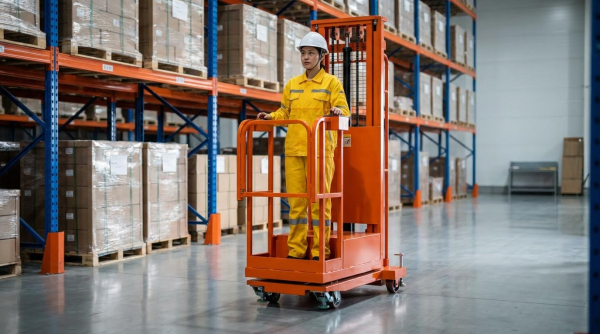
A warehouse order picker is a tightly integrated system of platform, mast, forks, and powertrain. The way these elements are configured sets your safe lift height, working aisle width, and energy use per pick. This section breaks the design down into three parts so you can match truck geometry, load rating, and power options to your storage strategy and duty cycle.
Platform, Mast, And Fork Arrangement
The working envelope of a warehouse picker truck is defined by how the operator platform, mast, and forks move relative to each other. Small geometry choices here decide whether you can work in wide, narrow, or very narrow aisles and how stable the operator feels at height.
- Platform position
- Low-level: operator rides low, picks from floor and first levels, forks may lift pallet only.
- Medium/high-level: man-up design, platform and controls rise with the forks for case picking at height.
- Mast motion
- Vertical lift only for simple, straight aisles.
- Tilt and side-shift options improve pallet engagement and reduce re-positioning, similar to reach/forklift masts. Counterbalanced masts typically tilt and side-shift for fine positioning
- Fork reach and articulation
- Fixed forks: truck must align fully with pallet.
- Reach-type forks: extend into the rack so truck body can stay clear of racking, enabling narrower aisles. Reach systems allow forks to move relative to the chassis
- Operator protection
- Guard rails around platform with mid-rails and toe boards.
- Non-slip deck, clear step-in points, and easy three-point contact.
Design implications for aisle types
Picker trucks that behave more like counterbalanced forklifts need wider aisles, because the whole vehicle must swing to face the pallet. Reach-style picker trucks keep the chassis more central while the forks extend, which supports narrow and very narrow aisles. Counterbalanced layouts typically require around 2.7–3.5 m aisle width, whereas reach-type machines can work in the 1.6–2.0 m band when configured correctly. Typical aisle width ranges differ by truck geometry
Load Ratings, Lift Heights, And Stability Limits
Load and height decisions are the core of any warehouse picker truck specification. You must balance capacity, lift height, and aisle width against stability and energy use.
| Design Aspect | Typical Range / Example | Engineering Impact |
|---|---|---|
| Rated load capacity (general order pickers) | ≈ 900–3629 kg depending on model and duty class Typical capacity spread for order pickers | Sets pallet weight limit at lowest lift height; derates at higher elevations. |
| Medium/high-level picker capacity | ≈ 1000–1500 kg for elevated picking applications Typical medium/high-level picker ratings | Capacity is optimized for man-up case picking rather than heavy pallet stacking. |
| Lift height (medium/high-level pickers) | ≈ 1000–12500 mm platform/fork lift range Typical lift height envelope | Determines max rack beam level accessible for case picking. |
| Low-level picker height | Up to first or second beam; typically ≤ 3000 mm | Suited to floor/low-rack picking with higher travel speeds. |
| Stability factors | Load center, mast deflection, wheelbase, and chassis width | Define safe working load curve and tip resistance at height. |
As lift height increases, the safe capacity of a warehouse picker truck reduces. The center of gravity rises and mast deflection grows, so the stability triangle margin shrinks.
- Key parameters to capture in a spec
- Maximum rated capacity at ground level and at your highest planned pick level.
- Rated load center (commonly 500–600 mm for pallets).
- Maximum lift height with and without operator on the platform.
- Permissible side reach or side-shift at full height.
Comparing picker trucks to reach and counterbalanced trucks
Counterbalanced forklifts often lift 3–8 m and can reach up to around 10 tons, but they require wider aisles and focus on pallet moves, not case picking. Reach trucks can work at 15 m or more with capacities in the 1000–1500 kg band, trading raw capacity for storage density and narrow aisles. Typical capacity and height ranges for reach vs. counterbalanced trucks A warehouse picker truck usually sits closer to the reach-truck profile on height, but with operator accommodation and controls designed for frequent stops and picks rather than full-pallet throughput.
Power Options, Batteries, And Automation Readiness
The powertrain of a warehouse picker truck dictates runtime, acceleration, lift speed, and how easily you can automate or semi-automate the fleet. Most modern picker trucks use electric power for clean indoor operation and precise control.
- Electric power choices
- Lead–acid batteries: proven, lower upfront cost, require charging rooms and battery changes.
- Lithium-ion: higher efficiency, fast opportunity charging, less maintenance, better for multi-shift use.
- Energy efficiency features
- Regenerative lowering: recovers energy when mast or platform descends.
- Advanced hydraulic systems: some reach-style trucks cut lift energy by up to about one-third by reusing stored gas energy in a closed-loop circuit. Example of energy-saving lift system with up to 35% reduction in lift energy
- Drive and control
- AC traction motors for smooth low-speed control in tight aisles.
- Speed reduction automatically applied at high lift heights for stability. Height-dependent speed control improves safety and productivity
| Power / Automation Feature | Function | Benefit in Order Picking |
|---|---|---|
| Basic electric drive with manual control | Operator drives, steers, and lifts manually. | Lowest complexity, suitable for smaller sites and mixed tasks. |
| Navigation and route optimization | Truck uses programmed pallet or slot locations to pick fastest path. Location-based routing and speed control | Reduces travel time and improves pick cycles per hour. |
| Personal Protection Systems (PPS) | Front/rear scanners define warning and stop zones. PPS scanners for narrow aisle safety | Enables safe higher speeds in very narrow aisles and protects pedestrians. |
| Zoning via RFID or tags | Truck reacts to local constraints like roof beams or aisle ends. Zoning adjusts behavior by location | Prevents mast collisions and enforces speed limits by zone. |
| AGV conversion / automation kits | Truck follows programmed paths or WMS tasks with minimal human input. Some order pickers can be equipped as AGVs | Supports lights-out or hybrid man–machine picking strategies. |
What to check for automation-ready picker trucks
When you specify a new warehouse picker truck and want future automation, verify that the control architecture can interface with your WMS, that there is space and provision for sensors and scanners, and that the drive and steering systems support precise, repeatable path tracking. Many modern order pickers already included options for intelligent navigation, zoning, and safety scanners, which are the building blocks for full AGV operation. Medium/high-level order pickers can often be upgraded with automation components
Aisle Design, Layout, And Truck Selection
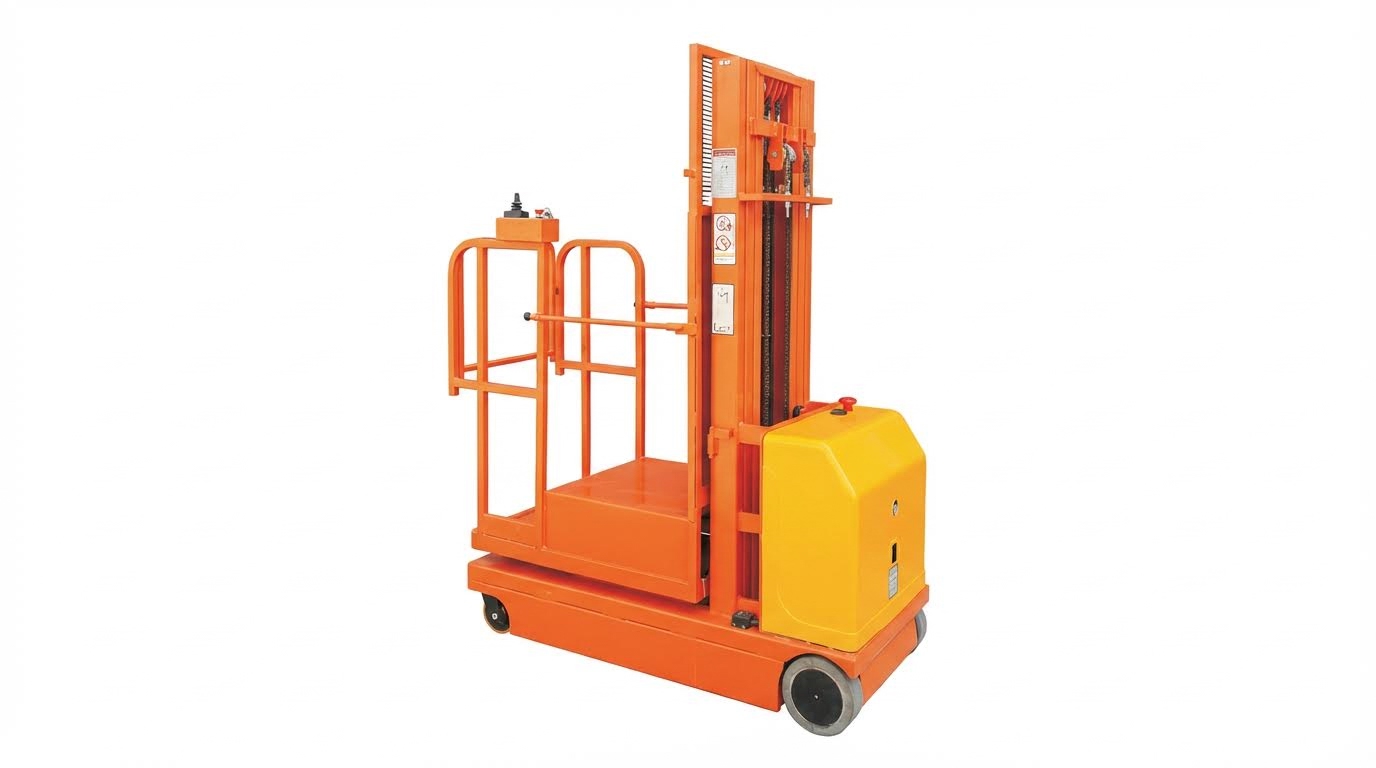
Aisle geometry dictates what type of warehouse order picker you can safely operate, and vice versa. The goal is to balance storage density, travel distance, and clearance so trucks turn, lift, and pass without damage or delays. Use the sections below to link aisle width, slotting, and digital systems into one coherent picking design.
Aisle Width, Turning Radius, And Truck Geometry
Aisle width must match the truck’s overall length, steering geometry, and required clearance for pallet handling. Oversizing aisles wastes storage space; undersizing them causes congestion, damage, and safety risks. Use aisle categories as a first filter, then refine based on the exact picker truck envelope.
| Aisle type | Typical clear width | Typical equipment | Storage density | Notes for warehouse picker truck selection |
|---|---|---|---|---|
| Wide aisle | ≈ 3.7 m–≥ 3.9 m (≈ ≥ 12 ft) wide aisles ≥ 12 ft | Counterbalanced trucks, manual carts | Low | Simple to operate; suitable if you use a counterbalanced truck and low-level picking. |
| Narrow aisle | ≈ 1.8–3.0 m (≈ 6–10 ft) narrow aisles 6–10 ft | Order pickers, reach trucks, turret trucks | Medium–High | Typical zone for a order picking machines with man-up platform and guided steering. |
| Very narrow aisle (VNA) | ≤ 1.5 m–≈ 1.6–2.0 m for reach/VNA trucks reach trucks in 1.6–2.0 m aisles very narrow aisles ≤ 5 ft | VNA order pickers, AGVs, AS/RS interfaces | Very High | Requires rail or wire guidance, high operator skill, and precise warehouse picker truck geometry. |
For any given warehouse picker truck, the minimum working aisle is usually: truck length + load length + safety clearance + turning allowance. Counterbalanced trucks typically need about 2.7–3.5 m aisles, while reach-style machines can work in 1.6–2.0 m aisles. Counterbalanced vs reach truck aisle widths
- Define pallet size and overhang (e.g., 1200 × 1000 mm) to know the load envelope.
- Add clearance for mast deflection and pallet entry/exit (typically 100–150 mm each side as a design starting point).
- Check maximum lift height; higher masts need more stability margin and often slower travel at height. Lift height and stability
- Match aisle width category (wide / narrow / VNA) to your target storage density and order volume. Aisle width optimization
When to use angled or one-way aisles
Straight aisles are common but can create bottlenecks in high-traffic pick zones. Angled aisles improve access and reduce congestion where many warehouse picker trucks converge. One-way aisles and enforced clockwise or counter-clockwise paths further cut cross-traffic delays and near-miss incidents. Straight vs angled aisles One-way aisle best practices
Slotting, Pick Zones, And Vertical Storage Use
Slotting decides where each SKU lives horizontally and vertically, which directly sets travel time for the warehouse picker truck. Good slotting keeps the highest-frequency picks in the shortest, safest reach zone. Poor slotting forces long travel, high lifts, and more replenishment moves.
- ABC analysis: Classify SKUs by demand. Place A-items closest to pick/pack, B-items mid-distance, C-items in remote or higher positions. ABC bin placement
- Golden zone: Reserve between knee and shoulder height for roughly the top 20% of picks. Next 30% goes in nearby mid-zones within two aisles of packing. Golden zone definition
- Review cadence: Re-slot A-items monthly and B/C-items quarterly, especially after promotions or seasonal shifts. Slotting process
Choose slotting method based on SKU volatility and your warehouse picker truck pattern.
| Slotting method | Best for | Impact on picker truck design |
|---|---|---|
| Fixed slotting | Stable SKU mix, predictable demand | Maps well to static pick routes and simple WMS; good where picker trucks follow repeatable loops. |
| Dynamic slotting | Fast-changing e-commerce, promotions | Requires flexible WMS and labeling; picker trucks may see frequent route changes but shorter average travel. Dynamic slotting |
| Zone-based slotting | Mixed-temperature or mixed-size operations | Supports zone picking; each warehouse picker truck can be dedicated to a temperature or product family zone. |
Vertical storage strategy must match truck lift height and stability envelope. Reach-style order pickers can work up to about 10–12.5 m in many designs, while some reach trucks reach 15 m or more. Medium/high-level picker lift heights Reach truck lift heights
- Store fast movers at waist-to-shoulder height to minimize platform lifting cycles. Vertical storage optimization
- Reserve highest beam levels for slow movers and full pallets serviced during off-peak times.
- Use mezzanines, AS/RS, or dense rack where your warehouse picker truck only interfaces at specific transfer levels.
- Check that lift height, load center, and aisle width stay within the truck’s rated stability limits at the top beam.
Designing pick zones around truck behavior
Separate high-velocity “each-pick” zones with flow rack near packing from bulk pallet reserve serviced by other equipment. Keep one or two main pick modules where warehouse picker trucks do most of their cycles, and push low-velocity or bulky items to satellite zones. Use one-way loops through these zones so every pick run is a continuous flow path.
Integrating WMS, AGVs, And Picking Strategies
Digital systems and picking methods determine how many trips a warehouse picker truck makes and how predictable its path is. The WMS should know both the aisle layout and truck capabilities so it can assign efficient routes and safe speeds.
- WMS core functions: bin location tracking, pick-route optimization, dynamic slotting suggestions, and real-time stock updates to cut empty travel and stockouts. WMS capabilities
- Labeling and coordinates: every rack position should carry a barcode/RFID tied to WMS coordinates for accurate guidance. Location labeling best practice
- Data feedback: use pick-time and travel-time data to refine aisle widths, pick zones, and the mix of manual vs automated trucks.
AGVs and automated reach or order-picking trucks fit best in narrow or very narrow aisles with consistent pallet and rack geometry. Some order pickers and reach trucks could be equipped with automation components, turning them into AGVs to support fully automated operations. Order pickers with AGV capability
| Picking strategy | Warehouse profile | Implications for warehouse picker truck and layout |
|---|---|---|
| Single-order picking | Low order volume, high order variability | Simple routing; wide aisles are acceptable. One truck can cover multiple zones but with more travel per order. Single-order picking |
| Batch (multi-order) picking | High order volume, many common SKUs | Favors narrow aisles and dense slotting of A-items. Warehouse picker trucks carry multiple totes to reduce aisle passes. |
| Wave picking | Shipping driven by carrier cut-offs | Aisle congestion peaks by wave; consider one-way aisles and traffic rules to prevent truck conflicts. Wave picking |
| Zone picking | Large sites with specialized areas | Each zone can be optimized for a specific warehouse picker truck type or AGV, with handoff at consolidation points. |
- Use AGVs or robotic systems in the most repetitive, high-density aisles to free manual picker trucks for complex tasks.
- Combine voice or RF-directed picking with WMS routing to minimize search time at each location. Voice and automation tools
- Separate inbound and outbound docks so picker truck traffic does not mix with put-away and shipping staging. Dock separation
Safety and speed controls for automated/narrow-aisle trucks
Modern narrow-aisle trucks use safety scanners to create warning and stop zones in front and rear, plus aisle indication tags to adjust speed at aisle ends. They can also vary driving speed with lift height, running faster at low levels and slower when elevated, which is critical in very narrow aisles with tall racking. Narrow-aisle safety and navigation
Final Considerations For Specifying Picker Trucks
Engineering a safe, efficient picker-truck fleet means treating trucks, racking, aisles, and software as one system. Load rating, lift height, and truck geometry must always come first. If you push capacity or height beyond the data plate, you shrink stability margins and raise real tip-over risk. Match every truck to a defined aisle class, pallet size, and rack envelope, then lock those rules into your layout and WMS.
Use low-level units for heavy, fast movers near the floor, and medium or high-level trucks only where vertical storage truly pays back. Keep golden-zone picks between knee and shoulder height to cut lift cycles and strain. Choose batteries and energy features to support your shift pattern with margin, not at the limit.
Build safety into the design, not as an add-on. Specify guard rails, harness points, scanners, zoning, and speed-by-height controls from day one. Then train operators to respect aisle directions, clearances, and rated loads. As your operation grows, favor automation-ready machines like Atomoving picker trucks so you can add guidance, AGV functions, and tighter speed control later without replacing the fleet.
The best practice is simple: design from the load and aisle back to the truck, verify every limit in data, and leave generous safety margins.
Frequently Asked Questions
What is a warehouse picker truck?
A warehouse picker truck, also known as an order picker, is a type of material handling equipment used to retrieve items from warehouse shelves. It allows operators to elevate themselves to higher storage levels safely and efficiently. These trucks are essential for fulfilling customer orders in environments like dry, refrigerated, and freezer warehouses. Warehouse Picker Overview.
Is operating a warehouse picker truck physically demanding?
Operating a warehouse picker truck can be physically demanding. Operators often walk 6 to 10 miles per day on hard concrete floors and may need to lift heavy loads. Tasks include moving around the warehouse, lifting items, and making high-reach moves. This constant physical strain can be exhausting. Challenges in Warehouse Work.
What are the duties of a warehouse picker truck operator?
The duties of a warehouse picker truck operator include safely and efficiently operating the equipment to retrieve items. They must navigate the warehouse, pick correct items, and ensure accuracy in fulfilling orders. Operators also need to perform regular safety checks on the equipment. Order Picker Duties.