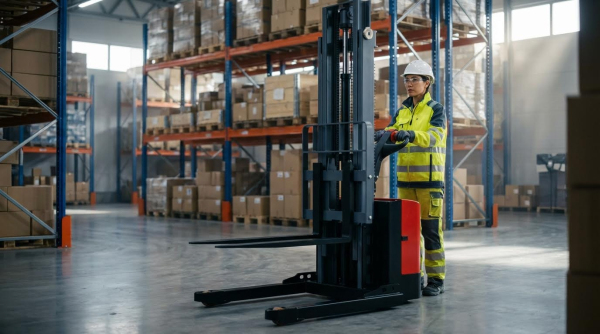
Walkie stackers bridge the gap between pallet jacks and forklifts, but their safe working height depends on mast design, load, and floor conditions. If you are asking how high can a walkie stacker lift, the answer is usually between about 3 m and just over 5 m, with capacity reducing as height increases. This guide explains typical lift ranges, duplex vs. triplex masts, and the stability limits you must respect when matching equipment to your racking and building. Use it to balance lift height, safety margins, and total cost of ownership for your application.
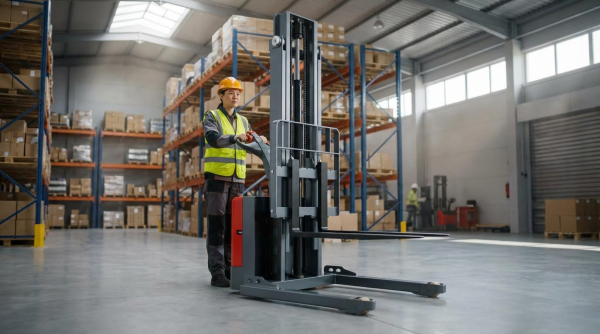
Defining Walkie Stacker Lift Heights and Limits
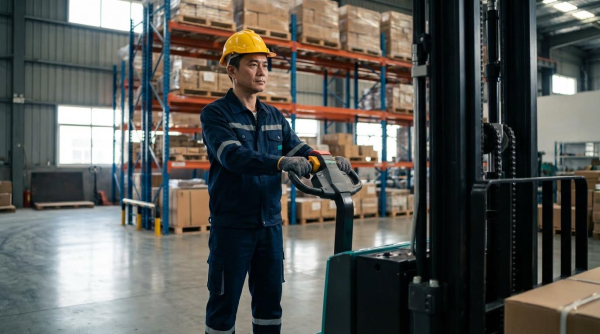
Typical lift height ranges by stacker type
When people ask how high can a counterbalanced stacker lift, the real answer depends on the stacker configuration and mast design. Different walkie stacker families cover very different lift bands, from low-level backroom work to mid-bay racking. The table below summarizes realistic ranges based on typical catalog data and engineering practice.
| Stacker type | Typical max lift height (mm) | Typical max lift height (in) | Typical capacity band | Typical application |
|---|---|---|---|---|
| Compact / light-duty walkie stacker | ≤ 3,000 | ≤ 118 | ≈ 1,000–1,500 kg | Retail back-rooms, low racking ≤ 3 m (light retail back-room guidance) |
| Walkie straddle stacker | ≈ 4,500–4,900 | ≈ 177–193 | ≈ 1,000–1,800 kg | Mixed pallet sizes, racking up to ~4.5 m (example 138–220 in ranges) (capacity band) |
| Pedestrian reach / pantograph stacker | ≈ 5,000–6,000 | ≈ 197–236 | ≈ 1,000–1,450 kg | High-bay up to ~6 m, narrow aisles down to ~2 m pallet-to-pallet (reach / pantograph and aisle width) |
| General walkie stacker (various configs) | ≈ 4,800–5,400 | ≈ 189–212 | ≈ 1,000–1,800 kg | Standard warehouse racking, bulk storage up to ~5.4 m (up to 5,400 mm) (≈192 in examples) |
| Two‑stage (duplex) mast walkie stacker | ≈ 3,600 | ≈ 143 | ≈ 1,000–1,800 kg | Medium-height racking where free lift is not critical (up to 143 in) |
Across the market, published maximums answer how high can a battery-powered stacker lift in simple terms: many units reach roughly 4.8–5.4 m, with some straddle and reach configurations working comfortably in the 4.5–6 m band. Above that, you typically move into specialized reach or ride-on equipment rather than pure pedestrian walkies.
Key points to remember about lift ranges
- Low-level walkies usually stay at or below 3 m.
- Common warehouse walkie stackers cluster around 4.5–5.4 m.
- Pedestrian reach stackers extend practical use up to about 6 m.
- Triplex masts and reach mechanisms are used as heights approach 6 m and above (duplex ≤ 6 m vs triplex > 10 m general guidance).
How capacity derates at higher lift heights
Rated capacity on the data plate is not a flat number. It always ties to a specific load center and lift height. As mast height and load center increase, the overturning moment grows, so the walkie stacker must derate capacity to stay within its stability triangle.
Manufacturers publish detailed capacity charts, but the engineering trends are consistent. Typical walkie and pedestrian stackers cover the 1,000–4,000 kg band, with many reach-style pedestrian units around 1,000–1,450 kg and straddle stackers up to about 1,800 kg. (capacity ranges)
- At low lift (near floor level): you can usually use 100% of the nameplate capacity at the rated load center.
- At mid lift (roughly half mast height): allowable capacity often drops by 10–25%, depending on wheelbase and mast type.
- Near maximum lift height: effective capacity can be 50–70% of the base rating, especially with extended load centers or attachments.
For a simple mental model, think in terms of overturning moment: Capacity × Load center distance must stay below a safe fraction of the restoring moment created by truck weight and wheelbase. As you ask how high can a electric platform stacker lift a given pallet, the real question becomes whether the moment at that height still fits inside the stability envelope.
| Parameter | Effect when increased | Impact on usable capacity at height |
|---|---|---|
| Lift height (mast extension) | Raises load CG, increases mast deflection | Capacity must decrease to keep overturning moment within limits. |
| Load center (pallet length, overhang) | Moves load CG further from mast | Capacity must decrease even at moderate heights. |
| Mast type (duplex vs triplex / reach) | More stages and reach mechanisms add flexibility but more deflection | High lifts with triplex or reach masts often have steeper derate curves. |
| Truck weight and wheelbase | Higher truck mass and longer wheelbase increase restoring moment | Better capacity retention at height, but with maneuverability trade-offs. |
Practical rules for specifying capacity vs. height
- Never size a walkie stacker only from the headline kg rating; always check the capacity chart for your required height.
- For racking above ~4.5–5 m, assume noticeable derate and add safety margin when choosing capacity.
- Account for non-standard pallets, overhang, slip-sheets, or attachments that move the load center out.
- In narrow aisles or poor floors, treat theoretical chart values cautiously because deflection and floor settlement further reduce practical stability.
In engineering terms, how high can a semi electric order picker lift is only half of the design question. The other half is how much weight it can lift safely at that height, on your floor, with your pallets. Always confirm both height and derated capacity against the manufacturer’s data and your site conditions before final selection.
“”
Matching Lift Height to Application and Technology
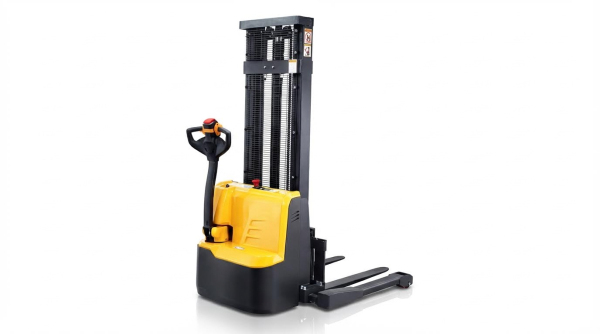
Selecting lift height for racking and building clearances
Before asking how high can a counterbalanced stacker lift, you need to define how high it actually needs to lift in your building. The goal is to reach the top pallet position safely while keeping enough clearance for sprinklers, lighting, and roof steel. Use the steps below as a quick engineering checklist.
- Measure your building and rack geometry
- Measure floor to underside of roof / lowest obstruction (sprinkler, duct, beam).
- Measure floor to top of highest pallet position (top of load, not just beam).
- Confirm pallet/load height and overhang on the rack.
- Define required fork height, not just mast height
- Forks must clear the top beam and then lower into the pallet opening.
- Add safety clearance above the top of the load (typically 100–200 mm).
- Check manufacturer’s “fork height” vs “overall mast height” in the spec sheet. Some walkie stackers reach up to about 4.9–5.4 m fork height depending on design with maximum lift heights quoted around 4.9–5.4 m.
- Check typical lift ranges by application type
- Back-room / light retail: up to ~3 m suited to basic walkie stackers.
- Standard warehouse racking: up to ~4.5–4.9 m for walkie straddle or reach stackers with some models around 4.8–4.9 m.
- High-bay zones: up to ~6 m with pedestrian reach stackers using reach or high-mast designs.
- Confirm overall lowered mast height vs doorways and mezzanines
- Compare lowered mast height with dock doors, tunnels, and mezzanine beams.
- Triplex masts often give higher fork lift with lower collapsed height than duplex masts because of the extra telescopic section.
- Account for floor tolerances and deflection
- Assume some mast deflection and floor unevenness at top lift.
- Avoid specifying lift height so tight that any sag hits sprinklers or roof steel.
Example lift-height selection for a typical warehouse bay
Assume: floor to underside of sprinkler = 6,000 mm; top of highest pallet = 4,800 mm. You might specify a stacker with ~5,000–5,200 mm fork height to give working clearance above the load, while keeping the mast’s maximum extended height at least 300–400 mm below the sprinklers. Many walkie and straddle stackers in this range quote maximum lift heights from about 4,800 mm to just over 5,400 mm depending on configuration.
Different walkie stacker families cover different lift envelopes, so matching equipment type to your rack layout is critical.
| Stacker type | Typical max lift height | Typical aisle width | Best-fit applications |
|---|---|---|---|
| Basic walkie stacker | ≤ 3 m (light-duty ranges) | ≥ 1.9 m | Back-rooms, low racking, small warehouses |
| Walkie straddle stacker | ≈ 4.5 m; some up to ~4.9 m (around 4.8–4.9 m) | ≥ 2.1 m (typical guidance) | Mixed pallets, standard warehouse racking |
| Pedestrian reach stacker | ≤ 6 m (high-bay range) | ≥ 2.3 m | High-bay racking, deeper storage |
| Platform / ride-on stacker | ≤ 5 m (typical) | ≥ 2.4 m | Long travel distances, frequent shuttling |
When you decide how high can a battery-powered stacker lift for your project, always cross-check lift height with aisle width, pallet type, and required capacity at the top level, not just at ground level.
Choosing mast, battery, and options for TCO and safety
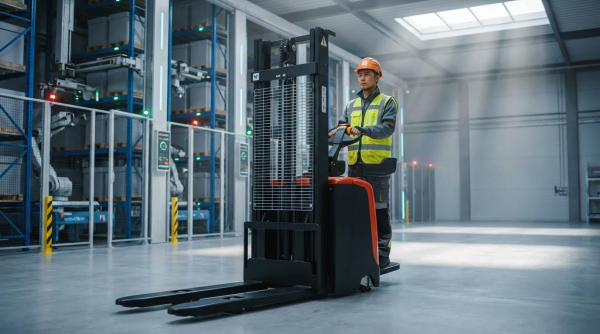
Mast type, battery technology, and safety options all change the true cost of ownership (TCO) of a walkie stacker over its life. Use the lists and table below to align engineering choices with your duty cycle and risk profile.
First, select the mast concept that fits your height and building constraints.
- Duplex mast
- Two telescopic sections, simpler and inherently more stable at a given height due to fewer moving parts.
- Economic choice for lift heights up to about 6 m in many applications.
- Typically 15–25% lower purchase price than triplex masts and lower maintenance.
- Triplex mast
- Three sections for higher lift with lower collapsed height.
- Needed where racking exceeds ~6 m or where door heights are tight.
- More components and lubrication points, so higher maintenance costs than duplex masts.
- Pantograph / reach mechanisms
- Allow handling in very narrow aisles, sometimes down to about 2 m pallet to pallet thanks to reach-out forks.
- Increase complexity and moving mass, so check capacity at height carefully.
Next, choose a battery system that matches your shift pattern and charging infrastructure.
| Battery type | Charge time (typical) | Cycle life (typical) | Maintenance | Best for |
|---|---|---|---|---|
| Lead-acid | ≈ 6–8 h from empty in standard chargers | ≈ 1,200–1,500 cycles | Needs watering and periodic equalization to maintain life | Single-shift, low-to-medium hours, lowest upfront cost |
| Lithium-ion | ≈ 1–4 h full charge; 10 min top-up ≈ 1 h runtime with opportunity charging | ≈ 2,000–3,000 cycles | No routine watering or equalization required reducing labor | Multi-shift, high-throughput, energy-sensitive operations |
Modern walkie stackers often run on 24 V electrical systems in typical warehouse models, so both lead-acid and lithium-ion options are widely available.
Finally, specify safety and control options that protect operators and product while keeping productivity high.
- Core safety and ergonomics
- Automatic braking and load limit indication to prevent overloads and roll-away in modern electric stackers.
- Ergonomic tiller heads and multi-position handles to keep the operator in a safe stance even when maneuvering in tight aisles.
- Low noise and zero local emissions for indoor environments improving comfort and air quality.
- Control and accuracy features
- Variable travel speed and fine lift controls for precise pallet placement in narrow aisles or tight racking.
- Smooth acceleration and deceleration to reduce product damage and mast sway.
- Programmable performance profiles to cap speed in congested zones.
- Productivity and TCO levers
- Travel speeds around 3.5 mph under load in many walkie stackers support efficient cycle times.
- Electric drive and lift reduce manual effort and handling time compared with manual stackers.
- Simple electric powertrains have fewer moving parts than engine machines, cutting maintenance cost over the life of the truck.
Quick TCO decision guide
<p “”Final Considerations When Specifying Walkie Stackers
Walkie stacker lift height is never a single number. It is the result of mast design, capacity derate, and real site limits. As height increases, overturning moment, mast deflection, and floor effects all grow, so safe capacity always falls. Engineers and operations teams must treat the data plate as a starting point, not the answer.
The best approach is to work from the rack and building back to the truck. Define top pallet height, aisle width, and clearances to sprinklers and steel. Then select mast type, wheelbase, and battery that can deliver the needed fork height and duty cycle with margin. Duplex masts, conservative load centers, and realistic derate assumptions usually give the most robust solution.
Operations leaders should lock in three rules. First, size every walkie stacker from the capacity chart at maximum required height. Second, verify stability on actual floors before full deployment. Third, invest in safety options and operator training so real practice matches the engineering model.
When in doubt, consult Atomoving application support. A short engineering review up front prevents tip‑over risk, product damage, and premature equipment change‑outs later in the life of the truck.
Frequently Asked Questions
How high can a walkie stacker lift?
A walkie stacker can typically lift loads to heights of up to 6100 mm (approximately 6 meters). This makes it ideal for applications where loads need to be stored at elevated levels. Crown Walkie Stackers. Some models, like the United T-Series Walkie Reach Stacker, can handle stacking up to 5.5 meters high with a lift capacity of 1500 kg. United T-Series Stacker.
What is the lifting capacity of a walkie stacker?
The lifting capacity of a walkie stacker generally ranges from 1500 kg to 2500 kg, depending on the model and manufacturer. For instance, Toyota’s Walkie Pallet Stacker has a lifting capacity ranging from 2,000-2,500 lbs (approximately 907-1134 kg) and a lift height of up to 143 inches (approximately 3.6 meters). Toyota Walkie Stacker.