Electric scissor lifts and other MEWPs sit in a grey area where fire extinguisher rules depend on both equipment design and jobsite risk. This guide explains when an extinguisher is mandatory, what type to use, and how to mount and maintain it safely. If you are asking “does electric scissor lifts require fire extinguishers,” you will find clear, code‑aligned answers here for indoor, outdoor, and high‑risk operations.
Code Basics For Fire Protection On MEWPs
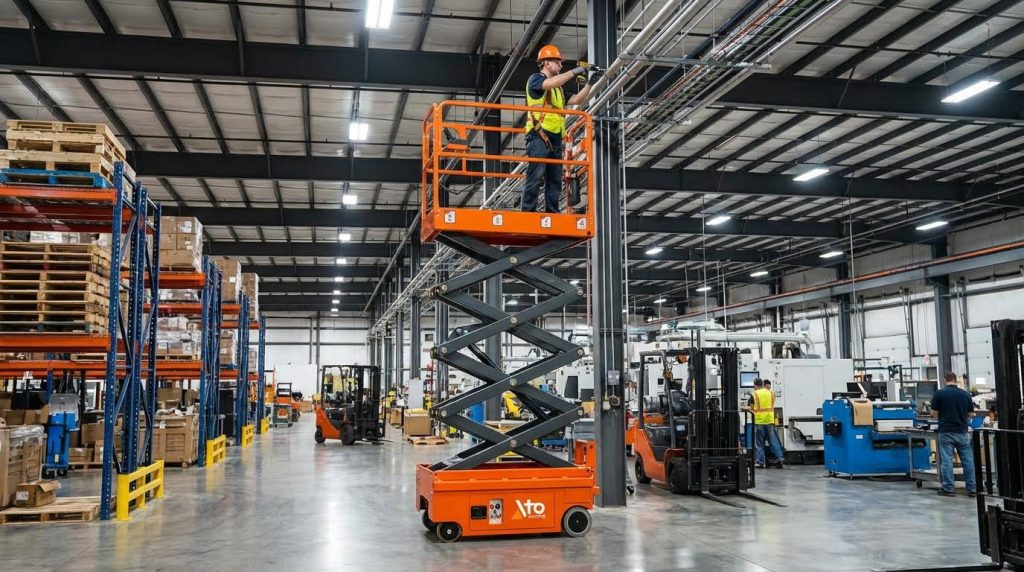
Fire protection on MEWPs is governed by a mix of OSHA, ANSI, NFPA and EN rules that indirectly answer “does electric scissor lifts require fire extinguishers” through risk-based requirements, travel distances and equipment design standards.
How OSHA, ANSI, NFPA And EN Standards Interact
Fire extinguisher rules for MEWPs come from how equipment design standards (ANSI/EN) mesh with workplace fire and emergency standards (OSHA/NFPA). Understanding this interaction stops you over‑ or under‑equipping scissor platform.
At a high level, different standards do different jobs for MEWPs and electric scissor lifts:
- OSHA (e.g., 29 CFR 1910): Sets employer duties for safe workplaces, including portable extinguisher provision, travel distances and training – this is what inspectors enforce on site. OSHA extinguisher distribution and maintenance rules
- ANSI A92 series: Defines how MEWPs are designed, built and tested, including hydraulic and electrical safety – this keeps the machine itself from becoming an ignition source. OSHA 1910.67 referencing ANSI A92.2
- NFPA 10: Covers selection, installation, inspection and maintenance of portable extinguishers – this drives rating, placement and service intervals for units you mount on or near lifts. OSHA guidance aligned with NFPA 10 practices
- EN 280 / EN ISO standards (for EU/UK): Provide the equivalent of ANSI A92 in Europe, plus harmonised machinery and electrical safety rules – these influence CE-marked MEWPs and local fire code expectations.
OSHA’s portable extinguisher rules answer part of “does electric scissor lifts require fire extinguishers” by setting maximum travel distances to an extinguisher based on hazard class. For example, travel distance must not exceed about 23 m for typical Class A hazards and about 15 m for Class B hazards. OSHA travel distance limits
ANSI A92 and EN 280 focus more on preventing fires (via electrical tests and hydraulic design) than on specifying extinguishers on the platform. OSHA and NFPA then step in to say how many extinguishers, of what type, and how far away they may be from any worker, including one on a scissor platform lift.
| Standard / Code | Main Role For MEWPs | Key Fire‑Related Focus | Operational Impact For Electric Scissor Lifts |
|---|---|---|---|
| OSHA 29 CFR 1910 (US) | Employer workplace safety duties | Extinguisher provision, travel distance, inspection, training | Determines if an extinguisher must be on the lift or can stay on the wall within 15–23 m |
| OSHA 1910.67 + ANSI A92.2 | Vehicle‑mounted / elevating platforms | Hydraulic bursting safety factors, electrical tests | Ensures lift systems are less likely to start fires or fail under fire‑related stress |
| NFPA 10 | Portable extinguisher standard | Class, rating, placement, inspection, hydrostatic testing | Guides rating (e.g., ABC), mounting and maintenance of extinguishers used with MEWPs |
| EN 280 + EN machinery / electrical standards | European MEWP design and safety | Structural stability, control systems, electrical protection | Influences CE‑marked lift design; local fire codes then set extinguisher expectations |
Why “design standards” don’t tell you exactly where to bolt the extinguisher
ANSI and EN standards assume many different work environments. They focus on making the MEWP safe by design. Fire load, travel distance and evacuation routes change from site to site, so codes like OSHA and NFPA 10 leave extinguisher placement to a risk assessment tied to those site conditions.
💡 Field Engineer’s Note: When you are unsure which rule “wins” on a multi‑regulation site, design to the strictest combination: shortest travel distance, highest practical extinguisher rating and the most conservative interpretation of escape route blockage for the lift operator.
When A MEWP Must Carry Its Own Extinguisher
A MEWP must carry its own extinguisher when a realistic fire could trap the operator aloft or when OSHA travel distance limits to the nearest unit are exceeded; this is how you practically answer “does electric scissor lifts require fire extinguishers.”
OSHA’s portable extinguisher rules require extinguishers to be “readily accessible” and within specific travel distances: up to about 22.9 m for Class A and 15.2 m for Class B hazards. If a worker on an electric scissor lift cannot reach a compliant extinguisher on the ground without passing through smoke, flame or an obstructed route, you should treat an on‑board unit as required. OSHA required extinguisher distances
In practice, common triggers for putting an extinguisher on the platform (or chassis) of an electric scissor lift or other MEWP include:
- Escape route could be blocked by fire: Work above a single exit door, stair, or narrow aisle that might be cut off – the operator may be stranded aloft without a safe descent path.
- Distance to nearest fixed extinguisher is too long: Operating more than roughly 15–23 m from a wall‑mounted extinguisher, depending on the hazard class – this breaches OSHA travel distance expectations for many hazards. OSHA travel distance criteria
- High‑risk work from the platform: Hot work, work in paint/coating booths, or near battery charging areas – these tasks significantly raise ignition probability around the lift.
- Confined or complex layouts: Tunnels, shafts, congested process lines or racking where fire or smoke can rapidly isolate the lift – ground extinguishers may be technically “nearby” but not realistically reachable.
- Outdoor or remote locations: Yard work, construction sites or remote plant areas with sparse fixed extinguishers – actual walking distance back to an extinguisher often far exceeds code limits.
These conditions apply equally to electric scissor lifts and other MEWPs. The fact that the lift is electric does not remove fire risk: batteries, wiring, hydraulic oil and surrounding combustibles still create Class A, B and C hazards. The deciding factor is whether the operator can safely and quickly access an extinguisher that meets OSHA distance rules in a credible fire scenario.
Linking “does electric scissor lifts require fire extinguishers” to a simple decision flow
Ask three questions: 1) Can a fire realistically block my way down or out? 2) Is the nearest extinguisher within about 15–23 m travel distance, considering actual walking paths? 3) Am I doing hot work, working in flammable atmospheres, or over high fuel loads? If any answer is “yes” and the extinguisher is not clearly reachable from the lift, mount an extinguisher on the MEWP.
💡 Field Engineer’s Note: During site surveys, I treat “more than one turn of stairs or more than one fire door between the lift and the nearest extinguisher” as a red flag. Even if drawings say the distance is compliant, real evacuation under smoke is slower and more chaotic—put the extinguisher on the lift.
Engineering The Right Extinguisher For Electric Lifts
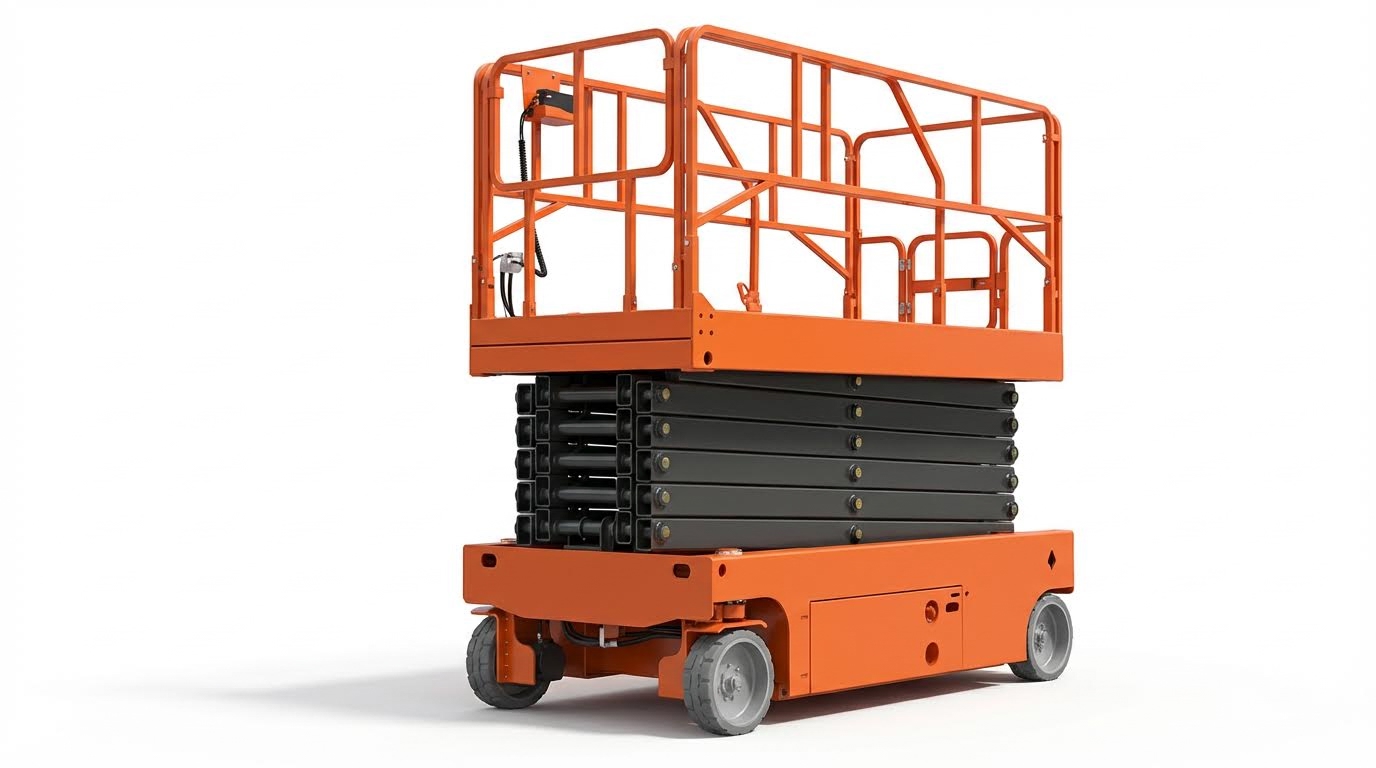
Engineering the right extinguisher for electric scissor lifts and MEWPs means matching fire class, rating, size, and mounting to the real fire risks and access limits on the platform. This is how you turn “does electric scissor lifts require fire extinguishers” into a concrete, engineered answer for each machine and job.
Fire Classes, Battery Risks And Hydraulic Fluids
Fire classes on electric scissor lifts and MEWPs come mainly from platform loads, electrical systems, and hydraulic circuits, so you must select extinguishers that safely cover Class A, B and C scenarios around the lift. Even when a code does not explicitly say an electric scissor lift must carry a fire extinguisher, the combination of battery, wiring, and hydraulic oil hazards often makes on-board coverage the most defensible engineering choice.
- Class A – Solids: Cardboard, timber, pallets, packaging on the platform or below – Drives need for basic A rating.
- Class B – Liquids: Hydraulic oil, lubricants, solvents, fuels near the work area – Requires B rating for spill or spray fires.
- Class C – Electrical: Batteries, chargers, wiring, control boxes – Demands non‑conductive agent with C rating.
- Battery packs: Electric MEWPs use large traction batteries – Localized cable or connector fires must be tackled without energizing the operator.
- Hydraulic circuits: Hoses routed under the platform carry pressurized oil – Atomized leaks can ignite from hot work or arcing.
How this links to “does electric scissor lifts require fire extinguishers”
If your risk assessment shows credible Class A/B/C fires where escape could be blocked or the nearest extinguisher is beyond typical 15–23 m travel distances, you should engineer an on-board unit, even if not named explicitly in a single regulation.
| Hazard Source On MEWP | Typical Fire Class | Likely Ignition Scenario | Extinguisher Requirement Impact |
|---|---|---|---|
| Platform load (cartons, plastics) | Class A | Hot work slag, faulty tool, arson | Drives baseline A rating on any extinguisher near the lift. |
| Hydraulic oil in hoses | Class B | Hose burst onto hot surface or arc | Supports need for A:B or B:C type agent near undercarriage and boom. |
| Traction batteries and wiring | Class C (plus battery-specific risks) | Cable insulation failure, poor terminations | Requires non-conductive agent; ABC dry chemical is common choice. |
| Nearby flammable liquids (paints, thinners) | Class B | Spill ignited by tools or static | Often tips the decision toward mandatory on-board units. |
💡 Field Engineer’s Note: When you run electric scissor lifts in cold storage (around 0°C or below), hydraulic oil thickens and leaks may atomize less, but operators wear heavy gloves and move slower. In those conditions, prioritize extinguishers with simple, glove-friendly controls and very clear labelling over exotic agents that are harder to operate under stress.
Sizing And Rating Extinguishers For MEWP Applications
Sizing and rating extinguishers for MEWPs means balancing enough Class A/B/C capacity to handle credible fires with the strict weight and space limits of a crowded platform. This is where you move from the general question “does electric scissor lifts require fire extinguishers” to a specific answer like “this 8–10 kg ABC unit, mounted at the guardrail, protects this lift in this building.”
- Start from the environment: Look at fuels within about 15–23 m at platform height – Ensures the extinguisher matches real fire load, not just the machine.
- Respect platform capacity: Typical small electric scissors have platform ratings around a few hundred kg – Every 8–10 kg extinguisher reduces payload for people and tools.
- Balance reach and control: Larger units discharge longer but are harder to aim from a cramped basket – Mid-size is usually the sweet spot.
- Cover electrical first: Always insist on Class C capability for electric MEWPs – Prevents current flow through the agent.
- Consider outdoor corrosion: For outdoor fleets, choose corrosion-resistant cylinders and brackets – Reduces failures and surprise rejections at inspection.
| Typical Extinguisher Size | Approx. Mass (kg) | Common Use Around MEWPs | Operational Impact On Lift |
|---|---|---|---|
| Small portable unit | ~2–3 kg | Supplementary coverage, tight platforms | Minimal payload impact but limited discharge time and range. |
| Medium ABC unit | ~6–9 kg | Most common on self‑propelled MEWPs | Good compromise of capacity and handling; typical choice when escape routes might be blocked. |
| Larger wheeled unit | >25 kg | Ground-based, near charging bays or hot-work areas | Not mounted on platform; positioned within required travel distance on the floor. |
How to decide “on-board” vs “nearby” size
If the lift can always drive or lower away from a fire within seconds and a larger extinguisher is reliably within 15–23 m on the floor, you may keep only ground units. If a fire could trap the platform (e.g., working over a single exit or in a congested line), engineer at least one medium ABC extinguisher on board.
💡 Field Engineer’s Note: On high-duty fleets, the limiting factor is often not the rating but damage and dislodging. I have seen more downtime from brackets tearing off when platforms hit racking than from discharged extinguishers, so always treat mounting loads and vibration as seriously as the fire rating itself.
Mounting, Ergonomics and Inspection On The Platform
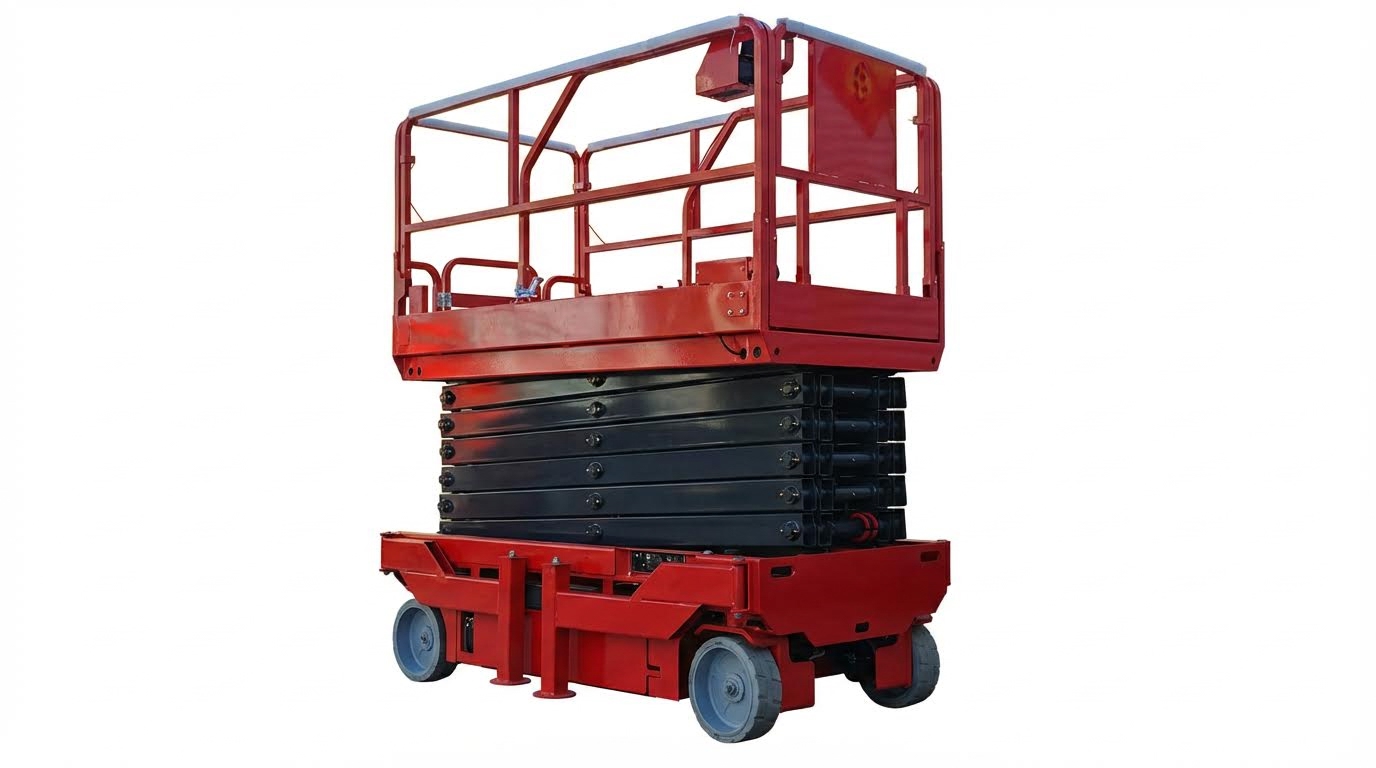
Mounting, ergonomics, and inspection on the platform determine whether an extinguisher on an electric scissor lift is actually usable in the first 10–20 seconds of a fire. The best-engineered answer to “does electric scissor lifts require fire extinguishers” fails if the unit is buried behind tools, mounted too low, or never inspected.
- Mount at waist–chest height: Fix the bracket on guardrail or mast where a harnessed operator can reach – Minimizes awkward bending or over-reaching.
- Keep the platform clear width: Mount flush to structure, not inside the walking path – Prevents trips and snag points for lanyards.
- Face the label outwards: Make the pressure gauge and label visible from the ground – Allows quick pre-use checks without climbing.
- Use robust quick-release: Choose pins or straps that open with gloved hands – Critical in cold, dirty, or emergency conditions.
- Protect controls and wiring: Avoid locations where a dislodged cylinder could hit e‑stop or joystick – Prevents secondary hazards in a fall or collision.
| Mounting Location | Pros | Cons | Best For… |
|---|---|---|---|
| Platform guardrail (inside) | Very fast access for operator | Can reduce clear width if poorly placed | Small–medium scissors in tight indoor aisles. |
| Platform guardrail (outside) | Keeps floor area clear | Higher risk of impact with structures | Outdoor work with wide clearances. |
| Chassis / base frame | Visible from ground; easy inspection | Harder to reach from elevated basket | When ground staff are expected to tackle incipient fires. |
Inspection and maintenance expectations
In a compliant MEWP fleet program, operators visually confirm presence, gauge, and pin status before each shift. Supervisors perform and document monthly checks. Qualified technicians carry out annual maintenance and periodic hydrostatic testing per extinguisher type, with each unit traceable to a specific lift ID for audits and replacements.
💡 Field Engineer’s Note: On rough-terrain scissors, vibration slowly loosens cheap brackets. I recommend specifying brackets with positive locking features and including a “shake test” in commissioning: drive the lift over your worst surface and confirm the extinguisher stays put and can still be released easily.
Applying Requirements To Real-World MEWP Fleets
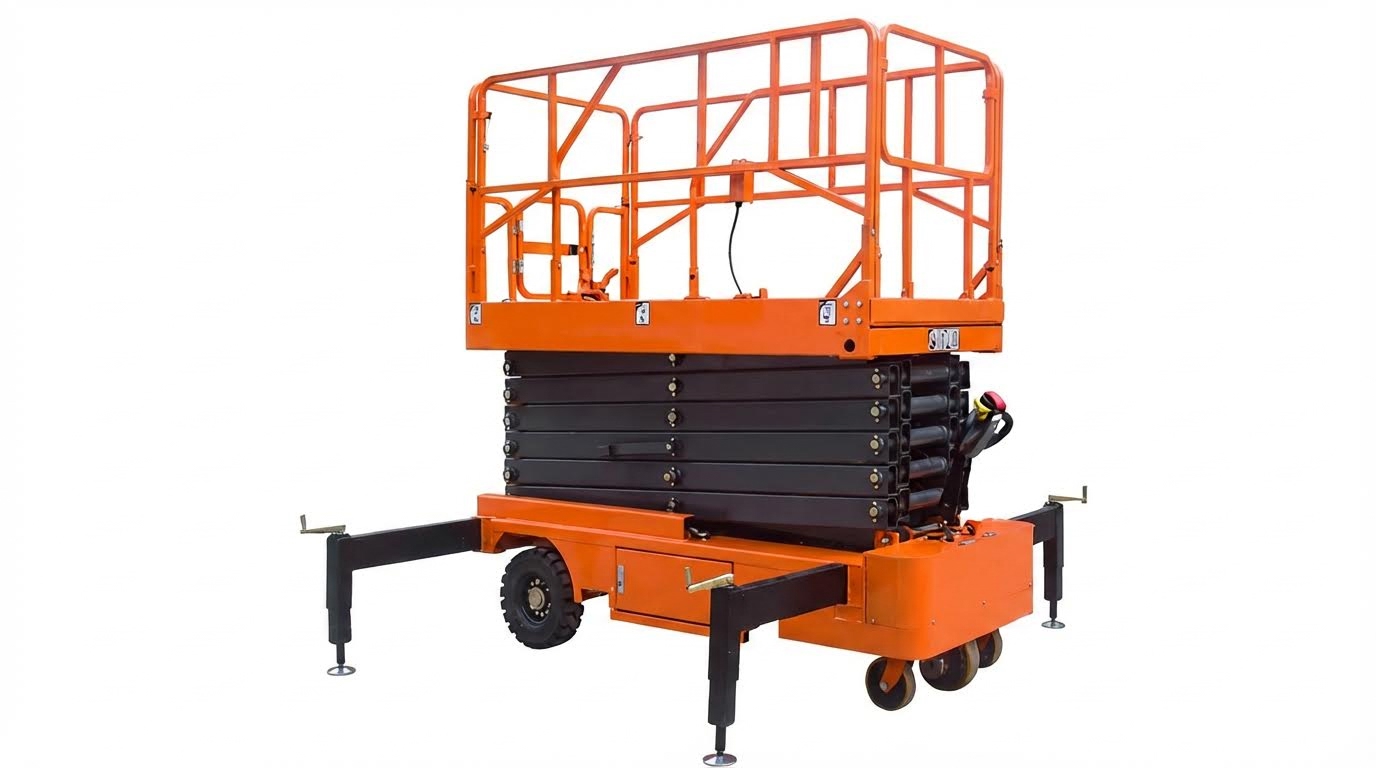
Real-world MEWP fleets should apply fire extinguisher rules by environment, task risk, and travel distance to fixed units, so operators always have an extinguisher within OSHA travel limits and an escape route that is not cut off by fire.
A fleet-level approach answers the question “does scissor platform require fire extinguishers” by looking at where and how each lift actually works. The same model may not need an on-board extinguisher in one building but absolutely require one in another.
- Environment-driven: Indoor plants, outdoor yards, and construction sites all change extinguisher distance and mounting strategy – this directly affects whether on-board units are mandatory.
- Task-driven: Hot work, painting, and battery maintenance from the platform sharply increase ignition risk – this usually justifies an extinguisher on the lift itself.
- Standards-driven: OSHA travel-distance rules for Class A and B hazards define when a nearby wall unit is enough – or when the MEWP must carry its own.
- Fleet-driven: Central policies for all MEWPs avoid one-off decisions by operators – raising consistency and compliance during audits.
💡 Field Engineer’s Note: When you standardize extinguisher fit-out by “use zone” (e.g., all lifts in welding bays carry 4–6 kg ABC units), technicians stop guessing and you avoid bare platforms creeping back into high-risk areas after maintenance or redeployment.
Indoor Versus Outdoor And High-Risk Operations
Indoor, outdoor, and high‑risk operations change whether scissor platform lift and other MEWPs must carry on‑board fire extinguishers, mainly through travel-distance limits and how easily a fire can block the operator’s escape route.
OSHA requires employers to place approved portable extinguishers so travel distance stays within 22.9 m for typical Class A fires and 15.2 m for Class B fires. These travel-distance limits are the backbone for deciding when a MEWP can “share” a wall unit and when it needs its own.
| Scenario | Typical Hazard Mix | OSHA Travel Distance Driver | On-Board Extinguisher Recommendation | Operational Impact |
|---|---|---|---|---|
| Indoor warehouse, standard racking | Class A (cartons, wood pallets), some Class B (oils) | ≤22.9 m for Class A, ≤15.2 m for Class B | Only needed on-board if racking aisles push distance beyond 15–23 m or exits are limited | Map extinguisher locations on floor plan; restrict lifts to zones that meet distance rules. |
| Indoor high‑bay with plastics or foams | High Class A plastic load, rapid fire growth | Class A distance, but higher severity | Strongly recommended 4–6 kg ABC on-board for every lift working above 6–8 m | Operators can attack small fires quickly before egress paths are cut off. |
| Outdoor yard / construction slab | Scattered combustibles, fuels, temporary power | Difficult to keep ≤15.2–22.9 m due to open layout | On-board ABC unit usually required to maintain effective coverage | Reduces reliance on distant site extinguishers that may be blocked by equipment. |
| Confined indoor areas (tunnels, shafts) | Limited ventilation, possible Class B/C from cables and fuels | Escape route can be blocked quickly | On-board extinguisher effectively mandatory; wall units may be unreachable | Supports self‑rescue in narrow headings where smoke and heat concentrate. |
| Covered loading docks | Mixed Class A/B from packaging and forklifts | Distances may be acceptable, but docked trucks can block access | Fit at least dock-assigned lifts with on-board units | Maintains extinguisher availability even when trailers block wall units. |
Beyond distance, you must ask if a fire could block the operator’s escape. For self‑propelled equipment like electric high lift pallet truck, guidance indicates an on-board extinguisher is required if a fire in the work area can cut off escape from the platform. This principle is what turns “does electric scissor lifts require fire extinguishers” from a generic question into a site‑specific engineering decision.
- Indoor operations: More walls and racking mean more chances that smoke and flames trap the platform – this pushes you toward on-board units even when distance technically complies.
- Outdoor operations: Better ventilation but poor extinguisher coverage – this often forces on-board units to satisfy travel-distance rules.
- Multi‑level work: Lifts above mezzanines or single stair exits are vulnerable – a small fire below can trap the platform in seconds.
How to map travel distances for MEWPs
Print your floor or site plan, mark all fixed extinguishers, then draw 15 m and 23 m radius circles around each. Any MEWP work zone falling outside those circles should trigger either a new fixed extinguisher or an on-board unit on every lift entering that zone.
💡 Field Engineer’s Note: In practice, the biggest gap is vertical distance. A wall extinguisher 10 m away on the floor is useless to a scissor lift at 12 m if smoke has already filled the lower level. If operators cannot reach a floor unit within 30–40 seconds in a drill, treat that area as needing on-board coverage.
Integrating Extinguishers Into MEWP Fleet Programs
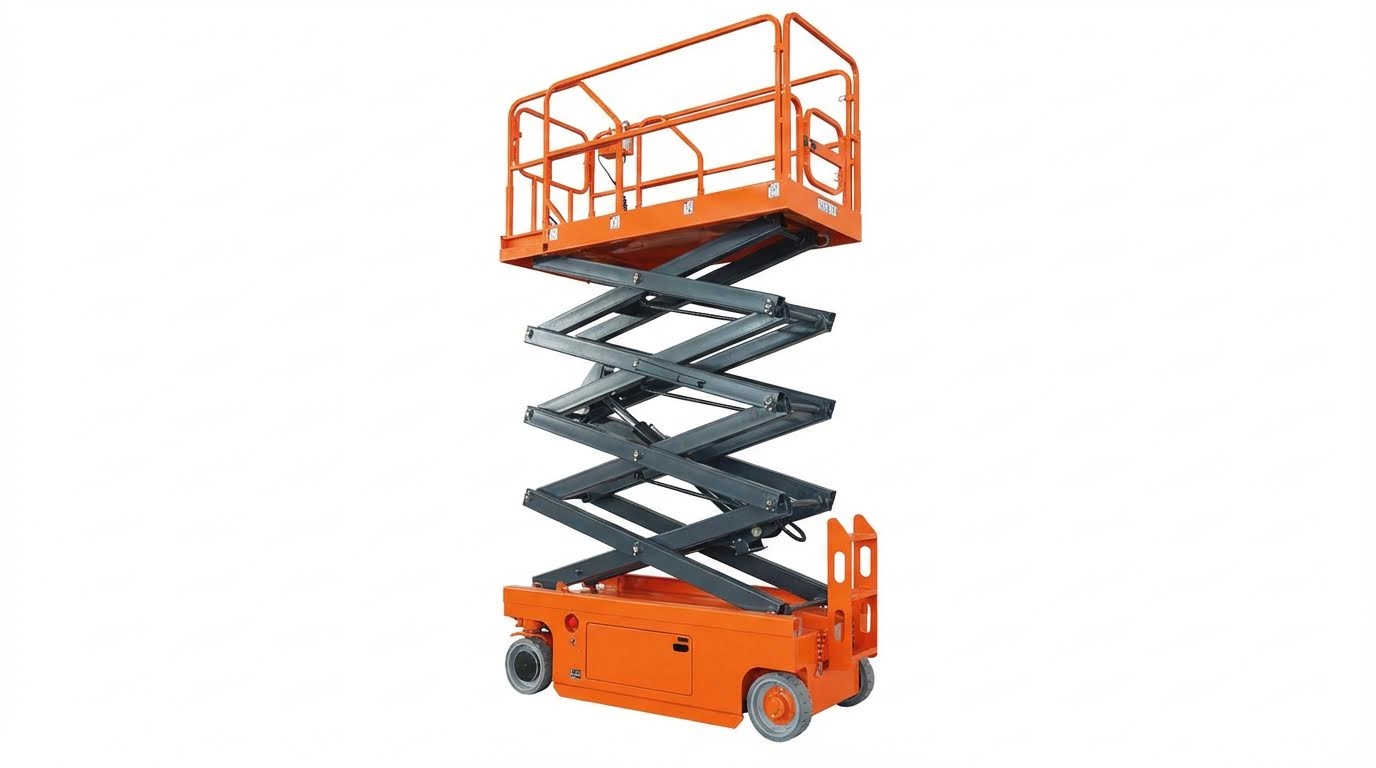
Integrating extinguishers into a MEWP fleet program means standardizing when lifts carry units, how they are mounted, and how inspections align with OSHA and NFPA 10 so compliance survives redeployments and rentals.
OSHA requires that employers visually inspect portable extinguishers monthly and perform annual maintenance checks with records kept for at least one year or the life of the shell. These same rules apply once an extinguisher is mounted to a MEWP, so fleet managers must treat extinguishers as serialized components, not disposable accessories.
- Define a fleet policy: Decide which MEWP categories (by height, task, or zone) always carry extinguishers – this removes ambiguity for supervisors and operators.
- Standardize sizes and classes: Use a small set of ABC ratings (e.g., 2–6 kg) across the fleet – this simplifies training and spare stocking.
- Assign IDs: Link each extinguisher ID to a specific MEWP serial in your asset system – you can then prove presence, inspections, and replacements during audits.
- Align inspections: Combine monthly MEWP pre‑use checks with extinguisher checks – one routine, two compliance boxes ticked.
Monthly inspections should confirm that extinguishers are visible, seals and tamper pins are intact, the pressure gauge is in the green, and there is no damage or blocked nozzle. Simple checklists like this integrate well into MEWP pre‑start forms.
- Step 1: Categorize your MEWPs – group by electric vs engine, working height, and typical tasks (maintenance, welding, painting).
- Step 2: Map work zones – identify where each group normally operates and overlay extinguisher travel distances.
- Step 3: Set rules per group/zone – e.g., all electric scissor lifts in welding bays carry a 4 kg ABC extinguisher.
- Step 4: Specify mounts and locations – define standard bracket type and guardrail position so operators always know where to reach.
- Step 5: Embed into procedures – update MEWP pre‑use checklists and operator training to include extinguisher presence and condition.
- Step 6: Track and audit – use your CMMS or spreadsheet to log inspections, hydrostatic test dates, and replacements.
Training integration tips
OSHA expects an educational program on extinguisher use and the hazards of incipient firefighting. Build a 20–30 minute module into your MEWP operator course that covers when to fight vs when to evacuate, basic PASS technique, and how to avoid spraying directly into energized electrical cabinets unless the extinguisher is Class C‑rated. OSHA guidance supports this approach.
💡 Field Engineer’s Note: The fleets that pass audits with zero findings usually treat “does electric scissor lifts require fire extinguishers” as a design question, not a paperwork one. They decide once, by risk category, print it in their MEWP SOP, and then let asset tracking and pre‑use inspections keep the system honest.
Final Thoughts On MEWP Fire Extinguisher Compliance
Fire extinguisher compliance for electric scissor lifts and MEWPs is not a yes-or-no checkbox. It is an engineering decision that links code rules, machine design, and real escape paths on each site. OSHA and NFPA define how close and how capable extinguishers must be. ANSI, EN, and good MEWP design reduce ignition sources but never remove fire risk.
When you decide if a lift needs an on-board extinguisher, you must ask two hard questions. Can a realistic fire block the operator’s way down or out? Can the operator reach a correctly rated extinguisher within OSHA travel distances, along an actually usable route? If either answer is no, the lift should carry its own unit.
The best practice is to treat extinguishers as part of the MEWP system, not loose accessories. Standardize ABC ratings and sizes by risk zone. Engineer brackets for vibration, impact and ergonomics. Tie extinguisher IDs, inspections, and hydro tests into the same asset controls you use for lifts from Atomoving.
When you design to the strictest credible combination of travel distance, fire load, and escape risk, you protect operators, satisfy inspectors, and avoid guesswork. That is how you turn “does electric scissor lifts require fire extinguishers” into a clear, defensible standard for your entire fleet.
Frequently Asked Questions
Do electric scissor lifts require fire extinguishers?
OSHA does not specifically mandate fire extinguishers on electric scissor lifts. However, workplaces where scissor lifts are used must comply with general fire safety regulations. According to OSHA Fire Safety Guidelines, fire extinguishers should be readily accessible throughout the workplace, including areas where equipment like scissor lifts operates.
- Fire extinguishers are not required on the scissor lift itself unless specified by the manufacturer or employer policies.
- If a fire extinguisher is provided on the equipment, it must adhere to OSHA’s maintenance and inspection standards under 1910.157(e).
What OSHA regulation governs fire extinguishers in workplaces?
OSHA’s standard 1910.157 covers portable fire extinguishers in workplaces. This regulation ensures that fire extinguishers are properly maintained and accessible in case of emergencies. For more details, refer to the OSHA Portable Fire Extinguishers Standard.