Safe movement of 55-gallon drums required understanding their mass, center of gravity, and failure modes, as well as the hazards of their contents. This article examined risk fundamentals, regulatory obligations, and labeling practices that underpinned compliant drum handling. It then compared equipment solutions for transport, lifting, and dispensing, from ergonomic trolleys to forklift attachments and below-hook devices. Finally, it addressed safe liquid transfer, storage design, spill containment, and fire protection so facilities could align operations with OSHA, NFPA, and environmental requirements.
Risk, Regulation, And Drum Handling Basics
Handling 55-gallon drums required a structured approach to risk, regulation, and technique. Each drum could represent a crush hazard, a chemical exposure hazard, or both, depending on contents and condition. Effective programs combined correct equipment, regulatory compliance, and worker training to control these risks. This section outlined the foundational engineering and safety concepts that governed drum operations in industrial facilities.
Weight, center of gravity, and drum stability
A full 55-gallon drum typically weighed between 180 kg and 360 kg, depending on product density. This mass created high kinetic energy and crush forces if a drum tipped, rolled, or fell from height. The drum’s center of gravity sat above mid-height when upright, so small impacts, sloped floors, or uneven pallets could initiate overturning. Engineers therefore minimized manual rolling, avoided stacking more than two drums high and two drums wide, and specified purpose-built drum trucks, dollies, or palletized systems to maintain stability.
Variability in drum condition, pallet integrity, and floor flatness further reduced stacking reliability. Deformed chimes, corrosion, or dented shells altered load paths and increased local stresses in lower drums. Good practice included routine visual inspection for dents, bulging heads, and rust before storage or movement. Facilities also defined clear travel paths, used chocks where drums were stored on their sides, and prohibited bare-fork lifting that could puncture shells and destabilize loads.
HazCom, SDS, and drum labeling requirements
Hazard communication relied on accurate, legible drum labels aligned with OSHA HazCom and GHS requirements. Operators read labels before handling to identify if contents were corrosive, toxic, oxidizing, or flammable, and adjusted PPE and handling methods accordingly. Unlabeled or illegible drums were treated as hazardous until contents were confirmed through documentation or testing. Safety Data Sheets (SDS) provided detailed information on physical properties, incompatibilities, and emergency response measures.
Procedures required personnel to verify that bungs and lids were present, intact, and correctly torqued before movement. Any sign of leakage, staining, or vapor emission triggered isolation and spill response, not routine handling. Facilities maintained SDS access at points of use and trained workers to interpret key sections, including exposure controls, stability and reactivity, and firefighting measures. This systematic HazCom approach reduced accidental exposure and incompatible storage scenarios.
OSHA and NFPA rules for flammable liquids
OSHA 29 CFR 1910.106 and 1926.152, together with NFPA 30, defined how flammable and combustible liquids in drums were stored and transferred. Metal drums used for these liquids followed DOT specifications and were limited to 227 L per drum, with portable tanks up to 2 500 L. Approved pumps, self-closing valves, or faucets were required for transfer; facilities did not use air or gas pressure on drums unless certified as pressure vessels. Containers remained closed when not in use, and open flames or ignition sources within 15 m of flammable storage were prohibited.
Storage quantities outside approved cabinets or rooms had strict limits. No more than 95 L of flammable liquids in safety cans and no more than 95 L of combustible liquids could be stored outside cabinets or inside rooms. Individual cabinets were limited to 227 L of Class I or II liquids and 455 L of Class III liquids, and NFPA 30 restricted each fire area to three cabinets. Cabinets carried “FLAMMABLE – KEEP FIRE AWAY” markings and complied with construction requirements for steel or plywood, including raised sills to contain spills. Inside storage rooms required rated construction, self-closing fire doors, explosion-protected electrical equipment, and ventilation providing at least six air changes per hour.
PPE, exclusion zones, and emergency planning
Personal protective equipment (PPE) for drum handling depended on the hazard classification and SDS guidance. Typical ensembles included chemical-resistant gloves, safety footwear with toe protection, eye and face protection, and, for corrosive or toxic materials, chemical suits and respiratory protection. Facilities established exclusion zones around transfer, crushing, or dispensing operations to keep nonessential personnel clear of potential splash, vapor, or crush hazards. Marked floor lines and physical barriers helped enforce these boundaries.
Emergency planning integrated spill response, fire protection, and medical treatment protocols. Spill kits with compatible absorbents, neutralizers, and overpack drums were staged near drum storage and transfer points. Secondary containment systems met EPA and FM guidance, with capacity equal to the larger of 10–25% of
Equipment Options For Moving 55-Gallon Drums
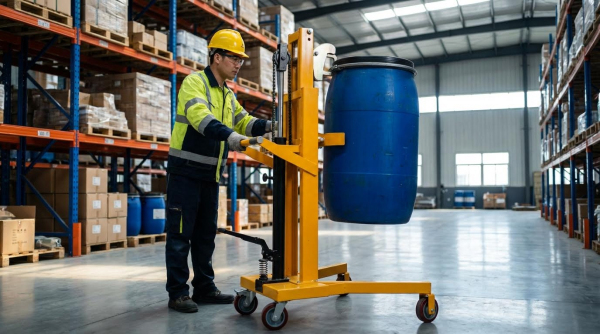
Equipment selection for 55-gallon drum handling directly affected injury rates, spill frequency, and regulatory compliance. Engineering controls reduced manual force, stabilized the drum center of gravity, and limited operator exposure to hazardous contents.
Drum trucks, dollies, and ergonomic trolleys
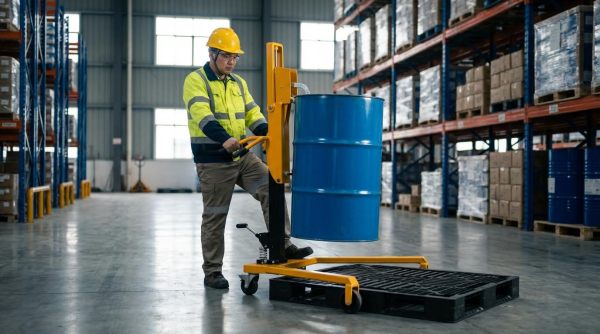
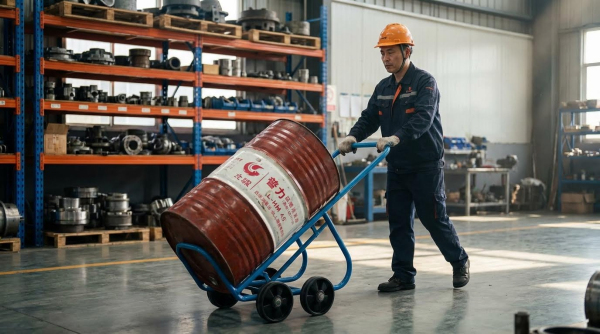
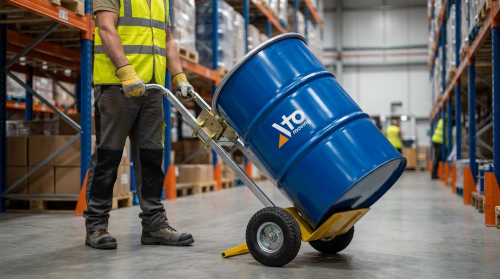
Drum trucks and dollies provided the primary ground-level solution for moving 400–800 lb (≈180–360 kg) drums. Two-wheel drum trucks supported the drum weight while the operator only controlled balance and direction, which reduced spinal loading compared with rolling drums. Four-wheel drum trucks improved stability for plastic drums that were difficult to grip and for uneven floors. Ergonomic trolleys such as the DTC01 positioned the wheels directly under the load, limiting input force to about 20 kg while handling 50–220 L drums. Stainless-steel construction and ATEX-certified variants supported corrosive or flammable service in Zones 1, 2, 21, and 22 where electrical continuity and grounding were required.
Forklift drum attachments and AGV integration
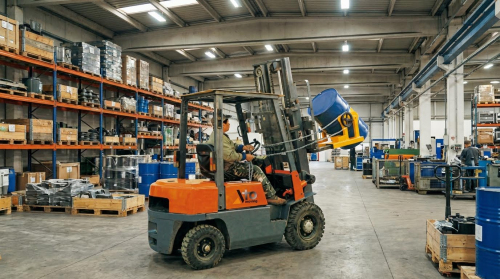
Standard forklift forks were not suitable for drums because they could puncture shells and cause hazardous releases. Dedicated forklift drum handlers used clamping jaws, rim grips, or cradle designs to lift, transport, and pour drums without the driver leaving the seat. These attachments maintained drum restraint under acceleration, braking, and turning, which reduced tip-over risk in mixed-traffic aisles. For high-throughput warehouses, similar gripping geometries were integrated into automated guided vehicles (AGVs) and palletizers, allowing automated pallet loading and unloading between roughly 150 mm and 660 mm heights. Integration with warehouse control systems enabled traceable drum movements and reduced personnel exposure in flammable liquid areas.
Hoists, below-hook devices, and tight-space lifts
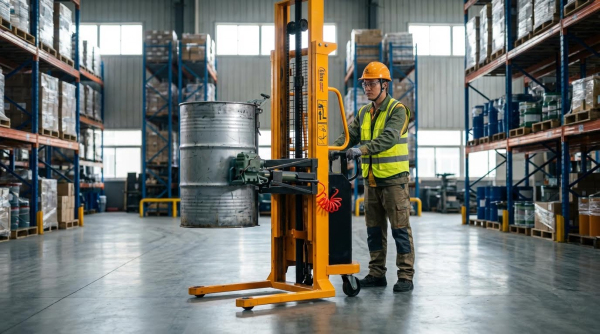
Where floor access was limited or vertical movement was required, facilities used hoists with engineered below-hook drum devices. These devices gripped the drum chime or body and allowed controlled lifting, tilting, and rotation for charging reactors, mezzanine storage, or elevated dispensing. Suspended drum systems were particularly useful in congested process rooms where forklifts and trucks could not maneuver safely. Hydra-lift drum carriers and similar equipment provided powered elevation up to about 1.8–2.4 m, with optional spark-resistant and electrostatic discharge (ESD) features for flammable atmospheres. Properly rated slings, hooks, and hoists had to match drum mass, dynamic factors, and applicable ASME and OSHA lifting requirements.
When manual techniques are still used – and limits
Manual techniques were sometimes used when no mechanical aids were available or for short repositioning tasks. Acceptable practices included carefully upending a horizontal drum using a lifter bar, crouching with a straight back, and lifting primarily with leg muscles. However, rolling drums on the rim or attempting to tilt and pour full 55-gallon drums by hand created high risk of back injuries, crushed extremities, and uncontrolled spills. Facilities increasingly defined strict thresholds, typically prohibiting manual lifting above roughly 25–30 kg and requiring trucks, dollies, or hoists for full drums. Written procedures emphasized that unlabeled or leaking drums were never handled manually and that mechanical devices were mandatory whenever hazardous or flammable contents were suspected.
Safe Dispensing, Storage, And Spill Containment
Safe management of 55-gallon drums required a systems view that linked transfer, storage, and containment. Facilities reduced risk by engineering compliant transfer methods, stable storage geometries, and robust secondary containment sized to regulatory thresholds. OSHA 29 CFR 1910.106 and 1926.152, together with NFPA 30, defined minimum technical requirements for equipment, layouts, and operating practices. Effective programs integrated these rules into standard operating procedures, training, and equipment selection.
Pumping and gravity transfer of flammable liquids
Flammable liquid transfer from drums relied on approved pumps or listed self-closing faucets, not improvised fittings. OSHA 29 CFR 1910.106(e)(2)(iv)(d) and 1926.152(e)(3,5) required approved pumps for top withdrawal and self-closing valves for gravity dispensing. Air or gas pressure was prohibited unless the drum or tank qualified as an approved pressure vessel under NFPA 30, because over-pressurization could rupture containers. During transfer, operators bonded and grounded drums and receiving vessels per 1910.106(e)(3)(vi) and 1926.152(e)(2) to control static discharge. Supervisors also enforced no-ignition-source zones, with at least 15 m separation from open flames or hot work, and ensured spills were cleaned promptly under 1910.106(e)(9)(i).
Drum pouring, tilting, and controlled dispensing
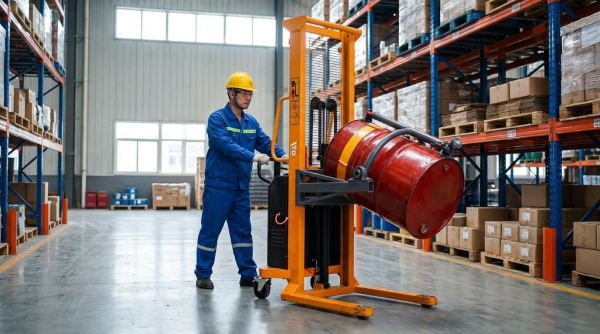
Direct manual pouring from full 55-gallon drums, which weighed roughly 225–360 kg, created unacceptable ergonomic and spill risks. Facilities instead used drum palletizers with geared tilt mechanisms, Hydra-Lift drum karriers, or similar tilting devices that allowed controlled rotation and met OSHA machine-guarding requirements. These systems enabled dispensing from heights up to about 1.8–2.4 m while keeping the operator outside the immediate spill path. Spark-resistant and electrostatic discharge-controlled designs were specified in classified areas to limit ignition probability. Where smaller draw-off volumes were required, approved drum pumps or faucets with self-closing features reduced overfill and allowed operators to maintain three-point contact and stable body posture.
Racking, stacking, and warehouse storage layouts
Warehouse layouts for 55-gallon drums balanced inspection access, structural stability, and fire code constraints. Guidance from industry practice limited floor stacking to two drums high and two drums wide per row, because higher stacks increased difficulty of inspection and imposed variable loads on lower drums. Pallet racking or drum racks supported vertical storage while maintaining clear access for forklifts or drum trucks and minimizing point loading on drum chimes. OSHA 1910.106(d)(4)(v) required at least 0.9 m aisle clearance in storage rooms, and prohibited stacking of certain 114 L containers. NFPA 30 and OSHA capacity limits governed how much flammable liquid could occupy a room, cabinet, or fire area, so planners sized rack bays around those thresholds. Drums were kept out of exit routes and stair enclosures to preserve egress, in line with 1910.106(d)(5).
Secondary containment, grounding, and fire protection
Secondary containment systems captured leaks and overfills and had to meet EPA and FM guidelines for capacity. Typical design criteria required containment volume of at least 10% or 25% of the aggregate stored volume, or the capacity of the largest single drum, whichever was greater. Spill pallets, sumps, or bermed areas under drum racks were constructed from compatible, chemically resistant materials and inspected for corrosion or damage. All metallic drums storing flammable or combustible liquids were bonded and grounded during transfer operations to control static, consistent with 1910.106(e)(3)(vi) and NFPA 30. Fire protection included 20-B rated portable extinguishers within 7.5–23 m of drum storage, flame-free and no-smoking policies, and electrical equipment suitable for any classified locations. Combined with disciplined housekeeping of combustible residues, these measures significantly reduced the likelihood and consequences of drum-related fires and spills.
Summary: Key Practices For Drum Transport Safety And Compliance
Safe drum handling depended on understanding both the mechanical risks and the regulatory framework. Facilities had to recognize that a full 55-gallon drum could weigh 180–360 kg and presented a high, shifting center of gravity, which increased tipping and crush hazards during transport, tilting, or stacking. HazCom-compliant labeling and current Safety Data Sheets were essential before any movement, especially for corrosive, toxic, or flammable contents; unlabeled drums required treatment as hazardous until verified.
OSHA 29 CFR 1910.106 and 1926.152 and NFPA 30 defined how flammable and combustible liquids were stored, transferred, and protected from ignition sources. Key provisions limited container sizes and quantities outside approved cabinets or rooms, required listed cabinets labeled “FLAMMABLE – KEEP FIRE AWAY,” and mandated bonding/grounding during transfers to control static discharge. Approved pumps and self-closing valves replaced improvised methods, and regulations prohibited using air or gas pressure on non-rated drums.
From an equipment standpoint, purpose-designed drum trucks, dollies, ergonomic trolleys, forklift drum handlers, and below-hook devices reduced manual forces and improved stability. Advanced solutions such as palletizers, Hydra-Lift carriers, and powered dumpers enabled controlled dispensing and elevated pouring without exposing operators to uncontrolled movement or overexertion. Manual techniques remained a last resort, with strict limits and emphasis on neutral spine posture, leg-driven lifting, and avoidance of rolling drums on the floor.
Future trends pointed toward wider adoption of stainless-steel ergonomic trolleys, ATEX-certified devices for hazardous zones, and integration of forklift attachments and AGVs into automated material-handling systems. Digital permit-to-work systems, electronic SDS access, and IoT-enabled leak and level monitoring were likely to strengthen compliance and early-incident detection. However, even with advanced equipment, fundamentals remained constant: pre-use inspection for rust, dents, bulging lids, or leaks; conservative stacking (typically no more than two drums high and two wide); compliant secondary containment sized to at least the largest container or 10–25% of aggregate volume; and clear 0.9 m aisles with protected egress paths.
Practical implementation required aligning procurement, operations, and EHS teams. Facilities needed to select equipment compatible with drum materials and weights, verify that storage layouts met OSHA and NFPA spacing and capacity limits, and ensure that electrical installations in storage rooms minimized ignition risk. Regular training on PPE, exclusion zones, spill response, and emergency shutdown procedures closed the loop between engineering controls and human behavior. By combining engineered handling solutions, code-compliant storage and transfer practices, and disciplined inspection and training, operations could reduce injury rates, limit environmental releases, and maintain reliable, regulation-aligned drum logistics.