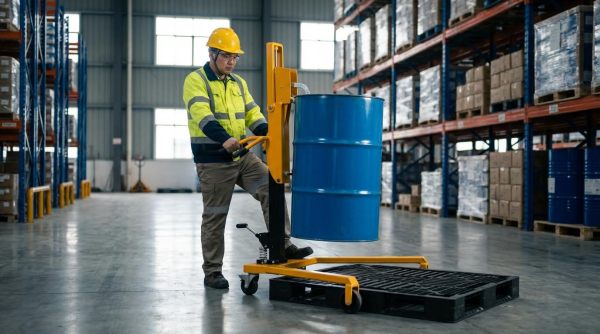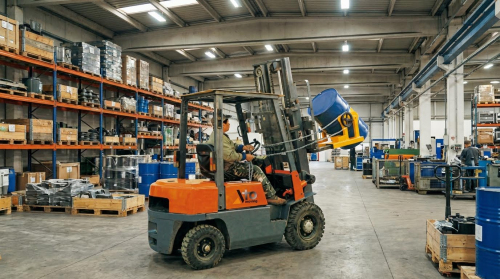
Full 55-gallon drums typically weighed between 180 kg and 360 kg, so improper handling created a high risk of serious injury and chemical exposure. This article outlined how to control that risk by combining regulations, PPE, inspections, and engineered handling methods. It covered risk thresholds, when manual movement was acceptable, and how OSHA, WHS, and site rules limited manual handling. It then detailed pre-handling checks, route planning, and specific techniques and mechanical aids that allowed industrial sites to move drums more safely and consistently.
Risk, Regulations, And When Hand Moving Is Acceptable
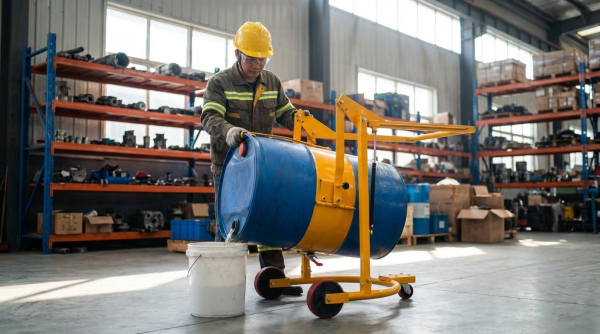
Full 55-gallon drums presented a high manual handling risk because typical filled masses ranged from 180–360 kg. The combination of high weight, awkward geometry, and sometimes hazardous contents created a credible potential for acute trauma and long-term musculoskeletal disorders. Effective risk control required aligning site practice with regulatory limits, formal assessments, and clear criteria for when workers could and could not use manual techniques.
Typical Drum Weights And Injury Mechanisms
A standard 55-gallon (208-liter) drum could weigh 400–800 lb (approximately 180–360 kg) depending on the liquid density. Even partial drums remained heavy enough to exceed recommended manual lifting limits for a single worker. Improper handling exposed workers to back sprains, hernias, and cumulative low-back disorders due to excessive spinal compression and shear. Crush injuries to toes and fingers occurred when drums tipped, slipped off pallets, or trapped hands at chimes and floor interfaces. Where drums contained corrosive, toxic, or flammable substances, leaks during handling also created chemical exposure, inhalation, and fire or explosion hazards.
OSHA, WHS, And Site Policy Considerations
Under OSHA’s general duty clause in the United States, employers had to maintain workplaces free from recognized hazards, including overexertion from manual material handling. OSHA and related guidance documents emphasized using mechanical aids for heavy loads and implementing ergonomics programs to reduce musculoskeletal risk. In jurisdictions operating under Work Health and Safety (WHS) laws, such as Australia, regulations required a formal risk management process for hazardous manual tasks, including identification, assessment, and control of drum handling risks. Site policies typically translated these legal duties into concrete rules, such as mandatory use of drum trucks or lifters above specified mass thresholds and prohibitions on single-person lifting of full drums. Internal procedures also had to align with chemical safety regulations covering labeling, storage, and spill response.
When Manual Methods Are And Are Not Appropriate
Manual techniques were acceptable only for low-risk operations such as controlled tilting, short-distance rolling on the chime, or repositioning a single drum on a flat, unobstructed surface. Operators needed adequate space, stable footing, and a verified drum condition without leaks, warping, or damaged chimes. Manual lifting of full 55-gallon drums from the ground or pallets by one person was not appropriate because the mass exceeded ergonomic guidelines and created unacceptable back and crush hazards. Two-person lifts were sometimes permitted for lighter or partially filled drums, but mechanical aids such as hand trucks, trolleys, or drum lifter-tilters were preferred. Manual handling was also unsuitable where contents were highly hazardous or where drums were stacked; in those cases, cranes, forklifts, or purpose-designed attachments were required.
Role Of Training, SOPs, And Permits-To-Work
Competent training ensured workers understood correct pulling, pushing, tilting, and rolling methods, as well as the limitations of manual handling. Instruction covered reading labels, estimating weight, identifying hazardous contents, and recognizing when to stop and request mechanical assistance. Standard operating procedures (SOPs) documented step-by-step methods, required PPE, equipment selection, and spill reporting processes, providing a consistent baseline across shifts. For higher-risk tasks, such as handling reactive chemicals, offloading bulk deliveries, or working in confined areas, sites often used permits-to-work to enforce pre-task checks and supervisory authorization. These administrative controls supported engineering measures and helped ensure that manual drum movement occurred only under conditions where residual risk was demonstrably low.
Pre-Handling Checks, PPE, And Route Planning
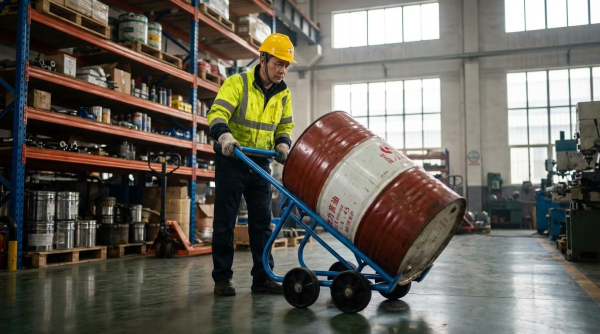
Pre-handling checks, appropriate PPE, and planned travel routes reduced drum handling incidents in industrial facilities. Structured preparation allowed operators to identify unstable loads, leaking containers, and route hazards before committing to a move. This section focused on what to verify on the drum, what to wear, and how to plan the path so that manual or mechanical handling stayed within safe limits.
Reading Labels, Estimating Weight, Checking For Leaks
Operators first read the drum label to identify contents, hazard class, and handling instructions. If labels were missing or illegible, best practice treated the drum as hazardous until identification. A standard 55-gallon (208 liter) drum could weigh about 180–360 kg depending on the product density, so workers estimated weight and decided whether mechanical aids or additional personnel were mandatory. Before moving, they inspected for leaks, seepage around bungs, and corrosion or dents that could compromise integrity. They ensured bungs and lids were present and tight to prevent releases during tilting, rolling, or transport.
Inspecting Drum, Bung, Pallets, And Stacking Layout
Visual inspection covered the entire drum shell, top and bottom chimes, and weld seams. Workers checked for warping, sharp burrs, or bulges that indicated internal pressure or structural weakness. They verified that bungs were compatible with the contents, undamaged, and torqued sufficiently to avoid loosening under vibration. If the drum sat on a pallet, they checked pallet boards and stringers for cracks, missing deck boards, or contamination that could affect friction. Storage layouts followed guidance that 55-gallon drums should be stacked no more than two high and two wide, enabling inspection access and reducing instability from variable drum strength and pallet loading. Any drum with visible damage, suspected pressurization, or unknown history was flagged for supervisor or engineering review before movement.
Required PPE For Chemical And Non-Chemical Drums
PPE selection depended on drum contents, condition, and task. For non-chemical or inert contents, baseline PPE typically included safety shoes with toe protection, thick work gloves to prevent lacerations and pinch injuries, and eye protection where tipping or splashing was possible. For hazardous chemicals, workers upgraded to chemical-resistant gloves, splash goggles or face shields, and chemical-resistant footwear and clothing or aprons consistent with the Safety Data Sheet. Where volatile, toxic, or corrosive materials were present, respiratory protection and increased skin coverage followed site risk assessments and regulatory requirements. Workers donned PPE before any physical contact, including inspections, to control exposure if an unnoticed leak or pressurized release occurred.
Planning Travel Paths And Housekeeping Controls
Before moving a drum, operators planned the entire route from origin to destination. They verified adequate clearance for tilting, rolling, or using hand trucks, and checked that floors were level, dry, and free from tripping or slipping hazards. Housekeeping controls included removing loose materials, hoses, and debris, and confirming adequate lighting along the path and at the final storage location. Workers identified slopes, thresholds, and doorways in advance and ensured appropriate mechanical aids or assistance for these transitions. They also confirmed that the receiving area supported the drum weight, allowed compliant stacking geometry, and provided access for inspection and emergency response, including spill kits and eyewash where hazardous materials were handled.
Manual Drum Moving Techniques And Aids
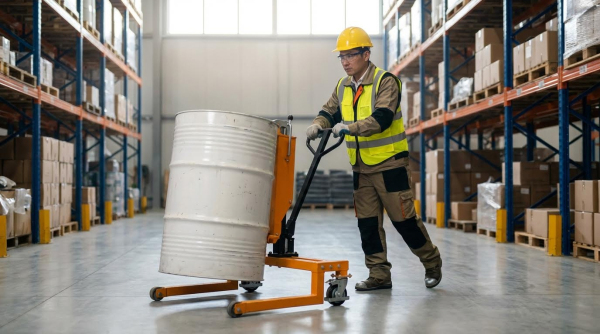
Manual handling of 55-gallon drums required controlled body mechanics, short travel distances, and clear communication between workers. Techniques focused on tilting, rolling, and controlled lowering rather than free lifting of full drums, which could weigh 180–360 kg. Mechanical aids such as lever bars, hand trucks, and hydraulic tilters significantly reduced peak forces on the spine and upper limbs. Selecting the correct technique or aid depended on drum fill level, surface conditions, travel distance, and the need for tilting or pouring.
One- And Two-Person Tilting, Rolling, And Up-Ending
For a single worker, the safest approach was to tilt and roll a full drum instead of lifting it. The operator stood close to the drum, feet staggered, knees flexed, and back straight, then pushed the top to bring the drum to its balance point on the lower chime. From this balance point, the worker rolled the drum on the chime using both hands, keeping hands clear of pinch points and never crossing them over. To up-end a drum from horizontal, the worker crouched, used leg muscles to lift, balanced the drum on the lower chime, shifted hands to the far edge, and eased it into the vertical position. Two-person techniques mirrored this but distributed load, with both workers squatting, coordinating the lift and tilt, and maintaining synchronized movements to avoid twisting.
Push, Pull, Drag/Pull, And Push/Pull Methods
Push and pull methods applied when drums stood upright and needed small positional adjustments. Pushing worked best where space existed: the worker placed hands at shoulder width on the upper chime, lowered shoulders close to the drum, and drove with the legs until reaching the balance point. Pulling suited tight clusters of drums; the worker gripped near and far chimes, braced a foot across the bottom chime, aligned hands and feet, checked for pinch points, and then pulled the drum toward themselves. The drag/pull method allowed incremental movement in confined spaces by bracing a foot, shifting body weight rearward, and dragging the drum a few centimetres side to side. The push/pull method was useful near walls; one hand pulled the far chime while the other pushed against the wall, giving controlled rotation and lateral movement with reduced strain.
Using Drum Lever Bars, Lifters, And Tilters
Drum lever bars provided mechanical advantage for repositioning full 55-gallon drums on floors or pallets without full lifting. Stainless steel lever bars engaged the upper lip or edge of the drum and used a long handle, around 1.2 m, to generate leverage with operator forces near 20 kg. Operators used them to rotate drums for label access or minor alignment, not to remove drums from pallets entirely. Drum lifters and tilter trucks added vertical lifting and controlled rotation, often using manual hydraulic pumps and gear-assisted tilt mechanisms. These devices could lift 200–210 liter drums up to roughly 1.3 m and tilt 120–180°, allowing controlled pouring while keeping the drum clamped and reducing the risk of sudden shifts or spills.
Comparing Hand Trucks, Trolleys, And Powered Aids
Two-wheel drum hand trucks carried drums in a tilted position and typically supported loads up to about 450 kg. They offered good manoeuvrability over short distances and uneven floors, especially with pneumatic or solid rubber wheels, and used chime hooks to secure steel, plastic, or fibre drums. Four-wheel drum trucks added rear wheels for better stability, which reduced the operator’s effort and improved control on level floors or longer routes. Powered drum hand trucks incorporated battery-driven traction and sometimes powered lift, handling loads in the 360 kg range at walking speeds around 1.1 m/s, which reduced pushing and pulling forces but required battery maintenance and operator training. Hydraulic drum trolleys and lifter-tilters combined transport with vertical lift and controlled tilting, making them suitable where drums needed frequent elevation and decanting, while purely manual aids remained preferable for short, low-frequency moves in less congested areas.
Summary: Engineering Safer Manual Drum Handling
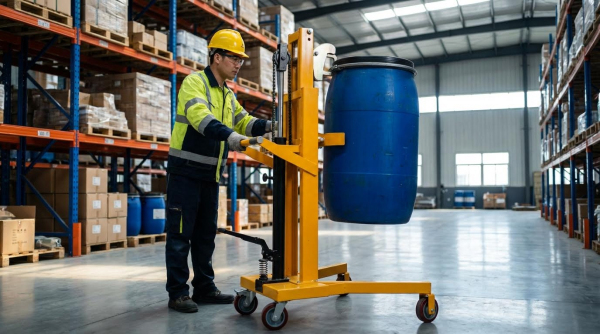
Safe manual handling of full 55-gallon drums relied on combining sound ergonomics, appropriate equipment, and strict procedural control. Typical drum masses of 180–360 kg made uncontrolled manual lifting unacceptable except for carefully defined tilting and rolling tasks. Regulations such as OSHA and WHS required employers to eliminate or reduce manual handling risks through hierarchy-of-control approaches, written procedures, and training. Site policies therefore limited hand-moving to short, low-risk moves with stable, intact containers and clear travel paths.
Engineering practice showed that risk control started before the drum moved. Operators read labels, estimated weight, verified bungs and lids, and checked for leaks or deformation. They selected PPE based on contents, then confirmed pallet integrity, stacking patterns, and route housekeeping. For movement, one- and two-person methods used leg power, neutral spine, and controlled balance-point tilting. Push, pull, drag/pull, and push/pull methods each had defined use-cases, particularly for tight clusters or wall-adjacent drums. Rolling on the chime, with strict hand placement to avoid pinch points, remained the preferred one-person technique for short distances.
Mechanical aids such as lever bars, drum lifter bars, hand trucks, trolleys, and powered drum handlers reduced required operator force from hundreds of kilograms to tens of kilograms. Modern trolleys with 300 kg ratings, 1 000 lb hand trucks, and 800 lb powered units enabled lifting, rotating, and transporting drums with controlled tilting and braking. Future developments will likely focus on powered, sensor-assisted handlers, better integration with automated storage, and corrosion-resistant designs for hygienic and outdoor use. In practice, sites should engineer systems that default to mechanical handling, reserve manual methods for low-risk exceptions, and continuously review incident data to refine SOPs. This balanced approach aligned regulatory expectations with real-world productivity while protecting workers from musculoskeletal injury and chemical exposure.