Counterbalanced stackers, straddle stackers, and counterbalanced forklifts formed the core equipment set for vertical material handling in warehouses and production plants. Understanding what a counterbalanced stacker is, how its core design worked, and how it compared with outrigger-based straddle stackers allowed engineers to match equipment to floor layouts, pallet types, and stability requirements. By contrasting stackers with full-size forklifts, decision-makers could balance capacity, aisle width, energy use, and lifecycle cost. This article walked through core design principles, structural and safety differences, and concluded with a structured way to choose the right stacking solution for a given application.
Core Design Of Counterbalanced Stackers
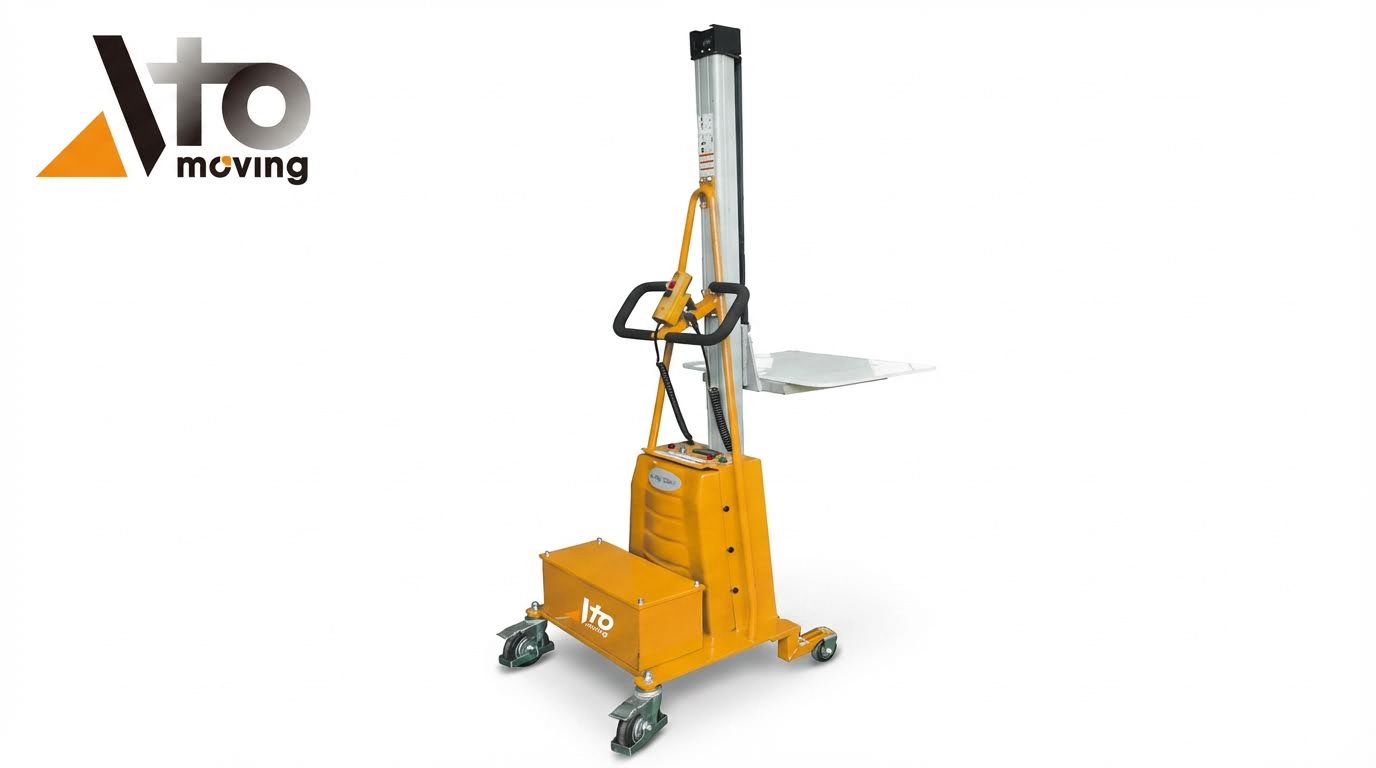
Engineers often ask what is a counterbalanced stacker and how its core design affects stability, access, and productivity. Counterbalanced stackers use a rear counterweight and a no-outrigger chassis to balance front loads while staying compact for narrow aisles. Their design defines safe capacity, lift height, and duty cycle, and it also determines whether electric or manual architecture fits a given application. Understanding these fundamentals helps compare counterbalanced stackers with straddle stackers and forklifts when selecting a stacking solution.
Counterweight Layout And Stability Principles
A counterbalanced stacker places a dedicated counterweight mass behind the drive axle. This rear mass generates a stabilizing moment that resists the tipping moment from the load on the forks. Engineers model the system as a lever about the front axle, with the load center distance at the forks and the counterweight distance at the rear. Stability requires that the overturning moment from the rated load never exceeds the restoring moment from the counterweight plus truck weight. Design standards specify a rated load at a defined load center, typically 500 mm in warehouse equipment, to ensure a predictable stability margin. Operators must keep the load low and mast vertical while traveling to maintain the designed stability envelope.
No-outrigger Design And Load Access Benefits
Counterbalanced stackers do not use front outriggers or straddle legs. The chassis ends close to the drive wheels, and the forks project forward without interference. This no-outrigger design allows direct approach to open-front machinery, conveyors, racks, and docks. It also works well with closed or open-bottom pallets, skids, and containers that outriggers could not straddle. The absence of front legs reduces the required operating envelope and simplifies positioning in tight, congested aisles. However, the design shifts more responsibility for stability to the counterweight and operator discipline, which makes adherence to rated capacity and correct load positioning critical.
Typical Capacities, Lift Heights, And Duty Cycles
Typical counterbalanced stackers handle capacities from approximately 450 kg to 1 800 kg. Common industrial models operate in the 1 000 kg to 1 500 kg range with standard 500 mm load centers. Lift heights usually span from about 1,6 m for simple feeding tasks up to roughly 3,5 m to 4,0 m for racking and stacking. Above that range, designers must address increased mast deflection and reduced residual capacity at height. Duty cycles for walk-behind counterbalanced stackers target intermittent or medium-frequency handling over short travel distances. They suit loading workstations, feeding production cells, and low-to-medium throughput storage rather than continuous high-speed dock work. Engineers should match capacity and lift height to the heaviest load, highest storage level, and required residual capacity at that height.
Electric Vs. Manual Counterbalanced Stackers
Electric counterbalanced stackers use battery-powered traction and hydraulic lift systems. They support higher duty cycles, faster lift and travel speeds, and reduced operator fatigue compared with manual units. Electric designs often integrate AC drive motors, electronic speed control, and regenerative or release braking for precise handling. Manual counterbalanced stackers typically employ a hand winch or foot pump for lifting and push-pull effort for travel. These units suit low-throughput tasks, lighter loads, and short distances where capital budgets are tight and utilization is limited. Electric versions require battery maintenance and periodic electrical inspections, while manual versions demand less energy infrastructure but more operator effort. Selecting between electric and manual configurations depends on daily operating hours, load mass, required productivity, and ergonomic constraints.
Straddle Stackers: When Outriggers Are An Advantage
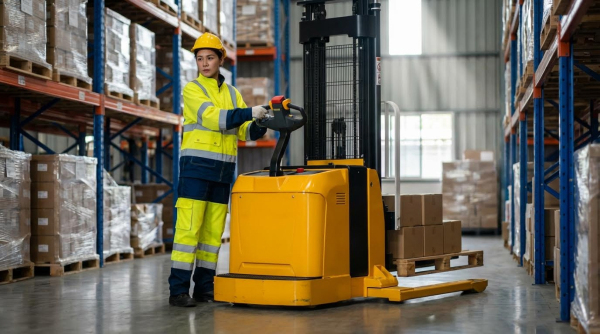
Straddle stackers complemented the answer to what is a counterbalanced stacker by showing the opposite design philosophy. Where counterbalanced stackers used rear counterweight and no front legs, straddle stackers used outriggers under and around the load to achieve stability. This structural difference affected aisle width, pallet compatibility, and floor loading patterns. Understanding these trade-offs helped engineers and warehouse planners select the correct stacking solution for each application.
Structural Differences From Counterbalanced Stackers
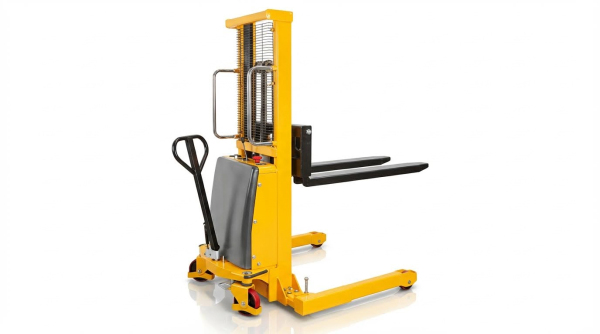
Straddle stackers used a mast and fork carriage similar to counterbalanced stackers but added front outriggers extending forward at floor level. These outriggers carried load wheels and sat wider than the forks, so the truck effectively “straddled” the pallet or load. In contrast, a counterbalanced stacker relied on a rear counterweight and kept the front clear, which improved access to closed faces and machinery interfaces. The straddle design shifted a larger portion of the load reaction directly into the outriggers, reducing overturning moments on the chassis. This geometry increased inherent lateral stability but required the load to fit between, or above, the legs, which constrained pallet and load dimensions.
Load Types, Pallet Styles, And Aisle Requirements
Straddle stackers worked best with standard pallets that allowed the outriggers to pass outside the stringers or under the deck. They handled block pallets, Euro pallets, and uniformly dimensioned crates effectively, provided the overall width matched the outrigger span. Counterbalanced stackers, by contrast, excelled with closed-bottom pallets, stillages, and machinery loading where outrigger interference would be unacceptable. Because straddle legs increased the effective front width, these machines required slightly wider aisles than compact counterbalanced stackers for the same load size. However, the tighter turning radius around the outrigger footprint still allowed use in narrower aisles than typical counterbalanced forklifts, making straddle stackers suitable for dense racking with repetitive pallet sizes.
Stability, Floor Loading, And Safety Considerations
Outriggers on straddle stackers widened the support polygon, which improved resistance to side tipping during lifting and travel. The load path transferred more directly to the floor through the outrigger wheels, lowering bending stresses in the chassis and mast base compared to an equivalent counterbalanced stacker. This configuration reduced sensitivity to high load centers and elevated lifts, but it also concentrated loads into multiple wheel contact points. Engineers had to verify that floor slabs could withstand these point loads, especially near joints and mezzanine edges. From a safety perspective, outriggers created tripping and impact hazards, so operators needed clear visibility and well-marked travel paths. Compared with counterbalanced designs, straddle stackers reduced overturning risk but demanded stricter control of load geometry and operator awareness around the projecting legs.
Counterbalanced Forklifts Compared To Stackers
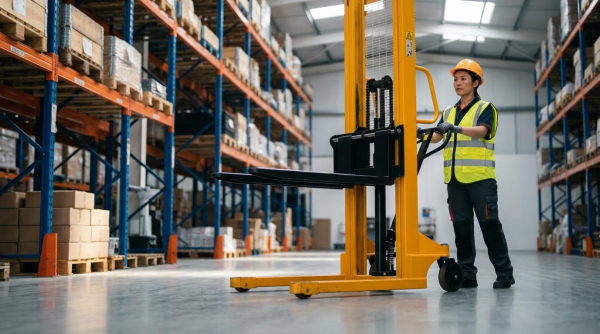
Counterbalanced forklifts and counterbalanced stacker shared the same basic principle: a rear counterweight balanced the front load. However, forklifts scaled that concept for higher capacities, longer travel distances, and harsher environments. Understanding these differences helped engineers decide when a compact counterbalanced stacker was the better answer to the question “what is a counterbalanced stacker” in real operations.
Size, Reach, And Terrain Capability Differences
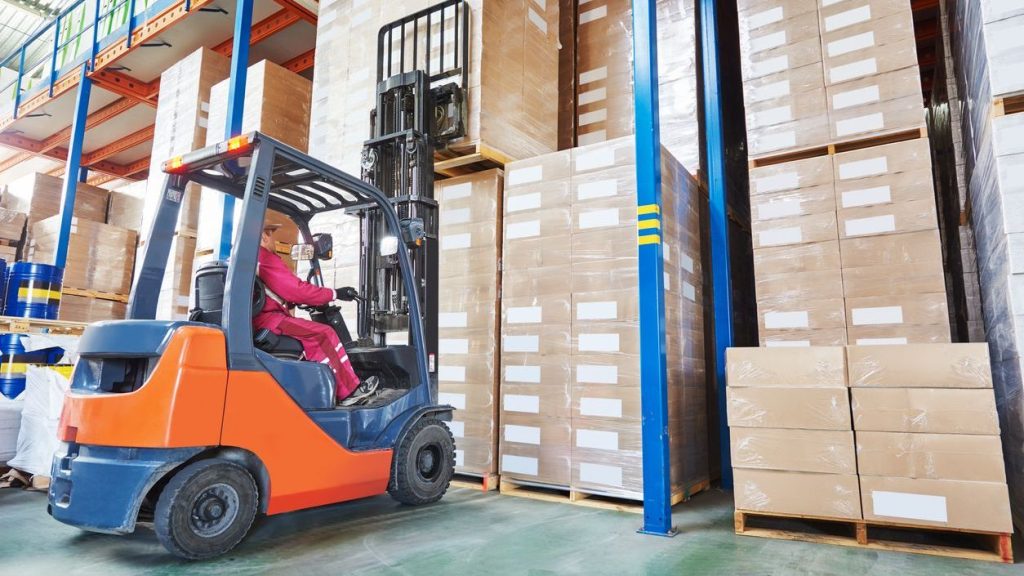
Counterbalanced forklifts typically had larger chassis, wider wheelbases, and higher unladen weights than stackers. Typical warehouse counterbalanced forklifts lifted 1.5–5 tonnes to heights above 6 m, with industrial models exceeding 10 tonnes. In contrast, counterbalanced stackers usually handled 0.5–2 tonnes with lift heights around 2–3 m, optimized for short internal transfers and stacking.
Forklifts operated on a wider range of surfaces, including outdoor yards, loading docks, and occasionally compacted gravel, depending on tyre type. Counterbalanced stackers required flat, hard floors such as concrete or smooth asphalt and were unsuitable for uneven or oily surfaces. Their smaller drive wheels and higher point loads made them sensitive to floor quality and slab capacity.
From an aisle planning perspective, counterbalanced stackers offered tighter turning radii than forklifts of similar capacity. Their compact counterweight layout and shorter overall length allowed work in narrower aisles where a forklift could not rotate safely. Forklifts provided greater reach with higher masts and attachments like side-shifters or clamps but demanded wider aisles and more clearance at racking interfaces.
Maintenance, Power Options, And Lifecycle Cost
Counterbalanced forklifts were available with internal combustion engines, lead-acid electric systems, and later lithium-ion powertrains. Internal combustion variants used diesel, LPG, or gasoline and required engine oil changes, fuel and air filter replacements, and exhaust system inspections. These tasks increased scheduled downtime and operating cost per hour, especially in high-hour fleets.
Electric counterbalanced forklifts reduced mechanical complexity but still needed periodic battery watering for lead-acid packs, charger maintenance, and hydraulic system checks. Lithium-ion forklifts lowered maintenance further by eliminating watering and equalization, while still requiring charger and cable inspections. Counterbalanced stackers were predominantly electric or manual, with no internal combustion options.
Electric counterbalanced stackers used smaller traction and lift systems than forklifts, which simplified servicing. Typical maintenance focused on daily visual inspections, hydraulic oil checks, brake and contactor inspections, and periodic verification of mast fasteners and chains. Manual units required only mechanical checks of winches, chains, and wheels, making them attractive where duty cycles were low and capital budgets tight.
Over a full lifecycle, forklifts carried higher acquisition and maintenance costs but delivered greater throughput and versatility. Counterbalanced stackers offered lower purchase price, lower energy consumption, and reduced service complexity when loads, lift heights, and shift patterns stayed within light to medium warehouse duty. For engineers evaluating what a counterbalanced stacker was suitable for, total cost per pallet moved in a defined duty cycle was the key comparison metric.
Safety, Training, And Regulatory Compliance
Counterbalanced forklifts fell under comprehensive powered industrial truck regulations, which specified operator certification, refresher training, and documented inspections. Their higher travel speeds, greater masses, and outdoor operation introduced elevated kinetic energy and collision risks. Regulatory frameworks required strict pre-use checks of brakes, steering, hydraulics, warning devices, and safety restraints.
Counterbalanced stackers, especially walk-behind types, presented lower impact energies but still required formal training and written procedures. Safe operation guidelines mandated driving with forks low, avoiding sudden braking, and prohibiting sharp turns or lifting on slopes. Operators had to keep forks below about 200 mm during travel and maintain safe distances from pedestrians and fixed structures.
Compared to forklifts, stackers generally offered better operator visibility due to smaller masts and lower chassis profiles. However, the absence of a seated, enclosed operator position meant that walk-behind stacker operators were more exposed to foot and crush hazards. Guarding around wheels, emergency stop buttons, and anti-roll-back functions on slopes mitigated these risks.
From a compliance standpoint, selecting between a counterbalanced forklift and a counterbalanced stacker required matching equipment category to task risk. High-bay, high-throughput, or mixed indoor–outdoor operations typically justified the more stringent forklift safety infrastructure. Compact, indoor-only workflows with moderate heights aligned better with counterbalanced stackers, provided that site-specific risk assessments, traffic separation, and emergency procedures were in place.
Summary: Choosing The Right Stacking Solution
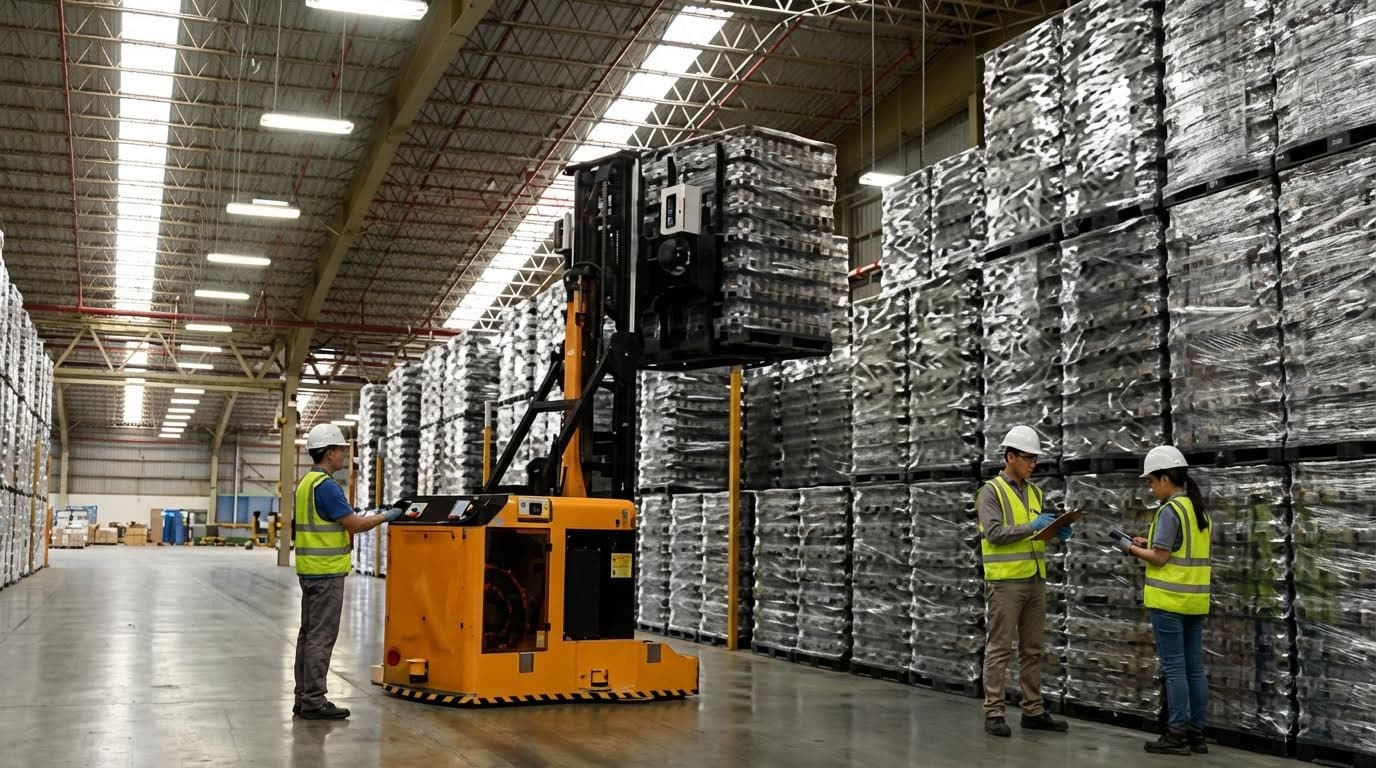
When asking what is a counterbalanced stacker, decision makers must compare it against straddle stackers and counterbalanced forklifts. A counterbalanced stacker used a rear counterweight and no front outriggers, so it accessed open-bottom pallets, machinery interfaces, and conveyors without interference. This configuration favored narrow aisles and moderate lift heights, with typical capacities up to roughly 1 800 kg and lift heights near 3 m, making it attractive for dense warehouse storage and short horizontal moves on flat, high-quality floors.
Straddle stackers offered a different value proposition. Their outriggers increased lateral stability and reduced reliance on a heavy counterweight, which lowered overall truck mass and floor loading. They suited closed-bottom pallets and standardized racking when aisle width allowed for the leg footprint. In sites with lighter floors, limited mezzanine capacity, or strictly standardized pallets, a straddle design often provided the most structurally efficient and cost-effective option.
Counterbalanced forklifts occupied the heavy-duty end of the spectrum. They handled higher capacities, greater lift heights, and longer travel distances, including outdoor yards and uneven ground. However, they required wider aisles, higher capital cost, and more intensive maintenance, especially for internal-combustion variants. Electric forklifts reduced emissions and maintenance but still demanded robust charging infrastructure and more space than walkie or pedestrian stackers.
From an implementation perspective, engineers should start with quantified constraints: required capacity at load center, maximum lift height, minimum aisle width, floor bearing capacity, and duty cycle. Then they should map these constraints to the three families: counterbalanced stackers for compact, mixed-load access; straddle stackers for palletized, indoor, stability-focused work; and forklifts for high-throughput, long-distance, or outdoor logistics. Future trends pointed toward higher-efficiency electric drives, lithium-ion batteries, and advanced safety electronics, which would narrow performance gaps while preserving each architecture’s core strengths. A balanced fleet strategy often combined all three, assigning each machine type to the operating envelope where its physics and lifecycle cost aligned best.