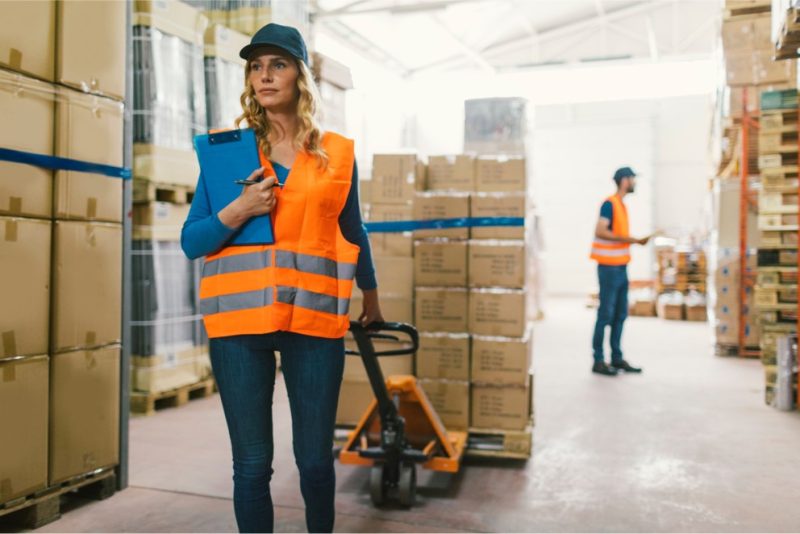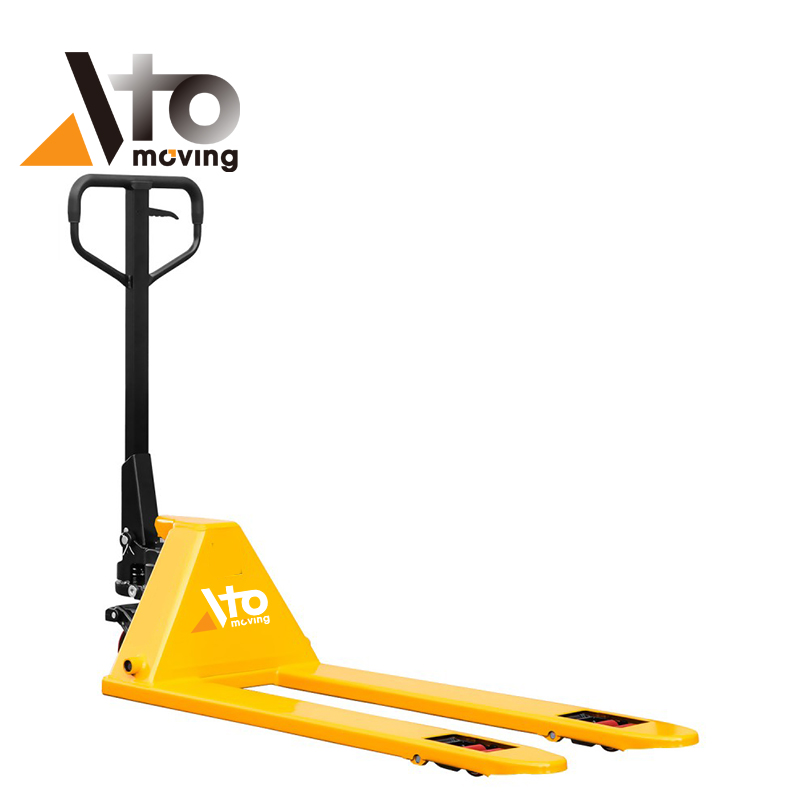
Moving and lifting pallets without a forklift means combining the right low‑level transport tools with safe vertical‑lift equipment matched to your floor, aisle width, and throughput needs. This guide explains how to lift a pallet without a forklift using 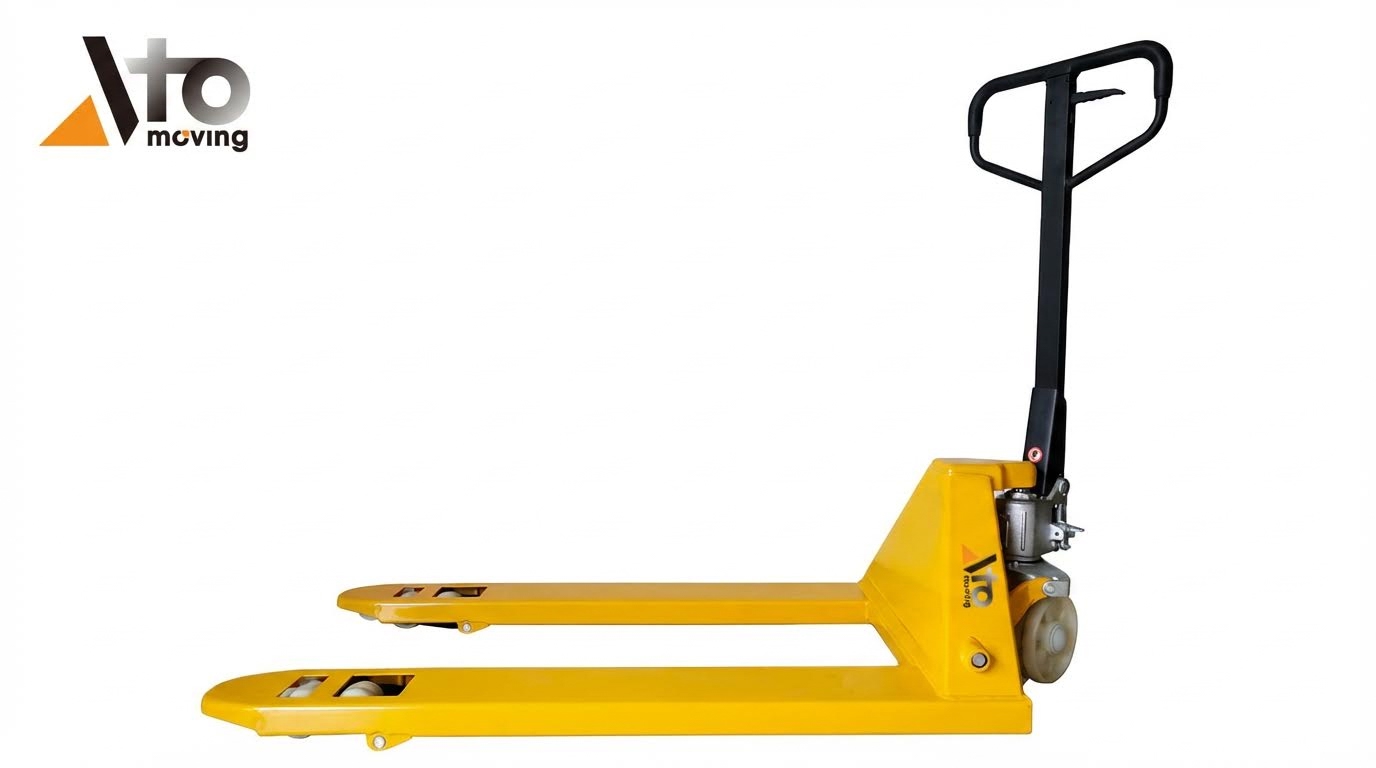 ,
, 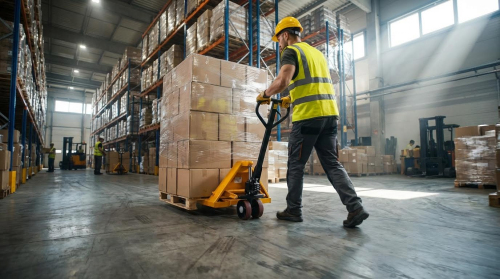 , stackers, lift tables, conveyors, and simple rollers instead of relying on ride‑on trucks. You will see how capacities, lift heights, ergonomics, and total cost of ownership compare so you can reduce forklift fleets without sacrificing safety or productivity. Using real warehouse scenarios, we will map each equipment type to your environment, labor model, and automation roadmap so you choose solutions that are OSHA‑compliant, efficient, and realistic for day‑to‑day operations.
Core Non‑Forklift Options For Pallet Handling
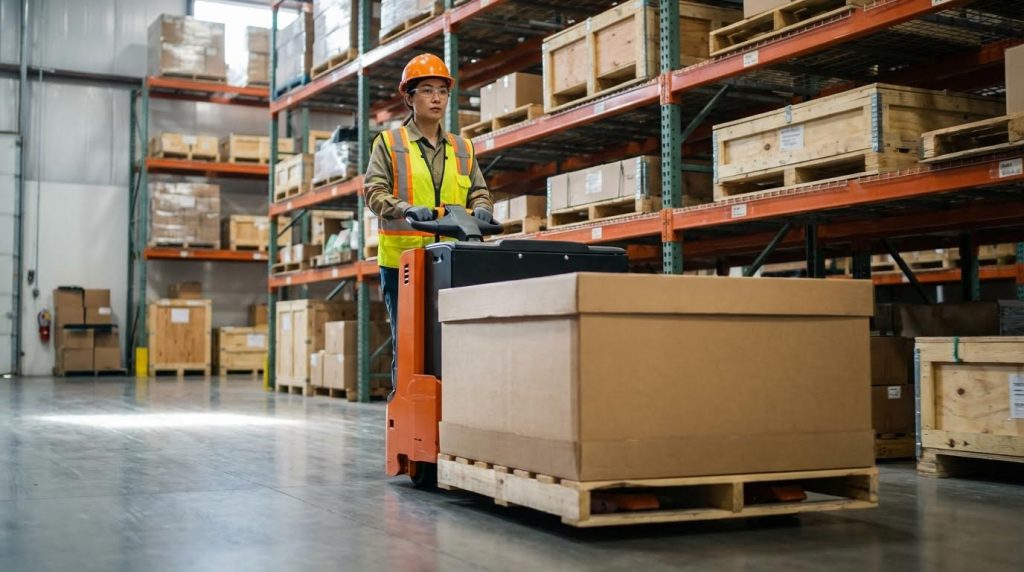
Core non‑forklift pallet handling options are manual and powered tools that move or lift pallets up to typical warehouse loads without needing a certified forklift operator, cutting cost while maintaining safety and throughput.
When you look at how to lift a pallet without a forklift, you are really choosing between low‑level movement tools and vertical lifting solutions that match your floor, aisle width, and daily pallet volume. Low‑level tools keep pallets near floor height for transport, while vertical equipment raises loads to ergonomic or racking height. Both categories can be mixed in one warehouse to reduce forklift hours without hurting service levels.
💡 Field Engineer’s Note: Every non‑forklift option still concentrates pallet weight into small wheel or foot contact patches, so verify floor slab condition and point‑load limits before scaling up any new equipment type.
Low‑level pallet movement tools
Low‑level pallet movement tools move pallets at floor height over short to medium distances, replacing many day‑to‑day forklift moves in docks, staging lanes, and pick zones.
These tools answer the practical part of how to lift a pallet without a forklift for ground‑level work: they raise the pallet just enough (typically 80–200 mm) to clear the floor, then roll it where it needs to go.
| Tool Type | Typical Capacity & Range | Best Use Case | Key Safety/Use Notes | Field Impact |
|---|---|---|---|---|
| Manual pallet jack | Up to about 2,500 kg (5,500 lbs) with lift height < 200 mm (source) | Short runs on flat, smooth floors; truck unloading; store back‑rooms | Keep loads within rating; require clear, even floors and basic operator training. | Lowest‑cost, low‑maintenance way to remove many “easy” forklift moves in 1.8 m aisles. |
| Electric pallet jack (powered pallet truck) | Commonly 2,500–3,000+ kg, low lift; faster travel over longer distances (source) | Medium‑to‑large warehouses, dock shuttling, cross‑docking | Keep batteries charged, obey speed limits, and use marked travel paths. | Cuts operator strain and boosts pallet‑per‑hour rates versus manual jacks. |
| Skates and dollies | Varies by model; suited to heavy loads on very smooth floors (source) | Occasional moves, tight spaces, machinery or pallet repositioning | Check weight limits, use brakes when parked, and move slowly for control. | Excellent for one‑off heavy relocations but not ideal for high‑throughput lanes. |
| Roller crowbars | Lever plus roller to nudge heavy pallets on smooth floors (source) | Fine positioning of heavy pallets or equipment | Confirm floor is level and clear; move slowly to avoid tipping. | Great for precision moves into racks or machines where jacks don’t fit. |
| Conveyor systems & gravity rollers | Designed for the line’s maximum pallet weight; gravity or powered rollers (source) | Repetitive, fixed routes (e.g., from production to shipping) | Control slopes, install end‑stops, and keep rollers clean and guarded. | Removes walking and truck travel entirely on fixed paths, ideal for automation. |
| Sliding and rolling techniques (pipes/rollers under pallet) | Depends on pipe strength and pallet weight (source) | Very short moves, tight budgets, or field conditions | Use strong rollers, gloves, level surfaces, and multiple workers for heavy loads. | Last‑resort method; useful in remote sites but not a long‑term warehouse solution. |
| Ropes and sheets | Only for lighter pallets over short distances (source) | Occasional repositioning of light loads where no equipment is available | Use strong materials, proper posture, and team handling for heavier loads. | Can bridge a gap in emergencies but should not replace engineered equipment. |
From an operations standpoint, manual and electric pallet jacks will handle 80–90% of low‑level pallet traffic in most warehouses. Skates, crowbars, and improvised rolling methods are niche tools for special moves, not your primary flow.
How low‑level tools affect floor loading and maneuverability
Manual and electric pallet jacks concentrate 1,000–2,500 kg into four small wheel footprints, which increases point loading versus a person walking. Softer wheels reduce floor damage but increase rolling resistance, so long pushes on rough concrete quickly fatigue operators. Short wheelbases on pallet jacks also allow turning within about 1.8–2.2 m aisles, which is why they outperform forklifts in dense racking.
💡 Field Engineer’s Note: If operators complain that pallet jacks are “too heavy,” it is usually a floor issue (spalled joints, ramps > 5%, or debris) rather than a jack issue—fix the floor and your effective capacity jumps.
Vertical lifting and work‑height solutions

Vertical lifting and work‑height solutions raise pallets from floor level to ergonomic or storage height, replacing forklifts for stacking, feeding production lines, or order picking at waist height.
These devices are the core answer to how to lift a pallet without a forklift when you must get the load off the floor: they provide controlled vertical lift with built‑in stability, so operators are not manually lifting pallet weight.
| Equipment Type | Capacity & Lift Height | Primary Application | Key Safety/Use Notes | Field Impact |
|---|---|---|---|---|
| High‑lift pallet trucks | Up to about 1,000 kg with fork height up to ~800 mm (source) | Feeding workstations, packing benches, or light assembly at waist height | Stay within capacity; use as a static work platform once raised. | Reduces bending and repetitive strain, increasing pick/pack speed and accuracy. |
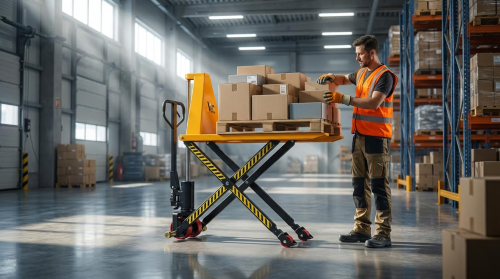
| Lift tables / scissor lifts | Varies widely; designed to raise pallets to ergonomic heights (source) | Static stations: loading, kitting, machine feeding, or pallet build/break | Never exceed rating; keep area clear and train operators on pinch‑point hazards. | Transforms a floor‑level, back‑breaking job into waist‑height, low‑injury work. |
| Manual stackers | Often up to 1,000–1,500 kg with lift to low racking levels; designed for ~500 h/year use (source) | Occasional stacking, light‑duty pallet put‑away or retrieval | Do not exceed height or weight limits; basic hydraulic inspection annually. | Low‑capex way to remove a forklift from small stores or low‑bay warehouses. |
| Electric stackers | Typical capacity around 1,200 kg with faster lift speeds and higher duty cycles (source) | Regular stacking 60–180 pallets/day, multi‑level rack access (>3 m) (source) | Monitor batteries, observe safe travel speeds, and train operators per local standards. | Halves cycle time versus manual stackers and can cut labor cost by ~50% in busy shifts. |
- Ergonomic focus: High‑lift trucks and lift tables bring the pallet to 700–800 mm working height, which dramatically reduces bending, twisting, and manual lift errors.
- Duty‑cycle matching: Manual stackers are optimized for low hours (around 500 h/year), while electric stackers are built for 1,200+ h/year and 60–180 pallets/day flows (source).
- Cost vs throughput: Over five years, manual stackers can cost roughly one‑fifth of electric models in cash terms but deliver lower throughput and require more labor hours (source).
- Environment fit: Manual hydraulics tolerate very low temperatures (around −25 °C), while electric units need insulated or heated batteries for cold stores (source).
When to choose stackers instead of a forklift truck
If your operation handles fewer than about 60 pallets/day in a single shift and works under budget pressure, manual stackers are typically sufficient and far cheaper to buy and run (source). Between 60–180 pallets/day in double shifts, electric stackers become more economical because they halve lift cycle times and can save tens of thousands in annual labor costs.
💡 Field Engineer’s Note: For “how to lift a pallet without a forklift” in a small warehouse, one electric stacker plus several manual pallet jacks usually beats a single forklift on both cost and flexibility—especially in narrow aisles where forklifts struggle to turn.
“”
Matching Equipment To Your Warehouse Application
Matching pallet equipment to your warehouse means sizing manual or powered tools to your aisles, floors, environment, and throughput so you can lift a pallet without a forklift safely, quickly, and cost‑effectively.
💡 Field Engineer’s Note: Before buying anything, walk one full shift with a stopwatch and tape measure. Real aisle widths, gradients, and congestion are usually worse than the CAD layout suggests—and that’s where most mis‑sizing mistakes start.
Aisle width, floor conditions, and environment
Aisle width, floor quality, and environment determine whether you can use compact manual tools or need powered pallet trucks and stackers to move and lift pallets without a forklift safely and efficiently.
| Design Factor | Typical Values / Options | Best‑Fit Equipment Types | Field Impact (What It Means On The Floor) |
|---|---|---|---|
| Aisle width | ≈1,8 m for tight pick aisles; ≈2,2 m for standard pallet handling cited aisle data | Manual pallet jacks in 1,8 m; electric pallet trucks in ≥2,2 m | Ensures turning radius fits so operators are not “three‑point turning” all day, which kills throughput and increases collision risk. |
| Floor flatness & damage | Even, crack‑free concrete vs patched, sloped, or dock plates | Manual jacks, skates, dollies on smooth floors; powered trucks where ramps/uneven joints exist | Small nylon wheels on manual jacks stop at cracks; powered trucks with larger drive wheels roll through joints and dock transitions more reliably. |
| Floor load limits | Light mezzanines vs heavy industrial slabs | Manual jacks, high‑lift pallet trucks, light stackers | Lower axle loads avoid slab cracking; manual equipment spreads 1,000–2,500 kg loads more gently than large counterbalanced trucks. |
| Temperature | Ambient 0–35°C vs cold store down to -25°C temperature guidance | Manual stackers/jacks to -25°C; electric trucks with insulated batteries to about -15°C or heated Li‑ion in deeper cold | Hydraulic oil thickens and batteries lose capacity in cold; picking the wrong type leads to slow lifting and frequent charging inside freezers. |
| Cleanliness / hygiene | Dry ambient vs wash‑down food/pharma zones | Stainless or sealed electric pallet trucks and stackers pharma application data | Seamless frames and food‑grade lubricants avoid contamination and survive aggressive cleaning, which standard painted equipment cannot. |
| Dust / explosive risk | Dust‑prone or static‑sensitive areas | IP54 manual stackers with sealed bearings and anti‑static tyres dust environment data | Reduces dust ingress and static discharge, supporting compliance with hazardous‑area rules and lowering bearing and seal failures. |
| Ramp / dock gradients | Flat floor vs frequent dock levellers and truck ramps | Electric pallet jacks or stackers; avoid basic skates/roller crowbars on slopes | Powered traction prevents roll‑back and strain; purely manual methods become unsafe once slopes exceed a few percent. |
When deciding how to lift a pallet without a forklift in tight aisles, manual pallet jacks and high‑lift pallet trucks are usually the first choice, because they can handle up to about 2,500 kg on smooth floors while working in ≈1,8 m aisles manual pallet jack capacity aisle compatibility.
For operations that need vertical access but still want to avoid forklifts, manual stackers or powered stackers and lift tables can raise loads up to ergonomic work heights around 800 mm and beyond, with manual models favoured in power‑restricted or low‑throughput zones and electric units used where higher racking and faster cycles are required high‑lift pallet truck data stacker overview.
How to quickly survey floors and aisles before choosing equipment
- Measure clear aisle width: Use a tape to record the narrowest point between rack uprights, not the design drawing value.
- Check turning pockets: Measure space at aisle ends and in front of docks where jacks or stackers must rotate 180°.
- Map floor defects: Mark cracks, steps, drains, and dock plates; test‑push a loaded manual jack across the worst sections.
- Record gradients: Use a simple digital level or smartphone to measure ramp angles at docks and internal slopes.
- Note environmental extremes: Log lowest and highest temperatures and whether wash‑down or heavy dust is present.
Throughput, labor cost, and automation roadmap
Throughput, labor cost, and your automation roadmap dictate whether low‑cost manual tools or higher‑CAPEX powered equipment give the best long‑term cost per pallet when you replace or reduce forklifts.
| Operational Factor | Typical Ranges / Data Points | Manual Equipment Fit | Powered / Automated Fit | Field Impact On Cost & Productivity |
|---|---|---|---|---|
| Daily pallet throughput | ≈60 pallets/day for manual stackers; up to ≈180 pallets/day for electric stackers throughput data | Recommended for ≤60 pallets/day and annual throughput <100,000 pallets manual application data | Preferred for 60–180 pallets/day and high‑frequency flows | Above manual limits, operators fatigue, cycle times stretch, and you effectively “run out of hands” before space. |
| Labor availability & cost | Two operators vs one per shift, with example labour costs of $60,000 vs $30,000 per year labor savings data | Lower equipment CAPEX but higher headcount and fatigue risk | Higher CAPEX but can halve operator count in some use cases | Where wages are high, powered trucks pay back quickly by reducing the number of pickers or handlers needed per shift. |
| Cycle time per lift | ≈55 s for manual vs ≈28 s for electric to 2,7 m rack height cycle time data | Acceptable for low‑frequency put‑away or kitting | Critical for dock‑side loading >50 pallets/hour and fast picking high‑speed loading | Shorter cycle time directly raises pallets/hour, which is essential when dock doors or carriers are your bottleneck. |
| Operating hours per year | ≈500 hours for manual vs ≈1,200 hours for electric in single‑shift use operating hours data | Suited to occasional or seasonal handling | Designed for continuous, multi‑shift operation with spare batteries | If equipment runs most of the shift, manual efficiency drops and operators slow down; powered units maintain consistent pace. |
| Five‑year equipment cost (excl. labor) | ≈$625 for manual vs ≈$3,060 for electric over 5 years 5‑year cost data | Lower cash outlay; good where capital is tight and wage costs are modest | Higher cash cost but offset by labour and throughput gains | Cost per operating hour is ≈$0,25 manual vs ≈$0,51 electric, so ROI depends on how many pallets you push through each hour. |
| Energy consumption | 0 kWh for manual vs ≈126 kWh/year for electric (≈$15 at $0,12/kWh) energy data | No energy cost; good for power‑restricted or sustainability‑focused sites | Low but non‑zero energy cost; some models recover ≈15% via regenerative braking regen braking | Energy cost is usually tiny versus labour; it rarely drives the decision but supports sustainability reporting. |
| Automation roadmap | Manual today vs semi‑automated conveyors and transfer carts tomorrow | Manual pallet jacks and stackers feeding basic gravity roller or skate systems gravity roller data | Electric pallet trucks integrating with powered conveyors and automated transfer carts 57% throughput increase | Designing flows around conveyors and transfer carts can boost throughput by over 50%, letting you avoid adding more forklifts. |
If your main question is how to lift a pallet without a forklift while controlling labour cost, start by calculating pallets per labour hour: manual stackers are recommended where you handle fewer than 60 pallets per day in a single shift and need the lowest equipment cost, while electric stackers and pallet trucks make sense when you target 60–180 pallets per day, run double shifts, or operate in docks and cold chains where speed is critical decision matrix data critical scenario guidance.
As you plan an automation roadmap, consider combining manual pallet jacks for flexible picking with fixed gravity rollers, conveyors, or transfer carts for repetitive, high‑volume moves, since this hybrid approach has been shown to increase daily throughput by around 57% in e‑commerce warehouses while keeping capital and complexity below full automation
Final Considerations For Replacing Or Reducing Forklifts
Replacing or reducing forklifts works best when you treat pallet handling as a system, not a single truck swap. Low‑level tools handle horizontal moves in tight aisles and on lighter slabs, while vertical equipment controls lift height, stability, and ergonomics at the rack or workstation. When you size both correctly, you cut risk and labour strain while keeping pallets flowing.
Engineering limits must lead every choice. Check floor point loads, aisle widths, gradients, and temperatures before you commit. Match duty cycle and daily pallet count to manual or powered stackers so operators do not become the bottleneck. Use conveyors, gravity rollers, and transfer carts where routes repeat, and keep flexible moves on pallet jacks and stackers.
For most small and mid‑size warehouses, a mixed fleet of manual pallet jacks, high‑lift trucks, and one or two stackers will safely replace at least one forklift. Higher‑throughput sites can add electric pallet trucks and powered stackers without jumping straight to full automation. The best practice is simple: measure real conditions, calculate pallets per labour hour, then build a right‑sized non‑forklift toolkit—often anchored by Atomoving equipment—that protects your people, your floor, and your budget.
Frequently Asked Questions
What are some alternatives to a forklift for lifting pallets?
If you don’t have access to a forklift, there are several alternatives you can use to lift and move pallets safely. These include manual pallet jacks, electric pallet jacks, lift tables, and electric stackers. Manual pallet jacks are particularly useful in tight spaces like trailers or small warehouses. For heavier loads or frequent use, electric pallet jacks provide more efficiency. Forklift Alternatives Guide.
How can I lift a pallet manually without equipment?
To lift a pallet manually, stand at the corner of the pallet and use your legs to tip it into a standing position. Maintain a wide stance for stability and use one hand as a support against your leg if needed. This technique minimizes strain on your back and shoulders. However, this method is only suitable for lighter pallets and should be done with caution to avoid injury. Pallet Handling Safety Tips.