Manual pallet jacks are simple, robust tools, but their lift height is tightly limited by geometry, hydraulics, and safety standards. This article explains how high can a manual pallet jack lift in real-world use, why most models stop in the 180–200 mm range, and how EN 1757-2 caps design extremes at around 300 mm. You will see how stability, center of gravity, ergonomics, and surface conditions all interact with lift height, and how to choose the right jack or step up to powered options when you need more elevation.
Understanding Manual Pallet Jack Lift Height
Typical lift range and fork geometry
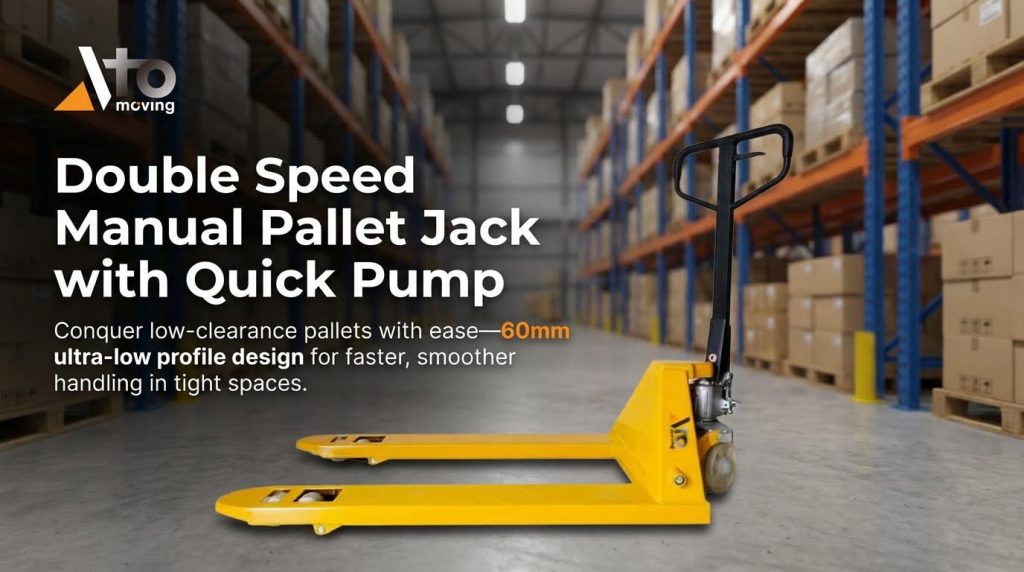
If you are asking how high can a manual pallet jack lift, most standard models raise a pallet only enough for safe rolling, not stacking. Typical minimum fork height is about 75–85 mm, with maximum fork height around 190–195 mm, giving a usable lifting range of roughly 110–120 mm (e.g. 75 mm to 195 mm) and 190–195 mm maximum height. This is enough to clear standard pallets and boards while keeping the load low for stability.
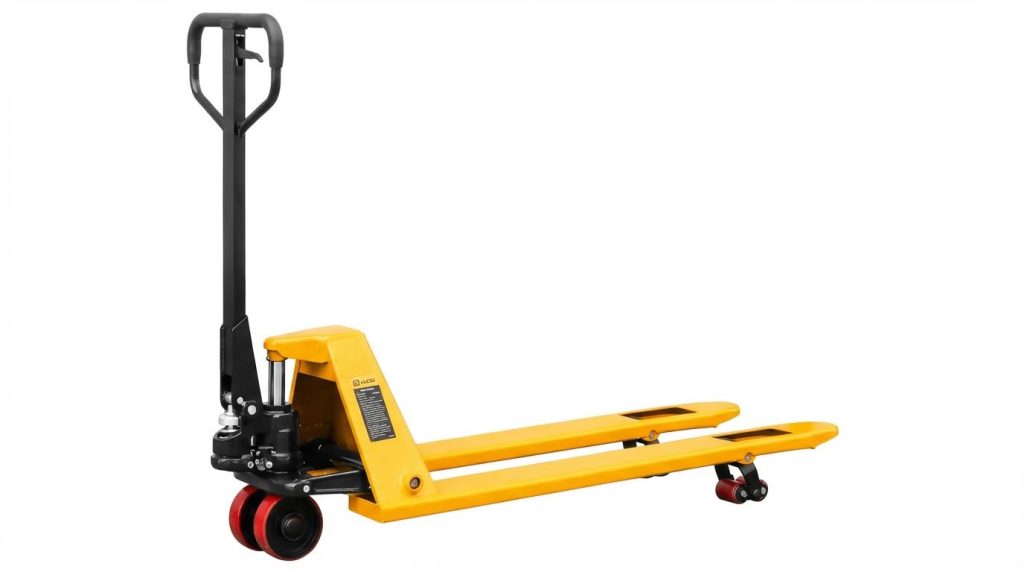
Fork geometry is standardized so the truck fits common pallets efficiently:
- Typical fork length: 1150–1220 mm (euro and standard pallet compatible).
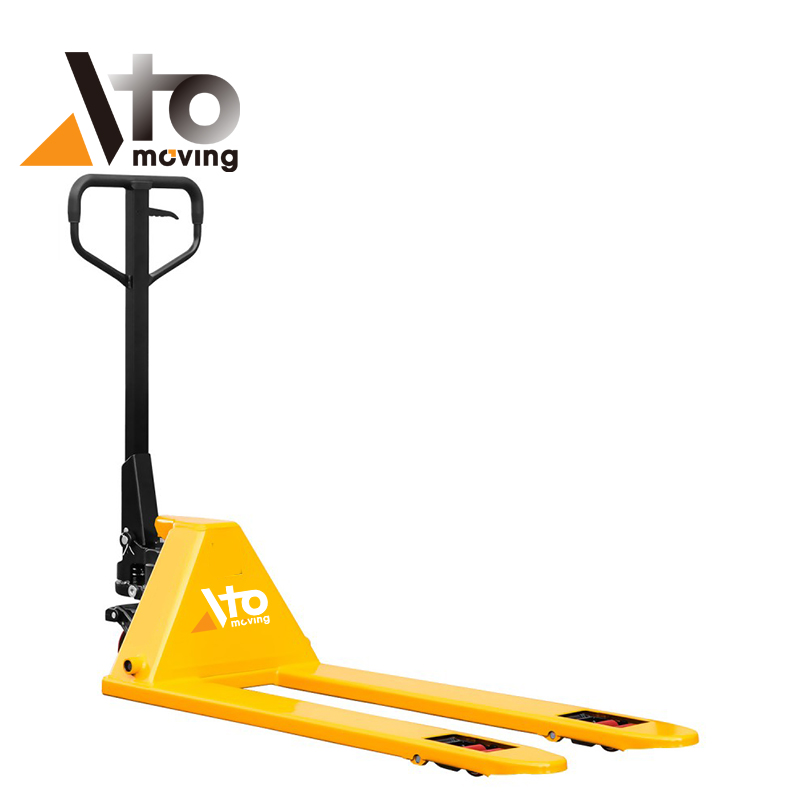
- Overall fork width: about 550 or 685 mm, with each single fork about 160 mm wide (common manual jack sizes).
- Load wheels are compact (≈ Φ80 × 70 mm) to slide into low pallet openings, while steering wheels are larger (≈ Φ180 × 50 mm) for easier maneuvering (typical wheel sizes).
Because the forks start very low and only lift a short distance, the pallet remains close to the floor, which reduces bending moments in the frame and keeps manual push–pull forces manageable.
Typical manual pallet jack lift and geometry data
| Parameter | Typical value |
|---|---|
| Minimum fork height | 75–85 mm (example: 75 mm) |
| Maximum fork height | 190–195 mm (example: 195 mm) |
| Approx. lift range | ≈110–120 mm |
| Common fork lengths | 1150 mm, 1220 mm (standard options) |
| Overall fork width | ≈550 mm or 685 mm (typical values) |
Why lift height is limited by design
From a design standpoint, how high can a manual pallet jack lift is intentionally restricted. The relevant European standard for pedestrian-controlled manual pallet trucks (EN 1757-2:2001) specifies a maximum fork height of 300 mm (upper design limit in the standard). Most standard warehouse jacks stay well below this limit, around 190–195 mm, to keep the load very low and stable (typical maximum fork height).
There are three main engineering reasons for this limit:
- Stability and tipping risk: As lift height increases, the load’s center of gravity rises and moves relative to the wheelbase, which raises overturning moments during braking, turning, or on uneven spots. Keeping lift low reduces tipping risk for loads up to 2000–5000 kg (typical capacity range).
- Hydraulic stroke and force limits: The pump and cylinder are sized for a short stroke with controlled forces. EN 1757-2 requires measures to limit hydraulic stroke and force for safe operation (hydraulic limitation requirements).
- Ergonomics and effort: Higher lift would require more handle strokes and higher push–pull forces. Studies showed that moving a 2000 kg load already demands forces above guideline limits (49.6 kg to start a 2000 kg load), so designers avoid extra height that would increase strain.
In short, manual pallet jacks are engineered as low-lift transport devices: they raise loads just enough to roll safely, not to act as stackers or high-lift trucks.
Engineering Factors That Set the Height Limit

Stability, center of gravity, and tipping risk
From a stability standpoint, the answer to how high can a manual pallet jack lift is constrained long before the hydraulics run out of stroke. As fork height increases, the combined center of gravity of truck and load rises and moves relative to the wheelbase. With typical fork lengths around 1150–1220 mm and fork widths between 550 and 685 mm, the support polygon is long and narrow, so extra height quickly reduces the tipping margin under braking or steering inputs. Designers therefore keep the lift range small, typically around 110–120 mm between minimum and maximum fork height, to maintain a low center of gravity and keep static and dynamic stability within safe limits. Uneven floors or gradients amplify this effect, so the geometry is optimized for smooth, level, hard surfaces, not for stacking at elevated levels. EN 1757-2:2001 reflects this by treating manual pallet trucks as low-lift, pedestrian-controlled equipment rather than high-lift devices.
Hydraulic stroke, overload valves, and EN 1757-2
Hydraulic design is the second hard limit on how high can a manual pallet jack lift. Standard manual jacks use a compact hydraulic unit with a short piston stroke, matched to a typical maximum fork height of about 190–195 mm above floor, from a low height near 75–85 mm. This yields a practical lift height increase of roughly 110 mm, enough to clear standard pallets while keeping the cylinder and linkage small and robust. Many designs include overflow or overload valves that prevent the system from building excessive pressure and protect components if the operator tries to lift above the rated capacity, commonly in the 2000–5000 kg range. Hydraulic cylinders, chrome-plated rods, and overflow valves are specified to balance durability with controlled stroke. The European standard EN 1757-2:2001 classifies these trucks as low-lift and caps maximum lift height at 300 mm, so manufacturers design stroke and linkage ratios to stay well within that envelope while meeting safety factors on pressure and structural stress.
Ergonomics, push–pull forces, and surface conditions
Human factors also influence how high can a manual pallet jack lift in real-world use. Even though the hydraulic system can raise heavy loads, operators must still generate the push–pull forces to start and keep the load moving. Independent measurements showed that starting a 500 kg load required about 23.3 kg of force and a 2000 kg load about 49.6 kg, while maintaining motion for 2000 kg still needed around 30.7 kg of force, all above common ergonomic guideline limits. Measured push–pull forces for 500–2000 kg loads highlight that simply increasing lift height or capacity would further increase strain, especially on less-than-ideal floors. EN 1757-2 assumes use on smooth, level, hard surfaces and requires design features such as brakes and protection against crushing points to keep pedestrian operation safe. On slopes or rough surfaces, higher loads and higher centers of gravity would push forces and risks even further beyond ergonomic and safety thresholds, so keeping lift height low is a deliberate control measure, not just a mechanical limitation.
Choosing the Right Jack For Your Lift Height Needs
Matching lift height to pallets, docks, and racks
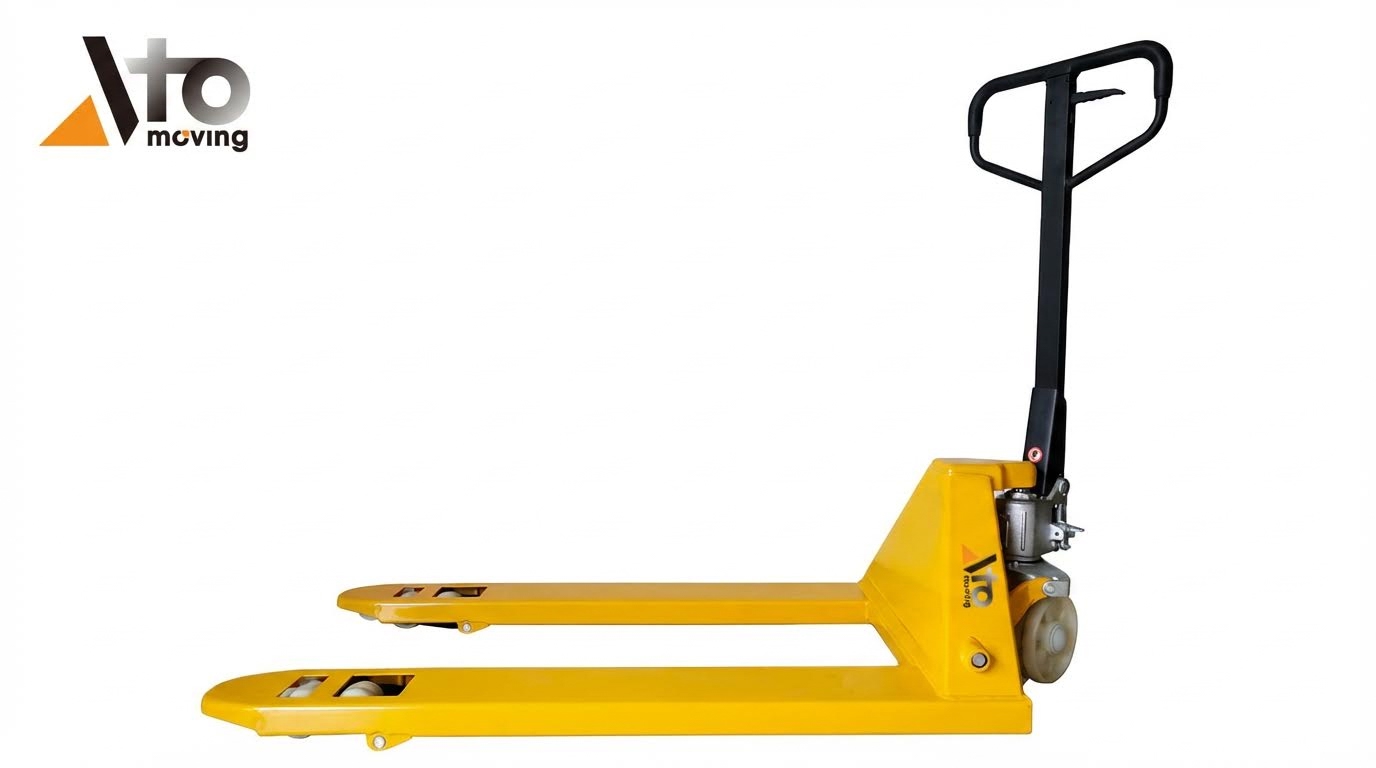
Start by matching jack lift range to the lowest and highest points you must clear. A typical manual pallet jack lifts the forks from about 75–85 mm minimum height up to roughly 190–195 mm maximum, giving around 110–120 mm of usable lift. Typical minimum and maximum fork heights are 75 mm and 195 mm, so the key question is not only how high can a manual pallet jack lift, but whether that is enough for your pallets and transfer points.
- Pallet compatibility: Standard pallets with 90–100 mm entry height work well with low-profile forks around 75–85 mm. Check that fork length (often 1150–1220 mm) and width (typically 550–685 mm) match your pallet size and aisle layout. Common fork lengths are 1150 or 1220 mm, with widths between 550 and 685 mm.
- Dock and truck loading: For dock work, the main lift requirement is clearing pallet bottoms over dock plates and truck floors, usually well within a 190–195 mm fork height. Manual jacks are well suited to level docks and trailers where you only need ground-level transport and minor height correction, not racking access.
- Racks and mezzanines: Manual jacks are designed for floor-level handling only. The EN 1757‑2 standard caps manual pallet truck lift height at about 300 mm, far below even low racking beam levels. This standard specifies a maximum lift height of 300 mm for pedestrian-controlled manual pallet trucks, so any requirement to place pallets into racks means you need a different type of equipment.
Quick specification check for manual jack selection
Confirm these points before purchase: pallet opening height vs. jack minimum fork height; need to clear thresholds, dock plates, or floor irregularities within the 110–120 mm lift range; required capacity (many manual jacks are rated between 2,000–3,000 kg) vs. operator push–pull limits; and wheel material (nylon, PU, or rubber) to suit floor type. Common wheel options include nylon, polyurethane, and rubber.
When to move from manual jacks to powered options
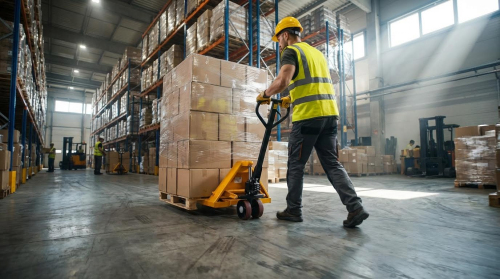
The practical answer to how high can a manual pallet jack lift is “only enough for ground handling,” so you move to powered options when your process needs more height, more throughput, or less strain on operators. Manual trucks are labor‑intensive and slower, and they are best for short, occasional moves on good floors. Manual pallet jacks were described as limited in lifting height and slower in operation, making them unsuitable for high-volume applications.
- Ergonomics and load size: Independent tests showed that starting a 2,000 kg load with a manual jack required about 49.6 kg of force, and keeping it moving needed around 30.7 kg, which exceeded guideline limits by over 50%. Measured starting forces for 2,000 kg loads were 49.6 kg, with sustaining forces of 30.7 kg. If you regularly move heavy loads, powered pallet jacks reduce strain and injury risk.
- Throughput and duty cycle: In multi‑shift or high‑volume docks, powered pallet trucks can cut labor time significantly. One analysis indicated about a 65% reduction in labor for three‑shift operations when using powered pallet trucks instead of manual units. Electric pallet trucks were associated with a 65% reduction in labor during three-shift operations.
- Height and application limits: For any work involving lifts above manual pallet jack range—such as multi‑level racks over several meters—you need powered stackers or forklifts. Guidance also recommended electric pallet trucks for dock‑side loading above roughly 50 pallets per hour and for rack access above 3 m. Electric pallet trucks were recommended for dock-side loading exceeding 50 pallets per hour and multi-level rack access over 3 meters.
Rule-of-thumb: when manual is still the right choice
Manual pallet jacks remain a good fit when loads are generally below about 1,500 kg, travel distances are short, floors are smooth and level, and annual pallet throughput is modest. One source suggested manual jacks for operations with yearly volume under 100,000 pallets and for power‑restricted zones where electric trucks are impractical. Manual pallet jacks were indicated as suitable for high-frequency light loads under 1,500 kg and annual throughput below 100,000 pallets.
“”
Key Takeaways On Manual Pallet Jack Lift Limits
Manual pallet jacks sit in a narrow design window where geometry, hydraulics, and human effort all align. Forks start low, usually near 75–85 mm, and only rise about 110–120 mm. This keeps the load close to the floor, reduces bending in the frame, and preserves a safe stability margin within a long, narrow wheelbase. EN 1757-2 formalizes this low-lift role and caps fork height at 300 mm, so engineers size cylinders, linkages, and overload valves to stay well below that limit with generous safety factors.
At the same time, ergonomics set a hard ceiling on real capacity. Push–pull forces for 2000 kg loads already exceed common guideline limits on smooth floors. Any extra lift height or rougher surface would push those forces higher and raise tipping risk as the center of gravity climbs.
For operations and engineering teams, the practical rule is clear. Use manual pallet jacks like the Atomoving units as ground-level transport tools only, on good floors, with controlled loads and modest throughput. Once you need higher lift, heavier pallets, longer travel, or multi-shift work, move to powered pallet trucks or stackers rather than stretching manual equipment beyond its engineered envelope.
Frequently Asked Questions
How high can a manual pallet jack lift?
A standard manual pallet jack can typically lift a load between 6 to 8 inches off the ground. Some models may reach up to 7.75 inches, but this is the maximum height for most regular manual pallet jacks. Pallet Jack Guide.
Are there pallet jacks that can lift higher than standard models?
Yes, high-lift pallet jacks are available and can raise loads much higher than standard models. While a regular manual pallet jack lifts up to 8 inches, high-lift pallet jacks can elevate loads up to 32 inches. Lift Height Guide.