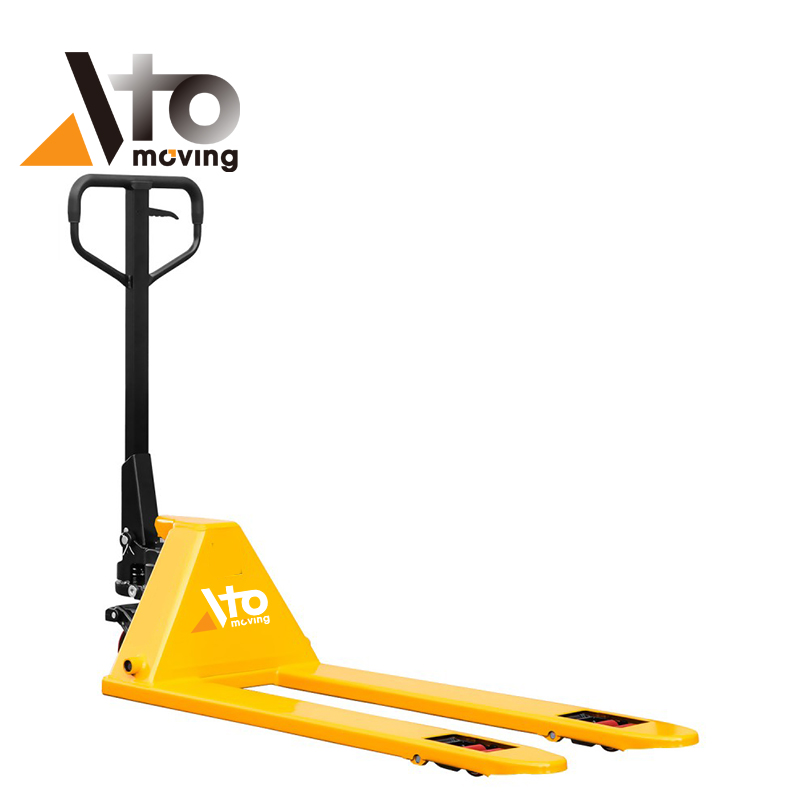
Standard pallet jack width is a simple number with big consequences for safety, pallet fit, and aisle efficiency. This guide answers “how wide is a standard pallet jack” with real dimensions, then shows how width ranges, fork spacing, and aisle clearance affect stability and throughput. You will see where standard sizes work, when you need narrow or low‑profile designs, and how to match fork width to different pallet types and load patterns. Use it as a quick engineering reference before you lock in specs for new equipment or a warehouse layout change.
Defining Standard Pallet Jack Width And Dimensions
Typical width for “standard” manual pallet jacks
When people ask “how wide is a manual pallet jack,” they usually mean a manual jack sized for common 48×40 pallets. Standard models follow a fairly tight band of fork and overall widths, with a few common “families” of sizes.
| Parameter | Typical / Common Range | Notes |
|---|---|---|
| Overall fork width (outside‑to‑outside) | ≈ 27 in (standard); 20–28.75 in typical range for common models | 27 in is the go‑to size for 48×40 pallets used in most warehouses |
| Width between forks (inner clear distance) | ≈ 20–27 in adjustable band on many models | Must match pallet openings and stringer spacing |
| Standard fork length | ≈ 48 in (some 49–48 in class) for manual jacks | Matched to 48 in pallet depth |
| Typical “Euro‑style” standard sizes (metric) | 550 × 1100 mm and 680 × 1200 mm for manual pallet jacks | ≈ 21.7 × 43.3 in and 26.8 × 47.2 in |
| Low‑profile jack fork width range | 520–685 mm (≈ 20.5–27.0 in) for low‑profile units | Still sits in the same “standard” width band |
So, in practical warehouse terms, when you ask how wide is a low profile pallet jack, you can assume an overall fork width of about 27 inches, with many designs allowing the space between forks to sit somewhere in the 20–27 inch range to suit different pallets.
Related key dimensions that go with width
Width is only one part of the standard pallet jack “envelope.” Typical manual jacks pair that width with:
- Fork length of about 48 inches for general warehouse use on standard models
- Lowered height around 3 inches and raised height around 7.5–8 inches for manual jacks
- Load capacity typically up to about 5,500 lb on full‑size versions in common warehouse duty
Relationship between pallet size and fork spacing
Correct pallet jack width is driven by pallet geometry. Fork outer width and inner spacing must fit the pallet’s openings while supporting the load over at least two stringers or blocks.
| Design factor | Engineering guideline | Why it matters |
|---|---|---|
| Fork length vs pallet length | Forks should reach at least 2/3 of pallet length for stable support | Too short increases tip‑over and board breakage risk |
| Outer fork width vs pallet “inner width” | Outer fork width slightly less than pallet inner opening to avoid jamming | Prevents forks from binding on stringers or blocks |
| Fork spacing vs stringer/block layout | Width between forks typically 20–27 in to match common pallets | Ensures each fork sits fully under a stringer or block line |
| Example: 48×40 in (US‑style) pallet | Works best with ≈ 27 in overall fork width and ≈ 48 in fork length on standard jacks | Forks align with the two outer stringers plus center support |
| Example: 800×1200 mm Euro pallet | Common choice is 550×1100 mm fork size for Euro pallets | Forks clear the inner openings and still give 2/3 length support |
To decide how wide is a drum dolly for your operation, you must start from your pallet fleet. The fork outer width and the gap between forks should be set so that:
- Each fork sits under solid load‑bearing members (stringers or blocks).
- The outer edges of the forks stay just inside the pallet’s inner width.
- The fork tips do not push on thin deck boards only.
Once pallet sizes and entry patterns are known, the “standard” 27‑inch class width either fits cleanly or you move to narrow or wider variants, which are covered in the next section of the article.
Engineering Details: Width Variants And Design Trade-Offs
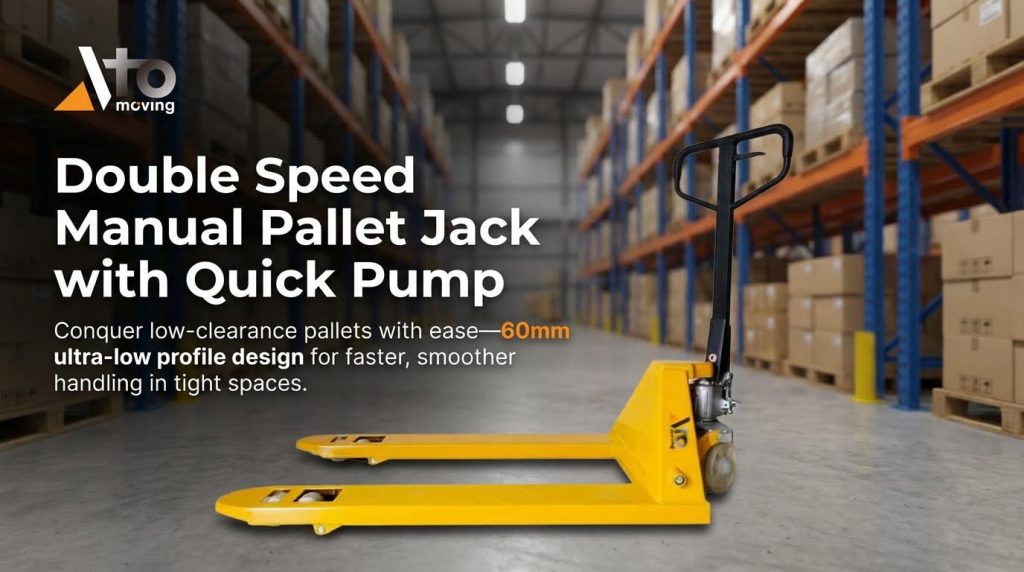
Standard vs narrow vs low‑profile fork widths
When people ask “how wide is a manual pallet jack,” they usually mean the outer fork width used for common 48×40 pallets. In engineering terms, you also need to compare that to narrow and low‑profile variants so you can match forks to pallets, load, and aisle constraints.
| Type | Typical outer fork width | Typical fork length | Typical pallet fit / use case |
|---|---|---|---|
| Standard manual pallet jack | 27 in outer width (fork spacing usually 20–27 in adjustable) (commonly quoted standard) | 48 in fork length for 48×40 pallets (typical) | General warehouse use with standard North‑American pallets |
| Alternative “standard” width range | Forks 20–28.75 in wide overall, depending on model (manufacturer data) | 49–66 in fork length options (varies by model) | Standard pallets plus longer or wider loads |
| Narrow pallet jack | As slim as 20 in overall width for tight aisles (narrow‑aisle type) | Often 42–48 in | Narrow pallets, small loads, or very tight rack spacing |
| Low‑profile pallet jack (metric) | Approx. 520–685 mm fork width (about 20.5–27 in) (typical range) | 1150 or 1200 mm fork length (about 45–47 in) (Euro‑oriented) | Low‑entry pallets, Euro pallets, partial‑deck or damaged pallets |
| Common “Euro” style manual sizes | 550 mm or 680 mm outer fork width (≈21.7 or 26.8 in) (standard options) | 1100 or 1200 mm fork length (≈43.3 or 47.2 in) (matched to pallet) | 800×1200 and 1200×1200 pallets, light to heavy loads |
In practice, when you ask “how wide is a manual pallet jack,” you can assume about 27 inches outer fork width for most 48×40 pallet applications, with narrower 20–22 inch units used where pallet windows or aisles demand it.
Why width options exist
Fork width is not a style choice. It is driven by pallet window spacing, load footprint, and aisle width. A jack that is too wide will not enter the pallet; a jack that is too narrow will not support the outer stringers properly and will overload the deck boards.
Fork width, wheel layout, and stability limits
Fork width and wheel layout form the base of the “support polygon” under the load. That geometry sets your stability margins long before you look at rated capacity.
- Wider fork sets increase lateral stability but need wider pallets and aisles.
- Narrow sets improve access but raise the risk of tipping or pallet damage if the load overhangs too far.
- Wheel size and spacing affect how the jack crosses joints, dock plates, and uneven floors.
| Design element | Typical data | Stability / performance effect |
|---|---|---|
| Standard fork width vs load footprint | Common fork outer width 550×1100 mm or 680×1200 mm fork sets support light (~2,200 lb) and heavy (~5,500 lb) loads respectively (capacity vs size) | Wider 680 mm sets place wheels farther apart, increasing resistance to side tipping under heavy loads. |
| Standard manual jack wheel sizes | Steer wheels about 6‑3/4–7‑3/4 in diameter and 2 in wide; load rollers about 2‑7/8–3 in diameter and 3‑5/8 in wide (typical manual spec) | Larger steer wheels roll more easily over joints; wider load rollers spread contact pressure and reduce point loading on deck boards. |
| Low‑profile jack wheel layout | Steer wheels around 180 mm diameter and 50 mm wide; load wheels about 80 mm diameter and 70 mm wide (low‑profile example) | Smaller rollers allow a lower minimum fork height (≈55 mm) but are more sensitive to floor defects; operators must keep speeds low on rough floors. |
| Service height range | Standard jacks: lowered ≈2‑7/8 in, raised ≈7‑3/4 in; low‑profile: ≈55–165 mm (standard) (low‑profile) | Lower minimum height lets forks enter thin or damaged pallets but reduces vertical wheel travel, so floor quality matters more for stability. |
| Hydraulic and control design | Low‑profile units use leak‑resistant pumps and slow‑release valves for smoother lowering (hydraulic design) | Controlled lowering avoids sudden shifts of the center of gravity that could push the support polygon to its limit. |
From a safety standpoint, the limiting case is usually a tall, narrow load on a narrow fork set, turning or braking hard. The combination of reduced base width and high center of gravity shrinks the allowable lateral acceleration before tipping.
Practical stability checks for width and wheels
Before standardizing a width, check three things: the narrowest pallet window you must enter, the tallest load height you will handle, and the worst floor defect in your travel path. If any of those are extreme, you should move away from the narrowest fork option, even if it looks attractive for aisle clearance.
Aisle width, turning radius, and clearance planning
Fork width feeds directly into overall truck width and required aisle width. Turning radius depends on fork length and steer‑wheel geometry, but you still need side clearance to swing the handle and keep the load clear of racks and columns.
| Parameter | Typical value / rule of thumb | Width‑related impact |
|---|---|---|
| Overall jack width vs aisle width | Standard pallet jack about 27 in wide; narrow‑aisle models down to 20 in (size ranges) | As a planning baseline, add at least 6 in of clearance beyond the jack width for safe operation in straight aisles (clearance guideline). |
| Turning radius – low‑profile example | Approx. 1265–1335 mm (about 49.8–52.6 in) turning radius for low‑profile units (manufacturer data) | Fork length and steer geometry dominate radius, but extra width still needs extra side clearance when you pivot the load near racking. |
| Clearance for manual vs electric | Standard manual pallet jacks need about 6 in side clearance and ≈12 in extra length to turn efficiently; electric models need an additional 8–10 in for the operator’s standing area (clearance and operator space) | Where aisles are fixed, you often choose narrower forks to keep within the available envelope, especially for pedestrian‑operated units. |
- For straight‑through travel, size aisles around jack width + 6–8 in minimum, more if loads overhang.
- For 90° rack entry, check the turning radius against the pallet length and any overhang.
- For cross‑docking or staging, wider forks may be acceptable because turning is less constrained.
When you decide how wide is a manual pallet jack for your site, do not stop at the catalog number. Convert that fork width into real aisle and turning clearances, then verify you still have enough stability margin for your tallest and heaviest loads in the tightest parts of the building.
Matching Pallet Jack Width To Pallets And Operations
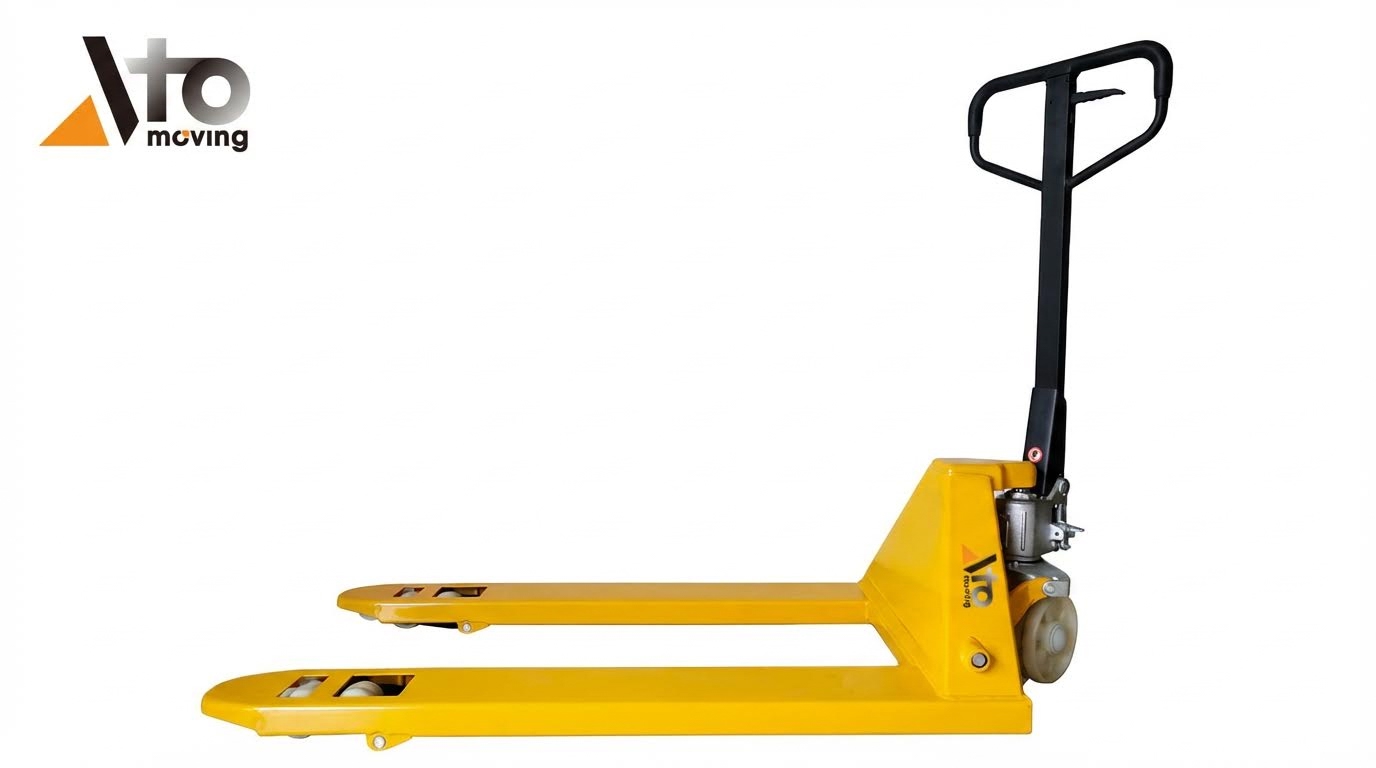
Selecting fork width for pallet type and load pattern
Fork width must match pallet geometry and how the load sits on the deck. This is where most “how wide is a manual pallet jack” mistakes show up in the field.
Use these practical targets when pairing fork width to pallet type and load pattern.
| Pallet / Load scenario | Typical pallet size | Recommended fork outer width | Typical fork size option | Why it works |
|---|---|---|---|---|
| US GMA / 48×40 stringer pallet, general mixed loads | 1219 × 1016 mm (48×40 in) | ≈ 680 mm (26–27 in) | 680 × 1200 mm forks (wide option) | Forks sit under both stringers; good support for heavy, uneven loads. |
| Euro pallet, block pallet, lighter boxed goods | 800 × 1200 mm | ≈ 540–560 mm (21–22 in) | 550 × 1100 mm forks (narrow option) | Fits between blocks, easier entry in tight or low-clearance pallets. |
| Heavy industrial pallet, dense loads | Up to 1200 × 1200 mm | ≈ 680–800 mm | 680 × 1200 mm or widened forks 800–1000 mm (custom) | Wider stance reduces deflection and tipping risk on tall, heavy loads. |
| Small cartons, half pallets, display pallets | Smaller than 800 × 1200 mm | ≈ 400–550 mm | Narrow forks 400–500 mm (custom narrow) | Reduces interference with shelving and fixtures, better for point-of-sale handling. |
Key rules when selecting fork width and length:
- Fork outer width should be slightly less than the pallet’s inner opening, so the forks enter cleanly without rubbing. Fork outer width should be slightly smaller than pallet inner width.
- Fork length should cover at least two-thirds of the pallet length for stable support. Fork length ≥ 2/3 of pallet length.
- Standard manual pallet jacks commonly use 550×1100 mm and 680×1200 mm fork sets, covering most Euro and US pallets. Typical fork dimensions.
How this ties back to “how wide is a standard pallet jack”
Many people ask how wide is a standard pallet jack and assume there is only one answer. In practice, “standard” in many warehouses means a unit with about 27 inches overall fork width and 48 inches fork length, sized for 48×40 pallets. Common 27×48 configuration. But from an engineering standpoint, you should treat 550×1100 mm and 680×1200 mm as two “standard families” and match them to your pallet mix and load pattern instead of chasing a single universal width.
Choosing widths for narrow aisles and high‑throughput zones
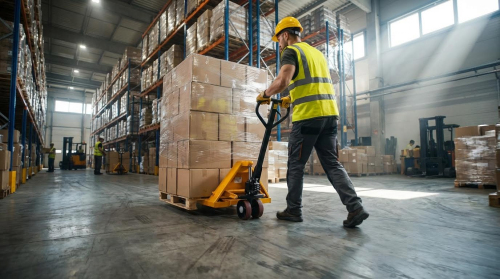
Width choice changes once aisle clearance and traffic flow become constraints. Here, maneuverability and cycle time matter as much as pallet coverage.
Use the matrix below when you balance pallet jack width against aisle width and throughput targets.
| Operating environment | Typical aisle width | Preferred jack width / fork size | Main advantage | Trade‑offs |
|---|---|---|---|---|
| Very narrow aisles, dense racking | ≤ 1.5 m | Narrow forks 400–500 mm, overall width ≈ 20 in Narrow‑aisle options | Reduced swing radius, easier turning in tight cross‑aisles. | Less lateral stability; not ideal for tall or top‑heavy loads. |
| Standard warehouse aisles, mixed traffic | ≥ 1.8 m | 550×1100 mm or 680×1200 mm forks, overall ≈ 21–27 in Standard sizes | Good balance of load stability and maneuverability. | May still be tight at dock doors or staging zones if aisles are poorly laid out. |
| High‑throughput staging, cross‑dock, shipping lanes | Wide, open staging lanes | Wider forks 680–1000 mm, longer forks up to 1200 mm Extended options | Higher stability at speed, can handle heavier or double‑length loads. | Larger turning radius; unsuitable for tight storage aisles. |
When sizing for narrow aisles and high throughput, apply these checks:
- Ensure at least 6 inches of side clearance beyond the pallet jack’s widest point for safe travel and turning. Minimum clearance guidance.
- Confirm that the turning radius of the jack (typically around 1265–1335 mm for low‑profile units) fits within cross‑aisles and dock pockets. Typical turning radius.
- In high‑traffic zones, prioritize a width that reduces steering corrections and side impacts, even if it is slightly wider than the minimum that fits the pallet.
Practical selection workflow for planners
Step 1 – Start from the pallet: List your top 3 pallet sizes and their inner openings. Map each to a fork length (≥ 2/3 pallet length) and candidate fork width.
Step 2 – Overlay aisle geometry: Check your narrowest aisle and tightest turn. Subtract at least 6 inches from that width to find the maximum acceptable jack width. Clearance requirements.
Step 3 – Choose the dominant “standard”: If most loads are on 48×40 pallets, a 27‑inch‑wide jack with 48‑inch forks is a robust default. If Euro pallets dominate, 550×1100 mm becomes the practical standard.
Step 4 – Add specialty units only where needed: Use ultra‑narrow or extended‑fork units as special tools, not as the only fleet, to avoid mismatches and damage.
Final Thoughts On Specifying Pallet Jack Width
Width choice is not just a catalog line. It sets how safely the jack supports pallets, how it behaves on the floor, and how fast people can work. Fork outer width and spacing must follow pallet openings and stringer lines, or the load rides on weak boards and invites breakage and tip‑over. Wheel layout and service height then fix the support polygon and how the truck handles joints, slopes, and damaged areas.
At the same time, aisle width and turning radius limit how wide you can go. Narrow jacks help in tight aisles but cut stability, especially with tall or dense loads. Wider forks improve support and confidence but demand more clearance and better planning of rack and lane geometry.
The best practice is simple. Start from your pallet fleet, not from a “standard” number. Map your top pallet sizes and load patterns to 550×1100 mm, 680×1200 mm, or a justified custom size. Check each candidate width against real aisle dimensions, floor quality, and worst‑case load height. Then standardize on one or two widths for most work, and use specialty Atomoving units only where geometry truly requires them. This engineering‑first approach keeps operators safer and throughput higher over the long term.
Frequently Asked Questions
How wide is a standard pallet jack?
A standard pallet jack is designed to fit the most commonly used pallet sizes. The fork width of a standard pallet jack is typically around 540mm, which works well with standard pallets measuring 800mm x 1200mm. Pallet Truck Size Guide.
What are the different widths available for pallet jacks?
Pallet jacks come in various widths to accommodate different pallet sizes and types:
- Standard Width: Around 540mm, suitable for general use.
- Narrow Width: Approximately 450mm, ideal for smaller pallets like printer pallets.
- Wide Width: For specialized applications such as pallet-wide containers, which can be about 2.44 meters internally. Pallet Wide Container Info.