Industrial facilities used pallet lifting machines to move, stack, and store palletized loads safely and efficiently. This article compares the core categories of pallet handling equipment, from simple pallet jacks to advanced stacker cranes and automated storage systems, to answer queries like “what is the machine that lifts pallets” in a precise engineering context. You will see how capacity, reach, aisle layout, and powertrain choices influence equipment selection and system design.
Later sections examine engineering trade-offs between forklifts, stackers, jacks, and AS/RS, then connect these to safety, lifecycle cost, automation, and digital tools such as driverless units and digital twins. The final summary distills practical decision rules so operations engineers can specify the right pallet lifting system for a given throughput, height, and space constraint profile.
Core Types Of Pallet Lifting Machines
Engineers answering “what is the machine that lifts pallets” must distinguish between several equipment families. Each machine class offers different lift heights, automation levels, and cost structures. Understanding these core types helps match pallet lifting technology to layout, throughput, and safety requirements.
Manual And Electric Pallet Jacks
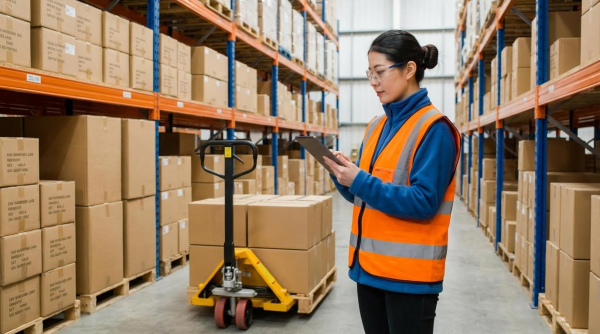
Manual pallet jacks were the simplest machines that lifted pallets a short distance off the floor. Operators pumped a hydraulic handle to raise the forks about 50–200 mm, just enough for rolling movement. Typical rated capacities ranged from 1 000 kg to about 2 500 kg. These units worked best for short horizontal moves in small warehouses, trucks, and retail backrooms.
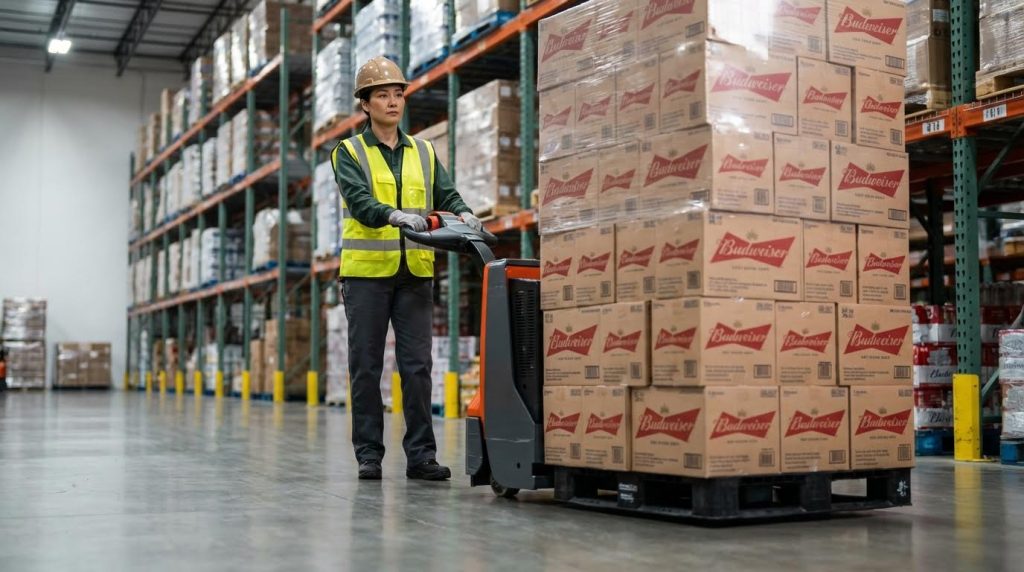
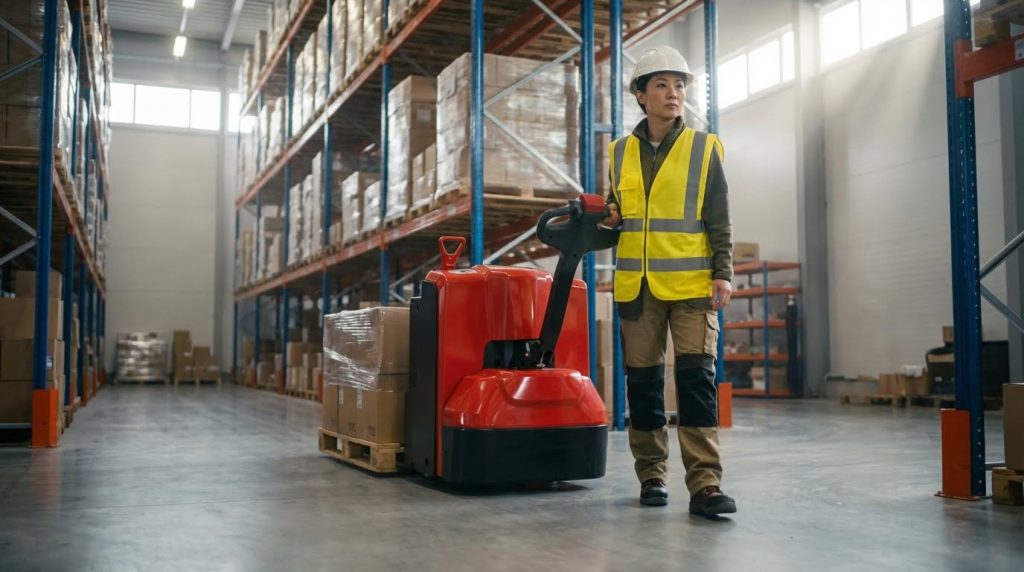
Electric pallet jacks, also called powered pallet trucks, used battery-driven traction and lift motors. They reduced operator effort and increased cycle rates compared with manual versions. Capacities often reached 2 500 kg to 3 500 kg, with similar low lift heights limited to ground-level transport. Electric variants required battery management, charger infrastructure, and more formal operator training.
For the search intent behind “what is the machine that lifts pallets,” pallet jacks answered the question for low-level, short-distance handling. They offered low acquisition cost, high maneuverability, and minimal infrastructure impact. However, they could not stack pallets vertically or service high racking. Engineers therefore treated them as ground-transport devices, not full lifting systems.
Walk-Behind And Ride-On Stackers
Walk-behind stackers bridged the gap between pallet jacks and forklifts. They used powered masts to lift pallets to medium heights, often up to about 4–6 m. Operators walked behind the chassis and controlled travel and lift via a tiller arm. These units handled loads from roughly 1 000 kg to 2 000 kg, depending on mast height and wheelbase.
Ride-on, or rider, stackers added a standing platform or seated position. This configuration improved travel speed and reduced fatigue over longer distances. They still operated mainly in narrower aisles than typical counterbalanced forklifts. Engineers used stackers where racking heights remained moderate and throughput sat at low to medium levels.
Compared with pallet jacks, stackers answered “what is the machine that lifts pallets” when vertical placement was required. They stacked pallets into lower racking levels and serviced mezzanines or dock interfaces. However, their stability envelope and residual capacity limited very high lifts or heavy loads. Designers often selected them for compact warehouses with controlled load ranges.
Counterbalanced And Reach Forklifts
Counterbalanced forklifts were the traditional answer when users asked which machine lifted pallets throughout a facility. A rear counterweight balanced the front load, allowing the forks to project without outriggers. These trucks typically handled 1 500 kg to over 5 000 kg, with lift heights from about 3 m up to 7–8 m in standard warehouse applications. They worked indoors and outdoors, depending on tire and powertrain selection.
Reach forklifts, or reach trucks, used outriggers and a pantograph or moving mast to extend the forks into racking. This architecture allowed narrower aisle widths than counterbalanced trucks for the same lift height. Typical capacities ranged from about 1 000 kg to 2 500 kg at lift heights that could exceed 10 m in high-bay warehouses. Designers used reach trucks where space utilization and racking height dominated requirements.
Both counterbalanced and reach forklifts supported higher duty cycles and more varied attachments than pallet jacks or basic stackers. They answered “what is the machine that lifts pallets” for intensive, multi-shift operations with tall racking. However, they required strict operator certification, structured traffic management, and more complex maintenance regimes.
Stacker Cranes And AS/RS Systems
Stacker cranes operated as rail-guided machines inside Automated Storage and Retrieval Systems (AS/RS). They lifted pallets to multi-level racking, often above 20 m, within very narrow aisles. A mast, carriage, and shuttle or fork assembly moved in coordinated vertical and horizontal axes. Warehouse Management Systems controlled missions, sequencing, and inventory locations.
Compared with manually driven equipment, stacker cranes represented a fully automated answer to the pallet lifting question. They handled high-density storage, especially in cold stores and high-throughput distribution centers. Their design minimized aisle width and maximized cube utilization. However, they required significant capital investment, structural integration, and specialized commissioning.
AS/RS solutions replaced many forklift movements for repetitive storage and retrieval tasks. They reduced direct labor, improved inventory accuracy, and enabled 24/7 operation with consistent performance. Engineers evaluated them when pallet flows were stable, volumes were high, and building geometry supported tall, narrow aisles. For mixed operations, facilities often combined AS/RS stacker cranes with conventional forklifts, stackers, or pallet jacks at inbound and outbound interfaces.
Engineering Comparison: Capacity, Reach, And Layout
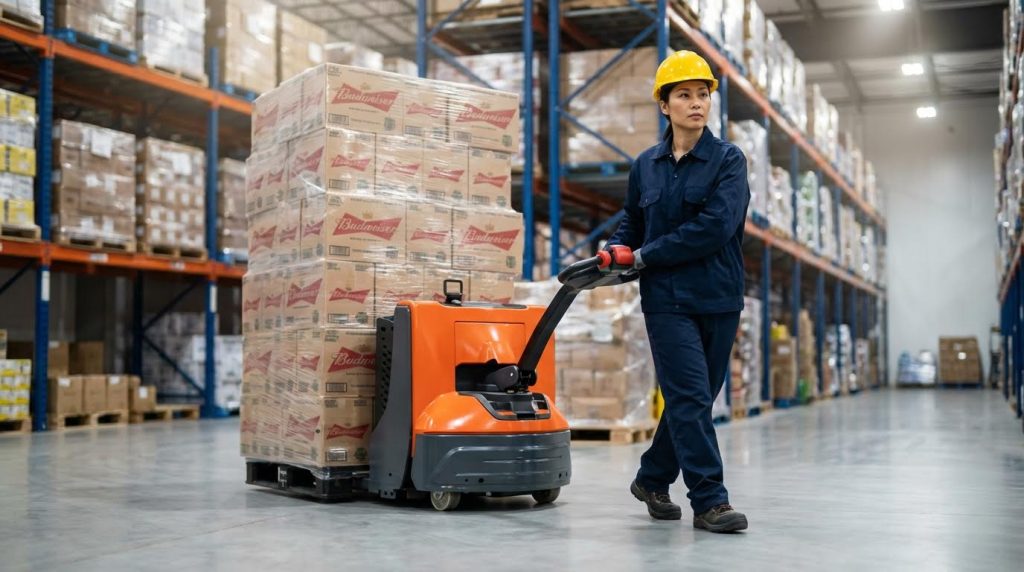
Engineers comparing what is the machine that lifts pallets must quantify capacity, reach, and spatial impact. Pallet jacks, stackers, forklifts, and automated systems each occupy a distinct performance envelope. Proper comparison focuses on rated load, lift height, duty profile, maneuverability, and integration with racking and dock layouts. These parameters determine which pallet lifting machine delivers the lowest total handling cost per pallet moved.
Load Capacity, Lift Height, And Duty Cycles
When asking what is the machine that lifts pallets, capacity and lift height define the first screening criteria. Manual and electric pallet jacks typically handled 1 000–2 500 kg with lift heights around 0.2 m, suitable only for ground-level transfer. Walk-behind and ride-on stackers increased lift height up to roughly 6 m and often carried 1 000–2 000 kg, allowing low to mid-level stacking. Counterbalanced and reach forklifts routinely managed 1 500–5 000 kg with mast heights exceeding 10 m in standard warehouse configurations.
Stacker cranes in AS/RS systems operated at even greater heights, serving multi-level racking that exceeded 20 m in some installations. Engineers defined duty cycles using lift frequency, travel distance, and operating hours per shift. Pallet jacks suited intermittent, low-intensity duty, while stackers and forklifts handled continuous multi-shift use with appropriate cooling and hydraulic design. AS/RS stacker cranes supported the highest duty cycles due to automated control, optimized acceleration profiles, and coordinated traffic management by warehouse software.
Maneuverability In Aisles And Dock Interfaces
Maneuverability drove equipment selection in narrow aisles and at dock interfaces. Pallet jacks offered the smallest turning radius and minimal overall length, enabling operation in aisles near 1.8 m wide, ideal for back-of-store and compact warehouses. Walk-behind stackers required slightly wider aisles due to mast and chassis length but still worked effectively in constrained spaces where forklifts could not operate efficiently. Ride-on stackers and standard counterbalanced forklifts typically needed 2.7–3.5 m aisles, depending on load length and steering geometry.
Reach trucks and very narrow aisle (VNA) trucks optimized maneuverability in high-bay racking with aisle widths around 1.6–2.0 m by rotating the mast or forks instead of the chassis. At docks, forklifts interfaced best with trailers because of their higher travel speed, ramp-climbing capability, and ability to place pallets at different trailer positions. Pallet jacks remained effective inside trailers for short shuttling moves, especially where dock levelers and smooth floors reduced rolling resistance. Stacker cranes did not enter docks directly; instead, they interfaced through infeed and outfeed conveyor stations that decoupled trailer operations from internal storage movements.
Power Options, Batteries, And Energy Efficiency
Power architecture significantly affected lifecycle cost and sustainability when choosing what is the machine that lifts pallets. Manual pallet jacks relied entirely on human input, eliminating energy consumption but limiting throughput and ergonomics. Electric pallet jacks and walk-behind stackers typically used 24 V or 36 V battery systems, balancing weight, cost, and runtime for low to medium duty cycles. Rider stackers, reach trucks, and most indoor forklifts used 36 V or 48 V traction batteries to support higher travel speeds and lift heights.
Traditional counterbalanced forklifts in outdoor or mixed-use applications historically used internal combustion engines, but electric variants increasingly replaced them to reduce emissions and noise. Stacker cranes and AS/RS shuttles relied almost exclusively on electric drives with regenerative braking, returning energy to the power bus during lowering and deceleration. Engineers evaluated energy efficiency using kilowatt-hours per pallet moved, factoring in acceleration profiles, idle losses, and charging strategy. Modern battery technologies, such as lithium-ion, reduced charging times and supported opportunity charging, which increased availability for high-intensity operations. Correct battery sizing, charger placement, and ventilation planning formed a critical part of warehouse layout design.
Space Utilization: Racking, VNA, And AS/RS Design
Space utilization linked directly to equipment geometry and required clearances. Pallet jacks and basic stackers worked best with conventional wide-aisle racking, where aisles often measured 3.0–3.5 m to accommodate manual maneuvering and turning. Standard counterbalanced forklifts also operated in wide aisles, trading floor space for flexibility and straightforward rack design. Reach trucks and VNA trucks enabled narrower aisles and higher racking, increasing pallet positions per square metre without full automation.
Stacker cranes in AS/RS installations maximized volumetric utilization by operating in very narrow aisles dedicated to automated movement. These systems allowed dense, tall racking with minimal clearance between vehicle and structure, controlled by precise guidance and software. Engineers compared scenarios using layout simulations that considered pallet flow, dwell times, and congestion. For low-throughput or variable operations, wide-aisle layouts with forklifts or stackers often remained optimal due to lower capital cost and simpler reconfiguration. For high-throughput, repeatable flows, AS/RS designs with stacker cranes delivered superior space utilization and predictable travel paths. Selecting the right machine that lifts pallets therefore required balancing density, flexibility, and capital intensity against the long-term handling profile of the facility.
Selection, Safety, And Lifecycle Cost Factors
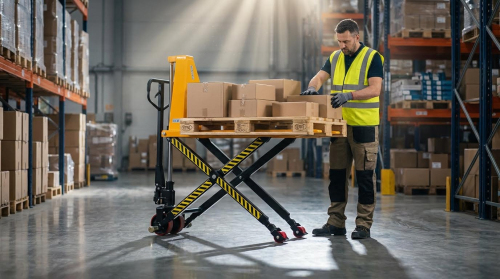
Engineers and operations managers who ask “what is the machine that lifts pallets” must look beyond basic definitions. The correct answer depends on throughput, lift height, aisle geometry, and lifecycle cost. This section explains how to match pallet lifting machines to load profiles, comply with OSHA, and manage maintenance and automation decisions over the full equipment life.
Matching Equipment To Throughput And Load Profile
When people search “what is the machine that lifts pallets,” they often mean manual pallet jacks, forklifts, or stackers. Each option fits a specific throughput and load profile. Manual pallet jacks suit low-throughput sites that move light to medium loads over short distances, typically up to about 2,500 kg and lift heights around 0.2 m. Electric pallet jacks handle similar loads but support higher cycle rates and reduce operator fatigue in small warehouses, retail backrooms, and loading docks. Stackers bridge the gap between jacks and forklifts. Manual and semi-electric stackers support several tonnes and reach up to roughly 6 m, which fits low to medium stacking frequency. Electric walk-behind or ride-on stackers fit small to mid-size warehouses with moderate pallet turnover and limited aisle width. Forklifts and stacker cranes suit high-throughput, multi-shift operations with intensive vertical storage. Counterbalanced forklifts handle heavier loads and mixed tasks such as truck loading, block stacking, and dock work. Reach trucks and AS/RS stacker cranes serve high-bay racking and very narrow aisle systems where vertical travel and storage density dominate the business case. Matching equipment to throughput avoids oversizing, which inflates capital and energy costs, and undersizing, which causes congestion and excessive labor hours.
OSHA Compliance, Training, And Ergonomics
Regardless of which machine lifts pallets, OSHA regulations require systematic hazard control. Powered industrial trucks, including electric pallet jacks, stackers, and forklifts, fall under OSHA 29 CFR 1910.178. Facilities must implement operator training, evaluation, and refresher programs. Manual pallet jacks usually do not require formal certification, but employers still must train staff on safe use, load limits, and pedestrian interaction. Training should cover pre-use inspections, rated capacity, center-of-gravity behavior, and safe travel speeds, especially on slopes and dock plates. Ergonomics strongly influences equipment choice. Manual pallet jacks and stackers demand more physical effort, so they fit shorter shifts or low-intensity tasks. Electric units reduce push–pull forces and help control musculoskeletal risk. Features such as adjustable tiller height, proportional lift controls, and low-effort steering reduce strain and improve precision in narrow aisles. Good ergonomic design also lowers error rates, which directly improves safety. Clear visibility, low mast deflection, and intuitive control layouts reduce collision risk around racking, pedestrians, and dock edges. Combining OSHA-compliant training, ergonomic equipment, and well-marked traffic routes significantly reduces injury rates and unplanned downtime.
Maintenance Regimes And Predictive Monitoring
Lifecycle cost depends heavily on maintenance strategy for pallet lifting machines. Manual pallet jacks require simple routines: daily visual checks, wheel and bearing inspections, and periodic lubrication of pivot points and hydraulic components. Electric pallet jacks and stackers add batteries, chargers, electrical harnesses, and power electronics to the maintenance scope. Engineers should define daily operator checks, weekly functional tests, and scheduled service intervals based on operating hours, not just calendar time. Forklifts demand structured multi-level maintenance. Typical regimes include daily operator inspections, first-level service after roughly 500 operating hours, and deeper inspections around 2,500 hours. Tasks include cleaning, tightening fasteners, checking mast rollers, inspecting hydraulic cylinders, and replacing filters for internal combustion units. Predictive monitoring further optimizes lifecycle cost. IoT sensors can track motor currents, hydraulic pressure, vibration, and battery parameters to detect early degradation. Data-driven alerts help schedule component replacements before failures stop production. For high-value assets such as stacker cranes or driverless forklifts, predictive maintenance protects uptime and justifies higher capital cost by reducing emergency repairs and inventory loss due to stoppages.
Automation, Driverless Units, And Digital Twins
Automation changes the answer to “what is the machine that lifts pallets” from a single device to a cyber-physical system. Driverless forklifts and automated stacker cranes use LiDAR, cameras, and embedded controllers to navigate pre-defined routes and storage locations. They move pallets with repeatable accuracy and maintain constant speeds, which improves safety and throughput in medium to large facilities. However, they introduce higher initial cost and more complex maintenance for sensors, networks, and software. Digital twins extend this concept further. A digital twin is a dynamic virtual model of the warehouse, including pallet lifting machines, racks, and traffic flows. Engineers use it to simulate new layouts, throughput scenarios, and control strategies before physical changes occur. This reduces commissioning risk for very narrow aisle systems and AS/RS projects. Digital twins also support continuous optimization. They ingest live data from equipment, compare actual performance against models, and highlight bottlenecks or underutilized assets. When combined with driverless units, digital twins help tune speed limits, acceleration profiles, and charging strategies. For smaller operations, partial automation such as task guidance, fleet management software, and basic telematics can still improve safety and lifecycle cost without full driverless deployment.
Summary: Choosing The Right Pallet Lifting System
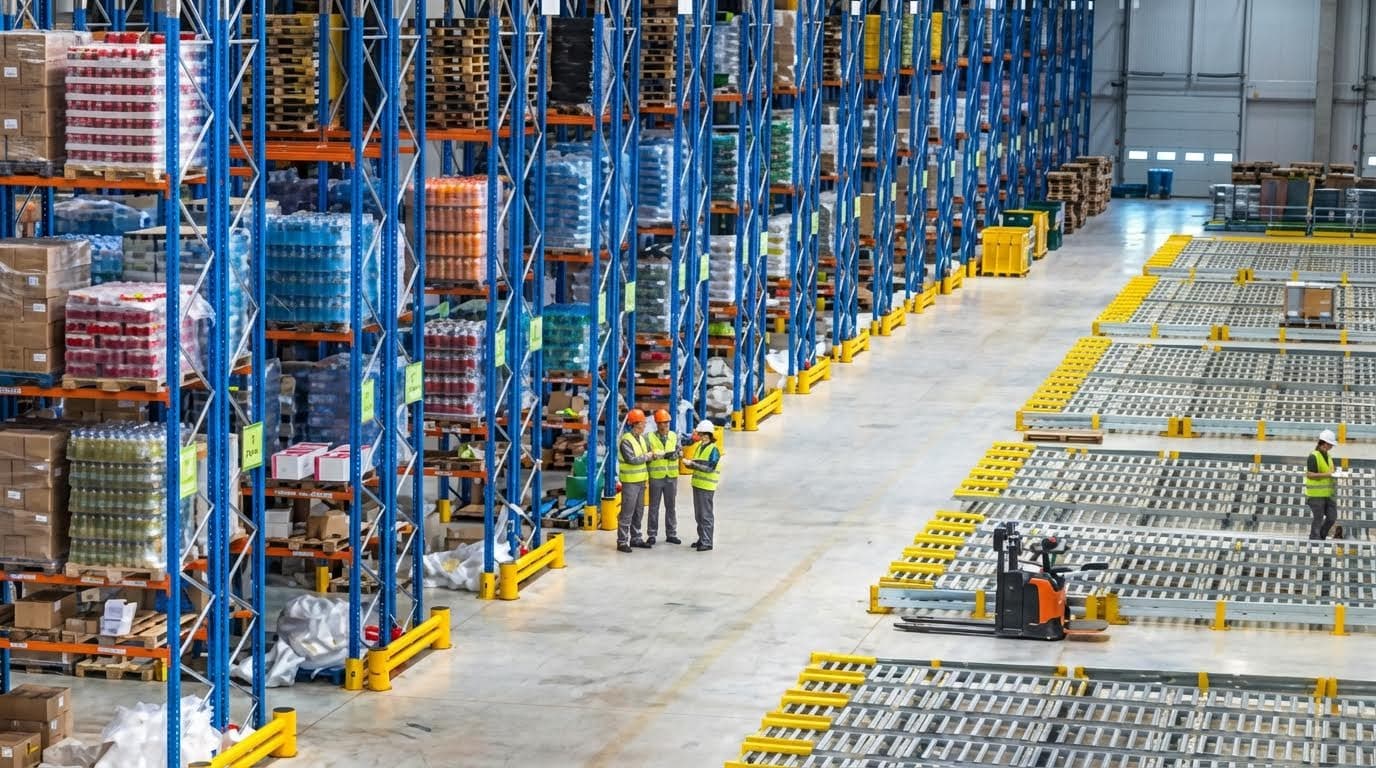
For search intent around “what is the machine that lifts pallets,” the answer depends on load, height, and automation needs. At the simplest level, that machine is the pallet jack, which lifted pallets a few centimetres for short horizontal moves. As requirements increased, engineers specified stackers, forklifts, or automated stacker cranes to add lift height, reach, and throughput.
From a technical standpoint, pallet jacks offered low-cost, low-lift capability, ideal for light to medium loads and tight retail or small warehouse spaces. Stackers extended lift heights to roughly 6 m, bridging the gap between jacks and full forklifts for low to mid-level racking. Forklifts handled heavier loads, dock interfaces, and mixed tasks, while AS/RS stacker cranes maximized cube utilization and eliminated manual driving in high-density facilities. This spectrum allowed precise matching of “the machine that lifts pallets” to layout, duty cycle, and safety requirements.
Industry practice moved steadily toward higher automation and data integration. Driverless forklifts and stacker cranes integrated with WMS and digital twins improved slotting, routing, and energy use. IoT sensors enabled predictive maintenance, reduced unplanned downtime, and supported longer equipment life across jacks, stackers, and forklifts.
When selecting equipment, engineers evaluated not only capacity and lift height but also training obligations, OSHA compliance, and lifecycle cost. Manual solutions minimized upfront spend but increased ergonomic risk and labor cost at scale. Automated and driverless systems demanded higher capital and more complex maintenance yet delivered consistent safety behavior and throughput gains.
Going forward, facilities rarely relied on a single “machine that lifts pallets.” Instead, they deployed a layered fleet: pallet jacks for floor-level moves, stackers or forklifts for vertical handling, and AS/RS where volume and density justified the investment. This balanced approach aligned technology level with operational risk, budget, and future flexibility, ensuring that pallet lifting systems evolved with the warehouse rather than constraining it.