If you are asking how high can you stack empty pallets on a truck, the safe answer is: only as high as fire codes, trailer geometry, and stability allow. This guide explains the real engineering limits behind pallet stack height so you can write rules that keep loads legal, stable, and efficient. You will see how OSHA and NFPA limits translate into pallet counts, and how floor conditions, center of gravity, and driver visibility set your true maximums in day‑to‑day operations.
Defining Safe Pallet Stack Heights On Trucks
Safe pallet stack height on trucks is governed by trailer clear height, fire codes, and stability rules, not just how many pallets you can physically fit in. When people ask “how high can you stack empty pallets on a truck,” the practical answer is normally 15–18 pallets high, provided you still meet NFPA, OSHA, and sprinkler clearance requirements.
Typical pallet counts by truck type
For real-world operations, typical safe stack heights for empty pallets on trucks fall around 15 pallets in box trucks and 18 pallets in semi-trailers, assuming sound floors and stable stacks. These counts keep within common 4.5–4.6 m code ceilings and typical trailer roof clearances while preserving visibility and handling safety.
| Truck / Location Type | Typical Internal Clear Height | Typical Empty Pallet Count (Vertical Stack) | Approx. Stack Height | Operational Impact / Best For… |
|---|---|---|---|---|
| Box truck (local delivery) | 2.6–2.8 m | ≈15 pallets | ≈1.8–2.3 m | Stays below roof bows and dock doors; workable visibility for forklift drivers. |
| Semi-trailer / dry van | ≈2.6–2.8 m | ≈18 pallets | Up to ≈2.4 m while leaving headroom | Maximizes backhaul of empties while staying clear of roof structure. |
| General “max height” guideline for trucks | Depends on vehicle | Varies with pallet thickness | ≈4.5 m (15 ft) upper bound | Used as a hard ceiling in planning; in most trailers the roof limits you first. |
| Dock staging under sprinklers | Sprinkler elevation minus 0.46 m | Often below truck-only limits | Height set by sprinkler clearance plane | Controls “how high can you stack empty pallets on a truck” when parked at the dock. |
- Box trucks: About 15 empty pallets per stack – Balances capacity with roof clearance and driver visibility.
- Semi-trailers: Around 18 empty pallets per stack – Uses full van height without contacting roof bows.
- Driver visibility: Keep stacks below ≈1.5 m where possible – Reduces blind spots and collision risk when moving stacks inside trailers.
- Manual handling limit: Max 6 pallets if hand-stacked – Controls fall and musculoskeletal risks during loading.
How to translate pallet counts into meters
To turn “15 pallets high” into a metric stack height, multiply pallet thickness by the count. For example, a 1200 × 1000 mm pallet that is 140 mm thick stacked 15 high gives ≈2.1 m. Always compare this to trailer clear height and any sprinkler clearance plane before approving a rule.
💡 Field Engineer’s Note: In mixed fleets, I standardize on the lowest trailer clear height when writing “max 15-pallet” or “max 18-pallet” rules. This avoids a stack that is legal in one van becoming jammed into roof bows or dock headers in a shorter body later in the route.
Regulatory limits: OSHA, NFPA, and fire codes
Regulations do not answer “how high can you stack empty pallets on a truck” with a single universal number; instead, OSHA and NFPA set stability, fire load, and sprinkler clearance limits that your own pallet-count rules must sit under. In practice, the NFPA 4.6 m idle pallet limit and the 460 mm sprinkler clearance rule become the hard vertical boundaries for empty pallet stacks on trucks and at docks.
| Regulation / Code | Key Height / Requirement | What It Means for Empty Pallets on Trucks |
|---|---|---|
| NFPA idle empty pallet rule | Max stack height ≈4.6 m; single pile footprint ≤37 m² | Sets an absolute ceiling for idle stacks; truck loads parked or staged must stay below this. |
| OSHA 29 CFR 1910.176(b) | Stacks must be stable, blocked, interlocked, and limited in height | Requires engineering judgment on “how high” based on stability, not just geometry. |
| OSHA 29 CFR 1910.159(c)(10) | ≥460 mm vertical clearance below sprinklers | Any truck or pallet stack parked under ceiling sprinklers must sit at least 0.46 m below the sprinkler plane. |
| State OSHA plans & local fire codes | May impose stricter limits; penalties for serious violations up to ≈USD 16,131–16,323 per item, and ≈USD 161,323 for willful/repeat | Fire marshals can demand lower stack heights or smaller pile footprints than NFPA alone. |
- NFPA 4.6 m limit: Treat as the upper bound for idle empty pallet piles – Truck stacks that are staged or parked are “storage” in the eyes of the code.
- Sprinkler plane: Subtract 460 mm from sprinkler elevation – This often gives a lower, building-specific limit than NFPA’s 4.6 m.
- OSHA stability rule: “Blocked, interlocked, and limited in height” – Justifies capping truck stacks at 15–18 pallets even if more could fit.
- Local enforcement: Always confirm with your fire marshal – They may restrict pallet storage in certain zones or near egress routes.
How to apply codes to your own max pallet count
Start with your trailer clear height. Subtract any sprinkler clearance that applies at your docks. Then check that the resulting number is below 4.6 m. Finally, reduce further for stability and visibility (often down to 15–18 pallets) to comply with OSHA’s “stable and limited” language.
💡 Field Engineer’s Note: When I write site rules, I never publish a height right at 4.6 m or right at the sprinkler plane. I build in at least 150–300 mm of safety margin so that minor floor dips, pallet warp, or driver error do not turn a compliant “on paper” stack into a real-world code violation.
Engineering Factors That Govern Maximum Stack Height

Engineering limits on how high can you stack empty pallets on a truck come from trailer geometry, floor conditions, stack pattern, and vehicle dynamics, not just a single pallet-count rule.
Even if codes allow up to about 4.5–4.6 m of idle pallet height, most trucks run far lower practical limits so stacks stay stable under braking, cornering, and vibration in transit. Understanding these engineering factors lets you defend your chosen pallet-count limits to safety teams, insurers, and regulators.
Trailer geometry, floor conditions, and roof clearances
Trailer internal height, door openings, and floor quality set a hard ceiling on how high you can stack empty pallets on a truck in real life.
Most dry vans and box bodies have internal clear heights around 2.6–2.8 m, which is why fleets typically cap empty pallet stacks at roughly 15 units in box trucks and about 18 in semi‑trailers. These counts keep the stack top below roof bows and dock doors and leave working headroom for handling and lashing. Source
| Vehicle Type | Typical Internal Clear Height | Typical Max Empty Pallets in One Stack | Resulting Stack Height (Approx.) | Operational Impact |
|---|---|---|---|---|
| Box truck | 2.6–2.8 m | ≈15 pallets | ≈1.8–2.3 m | Leaves headroom for forks, avoids roof impact at docks |
| Semi‑trailer (dry van) | ≈2.7–2.8 m | ≈18 pallets | ≈2.2–2.5 m | Maximizes backhaul pallets but still clears roof bows |
| Code ceiling for idle pallets (general) | ≥4.6 m allowed for piles | Varies | Up to 4.6 m | Theoretical fire‑code cap; usually not reachable inside trailers |
Floor condition is just as critical as roof height. Engineers assume a flat, continuous deck without debris, ice, or steps so pallet feet sit fully supported and load paths run straight into the floor. Any local step, patch, or soft spot can tilt the base and reduce the safe stack height well below the theoretical pallet count. Source
- Flat deck: Keep the first pallet layer fully supported – prevents rocking and progressive lean as height increases.
- Clean surface: Remove shrink‑wrap scraps, strapping, ice, and oil – avoids low‑friction slip planes at the base.
- Uniform pallets: Group by type and size – reduces gaps and maintains vertical load paths through the stack.
How roof and dock geometry can silently cut your pallet count
Even if a trailer is 2.8 m inside, the dock door, dock shelter, or internal logistics posts can sit 50–150 mm lower. If you build a stack to the trailer roof at the yard, it may strike the dock header when you back in. Always confirm the tightest vertical restriction in the entire route: yard, dock, and internal staging.
💡 Field Engineer’s Note: On older trailers with sagging roofs, I assume 50–75 mm less clear height than the nameplate. A stack that “just fits” in the yard can catch a roof bow on a crowned yard or ramp, then lean dangerously as the trailer flexes during travel.
Stack patterns, interlocking, and anti-slip interfaces
Above about 10 pallets high, stack pattern and friction interfaces start to control how high you can stack empty pallets on a truck more than the pallet count itself.
Empty pallets are light and stiff, so side loads from braking and cornering matter more than vertical crushing. Straight‑column stacking gives strong vertical support but poor resistance to lateral shear; interlocked patterns sacrifice a little vertical stiffness but greatly improve side‑load stability. OSHA requires stacks to be stable, blocked, interlocked, and limited in height to prevent sliding or collapse. Source Source
| Design Choice | Effect on Stack Behavior | Best For… |
|---|---|---|
| Straight (column) stack | High vertical capacity, low lateral resistance | Short stacks, very tight blocking on all sides |
| Interlocked / rotated layers | Improved shear resistance, better “one piece” behavior | Taller stacks (10–18 pallets) in mixed‑direction forces |
| High‑friction mat under base | Raises friction coefficient at floor interface | Trailers with smooth or painted floors |
| Anti‑slip sheets between layers | Limits layer‑to‑layer sliding under braking | Very tall stacks or long‑distance hauls |
| Mechanical blocking (load bars, posts) | Physically stops gross movement | High‑risk routes, emergency‑braking scenarios |
- Interlocking: Alternate pallet orientation every layer or every second layer – ties the stack together against side pushes.
- Friction control: Use friction mats or high‑grip sheets under and within stacks – raises the force needed to start sliding.
- Blocking and bracing: Use load bars, straps, or side blocking – prevents a “domino” lean into adjacent freight.
When to move from straight to interlocked stacking
A practical rule many sites adopt: up to about 8–10 empty pallets, straight stacking is acceptable on a clean, high‑friction floor with good side blocking. Above that, especially in over‑the‑road trailers, interlock layers and introduce friction aids or mechanical restraints to keep the stack together during hard braking.
💡 Field Engineer’s Note: The failure I see most often is not toppling but “unzipping” of a tall straight stack under a hard brake. The bottom few pallets slide 50–100 mm, the stack leans, then the top third peels off. Interlocking and a simple friction mat at the base almost always stop this.
Center of gravity, vehicle dynamics, and braking loads
Vehicle dynamics under braking and steering ultimately decide how high you can stack empty pallets on a truck without tipping or sliding the stack.
Even though NFPA allows idle empty pallet piles up to about 4.6 m high, trucks rarely approach that because acceleration loads in transit are far higher than static warehouse conditions. Tall, narrow stacks raise the combined center of gravity (CoG), making them more sensitive to deceleration, lane changes, and road shocks. Source
| Factor | Engineering Effect | Operational Impact |
|---|---|---|
| Stack height vs. base width | Higher height‑to‑width ratio raises tip‑over risk | Keep tall stacks wide and centrally located in the trailer |
| Braking deceleration | Forward inertial force acts at the CoG | Higher CoG increases tendency to slide or tip during hard braking |
| Cornering / lane change | Side acceleration shifts effective weight | Unbraced stacks can lean into walls or other freight |
| Visibility for drivers | Stacks above ≈1.5 m block rear view | Limit height or use spotters when maneuvering forklifts |
Stacks taller than about 1.5 m already start to reduce rearward visibility for forklift drivers, and stacks above roughly 1.5 m (≈60 in) can significantly block their view, increasing collision risk while loading and unloading. Source
- Lower CoG: Keep the heaviest or stiffest pallets at the bottom – improves stability under sudden deceleration.
- Central placement: Center tall stacks between trailer sidewalls – reduces roll moment and wall impact risk.
- Conservative height: Use lower limits on routes with frequent hard braking or poor roads – prevents progressive leaning and collapse.
Why “code‑legal” height can still be unsafe on a moving truck
The 4.5–4.6 m limits in fire codes assume static piles on a flat floor with no vehicle dynamics. In a truck, you add 0.3–0.5 g of forward and lateral acceleration during real braking and swerves. That extra load can turn a code‑compliant height into a rollover risk, which is why fleets commonly cap stacks around 15–18 pallets even though the math could allow more.
💡 Field Engineer’s Note: When I set site‑specific limits, I start from visibility (≈1.5 m), then check trailer height and worst‑case braking. If those numbers disagree, I pick the lowest and round down to a simple pallet count so operators never have to guess “how high can you stack empty pallets on a truck” in the moment.
Applying Codes And Best Practices In Real Operations
In real operations, you control how high you can stack empty pallets on a truck by applying fire codes, sprinkler clearance, inspection rules, and handling limits, then locking them into daily procedures and training.
Sprinkler clearance at docks and staging areas
Sprinkler clearance often becomes the tightest limit on how high can you stack empty pallets on a truck that is parked or staged under ceiling protection.
NFPA and OSHA both require at least 460 mm of vertical clearance between the sprinkler deflector and the highest stored material, including empty pallet stacks. Sprinkler clearance requirements create a flat “no-storage” plane across the whole dock or staging bay.
For trucks backed into a dock door, engineers start from the sprinkler elevation, subtract the 460 mm clearance, then subtract the trailer floor height to find the maximum allowable pallet stack height inside the truck while it sits at that door. Dock sprinkler interactions often drive lower limits than over-the-road practice alone.
| Parameter | Typical Value / Rule | How It Affects Pallet Stack Height | Operational Impact |
|---|---|---|---|
| NFPA idle pallet cap | ≈4.6 m maximum stack height | Hard ceiling for empty pallet piles in storage or staging | Prevents “tower” stacks even if trailer volume allows taller |
| Sprinkler clearance | ≥460 mm below sprinkler deflector | Top of pallets must stay under this clearance plane | May reduce truck stack height at low-bay docks |
| Box truck internal clear height | ≈2.6–2.8 m | Fits about 15 empty pallets per stack with headroom | Avoids roof contact and eases loading/unloading |
| Semi-trailer internal clear height | Similar 2.6–2.8 m range | Typically supports stacks of ≈18 empty pallets | Balances capacity with rollover and impact risk |
At docks, you must treat any truck parked under sprinklers as “storage” for fire-code purposes, even if it will leave in an hour. That means the combination of NFPA’s ≈4.6 m idle pallet limit and the 460 mm clearance can easily cap stacks around 2.0–3.0 m depending on building height. Code-based height limits must be written into dock SOPs.
- Mark clearance planes: Paint or tape lines on dock walls/posts at the maximum allowed pallet height – staff see instantly when stacks are too tall.
- Separate “load” vs “stage” zones: Keep tall pallet stacks away from sprinklered staging lanes – reduces code conflicts when trucks dwell at doors.
- Control door assignments: Use low-bay doors for shorter pallet stacks – avoids last-minute down-stacking to meet sprinkler rules.
- Check floor-to-sprinkler distance: Verify actual measured height, not drawings – old buildings often have lower clearances than plans show.
How to calculate your maximum dock-side stack height
Measure from floor to sprinkler deflector, subtract 460 mm for clearance, then subtract trailer floor height (if loading inside the truck). The result is your absolute maximum pallet stack height under that sprinkler zone, even if the truck body could safely hold more.
💡 Field Engineer’s Note: In low-bay docks with sprinklers at 4.0–4.5 m, the 460 mm clearance often forces pallet stacks below what the trailer could otherwise carry. Lock a conservative dock-side limit into your procedures so drivers don’t “build to the roof” inside the truck and then discover they violate clearance the moment they park under the sprinklers.
Inspection, sorting, and damaged pallet removal

Inspection and sorting rules decide whether you can safely reach theoretical height limits or must stop lower because of weak, damaged pallets.
OSHA requires pallets to be stacked evenly and securely and mandates regular inspections for cracks, splinters, or compromised integrity. OSHA pallet safety regulations emphasize removing damaged units from service and placing heavier, stiffer pallets at the bottom of stacks.
Engineering guidance notes that cracked stringers, loose deck boards, and protruding nails reduce stiffness and can pull safe stack height below nominal code caps like the ≈4.6 m NFPA limit. Inspection and sorting practices therefore become a direct control on how high empty pallets can be stacked on trucks in real life.
- Pre-stack inspection: Check each pallet for broken stringers, missing boards, or exposed nails – prevents sudden collapse within a tall stack.
- Sort by type and size: Keep similar pallets together (all 1,200 × 1,000 mm wood, etc.) – maintains straight, predictable load paths.
- Remove “bad actors” early: Pull warped or cracked pallets to a repair/reject area – avoids building height on a weak base.
- Heaviest and stiffest at bottom: Place stronger pallets in the lowest layers – improves overall column strength and stability.
| Condition Found | Recommended Action | Effect on Safe Stack Height | Best For… |
|---|---|---|---|
| Cracked or split stringer | Remove from stack; send to repair or scrap | Prevents sudden buckling in lower layers | High stacks in trailers or high-bay staging |
| Loose / missing deck board | Reject or repair before reuse | Reduces risk of point loading and tilt | Mixed pallet-size operations |
| Warped or twisted pallet | Limit to low stacks or single-layer use | Caps stack height well below code maximums | Short-haul or in-plant moves |
| Mixed pallet sizes in one stack | Rebuild into uniform stacks | Improves vertical alignment and stability | Busy cross-docks and returns areas |
Simple dock checklist before building tall stacks
Ask three questions: Are all pallets structurally sound? Are they all the same footprint and style in this stack? Is the floor clean, flat, and dry where the stack will stand? If any answer is “no,” reduce the planned height or rebuild the stack.
💡 Field Engineer’s Note: In accident investigations, we often found one or two badly damaged pallets buried low in a tall stack. They passed a quick glance but failed under vibration and braking. A 10–15 second inspection per pallet at the building stage is far cheaper than a spilled stack and blocked dock later.
Visual limits, training, and handling equipment rules
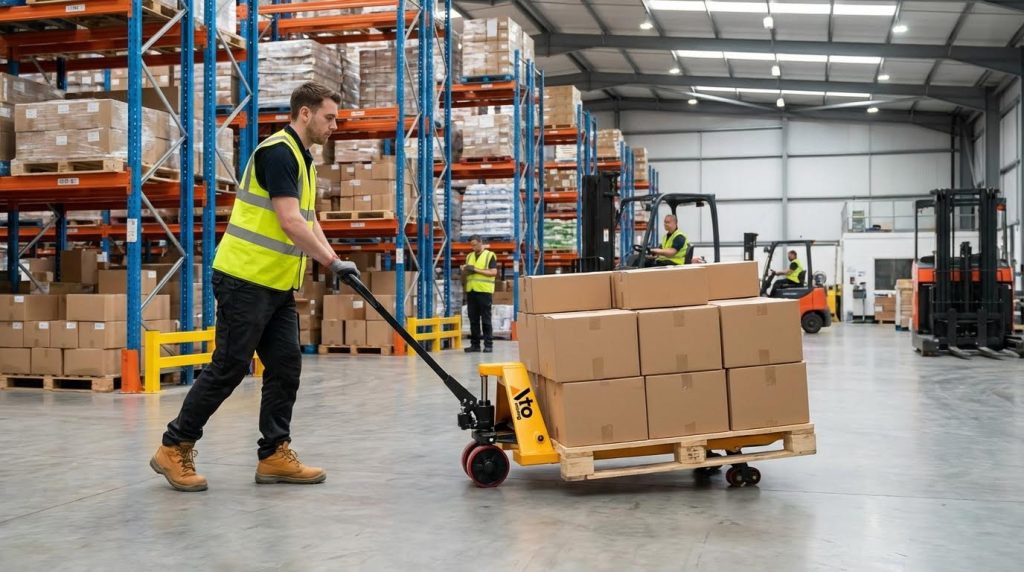
Visual limits, operator training, and equipment rules translate abstract height numbers into clear, enforceable answers to how high can you stack empty pallets on a truck in daily operations.
Stacks taller than about 1.5 m already reduce rearward visibility for forklift drivers, and stacks above roughly 1,520 mm (60 inches) can severely block the view. Visibility and dynamics limits show why safe stack height is often lower than pure structural or code limits, especially during vehicle motion and emergency braking.
Operational guidance also sets handling-specific limits: manual stacking of empty pallets should not exceed about six units, and workers should not down-stack from above roughly nine units to avoid fall and musculoskeletal risks. Forklifts and manual pallet jack can handle taller stacks, but only within rated capacities and stability envelopes. Handling equipment limits must be embedded into site rules.
| Scenario | Typical Limit | Reason | Operational Rule of Thumb |
|---|---|---|---|
| Manual stacking by hand | ≤6 empty pallets | Controls strain and fall risk | Above 6, switch to mechanical handling |
| Manual down-stacking | No down-stacking from >9 pallets | Reduces overhead reach and instability | Use forklift to lower tall stacks first |
| Forklift transport visibility | ≈1.5 m height for good rearward view | Taller stacks block line of sight | If vision is blocked, drive in reverse or lower stack |
| Typical box truck stack | ≈15 empty pallets | Matches 2.6–2.8 m interior height with headroom | Common limit for local deliveries |
| Typical semi-trailer stack | ≈18 empty pallets | Uses height efficiently while limiting rollover risk | Standard for many long-haul operations |
- Painted height bands: Mark maximum pallet height on trailer posts, dock doors, and warehouse walls – gives instant visual go/no-go feedback.
- Link rules to OSHA training: Tie stack-height limits to OSHA 29 CFR 1910.176(b) and powered truck training – operators understand both the “what” and the “why.”
- Write equipment-specific limits: Define different max stack heights for manual, pallet jack, and forklift handling – avoids “one-size-fits-all” rules that people ignore.
- Stop-work authority: Train staff to halt loading if a stack leans or visibility is lost – prevents tip-overs and collisions before they happen.
Embedding rules into your safety program
Include pallet stack-height diagrams in your powered industrial truck training, post laminated charts at each dock door, and add stack checks to pre-shift inspections. Align these with OSHA and local fire-code requirements so supervisors can enforce them confidently.
💡 Field Engineer’s Note: The safest facilities I’ve seen treat pallet stack height like speed limits: clearly posted, enforced, and tied to equipment type. When operators know that “manual = 6 high, forklift in truck = 15–18 max, plus sprinkler and visibility rules,” incidents with empty pallets drop sharply.
Final Thoughts On Setting Pallet Stack Height Limits
Safe pallet stack height on trucks is never a single “magic number.” It comes from geometry, codes, and real vehicle behavior working together. Trailer clear height and dock sprinklers set hard ceilings. OSHA and NFPA then add stability and fire‑load limits that you must respect even when the truck is moving.
Engineering factors tighten those limits further. Floor flatness, pallet condition, stack pattern, and friction decide whether a tall stack stays upright under braking and cornering. Center of gravity and driver visibility then cap the height again, which is why well-run fleets hold empty pallet stacks near 15 pallets in box trucks and 18 in semi‑trailers, not at code‑maximum heights.
The most effective operations turn these technical rules into simple field standards. They mark sprinkler planes and height bands, sort and inspect pallets before stacking, and set different limits for manual, pallet jack, and forklift handling. They also train operators to stop when stacks lean or sight lines disappear.
For a practical, defensible answer to “how high can you stack empty pallets on a truck,” treat code limits as the outer fence, then step down to conservative, easy-to-remember pallet counts that your teams can apply every shift.
Frequently Asked Questions
How high can you stack empty pallets on a truck?
The maximum height for stacking empty pallets is typically around 15 feet, as recommended by safety guidelines to prevent accidents. Pallet Storage Safety Tips. However, this may vary depending on the stability of the pallets and the conditions during transit.
- Ensure pallets are evenly aligned to avoid leaning or collapsing.
- Secure stacks with straps or shrink wrap to prevent shifting.
- Avoid stacking higher than 15 feet in busy or unstable environments.
What is the height limit for stacking pallets safely?
For safe stacking, the height should not exceed 15 feet for most pallets. This limit ensures stability and reduces the risk of collapse. Safe Pallet Stacking Guide. Always consider the load-bearing capacity of the pallets and the environment where they are stored.
- Follow NFPA standards for outdoor storage, limiting height to 15 feet.
- Ensure the stacked area does not exceed 400 square feet for outdoor storage.
- Check local regulations for additional restrictions.