Safe pallet lifting in warehouses is about more than moving wood and plastic; it is managing weight, stability, and people in tight spaces. This guide explains how to lift pallets safely, choose the right equipment, and apply proven rules that cut injuries and damage. You will see how pallet condition, load setup, and operator technique work together with manual pallet jack, hydraulic pallet truck, AGVs, and conveyors. Use it as a practical playbook to raise safety, throughput, and equipment life across your warehouse.
Fundamentals Of Safe Pallet Lifting And Load Setup
Fundamentals of safe pallet lifting and load setup define how to lift pallets without breaking the pallet, damaging product, or injuring people. This section focuses on pallet condition, storage, and load-building rules that directly affect stability and equipment safety.
Pallet condition, inspection, and storage rules
Pallet condition, inspection, and storage rules ensure the support structure is sound before any lifting starts, which is the first control step in how to lift pallets safely.
Inspect every pallet before use: Check for cracks, missing or loose boards, loose blocks, and protruding nails – prevents sudden pallet failure under fork or jack load.Inspection criteria
Reject and segregate damaged pallets: Move cracked or broken pallets to a clearly marked repair/scrap zone – stops unsafe pallets from re-entering circulation.Damaged pallet handling
Store pallets off the floor: Use racks or dunnage to keep wood clear of the floor – reduces moisture uptake, rot, and loss of load capacity.Storage guidance
Control stack height of empty pallets: Limit stack height based on pallet type and floor flatness – prevents tipping stacks and struck-by incidents.
Keep pallet stacks square and aligned: Align corners vertically and avoid leaning columns – improves stability when using pallet jacks or forklifts to pick from the stack.
Separate pallet types and sizes: Do not mix different footprints in the same stack – avoids overhang and point loading that can crush lower pallets.
Clean and dry storage areas: Keep floors free from oil, water, and debris – reduces slip risk for both operators and rolling equipment under the pallet.
How pallet condition changes safe lifting capacity
Even if a forklift is rated for 1,500–2,000 kg, a cracked stringer or broken deck board can fail at a fraction of that. Treat the pallet as part of the lifting system: if it is compromised, reduce load or remove it from service.
💡 Field Engineer’s Note: In cold or damp zones, wood pallets absorb moisture and become heavier yet weaker at the same time. Build your inspection checklist to flag dark, swollen, or moldy boards, and derate or scrap those pallets before they ever see a 1,000 kg load.
Load building, weight distribution, and stability
Load building, weight distribution, and stability rules define how to lift pallets without tipping by controlling the center of gravity and securing the product to the pallet deck.
Most real accidents with “good” pallets come from poor load setup, not from the pallet itself. Good pallet condition plus bad load building is still an unsafe system.
Load-Building Rule
Key Practice
Operational Impact
Center the load
Place cases so the combined center of gravity sits near the geometric center of the pallet
Reduces side tipping when turning with pallet jacks or forklifts
Minimize overhang
Keep product within the pallet footprint where possible
Reduces damage, snagging on racks, and instability during lifting
Heavy items low and central
Put heavier cartons at the bottom and near the pallet center
Lowers center of gravity and improves stability during acceleration and braking
Secure loose items
Use stretch wrap, straps, or bands around the load
Prevents cartons from shifting or falling during transport
Respect equipment capacity
Keep total pallet mass within the rated capacity of pallet trucks or forklifts
Prevents overload and loss of braking and steering control
Loads should be centered on the pallet with minimal overhang to avoid product damage and snagging when lifting and traveling. Centering and overhang Heavier items belong at the bottom layers and close to the middle to prevent tipping when using pallet jacks or forklifts.
Build straight vertical “columns” where possible: Align case corners instead of interlocking every pattern – improves top-load strength for racking or stacking.
Use interlocking patterns only when needed: Interlock for very tall or unstable loads – gains lateral stability but may reduce vertical strength.
Top sheet and corner protection: Add a top sheet and edge protectors before wrapping – spreads strap or film pressure and protects packaging.
Wrap to the pallet deck: Start stretch wrap at or below the bottom deck boards – ties the load to the pallet so they behave as one unit when lifted.
Keep height within safe reach: Avoid exceeding about 1.5–1.8 m unless designed for high stacking – tall, narrow pallets have a higher tipping moment.
Label orientation and access: Face labels and handles outward – reduces twisting and overreaching during picking and depalletizing.
Manual handling and how to lift pallets by hand safely
Manual lifting should be minimized by keeping loads between mid-thigh and elbow height and close to the body. Twisting while lifting must be avoided; workers should turn with their feet instead. Mechanical aids such as pallet jacks, hoists, or lift tables are recommended for frequent or heavy tasks to reduce back and shoulder strain. Manual lifting practices
💡 Field Engineer’s Note: If a pallet feels “top heavy” when you nudge it by hand, assume it will be worse on a moving truck. Rebuild the load with heavy cartons low and central, then re-wrap; correcting stability at the dock is far cheaper than a collapsed pallet in a 10 m high bay.
Pallet Handling Equipment And Operating Techniques
This section explains how to lift pallets safely using the right equipment and techniques, so operators reduce strain, avoid tip‑overs, and keep throughput high in real warehouse conditions.
Manual vs electric pallet trucks and stackers
Manual and electric pallet trucks and stackers handle the same pallet, but they suit very different distances, weights, and daily pallet moves.
Good alternative to small forklifts for aisles around 2.2–2.5 m wide and racking up to medium height.
When deciding how to lift pallets with trucks or stackers, match equipment to three basics: load mass, travel distance, and number of pallet moves per shift. Manual trucks handle low counts and short runs; electric units are safer and faster once you cross roughly 50 pallet moves per day or start pushing loads over long distances. Electric stackers fill the gap where you must lift but a full forklift is not justified.
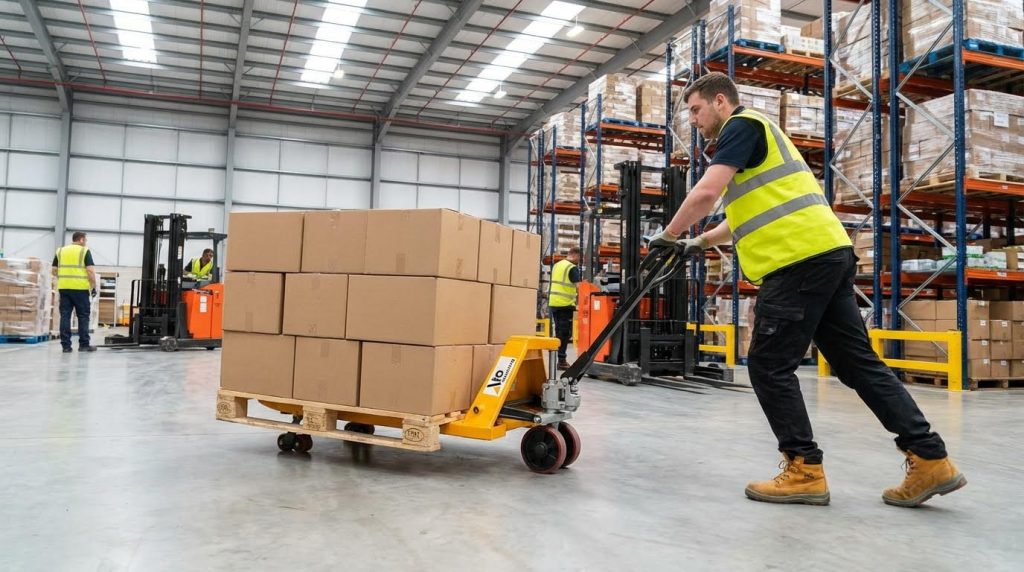
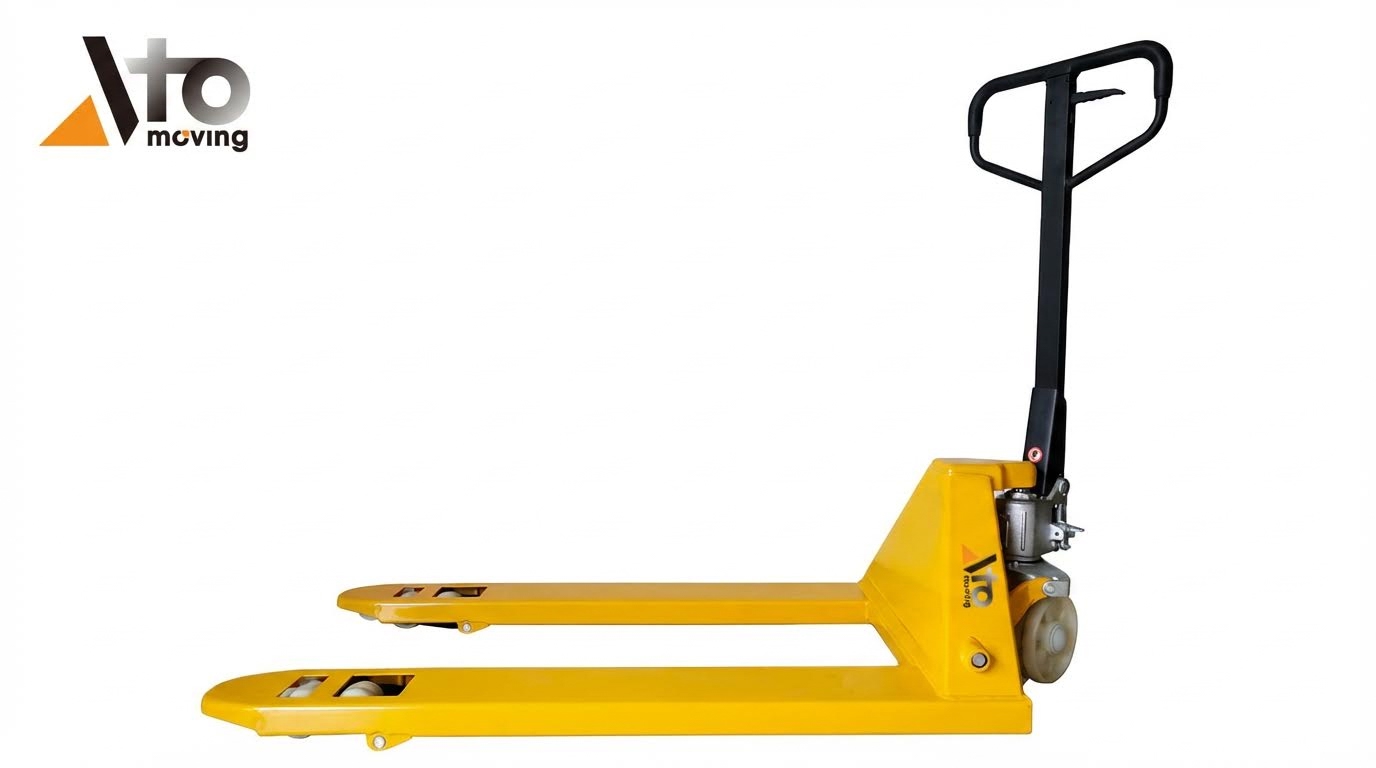
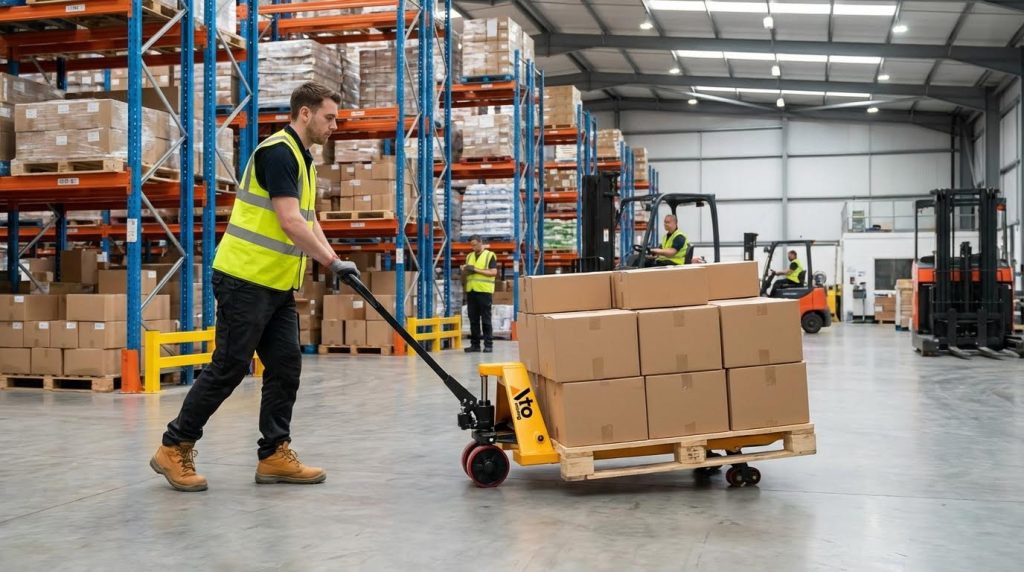
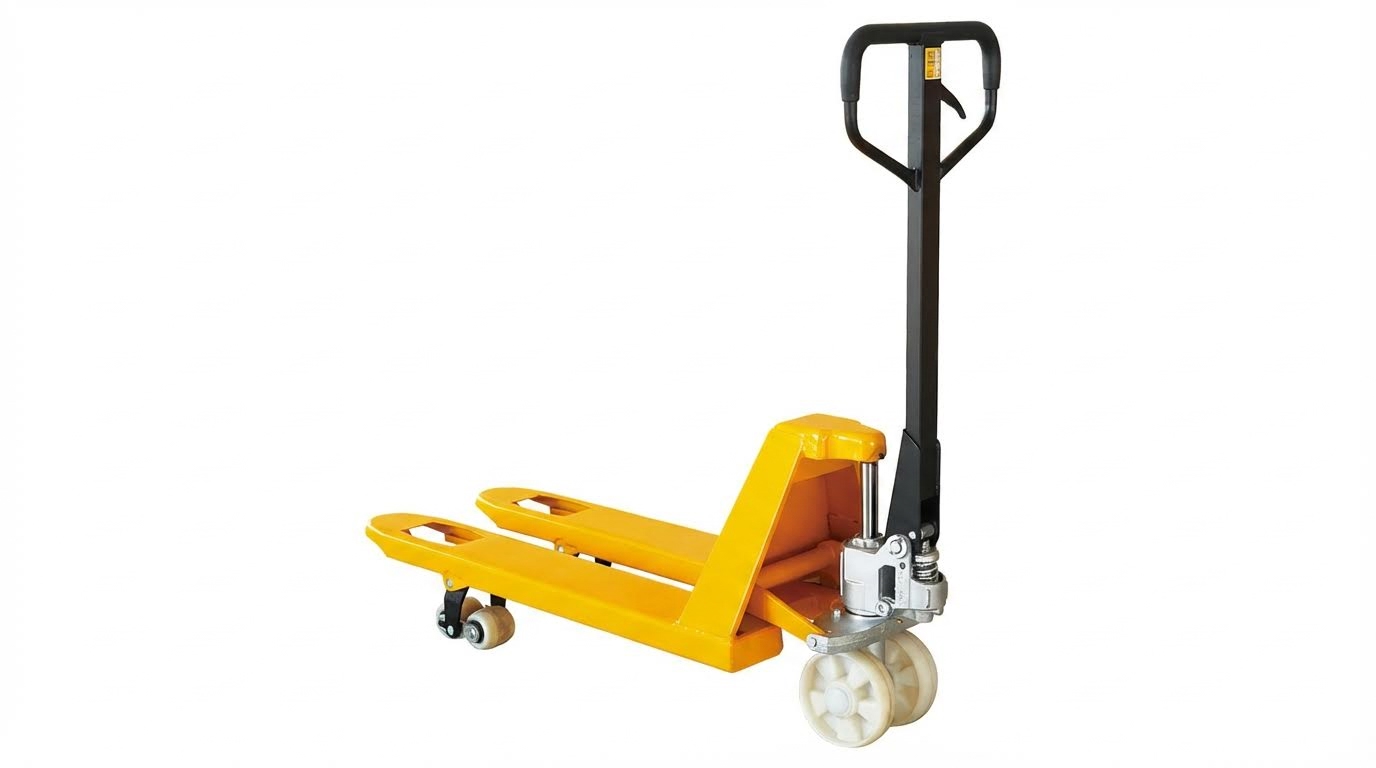
Manual pallet trucks: Best for small warehouses – keep operator push forces within safe limits and avoid slopes.
Electric pallet trucks: Power drive and lift – mitigate wrist, shoulder, and back injuries in high‑frequency work.
Manual stackers: Pump or winch‑lift pallets to low racks – cheap but physically demanding above a few lifts per hour.
Electric stackers: Battery‑powered lift and travel – support dense storage in narrow aisles with less fatigue.
Whatever truck you use, safe operation follows the same core rules: fully insert the forks, center the load, stay within the rated capacity, and raise the pallet only high enough to clear the floor. On slopes, pull a manual pallet jack rather than push it, and avoid sharp turns, sudden stops, or rapid direction changes that can throw the load off balance source.
💡 Field Engineer’s Note: If staff complain that “the jack is heavy” on flat floors, measure the actual push force. Once you routinely exceed roughly 150–200 N over several meters, it is time to switch that lane or task to an electric pallet truck to keep musculoskeletal risk under control.
How to choose between a pallet truck and a stacker
Use a pallet truck if you only move pallets at floor level. Choose a stacker when you must regularly place pallets into racking above about 1.2–1.5 m; this keeps operators from dangerous manual lifting and climbing.
Forklift load centers, mast control, and fork positioning
Forklift load centers, mast tilt, and fork positioning directly control whether the truck stays stable while you lift and transport pallets.
The load center is the horizontal distance from the fork face to the load’s center of gravity. Many forklifts are rated at a 600 mm (24 in) load center, meaning the pallet’s center of gravity must sit at 600 mm or less from the fork face to keep the truck within its rated capacity source. Oversized or off‑center loads effectively increase that distance and can overload the truck even if the pallet’s mass looks acceptable on paper.
Forklift Parameter
Safe Practice
Reason / Physics
Operational Impact
Load center
Keep center of gravity within rated load‑center distance (often 600 mm)
Longer load center increases overturning moment
Controls tip‑over risk when handling long pallets or bulky loads.
Fork insertion
Insert forks as far as possible, at least two‑thirds of load length source
Reduces bending stress on pallet and forks
Prevents broken deck boards and dropped pallets during travel.
Fork spacing
Adjust forks just inside outer pallet stringers
Spreads load evenly across both forks
Minimizes fork deflection and pallet damage.
Mast tilt while traveling
Tilt mast slightly back with elevated load
Moves center of gravity toward truck, improves stability
Helps keep boxes tight against the backrest on rough floors.
Lower center of gravity reduces overturning moment
Clears floor irregularities while maintaining maximum stability.
To approach a pallet correctly, the operator should drive slowly and stop about 200–300 mm in front of the load, line up square, and set the direction control to neutral before raising or lowering the forks source. Once the forks are at the correct height, drive forward until the blades are fully under the pallet, adjust fork spacing if needed, then lift the load about 100 mm above the supporting surface and tilt the mast slightly back to rest the pallet against the backrest.
Step 1: Inspect pallet and load – damaged boards or loose goods can fail under fork pressure.
Step 2: Approach slowly and square – prevents side impacts on stringers and racking.
Step 3: Level forks and insert fully – keeps the pallet flat and reduces bending.
Step 4: Lift 100–200 mm and tilt back slightly – shifts the center of gravity toward the truck for stability.
Step 5: Travel at low speed with wide turns – limits dynamic forces that can topple tall or poorly wrapped loads.
When stacking or tiering, tilt back only enough to stabilize the pallet and never tilt forward with elevated forks except when placing or removing the load from the stack source. For high tiering with reach trucks, heaviest pallets should go on the bottom, lighter loads above, and the rated capacity must be reduced when the mast is fully extended.
Before lifting: Check overhead clearance – avoid striking beams, sprinklers, or trailer roofs.
During travel: Maintain about three truck lengths distance from other vehicles – gives space to stop safely.
When lowering: Stop 200–300 mm from the stack, return mast to vertical, then lower – prevents pushing or dragging the pallet.
💡 Field Engineer’s Note: Many “mysterious” pallet breakages come from partial fork insertion combined with forward mast tilt. Train operators to visually confirm fork tips are near the back of the pallet and to neutralize tilt before setting down; this alone can eliminate a large share of dropped‑load incidents.
How this ties back to how to lift pallets safely
Correct load center, fork placement, and mast tilt keep the forklift within its design stability triangle. That is the engineering backbone behind every safe procedure for how to lift pallets, especially at height or with heavy loads.
AGVs, conveyors, and predictive maintenance
Automated guided vehicles, conveyors, and predictive maintenance programs reduce human error and unplanned downtime in pallet lifting and handling flows.
AGVs automate pallet transport along predefined paths, running continuously without fatigue and using sensors and navigation systems to avoid collisions and protect workers and inventory source. They integrate with warehouse management systems to provide real‑time data on pallet movements and inventory levels, which helps planners balance dock, storage, and picking activities.
Conveyors automate the flow of cases or palletized units over fixed routes, cutting manual travel and lifting. Belt conveyors suit packaging and sorting, modular belts work in hygiene‑sensitive environments, and flexible conveyors help with truck loading and unloading source. Vertical conveyors move items between floors, while pneumatic or vacuum systems handle light goods and reduce contamination risks. The trade‑off is higher initial cost and reduced layout flexibility, so they fit best where flows and building geometry are stable.
Repetitive routes between production, storage, and shipping with predictable flows.
Conveyors
Continuous flow of cases or pallets along a fixed path
High throughput, reduced manual lifting, improved safety source
High‑volume lines and dock areas where building layout is stable.
Predictive maintenance
Condition‑based servicing of trucks, stackers, and conveyors
Fewer breakdowns, safer operation, longer component life source
Any fleet with critical uptime needs or history of in‑service failures.
Predictive maintenance programs track hours, impacts, error codes, vibration, temperature, and hydraulic pressure to schedule service before a failure happens. This helps detect worn mast chains, leaking hoses, or failing pumps in forklifts and stackers, and bearing or belt issues in conveyors, reducing the risk of a pallet being in the air when a critical component fails source.
AGVs: Remove human variability on fixed routes – ideal where “touches per pallet” must be minimized.
Conveyors: Turn stop‑start handling into continuous flow – excellent for docks, sortation, and production linking.
Predictive data: Uses sensors and logs to trigger service – prevents sudden loss of lift or drive during pallet moves.
💡 Field Engineer’s Note: When you deploy AGVs or conveyors, revisit your manual and forklift routes. Leaving old routes active often creates dangerous crossings where automated and manual traffic intersect; redesign aisles and
Selecting Methods For Different Warehouse Applications
Selecting the right pallet handling method starts with throughput, travel distance, lift height, and aisle width, then adds ergonomics and manual handling limits to keep operators safe while maximizing pallet moves per hour.
Core idea: Choose the lightest, simplest equipment that still meets your peak pallet volume – this cuts cost, reduces failure points, and improves safety.
Key factors: Pallet moves per shift, typical load mass, rack height, and narrowest aisle – these directly dictate what can safely turn, lift, and stop.
Safety overlay: Respect forklift load centers, pallet condition, and manual lifting rules – this is the real foundation of how to lift pallets safely.
How this section helps you decide “how to lift pallets”
This section translates basic specs (kg, m, aisle width) into concrete choices: pallet jacks, stackers, forklifts, AGVs, or conveyors. It also shows when to stop using people and start using machines.
Matching equipment to throughput and aisle layout
Matching equipment to throughput and aisle layout means sizing trucks and automation to your pallet volume and the narrowest paths they must travel without compromising safe clearances.
Use equipment that can physically turn within your aisles, reach your highest pallet, and sustain your peak pallet flow without overloading operators or machines. The table below summarizes typical choices based on raw-material guidance for pallet trucks, stackers, forklifts, AGVs, conveyors, and dollies.
Great for ergonomics at workstations but not for long-haul pallet transport.
Throughput rule: Below ~50 pallet moves per day per route, manual tools can work; above that, move to powered or automated options to keep forces within ergonomic limits. (manual vs electric guideline)
Aisle rule: Design aisle width around the largest turning radius you need, not the smallest, and keep at least 200–300 mm clearance each side of the truck body for safe maneuvering.
Height rule: Match equipment mast height to your top beam plus at least 200–300 mm clearance for fork entry and safe mast tilt when placing or retrieving pallets.
Load path rule: If pallets must cross ramps or uneven floors, favor powered equipment with better stability and braking over manual jacks, which are harder to control under heavy loads.
How to check if your aisles fit your trucks
Measure clear aisle width between racks or walls. Compare to the manufacturer’s stated “AST” (turning aisle) for your truck. Add margin for pallet overhang and any floor obstructions like column guards.
💡 Field Engineer’s Note: When you tighten aisles to gain racking space, you often increase impact damage and slow travel. The lost productivity and rack repairs can wipe out the storage gain, so validate aisle widths with real test runs before committing.
Ergonomics, manual handling limits, and depalletizing
Ergonomics, manual handling limits, and depalletizing define how much human muscle you can safely use in how to lift pallets and cases before you must introduce mechanical aids or redesign the workflow.
Raw-material guidance is clear: manual lifting should be minimized, loads should stay between mid-thigh and shoulder height, and twisting must be avoided. Ergonomic picking and depalletizing rules give a strong baseline for safe case handling from pallets.
Body zone: Keep loads between mid-thigh and shoulder height – this is where the spine and shoulders tolerate force best.
Distance: Keep the load close to the body – every extra 100 mm in reach multiplies the bending moment on the lower back.
Twist control: Turn with the feet, not the spine – twisting under load is a common path to disc injuries.
Frequency: As lift counts rise, reduce individual box mass or add mechanical aids – repetition turns “okay once” into a chronic injury risk.
Choosing depalletizing methods
Choosing depalletizing methods means selecting how workers remove cases from pallets so that forces stay within safe limits while maintaining flow to picking or production lines.
The source material describes two main methods: layer-by-layer and pyramiding. Each has different stability and effort implications depending on box friction, mass, and pallet quality. Depalletizing practices explain how to apply them.
Depalletizing Method
Best Load Type
Ergonomic Profile
Stability Requirements
Best For…
Layer-by-layer removal
Light, easy-sliding cases with good friction between layers
Low–moderate effort if case mass is reasonable and height is in the “power zone”
Needs stable pallet, good stretch-wrap or banding removed in stages
High-frequency picking from mixed-SKU pallets with lighter cartons
Pyramiding (removing from top/edges, reshaping stack)
Heavier or non-sliding items that are hard to drag across each other
Higher effort per case but can reduce awkward sliding motions
Requires solid pallet and enough clearance around pallet to step and turn
Lower-frequency depalletizing of heavy or fragile items
Light, high-frequency work: Use layer-by-layer and keep pallet height so that most picks fall between ≈700–1,400 mm from floor.
Heavy or sticky cartons: Use pyramiding to avoid dragging, but shorten pallet height or add lift tables so workers do not bend deeply.
Unstable or damaged pallets: Rebuild the load on a sound pallet before depalletizing – do not let workers “fight” a leaning stack.
When to add mechanical aids for depalletizing
Introduce lift tables, tilt tables, or vacuum lifters when: individual case mass is high, reach distance is large, or pick frequency is high. These devices keep the work in the power zone and cut cumulative spinal load.
Integrating ergonomics into equipment selection
Integrating ergonomics into equipment selection means you choose pallet trucks, stackers, forklifts, and automation not just on speed, but on how well they keep people out of high-risk lifting zones.
For horizontal moves, the raw material clearly recommends electric pallet trucks for medium to heavy loads and higher daily pallet counts, because they reduce push and pull forces and mitigate wrist and back injuries. Manual vs electric pallet trucks provide the throughput breakpoints.
Horizontal transport: Upgrade from manual to electric pallet trucks once operators report fatigue or you exceed roughly 50 pallet moves per day on a lane – this is where push/pull forces start to accumulate into injury risk.
Vertical lifting: Use stackers or forklifts instead of manual handling when pallets must be placed above ≈1.5 m – lifting above shoulder height is inherently risky.
Repetitive case picking: Combine good pallet building (heavy items low and centered) with height-adjustable platforms so workers always pick near elbow height.
Automation triggers: Consider AGVs or conveyors where operators mainly walk long distances between fixed points – this removes low-value walking and reduces fatigue.AGVs and conveyors overview
💡 Field Engineer’s Note: If your incident reports show “strains while breaking down pallets,” your fastest win is usually not a new truck. It is lowering pallet heights, improving load building, and adding one or two lift/tilt tables at the busiest depalletizing points.
Final Thoughts On Safe And Efficient Pallet Handling
Safe pallet handling depends on one idea: treat the pallet, load, and equipment as a single engineered system. Pallet inspection, sound storage, and disciplined load building protect that system at its weakest point. When you keep decks intact, centers of gravity low and central, and wrapping tied into the pallet, you sharply cut tip‑overs and product loss.
Equipment choice then turns geometry and workload into clear decisions. Match pallet trucks, stackers, forklifts, AGVs, and conveyors to aisle width, lift height, and daily pallet moves. Use manual tools only where forces stay within ergonomic limits. Move to powered or automated options when distance, slopes, or frequency rise, and back this with predictive maintenance so trucks and conveyors stay safe in service.
Finally, design every task around the human body. Keep work in the power zone, limit twisting, and add lift, tilt, or vacuum aids where case mass or pick rates climb. Operations and engineering teams that apply these rules as hard standards, not suggestions, will see fewer injuries, fewer dropped loads, and higher throughput. Use Atomoving equipment and these principles together as a continuous improvement framework, and audit them often on the floor, not just on paper.
Frequently Asked Questions
What is the proper way to lift heavy pallets manually?
Lifting heavy pallets manually requires proper technique to avoid injury. Start by placing your feet shoulder-width apart for a stable base. Keep your upper back straight and maintain a neutral posture throughout the lift. Bend at the hips and knees, using your legs to lift instead of your back. For additional safety, consider tipping the pallet onto your thighs while maintaining a wide stance and good posture. Pallet Handling Safety Guide.
How to lift a pallet without a forklift?
If you don’t have access to a forklift, you can use manual techniques. One method is to tip the pallet onto your thighs, using your legs to support the weight. Maintain a wide stance and ensure you’re bending at the hips and knees rather than the waist. This minimizes strain on your back. However, always prioritize using mechanical equipment like pallet jacks or hand trucks whenever possible to reduce physical strain.
What do you call the machine that lifts pallets?
The machine commonly used to lift pallets is called a forklift. Forklifts are designed to safely lift and move heavy loads in warehouses and industrial settings. They come in various types, including electric, propane, and diesel-powered models. Always ensure operators are trained and certified to use forklifts according to safety standards such as OSHA guidelines. Proper Pallet Lifting Guide.