Automated warehouse order picking is the engineered combination of storage technology, robotics, and software to move lines per hour, not just boxes. This guide walks you through architectures, layouts, and control strategies that actually determine throughput, scalability, and cost per order in real facilities.
Drawing on real performance data from AS/RS, shuttles, carousels, AMRs, and goods-to-person systems, we translate specs into layout rules, pathway design, and task-planning principles. Use it as a blueprint to design or retrofit automated picking that is fast, safe, and economically defensible over its full lifecycle.
Core System Architectures For Automated Order Picking
Core system architectures for automated warehouse order picking determine how far people walk, how fast lines per hour scale, and how much you spend per shipped order. The two anchor choices are goods-to-person vs. person-to-goods, then specific AS/RS technologies inside each model.
Goods-to-person vs. person-to-goods models
Goods-to-person systems move inventory to stationary operators, while person-to-goods systems still rely on people (or pick-assist tech) travelling to storage locations. This choice drives layout, labor model, and achievable throughput.
In automated warehouse order picking, “goods-to-person” typically uses AS/RS, shuttles, or AMRs to bring totes or trays to ergonomic stations, cutting walking to near zero and boosting lines per hour by 2–3× compared with manual walking processes. Facilities that implemented goods-to-person robots reported productivity improvements exceeding two to three times traditional manual picking rates, because operators stay put and focus on accuracy instead of travel waste according to field data.
Person-to-goods models keep operators mobile but add guidance and verification. Pick-to-light systems use LEDs at storage locations to show where and how many units to pick, which eliminates search time and increases throughput by 30–50% over paper-based picking while achieving 99.9–99.99% accuracy in documented deployments. Voice-picking uses headsets and speech recognition, reaching 99.9%+ accuracy and working reliably in cold or gloved environments, which makes it attractive for pallet and case picking in chilled or frozen storage areas as reported.
Goods-to-person automation can deliver 300–600 picks per hour at a single station when powered by AS/RS like vertical lift modules, carousels, or shuttle systems in typical designs. Person-to-goods with AMR pick-assist can reach 100–300 lines per hour depending on fleet size, while still using existing rack layouts without structural changes based on AMR performance data.
| Model Type | Typical Tech | Throughput Range | Labor Pattern | Best For… |
|---|---|---|---|---|
| Goods-to-person | AS/RS, shuttles, carousels, cube storage, GTP robots | 300–600 picks/hour per station reported | Stationary pickers, high automation density | High-SKU, high-order-volume e‑commerce, tight SLAs |
| Person-to-goods with pick-assist | Pick-to-light, RF, voice, AMR cart follow | 30–50% faster than paper; 100–300 lines/hour with AMRs for AMRs | Mobile pickers, reduced search time | Brownfield warehouses, mixed pallet/case/eaches |
| Manual person-to-goods | manual pallet jack, carts, RF scanners | Lowest; highly travel-dependent | High walking, variable methods | Small sites, low order volume |
- Goods-to-person focus: Inventory travels, not people – maximizes lines per hour and reduces ergonomic risk.
- Person-to-goods focus: People travel but tech guides them – lowers capex and fits existing rack layouts.
- Hybrid architectures: Combine GTP for each-picking with voice for pallet areas – balances capex with flexibility.
- Accuracy leverage: Light and voice systems reach 99.9%+ – cuts rework and customer complaints.
💡 Field Engineer’s Note: In brownfield sites, I often start with person-to-goods plus AMRs or pick-to-light in the heaviest 10–20% of SKUs, then phase in goods-to-person where travel hot-spots remain. This avoids over-investing in automation in low-velocity zones.
How to choose between goods-to-person and person-to-goods
Use three filters: target lines per hour, order profile (eaches vs. cases), and building constraints. If you need >300 lines per hour per operator and have the clear height, goods-to-person usually wins. If you must reuse existing pallet racking and capex is tight, person-to-goods with pick-assist and AMRs is often the first step.
Key AS/RS types and performance envelopes
Key AS/RS types for automated warehouse order picking include carousels, VLMs, mini-load cranes, shuttles, cube storage, vertical buffers, and floor robots, each with a distinct throughput and payload envelope that must match your order profile.
Vertical carousel modules deliver slow-to-medium velocity items to an ergonomic counter with about 100–400 lines per hour and carrier capacities up to roughly 650 kg (1,430 lbs) per carrier as specified. Horizontal carousels mount dense storage bins on an oval track and can reach up to 600 lines per hour when grouped in pods, with around 900 kg (2,000 lbs) per carrier, which suits fast-moving small parts according to published data.
Vertical lift modules (VLMs) store trays dynamically in a tall enclosed cabinet, saving up to 85% floor space while delivering roughly 125–350 items per hour per unit and handling up to about 1,000 kg (2,200 lbs) per tray in standard configurations. Crane-based mini-load AS/RS handle totes, cases, or trays in single- or double-deep storage; single-deep systems deliver roughly one load per minute (around 60–100 lines per hour), while double-deep can reach about 120 combined putaways and picks per hour by handling two loads at once as reported.
Robotic shuttle systems use many independent shuttles running on multiple levels. They typically achieve 200–700 lines per hour, with higher throughput unlocked by adding more shuttles, and handle cases, totes, or trays from around 15–50 kg (35–110 lbs) each per performance data. Robotic cube storage stacks bins in a dense grid; autonomous robots dig and present bins to workstations, with throughput scaling primarily with robot count and grid design rather than fixed crane speeds based on vendor descriptions.
Vertical buffer modules (VBMs) handle under about 10,000 totes or 25,000 SKUs and pre-stage the next tote to maximize station utilization, often linking via conveyor to remote pick stations for small and medium applications as described. Floor robots (AGVs/AMRs) move shelving or carts, with typical throughput in the 100–300 lines per hour range depending on fleet size and up to around 450 kg (1,000 lbs) per standard shelving unit, or 1,350 kg (3,000 lbs) for heavy-duty models per published specs.
| AS/RS Type | Typical Throughput | Payload Envelope | Operational Impact / Best For… |
|---|---|---|---|
| Vertical carousel | 100–400 lines/hour reported | Up to ~650 kg per carrier | Slow/medium movers in vertical space; ergonomic counter for small parts. |
| Horizontal carousel | Up to 600 lines/hour in pods reported | Up to ~900 kg per carrier | High-velocity each-picking with dense storage and batch waves. |
| Vertical lift module (VLM) | 125–350 items/hour per unit reported | Up to ~1,000 kg per tray | High-SKU, moderate throughput with up to 85% floor-space savings. |
| Mini-load crane AS/RS | ~60–100 lines/hour single-deep; ~120 combined picks/putaways double-deep reported | Totes, trays, or cases | Medium throughput, deep aisles, good for case reserve plus decant to GTP. |
| Robotic shuttle system | 200–700 lines/hour; scalable with shuttles reported | ~15–50 kg per tote/case | High-throughput each-picking, short order cycles, multi-level mezzanines. |
| Robotic cube storage | Variable; scales with robot count described | Bins in stacked grid | Maximum storage density; flexible footprint for irregular buildings. |
| Vertical buffer module (VBM) | Optimized by pre-queuing totes (small to medium throughput) reported | <10,000 totes; <25,000 SKUs | Compact operations needing modular growth and remote pick stations. |
| Floor robots (AGVs/AMRs) | 100–300 lines/hour depending on fleet size reported | Up to ~450–1,350 kg per shelving system | Retrofit into existing racks; scalable pick-assist without heavy construction. |
- Carousels & VLMs: Deliver trays to one face – great for ergonomic, compact GTP stations.
- Shuttles & cube storage: Add robots to lift throughput – ideal when order volumes grow faster than floor space.
- Mini-load cranes: Offer depth and height reach – good for tote/case reserve feeding downstream picking.Designing High-Throughput Automated Picking Layouts
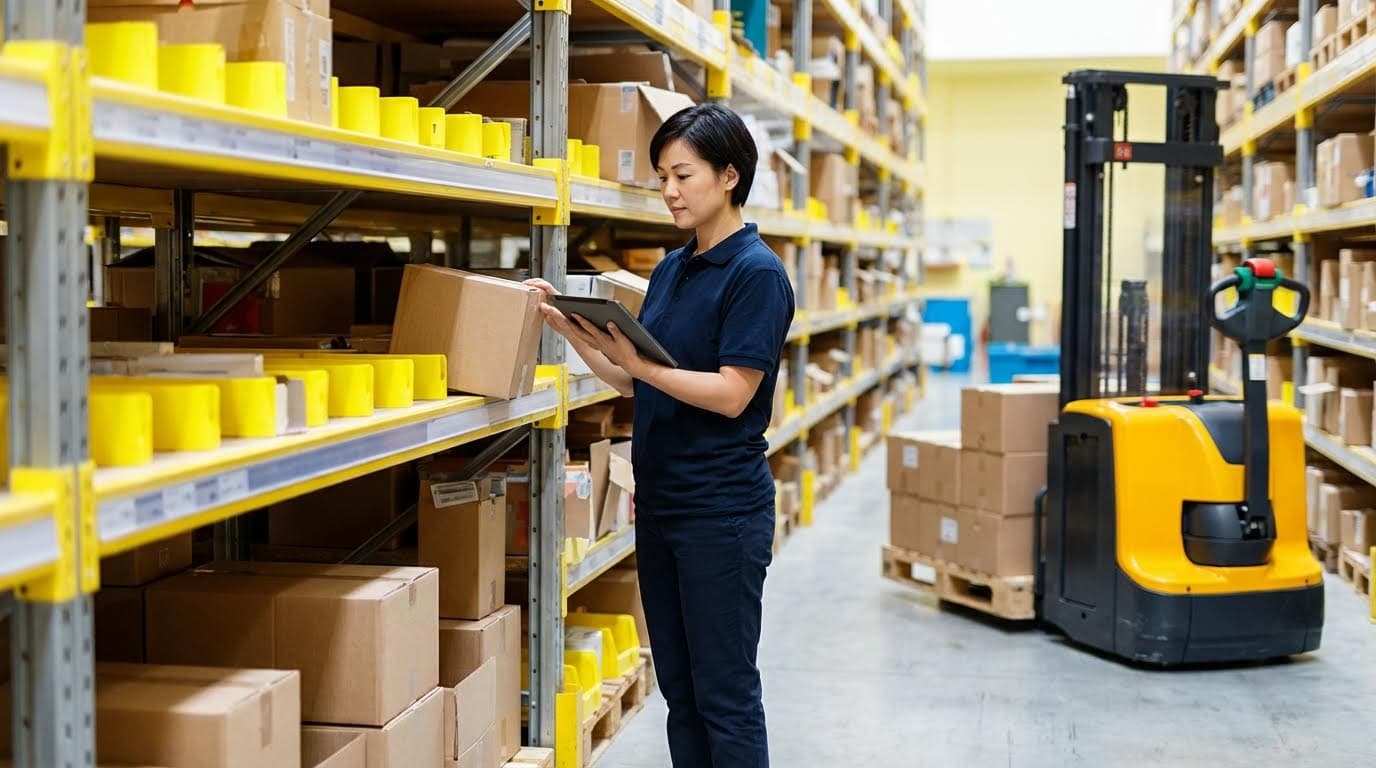 Designing high-throughput layouts for automated warehouse order picking means matching storage technologies, travel paths, and pick stations so every meter and every second drives more lines per hour with safe, repeatable flow.The goal is to turn AS/RS, shuttles, carousels, AMRs/AGVs, and pick tech into one coherent system, not isolated islands of automation. That starts with the physical layout, then slotting logic, then tight WMS integration.Layout patterns for ASRS, shuttles, and carouselsLayout patterns for ASRS, shuttles, and carousels determine how many lines per hour you can get per square meter of building and per operator at the workstation.Different automated storage systems have very different throughput envelopes and space impacts, so you design their position, orientation, and workstation clusters around their strengths, not as generic “racks.”
System Type Typical Throughput Load / Tray Capacity Space Behavior Best Role in Automated Warehouse Order Picking Vertical Carousel Module 100–400 lines/hour per unit (source) ≈ 650 kg per carrier Vertical, compact footprint Slow/medium movers near packing; ergonomic GTP workstations Horizontal Carousel Module Up to 600 lines/hour in pods (source) ≈ 900 kg per carrier Dense horizontal loop Very high-velocity SKU zones feeding clustered pick stations Vertical Lift Module (VLM) 125–350 items/hour per unit (source) ≈ 1,000 kg per tray Up to ~85% floor-space saving High-SKU, medium-velocity GTP wall along a main pick aisle Crane Mini-Load AS/RS ≈ 60–100 lines/hour single-deep; up to 120 picks/hour double-deep (source) Cases, totes, trays High bay, long aisles Reserve and medium-velocity storage feeding multiple pick points Robotic Shuttle System ≈ 200–700 lines/hour depending on shuttles (source) ≈ 15–50 kg per tote Multi-level, high-density Core high-throughput GTP engine for e‑commerce orders Vertical Buffer Module (VBM) Queue-optimized; under 10,000 totes or 25,000 SKUs (source) Light totes Compact, modular Decoupling buffer between AS/RS and remote pick/pack lines Robotic Cube Storage Throughput scales with robots (source) Bins stacked in cube Very high cubic utilization High-SKU, variable demand, footprint-constrained sites
For automated warehouse order picking, you place these systems to minimize transfer distances between storage face and pick/pack, and to keep operators in ergonomic “golden zones.”- Rule 1 – Put GTP walls on the spine: Align VLMs, VBMs, shuttles, and carousels along a central “automation spine” feeding pack lines – this shortens conveyor runs and AMR handoffs.
- Rule 2 – Separate velocity bands physically: Use horizontal carousels and shuttles for the top 20% SKUs and mini-load or VLMs for the long tail – this avoids mixing very fast and slow lines at one station.
- Rule 3 – Design for queuing, not averages: Provide 3–5 tote buffer positions per workstation via VBMs or conveyors – this smooths peaks and protects operator utilization.
- Rule 4 – Protect maintenance access: Leave at least 800–1,000 mm clear service aisles behind AS/RS and carousels – this avoids shutdowns when technicians cannot reach components.
How to choose between VLM, carousel, shuttle, and mini-load in one site Use each technology where its throughput and density match SKU behavior. Shuttles and carousels handle high-velocity small items; VLMs and mini-loads handle medium velocity and deeper storage; cube storage or mini-loads manage long-tail SKUs in constrained footprints.
💡 Field Engineer’s Note: In retrofits, I often rotate carousels 90° so operators face a common central aisle. That single change can cut walking by tens of meters per batch, because pack benches, quality check, and exception handling all sit on the same line of travel.
AMR and AGV pathway and zone design AMR and AGV pathway and zone design decides whether your robots increase throughput or just move congestion from one part of the warehouse to another.Because AMRs and floor robots already cut walking distance by roughly 60–80% in automated order picking machines, the layout must prevent traffic jams so you actually realize that benefit. (source)
Robot Type Typical Throughput Load Capacity Layout Sensitivities Operational Impact Floor Robots / AMRs (GTP transport) ≈ 100–300 lines/hour per robot (source) ≈ 450–1,350 kg per shelving unit Aisle widths, crossing points, charging areas Replaces walking with robot travel; ideal in existing racking AMR Picking (pick-assist) ≈ 100–300 lines/hour depending on fleet size (source) Totes/cases on top deck Human-robot interaction points, safe passing zones Reduces operator walking 60–80% in manual rack areas - Pathway Hierarchy: Define “highways” (main robot corridors, ≥ 2,500–3,000 mm wide) and “local streets” (rack aisles, ≈ 1,800–2,200 mm) – this prevents bidirectional blocking.
- Dedicated Handoff Zones: Create clear buffer areas where AMRs drop totes to conveyors or GTP stations – this keeps robots out of dense human workcells.
- Charging Island Design: Place chargers at the perimeter of robot zones, not in the middle – this avoids dead-ends and keeps low-battery robots from clogging pick paths.
- Turn Radii and End-of-Aisle Space: Leave 1,500–2,000 mm turning pockets at aisle ends – this keeps robots from doing multi-point turns that kill cycle time.
- Segregated Human Walkways: Mark pedestrian lanes with floor tape and visual management – this improves safety and makes robot routing more predictable.
Software and AI implications for robot pathway design Advanced order assignment and path planning algorithms minimize total travel and makespan by jointly deciding which rack each robot should visit and which path it should follow. Multi-agent reinforcement learning approaches have shown lower path cost and better scalability when item types and rack content are diverse. (source)
💡 Field Engineer’s Note: On mixed manual/AMR floors, I design “robot-only” one-way loops around each block of racking and keep humans on cross-aisles. That single directional rule dramatically reduces near-misses and helps the fleet manager keep robot utilization high without complex traffic rules.
Slotting, pick technologies, and WMS integration Slotting, pick technologies, and WMS integration translate your physical layout into actual lines per hour by deciding which SKUs live where, which guidance tech supports each zone, and how the WMS orchestrates tasks.Without engineered slotting and system logic, even the best AS/RS or AMR layout will underperform in automated order picking machines.
- Velocity-Based Slotting: Place the top 20% SKUs that generate 80% of picks in “golden zones” near pack or GTP stations – this can cut travel time by up to 40%. (source)
- Functional Separation: Keep receiving, storage, picking, and shipping in distinct zones – this avoids cross-traffic and protects pick aisles from dock congestion.
- Automation-Aware Slotting: Reserve GTP locations (shuttles, VLMs, VBMs) for SKUs that benefit most from travel elimination – typically small, high-order-frequency items.
Pick Technology Performance Characteristics Best Use Case Layout Implication Pick-to-Light Accuracy 99.9–99.99%; throughput +30–50% vs paper (source) High-velocity, limited-SKU zones Short, dense flow racks along main pick aisles, with easy visual access Voice Picking Accuracy 99.9%+; hands-free operation (source) Case/pallet picking, cold stores Wider aisles for pallet jacks and fewer visual devices on racks Goods-to-Person (GTP) ≈ 300–600 picks/hour per station (source) High-SKU, high-order-volume Cluster stations into pods close to packing, with ergonomic benches Pick-Assist Tech (RF, light, etc.) Up to 40% faster confirmations (source) Hybrid manual/automated zones Provide mounting points, power, and sightlines for devices
WMS and fulfillment management systems are the glue that make these technologies behave like one system instead of separate islands.- AI-Driven Slotting: Use AI to continually reshuffle SKUs based on real demand, not static ABC lists – this can cut order completion time by up to 25% by preventing new bottlenecks. (source)
- Wave / Waveless Logic: Let the WMS or FMS group orders by zone and carrier cut-off – this keeps each pick area working on homogeneous work instead of constant context switching.
Engineering Throughput, Scalability, and TCO
Engineering throughput, scalability, and total cost of ownership (TCO) in automated warehouse order picking means sizing, orchestrating, and governing systems so they hit lines-per-hour targets today and scale without exploding capex or operating risk.
This section links hardware rates, AI task planning, and safety/standards into one engineering model so you can defend your design in both peak season and board meetings.
Dimensioning systems for lines per hour
Dimensioning for lines per hour starts by converting each technology’s raw pick rate into a realistic, end-to-end system throughput under your order mix and staffing model.
The table below summarizes typical performance envelopes for core automated picking and AS/RS technologies used in automated warehouse order picking.
Technology Typical Throughput Load Capacity Best-Use Scenario / Operational Impact Vertical Carousel Module 100–400 lines/hour per workstation (source) ≈ 650 kg per carrier Slow–medium velocity SKUs; good when footprint is tight but vertical space to ~10–15 m is available. Horizontal Carousel Module (pod) Up to 600 lines/hour per pod (source) ≈ 900 kg per carrier High-velocity, medium-SKU zones; ideal when you can dedicate 1–3 operators per pod. Vertical Lift Module (VLM) 125–350 items/hour per station (source) ≈ 1,000 kg per tray High-SKU, lower-line density; excellent where you need dense storage and ergonomic access in 8–16 m height. Crane-based mini-load AS/RS ≈ 60–100 lines/hour single-deep; up to ≈ 120 combined putaway/picks/hour double-deep (source) Cases/totes (typically 20–50 kg each) Deep buffer storage feeding downstream picking; best when travel distances are long (30–100 m aisles). Robotic shuttle system ≈ 200–700 lines/hour per aisle, depending on shuttle count (source) ≈ 15–50 kg per tote/case High-throughput goods-to-person; scalable by adding shuttles for peak seasons. Floor robots (AGVs/AMRs) for GTP ≈ 100–300 lines/hour per robot cluster (source) ≈ 450–1,350 kg per shelving unit Retrofit into existing racks; good when you must avoid major civil works. Goods-to-person picking (GTP) ≈ 300–600 picks/hour per station (source) Tray/tote limited by upstream system Core engine for automated warehouse order picking; minimizes walking and stabilizes labor productivity. To dimension throughput, work backwards from peak demand, not average. For example, if you need 18,000 order lines in a 3-hour peak window, your net requirement is 6,000 lines/hour at the system level.
- Step 1: Define peak window: Use worst historical 15–30 days – Prevents undersizing for promotions or seasonal spikes.
- Step 2: Convert orders to lines: Multiply orders/hour by average lines/order – Aligns design with real picking effort.
- Step 3: Apply efficiency factor: Use 70–80% of theoretical tech rate – Accounts for breaks, micro-stoppages, and exceptions.
- Step 4: Size workstations: Divide required lines/hour by realistic picks/hour per station – Gives operator and station count.
- Step 5: Check buffers: Add 10–20% extra capacity in AS/RS aisles and conveyors – Absorbs variability without queue blow-ups.
Quick example: Sizing GTP stations
Target: 6,000 lines/hour. Assume 450 picks/hour per GTP station (midpoint of 300–600 picks/hour) and 80% utilization. Effective rate ≈ 360 picks/hour. Stations required = 6,000 ÷ 360 ≈ 16.7, so you engineer for 18–20 stations to maintain headroom.
Beyond static rates, intelligent slotting and layout directly influence real throughput. Velocity-based slotting places the top 20% of SKUs (generating 80% of picks) in golden zones to cut travel by up to 40% (source).
💡 Field Engineer’s Note: When you dimension lines/hour, always check floor gradients and lift interface heights. Even a 2–3% slope into a GTP or shuttle zone can slow manual pallet moves, starving high-speed stations that look fine on paper but sit idle in reality.
AI-driven task assignment and path planning
AI-driven task assignment and path planning increase effective throughput by reducing robot and picker travel, smoothing congestion, and better matching racks and tasks to real-time order patterns.
In AMR-based automated warehouse order picking, you are solving a joint order allocation and routing problem, not just “shortest path.” Research on rack-to-order assignment and robot routing showed that jointly optimizing rack contributions and path cost, using reinforcement learning-based algorithms, significantly reduced makespan and cumulative path cost versus heuristics (source).
- Dynamic order batching: Group orders sharing SKUs in the same rack or zone – Cuts redundant visits and boosts lines per robot trip.
- Rack contribution scoring: Score each rack by how many current orders it can satisfy vs travel cost – Prioritizes “rich” racks for early service.
- Multi-agent coordination: Use RL or swarm logic to avoid robot blocking – Maintains flow in narrow 2.0–2.5 m aisles.
- Live re-slotting suggestions: Feed AI slotting outputs back to WMS – Moves rising SKUs closer to GTP, maintaining throughput as demand shifts.
AI-driven SKU velocity mapping can achieve up to 25% faster order completion by continuously re-optimizing slotting from real-time demand signals (source). Combine that with goods-to-person automation, which has delivered 2–3× productivity gains over manual picking in practice (source), and your system-level lines/hour can effectively double without widening aisles or adding mezzanines.
Where AI path planning matters most
AI path planning delivers the biggest gains when: (1) aisles are long (40–80 m), (2) there are many item types per rack, and (3) robot fleets exceed ~20 units. Under these conditions, RL-based multi-agent planners have shown lower makespan and path cost than classic heuristics while keeping memory usage moderate (source).
- Pick-assist tech: Use pick-to-light or RF-directed verification at GTP stations – Improves accuracy to 99.9%+ and boosts lines/hour by 30–50% vs paper picks (source).
- Voice picking in hybrids: Keep voice for pallet/case picks around automated zones – Maintains 99.9% accuracy in cold or glove-heavy areas (source).
- Real-time dashboards: Track picks/hour, robot utilization, and lines/order – Lets supervisors re-balance zones before queues explode (source).
💡 Field Engineer’s Note: In live sites, the biggest AI win is often not exotic RL but simple “no-crossing” rules and time-sliced right-of-way at choke points. That alone can raise AMR fleet throughput 10–15% in 2.4 m aisles without touching hardware.
Safety, standards, and lifecycle cost control
Safety, standards, and lifecycle cost control ensure that high-throughput automated warehouse order picking systems remain compliant, insurable, and economically viable over 10–15 years.
Layout and traffic design directly affect both safety and TCO. Poor layouts increase worker travel, congestion, and maintenance costs, and they limit scalability during peaks (source).
- Functional separation: Physically separate receiving, storage, picking, and shipping – Reduces cross-traffic between forklifts, AMRs, and pedestrians.
- Traffic management: Design one-way AMR and forklift routes with marked crossings – Mitigates collision risk and unplanned downtime.
- Lighting and visibility: Maintain at least ≈ 50–100 lux (5–10 foot-candles) in aisles – Supports camera-based robots and human operators (source).
- Ergonomic stations: Keep pick faces between ≈ 750–1,500 mm height – Reduces musculoskeletal injuries and long-term labor costs.
- Visual management: Use floor tape and color-coded zones – Clarifies AMR paths, pedestrian walkways, and restricted robot cells (source).
From a TCO perspective, you engineer for lifecycle, not just purchase price. Robotic picking cells, for instance, may require investments from roughly RM 500,000 to over 2,000,000 per cell, so you must model maintenance, spare parts, and obsolescence alongside labor savings (source).
Key KPIs to monitor TCO and performance
Use KPIs such as dock-to-stock time, lead time from order to ship, storage utilization (target 80–85%), picks per labor hour, and robot utilization to continuously tune your design and justify upgrades (source). Real-time visibility via WMS and BI tools enables self-correcting operations that balance productivity, accuracy, and flow
Final Thoughts On Automated Picking System Design
Automated warehouse order picking only delivers its promise when architecture, layout, controls, and safety form one engineered system. Goods-to-person, person-to-goods, and hybrid designs must match SKU velocity, order profiles, and building limits, or you will pay for capacity you cannot use.
AS/RS selection and placement set the ceiling for lines per hour. AMR pathways, queue buffers, and workstation ergonomics decide how much of that ceiling you actually reach. AI-driven slotting and task planning then squeeze more work from the same hardware by cutting travel and smoothing peaks.
Safety and standards are not add-ons. Clear traffic rules, visibility, and ergonomic pick zones protect people and also protect throughput, because incidents, congestion, and injuries destroy capacity and raise lifecycle cost.
For operations and engineering teams, the best practice is clear. Start with peak lines-per-hour requirements and TCO, design backwards through technology choices and layout, then let data and AI refine slotting and routing over time. Treat Atomoving automation, WMS, and AMRs as one coordinated platform, not separate projects. That system mindset will give you fast, safe, and scalable order picking that stays viable for more than a decade.
Frequently Asked Questions
What is order picking in warehouse operations?
Order picking is the process of selecting items from their storage locations in a warehouse to fulfill customer orders. The goal is to accurately assemble requested items while optimizing efficiency to meet customer demand within specified timeframes. This process is considered the backbone of warehouse operations. Warehouse Picking Guide.
What are the methods of improving order picking in a warehouse?
To improve order picking, optimize your warehouse layout by storing high-demand items closer to the packing area to reduce travel time. Organize items by type, size, or demand to speed up the picking process. Additionally, maximizing vertical space can help improve storage capacity and organization. Improve Pick Rate Tips.
What is the primary goal of order picking in a warehouse?
The primary goal of order picking is order fulfillment. Warehouse managers often focus on goals that keep employees productive, effective, and healthy while optimizing the picking process. These goals ensure efficient and accurate order assembly. Order Picking Goals.