Choosing the right pallet jack fork width is about more than “will it fit”; it determines stability, pallet compatibility, and aisle efficiency. This guide explains how wide pallet jack forks are in real operations, how width affects safety and performance, and how to spec the optimal size for your pallets and warehouse layout.
Key Fork Width Dimensions And Industry Standards
This section explains how wide are pallet jack forks in real-world use and how those widths tie into pallet standards. Get the key outside and inside fork dimensions so you avoid jammed entries, broken boards, and unstable loads.
Overall fork width: common sizes and ranges
Overall fork width is the outside dimension from the outer edge of one fork to the outer edge of the other, and it dictates basic pallet and aisle compatibility. When people ask how wide are pallet jack forks, they usually mean this overall fork width.
| Overall Fork Width (mm) | Approx Width (inch) | Typical Use / Pallet Type | Operational Impact |
|---|---|---|---|
| 520–540 mm | 20.5–21 in | Narrow-aisle, tight doorways | Improves access in tight spaces but reduces lateral stability for tall/heavy loads compared with wider frames. |
| 550–570 mm | 21.5–22.5 in | Common Euro 800×1200 mm pallets | Most common European standard; balances stability with good aisle fit for general warehouse work. |
| ~685 mm | 27 in | North American 48×40 in GMA pallets | Standard manual jack width; fits most block/stringer pallets and offers strong lateral stability in typical warehouses. |
| 680–700 mm | 26.8–27.6 in | Wide stability-focused applications | Wider wheel track improves side-to-side stability for heavy or top-heavy loads on good floors. |
| Up to ~730 mm | ≈28.75 in | Oversize / industrial pallets | Supports wider pallets but demands more aisle width and turning space for safe operation. |
Across common models, overall fork width typically ranges from about 520–700 mm (20–27.5 in), with many standard manual pallet jacks clustered around 685 mm (27 in). Low-profile pallet jacks usually keep the same width range while changing fork height, not fork spacing for thin pallets.
- Standard warehouse answer: 680–690 mm (around 27 in) – Best default if you handle typical 48×40 in or similar block/stringer pallets.
- Narrow-aisle answer: 520–540 mm (about 21 in) – Used where aisle width is the primary constraint, not pallet size.
- Wide-load answer: 680–700+ mm – Chosen when stability for heavy or wide pallets is more critical than tight maneuvering.
How fork width ties into aisle and doorway clearance
Overall fork width equals the truck’s overall width, so it directly controls minimum aisle and doorway clearance. Many guidelines recommend at least 150 mm (≈6 in) total clearance beyond jack width in straight aisles for safe travel and steering corrections with a loaded pallet.
💡 Field Engineer’s Note: When you are right on the edge of doorway clearance, a 20–30 mm reduction in overall fork width can be the difference between smooth traffic and constant sidewall impacts, especially with less-experienced operators.
Inside fork span and pallet opening compatibility
Inside fork span is the clear distance between the inner faces of the two forks, and it must match the pallet’s bottom openings. If the inside span is wrong, the question is no longer how wide are pallet jack forks, but whether they will enter the pallet at all.
| Inside Fork Span (mm) | Typical Pallet Bottom Opening | Pallet Type / Region | Operational Impact |
|---|---|---|---|
| ≈160 mm | ≈160–170 mm openings | Euro 800×1200 mm pallets | Matches Euro entry gaps; ensures smooth entry without jamming or riding on blocks under typical tolerances. |
| ≈182 mm | ≈180–190 mm openings | North American 48×40 in GMA pallets | Aligns forks under stringers/blocks so load sits on multiple members instead of a few deck boards reducing board breakage. |
| 230–250 mm | Wider gaps or block layouts | Heavy-duty block pallets | Lets forks sit between blocks without interference, spreading load over wider area for higher capacities. |
| 120–140 mm | Narrow channels / custom skids | Specialty pallets and display bases | Used where bottom deck geometry is tight; requires accurate surveying of actual pallet openings before specifying. |
On many adjustable-fork pallet jacks, the inside fork span can be varied roughly between 510–685 mm overall width, giving an inside span band of about 500–630 mm (20–27 in between forks) to suit different pallet designs and stringer spacing. The goal is always the same: get the forks under the strongest parts of the pallet without binding.
- Correct span: Inside fork width slightly less than pallet entry gap – Forks slide in cleanly and sit under stringers or blocks.
- Too narrow: Forks sit between stringers or on thin deck boards – High risk of board cracking and sudden load drop.
- Too wide: Forks hit blocks or bottom boards – Jack will not enter fully, causing partial lift and unstable loads.
Quick field method to check pallet opening vs fork span
Measure the clear distance between the inner faces of the forks in mm. Then measure the narrowest pallet bottom opening you actually see in the warehouse, not just from drawings. You want at least 5–10 mm clearance per side between fork and pallet member to account for damaged wood, swelling, and paint buildup in daily use.
💡 Field Engineer’s Note: Most pallet entry failures come from assuming “standard” pallets. Always sample at least 10–20 worst-looking pallets on site and size your inside fork span to those, not to the catalog drawing.
Engineering Impacts Of Fork Width On Stability And Performance
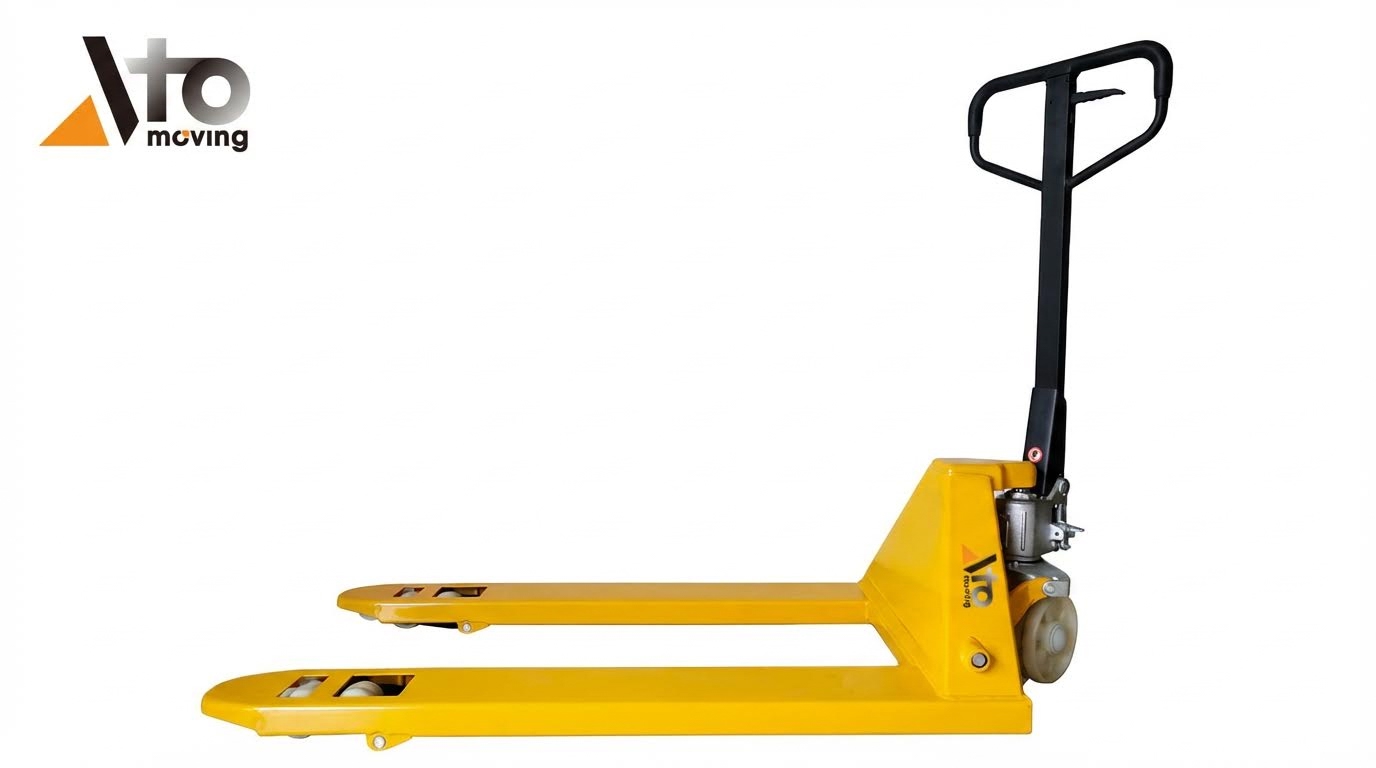
Fork width directly controls how stable the pallet jack is, how it steers, and how much aisle space you actually need to move safely. When people ask how wide are pallet jack forks, the real answer is about stability, floor contact, and turning room—not just a number on a nameplate.
Standard overall fork widths typically range from about 520–700 mm, with common standards around 520–570 mm for general pallets and 680–700 mm for extra stability on wider loads. Wider fork spacing increases the lateral wheel track, which improves resistance to side tipping but demands more aisle and doorway width. Narrower forks do the opposite: better access, but less margin when loads are tall, heavy, or poorly wrapped. Reference data on width ranges.
💡 Field Engineer’s Note: Treat fork width like a stability lever: every time you go narrower to squeeze through a gap, mentally downgrade what you consider a “safe” load height and weight for that truck.
Load capacity, center of gravity, and tipping risk
Fork width changes how much of the rated capacity you can safely use before the center of gravity gets too close to a tipping line. Capacity plates assume the load is centered both front-to-back and side-to-side on forks that match the intended pallet pattern.
- Rated capacity vs. real capacity: Standard pallet jacks commonly support about 2,000–2,500 kg (≈5,500 lbs). Engineers expect a centered, evenly distributed load at a defined load center. Capacity ranges and norms.
- Side-to-side center of gravity: Wider forks (e.g., 680 mm) push the load wheels further apart, increasing the lateral base of support and reducing side-tipping risk under heavy or top-heavy loads. More width = more sideways stability. Stability comments on wider forks.
- Narrow forks and overhang: When forks are too narrow for the pallet, deck boards or blocks can overhang. This shifts the center of gravity outside the wheel track and can overload single boards, increasing breakage and tipping risk. Narrow is only safe if the pallet design matches. Fork spacing vs pallet structure.
- Front-to-back bending moment: The further the center of gravity moves from the load rollers, the higher the bending moment on the forks and frame. Uneven fork engagement (one fork fully in, one short) twists the frame and shifts the effective load center sideways. This is how side-tipping and fork cracking start. Engineering note on center of gravity.
- Safe working margin: In daily use, it is good practice to plan for only 80–85% of the rated capacity, especially with narrow or non-standard fork widths, to allow for dynamic forces (braking, bumps, ramps). This margin is your insurance against unknowns. Recommended safety margin.
Why “how wide are pallet jack forks” matters for tipping
When someone asks how wide are pallet jack forks, the hidden question is how far apart the load wheels are. That distance defines the triangle of stability between the two load wheels and the steering wheels. A wider triangle resists side tipping when a load shifts or when you hit a floor defect.
Fork geometry, wheel track, and floor interaction

Fork width defines the wheel track, which controls how the pallet jack interacts with joints, drains, and floor defects, as well as how load is distributed into the concrete. Geometry is not just length and height; it is the 3D footprint of the wheels under load.
- Overall and inside fork width: Typical overall fork widths run about 520–700 mm, with inside spans chosen to match pallet entry gaps (e.g., ≈160 mm for Euro pallets, ≈182 mm for GMA). Correct inside span keeps load on stringers/blocks, not on thin deck boards. Inside fork span standards.
- Wheel size and spacing: Steering wheels are commonly about 170–197 mm diameter and 50 mm wide, while load rollers are about 74–76 mm diameter and 90 mm+ wide. Wider fork spacing pushes these rollers apart, so each wheel sees less load for the same pallet weight. That reduces point loading and floor damage. Wheel dimension data.
- Floor joints and drains: Narrow wheel tracks tend to “fall into” slab joints, dock plates gaps, and trench covers more often, because both rollers are closer together. Wider tracks can bridge some defects but may be forced to run one wheel on sound concrete and one in a weak area, twisting the frame.
- Lowered and raised heights: Standard lowered fork heights are about 75–85 mm, with low-profile models down to 50–65 mm. These low heights reduce vertical wheel travel, so any floor high spot is felt more sharply. Narrow widths plus low-profile geometry demand better floor quality to avoid shock loads into the frame and operator. Lowered height data.
- Wheel material vs. width: Polyurethane wheels work best on smooth indoor floors, while nylon handles rougher or outdoor surfaces. On narrow trucks, any flat spot or chip in a wheel concentrates load in a smaller area, increasing floor stress and jerk forces into the handle. Wider frames spread these shocks across more floor area. Wheel material guidance.
- Hydraulic smoothness and load shift: Leak-resistant pumps and slow-release valves in low-profile jacks control how quickly the load descends. With narrow forks, any sudden drop can swing the center of gravity sideways relative to the wheel track, so controlled lowering is more critical. Hydraulic design details.
💡 Field Engineer’s Note: If you see cracked concrete or crushed trench covers along a route, check fork width and wheel spacing; a slightly wider frame can spread load enough to stop the damage—and the resulting sudden jolts that upset tall loads.
How to sanity-check fork width against pallet design
Measure the pallet’s inner opening between stringers or blocks. Your overall fork width should be a few millimeters less than that opening, and your inside fork span should align under the main load-bearing members. If either dimension is off, you are trading floor life and pallet life for short-term maneuverability.
Aisle width, turning radius, and narrow-aisle constraints
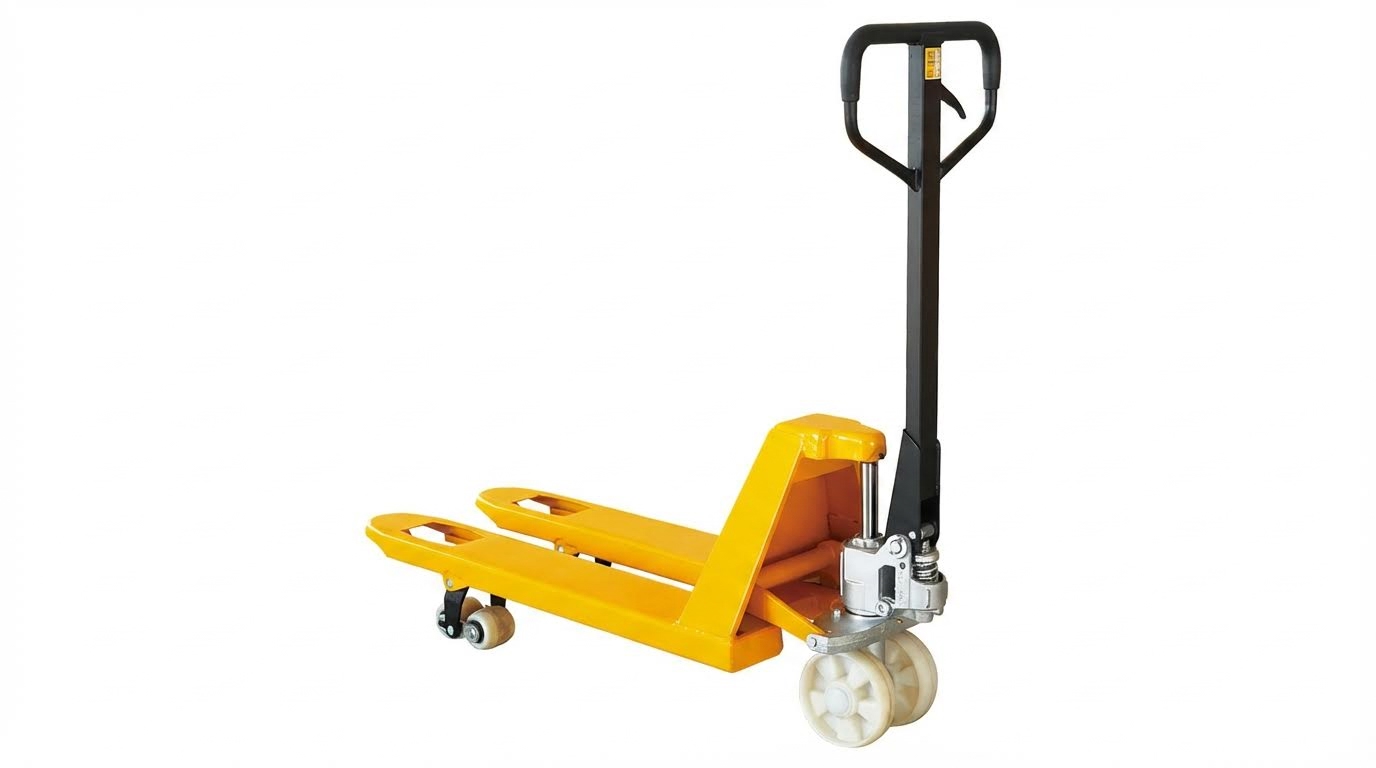
Fork width sets the minimum aisle and doorway clearance you need to turn a loaded pallet jack without clipping racking, posts, or walls. For layout engineers, width is the starting dimension for aisle design, not an afterthought.
- Base clearance rule: For straight travel, you typically add at least about 150 mm of clearance beyond the pallet jack’s overall width in a single-direction aisle. That means a 550 mm wide truck wants roughly 850 mm+ of clear aisle just to move straight with a pallet. Aisle calculation guidance.
- Typical width vs. aisle design: General warehouse pallet jacks are often around 685 mm (≈27 in) wide, while narrow-aisle units can be about 510–530 mm (≈20–21 in). That 150–175 mm difference can cut aisle width requirements by a similar amount, which is significant in dense storage. Width recommendations by application.
- Turning radius interaction: Low-profile pallet jacks with standard fork lengths have turning radii around 1,265–1,335 mm. For a typical 1,150–1,220 mm fork, a practical estimate is: turning radius ≈ fork length + (pallet width ÷ 2) + ~200 mm. Wider forks increase effective pallet width, so the turning radius grows. Turning radius formula.
- One-way vs. two-way aisles: For one-way aisles, a common planning rule is pallet width + about 600 mm clearance. For two-way aisles, the rule of thumb is (pallet width × 2) + fork length + about 600 mm. Wider forks increase the “pallet width” term and can quickly make two-way traffic impossible in older buildings. Aisle width rules.
- Narrow-aisle trade-offs: Narrow frames around 400–520 mm improve maneuverability in tight spaces, but they reduce lateral stability, especially with tall stacked loads or when pulling instead of pushing. In practice, you may need to cap load height or weight when using these very slim trucks. Narrow-frame notes.
- Doorways and dock pockets: A pallet jack’s overall fork width plus a minimum of about 150 mm each side is a realistic minimum for safe doorway clearance. For dock pockets and truck bodies, remember that the turning radius, not just width, governs whether you can reposition pallets once inside.
💡 Field Engineer’s Note: When you shrink aisle widths on paper, also downgrade your “acceptable” fork width; if you keep wide jacks in narrow aisles, operators will start pulling loads at angles, which quietly multiplies side-tipping risk and rack strikes.
Quick layout check using fork width
1) Note your pallet jack overall width and fork length. 2) Use pallet width + 600 mm to estimate minimum one-way aisle. 3) For two-way, use (pallet width × 2) + fork length + 600 mm. If your existing aisles are tighter than that, consider narrower fork widths and stricter limits on load height and weight.
Selecting The Correct Fork Width For Your Operation
Selecting the correct pallet jack fork width means matching your pallets, load geometry, and aisle layout so the truck rolls, turns, and supports safely with margin. This is where “how wide are pallet jack forks” becomes an engineering decision, not trivia.
- Start from pallets: Measure inner openings and stringer spacing – this prevents forks jamming or riding on deck boards.
- Check load geometry: Height, overhang, and weight distribution – this controls tipping risk and fork bending.
- Overlay the building: Aisles, doors, docks, and lifts – this ensures the chosen width can actually move everywhere you need.
- Apply safety margin: Use 80–85% of rated capacity in normal use – this absorbs real-world shocks, uneven floors, and misloads.
💡 Field Engineer’s Note: When operations complain about “unstable” pallet jacks, I usually find a width mismatch: forks riding too close to one stringer, or a narrow frame under a tall, shrink-wrapped tower. Width is cheap; tip-overs are not.
Matching fork width to pallet standards and load types
Matching fork width to pallet standards and load types starts with the pallet opening, then checks how the load actually sits on those boards or blocks. You want the widest forks that still slide in cleanly and support the heavy lines of the pallet.
From the raw data, typical overall fork widths on manual pallet jacks run roughly 520–700 mm, with common “standard” frames around 550–570 mm for Euro pallets and ~680 mm for wider, higher-stability work. Typical fork width ranges show how wide are pallet jack forks in real fleets: about 520–540 mm for tight aisles, 550–570 mm as the general-purpose sweet spot, and 680–700 mm where lateral stability is critical.
| Pallet / Load Type | Typical Pallet Size | Recommended Overall Fork Width | Inside Fork Span Target | Operational Impact |
|---|---|---|---|---|
| Euro pallet (EUR/EPAL) | 800 × 1200 mm | ≈ 550–570 mm | ≈ 160 mm between forks Inside fork span data | Standard European warehouse fit; good stability and easy entry in 800 mm direction. |
| GMA / North American stringer pallet | 1016 × 1219 mm (48×40 in class) | ≈ 680 mm | ≈ 182 mm between forks | Aligns with stringers; reduces deck-board breakage and side tipping. |
| Block pallet (multi-entry) | Typically 1000–1200 mm wide | 550–680 mm | ≈ 230–250 mm between forks | Supports on blocks instead of thin boards; better under heavy, dense loads. |
| Display / retail half pallets | 600–800 mm wide | 520–540 mm | Smaller gap, often custom | Good for tight store aisles and light-to-medium loads. |
| Oversized industrial pallets | > 1200 mm wide | 680–700 mm | Custom to match stringers/blocks | Maximizes lateral stability under tall or top-heavy loads. |
On adjustable models, the clear span between forks typically ranges from about 20–27 in (≈ 510–685 mm) to align with different stringer and block layouts. If the forks are too narrow, they overload individual deck boards; if too wide, they simply will not enter the pallet at all.
- Rule 1 – Outer width vs pallet opening: Keep overall fork width slightly less than the pallet’s inner opening – this prevents binding and damage to lead boards.
- Rule 2 – Forks under the “strong lines”: Aim to sit forks directly under stringers or blocks – this routes load into structural members, not thin boards.
- Rule 3 – Length still matters: Ensure forks reach at least two-thirds of pallet length – this avoids nose-diving and tipping when you brake or hit a joint.
How to measure your pallets correctly
Measure the inner distance between entry points (clear opening), the spacing between stringers/blocks where forks will sit, and the overall pallet width. Add 5–10 mm safety clearance between forks and wood on each side.
Balancing maneuverability, safety margins, and TCO
Balancing maneuverability, safety margins, and total cost of ownership (TCO) is about trading a few millimetres of width against years of reduced damage, strain, and bottlenecks. Too narrow and the truck feels agile but nervous; too wide and it feels safe but clumsy in tight aisles.
Standard manual pallet jacks often center around an overall width of about 685 mm (≈ 27 in) for general warehouse work, with narrower 520–540 mm frames for tight aisles and up to about 700–750 mm for high-stability, heavy-duty use. Application-based width recommendations show that ≈ 510–535 mm (20–21 in) frames suit tight spaces, ≈ 685 mm fits most warehouse pallets, and wider up to ≈ 760 mm (30 in) can be used for oversized or very heavy pallets.
| Overall Fork Width | Typical Use Case | Maneuverability | Stability / Safety Margin | Impact on TCO |
|---|---|---|---|---|
| ≈ 520–540 mm | Retail backrooms, tight store aisles, small pallets | Excellent in narrow aisles and small doors | Lower lateral stability on tall / heavy loads | Lower purchase cost; potential higher damage if misapplied. |
| ≈ 550–570 mm | Euro pallet warehouses, mixed SKUs | Good compromise between width and turning space | Solid stability for typical 800×1200 mm pallets | Often best lifecycle value in Euro operations. |
| ≈ 680–700 mm | General GMA pallet warehouses, heavy loads | Needs wider aisles and doors | High lateral stability; better for top-heavy or tall stacks | Reduces product and pallet damage, fewer tip incidents. |
| > 700 mm (wide specials) | Oversized pallets, machinery, very dense loads | Restricted in tight aisles; may not clear some doors | Maximum stability; spreads load widely | Higher unit cost but can prevent rare, very expensive failures. |
- Aisle width constraint: You need at least pallet width plus about 150 mm per side in single-direction aisles; two-way aisles need roughly twice pallet width plus fork length and 600 mm clearance. A typical 550 mm wide truck wants about 1800–2000 mm aisle width.
- Door and lift openings: Always check the narrowest pinch point in the route, not just racking aisles – fork width plus load overhang must clear with a few centimetres to spare.
- Capacity and safety margin: Standard trucks often rate around 2000–2500 kg; plan normal operations at only 80–85% of that to absorb uneven floors and mis-stacked loads. This operational margin is cheaper than broken product or injuries.
Quick decision checklist for fork width selection
- Step 1: List your top 3 pallet types by volume – design for the 80%, not the rare oddball.
- Step 2: Measure pallet inner openings and stringer spacing – define the maximum allowable outer fork width.
- Step 3: Map the tightest aisle and doorway on the route – set the maximum truck width including load overhang.
- Step 4: Classify loads by height and weight – taller and heavier loads push you toward the wider end of the width range.
- Step 5: Choose the widest frame that still fits routes and pallets – this maximizes stability and minimizes lifetime damage.
💡 Field Engineer’s Note: If you are unsure between two widths that both fit your pallets and aisles, choose the wider one. Over 10–15 years of use, the reduction in pallet breakage, wheel damage, and near-miss incidents usually repays the slightly higher purchase price several times over.
Final Thoughts On Specifying Pallet Jack Fork Widths
Correct fork width is a structural decision, not a comfort feature. It sets the wheel track, defines the stability triangle, and decides how loads flow into pallet members and floor slabs. When you match overall width and inside span to real pallet openings, you cut board breakage, wheel shock, and tip risk in one move.
Narrow frames help in tight aisles, but they shrink the lateral base of support and raise the chance of side tipping with tall or dense loads. Wider frames spread wheel loads, bridge floor defects better, and keep the center of gravity further inside the stability triangle, at the cost of extra aisle and doorway space.
The best practice is clear. Start from your dominant pallet types and worst-case samples, then layer in real aisle, doorway, and dock constraints. Choose the widest fork width that still enters pallets cleanly and moves everywhere you need. Run daily loads at about 80–85% of rated capacity, and cap height on narrow frames.
Operations and engineering teams that treat fork width as an engineering control, not an afterthought, see fewer damaged pallets, smoother traffic, and lower lifetime cost. Use these width rules as a standard spec process for every new pallet jack, including future Atomoving units.
Frequently Asked Questions
How wide are pallet jack forks?
Pallet jack forks typically come in different widths to accommodate various pallet sizes. The most common fork width is 540mm, designed for standard pallets measuring 800mm x 1200mm. However, narrower pallet trucks with 450mm wide forks are also available for specialized uses, such as handling printer pallets.
- Standard pallet size: 800mm x 1200mm, compatible with 540mm wide forks.
- Narrower forks: 450mm wide, used in industries like printing.
For more details on pallet truck sizes, you can refer to this Pallet Truck Size Guide.
What is the standard width of a pallet?
The standard pallet size commonly used in North America is 48 inches by 40 inches. This translates to approximately 1220mm by 1016mm. The deck boards on these pallets are typically 3 1/2 inches (89mm) wide and 5/16 inches (8mm) thick.
- Standard pallet dimensions: 1220mm x 1016mm (48″x40″).
- Deck board width: 89mm (3 1/2″).
To learn more about standard pallet sizes, check out this Standard Pallet Size Guide.