Pallet jacks evolved alongside pallets, forklifts, and racking to reshape how industry handled unit loads. This article traces that evolution from ancient sledges and rollers through early factory skids, low-lift devices, and the emergence of true pallets in the late 19th and early 20th centuries. It then examines the birth of manual pallet trucks, their wartime standardization, and the resulting leap in warehouse throughput and labor productivity. Finally, it reviews modern hydraulic, ergonomic, and electric developments, highlighting specialized variants and key engineering lessons from a century of pallet-handling technology.
From Sledges To Skids: Pre‑Pallet Handling Methods
Pre‑pallet handling methods created the baseline constraints that later pallets and pallet jacks had to solve. Engineers gradually shifted from pure friction-based dragging to guided rolling and then to semi-unitized loads on skids. Understanding this progression clarifies why modern pallet jack geometry, fork spacing, and lift heights evolved as they did.
Ancient Sledges, Rollers, And Block And Tackle
Ancient handlers used sledges to drag loads across the ground, often on lubricated paths. Logs or cylindrical rollers reduced friction by converting sliding contact into rolling contact. These systems enabled movement of multi‑ton stones and bulky cargo but required large labor forces and careful ground preparation. Block and tackle systems introduced mechanical advantage for vertical or inclined lifting using rope and pulleys. However, these methods treated each object as an individual load, with no standardized interface comparable to a pallet deck.
Crates, Barrels, And Manual Handling Before Pallets
Before pallets, industries relied heavily on wooden crates, boxes, and barrels for storage and transport. Workers stacked these containers directly on floors, wagon beds, or railcars, which limited vertical utilization and stability. Handling remained labor intensive because each crate or barrel required individual lifting, rolling, or hooking. Break‑bulk loading dominated, so cycle times for ships and railcars were long and highly variable. Damage rates stayed relatively high because impacts concentrated on container corners, hoops, or staves rather than on a sacrificial platform. This context drove the later push toward unit loads, where a palletized stack could move as a single engineered package.
Early Factory Skids, Live Skids, And Low-Lift Devices
In the late 19th and early 20th centuries, factories adopted wooden skids as intermediate platforms. These skids typically used stringers with a single deck, without a lower deck board layer, so operators slid or pried them into position. Live skids incorporated small wheels or casters, allowing workers to reposition loads manually over short distances. Dead skids lacked wheels and depended on pry bars, rollers, or tow hooks for movement. In 1887, a simple low‑lift truck appeared that could raise a skid a few centimetres, just enough to clear the floor. By 1909, self‑propelled lift platforms supported horizontal travel and modest lift heights, foreshadowing the geometry and fork function of later order picking machines. These devices still interfaced with non‑standard skids, but they demonstrated the productivity potential of combining a defined load platform with a dedicated lifting mechanism.
Birth Of The Pallet And Manual Pallet Truck

The birth of the pallet and the manual pallet truck represented a shift from loose-piece handling to true unit-load logistics. This period linked mechanical lifting capability with standardized wooden platforms, enabling vertical storage and rapid vehicle loading. The resulting system changed warehouse geometry, labor deployment, and transport economics across rail and road networks.
Late 19th To 1920s: From Skids To True Pallets
In the late 19th century, factories used wooden skids with metal supports and a single deck of boards placed directly on the floor. These skids could be either live, with wheels for limited repositioning, or dead, without wheels, and relied on separate lifting devices. Around 1887, low-lift machines appeared that raised skids only a few centimetres, still demanding high manual effort. By 1909, self-propelled lift platforms handled unit loads more productively, preparing the ground for palletization. Between the 1910s and mid‑1920s, designers replaced loose spacers with boards fixed to stringer beams, and then added a lower deck, creating the double-deck pallet. This lower deck distributed load, improved stack stability, and removed the hazardous need for workers to insert spacers between layers.
Early Lift Platforms And The First Manual Pallet Jacks
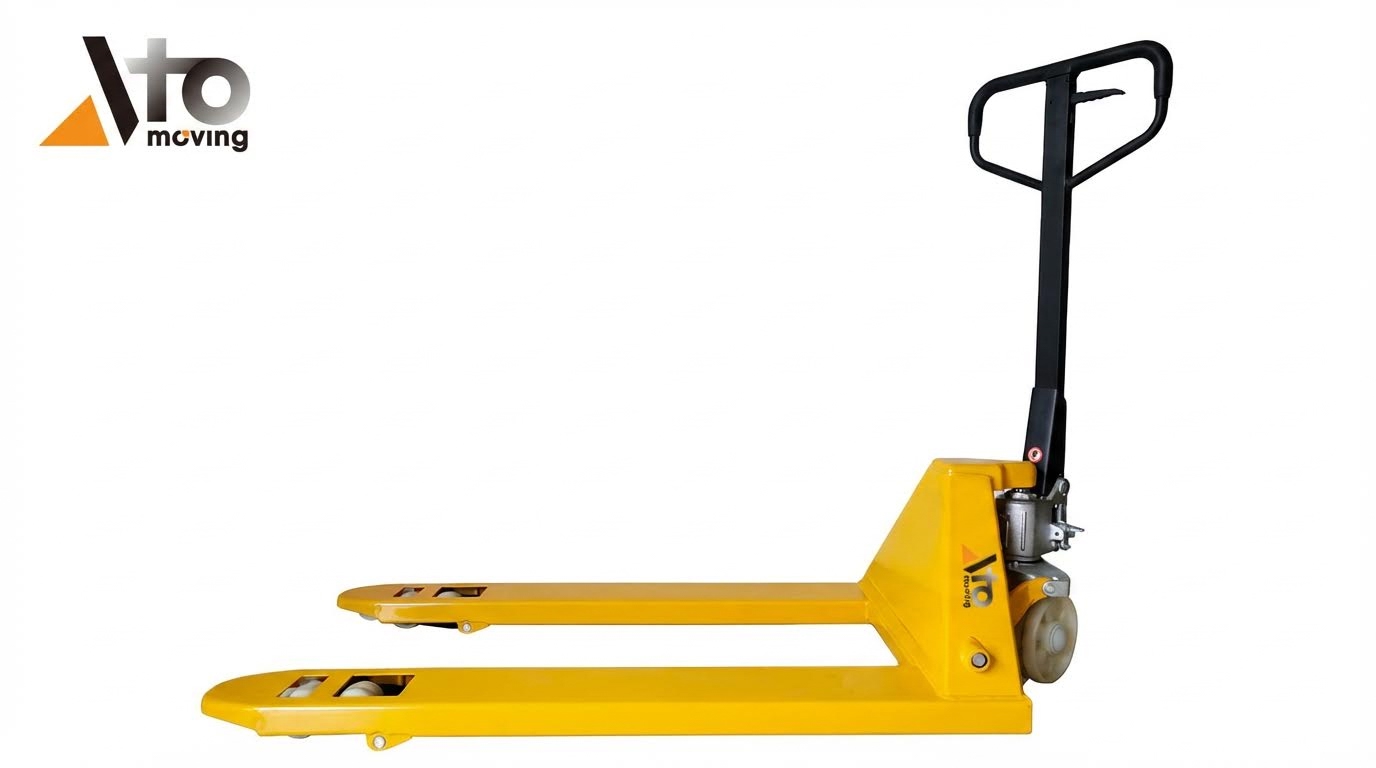
By 1926, prototypes of modern warehouse floor transport allowed vertical stacking of cargo blocks on pallets. Parallel developments in forklifts introduced forks or skids capable of engaging these platforms and lifting them several decimetres, then several metres. In the 1920s, manual pallet trucks, or hand pallet jacks, appeared as compact, low-lift devices that combined steering, rolling support, and a short-stroke lifting mechanism. These hand-pumped trucks typically used mechanical or early hydraulic linkages to raise palletized loads just enough for rolling transport. By the mid‑20th century, rated capacities around 1,500 kilograms became common, enabling a single operator to move loads that previously required multiple workers or cranes. The manual pallet truck therefore closed the loop between standardized pallets and practical floor-level handling.
WWII Logistics, Standard Sizes, And Global Adoption
During World War II, military logistics requirements drove rapid expansion of pallets and handling equipment. Before the war, only progressive industries adopted pallets due to low labor costs and limited capital for machinery. Wartime supply chains, especially in the United States, required high-throughput loading of ammunition, rations, and spare parts, making unit-load handling essential. Armed forces promoted standard pallet dimensions to simplify interchange across depots, ships, rail wagons, and trucks. A 1,219 millimetre by 1,219 millimetre (48 inch by 48 inch) pallet size supported dense, stable stacking of ammunition boxes and matched typical vehicle widths. Standardization reduced compatibility issues, simplified packaging design, and accelerated material flow. After the war, similar principles spread to civilian logistics, with the 1,219 millimetre by 1,016 millimetre (48 inch by 40 inch) pallet emerging as a dominant size in North American road-based distribution. This period firmly established the pallet and manual pallet truck as core infrastructure in global supply chains.
Impact On Warehouse Throughput And Labor Utilization
The combination of pallets and pallet trucks produced quantifiable gains in throughput. Historical comparisons indicated that unloading 13,000 cases of canned goods without pallets or trucks took about three days. By the 1940s, with palletized loads and appropriate trucks, operators reduced this task to roughly four hours. This improvement translated into higher dock utilization, shorter vehicle dwell times, and lower demurrage costs. On the labor side, unit-load handling reduced manual lifting cycles and peak exertion levels per worker. A single operator with a hand pallet jack could move pallet loads above 1,000 kilograms along flat floors, replacing teams of handlers with hand trucks or loose-case methods. This shift allowed warehouses to reassign labor from pure handling to value-adding tasks such as quality control or order assembly. It also laid the foundation for later automation, because standardized pallet footprints and predictable handling paths simplified the design of racking, conveyors, and powered trucks.
Evolution To Modern Manual And Electric Pallet Jacks
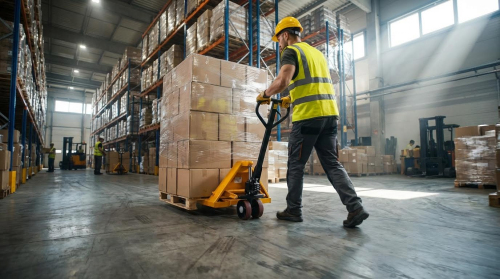
Modern pallet jacks resulted from incremental improvements in hydraulics, ergonomics, and power systems. Designers optimized these tools to move standardized pallets efficiently while limiting operator strain and floor damage. The following sections trace how engineering decisions in hydraulics, structure, and controls shaped current manual and electric pallet trucks.
Hydraulic Improvements And Load Capacity Growth
Early pallet jacks used simple mechanical or rudimentary hydraulic linkages with limited lift height and capacity. As hydraulic seal technology and pump design improved during the mid‑20th century, hand-pumped pallet jacks routinely achieved rated capacities near 1,500 kg. Engineers optimized cylinder bore, stroke, and lever ratios to raise loads typically 100–200 mm, just enough for ground clearance without sacrificing stability. Better steel alloys and welded frames increased fatigue strength, allowing higher safety factors against yielding and buckling under dynamic loads. Modern designs also used check valves and flow restrictors to control lowering speed, preventing sudden drops that could overload pallet stringers or destabilize stacked goods.
Ergonomic Design, Safety, And Standards Compliance
Earlier pallet trucks demanded high push and pull forces and exposed operators to awkward postures. Progressive designs shortened handle reach, introduced contoured grips, and optimized steering geometry to reduce required tractive effort on flat floors. Safety features evolved in line with standards such as ISO and EN requirements, including overload relief valves, controlled descent, and toe‑guarded fork tips. Manufacturers added neutral positions and dead‑man controls on powered units to prevent unintended movement in congested aisles. Wheel material selection, especially the shift to polyurethane, reduced vibration, noise, and rolling resistance, improving both ergonomics and compliance with occupational health regulations. Guarding around linkages and smooth, rounded chassis edges further reduced impact and pinch hazards during tight maneuvering.
Electric And High-Lift Pallet Trucks In Racked Storage
The introduction of electric pallet trucks addressed the limits of human pushing force over long distances and on slight gradients. Battery-powered traction and lift systems allowed operators to move unit loads efficiently through larger warehouses and distribution centers. High-lift pallet trucks bridged the gap between simple pallet jacks and full forklifts by raising pallets to ergonomic working heights or to low rack levels. These trucks typically offered lift heights up to roughly 800–1,000 mm, sufficient for workstations and first-tier racking. Engineers reinforced masts, added stabilizing outriggers, and tuned center-of-gravity envelopes to maintain lateral stability under partial or offset loads. Integration with pallet racking geometries, including minimum under-clearances and fork lengths, ensured compatibility with standardized pallet sizes used in modern logistics.
Weighing, Four-Way Entry, And Specialized Variants
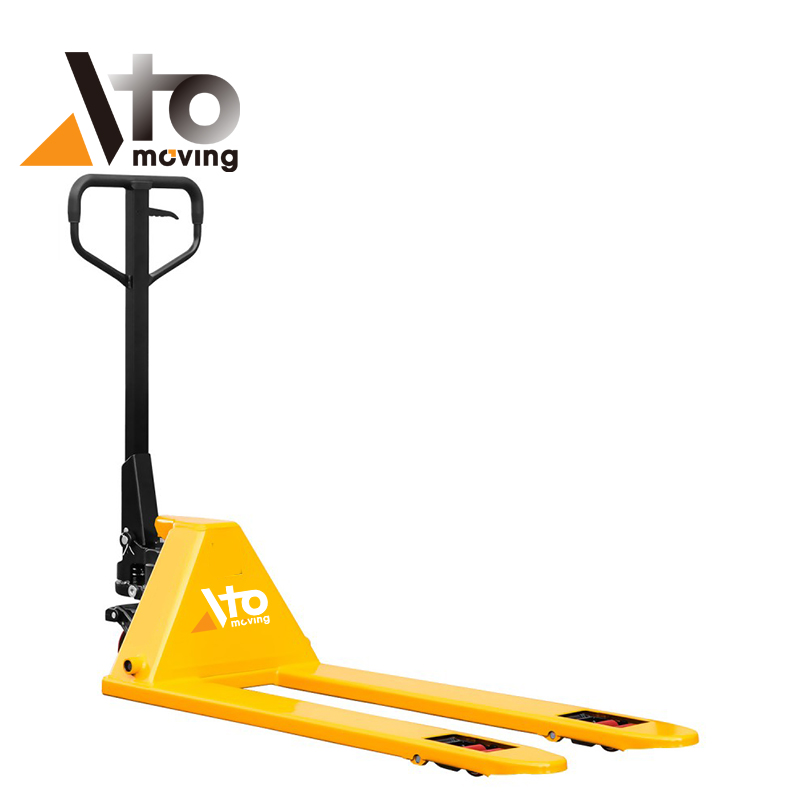
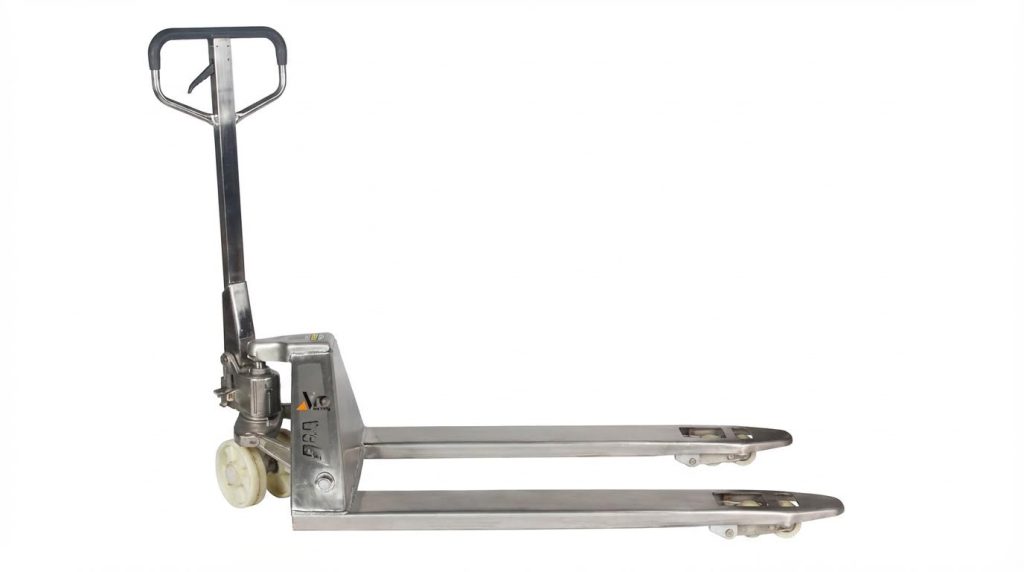
As palletized supply chains matured, integrated weighing functions became valuable for shipping, inventory control, and regulatory compliance. Weigh-scale pallet jacks incorporated load cells in the fork structure and digital indicators, allowing mass measurement directly at the pick location with typical accuracies within a few kilograms. The spread of four-way entry pallets, which allowed fork access from all sides, influenced fork profile, taper length, and wheel placement to avoid deck and stringer damage. Specialized variants emerged for corrosive, hygienic, or hazardous environments, using stainless steels, sealed bearings, and antistatic or spark-resistant components. Other designs targeted niche tasks, including low-profile jacks for thin skids, reel and drum handlers, and scissor-lift pallet trucks for adjustable-height work platforms. Collectively, these variants demonstrated how relatively simple base mechanics supported a wide range of engineered solutions for distinct industrial use cases.
Summary: Engineering Lessons From A Century Of Pallet Jacks
The evolution from sledges and skids to standardized pallets and pallet jacks demonstrated the power of unit-load thinking. Engineers learned that integrating load carriers, handling equipment, and storage systems produced step changes in throughput, not incremental gains. The shift from crates and barrels to double-deck pallets, paired with lift trucks, enabled vertical storage and reduced manual handling risk.
Historically, each major improvement combined a mechanical innovation with process redesign. Early low-lift devices, the introduction of hydraulic lifting, and later electric drives all required changes in warehouse layout, rack design, and packaging geometry. Standard pallet sizes, such as 1 219 mm × 1 016 mm, allowed predictable load distribution, stable stacking, and efficient vehicle utilization. These standards also simplified design calculations for fork dimensions, wheel loads, and floor bearing pressures.
Modern pallet jacks highlighted the importance of ergonomics and regulatory compliance. Designers had to limit push–pull forces, control lowering speeds, and ensure stability under rated loads typically up to 1 500 kg for hand trucks. Safety standards drove features such as controlled descent valves, overload protection, and improved handle geometry. Material choices, including high-strength steels and polyurethane wheels, balanced durability, floor protection, and rolling resistance.
Looking ahead, the same principles will guide further evolution. Integration with automated storage and retrieval systems, sensor-assisted maneuvering, and data-enabled maintenance will refine how unit loads move through facilities. Engineers will need to reconcile higher density storage and tighter aisle widths with strict stability margins and human–machine interaction rules. The century-long history of pallet jacks showed that the most successful solutions treated the pallet, the truck, and the warehouse as a single engineered system rather than independent components.