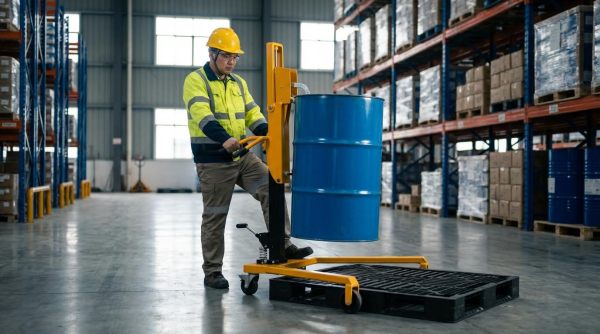
Safe lifting of 55-gallon drums in industrial facilities required a structured approach that combined risk assessment, regulatory compliance, and engineered controls. Typical drum masses ranged from roughly 180 kg to well over 900 kg, which made uncontrolled manual handling a high-consequence activity. This article examined how to evaluate drum weights, hazards, and site conditions, and how to align practices with OSHA, ASME, and below-the-hook standards.
It then contrasted the strict limits of manual handling with stepwise techniques for uprighting and rolling drums, supported by PPE and housekeeping controls. The article also detailed selection and use of mechanical lifting devices, including forklift attachments, overhead hoists, drum tilters, and advanced solutions such as AGVs, cobots, and digital twins. Finally, it concluded with a concise implementation checklist that facilities could use to embed safe drum lifting into daily operations.
Risk Assessment And Regulatory Requirements
Risk assessment for 55-gallon drum handling in industrial facilities required a structured review of drum mass, contents, handling methods, and workplace conditions. Facilities evaluated both routine and non-routine tasks, such as receiving, decanting, internal transport, and waste handling. Effective programs linked hazard identification directly to equipment selection, operator training, and regulatory compliance.
Typical Drum Weights And Load Calculations
A standard 55-gallon drum could weigh between approximately 180 kg and 360 kg when full, depending on product density. Dense solids or high–specific-gravity liquids could push total mass above 900 kg in extreme cases, which exceeded typical below-the-hook device capacities. Risk assessments therefore used conservative density assumptions and verified actual product data sheets rather than relying on nominal weights. Engineers calculated total lifted load as the sum of drum, contents, rigging, and any attached accessories, then compared this value to the rated capacity of forklifts, hoists, and drum lifters with an adequate safety margin. Planners also considered dynamic effects from acceleration, deceleration, and potential impact, especially when drums were rotated, tilted, or transported over uneven floors.
Hazard Identification, Labeling, And SDS Review
Before any lifting or movement, operators inspected each drum label for hazard pictograms, signal words, and transport markings. If a drum lacked clear labeling, facilities treated it as hazardous until they confirmed contents through documentation or testing. Supervisors required review of the relevant Safety Data Sheet (SDS) to identify flammability, toxicity, corrosivity, reactivity, and recommended PPE, as well as special handling or temperature limits. Personnel checked for leaks, bulging, corrosion, or missing bungs and lids, and secured closures before moving the drum to avoid spills during lifting or rolling. These steps fed into the risk assessment, influencing whether manual handling was allowed and which mechanical aids, containment pallets, or ventilation controls were necessary.
OSHA, ASME, And Below-The-Hook Compliance
U.S. facilities aligned drum handling practices with OSHA regulations that governed material handling and flammable or combustible liquids, including 29 CFR 1926.152 and related sections. Below-the-hook lifting devices, such as drum lifters and tilters, followed ASME B30.20 and ASME BTH-1 requirements for design, fabrication, inspection, and marking. Manufacturers typically designed these devices with a minimum 3:1 design factor based on material yield strength, but users still had to ensure that the rated capacity exceeded the maximum expected drum load. Safety programs required regular inspections, documented maintenance, and operator training on proper rigging, engagement verification, and lockout of defective equipment. Compliance reviews also checked that only compatible devices were used on closed-head or open-head drums, and that hazardous-material drums used equipment suitable for their construction and condition.
Facility Conditions, Traffic Flow, And Ergonomics
Risk assessments evaluated floor conditions, lighting, congestion, and slope along all drum-handling routes. Planners eliminated or controlled slippery surfaces, thresholds, and tight turns that could cause a drum cart, forklift, or suspended drum to become unstable. Facilities organized traffic flow to separate pedestrian walkways from powered industrial truck routes, especially near drum storage and decanting areas. Storage layouts limited rows to two drums high and two drums wide for 55-gallon drums, which improved inspection access and reduced collapse risk. Ergonomic evaluations set limits on manual tilting, rolling, and upending, promoting mechanical aids where drum weights or task frequency exceeded safe human capabilities.
Manual Drum Handling: Limits And Best Practices
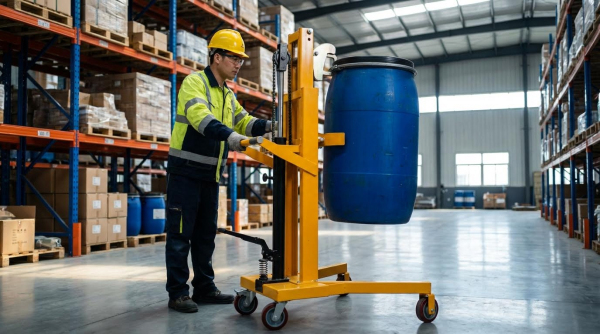
Manual handling of 55-gallon drums in industrial facilities required strict control because a filled drum typically weighed 180–360 kg, and could exceed 900 kg with very dense contents. Facilities minimized manual lifting to short, low-risk maneuvers and relied on mechanical aids whenever possible. Effective programs defined clear limits, standardized techniques, and enforced PPE and housekeeping rules to keep injury rates low.
When Manual Handling Is Acceptable Or Prohibited
Facilities typically allowed manual handling only for empty or near-empty drums, or for short-distance repositioning such as fine alignment, minor tilting, or controlled rolling on level floors. Workers estimated drum weight from contents and labeling, and treated any unknown or unlabeled drum as potentially full and hazardous, which required mechanical assistance. Policies usually prohibited solo manual lifting of full drums, manual handling of stacked drums, and manual movement on slopes, wet floors, or near openings. Operations involving flammable, corrosive, or toxic contents followed OSHA flammable liquid rules and internal permit-to-work systems, which mandated drum trucks, below-the-hook lifters, or forklifts. Supervisors documented when mechanical aids were unavailable and implemented temporary controls such as team lifts, reduced weights, or task rescheduling.
One- And Two-Person Techniques For Uprighting And Rolling
When workers manually upended a drum, they crouched close with feet apart, grasped the chime, kept the back straight, and used leg muscles to lift and rock the drum onto its lower chime. They then shifted their hands to the far edge of the rim and eased the drum into a vertical position, avoiding jerking motions. For rolling, the operator placed both hands on the far side of the chime, pulled the drum forward until it balanced on the lower rim, and rolled it without crossing hands, using body weight rather than arm strength. Two-person techniques mirrored this method, with both workers squatting on opposite sides, lifting in unison, communicating continuously, and maintaining synchronized movements to prevent twisting loads. Facilities often preferred drum-tilting levers or stands for upending, which reduced spinal loading and standardized the motion.
PPE, Housekeeping, And Injury Prevention Controls
Workers wore safety shoes with toe protection, chemical-resistant gloves, and eye protection as a baseline, and added aprons, face shields, or respiratory protection when SDS documents indicated corrosive, toxic, or volatile contents. Back belts or supports functioned only as administrative aids and never replaced engineering controls or proper technique. Good housekeeping practices included clean, dry, level floors, unobstructed aisles, and well-lit routes free of slopes, thresholds, or blind corners. Facilities limited storage rows to a maximum of two drums high and two drums wide to keep stacks stable and allow visual inspection for leaks or deterioration. Supervisors reinforced safe behavior through training, observation, and incident reviews, focusing on avoiding manual handling where mechanical devices, such as drum carts or lifters, could eliminate high-risk lifts.
Mechanical Lifting Devices And Selection Criteria
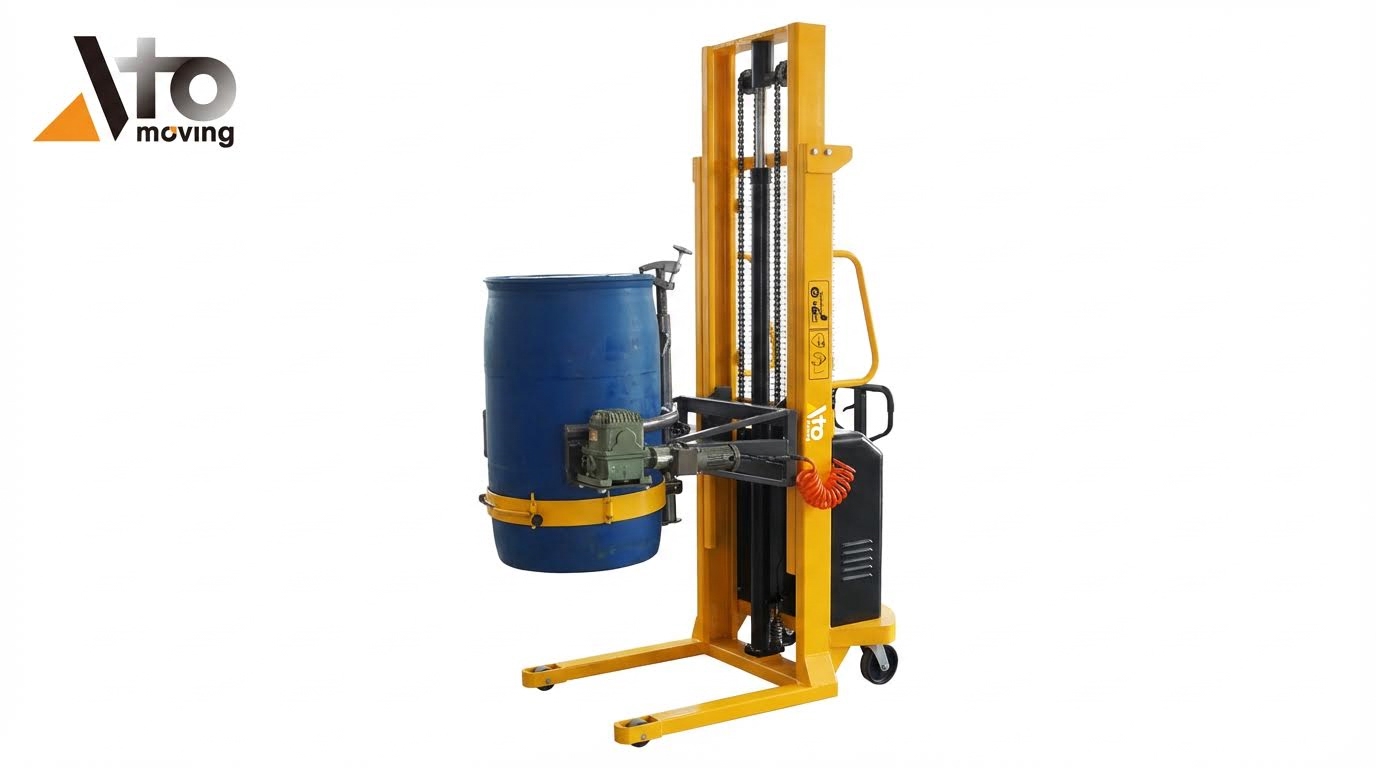
Mechanical lifting devices reduced manual effort and controlled drum movement in industrial facilities. They also limited ergonomic stress and exposure to hazardous contents. Proper device selection depended on drum type, weight, orientation, and required motion such as lift, tilt, or rotation. Engineers needed to verify capacity, compatibility, and regulatory compliance before deployment.
Forklift Attachments And Below-The-Hook Drum Lifters
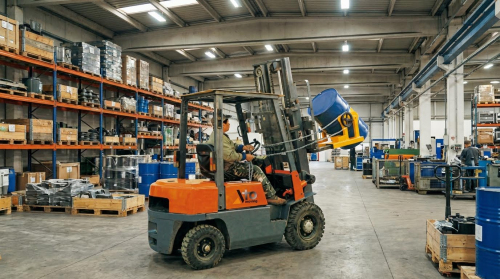
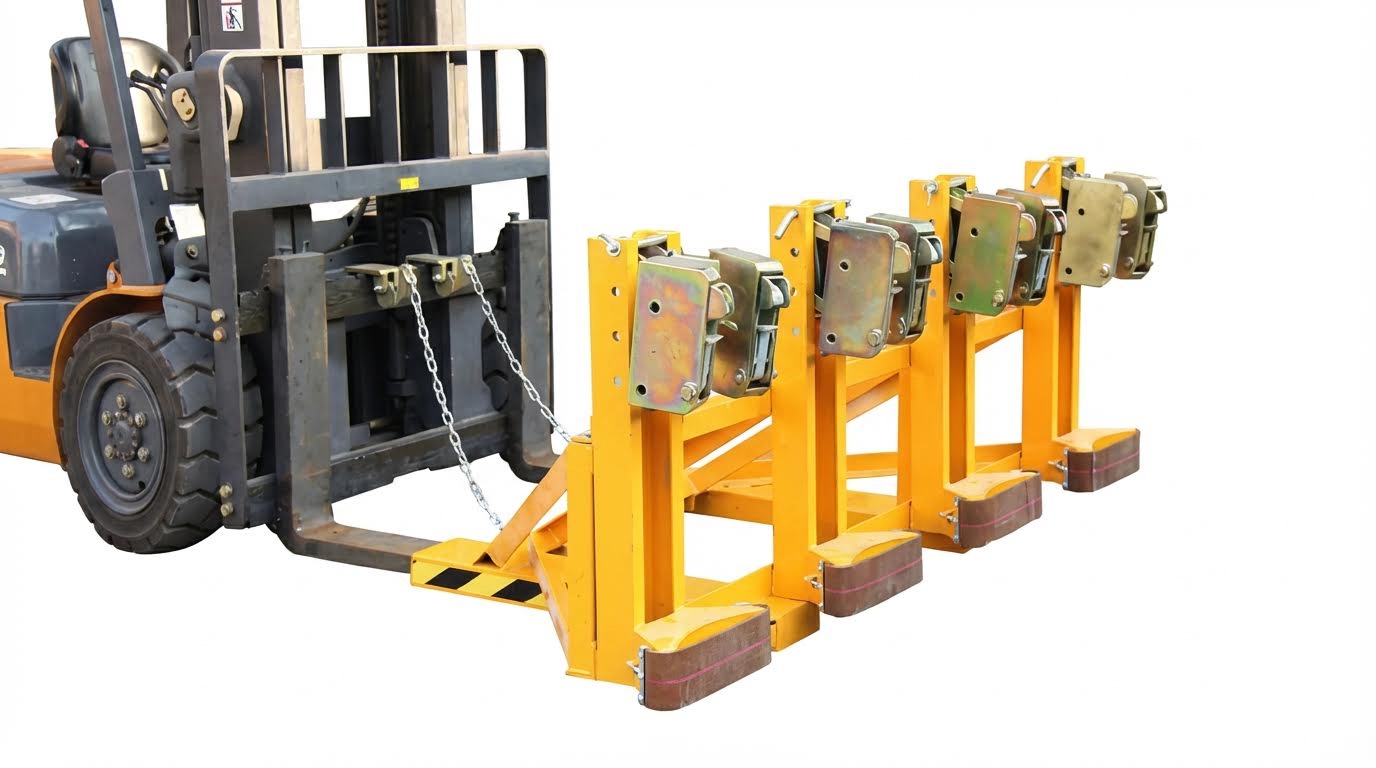
Forklift-mounted drum handlers allowed operators to lift and transport 30- and 55-gallon drums without leaving the cab. Typical designs included fork-mounted clamps, cradle-type carriers, and fork pockets integrated into drum lugs. Below-the-hook drum lifters, such as BPDL, BDCL, and BVDL Series, attached to overhead hooks or chains and engaged the drum chime or top lip. Engineers selected between forklift attachments and below-the-hook devices based on travel distance, aisle width, stacking height, and available lifting infrastructure.
Closed-head steel, plastic, and fiber drums with a pronounced top lip suited chime-grip or 2-point contact lifters. Units such as BCDL-2000 used grade 80 chain and spring-loaded latches to maintain positive engagement and comply with OSHA and ASME below-the-hook requirements. Fork/hoist combination models like FDT-22 or DL-31 provided flexibility where both cranes and trucks operated. Selection criteria included fork opening dimensions, minimum drum diameter, lip geometry, and whether open-head drums were allowed or explicitly excluded.
Overhead Hoists, Drum Tilters, And Rotation Control
Overhead hoists with dedicated drum lifters enabled vertical lifting, precise placement, and controlled rotation for pouring or dumping. Drum tilters such as DRUM-LUG, model 770, 771, and 775 supported drums in cradles, bands, or chain baskets to resist slip during rotation. Self-locking worm gear reducers held the drum angle without rollback, which protected operators during metered discharge. Motorized rotation options, as on M771, allowed remote actuation and fine angular positioning, important when handling hazardous or flammable liquids.
Engineers specified hoist and tilter combinations based on required rotation range, typically 0–360°, and load control method, manual wheel, crank, or powered drive. Basket-type lifters like model 775 spread loads over the shell and suited damaged or low-strength drums that could not accept high clamping pressure. Horizontal drum carriers such as BDCS supported 30- and 55-gallon drums up to about 2 000 kg for side-handling or rack loading. Integration with existing monorails or bridge cranes required verification of headroom, hook approach, and clear swing radius to avoid collisions.
Capacity Ratings, Safety Factors, And Drum Compatibility
Drum handling devices carried uniform capacity ratings, typically between 450 kg and 900 kg for standard units and up to 2 000 kg for heavy-duty horizontal lifters. Engineers needed to compare these ratings to worst-case drum mass, which could exceed 900 kg when filled with dense materials. Manufacturers such as Bushman designed below-the-hook devices with a minimum 3:1 safety factor based on material yield strength, aligning with ASME BTH-1 design categories. Users still had to apply appropriate design factors from ASME B30.20 and site-specific lifting policies.
Compatibility extended beyond weight to drum geometry, construction, and closure type. Devices often specified closed-head drums only, or excluded open-head units due to weaker rims. Top-lip or chime-engaging lifters required intact, non-deformed rims on 30- or 55-gallon drums. Basket and band-style units handled plastic and fiber drums or damaged steel drums where chime grip was unreliable. Engineers documented allowed drum types, capacities, and orientations in standard operating procedures and lockout tags to prevent misapplication.
Integrating AGVs, Cobots, And Digital Twins For Handling
Automated guided vehicles (AGVs) and autonomous mobile robots (AMRs) transported drums between storage, processing, and shipping zones with consistent speed and route control. These platforms interfaced with specialized drum clamps or pallets designed for robotic pickup. Collaborative robots (cobots) supported tasks such as valve positioning, bung removal, or assisting with alignment under below-the-hook lifters, while humans supervised hazardous operations. Force and torque limits on cobots constrained direct lifting, so engineers typically restricted them to manipulation, sensing
Summary And Implementation Checklist For Safe Drum Lifting
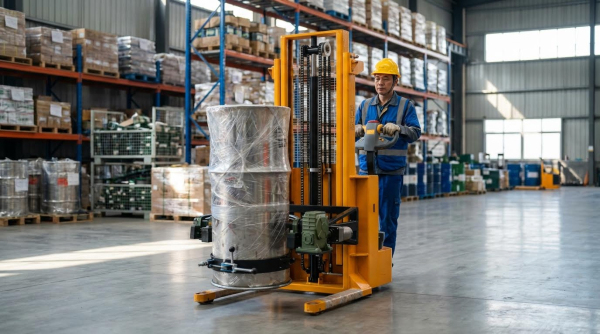
Safe lifting of 55-gallon drums in industrial facilities required a structured approach that combined risk assessment, regulatory compliance, and appropriate handling methods. Typical drum weights ranged from roughly 180 kg to over 900 kg depending on contents, which made accurate load estimation essential before choosing manual or mechanical handling. OSHA requirements for hazardous and flammable liquids, together with ASME B30.20 and BTH-1 for below-the-hook devices, governed equipment design, use, and inspection. Facilities that integrated good ergonomics, clear traffic flow, and disciplined housekeeping significantly reduced injury rates and spill incidents.
Manual handling was only acceptable for empty or very light drums and under controlled conditions with proper technique and PPE. For full or heavy drums, facilities relied on forklifts with drum attachments, dedicated drum carts, vertical and horizontal drum lifters, and powered drum tilters with positive locking and adequate safety factors. Modern practice increasingly used AGVs, cobots, and digital twins to simulate drum routes, validate clearances, and optimize equipment selection before implementation. This trend supported both productivity gains and lower risk exposure for operators.
For implementation, facilities should develop a checklist that covers: drum identification and SDS review, weight estimation, condition checks for leaks and closures, selection of a device with sufficient rated capacity and correct drum type compatibility, and verification of 3:1 or better design safety factors. The checklist should also require inspection of lifting points, rigging, and floor conditions, confirmation of operator training and PPE, and verification that travel paths are clear, lit, and free of slopes or obstructions. Periodic audits and incident reviews then closed the loop, ensuring that drum handling practices evolved with changes in materials, equipment technology, and regulatory expectations.