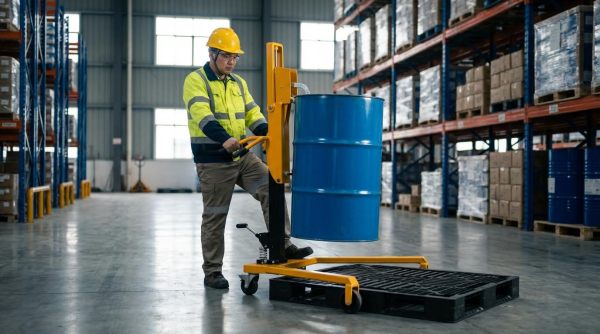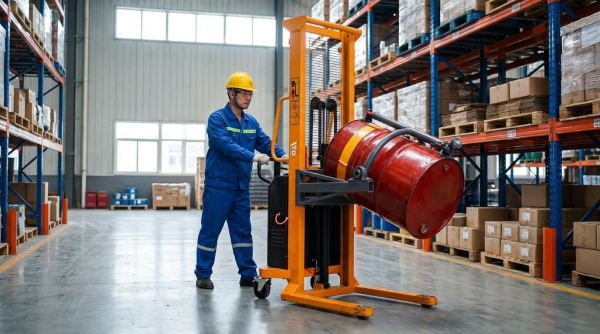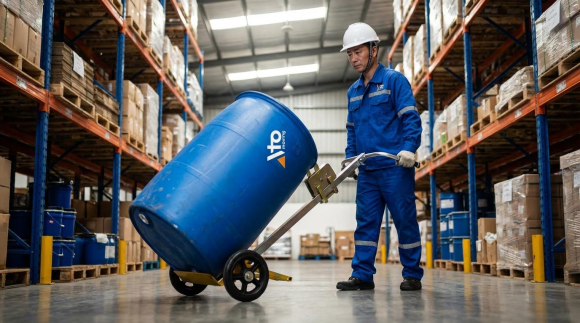
Moving 55-gallon drums safely depends on the right technique, equipment, and facility design. This guide explains how to transport 55 gallon drums in compliance with core safety standards, from manual handling limits to engineered devices and vehicle securement. You will also see how storage layout, spill containment, and equipment selection work together to control risk. Use these best practices to reduce injuries, leaks, and regulatory violations across your operation.
Core Safety Standards For Drum Transport
Regulatory definitions and drum classifications
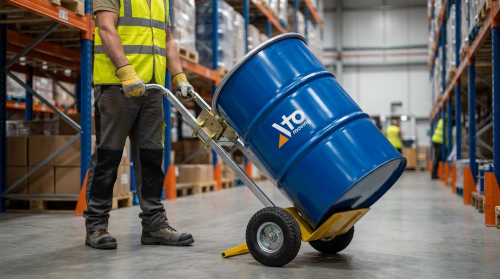
Understanding basic regulatory terms is the first step in learning how to transport 55 gallon drums safely. A 55-gallon drum is typically treated as a “large container” for flammable or toxic liquids, which triggers specific containment and protection rules. For example, containers holding 55 gallons or more of flammable or toxic liquids must be surrounded by dikes or pans that can hold at least 35% of the total volume of all containers in the area. Containment for 55-gallon and larger drums This is a core design requirement for compliant drum storage and staging zones.
Drums that contain flammable or toxic substances and have a capacity of 30 gallons or more must be placed in out-of-the-way locations or protected by physical barriers or guards to prevent impact damage. Protection from physical damage for large drums This means 55-gallon drums should not sit unprotected in traffic aisles, loading zones, or where lift trucks can strike them. Before drums enter transport, they also need inspection for dents, rust, and label legibility so that hazard classes are known and any unknown contents are flagged and isolated. Pre-storage inspection standards These classification and inspection steps define which controls apply along the full transport route.
OSHA, EPA, and fire code requirements overview
When planning how to transport 55 gallon drums, facility managers must align OSHA worker-safety rules, EPA spill-containment criteria, and fire code controls for flammable liquids. OSHA required that shipping drums must not be pressurized to remove contents, and any temporary pressurized piping used with drums carrying hazardous liquids or gases must include a relief valve and bypass to prevent rupture and uncontrolled release. Drum pressurization and relief valve requirements Drums with flammable or toxic liquids must not be stored or used near open flames, hot metal, or other artificial heat sources, and suitable fire extinguishers must be available in the immediate area and kept ready for use. Heat separation and extinguisher placement
EPA-style secondary containment criteria also drive drum transport staging design. Spill containment sumps should hold at least 10% of the total stored volume or the volume of the largest single container, whichever is greater, while Factory Mutual guidance increases this to 25% of total volume or the largest container. Spill containment sump sizing For mobile operations such as transporting gasoline-filled 55-gallon drums on a truck and dispensing by hand pump, OSHA construction standards in 29 CFR 1926.155(a), 1926.152(a)(1), and 1926.152(e) apply, and refueling operations must be evaluated case by case against additional fire protection and handling rules. Gasoline drum transport and refueling standards Together, these OSHA, EPA, and fire code requirements form the minimum safety envelope for any operation moving, staging, or dispensing from 55-gallon drums.
Engineering Controls And Handling Methods
Manual drum movement biomechanics and limits
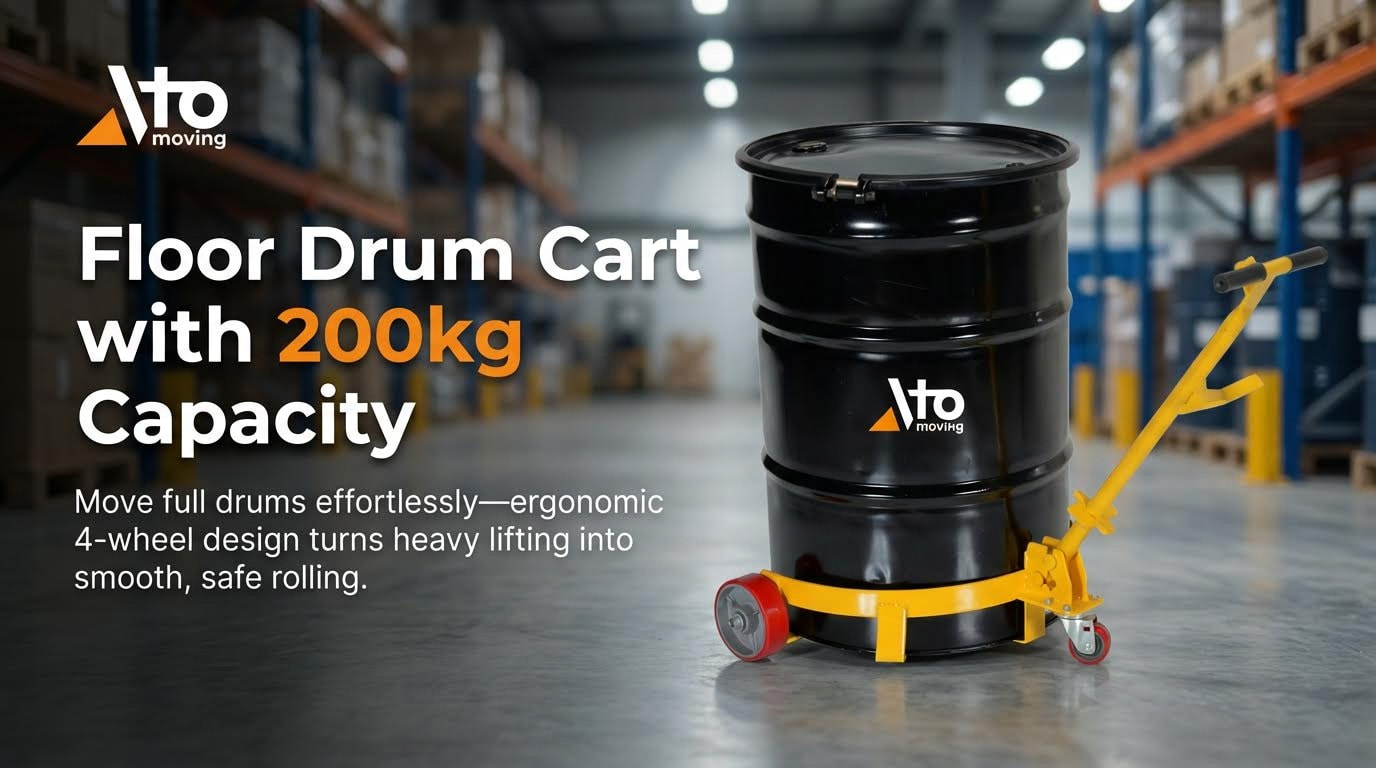
Understanding basic biomechanics is critical when planning how to transport 55 gallon drums safely. A full drum can weigh 385 lb or more, so manual handling must focus on minimizing spinal load and avoiding twisting under load. Before any manual movement, operators should complete a checklist: wear thick gloves, verify the available space, inspect the route for tripping hazards, check the drum for warping, burrs, leaks, and confirm the bung is tight and any pallet is sound Handling 55 Gallon Drums Safely. These steps reduce the risk of fractures, lacerations, hernias, and back strain that occur when heavy drums are mishandled Handling 55 Gallon Drums Safely.
Four basic techniques define initial manual movement from the upright position: pulling, pushing, drag/pull, and push/pull. Pulling is suited to tightly grouped drums; the operator grips near and far chimes, braces a foot across the bottom chime, checks for pinch points, then pulls the drum back under control Handling 55 Gallon Drums Safely. Pushing is used where there is room to work and keeps the load in front of the body; hands are placed at shoulder width near the chime, shoulders stay low and close, and the operator uses leg drive to bring the drum to balance Handling 55 Gallon Drums Safely.
In constrained spaces, the drag/pull method allows small lateral moves without lifting. The operator positions hands at the near side at shoulder width, braces the drum with a foot to prevent sliding, shifts weight to the rear foot, then drags the drum a few inches left or right Handling 55 Gallon Drums Safely. The push/pull method combines one hand pulling on the far chime and the other hand pushing off an adjacent wall, useful when drums are lined along a barrier Handling 55 Gallon Drums Safely. These techniques limit the need for full lifting and keep forces close to the operator’s center of gravity.
Rolling is often the lowest-strain manual option when planning how to transport 55 gallon drums over short, flat distances. To roll a drum to the left, the operator places the left hand high on the chime and the right hand low, then uses both hands to rotate the drum while keeping feet apart and using side steps Handling 55 Gallon Drums Safely. Hands must be lifted and re‑positioned without sliding to avoid cuts or burns on damaged or hot chimes, and the operator should stay slightly ahead of the drum but close enough to maintain control Handling 55 Gallon Drums Safely. Even with correct technique, facilities should set clear limits: manual methods are for short moves on good surfaces, while mechanical aids handle distance, slopes, and frequent handling.
Drum trucks, dollies, and forklift attachments
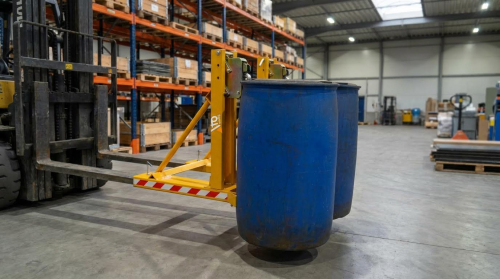
Engineering controls are the backbone of safe, efficient drum handling, and they are central to any procedure on how to transport 55 gallon drums. Mechanical equipment reduces operator strain, controls the drum’s center of gravity, and limits the risk of leaks or drops. Typical systems include forklift drum attachments that clamp to forks, mobile drum handlers with wheels, drum lifters and hoists for vertical moves, drum dollies and trucks for floor transport, and drum rotators or pourers for controlled decanting FAQs – Drum Handling Equipment. Storage racks and cages then secure drums in fixed locations to prevent tipping FAQs – Drum Handling Equipment.
For drum trucks specifically, a structured safety check is essential before loading. The operator should inspect the frame for cracks, bends, or loose joints, check all wheels for damage or low inflation, and confirm that straps, chains, or clamps operate correctly and show no excessive wear How to Use a Drum Truck. The drum truck’s rated capacity on the frame label must exceed the drum weight, and the route should be cleared of spills, debris, and obstacles before moving off How to Use a Drum Truck. These checks prevent structural failure and loss of control under dynamic loads.
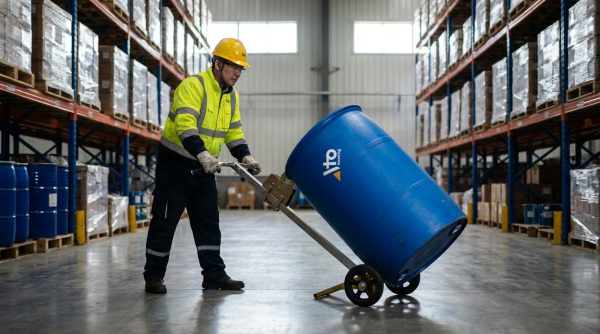
Proper loading and travel technique further protect both operator and drum. The curved cradle is positioned vertically at the drum base and centered; the truck is then tilted back slowly until the drum’s weight transfers to the wheels and rests against the backrest How to Use a Drum Truck. Straps should be snug without deforming the shell, and chains should seat on the chime, not mid‑body How to Use a Drum Truck. During movement, maintaining an angle of roughly 15–20 degrees keeps the center of gravity over the axle, supports steering control, and avoids excessive load on the operator’s back How to Use a Drum Truck.
Safe travel practices apply to all drum handling equipment. Operators should walk at a controlled pace, slow down for turns, and use wide arcs instead of sharp pivots to prevent tipping or shifting How to Use a Drum Truck. For long internal routes, periodic stops allow checks that the drum remains secure How to Use a Drum Truck. PPE should include steel‑toe boots, work gloves, and eye protection, and drums must be inspected for leaks or loose lids before lifting or transport How to Use a Drum Truck. Forklift attachments and hoists follow the same principles: respect rated capacity, keep the load low and stable, and avoid sudden acceleration, braking, or turns.
Securing drums in vehicles and during internal transit
Securing drums correctly in vehicles is a critical part of how to transport 55 gallon drums without spills or tip‑overs. A full drum can weigh 385 lb or more, so inertia during braking or cornering can easily overcome weak tie‑downs How to Secure a Barrel in a Truck Bed. In a truck bed, drums should be oriented so straps restrain movement from front to rear, never relying on the tailgate alone How to Secure a Barrel in a Truck Bed. Hooks on ratchet straps should connect to rated anchor points or receivers, and the binding system must have tensile strength comfortably above the calculated load from the drum’s mass under emergency braking How to Secure a Barrel in a Truck Bed.
Vertical stability is as important as horizontal restraint. Securing the drum at the base prevents sliding, but tie‑downs must also control the top of the drum to prevent rocking and tipping during vibration or cornering How to Secure a Barrel in a Truck Bed. For hazardous or previously hazardous contents, transport regulations treat the drum as “full” for classification and placarding, even if it appears empty, and improper transport can result in significant penalties How to Secure a Barrel in a Truck Bed. Refueling directly from drums in vehicles must also comply with specific fire and fuel handling standards, which depend on location, method, and volume dispensed OSHA Standard Interpretation – 55-Gallon Drum of Gasoline.
Within facilities, internal transit security focuses on route design and equipment selection. Drums should not block exits or entryways, and mechanical equipment such as forklifts, dollies, or hoists should be used instead of manual carrying to prevent load shifts and injuries 55 Gallon Drum Storage Building Safety Requirements. In tight areas, suspended hoists or cranes allow controlled lifting and rotation without rolling drums near obstacles 55 Gallon Drum Storage Building Safety Requirements. Before any move, drums should be checked for rust, dents, or label issues, and any drum with unknown contents should not be handled until identified 55 Gallon Drum Storage Building Safety Requirements.
Engineering controls for internal transit also include spill containment and fire safety around the transport path. For drums with flammable or toxic liquids, regulations require that they be protected from physical damage, either by locating them out of traffic paths or using barriers and guards OSHA 1915.173 – Drums and Containers. Adequate fire extinguishers suitable for the specific hazard must be immediately available and kept ready for use wherever such drums are stored or handled OSHA 1915.173 – Drums and Containers. Combined with proper mechanical equipment and tie‑down methods, these controls create a complete system
Facility Design, Storage, And Equipment Selection
Spill containment, sumps, and diking for 55-gal drums
Spill control is a core design element when planning how to transport 55 gallon drums within a facility and stage them in storage. Regulatory guidance required that containment sumps hold at least 10% of the total stored volume or the volume of the largest container, whichever was greater (EPA requirement). Insurance and loss-prevention criteria were more conservative, calling for sump capacity equal to 25% of the total stored volume or the volume of the largest container, whichever was greater (FM requirement). For drums containing flammable or toxic liquids, codes also required dikes or pans capable of enclosing at least 35% of the total volume when container size was 55 gallons or more (containment for large drums).
Typical containment sizing approach
| Design basis | Rule of thumb | Design implication |
|---|---|---|
| Regulatory minimum | ≥ 10% of total volume or largest drum | Baseline compliance for mixed storage |
| FM / risk-based | ≥ 25% of total volume or largest drum | Higher safety margin for leaks and firewater |
| Large flammable/toxic drums | ≥ 35% of total volume for ≥55-gal containers | Deeper dikes or larger pans around drum groups |
Practical layouts typically combine elevated grating over sumps with drum racks or pallets so small leaks drain away from traffic. When planning how to transport 55 gallon drums from receiving to storage, locate containment points at transfer nodes such as loading docks, decanting stations, and drum-lift areas. Fire protection should include suitably rated extinguishers in the immediate area of flammable drum storage, kept ready for use at all times (fire extinguisher placement). Drums must not be stored near open flames or hot metal surfaces when they contain flammable or toxic liquids (storage conditions for flammable liquids).
Layout, routing, and barrier protection against impacts
Facility layout has a direct impact on drum damage risk and ergonomics. Guidance required that drums of 30 gallons or more holding flammable or toxic materials be placed in out-of-the-way areas or protected by guards or barriers to prevent physical damage (protection from physical damage). In practice, this means separating forklift aisles from static drum storage with bollards, guardrails, or rack-end protectors, and avoiding blind corners where trucks and drum trucks intersect. Exits and entryways should never be blocked with drums, so staging zones need clear markings and capacity limits (drums not blocking exits).
- Design straight, wide routes for drum dollies and trucks, with minimal slopes.
- Keep transfer points on level floors to reduce tipping risk during loading and unloading.
- Plan turning radii for forklifts carrying drum pallets, avoiding tight turns near drum stacks.
- Separate pedestrian walkways from drum routes using painted lines and physical barriers where possible.
Before drums enter storage buildings, they should be inspected for rust, dents, and lid or bung condition, and labels should be verified so hazard classifications are known (inspection prior to drum storage). When planning how to transport 55 gallon drums internally, route planning must also account for floor conditions; operators are advised to survey paths for spills, narrow entrances, or steep inclines before moving drums (route planning and hazards). This combination of inspection, defined routes, and barrier protection significantly reduces leak, impact, and injury risks.
Criteria for choosing drum handling and lifting systems
Equipment selection should match drum weight, frequency of movement, travel distance, and available space. A full 55-gallon drum can weigh 385 lb or more, so manual rolling alone is rarely acceptable for routine handling (drum weight). Guidance recommended using mechanical equipment such as forklifts, drum dollies, or drum cranes/hoists instead of hand-moving drums, particularly in tight spaces (mechanical equipment for drum transport). Typical equipment options include forklift drum attachments, mobile drum handlers, drum lifters and hoists, drum dollies and trucks, drum rotators and pourers, and storage racks or cages for stability (drum handling equipment types).
| Need | Preferred equipment type | Key selection criteria |
|---|---|---|
| Short internal moves on level floors | Drum dollies / drum trucks | Capacity, wheel type, angle stability, route conditions |
| Palletized storage and loading | Forklift with drum attachment | Attachment clamp type, drum material, lift height |
| Vertical lifting in tight spaces | Drum lifters / hoists | Headroom, suspension points, rotation control |
| Pouring or mixing contents | Drum rotators / pourers | Rotation range, locking, spill containment |
Safe operation depends on pre-use checks and proper technique. Drum trucks, for example, should be inspected for frame damage, wheel condition, and functioning securing mechanisms, and their rated capacity must not be exceeded (drum truck operation safety check). During movement, maintaining the truck at an angle of about 15–20 degrees improves stability and reduces strain on the operator (drum movement technique). When you define how to transport 55 gallon drums as a standard process, align equipment choice with these engineering and safety criteria, then train operators on PPE, inspection, and route control to close the loop between design and day-to-day handling.
“”
Summary Of Key Drum Transportation Practices
Safe 55-gallon drum transport depends on one integrated system, not isolated rules. Regulations define drum classes, spill capacity, and fire separation, which in turn set the minimum design of storage, staging, and routes. Engineering controls then manage weight, center of gravity, and impact forces so operators do not rely on strength or luck. Manual techniques stay limited to short, flat moves with clear surfaces, while drum trucks, forklifts, hoists, and purpose-built Atomoving handlers carry most loads.
Facility design must assume leaks, impacts, and emergency stops will occur. Sumps, dikes, and pans catch released liquid. Barriers, marked aisles, and protected storage keep vehicles away from drums. Rated tie-downs, correct drum orientation, and dual-point restraint prevent shift and rollover in vehicles and during internal moves.
The best practice for operations teams is clear. Start with regulatory containment and fire code as the floor, not the goal. Add risk-based sump sizing, guarded layouts, and conservative capacity limits. Standardize equipment selection, inspection checklists, and travel angles. Train every operator to treat each drum as heavy, hazardous, and capable of failing. This combined approach reduces injuries, spills, and violations while keeping drum handling predictable and controllable.
Frequently Asked Questions
How to Safely Move a 55-Gallon Drum?
Moving a 55-gallon drum requires the right equipment to ensure safety and efficiency. Forklifts, pallet jacks, and drum dollies are essential tools for this task. Attempting to manually roll or lift these containers increases the risk of accidents. Drum Handling Guide.
What Equipment is Recommended for Transporting 55-Gallon Drums?
To transport 55-gallon drums safely, use equipment like forklifts, pallet jacks, and drum dollies. These tools help minimize the risk of injury and damage during movement. Additionally, bracing the drum with your foot while shifting weight can help in smaller movements. USDA Drum Moving Tips.
Will a 55-Gallon Barrel Fit in a Car?
A standard 55-gallon barrel is unlikely to fit in most cars due to its size and weight. Typically, these barrels are approximately 0.85 meters (34 inches) tall and 0.61 meters (24 inches) wide. Specialized transport equipment or larger vehicles such as trucks or vans are recommended for moving them.