Industrial teams asking what is a counterbalanced stacker usually face tight aisles, mixed pallet types, and budget pressure. This article explains how counterbalanced stackers use a rear counterweight instead of front outriggers, and how that choice affects stability, capacity, and floor layout.
You will see how counterweight layout, drive type, and duty cycle link to safety, ergonomics, and standards for industrial trucks. The middle sections compare counterbalanced and straddle stackers in real warehouses, then contrast stackers with counterbalance forklifts on power, runtime, and lifecycle cost. The final section gives a structured method to select the right truck for your loads, heights, and building constraints, including when a counterbalanced stacker is the most efficient option.
Core Design Of Counterbalanced Stackers
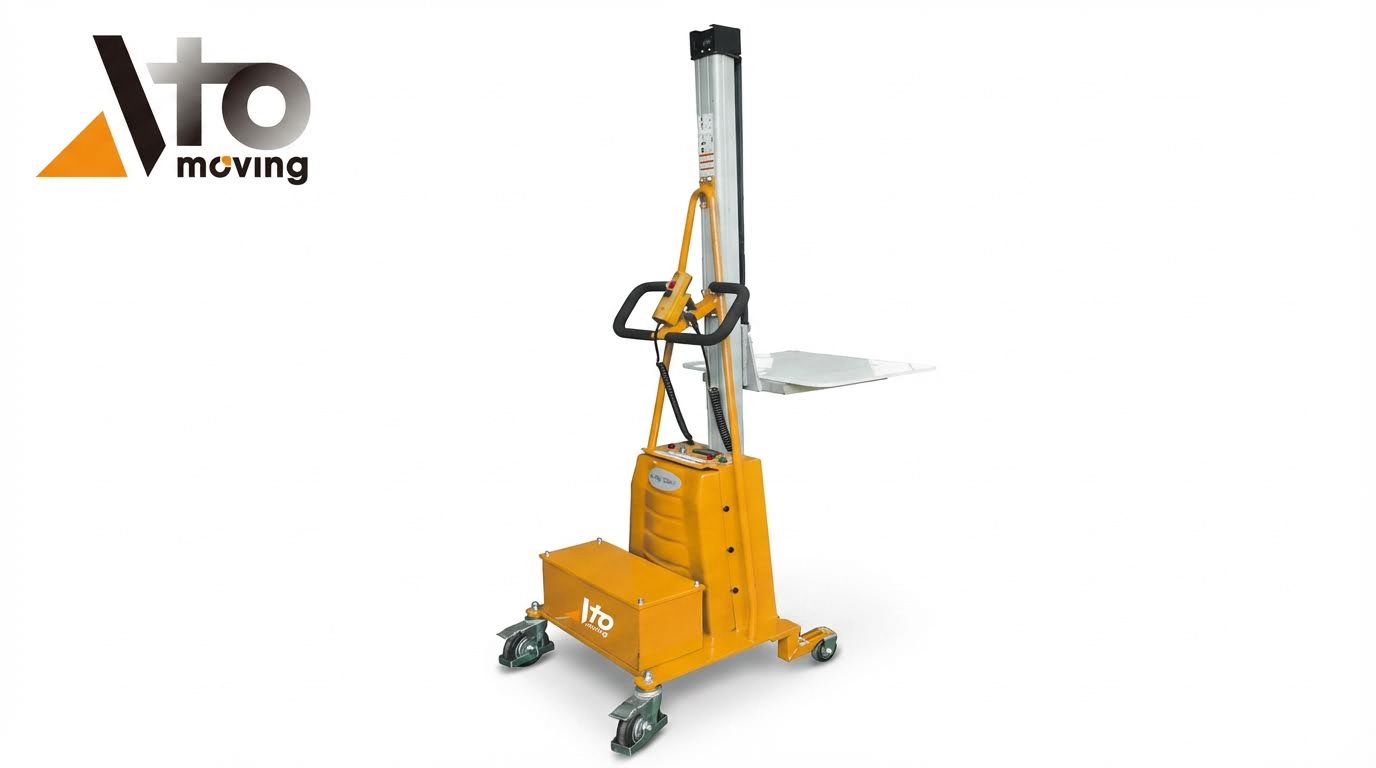
Engineers ask “what is a counterbalanced stacker” when they need a compact, forklift-like truck without outriggers. The core design uses a rear counterweight to balance the load on the forks, so the front stays clear for open-bottom pallets, skids, and machines. This section explains how the counterweight layout sets stability limits, how manual and electric systems differ, and how capacities and duty cycles match real warehouse tasks. It also links these design choices to safety, ergonomics, and compliance with current industrial truck standards.
Counterweight Layout And Stability Principles
A counterbalanced stacker places the forks and mast ahead of the front axle and the counterweight behind the rear axle. The combined centre of gravity must stay inside the stability triangle formed by the wheels during all movements. Designers size the counterweight and wheelbase so the truck remains stable during lifting, braking, and turning.
Key design variables include:
- Load centre distance
- Wheelbase length and track width
- Mast tilt range and fork height
- Tyre type and floor friction
Engineers calculate worst-case conditions. These include maximum rated load at full height, with mast tilted, and during steering. They then apply safety factors defined in industrial truck standards. This approach keeps the truck compact while still allowing operation in narrow aisles and near production lines.
Manual Vs. Electric Drive And Lift Systems
Manual counterbalanced stackers use a hand pump or foot pedal for lift and push or pull force for travel. They suit low-throughput tasks, short distances, and light to medium loads. They have low purchase cost and simple maintenance but generate higher operator effort and slower cycles.
Electric counterbalanced stackers add powered lift and often powered travel. Typical systems use:
- Battery pack with on-board charger
- DC or AC traction motor
- Hydraulic power unit for mast lift
- Electronic speed and brake control
Electric units reduce strain, support higher duty cycles, and hold more consistent performance over a shift. They also allow controlled operation on slight slopes and smoother positioning at racking. Engineers select manual or electric based on move frequency, route length, and target productivity.
Typical Capacities, Lift Heights, And Duty Cycles
Counterbalanced stackers usually work in light to medium-duty roles. Typical rated capacities range from about 1 000 kilograms to 2 500 kilograms. Higher capacities exist but move closer to forklift territory. Common lift heights fall between 3 metres and 4 metres, enough for standard warehouse racking.
Duty cycles vary by power type:
| Type | Typical use |
|---|---|
| Manual | Low hours per day, intermittent lifts |
| Electric walk-behind | Single-shift, frequent short moves |
| High-capacity electric | Higher frequency, multi-bay stacking |
Engineers consider load mass, lift height, and cycles per hour when sizing motors, hydraulics, and batteries. They also check that the rated capacity applies at the specified load centre and at maximum lift height. This prevents overloads that could shift the combined centre of gravity outside the safe base.
Safety, Ergonomics, And Standards Compliance
Modern counterbalanced stackers follow safety rules from standards such as ISO 3691 and related regional adoptions. These rules cover stability tests, braking performance, guarding, and emergency controls. Designers must prove stability with and without loads, during travel and lifting.
Common safety and ergonomic features include:
- Emergency stop and key switch
- Dead-man or tiller presence control
- Guarded mast and overhead protection where needed
- Clear sight lines to forks and load
Electric models often add speed reduction with elevated loads and controlled acceleration. Ergonomic tiller heads place lift, lower, and travel controls within easy reach. Good handle geometry and low steering effort reduce strain for walk-behind operators. Regular inspections, documented maintenance, and operator training complete the safety system and keep the truck compliant over its service life.
Counterbalanced Vs. Straddle Stackers In Practice
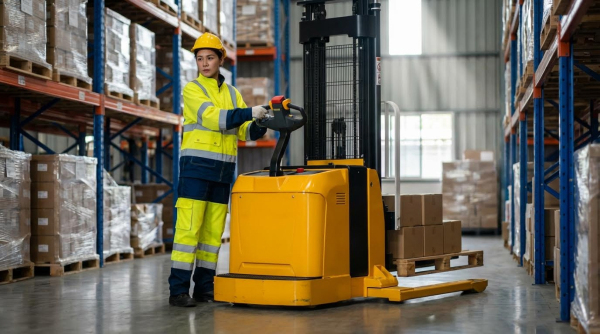
This section explains what is a counterbalanced stacker in daily use and compares it with straddle stackers. The focus stays on how design details change pallet access, aisle planning, and stability on real warehouse floors.
Outriggers, Load Access, And Pallet Compatibility
A counterbalanced stacker carries a heavy counterweight behind the mast. This weight balances the load on the forks, so the truck does not need front outriggers. Straddle stackers use outrigger legs that project forward and sit on each side of the pallet. These legs give stability but limit which pallets and loads the truck can handle.
When engineers ask what is a counterbalanced stacker good for, pallet access is a key answer. The counterbalanced layout lets the forks enter open-bottom pallets, skids, bins, and under machines without leg interference. Straddle stackers work best with closed-bottom pallets that sit between the outriggers.
| Aspect | Counterbalanced stacker | Straddle stacker |
|---|---|---|
| Front legs | No outriggers | Fixed or adjustable outriggers |
| Open-bottom pallets | Direct handling | Often not compatible |
| Closed pallets between legs | Less efficient | Primary use case |
| Machine and conveyor feeding | Very suitable | Legs can clash with frames |
For mixed pallet fleets or machine loading, counterbalanced stackers usually give higher flexibility. For single pallet types and repeat rack work, straddle units can offer lower truck mass for the same rated capacity.
Aisle Width, Turning Radius, And Space Utilization
Counterbalanced stackers keep a compact overall width because they do not carry side outriggers. This helps in aisles where every centimetre matters. However, the rear counterweight extends the chassis length. This extra length increases turning radius versus some short straddle designs.
Straddle stackers need extra aisle width to clear their outriggers around racks and loads. In return, they can use shorter wheelbases because the legs move the stability triangle forward. Engineers should compare the total “right angle stacking” dimension for each truck type, not just chassis width.
For space planning, consider three factors together:
- Truck length including counterweight or outriggers
- Required pallet overhang and mast tilt envelope
- Operator position and safe clearance to racking
In narrow aisles with mixed load interfaces, counterbalanced stackers often give better net storage density. In very tight, repeat pallet lanes with consistent loads, straddle stackers can still win on turning radius and cost.
Floor Conditions, Stability Margins, And Risk Modes
Both designs rely on a stable floor with limited slope and good surface quality. Counterbalanced stackers place more mass within the truck body, so wheel loads are high but well concentrated. Straddle stackers spread loads through outriggers, which can reduce point pressure but increase sensitivity to level changes between wheels.
Typical risk modes differ. Counterbalanced stackers face higher risk of forward tip if operators exceed rated capacity or lift with the mast tilted. Straddle stackers face higher risk of side instability if one outrigger runs over a pit, rail, or damaged slab edge. Poor pallet fit between legs can also shift the centre of gravity.
When engineers evaluate what is a counterbalanced stacker for a given site, they should map floor joints, ramps, and dock transitions. Key checks include:
- Maximum floor slope in working areas
- Condition of joints and drains under outrigger paths
- Clear marking of no-go zones near edges or pits
With correct truck selection, load charts, and operator training, both counterbalanced and straddle stackers can meet ISO stability requirements and deliver safe, predictable handling.
Stackers Vs. Counterbalance Forklifts
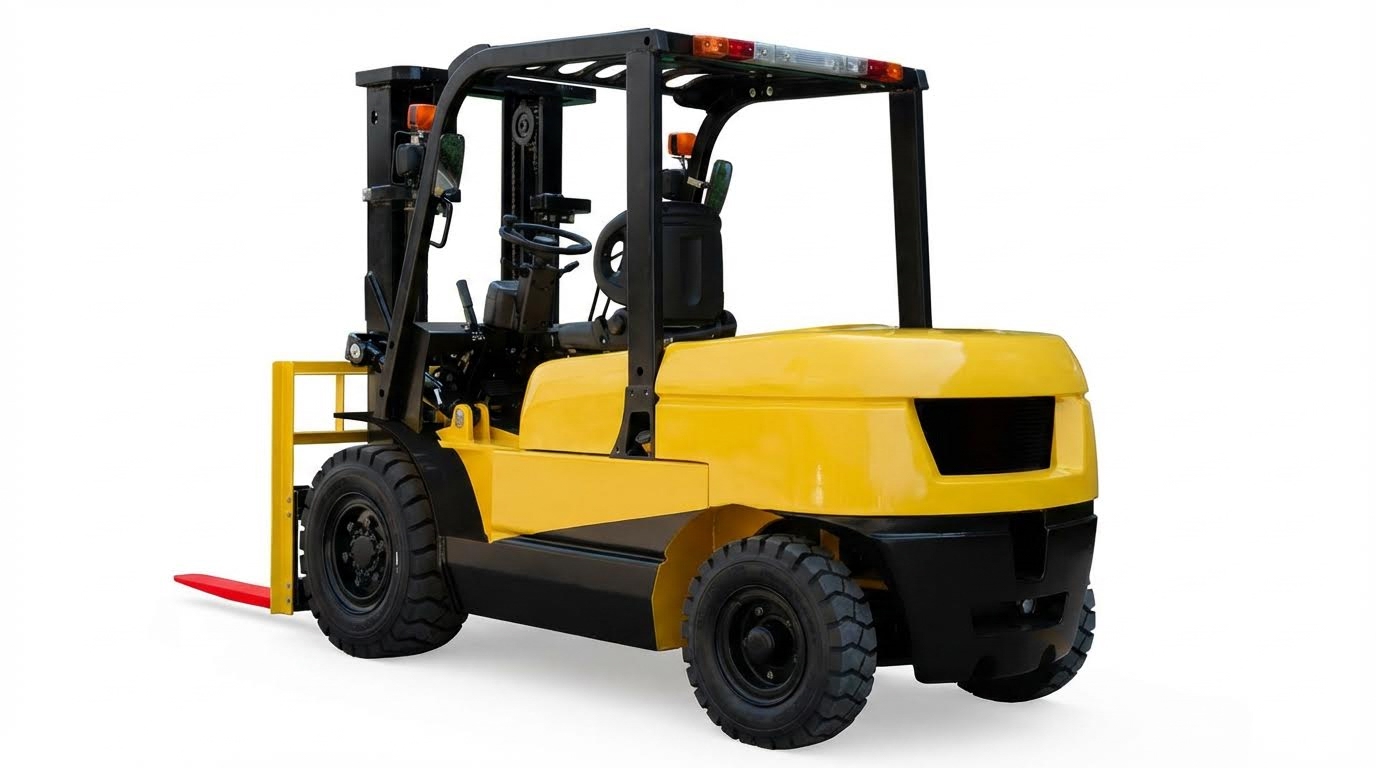
This section compares stackers and counterbalance forklifts from a mechanical, operational, and compliance view. It helps answer what is a counterbalanced stacker and when it replaces or complements a forklift. The focus stays on capacity, lift height, power choices, energy use, training needs, and lifecycle cost.
Capacity, Height, And Structural Design Limits
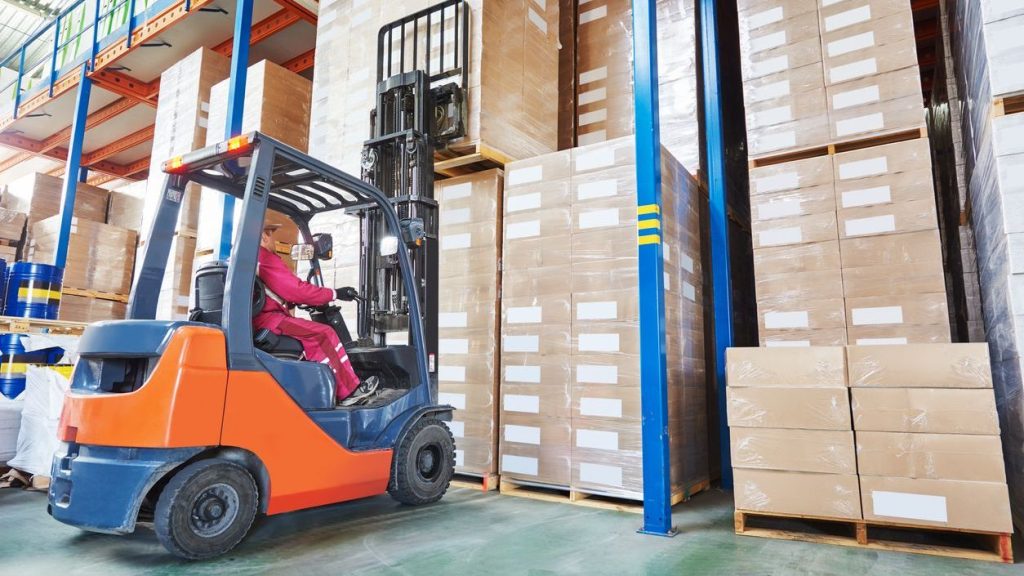
A counterbalanced stacker is a compact industrial truck that uses a rear counterweight to balance the load. Typical rated capacities sit roughly between 1,000 kilograms and 2,500 kilograms. Counterbalance forklifts often reach far higher capacities and can exceed 10,000 kilograms on heavy models. Stackers usually lift to about 3 to 4 metres, while forklifts can reach racking above 10 metres in high bay systems.
The structural frames reflect these limits. Stackers use lighter masts, shorter wheelbases, and smaller counterweights. Forklifts use heavier mast sections, larger steer axles, and robust drive axles to handle dynamic loads at higher speeds and heights. Engineers must check:
- Load centre and derating at height for both machines
- Floor bearing pressure from wheel loads
- Deflection of masts and attachments under rated load
Stackers suit light to medium duty, short travel, and moderate racking. Counterbalance forklifts cover heavy duty, long travel, and tall storage where higher moment loads act on the mast and chassis.
Power Sources, Energy Use, And Runtime Profiles
Most counterbalanced stackers use manual pump lift, electric lift, or full electric lift and drive. They usually rely on battery packs that charge from standard building power. This keeps energy demand and infrastructure needs low. The smaller drive motors and lower travel speeds reduce peak power draw compared with forklifts.
Counterbalance forklifts offer a wider power range. Common options include large traction batteries, diesel, gasoline, and liquefied petroleum gas engines. These trucks support longer duty cycles, higher speeds, and outdoor work. Combustion models run continuous shifts with fast refuelling. Electric forklifts need higher capacity chargers and planned opportunity charging.
For typical warehouse tasks, stackers deliver good energy efficiency per tonne moved over short distances. Forklifts become more efficient when loads are heavier, cycles are longer, or gradients and outdoor travel appear in the duty profile. Engineers should map travel distance, lift frequency, and idle time before selecting the power concept.
Training, Compliance, And Total Lifecycle Cost
Stackers, including counterbalanced types, usually fall under simpler operator training schemes. Many regions did not require a full forklift licence, but site-specific training and documented instruction still applied. Counterbalance forklifts required certified operator courses, periodic refreshers, and stricter medical and competence checks.
Relevant ISO and EN standards defined safety functions for both machine types. Examples included ISO 3691 series and ISO 21262 for industrial trucks. These standards covered stability, braking, visibility, warning devices, and emergency controls. Facilities had to integrate truck rules with local occupational safety law and internal traffic plans.
Total lifecycle cost often favours stackers in light to medium duty roles. Key cost drivers differ:
- Stackers: lower purchase price, smaller batteries, simpler tyres, less structural wear
- Forklifts: higher purchase price, but better productivity in heavy or tall stacking
Maintenance on stackers tends to be lighter, with fewer high-stress components. Forklifts demand more frequent checks on masts, chains, hydraulic circuits, and brake systems due to higher speeds and loads. A balanced decision compares not only price but also throughput targets, shift patterns, and safety obligations.
Summary: Selecting The Right Industrial Truck
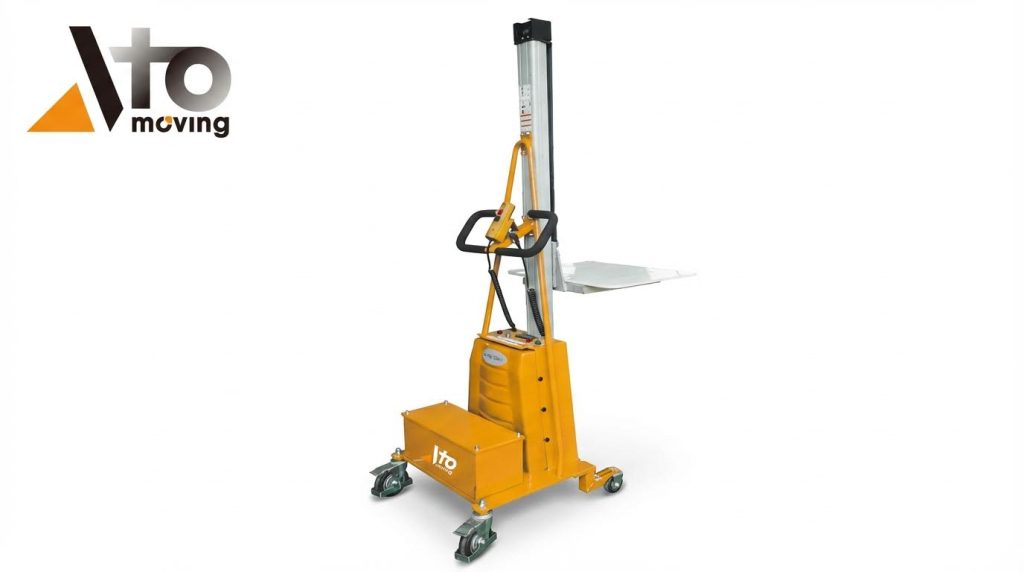
Operations teams that ask what is a counterbalanced stacker usually compare it with straddle stackers and counterbalance forklifts. A counterbalanced stacker uses a rear counterweight instead of front outriggers. This lets the forks reach open-bottom pallets, skids, and machines without leg interference. The compact chassis works well in tight aisles and short transfer runs.
From an engineering view, counterbalanced stackers suit light to medium loads and moderate lift heights. Typical designs cover roughly 1,000–2,500 kilograms and up to about 4 metres. Electric drive and lift reduce operator effort and support repeatable duty cycles. Manual units fit low-throughput work cells where capital budgets are tight and utilisation is low.
Compared with straddle stackers, counterbalanced stackers trade some inherent lateral stability for superior access and flexibility. They remove outrigger legs but rely on correct counterweight sizing, wheelbase, and mast stiffness. Compared with counterbalance forklifts, they offer lower capacity, shorter lift, and reduced travel speed. In return, they bring lower purchase cost, simpler maintenance, and easier training.
Selection should start from four checks: load mass and centre of gravity, required lift height, aisle width, and floor quality. Where loads stay below medium range, aisles are narrow, and work is mainly indoors, counterbalanced stackers are often the most efficient choice. Where loads are heavy, heights exceed warehouse racking, or outdoor travel is routine, counterbalance forklifts remain the better fit.
Future fleets will likely mix compact stackers, heavier forklifts, and automated variants. Engineers should keep options open for later upgrades, such as higher energy-density batteries or semi-automated travel. A balanced view recognises that stackers will not replace forklifts but will keep expanding in indoor, short-shuttle, and precision handling roles.
Frequently Asked Questions
What is a counterbalanced stacker?
A counterbalanced stacker, often referred to as a counterbalance forklift, is designed with forks at the front and no outrigging legs. This design allows it to drive right up to loading spots or racking systems. The weight of the machine itself acts as a counterbalance to the load being lifted, enabling stable operation without additional support arms. Forklift Basics.
Are all forklifts counterbalanced?
No, not all forklifts are counterbalanced. For example, side loaders are specialized forklifts that carry long loads like timber or pipes on the side rather than the front. These forklifts are ideal for narrow aisles and tight spaces where traditional counterbalance forklifts may struggle. Types of Forklifts.