Diesel forklifts typically weigh far more than the loads they lift, and that weight directly drives stability, axle loads, and floor loading risk. This guide explains how much a diesel forklift weighs, how axle loads shift when lifting, and what that means for slab design, transport, and safe operation.
Using real service weights, axle load data, and typical capacity ratios, we break down counterweight, powertrain, and mast contributions to total mass. You will learn how to match forklift weight to your loads, aisles, and concrete strength so you can answer “how much does a diesel forklift weigh” in a way that is meaningful for engineering and safety decisions.
Diesel Forklift Weight Basics And Typical Ranges
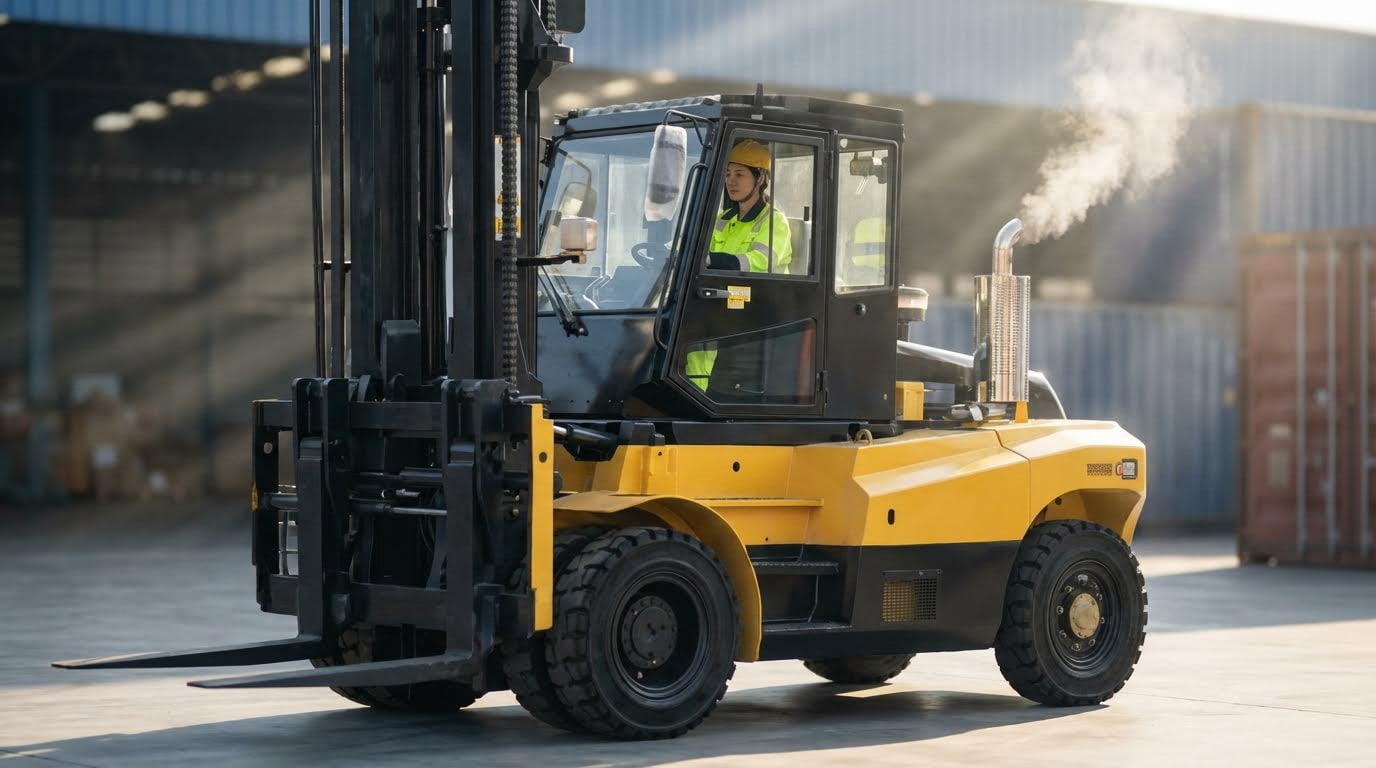
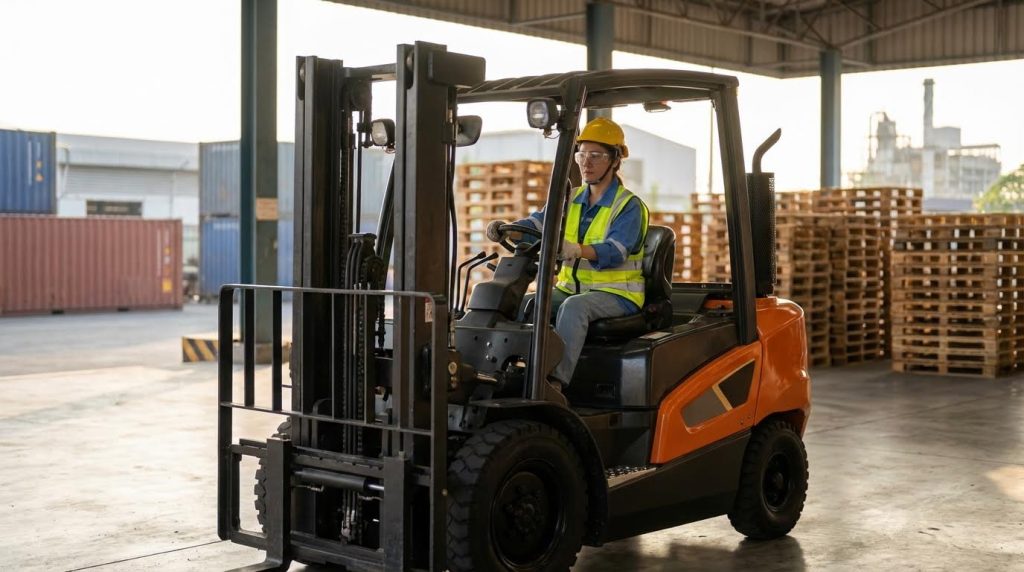
When people ask “how much does a diesel forklift weigh”, the honest answer is that it ranges from about 3,000 kg to well over 20,000 kg depending on capacity and design. For heavy diesel pneumatic-tire models, service weight alone can exceed 15,000–19,000 kg, so understanding where your truck sits in this range is critical for floor loading, transport, and stability planning. This section explains how service weight relates to lifting capacity and which components add most of the mass.
| Diesel Forklift Type | Typical Rated Capacity | Typical Service Weight (Truck Only) | Operational Impact |
|---|---|---|---|
| Light industrial diesel (warehouse / light yard) | 1,500–2,500 kg | 3,000–5,000 kg (estimate based on industry ratios) | Suitable for standard warehouse slabs and docks if designed for forklifts. |
| Medium diesel, cushion or small pneumatic | 2,500–5,000 kg | 5,000–9,000 kg (estimate based on industry ratios) | Common “workhorse” trucks; check slab design and transport limits. |
| Heavy diesel, pneumatic tire yard truck | 4,500–7,000 kg | 15,300–19,300 kg service weight for some models according to published specs | Demands engineered slabs, strong yards, and heavy low-bed trailers. |
| Very heavy industrial / port diesel | 10,000 kg and above | Often 20,000 kg+ (varies by model and capacity) | Requires structural review of floors and often special transport permits. |
💡 Field Engineer’s Note: When evaluating “how much does a diesel forklift weigh”, always consider the heaviest configuration you might end up with (attachments, cab, full fuel), not just the brochure base weight. This avoids surprises when checking slab capacity or arranging transport.
Service weight vs. rated lifting capacity
Service weight is the actual mass of the forklift itself, while rated lifting capacity is how much load it can safely lift at a specified load center and height. For diesel forklifts, the two are linked by stability physics, but they are not the same number and they appear as different fields on the data plate.
- Service weight (truck weight): The total operating weight of the forklift with standard equipment, fluids, and sometimes a nominal operator, but without any payload. This is the number you use for floor loading, transport, and elevator or dock checks.
- Rated lifting capacity: The maximum load mass the truck can safely lift at a defined load center (commonly 500 mm) and mast height. This is the number operators watch to avoid tipping or overloading the mast.
- Typical ratio: The gross weight of a forklift is usually 1.5–2 times its rated lifting capacity according to industry guidance. This extra mass provides the counter-moment needed to keep the truck stable.
| Example Diesel Forklift | Rated Capacity | Typical Service Weight (Using 1.5–2× Rule) | Operational Impact |
|---|---|---|---|
| Small diesel counterbalance | 1,500 kg | 2,250–3,000 kg (estimated) | Often acceptable on standard warehouse slabs designed for forklifts. |
| Mid-size diesel, common in yards | 3,000 kg | 4,500–6,000 kg (estimated) | Needs checked floor capacity at loading docks and mezzanines. |
| Heavy diesel, high-capacity yard truck | 4,500–7,000 kg | 6,800–14,000 kg (estimated) with some models documented at 15,300–19,300 kg in manufacturer data | Almost always requires engineered slabs and checked outdoor subgrade. |
- Why the truck is heavier than the load: The forklift must generate a stabilizing moment around the front axle that exceeds the overturning moment from the load at the forks. Extra truck mass behind the axle provides that stabilizing moment.
- Effect on floor loading: When you add the rated load to the service weight, almost all of that combined mass sits over the front axle during lifting. This is the critical figure for slab design and rack-aisle checks.
How to find service weight and capacity on your truck
Check the nameplate or data plate usually mounted near the operator’s seat. It lists truck service weight, rated capacity at a specific load center, and often alternate ratings for different mast heights or attachments. Use the service weight plus maximum load to evaluate floor loading and transport limits.
How counterweight and powertrain drive total weight
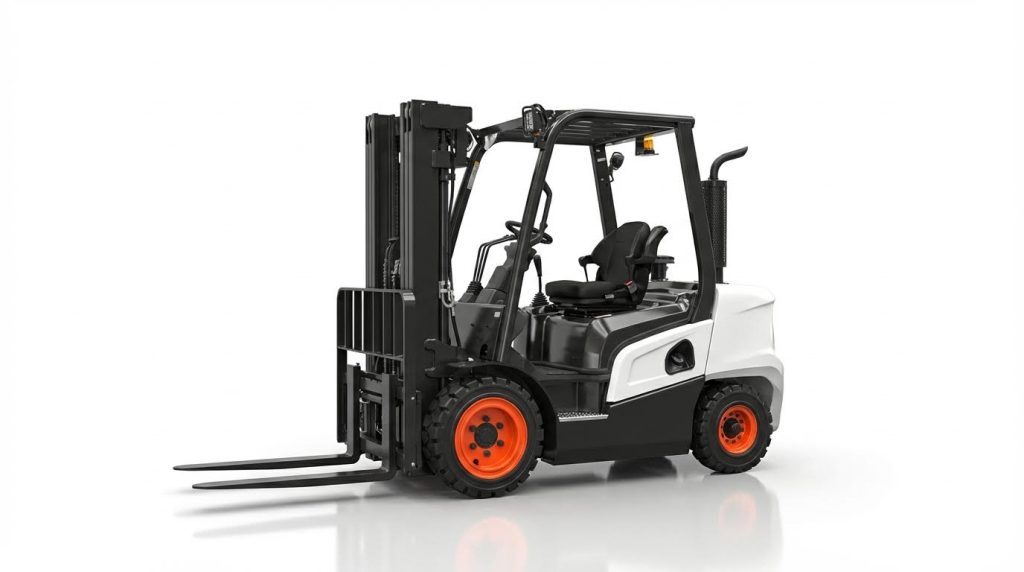
The counterweight and diesel powertrain are the two biggest contributors to how much a diesel forklift weighs. Engineers size these components to keep the center of gravity inside the stability triangle while delivering enough power for travel, lifting, and gradeability.
- Counterweight sizing: The counterweight commonly equals about 1.5–2 times the rated lifting capacity based on industry practice. This large steel casting at the rear is usually the single heaviest component.
- Powertrain mass: Diesel engines, transmissions, and driveline components are much heavier than electric motors and batteries of similar power. This adds to the total truck weight but also improves continuous-duty performance outdoors.
- Pneumatic tires and axles: Heavy-duty pneumatic tires, drive axles, and steer axles are sized to carry front axle loads that can exceed 22,000–31,700 kg when loaded on large models according to published specs. These structural parts add significant dead weight.
| Component Group | Weight Role | Effect on Total Truck Weight | Practical Impact |
|---|---|---|---|
| Rear counterweight | Provides stabilizing moment against load | Often the largest single mass on the truck | Improves capacity and stability but increases floor loading and transport weight. |
| Diesel engine & transmission | Power source for drive and hydraulics | Hundreds of kilograms of cast iron and steel | Enables high travel speeds and gradeability; adds to rear-biased weight. |
| Drive & steer axles | Carry and transmit wheel loads | Heavy housings, gears, and hubs | Must be rated for front axle loads over 22,000–31,700 kg on large units per manufacturer data. |
| Mast, carriage, and forks | Lift and position loads | Thick steel sections and weldments | Higher masts and heavy carriages increase truck weight and move the center of gravity forward. |
- Diesel vs. electric weight distribution: Electric forklifts derive much of their mass from the traction battery, while diesel trucks concentrate mass in the rear counterweight and engine. This changes how the center of gravity shifts when lifting and braking.
- Options and attachments: Cabs, side-shifters, clamps, and larger masts all add kilograms on top of the base service weight. Always check the updated capacity plate after adding equipment.
💡 Field Engineer’s Note: When you upgrade a diesel forklift with a heavier mast or clamp, you often gain several hundred kilograms of extra truck weight but lose rated capacity at the forks because the load center moves forward. Always ask the supplier for a revised capacity plate and updated service weight before putting the truck on marginal slabs or mezzanines.
Axle Loads, Floor Loading, And Structural Design
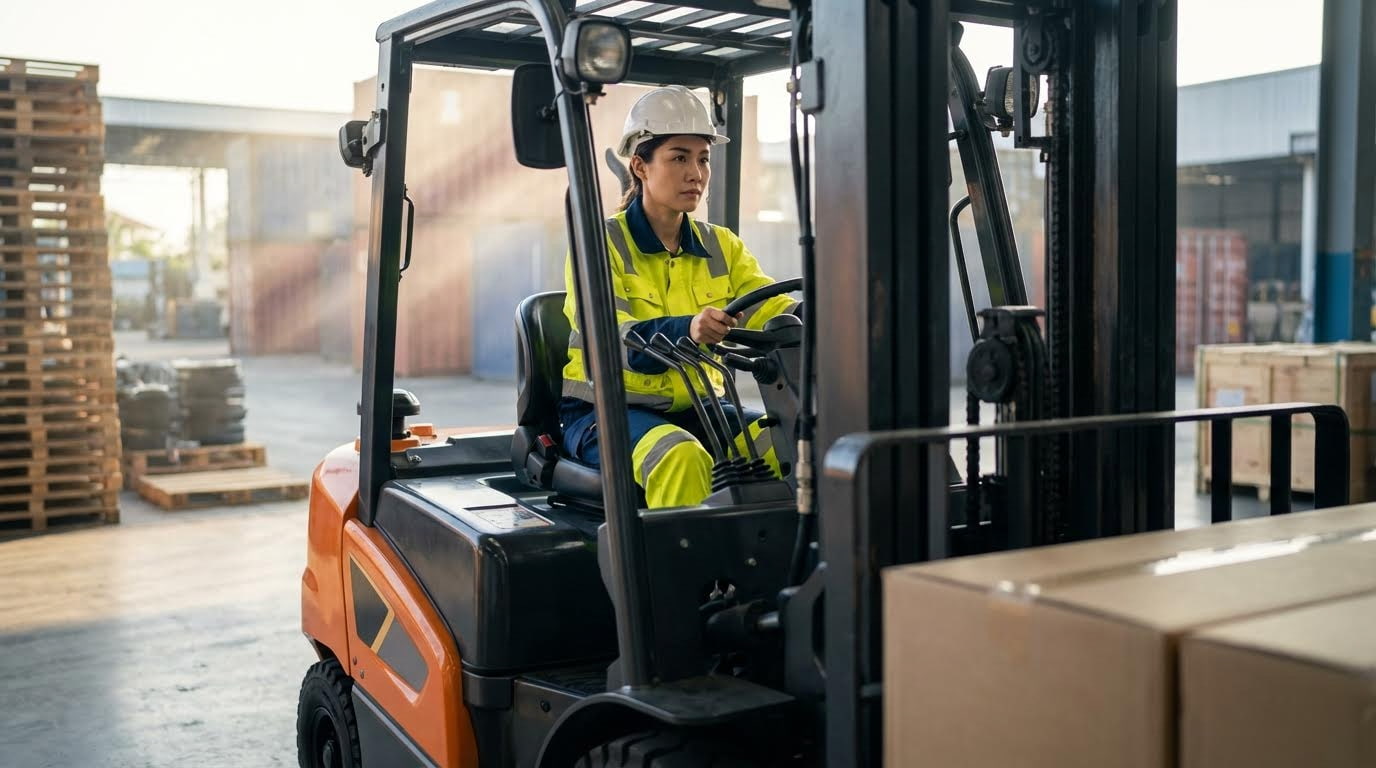
This section explains how axle loads from a diesel forklift transfer into floor loading and why slab and structure design must match the real wheel loads, not just “how much does a diesel forklift weigh”.
Engineers care less about the headline truck weight and more about how that weight and the lifted load split between axles and then into small tire contact patches. That distribution controls concrete slab thickness, reinforcement, joints, and even whether an older mezzanine can safely see diesel forklift traffic.
Front and rear axle loads, loaded vs. unloaded
Front and rear axle loads change dramatically between unloaded and loaded conditions, and most of the combined weight ends up on the front axle when the truck is lifting near capacity.
The table below uses published data for heavy diesel pneumatic forklifts to show how axle loads shift as you go from parked to fully loaded. Values are ranges across several models.
| Condition | Front axle load | Rear axle load | Typical service weight band | Operational impact |
|---|---|---|---|---|
| Unloaded | 7,585–11,436 kg | 7,693–12,087 kg | 15,278–19,300 kg service weight (spec data) | Axle loads are roughly balanced; rear axle still carries significant weight. |
| Loaded (near rated capacity) | 22,102–31,761 kg | 3,176–3,539 kg | Same truck, but with rated load on forks (spec data) | Front axle may see >70–85% of total weight; governs floor design and rack aisle checks. |
When people ask “how much does a diesel forklift weigh”, they often ignore that a 15,000–19,000 kg service-weight truck can push over 30,000 kg onto the front axle once you add a heavy load and shift the center of gravity forward.
- Loaded front axle dominance: The front axle may carry 4–7 times the rear axle load when lifting near capacity – this is the critical case for slab and ramp checks.
- Rear axle unloading: Rear axle load can drop to only about 3,200–3,500 kg on heavy trucks when fully loaded (spec data) – this reduces rear tire grip and braking contribution.
- Dynamic effects: Braking, accelerating, or traveling on slopes further shifts load between axles – designers apply safety factors to cover these transient peaks.
💡 Field Engineer’s Note: On older suspended slabs or mezzanines, I never approve diesel forklift traffic based only on “truck weight.” I demand axle load data from the capacity plate or spec sheet and check front-axle loaded cases explicitly, including an allowance for impact and braking.
Wheel contact pressure and concrete slab design
Wheel contact pressure converts axle loads into local stresses in the concrete slab, and this pressure usually governs slab thickness and reinforcement for heavy diesel forklifts.
To go from “how much does a diesel forklift weigh” to “will my floor survive,” you must divide the critical axle load by the real tire contact area, then compare that pressure and the resulting internal forces to what the slab and subgrade can safely carry.
| Parameter | Typical range for heavy diesel pneumatic truck | How it affects floor/slab design |
|---|---|---|
| Service weight | 15,278–19,300 kg (spec data) | Base dead load from the truck itself; starting point for axle and wheel load calculations. |
| Loaded front axle load | 22,102–31,761 kg (spec data) | Controls punching shear and bending at the critical wheel locations, especially at rack aisles and joints. |
| Front tire type and size | Pneumatic 10.00×20–16PR to 12.00×R20 (spec data) | Larger tires spread the load, reducing contact pressure; solid or foam-filled tires increase pressure. |
| Front track width | 1,724–1,925 mm (spec data) | Wider track spreads wheel loads laterally; narrow track concentrates stresses in narrow aisles. |
| Ground clearance | 200–240 mm at lowest point loaded (spec data) | Influences ramp and dock geometry; not a direct load factor but relevant for joint and dock impact. |
- Point load vs. uniform load: A 20,000+ kg front axle acting through four relatively small tire footprints is a point-load problem, not a simple “kg/m²” uniform load – this is why rack aisle slabs often crack first.
- Dynamic factor: Engineers typically add 10–30% to static wheel loads for impact from travel, braking, and joint crossings – this compensates for real-world abuse.
- Standard warehouse slabs: Many “light” warehouse slabs were only intended for forklifts below about 6,800 kg total weight; heavy diesel units can exceed punching shear or subgrade bearing capacity if not checked.
How engineers estimate wheel contact pressure
Designers start with the worst-case front axle load from the spec sheet or capacity plate, then divide by the number of front wheels. They estimate each tire’s contact area from tire size and inflation pressure (for pneumatic tires) or from manufacturer data (for solid tires). Dividing wheel load by contact area gives contact pressure in kN/m². They then verify that slab thickness, reinforcement, and subgrade can sustain this pressure with an appropriate safety factor, following relevant concrete design standards.
💡 Field Engineer’s Note: When I investigate floor failures, the root cause is often a change from light electrics to heavy diesel forklifts without revisiting wheel loads. The “new trucks” might be only 20–30% heavier on paper, but front wheel loads and contact pressures can nearly double once you factor in bigger loads and different tires.
Effects of mast height, attachments, and tires on floor loads
Mast height, attachments, and tire choices all change how much load reaches the floor and where it acts, even if the base diesel forklift model number stays the same.
This is why the answer to “how much does a diesel forklift weigh” is not enough for engineering; you must consider the configured truck with its actual mast, carriage, forks, and any added tools.
- Taller masts: Multi-stage high-lift masts add significant steel mass ahead of the front axle and raise the center of gravity – this increases front axle load and can require thicker slabs in high-bay rack aisles.
- Attachments: Side-shifters, clamps, rotators, and fork positioners add dead weight at the carriage and push the effective load center forward – this both derates capacity and increases front wheel loading.
- Capacity derating: Regulations require recalculating and updating the capacity plate when attachments are installed, because added attachment weight and longer load centers change stability and wheel loads – ignoring this can overload both truck and floor. Capacity & attachment effects
- Tire construction: Solid or foam-filled tires are heavier and deform less than pneumatics – they reduce footprint size and increase contact pressure, which is harder on joints and thin slabs.
- Tire size changes: Upsizing to larger-diameter or wider tires can reduce contact pressure, but may change turning radius and aisle clearance – engineers must check both structural and maneuvering constraints.
Why mast and attachment weight matter for axle loads
The mast, carriage, forks, and attachments sit ahead of the front axle, acting like a long lever arm. Adding mass here increases the overturning moment around the front axle. To stay within the stability triangle, manufacturers either increase counterweight mass or accept a lower rated capacity. In both cases, front axle loads under working conditions rise, and that extra load goes directly into the floor through the front tires.
💡 Field Engineer’s Note: For projects with paper rolls, clamps, or rotators, I always request the “as-configured” capacity plate and attachment weights. Catalog data for the base truck can understate front axle load by several thousand kilograms once you bolt on real-world attachments and go to tall masts.
Matching Forklift Weight To Application And Site Conditions
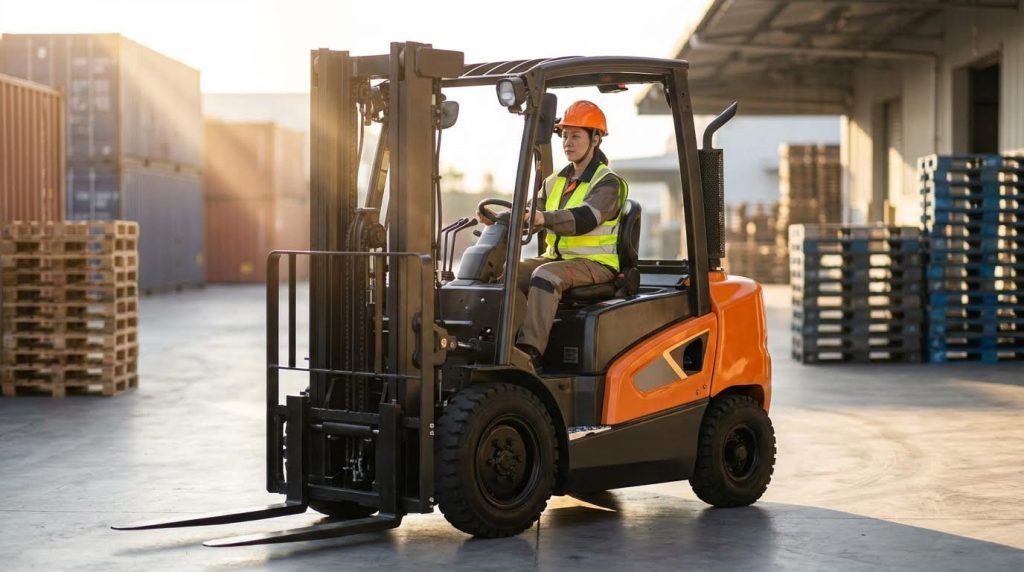
Matching diesel forklift weight to your site means balancing capacity, reach, and terrain against floor loading, aisle width, and maneuverability limits. The right answer to “how much does a diesel forklift weigh” depends on these combined factors.
💡 Field Engineer’s Note: Before upgrading to a heavier diesel truck, walk the route with a tape measure and a floor plan. Check slab thickness, joint locations, and ramp gradients; many problems only appear when a fully loaded truck hits a thin slab at a doorway or dock transition.
Selecting truck weight for load, reach, and terrain
Choosing diesel forklift weight for load, reach, and terrain starts with defining maximum load mass, load center, and lift height, then checking how truck weight and counterweight maintain stability on your actual ground conditions.
Engineers usually work backwards from the load: weight, dimensions, and where it must go. Heavier diesel forklifts use larger counterweights and stronger chassis to keep the load within the stability triangle at higher lift heights and longer load centers. The counterweight often equals 1.5–2 times the rated capacity, so increasing capacity quickly drives up total truck mass. Engineering guidance notes that gross forklift weight typically runs 1.5–2× the rated lifting capacity, which is why a seemingly modest increase in capacity can mean several thousand extra kilograms on your floor.
| Rated Capacity (approx.) | Typical Diesel Forklift Service Weight | Counterweight Rule-of-Thumb | Operational Impact |
|---|---|---|---|
| 2,500 kg | ≈3,000–5,000 kg (light IC or electric range) (Class I/IV typical) | ≈3,800–5,000 kg counterweight equivalent | Suited to standard warehouse slabs and docks; limited outdoor rough terrain use. |
| 5,000 kg | ≈7,500–10,000 kg (1.5–2× rule) (weight vs. capacity) | ≈7,500–10,000 kg counterweight plus structure | Good for heavy pallets, steel, and machinery; floor loading and transport weight start to matter. |
| 10,000–16,000 kg | ≈15,000–30,000+ kg (heavy diesel range) | Counterweight ≈1.5–2× rated capacity (engineering practice) | Used in ports and steel yards; requires engineered slabs or compacted outdoor yards. |
Heavy-duty diesel pneumatic forklifts with high capacities show how fast mass climbs. Service weight for large diesel units can reach about 15,300–19,300 kg, with front axle loads under full load rising to roughly 22,100–31,800 kg. These trucks also see unloaded front axle loads around 7,600–11,400 kg and rear axle loads around 7,700–12,100 kg, which is critical for floor design and bridge or dock rating.
- Define the real maximum load: Mass + load center + any dynamic effects – Prevents oversizing the truck “just in case,” which adds unnecessary weight and cost.
- Check lift height and mast type: High masts add structural and counterweight mass – Stability at 5–7 m often demands a heavier truck than low-level work.
- Account for attachments: Clamps, rotators, and fork positioners add dead weight and shift the center – They reduce rated capacity and may push you into a heavier base truck.
- Match weight to terrain: Rough, sloped, or soft yards favor heavier, long-wheelbase diesel units – But too much weight increases sinkage and rutting on weak ground.
How “how much does a diesel forklift weigh” changes with terrain
On smooth indoor slabs, you usually want the lightest truck that still meets capacity and reach. Outdoors on gravel or compacted fill, a heavier diesel truck improves traction and reduces bounce with long steel or timber loads. On very soft soils, though, you may deliberately choose a smaller, lighter-capacity truck, or add mats and plates, to keep ground pressure within safe limits.
Aisle width, turning radius, and maneuverability impacts
Aisle width and turning radius control how much diesel forklift weight you can realistically use in your building, because heavier trucks need wider aisles and larger turning circles to move safely.
Heavy diesel forklifts show this clearly. For pallets of 1,000 × 1,200 mm or 800 × 1,200 mm, large diesel pneumatic trucks can require aisle widths of about 6,560–8,700 mm to turn and stack. At the same time, their external turning radius runs roughly 4,255–5,115 mm, with internal radii around 1,567–1,874 mm. These geometry limits come directly from wheelbase, track width, and overall truck size, all of which grow with weight and capacity.
| Parameter | Typical Range (Heavy Diesel Forklifts) | Operational Impact |
|---|---|---|
| Aisle width (AST) with 1,000 × 1,200 mm pallet | 6,560–8,700 mm (also for 800 × 1,200 mm) | Determines minimum rack spacing and cross-aisle width; oversize trucks cannot turn in narrow aisles. |
| External turning radius | ≈4,255–5,115 mm | Sets required clear space at aisle ends, intersections, and around columns. |
| Internal turning radius | ≈1,567–1,874 mm | Influences how close the rear swing can approach walls, racks, or equipment. |
| Front track width | ≈1,724–1,925 mm | Wider stance improves stability but increases space needed between obstacles. |
| Rear track width | ≈1,910–1,976 mm | Affects rear swing path and clearance to columns and rack uprights. |
As truck weight rises, the wheelbase and overall length grow to carry the extra counterweight and mast structure. This makes the answer to “how much does a diesel forklift weigh” inseparable from “how wide are your aisles and doors.” A truck that is perfect for outdoor steel handling may simply not fit between indoor rack rows or through a 3,000 mm door opening.
- Measure your narrowest aisle and door: Compare to manufacturer aisle width and turning radius – Prevents buying a truck that cannot physically reach your loads.
- Check end-of-aisle clearances: Add at least 500–1,000 mm beyond the external turning radius – Gives room to straighten the truck without hitting racks or columns.
- Consider rear swing and pedestrians: Heavier trucks have larger rear overhang and swing – Requires wider pedestrian zones and stricter traffic management.
- Balance capacity vs. maneuverability: If aisles are tight, consider slightly lower capacity to stay with a shorter, lighter truck – Often cheaper than rebuilding racking or widening doors.
Quick checklist before selecting a heavier diesel forklift
1) Confirm maximum pallet or load dimensions and mass. 2) Measure aisle widths, door openings, and turning zones. 3) Verify slab capacity and any mezzanine or dock ratings. 4) Check yard gradients and soft spots. 5) Compare at least two capacity options and their weights, aisle requirements, and axle loads. This structured approach keeps you from oversizing the truck and overloading your building.
Final Thoughts On Diesel Forklift Weight And Floor Safety
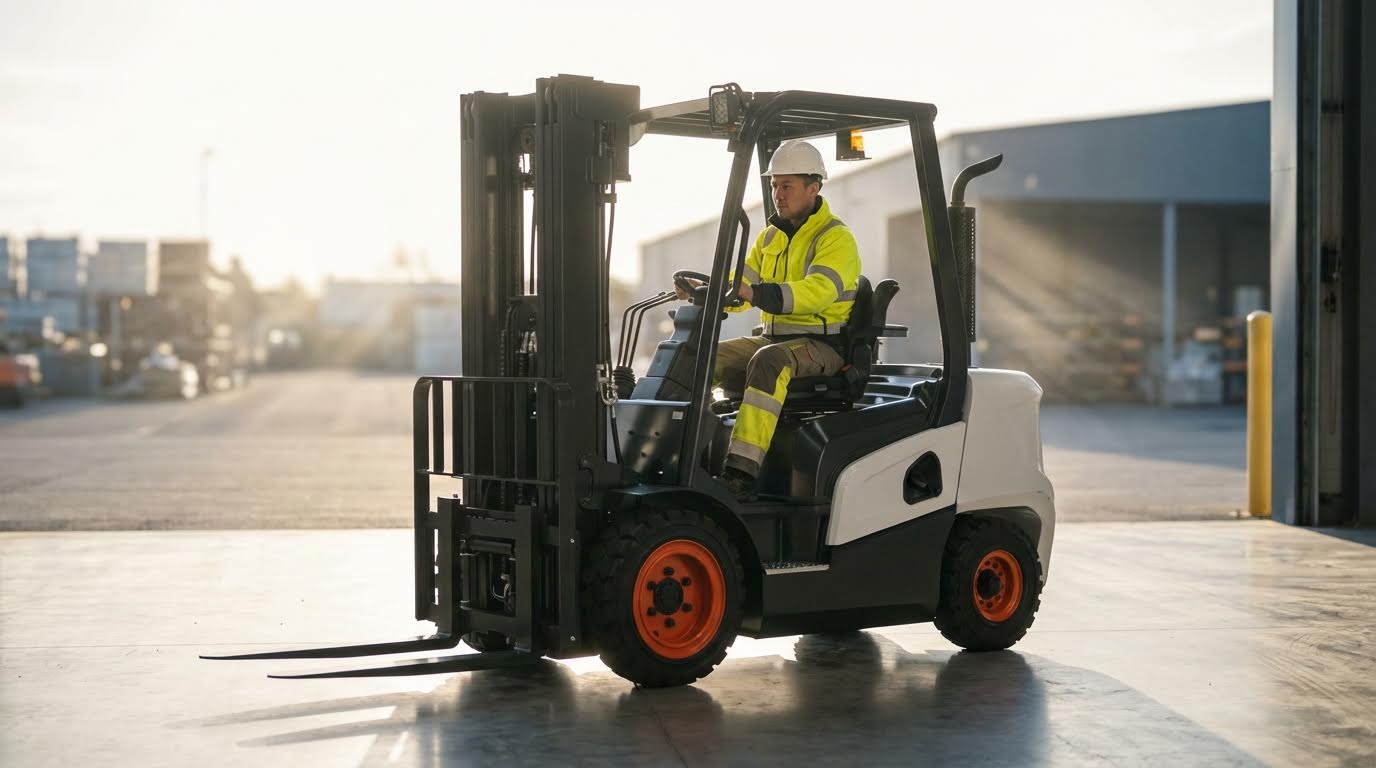
Diesel forklift weight is not just a number; it controls stability, floor damage risk, transport cost, and overall site safety. Treat “how much does a diesel forklift weigh” as an engineering input, not a sales afterthought.
Heavy diesel pneumatic-tire forklifts can reach service weights from about 15,300 kg to 19,300 kg depending on capacity and configuration according to published spec sheets. When loaded, front axle loads alone can exceed 22,000–31,700 kg, while the rear axle may carry only 3,200–3,500 kg, concentrating most floor stress under the drive axle. That is why floor loading checks and axle-load verification matter more than the brochure “service weight” number.
- Know the real weight: Use the data plate and spec sheet, not guesses – this keeps trailers, docks, and ramps within rated limits.
- Consider load + truck together: Add truck service weight to maximum load – this is the mass your slab or yard must safely support.
- Check axle and wheel loads: Front axle may see 70–80% of the total when loaded – critical for thin slabs, mezzanines, and trench covers.
- Account for attachments and options: Clamps, sideshifters, cabs, and solid tyres all add kg – they raise floor loads and reduce rated capacity.
- Match weight to terrain: Heavier trucks improve stability outdoors but increase sinkage on weak soils – sometimes a slightly smaller, lighter unit is safer overall.
- Plan transport early: Forklifts over roughly 18,000 kg often need special trailers and permits – late discoveries here can delay projects and inflate cost.
For many buyers, the starting question is “how much does a diesel forklift weigh,” but the right question is “how do this truck’s service weight and axle loads interact with my loads, floors, and routes.” Once you frame it that way, the correct capacity class, mast height, tyre type, and attachment package usually become obvious – and so do the jobs your floor, slab, or yard is simply not built to handle.
Before introducing a new diesel truck into an existing building, have a structural or materials-handling engineer review slab thickness, joints, and rack aisles against the manufacturer’s axle-load data. Combine that with solid operator training on capacity plates, daily inspections, and speed control, and the same weight that could crack concrete becomes a stability advantage that moves heavy product safely for years.
Final Thoughts On Diesel Forklift Weight And Floor Safety
Diesel forklift weight, axle loads, and wheel contact pressure all link directly to stability and floor safety. Service weight alone does not tell you if a truck will work on your site. What matters is how that weight, plus payload, shifts onto the front axle and then into the slab through small tire footprints.
Counterweight size, mast height, attachments, and tire type all push front axle loads higher. This can turn a “safe on paper” truck into a real risk on thin slabs, mezzanines, or weak yards. At the same time, extra mass improves stability and outdoor performance when the ground and structure can carry it.
Operations and engineering teams should treat every new or upgraded diesel forklift as a small structural project. Start with real data from the capacity plate and spec sheet. Check loaded front axle and wheel loads against slab design, joints, and rack aisles. Verify aisle width and turning space before increasing capacity class. When in doubt, ask a structural or materials-handling engineer, or work with Atomoving to review options.
The best practice is clear: choose the lightest diesel forklift that safely meets load, reach, and terrain needs, and prove the floor, yard, and routes can carry it before the truck arrives.
Frequently Asked Questions
How much does a diesel forklift weigh?
The weight of a diesel forklift varies depending on its lifting capacity and design. Typically, a small diesel forklift with a 2-tonne capacity weighs around 3,000 kg, while larger models with capacities of 10 tonnes or more can weigh over 15,000 kg.
- Small forklifts (2-3 tonne capacity): 3,000–4,500 kg
- Medium forklifts (5-7 tonne capacity): 5,000–9,000 kg
- Large forklifts (10+ tonne capacity): 10,000–15,000+ kg
To determine the exact weight of a specific model, consult the manufacturer’s specifications. Always consider the forklift’s weight when planning transportation or floor load capacity in warehouses.