Understanding how high a pallet jack can lift is critical for safe clearance, dock work, and ergonomic handling. This guide breaks down typical lift height ranges for manual, electric, and high-lift pallet trucks, and explains the engineering limits behind them. You will see where 190–220 mm low-lift ranges end and scissor heights begin, so you can match equipment to your floors, pallets, and racks. If you are asking “how high can a pallet jack lift” for your operation, this article gives you the numbers and the real-world constraints in one place.
Core Lift Height Ranges For Pallet Jacks

Core pallet jack lift heights range from about 170–220 mm for standard low‑lift models up to roughly 700–1,000 mm for high‑lift and scissor designs, and understanding these ranges answers “how high can a pallet jack lift” for most operations. This section breaks the ranges down by manual, electric, and high‑lift types so you can match fork height to real warehouse needs, not just catalogue numbers.
💡 Field Engineer’s Note: When you size equipment, think in “clearance to clear the worst floor defect,” not “maximum height.” In most warehouses, 40–60 mm of under‑clearance above the highest bump or dock plate is the real design driver.
Typical manual pallet jack lift heights
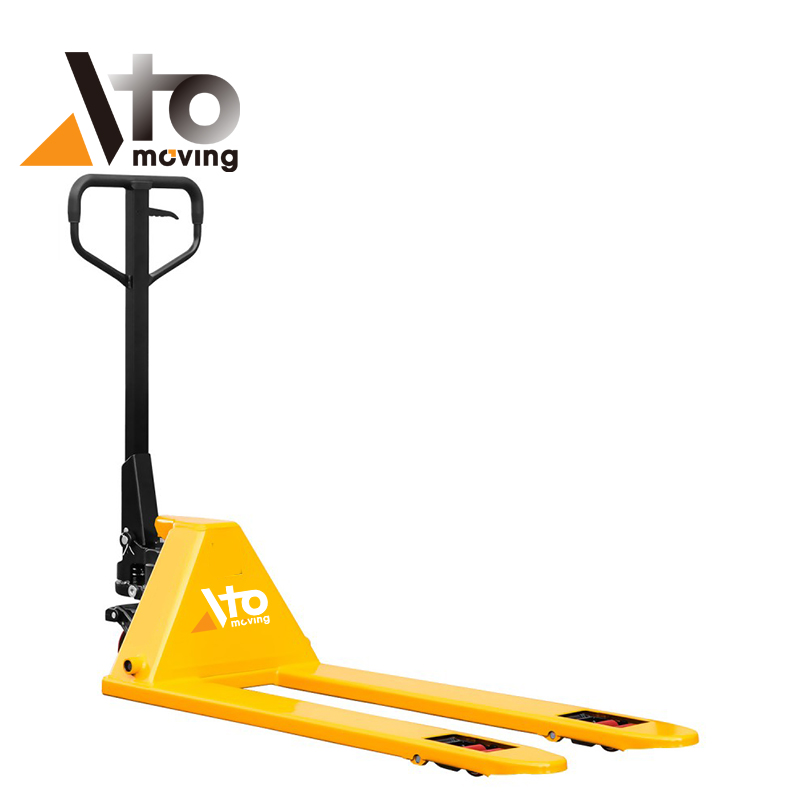
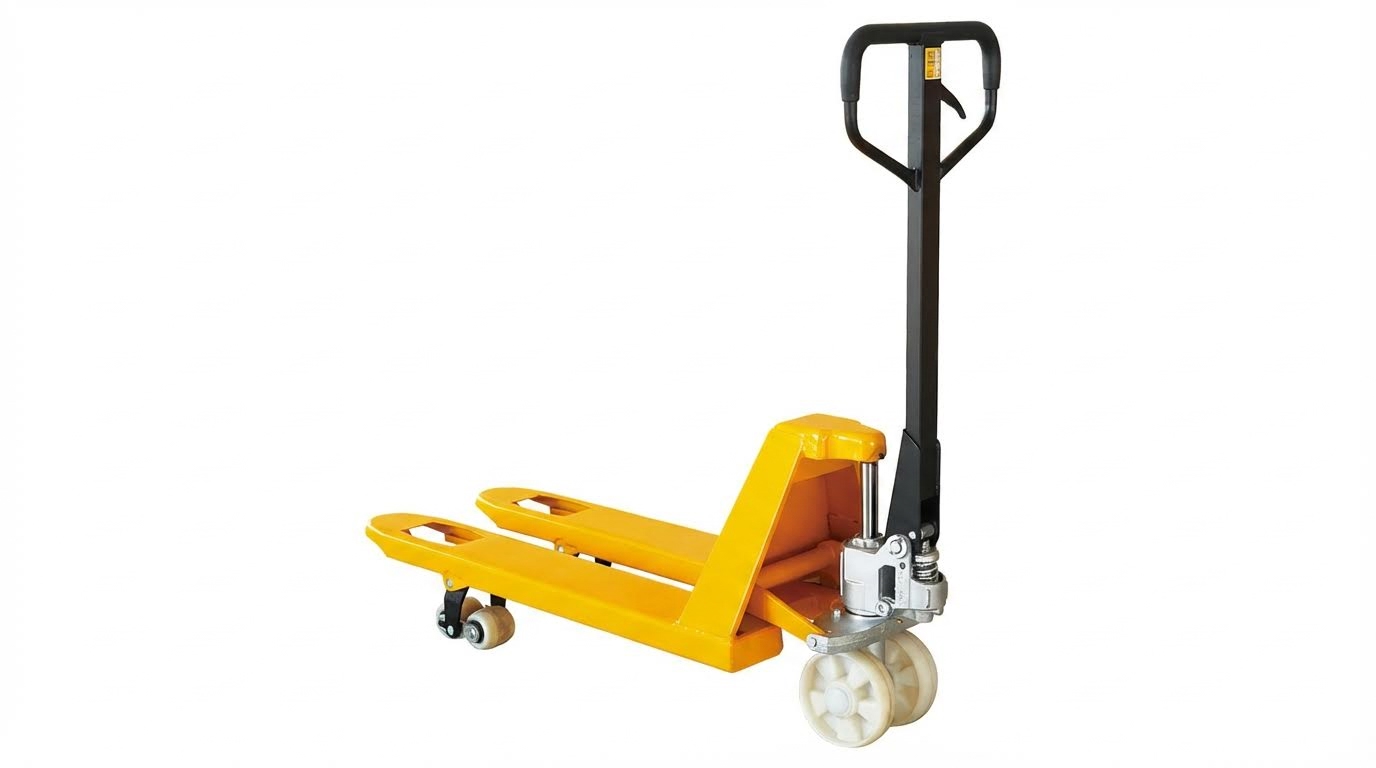
Standard manual pallet jacks usually lift to about 180–220 mm, which is just enough to clear pallets and floor defects safely without sacrificing stability. Lowered fork height is typically around 75 mm, with some low‑profile units going even lower for thin pallets.
| Manual pallet jack type | Typical lowered fork height (mm) | Typical max fork height (mm) | Common capacity range (kg) | Operational impact / Best for… |
|---|---|---|---|---|
| Standard manual low‑lift | 75–85 | 180–220 | 1,680–5,000 | General warehouse moves; clears standard 1200 × 1000 mm pallets and dock plates with ~80–120 mm under‑clearance. |
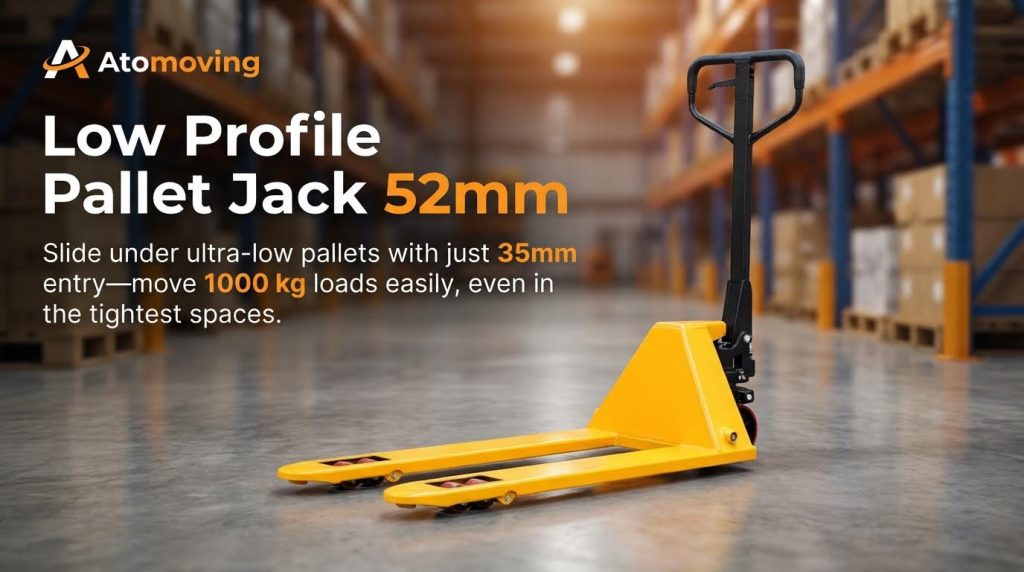
| Low‑profile manual | 35–52 | 170–190 | ≈1,500–2,000 (typical range) | Thin or damaged pallets with low entry height; good where floor is relatively flat. |
| Heavy‑duty manual (short‑stroke) | 75–85 | ≈190–210 | Up to 5,000 | High‑mass loads where capacity matters more than extra lift height. |
In practice, operators only use part of this height during travel. To keep the center of gravity low and inside the stability triangle, you normally run loads just 30–60 mm off the floor, even if the jack can reach 200+ mm.
- Lowered height: 75–85 mm – Allows fork entry into standard pallets without scraping the floor.
- Typical max height: 180–220 mm – Answers “how high can a pallet jack lift” for most manual units.
- Clearance in use: 30–60 mm under pallet – Enough to roll over joints while keeping stability margins high.
How to quickly check if your manual jack reaches rated height
Park on a level floor with no load. Pump the handle until the bypass valve opens and forks stop rising. Measure from floor to top of fork at the heel. Compare to the nameplate or typical 180–220 mm range. If you are 10–30 mm short, suspect low oil, trapped air, or worn seals.
Electric pallet jack and low-lift powered ranges
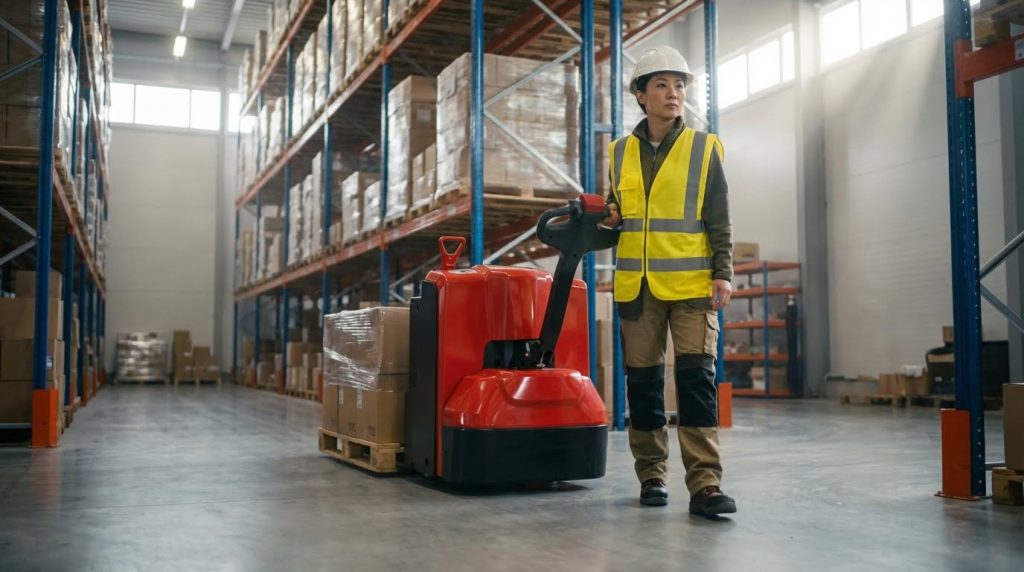
Electric and powered pallet jacks generally lift slightly higher than manual units, with maximum fork heights around 200–305 mm to improve clearance over dock plates and uneven floors. They still fall under the “low‑lift” category defined as ≤300 mm by modern standards.
| Electric / powered low‑lift type | Typical lowered fork height (mm) | Typical max fork height (mm) | Standards / classification | Operational impact / Best for… |
|---|---|---|---|---|
| Standard electric pallet jack | 75–90 | 200–250 | Low‑lift ≤300 mm per EN ISO 3691‑5 | High‑throughput loading bays; good clearance on dock levelers and worn floors. |
| Extended‑lift electric low‑lift | ≈75–90 | 250–305 | Upper end of low‑lift band (still ≤300 mm in most designs) | Sites with deep dock plates, ramps, or frequent floor defects that demand extra fork height. |
| Semi‑electric pallet truck | 75–90 | ≈410–535 (mid‑lift) | Above low‑lift; behaves closer to a compact high‑lift | Short moves plus light work‑positioning where full 800–1,000 mm scissor height is not required. |
Standards such as EN ISO 3691‑5 defined low‑lift pallet trucks as units with lift heights up to about 300 mm and rated capacities up to roughly 2,300 kg, while allowing scissor‑lift pallet trucks up to 1,000 mm or 1,000 kg.These limits reflect the trade‑off between lift height, frame strength, and stability.
- Consistent lift speed: Electric units maintain near‑constant lift speed under load – Improves cycle time and operator comfort.
- Gradeability limits: Typical 8% loaded, 15% unloaded – Higher fork heights on ramps sharply increase tip risk.
- Sensor options: Height sensors and pressure transducers – Enable overload cut‑outs and predictive maintenance before loss of lift appears.
💡 Field Engineer’s Note: With powered pallet jacks, the extra 20–50 mm of lift over a manual unit often hides floor problems. If operators complain about “sticking” at dock plates even with 250+ mm lift, inspect the dock transitions and wheel condition before blaming the truck.
Travel rules for electric low-lift pallet jacks
Keep forks just high enough to clear the worst floor defect on the route. Avoid turning sharply or braking hard with forks at maximum height. On ramps, drop the load as low as safely possible before moving, and stay within the manufacturer’s gradeability limits.
High-lift and scissor pallet truck heights
High‑lift and scissor pallet trucks typically raise loads between about 700 mm and 1,000 mm, turning a pallet into an ergonomic work platform rather than just a load to transport. Some semi‑electric mid‑lift variants sit around 410–535 mm and bridge the gap between low‑lift and full scissor heights.
| High‑lift / scissor type | Typical max lift height (mm) | Typical capacity (kg) | Classification / design notes | Operational impact / Best for… |
|---|---|---|---|---|
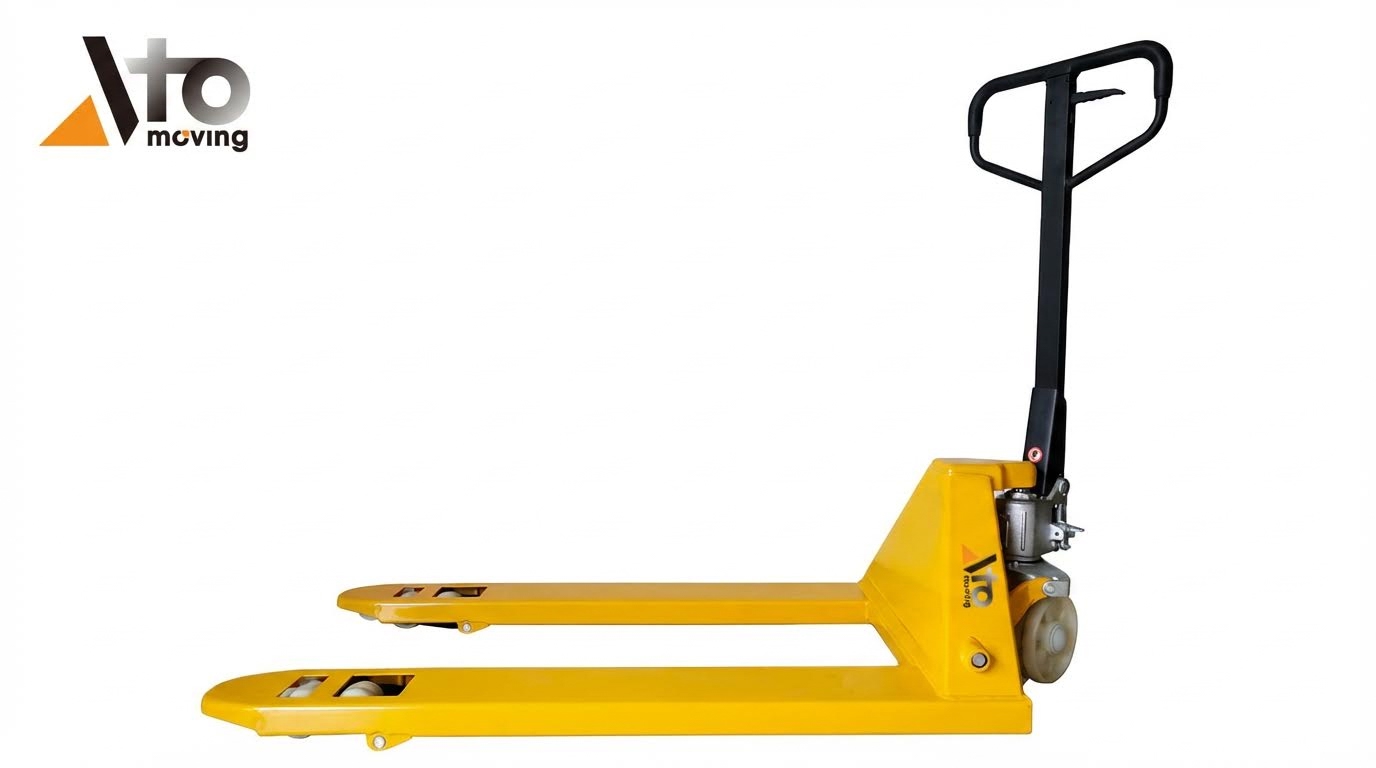
| High‑lift scissor pallet truck | ≈700–1,000 | Up to 1,000 | Scissor mechanism increases overturning moment; often limited capacity vs low‑lift jacks. | Packing lines, assembly cells, bench‑height loading where operators work from the pallet. |
| Semi‑electric / mid‑lift pallet truck | ≈410–535 | Typically below 1,500 | Extended cylinder stroke without full scissor table; more compact footprint. | Feeding low shelves or conveyors; partial work‑positioning with some travel capability. |
| All‑terrain / long‑stroke pallet jack | Up to ≈305 (12 in) for some designs | Varies; often derated vs warehouse jacks | Larger wheels and longer stroke to cope with rough ground. | Yards and construction sites where surface irregularities demand extra clearance. |
Standards allow scissor‑lift pallet trucks up to 1,000 mm lift or 1,000 kg capacity, reflecting how rapidly stability margins shrink as the load rises.Engineers respond by widening the wheelbase, adding outriggers, and derating capacity at maximum height.
- Primary purpose: Work‑positioning, not long‑distance travel – Use them mainly as static lifts at the workstation.
- Travel at height: Often restricted or prohibited – Moving with forks raised near 800–1,000 mm dramatically increases tip risk.
- Answer to “how high can a pallet jack lift” overall: ≈170–220 mm for standard low‑lift, ≈250–305 mm for extended low‑lift, and ≈700–1,000 mm for high‑lift scissor designs.
💡 Field Engineer’s Note: If operators start using high‑lift or scissor pallet trucks like mini‑stackers, stop and reassess. At 800+ mm, a minor floor dip or side pull can be enough to push the center of gravity outside the support polygon and tip the whole unit.
When to choose a stacker instead of a high-lift pallet truck
If you routinely need to place pallets above about 1.0 m, especially into racking at 1.5–3.0 m or higher, a dedicated pallet stacker with a mast is safer. Stackers are engineered for vertical lifting and include better load backrests, masts, and stability controls. High‑lift pallet jacks should stay in the role of ergonomic work tables and short‑distance movers.
Engineering Factors That Limit Lift Height
Engineering limits on pallet jack lift height come from stability, hydraulics, and structure, not just “how high can a pallet jack lift” on paper. Designers balance these factors so trucks stay upright, strong, and controllable in real warehouses.
- Stability envelope: Load center and stability triangle geometry cap safe fork height – prevents tip-over during turns, braking, or on slopes.
- Hydraulic system: Cylinder stroke and pressure define theoretical height – oil health and leaks decide what you actually reach.
- Structure and wheels: Frame stiffness and wheel layout limit how high you can go – too much deflection or a small support polygon makes jacks unsafe.
💡 Field Engineer’s Note: Any pallet jack that no longer reaches its catalog height is a red flag. In practice, that usually means hydraulic issues or bent structure, and I tag those units out of service immediately.
Load center, stability triangle, and tip risk
Load center and the stability triangle are the first hard limit on how high a pallet jack can lift before tip risk becomes unacceptable. As soon as you raise the load, the combined center of gravity climbs and moves, shrinking your safety margin.
On a pallet jack, the stability triangle sits between the two steer wheels and the line joining the two load rollers. Lift is safe only while the combined center of gravity stays inside this triangle. When forks rise, that center of gravity moves up and can shift toward one edge if the load is long, offset, or top-heavy. This is why low-lift pallet trucks are limited to around 300 mm lift height in standards and why most warehouse jacks stay down at 170–220 mm.
| Factor | Engineering Effect | Operational Impact on Lift Height |
|---|---|---|
| Rated load center (typically 500 mm from fork heel) | Defines where the assumed center of gravity sits along the forks | Longer or off-center loads effectively increase load center and reduce safe lift height |
| Stability triangle size | Base formed by steer wheels and load rollers | Smaller triangle (short wheelbase, narrow track) means lower allowable fork height before tip risk rises |
| Load height and stacking pattern | Raises center of gravity vertically | Tall, top-heavy loads may be unsafe even at 150–200 mm; keep forks at minimum height for travel |
| Dynamic forces (turning, braking, ramps) | Add lateral and longitudinal acceleration to the load | Effective overturning moment increases; practical safe lift is well below the rated maximum while moving |
- Within the triangle: Load center kept between both forks and close to the heel – best stability at any allowed height.
- Outside the triangle: Long, cantilevered, or one-fork loading – dramatically lowers the height where tip-over can occur.
- Dynamic maneuvers: Sharp turns or sudden stops with forks raised – shift the center of gravity toward triangle edges.
Because of these effects, engineers typically cap conventional pallet jack lift heights at about 165–220 mm, and even all‑terrain or extended-lift low-lift trucks rarely exceed 305 mm under ISO 3691‑5–style stability criteria. Stability analysis of center of gravity vs. support polygon is what keeps those limits conservative.
Why operators should travel at minimum lift height
Even if the spec sheet says 200–220 mm, best practice is to travel with forks only a few tens of millimeters off the floor. This keeps the center of gravity as low as possible, reduces overturning moment during emergency braking or bumps, and still clears dock plates or rough patches.
Hydraulic cylinder stroke, pressure, and oil health
Hydraulic cylinder stroke and pressure set the theoretical answer to “how high can a pallet jack lift,” while oil condition and leaks decide the real height you see on the floor. A tired hydraulic circuit can easily lose 10–30 mm of lift.
The pump, cylinder bore, and stroke determine how much oil volume converts into fork movement. For standard low-lift manual jacks, that design usually delivers around 190–210 mm raised fork height from a lowered height near 75–85 mm. Designers keep lift below 300 mm on low-lift trucks to avoid oversized cylinders or excessive working pressure. For high‑lift and scissor units, engineers increase cylinder stroke and use mechanisms that multiply motion to reach 700–1,000 mm, but they also reduce rated capacity to keep stresses and stability under control.
| Hydraulic Aspect | Typical Design Range | Effect on Achievable Lift Height |
|---|---|---|
| Manual low-lift pallet jack fork height | ≈ 75–85 mm lowered, 190–210 mm raised | Defines baseline answer to how high a standard pallet jack can lift in good condition |
| Electric low-lift pallet jack | ≈ 75–90 mm lowered, 200–305 mm raised | Extra stroke gives more clearance for ramps and dock levelers |
| High-lift / scissor pallet truck | ≈ 700–1,000 mm raised | Uses longer stroke and linkages for work-positioning, not long-distance travel |
| Hydraulic working pressure | Set below hose and seal ratings | Too low: jack stalls early; too high: risk of burst or accelerated wear |
| Oil level and trapped air | Low oil or aerated fluid | Reduces effective stroke, causing “short lift” and spongy feel |
- Stroke-limited height: Once the piston hits end of stroke, lift stops – no amount of extra pumping will add millimeters.
- Pressure-limited height: If load is near capacity, relief valves may open early – forks stop below rated height under heavy load.
- Oil health: Dark, contaminated, or emulsified oil causes valve sticking – forks may creep down or fail to reach spec height.
Common field faults like low oil, trapped air, or worn seals typically cut usable lift by 10–30 mm. That means a jack designed for 200 mm might only reach 170–180 mm before it feels “dead” at the handle. Regular inspections with a steel rule against nominal ranges are the simplest way to verify that hydraulic performance still matches the design.
💡 Field Engineer’s Note: If a jack stops lifting a heavy pallet 10–20 mm below normal but still reaches full height empty, suspect pressure relief setting or internal leakage under load, not stroke length. That’s a maintenance job, not an operator issue.
Simple check to verify hydraulic lift height
Park on level floor, lower forks fully, then measure fork tip height. Pump to maximum, then measure again. Compare with the typical 190–210 mm range for standard units. If you are short by more than about 10–15 mm, remove the jack from service and check oil level, bleed air, and inspect for leaks.
Frame stiffness, wheel geometry, and deflection
Frame stiffness and wheel geometry quietly restrict how high a pallet jack can lift by controlling deflection and the size of the support polygon. If the frame bends or the wheel layout shrinks the base too much at height, the design fails stability and fatigue tests.
As forks rise, bending moments in the chassis, fork arms, and handle mount increase. Engineers check elastic deflection and local stress at welds and cutouts at full load and height to protect fatigue life. To reach higher heights, you need thicker steel or deeper sections, which add weight and cost. At the same time, the wheel layout defines the support polygon. As forks rise, the geometry between load rollers and steer wheels changes, often shrinking the effective support area. This is another reason low-lift pallet jacks stay below 300 mm while scissor trucks, with a different footprint and outrigger geometry, can safely reach 700–1,000 mm.
| Design Element | Typical Design Choice | Operational Impact on Lift Height |
|---|---|---|
| Fork and chassis stiffness | Reinforced sections sized for 165–220 mm lift | Too much flex at height tilts load and shifts center of gravity, so engineers limit height or increase steel thickness |
| Wheelbase and track width | Optimized for maneuverability in narrow aisles | Short wheelbase improves turning but reduces stability, capping practical lift height |
| Load roller diameter and spacing | Small rollers near fork tips | Influence how the support polygon changes as forks rise over bumps or dock plates |
| Steer wheel size and offset | Larger diameter for lower rolling resistance | Offset and swivel angle affect how much stability is lost in tight turns with raised forks |
| High-lift scissor geometry | Wide outriggers and scissor arms | Allows 700–1,000 mm lift, but usually as a static work platform, not for moving loads at height |
- Deflection control: Limiting elastic deflection keeps pallets level – prevents creeping center-of-gravity shifts that could trigger tip.
- Support polygon: Wheel layout defines the base – higher lifts demand a wider or longer footprint, which conflicts with tight-aisle maneuverability.
- Fatigue life: Repeated cycles at full height and load drive crack growth – standards require structural tests that effectively bound maximum lift.
💡 Field Engineer’s Note: If you see a loaded pallet jack where the forks “smile” (visible sag) or the handle base twists when turning, treat that unit as structurally compromised. Even if it still reaches 200 mm, its real safe lift height is already lower than when it left the factory.
Why high-lift pallet trucks are not mobile stackers
High-lift and scissor pallet trucks can reach 700–1,000 mm, but their frames, wheels, and outriggers are optimized for static work positioning, not for traveling with a raised load. Using them like walkie stackers pushes the stability triangle and fatigue life beyond what ISO 3691‑5–type tests assumed, increasing tip and structural failure risk.
Selecting The Right Lift Height For Your Operation
The right pallet jack lift height is the minimum fork height that safely clears your pallets and floor while keeping stability high and cost low. You match lift range to pallet design, floor quality, dock interfaces, and how much vertical handling your process truly needs.
Matching lift height to pallets, floors, and docks
You choose lift height by working backwards from pallet geometry, floor conditions, and any dock or ramp transitions in your building. This keeps the answer to “how high can a pallet jack lift” focused on what you actually need, not the catalog maximum.
- Pallet entry clearance: Standard pallets work with lowered fork heights around 75–85 mm – this lets forks enter without scraping deck boards.
- Travel clearance: Typical raised heights of 170–210 mm give 80–120 mm under-clearance – enough to bridge small floor defects and dock plates.
- Thin or special pallets: Low‑profile designs down to about 35–52 mm lowered height – avoid jamming on very low skids.
- Dock plates and levelers: Raised fork heights near 190–210 mm – usually clear dock lips and short ramps without bottoming out.
- Uneven or damaged floors: More clearance helps, but only up to roughly 200–300 mm on low‑lift trucks – beyond that, stability falls faster than benefit.
- Static work height: High‑lift or scissor trucks at 700–1,000 mm – put loads at bench height for packing or assembly. Reference: standard height ranges
| Use Case | Recommended Lift Type | Typical Raised Height | Operational Impact |
|---|---|---|---|
| General pallet moves on good floors | Standard manual or electric low‑lift | 170–210 mm | Clears floor and dock plates with minimal tip risk. |
| Thin pallets / display pallets | Low‑profile manual truck | 170–200 mm | Fits low openings while still rolling over minor defects. |
| Rougher floors, short ramps | Electric low‑lift with ~200–300 mm | Up to 300 mm | Extra clearance for lips and transitions without using a stacker. |
| Packing benches, kitting, line feeding | High‑lift / scissor pallet truck | 700–1,000 mm | Brings load to ergonomic waist height; stay mostly static. |
| Dock-to-rack vertical storage | Pallet stacker (not a jack) | 1.5–4.0 m+ | True stacking; replaces reach/forklift at lower heights. |
How to size lift height from your pallets
Measure pallet bottom deck thickness and lowest floor defect. Add at least 20–30 mm safety margin. That sum is the minimum under‑clearance you need when raised. Then pick a pallet jack whose maximum fork height comfortably exceeds that clearance while staying within low‑lift ranges (≤300 mm) for stability.
💡 Field Engineer’s Note: If your floors are bad enough that you think you “need” 300 mm+ just to travel, you usually have a floor repair problem, not a lift‑height problem. Over‑lifting to fight potholes is a classic way to end up with side‑tip incidents on manual and electric pallet jacks.
Choosing between manual, electric, and high-lift designs
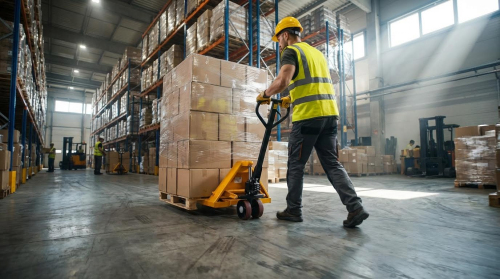
You choose between manual, electric, and high‑lift pallet jacks by balancing lift height, push/pull effort, duty cycle, and whether you are transporting loads or working at height. The question is less “how high can a pallet jack lift” and more “how high do we need it to lift to do the job safely.”
| Design Type | Typical Lift Range | Best For… | Key Limits |
|---|---|---|---|
| Manual low‑lift pallet jack | Max ~180–220 mm | Short moves on flat floors, low to medium volumes. | Human push/pull effort; not for vertical storage. Reference: typical max heights |
| Electric low‑lift pallet jack | Max ~200–305 mm | Longer runs, higher throughput, mild ramps and docks. | Still a “floor‑level” truck; not a stacker or order picker. |
| Semi‑electric pallet truck | Approx. 410–535 mm | Where you need a bit more height, e.g., low platforms. | Higher center of gravity; reduced rated capacity at height. |
| High‑lift / scissor pallet truck | Approx. 700–1,000 mm | Ergonomic work height at a fixed station. | Not for traveling with load raised; often 1,000 kg or less capacity. Reference: high‑lift limits |
| Pallet stacker (separate class) | 1.5–4.0 m+ | Racking, mezzanine feeds, real vertical storage. | Higher cost, more training; different standards and risk profile. |
- If you only move pallets on the floor: Manual or electric low‑lift with ~200 mm max height – cheapest, simplest, and safest choice.
- If operators complain about back strain: Add high‑lift or scissor units at fixed workstations – lift pallets to 700–1,000 mm instead of bending.
- If you need to reach racks above 1.5 m: Switch to a pallet stacker – pallet jacks are not engineered as stackers. Reference: stacker height bands
- If you run long shifts or heavy loads: Prefer electric over manual – keeps productivity up and strain injuries down.
- If floors are sloped or uneven: Stay conservative on lift height and capacity – use the minimum lift that clears the floor to protect stability.
Quick decision checklist for lift height and truck type
1) Confirm pallet type and lowest opening. 2) Measure worst floor defect or dock lip. 3) Add 20–30 mm safety margin to get needed under‑clearance. 4) If this is ≤200–220 mm, a standard low‑lift jack is enough. 5) If you need 400–1,000 mm for work positioning, choose a high‑lift/scissor unit and lock in “no travel when raised” rules. 6) If you truly need above 1.5 m, move to a pallet stacker or forklift instead of stretching a pallet jack beyond its design envelope.
💡 Field Engineer’s Note: When people ask “how high can a pallet jack lift,” they often already operate at the edge of stability. Before upgrading to a higher‑lift model, fix load centering, floor quality, and operator habits; then size lift height. You solve more accidents that way than by simply adding more stroke to the hydraulics.
Final Thoughts On Safe Pallet Jack Lift Heights
Safe pallet jack lift height is not about chasing the biggest number. It is about clearing your worst floor defect with the lowest practical fork position. Geometry, hydraulics, and structure all work together to set that safe window. The stability triangle and load center define how far you can raise a pallet before tip risk grows too high. Hydraulic stroke and pressure then decide the real height you reach on the floor. Frame stiffness and wheel layout finally cap how much deflection and dynamic loading the truck can survive over its life.
For most sites, standard low‑lift heights around 180–220 mm on manual units and up to about 250–305 mm on powered jacks give enough clearance with strong stability margins. High‑lift and scissor trucks belong at fixed workstations, not traveling at 800–1,000 mm. Operations and engineering teams should size lift height from pallet openings, floor defects, and dock transitions, then choose the simplest truck that meets those numbers. Keep loads centered, travel at minimum lift, and pull any unit that sags, twists, or loses 10–30 mm of height for maintenance. When you follow these rules, Atomoving pallet jacks deliver safe, predictable handling without pushing the design envelope.
Frequently Asked Questions
How high can a standard pallet jack lift?
A standard manual pallet jack can lift loads up to 8 inches off the ground. High-lift pallet jacks, on the other hand, can raise loads as high as 32 inches. Pallet Jack Lift Guide.
What is the maximum height for an electric pallet jack?
Electric pallet jacks typically lift to a height of around 6 inches, similar to manual models. However, specialized electric models can lift loads to over 20 inches. These are commonly used in warehouses and distribution centers where frequent lifting is required. Electric Pallet Jack Heights.
What is the maximum safe stacking height for a pallet?
As a general rule, you can safely stack a pallet up to a maximum of 60 inches high. Always place heavier boxes at the bottom and lighter ones on top to ensure safety and protect the shipment. Pallet Stacking Safety.