If you are searching for how to fix a pallet jack that won’t go up, this guide walks you through the fastest, safest checks before calling in a full repair. You will learn how to spot hydraulic, linkage, and wheel issues in minutes, using simple inspections and basic tools. Every step focuses on real-world warehouse conditions, so you can restore lifting and avoid unsafe “make it work” shortcuts.
Why Pallet Jacks Stop Lifting And What To Check First
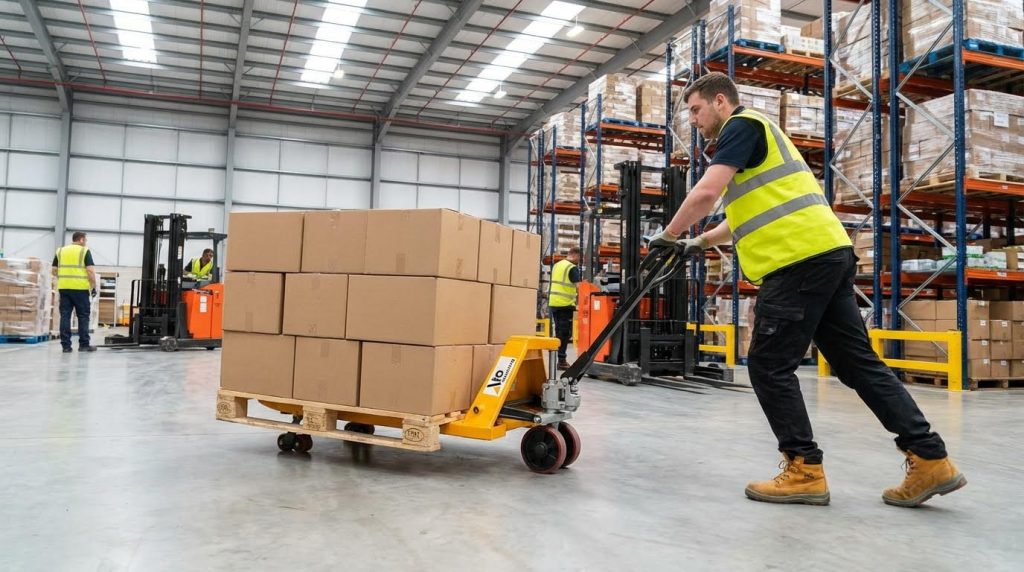
Most “no lift” problems come from air in the hydraulic circuit, low or dirty oil, worn seals, or misadjusted linkages, and these are the first things to check when deciding how to fix a manual pallet jack that won’t go up.
Before you grab tools, you need to understand how the hydraulic circuit should work and how to lock the truck out safely for a fast, structured inspection. That prevents guesswork, crushed fingers, and wasted downtime.
- Air in hydraulic oil: Trapped air makes the system spongy – pressure never builds, so the forks will not rise properly. Hydraulic air ingress
- Low or contaminated oil: Oil below the correct level or full of water/particles starves the pump – lift is weak, noisy, or fails completely. Oil level and condition
- Worn seals and O-rings: Internal bypass lets oil leak past instead of lifting – forks rise slowly, stop early, or sink back down. Seal and O-ring replacement
- Misadjusted lowering valve: Valve not fully closed in “raise” position – pump builds little or no pressure, so there is no effective lift. Valve adjustment issues
- Mechanical linkage wear: Bent or loose pins cut pump stroke – handle moves, but the pump piston barely travels, so no lift. Linkage wear effects
Typical symptoms and what they usually mean
- No lift at all: Severe air entrapment, very low oil, or failed pump/valve.
- Spongy feel, poor lift: Air in hydraulic circuit.
- Lifts then sinks: Internal leakage past seals or valve seats.
- Slow lift, noisy: Contaminated or aerated oil, worn pump elements.
💡 Field Engineer’s Note: If a jack “won’t go up” only when it is loaded near capacity (around 2,000–2,500 kg), suspect internal bypass or overloading, not just air; repeated overloads permanently damage seals and rods.
Hydraulic circuit basics in manual pallet jacks
The hydraulic circuit in a manual pallet jack is a simple single-acting system that converts short handle strokes into high lifting force at the forks.
Understanding these components makes it much easier to decide how to fix a pallet jack that won’t go up without tearing everything apart unnecessarily.
| Component | Main Function | Typical Issue When Jack Won’t Lift | Operational Impact |
|---|---|---|---|
| Pump piston / hand pump | Pressurizes hydraulic oil when you pump the handle | Worn surfaces, internal leakage, or air ingestion | Handle moves freely but forks barely rise or don’t move |
| Reservoir (oil tank) | Stores hydraulic oil feeding the pump | Low level or contaminated oil | Spongy lift, noisy operation, reduced maximum lift height |
| Check valves | Let oil flow toward the cylinder and prevent backflow | Dirt on seats, wear, or damage | Forks lift then sink, or cannot build pressure |
| Lowering valve | Releases oil back to reservoir when lowering | Stuck slightly open or misadjusted | No lift or constant slow sinking under load |
| Seals and O-rings | Seal clearances in pump, valves, and cylinder | Hard, cracked, or extruded seals causing bypass | Jack lifts poorly, will not hold a static load |
| Lift cylinder (ram) | Converts oil pressure into fork lift | Scored rod, worn bore, leaking rod seal | Oil leaks, reduced stroke, forks drift down |
The circuit is “single-acting”: oil pressure only works in one direction to raise the load; gravity and the lowering valve bring it down. The system stays closed, so any air that enters has nowhere to escape until you bleed it out by controlled pumping. Manual pallet jack hydraulic layout
- Single-acting cylinder: Pressure only on the “lift” side – simple, robust, but very sensitive to air bubbles.
- Closed reservoir: Small volume, typically filled to about 20–30 mm below the top – too low and you suck air, too high and there is no space for expansion. Reservoir filling guidance
- Check valves and seats: Keep oil trapped under the ram – any dirt here behaves like a constant “lower” command. Common valve failures
Why trapped air kills lift performance
Oil is effectively incompressible; air is highly compressible. When air mixes into the oil, handle strokes compress bubbles instead of pushing the ram. You feel this as a light, springy handle with little fork movement. Bleeding procedures typically call for 10–20 full handle strokes with the control in the lower position and no load on the forks to drive air back to the reservoir. Air bleeding explanation
💡 Field Engineer’s Note: If you regularly see milky oil when checking the reservoir, you likely have water ingress from washing or condensation; this quietly destroys seals and valve seats long before the jack fully “stops lifting.”
Safety lockout and initial visual inspection
The safest way to start diagnosing a pallet jack that won’t lift is to secure it on level ground, remove any load, and perform a fast visual inspection before touching the hydraulics.
This quick routine often tells you within minutes whether the problem is simple (air or oil level) or serious (structural damage, major leaks), guiding your next steps on how to fix a pallet jack that won’t go up.
- Level, clear work area: Work on flat, clean floor with good lighting – prevents unintended rolling and missed defects.
- No load on forks: Always unload the pallet jack completely – removes crush risk and lets you see true hydraulic behavior.
- Forks fully lowered: Lower control to the bottom position – depressurizes the circuit before any work. Safe depressurizing
- Wheel chocks where needed: Chock steer wheels if on a slight gradient – prevents creep during inspection.
- Personal protective equipment: Safety shoes and gloves as a minimum – protect against crush points and oil exposure.
Once the jack is safe, run a structured visual check from handle to forks.
- Handle and linkage: Look for bent arms, cracked welds, missing or undersized pins, and excessive play in joints. Large free play often explains poor lift even with a healthy pump. Linkage inspection
- Hydraulic unit and cylinder: Check around the pump body, valve block, and ram for wet oil, drips, or old dirt stuck to oil. Fresh wetness points to active leaks and likely seal failure. Leak detection
- Forks and frame: Sight along the forks for bends, cracks at welds, or twisted sections – severe deformation often follows overloading and may justify replacement instead of repair. Structural inspection
- Wheels and rollers: Spin them by hand and look for flat spots, embedded debris, or cracks. Bad wheels increase push effort and can be mistaken for “no lift” issues. Wheel and roller assessment
Quick “go / no-go” checklist before deeper teardown
- Step 1: Confirm forks are empty and fully lowered – ensures zero load and minimal pressure.
- Step 2: Check for obvious oil leaks under the jack – indicates seal or hose failure.
- Step 3: Move handle through raise/neutral/lower – feel for binding or missing detents.
- Step 4: Inspect for bent handle, twisted forks, or cracked welds – serious structural damage may make repair uneconomical.
- Step 5: Only after these checks, proceed to bleed air and inspect oil level.
💡 Field Engineer’s Note: If you see deep gouges or rust streaks on the exposed ram surface, stop: cycling the jack will cut new seals almost immediately; plan on polishing or replacing the ram when you rebuild the hydraulics.
Fast Diagnostic Steps To Restore Lift Function
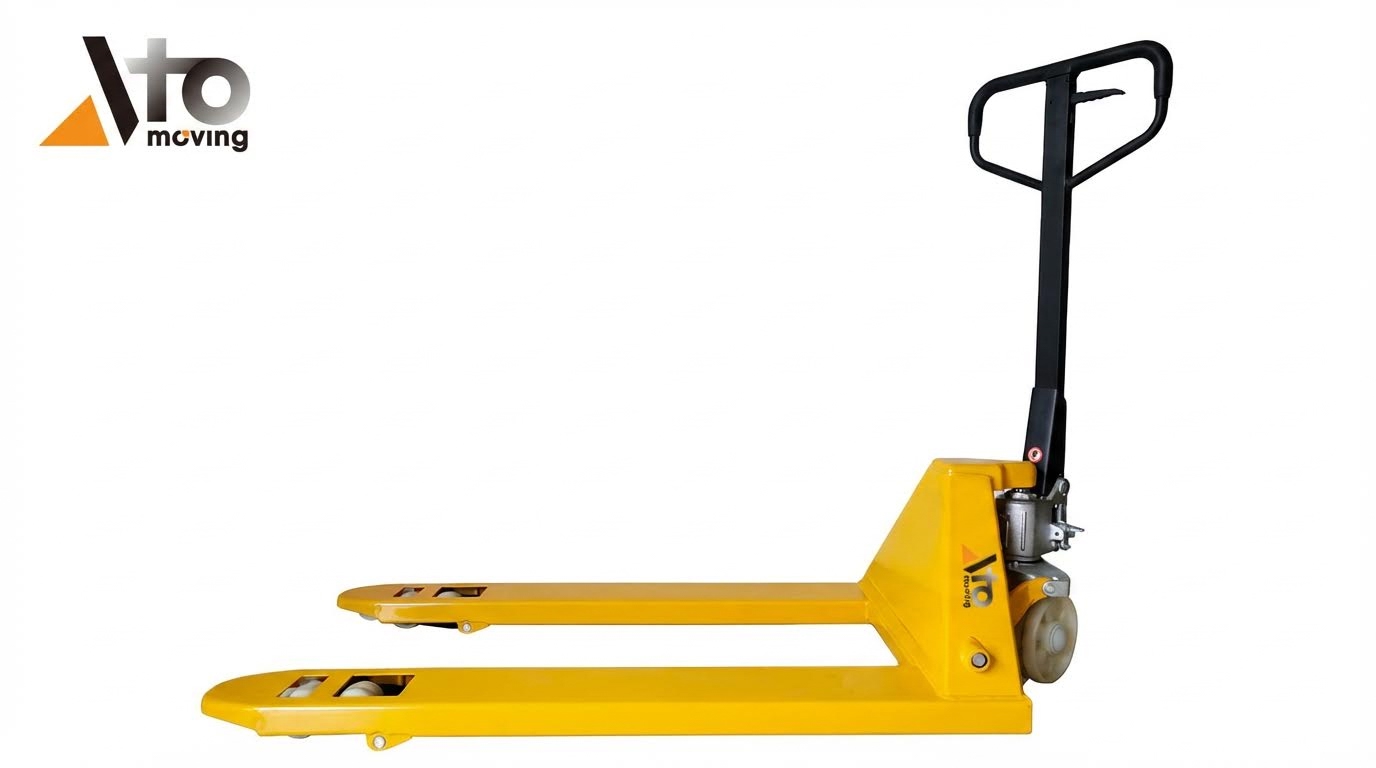
Fast diagnostic checks focus on air, oil, and linkage so you can decide quickly how to fix a pallet jack that won’t go up without stripping the whole hydraulic unit.
- Priority 1 – Safety: Work on level ground with empty forks – Prevents unintended movement and crush injuries.
- Priority 2 – Speed: Start with air bleeding and oil level – These cause most “no-lift” complaints.
- Priority 3 – Isolation: Separate mechanical from hydraulic faults – Stops you wasting time on the wrong components.
💡 Field Engineer’s Note: If a pallet jack has been stored on its side or dragged by a forklift, assume both air in the circuit and low oil level; fix those before touching valves or seals.
Bleeding trapped air from the hydraulic system
Bleeding trapped air is usually the quickest way to restore lift when a pallet jack feels spongy or will not raise under load.
- Step 1: Park and unload – Forks on the floor, no load, level surface to avoid roll-away.
- Step 2: Set control to “lower” or “release” – Opens the return path so air can move back to the reservoir.
- Step 3: Pump 10–20 full strokes – Forces oil and air through the circuit, purging bubbles into the tank standard bleeding method.
- Step 4: Test lift in “raise” – Check if forks now reach full height and feel firm.
- Step 5: Repeat cycle if needed – Some units need several cycles to stabilize the fluid column after heavy aeration.
Bleeding with a dedicated bleeder screw
Some jacks include a small bleeder screw on the pump or cylinder. With forks unloaded, crack the screw slightly, pump until a solid oil stream (no bubbles) appears, then retighten before testing lift again. This method speeds up air removal.
- Sign it worked: Handle feels firm, forks reach normal height, and hold a test load without sinking.
- Sign of deeper issues: Only small improvement, or lift returns spongy after a few minutes – Likely low oil or internal leakage.
Checking hydraulic oil level and contamination
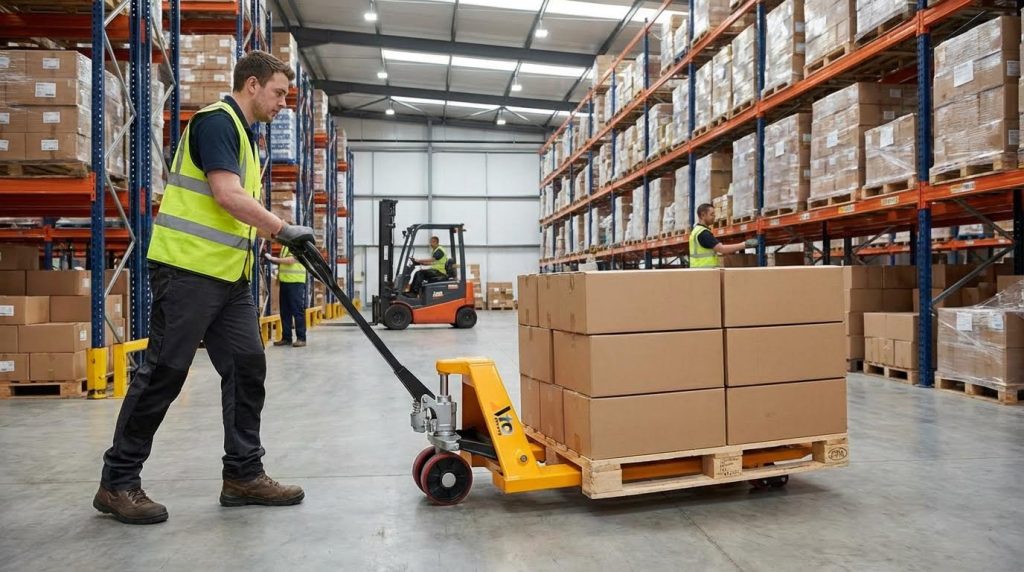
Checking hydraulic oil level and condition is the next critical step because low or dirty oil both cause no-lift, partial lift, and rapid seal wear.
- Step 1: Lower forks fully – Ensures all oil is in the reservoir for an accurate level reading as recommended.
- Step 2: Remove the fill plug – Usually on top or side of the pump body; clean around it first to keep dirt out.
- Step 3: Check oil level ~20–30 mm below top – Typical spec is about 20–30 mm clearance, or 25–40 mm depending on design for most jacks and pump modules.
- Step 4: Top up with correct hydraulic oil – Stops air ingestion at the pump inlet and restores full stroke volume which is essential for lift.
- Step 5: Inspect oil colour and clarity – Dark, milky, or gritty oil signals contamination and internal wear risk requiring a full change.
- Step 6: Drain, flush, and refill if contaminated – Prevents sticking check valves and accelerated O‑ring damage noted in pump failures.
- Step 7: Bleed air again after refilling – Removes air introduced during filling and restores solid hydraulic column.
| Oil Condition | Likely Cause | Recommended Action | Operational Impact |
|---|---|---|---|
| Clear, correct level | Normal operation | Proceed to linkage/valve checks | Hydraulics probably healthy; look for mechanical faults. |
| Low level (>30 mm below top) | External leak or long-term neglect | Top up, inspect for wet areas and drips | Air ingestion, no-lift or partial lift under load. |
| Dark / burnt smell | Overheating, long service interval | Full drain, flush, refill | Reduced efficiency, faster seal wear. |
| Milky / foamy | Water ingress, aeration | Drain immediately, investigate seals and storage | Spongy lift, corrosion risk in ram and bore. |
| Visible particles / sludge | Internal wear, dirt entry | Flush, replace oil and filters (if fitted) | Sticking valves, internal bypass, unpredictable lifting. |
💡 Field Engineer’s Note: If you keep topping up oil every few weeks, you do not have a “small leak”; you have a progressive failure that will end in a sudden no-lift event—find and fix the leak before that happens.
Isolating handle linkage, valves, and pump faults
Isolating handle, valve, and pump faults tells you whether how to fix a pallet jack that won’t go up will be a simple adjustment or a deeper hydraulic repair.
- Symptom 1 – No lift, firm handle: Often misadjusted lowering valve or stuck check valve.
- Symptom 2 – No lift, very soft handle: Air, very low oil, or severe internal bypass.
- Symptom 3 – Lifts then sinks: Internal leakage past seals or valve seats.
- Step 1: Verify handle moves through raise / neutral / lower – Stiff or vague positions suggest linkage or valve adjustment issues affecting lift.
- Step 2: Inspect linkage, pins, and bushings – Look for bent rods, elongated holes, or undersized replacement pins that add play and reduce pump stroke.
- Step 3: Disconnect lifting link at pump lever – Separates handle mechanics from the hydraulic group for testing as a standard isolation step.
- Step 4: Manually set pump lever to “raise” and pump – If the jack now lifts, the fault is in the handle or linkage, not the pump as documented.
- Step 5: If still no lift, suspect pump/valves – Likely worn pump piston, check valves, or O-rings causing internal bypass inside the hydraulic block.
- Step 6: Fine-tune lowering valve adjustment – With lever in neutral, turn the adjust screw in small increments, cycling the jack each time, until it both lifts and holds without creeping down to correct no-lift from misadjustment.
When to move from diagnostics to component replacement
If correct bleeding, oil level, and linkage/valve checks do not restore lift, the remaining causes are usually worn seals, O-rings, or damaged pump and valve components. At that point, plan for a seal kit, valve service, or full hydraulic unit replacement depending on cost versus the price of a new jack. Service guides highlight this decision point.
- Mechanical-side fix: Replacing worn pins, straightening bent rods, and readjusting the valve often restores full lift with minimal parts cost.
- Hydraulic-side fix: Seal/O-ring replacement or pump cartridge swap is needed if the jack still will not lift after all simple diagnostic steps.
💡 Field Engineer’s Note: If the jack lifts fine by manually moving the pump lever but not from the handle, do not touch the hydraulics—90% of the time it is just linkage wear or a half‑turn on the valve adjuster.
When Simple Fixes Fail: Repair, Rebuild, Or Replace
When basic bleeding and oil checks do not restore lift, you decide whether to repair, rebuild, or replace the pallet jack based on damage, cost, and safety risk. This is the critical stage in how to fix a pallet jack that won’t go up reliably for the long term.
| Option | Typical Work Scope | Cost & Downtime | Best For… | Operational Impact |
|---|---|---|---|---|
| Seal / O-ring replacement | Drain oil, open pump/valves, replace soft seals, refill, bleed | Low parts cost, 1–2 labour hours | Units with clean rods and bores, no heavy corrosion | Fastest way to restore full lift and holding ability |
| Partial hydraulic repair | Seal kit plus valve cartridge or pump element replacement | Moderate parts cost, 2–4 labour hours | Mid‑age units with good frame and wheels | Restores performance when basic seal change is not enough |
| Full hydraulic rebuild | Strip pump/ram, inspect, hone, replace worn hard parts | High labour, higher parts cost | Heavy‑duty or premium trucks in otherwise good condition | Extends life but only economical below ~50–60% of new cost |
| Complete jack replacement | Remove from service, buy and commission new unit | One‑time purchase; minimal workshop time | Old, corroded, bent, or repeatedly failing units | Reduces downtime and safety risk when damage is extensive |
Before committing to a rebuild, confirm that you already tried bleeding air, correcting oil level, and basic valve/linkage checks. If the pallet jack still will not go up, you are likely dealing with internal leakage or mechanical wear that simple fixes cannot cover.
💡 Field Engineer’s Note: In most warehouses I have worked with, once repair parts and labour for a basic jack pass about half the price of a new unit, replacement wins. The hidden cost is downtime and the risk of a repeat failure in peak season.
Seal and O-ring replacement versus full pump rebuild
Seal and O-ring replacement is the lowest-cost way to restore lift, while a full pump rebuild is reserved for units with worn hard parts like rams, bores, and valve seats.
- Understand the failure: If the jack pumps but will not lift or will not stay up, internal bypass through worn seals or O-rings is likely – pressure bleeds back into the reservoir instead of lifting the ram.
- Confirm simple checks first: Only move to seal work after you have bled air and verified fluid level and condition – this avoids unnecessary teardown when the problem is just trapped air or low oil.
- When seal replacement is enough: If the pump rod and cylinder bore look smooth (no scoring, pitting, or rust), a seal and O‑ring kit is usually sufficient – you restore sealing surfaces without machining work.
- When you need a full rebuild: If you see scoring, out‑of‑round bores, corrosion, or damaged check valves, a full hydraulic unit rebuild or replacement is required – new seals alone will still bypass under load.
Typical procedure for seal and O-ring replacement
This is a generic, engineering-level outline; always follow the specific service manual for your model.
- Step 1: Secure and depressurize – Park on level floor, remove load, chock wheels, and lower forks fully to remove stored energy.
- Step 2: Drain hydraulic oil – Remove the reservoir plug or cover screw and drain fluid into a clean container to prevent spills and contamination.
- Step 3: Access the pump/valves – Remove retaining pins, clips, or threaded plugs to expose valve cartridges and seal grooves.
- Step 4: Replace O-rings and seals – Pick out old elastomers without scratching metal, then install correctly sized new parts lubricated with compatible hydraulic oil.
- Step 5: Refill and bleed – Refill to about 20–30 mm below reservoir top, then bleed air by pumping 10–20 strokes under no load until lift feels solid.
- Step 6: Load test – Raise a rated test load and verify the forks hold height without sinking over the specified time.
If the jack still will not go up after a correct seal job and bleed, you are beyond “quick fixes” and into full power‑unit rebuild or replacement territory.
- Full rebuild indicators: Persistent no‑lift, severe sinking under load, metal particles in the oil, or noisy pumping – these point to worn pistons, bores, or valve seats.
- Replacement indicators: Bent pump rods, heavy corrosion, cracked housings, or total cost of rebuild approaching 50–60% of a new jack – replacement usually gives better lifecycle value.
Mechanical wear in wheels, rollers, and linkages
Mechanical wear in wheels, rollers, and linkages will not usually stop the jack from going up, but it can make you think the hydraulics are failing and can turn a marginal unit into a write‑off.
| Component | Wear / Damage Sign | Typical Threshold | Effect on Operation | Best Action |
|---|---|---|---|---|
| Load rollers | Flat spots, cracked tread, embedded debris | Diameter loss > 6 mm | High rolling resistance, feels like “no lift” on rough floors | Replace rollers in pairs to avoid fork twist |
| Steer wheels | Chunking, wobble, seized bearings | Do not rotate freely or visibly out‑of‑round | Hard steering, uneven loading on pump and frame | Replace wheel and damaged bearings/bushings |
| Linkage pins & bushings | Excessive play, elongated holes, bent rods | Handle movement not translating to pump stroke | Reduced pump stroke, poor lift or no‑lift symptoms | Replace pins with correct diameter; repair egg‑shaped holes |
- Check linkage before condemning the pump: Disconnect the lifting link and manually actuate the pump lever – if it lifts, the fault is mechanical, not hydraulic.
- Replace undersized “quick fix” pins: Do not leave smaller, non‑OEM pins in elongated holes – side play grows, changing valve timing and shortening pump life.
- Assess wheel condition with calipers: Measure diameters rather than guessing – more than about 6 mm loss means your jack is dragging, not rolling.
When mechanical wear justifies full replacement
Even if you know how to fix a pallet jack that won’t go up hydraulically, stacked mechanical problems can make the unit uneconomical.
- Multiple systems worn: If wheels, rollers, linkage, and hydraulic unit all need work, the combined cost often exceeds 50–60% of a new jack – replacement is usually smarter.
- Structural damage: Bent forks, cracked welds, or distorted frames mean the jack may never track or lift square again – scrap it rather than rebuilding around a bad structure.
Final Thoughts On Keeping Pallet Jacks Lifting Reliably
Reliable pallet jack lift depends on three linked areas: clean hydraulics, tight mechanical geometry, and disciplined safety practice. When you control these, “no lift” failures drop and each fault takes less time to solve.
Air, low oil, and worn seals attack the basic pressure path. If you keep the reservoir at the correct height, use clean hydraulic oil, and bleed air after any leak or refill, the pump can always build pressure. When lift still fails, a structured isolation test on valves and linkages tells you whether to adjust, reseal, or replace the hydraulic unit.
Mechanical parts then decide how efficiently that pressure becomes fork movement. Straight forks, healthy wheels, and correct‑size pins keep the load path aligned and the pump stroke full. Ignoring bent rods or undersized “temporary” pins slowly turns a simple adjustment into a major rebuild.
For operations teams, the best practice is clear: standardize a short lockout and inspection routine, log oil condition and top‑ups, and set a cost limit where you stop repairing and replace the jack. That approach keeps trucks safe on the floor, protects technicians, and gives Atomoving pallet jacks a predictable, long service life.
Frequently Asked Questions
Why won’t my pallet jack go up?
If your pallet jack isn’t lifting, it could be due to low hydraulic fluid levels, air trapped in the system, or worn seals and valves. These issues prevent the hydraulic mechanism from functioning properly. For more details, check out this Hydraulic Jack Troubleshooting Guide.
- Check and refill hydraulic fluid if necessary.
- Bleed the system to remove trapped air.
- Inspect seals and valves for wear and replace them if needed.
What causes a hydraulic jack to fail lifting?
A hydraulic jack may fail to lift due to a malfunctioning ram, which can happen because of rust, lack of lubrication, overloading, or incorrect oil levels in the reservoir. Proper maintenance is key to avoiding these problems. Learn more about maintaining hydraulic jacks in this Hydraulic Jack Repair Guide.
- Ensure the ram is clean and lubricated.
- Avoid overloading the jack beyond its capacity.
- Maintain the correct oil level in the reservoir.