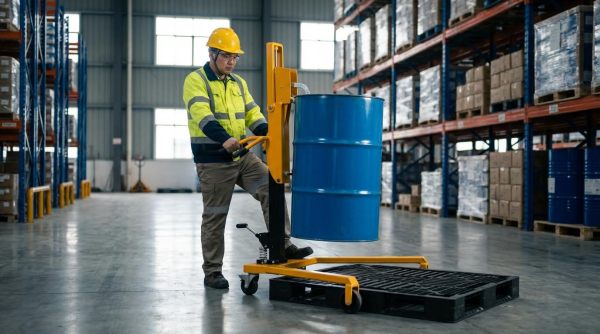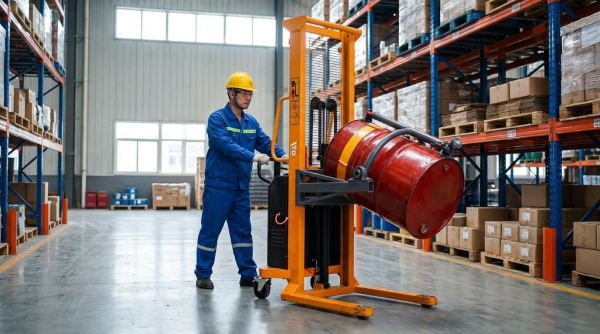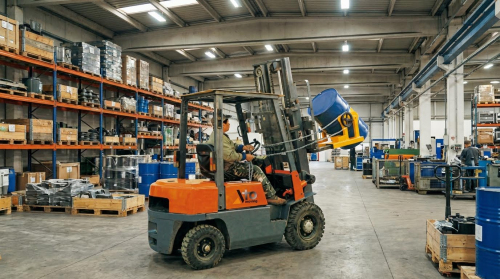
Forklift drum handling is the safest, most efficient option once drum weight, distance, and throughput exceed what manual or pallet truck methods can manage without injury or spills. This guide explains when should a forklift be used to handle drums and how to choose the right attachment for each job. You will see where forklifts beat manual handling on ergonomics, how different gripping and rotation systems work, and which designs best match your drums, floors, and process points. Use it as an engineering playbook to cut risk while increasing drum-handling throughput in real plants and warehouses.
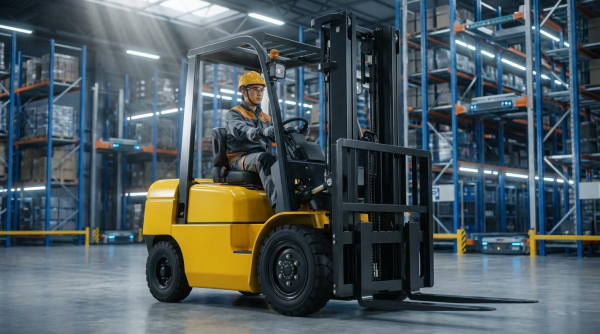
When Forklift Drum Handling Is Justified
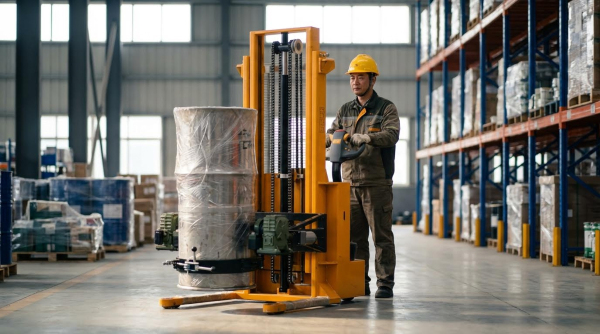
Forklift drum handling is justified when drum weight, travel distance, and throughput exceed safe manual limits, or when product, floor, or layout risks make manual methods unstable or non‑compliant. This section gives clear, engineering-style thresholds so you know exactly when should a forklift be used to handle drums instead of trolleys or pure manual handling.
Load, distance, and throughput thresholds
Forklift drum handling becomes the right choice when individual drum weight, travel distance, or handling frequency creates clear ergonomic and stability risks for manual methods. You should move from manual or simple drum dollies to forklift attachments once you cross certain “trigger levels” in weight, distance, and daily moves.
| Factor | Typical Range / Limit | Trigger for Forklift Drum Handling | Operational Impact |
|---|---|---|---|
| Single drum weight | 180–360 kg for full 200–210 L drums (engineering guidance) | Above ~180 kg, any lift, tilt, or stacking should use mechanical aids; above ~250–300 kg, forklift attachment is preferred over pure manual trucks. | Reduces musculoskeletal injury risk and complies with ergonomic best practice. |
| Travel distance per move | Short shunts: <10 m; internal transfers: 10–50 m; cross‑plant: >50 m | For >10–15 m with full drums, especially on mixed traffic routes, switch to forklift with drum attachment. | Improves control and reduces fatigue and trip risks on long routes. |
| Daily throughput (drums/shift) | Light: <20; medium: 20–80; heavy: >80 | Above ~20–30 full drums/shift, forklifts and attachments become more efficient than manual trucks or dollies. | Cuts handling time per drum and avoids cumulative overexertion. |
| Drum contents | Water, oils, chemicals, flammables, corrosives (safety guidance) | Any hazardous, high‑value, or spill‑critical liquid justifies powered or mechanical drum handling even at lower volumes. | Minimizes spill probability and clean‑up cost; supports environmental compliance. |
| Stacking / racking height | Floor level to 1,500–3,000 mm high | Any stacking above about 1,000 mm should use forklift attachments, not manual tipping or rolling. | Eliminates unstable “man‑handling” of tall, heavy drums. |
| Required functions | Simple transfer vs tilt, rotation, dosing (attachment overview) | For controlled pouring, dosing, or frequent rotation, use fork‑mounted drum rotators or positioners instead of manual tipping. | Improves process accuracy and operator safety over vessels and filling points. |
Industrial 200–210 L drums often weigh 180–275 kg when filled, and up to about 360 kg in heavy products, which already exceeds safe one‑person manual lift capability and creates serious crush and strain risks if mishandled (safety guidance). That is why most ergonomic guidance treated full 55‑gallon (200 L) drums as “mechanical aid only” loads, not suitable for team lifts except for very short, controlled moves.
Engineers also had to factor in the shape and behavior of drums. Cylindrical drums are tall and narrow, so they are easy to roll but hard to control on slopes, damaged floors, or around obstacles, especially when partially filled and the liquid sloshes. Forklift drum attachments, whether mechanical or hydraulic, clamp the drum at the rim, waist, or base to keep the centre of gravity predictable during transport and tilt (engineering guidance).
- Weight >180–200 kg: Treat as a “forklift or dedicated drum truck” load – protects operators from high spinal and joint loading.
- Frequent moves (>20 drums/shift): Move to forklift drum handling – reduces cumulative strain and speeds the flow.
- Travel >10–15 m or mixed traffic routes: Use forklifts – better braking, visibility, and segregation from pedestrians.
- Any stacking or loading into vehicles: Use forklift attachments – keeps drums stable when lifting above floor level.
- Hazardous or high‑value liquids: Prioritize controlled mechanical handling – lowers spill, fire, and contamination risk.
How to set your own trigger levels on site
Start by listing all drum types, fill weights, and typical routes. Note the longest push/pull distances, the number of drums per batch, and where operators currently “fight” the load (ramps, door thresholds, tight corners). Any task that combines high weight with long distance or awkward geometry is a candidate for forklift drum handling. Then add a safety factor: if a task is on the borderline today, plan for growth in throughput when justifying attachments.
💡 Field Engineer’s Note: In real plants, the tipping point is often not the maximum drum weight but the combination of weight plus floor condition. Once you have wet, oily, or uneven floors, even a 180 kg drum on a basic dolly becomes unstable. That is when a fork‑mounted drum handler with positive grip and good truck brakes moves from “nice to have” to “mandatory.”
Risk factors that rule out manual handling
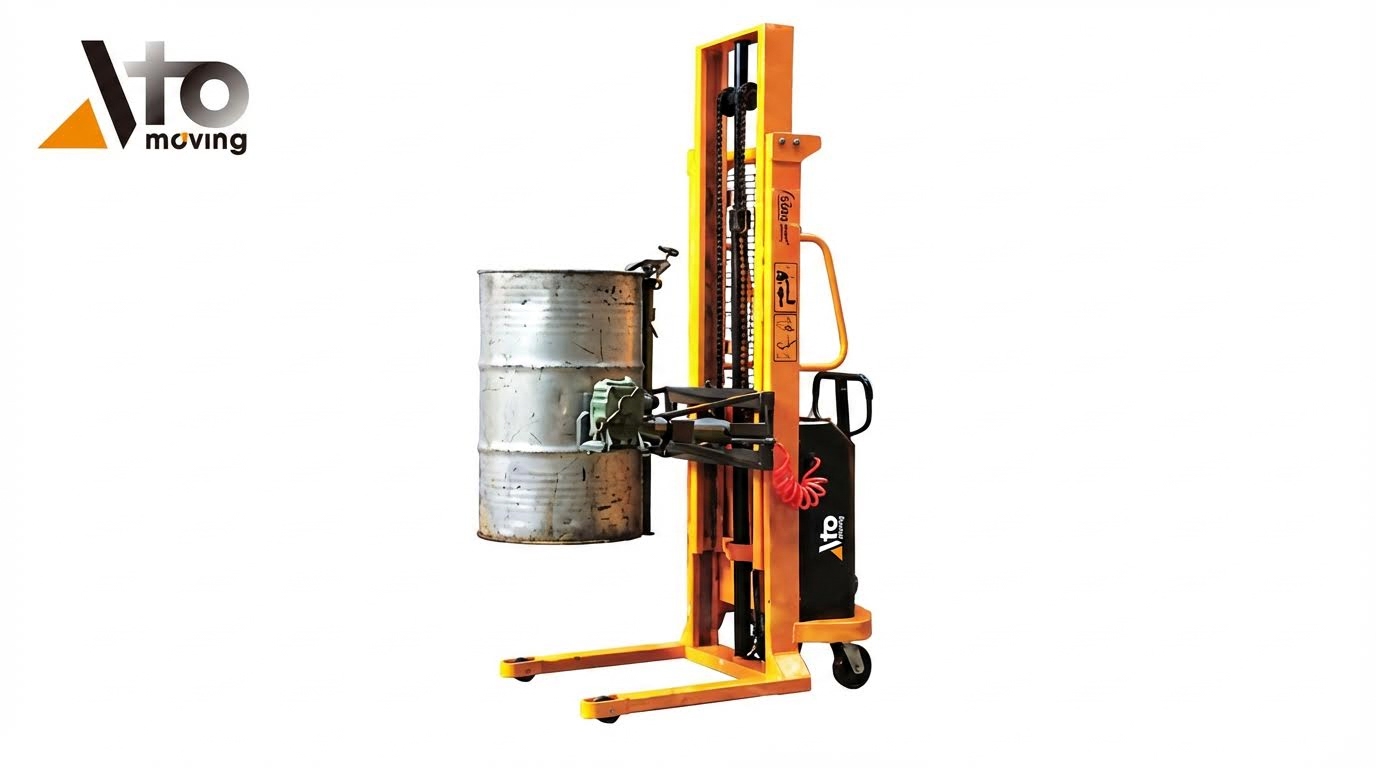
Manual drum handling becomes unacceptable when specific risk factors—such as hazardous contents, poor floors, confined spaces, or high volumes—raise the likelihood of injury or spills beyond reasonable control. In these conditions, the correct answer to when should a forklift be used to handle drums is “almost always.”
| Risk Factor | Why It Matters | Effect on Manual Handling | Forklift / Attachment Advantage |
|---|---|---|---|
| High drum mass (180–360 kg) | Large inertial forces and crush potential if a drum tips or rolls uncontrollably (safety guidance) | Manual tipping or catching a falling drum can cause severe musculoskeletal and impact injuries. | Rigid clamping and powered lifting remove the need for operators to support drum weight. |
| Hazardous contents (corrosive, flammable, toxic) | Leaks, splashes, or drum rupture pose serious health, fire, or environmental risks (safety guidance) | Manual rolling or prying bungs increases chance of punctures, drops, or uncontrolled slosh. | Controlled lift and tilt; operator stays seated and away from splash zone. |
| Unstable floors (wet, oily, uneven) | Reduced friction and unexpected level changes destabilize both operator and drum. | Dollies and drum trucks can slip or snag, causing sudden jerks or side loads. | Forklifts offer better traction, bigger tyres, and higher resistance to minor floor defects. |
| Confined spaces and tight aisles | Limited maneuvering room magnifies the effect of small errors. | Manual rolling often needs wide arcs and body twisting in cramped conditions. | Compact forklifts with suitable drum attachments can rotate drums within narrow aisles. |
| Half‑filled or sloshing drums | Shifting liquid moves the centre of gravity dynamically during transport. | Manual handlers struggle when the drum “pulls” to one side on ramps or turns. | Positive gripping and slow, smooth truck control reduce the effect of liquid movement. |
| High handling frequency | Repetition multiplies even small ergonomic stresses. | Overexertion and fatigue accumulate over a shift, degrading attention and control (safety guidance). | Forklifts handle peak and sustained volumes with minimal operator strain. |
| Need for precise pouring / dosing | Overfilling or splashing can damage product and equipment. | Manual tipping is hard to modulate, especially with heavy drums. | Hydraulic drum rotators and positioners allow slow, metered tilt and rotation (attachment overview). |
Safety guidance highlighted that drums present multiple combined hazards: heavy lifting, awkward shape, confined spaces, poor floors, shifting liquid, and potential leaks all stack together to create high overall risk when handled manually (safety guidance). In many plants, even if one factor alone might appear manageable, the combination means manual handling no longer meets a “reasonably practicable” safety standard.
- Presence of hazardous liquids: Use forklift drum attachments as default – reduces exposure to leaks and splashes.
- Damaged or suspect drums: Avoid manual rolling – mechanical handling keeps operators away from potential rupture points.
- Oily, wet, or sloped routes: Ban manual rolling of full drums – forklifts manage gradients and low friction better.
- Confined or low‑headroom areas: Use compact trucks and side‑grip or waist‑grip attachments – keeps the drum under control without awkward body positions.
- Poor lighting or congested layouts: Prefer seated operation with defined forklift lanes – improves visibility and traffic management.
Checklist: situations where manual drum handling should be prohibited
Prohibit manual handling and mandate forklift drum handling when any of the following apply: (1) full drums above 200 kg; (2) hazardous or environmentally sensitive contents; (3) travel over ramps, dock plates, or uneven external yards; (4) stacking or unstacking above waist height; (5) more than 20–30 full drums per operator per shift; or (6) persistent floor contamination that cannot be fully controlled. In these scenarios, manual methods expose the business to avoidable injury and spill risks.
Properly selected forklift drum attachments, including rim, waist, or base gripping devices, dramatically reduce these risks by securing drums of steel, plastic, or fibre construction and allowing smooth, controlled lifting, tilting, and rotation within their rated capacities of roughly 250–2,000 kg (attachment overview). When combined with trained operators and clean, well‑organised routes, they turn a high‑risk manual job into a routine, repeatable material handling task.
💡 Field Engineer’s Note: In incident investigations, the root cause is often “we thought this move was too small to justify a forklift.” The reality is that many serious drum accidents happened on short, informal moves—dragging a single drum across a wet area or “just tipping it into place.” If a drum is heavy enough that you would not want it to fall on your foot, it is usually heavy enough to justify a forklift attachment.
Matching Attachments to Applications and Workflows
Forklift drum handling should match the attachment to the task, drum type, and travel path so you move maximum volume with minimum manual contact and spill risk. This is the point where “when should a forklift be used to handle drums” becomes a workflow decision, not just a lifting decision.
- Define the task first: Transfer, stack, stage, pour, or rotate – the task dictates the attachment, not the other way around.
- Match grip to drum: Rim, waist, or base grip – prevents slip, crushing, and dropped drums.
- Check geometry and reach: Aisle width, rack height, vessel height – ensures the forklift can place and retrieve drums without unsafe stretching.
- Align with throughput: Single-drum vs multi-drum handlers – avoids bottlenecks when handling hundreds of drums per shift.
- Prioritize operator stay-seated work: Use fork-mounted, auto-grip tools – cuts manual handling and keeps operators out of crush zones.
💡 Field Engineer’s Note: In busy drum yards, the limiting factor is rarely forklift capacity; it is usually aisle geometry and turning space. Always test the longest drum-handling combination (forklift + attachment + drum overhang) in your tightest aisle before standardizing the attachment.
Transferring, stacking, and staging full drums
For transferring, stacking, and staging full drums, use fork-mounted rim/waist/base gripping attachments sized 25–50% above maximum drum weight to move drums quickly with minimal manual contact.
| Task Scenario | Recommended Attachment Type | Typical Capacity Range | Best For… (Operational Impact) |
|---|---|---|---|
| Short transfers between pallets or conveyors | Mechanical rim or beak gripper (fork-mounted) | ≈250–900 kg per drum (typical fork-mounted drum handler range) | Fast pick-and-place of standard 210 L steel drums with lipped rims in open areas. |
| Moving mixed steel and plastic drums around site | Adjustable jaw or strap-type waist gripper | ≈400–1,000 kg (typical jaw/strap attachment capacities) | Accommodates 460–710 mm drum diameters and different materials without swapping tools. |
| High-throughput staging in loading bays | Multi-drum mechanical grab (2–4 drums) | Up to ≈2,000 kg per lift (multi-drum handler examples) | Clears trailers fast and minimizes truck dwell time in docks. |
| Stacking drums one or two high in a yard | Side-grip or rim-grip with good vertical control | ≈250–900 kg per drum | Places drums accurately on pallets or in low stacks without nudging with the forks. |
| Frequent repositioning in tight aisles | Compact fork-mounted grab with non-marking jaws | ≈680 kg per drum (non-marking drum grab) | Prevents damage to coated or plastic drums while turning in narrow aisles. |
This is typically when a forklift should be used to handle drums instead of manual pallet jacks or dollies: full 210 L drums weighing 180–360 kg, moved more than a few meters, or handled at height. Mechanical aids were recommended for these weights to mitigate ergonomic risk and overexertion (drum handling equipment selection guidance).
- Use rim/beak grippers for lipped steel drums: They auto-engage on the rim once lifted to about 600 mm above the floor (beak attachment requirements) – ideal for fast transfer without leaving the seat.
- Use strap/jaw grips for plastic and fiber drums: Fully enclosing or rubber-lined jaws prevent slippage and drum deformation during travel and gentle stacking (plastic drum guidance) – critical for thin-walled containers.
- Size capacity with margin: Select attachments 25–50% above maximum filled drum weight, typically 180–360 kg per drum (capacity margin recommendation) – protects against overload and dynamic effects when braking.
- Use drum positioners when orientation changes often: Fork-mounted positioners rotate drums between horizontal and vertical with 400–800 kg capacity (drum positioner data) – ideal for loading racks or conveyors.
- Standardize travel rules: Keep drums low (≈200–300 mm) during travel, avoid sudden braking, and ensure clear routes – reduces sway and tip risk, especially with liquid-filled drums (smooth operation guidance).
When should a forklift be used to handle drums for transfer and staging?
Use a forklift with drum attachments once drums exceed about 100–120 kg, must be moved more than 5–10 m, or need stacking. At typical 180–360 kg full weight, manual handling is no longer acceptable from an ergonomic or safety standpoint (equipment selection rationale).
Pouring, dosing, and rotating drums over process points
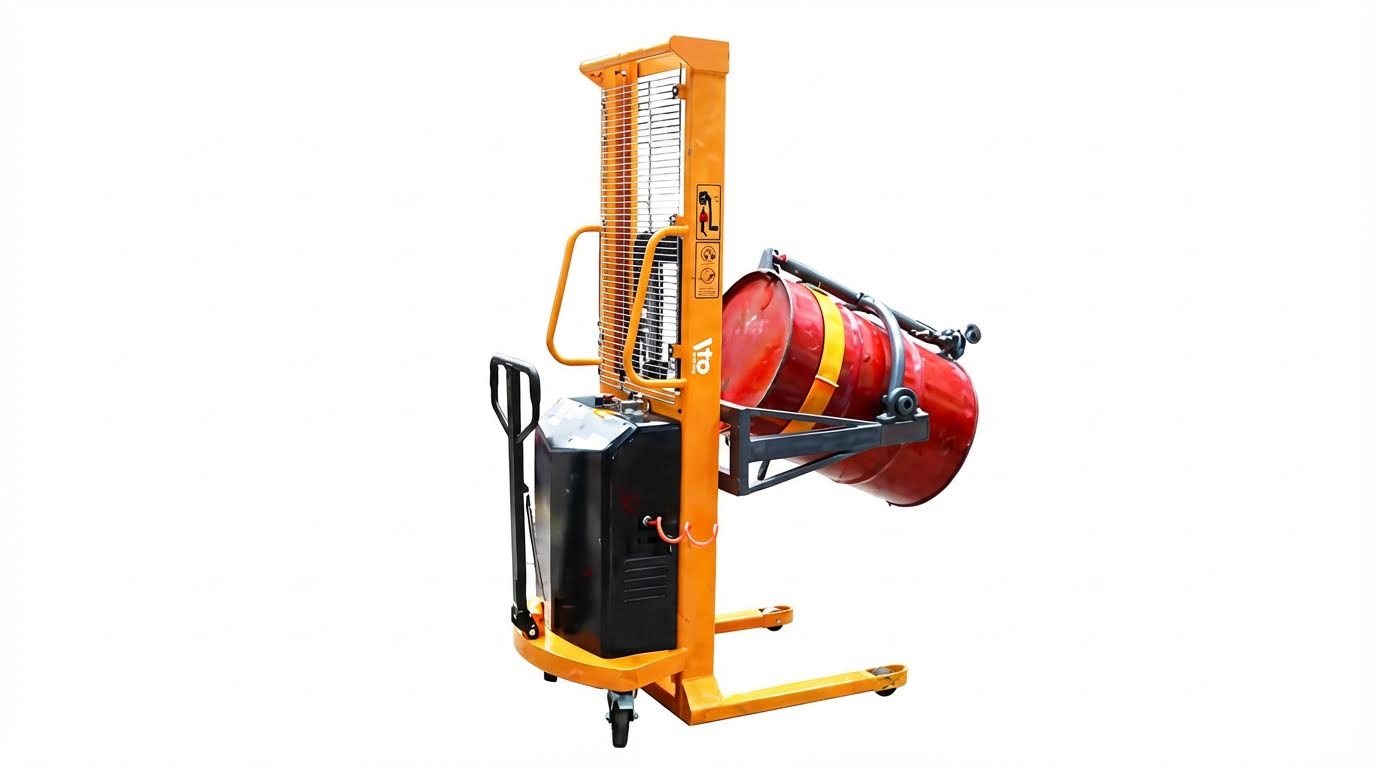
For pouring, dosing, and rotating drums over process points, use dedicated drum rotators or hydraulic multi-grip handlers that provide controlled tilt or 360° rotation from the forklift seat.
| Pouring / Rotation Use Case | Attachment Type | Typical Capability | Best For… (Operational Impact) |
|---|---|---|---|
| Occasional decanting into low tanks or bunds | Mechanical drum rotator (chain or crank) | 200–1,000 kg capacity with manual rotation (drum rotator data) | Low-cost option where operators can safely leave the cab and work at ground level. |
| Frequent dosing into elevated process vessels | Hydraulic drum rotator or multi-grip handler | Up to ≈900 kg with controlled forward dump to ≈125° (hydraulic multi-grip handler) | Accurate pour control into hoppers or reactors without splashing or overfill. |
| Batch dosing with tight fill tolerances | Powered tilt/rotation with variable speed control | Hydraulic or electro-hydraulic actuation, up to ≈900–1,000 kg (control and pour functions) | Fine control of pour rate to prevent foaming, reaction spikes, or over-dosing. |
| Rotating drums packed closely together | Compact drum rotator (fork or crane-slung) | 200–1,000 kg capacity, rotation via chain/crank/hydraulics (drum rotator data) | Allows rotation without pulling drums out into wider aisles. |
- Use powered rotation for repeat processes: Hydraulic or electro-hydraulic units allow the operator to stay seated and control tilt/rotation for lifting, tilting, rotating, and dumping drums up to about 900–1,000 kg (hydraulic powered attachment capacities) – ideal for high-frequency dosing.
- Target 120–125° forward tilt minimum: This angle was recommended to ensure complete emptying into process vessels without excessive shaking or back-tilting (tilt function guidance) – reduces residual product and clean-out time.
- Use jaw pressure suited to drum material: Jaw pressure ranges were selected to hold drums securely without crushing thin-walled plastic drums during tilt operations (jaw pressure considerations) – prevents leaks and stress cracks.
- Secure the attachment properly: Quick-attach fork systems allow connection and release without leaving the seat, but operators must double-check locks before lifting over people or equipment (securing drum attachments) – critical when drums are suspended over open tanks.
- Use forklifts whenever pouring height exceeds manual reach: If operators must lift drums above about 1.2–1.4 m to pour, switch to forklift-mounted rotators – this is a clear case of when a forklift should be used to handle drums to avoid overreaching and crush risk.
- Control motion with smooth hydraulics: For liquid drums, minor surges can destabilize the truck; variable-speed hydraulic valves help meter flow and prevent splashing and overfilling (pour and smooth operation guidance).
When should a forklift be used to handle drums for pouring and dosing?
Use a forklift with drum rotators whenever drums contain hazardous or heavy liquids, must be lifted above waist height, or require controlled dosing into process vessels. Manual tipping at these weights and heights creates unacceptable risks of strains, splashes, and loss of control (drum
“”
Final Considerations for Safe, Compliant Drum Handling
Safe drum handling depends on more than choosing a forklift. You must link load, distance, and throughput thresholds with real site conditions and drum geometry. Once drums approach 180–200 kg, travel beyond 10–15 m, or exceed about 20–30 moves per shift, manual methods no longer control ergonomic and stability risks. At that point, fork-mounted drum attachments move from optional to required if you want a defensible safety case.
Attachment selection then becomes an engineering decision. Rim, waist, and base grips keep the centre of gravity predictable. Hydraulic or mechanical rotators add controlled tilt and dosing. Capacity margins of 25–50% above maximum drum weight absorb dynamic forces from braking and liquid surge. Correct jaw type and pressure protect thin plastic drums from crushing. Geometry checks on aisle width, stack height, and vessel height ensure the truck can place drums without awkward maneuvers.
Operations and engineering teams should codify this into site rules. Define clear trigger points for when to use forklifts, standardize approved attachment types, and train operators on low-travel heights and smooth hydraulic control. With this discipline, Atomoving drum handling solutions turn a high-risk manual job into a stable, repeatable, and compliant process.
Frequently Asked Questions
When should a forklift be used to handle drums?
A forklift should be used to handle drums when the right attachment is selected based on the drum type and material. For steel drums with pronounced rolling rims, such as 205-liter or 210-liter drums, a waist gripper drum handler can be effective. Drum Handling Guide. Fiber drums may require specialized clamps or adapters to prevent damage.
- Ensure the attachment matches the drum type (steel or fiber).
- Check the drum’s weight and stability before lifting.
- Never exceed the forklift’s load capacity.
What safety precautions should be followed when using a forklift to handle drums?
When handling drums with a forklift, operators must follow key safety rules. Always ensure the forks are downgrade when the truck is unloaded, and never turn on a grade. Additionally, maintain a “safety halo” of at least three feet around the forklift to protect pedestrians. Forklift Safety Tips.
- Inspect the attachment and forklift before use.
- Sound the horn at intersections or when pedestrians are nearby.
- Adhere to OSHA guidelines for safe operation.